
Our readers keep the lights on and my morning glass full of iced black tea. As an Amazon Associate, I earn from qualifying purchases.
Specs are compiled from manufacturer listings and verified buyer reviews and can change over time — please confirm the key details on the product page before buying.
You are heading out for a multi-day trek, and every ounce in your pack is a decision. The best backpacking binoculars are the ones you actually carry to the summit — not the heavy full-size pair left in the car. This guide focuses purely on compact models, typically 10×25 or 8×25, that weigh around 10 to 12 ounces and slip into a hip belt pocket or a stuff sack without a second thought.
I’m Min — the founder and writer behind Gadgets Feed. This guide is built by comparing the manufacturers’ published specifications and the patterns across verified customer reviews, so you get each pick’s real strengths and trade-offs instead of marketing spin.
For your next backcountry trip, you need binoculars that are light enough to ignore, tough enough to survive a tumble, and bright enough to make a distant ridge worth stopping for. The crowd favorite here is a 4.7-star performer trusted by over 700 hikers, and this list of nine trail-ready backpacking binoculars compares them side by side so you can pick the right pair.
Our Picks at a Glance


How To Choose The Best Backpacking Binoculars
Backpacking binoculars live in a tiny niche: they must be small enough to ignore in your pack, tough enough to survive being tossed around, and bright enough to make a distant ridge or a bird in the brush actually worth stopping for. The two numbers in the name — like 10×25 — tell you the whole story: the first is magnification (how many times closer things appear), and the second is the objective lens diameter in millimeters (how much light enters).
Magnification and Lens Size
The first number (10x) is how many times closer an object appears. The second number (25mm) is the diameter of the objective lens that gathers light. A 10×25 gives you more reach, but a 8×25 is easier to hold steady because your natural hand shake is magnified less. For a trail where you are out of breath and bracing against a tree, 8x is often the more useful choice.
Eye Relief
Eye relief is the distance between your eye and the eyepiece where you can still see the whole image. If you wear glasses, you need generous eye relief — 10mm is workable, 15mm to 21mm is far more forgiving, so you do not have to jam the cups into your lenses. Twist-up eyecups with multiple stops let you adjust the distance in seconds.
Waterproofing and Fogproofing
A sealed binocular is filled with nitrogen or argon and O-ring sealed so moisture cannot get in and cause internal fogging on the glass. An IPX7 rating means the body can be submerged in up to three feet of water for 30 minutes without damage — handy for a surprise rainstorm or a river crossing. Some models go further, promising waterproofing to a specific depth for a few minutes.
Quick Comparison
| Model | Best For | Magnification | Eye Relief | Weight | Amazon |
|---|---|---|---|---|---|
| Leupold BX-1 Rogue 10×25★ Best Overall | All-around clarity in a light body | 10×25 | 15 mm | Light | Amazon |
| Nocs Standard Issue 10×25Style Pick | Pocket carry and style | 10×25 | 10 mm | 11.85 oz | Amazon |
| Nikon Trailblazer II 10×25Wide View | Wide views for tracking | 10×25 | 10 mm | 10.9 oz | Amazon |
| Vortex Vanquish 10×26 | Glove-box durability | 10×26 | 16 mm | Light | Amazon |
| Nikon TRAVELITE EX 8×25 | Steady handheld holds | 8×25 | 11.1 mm | Compact | Amazon |
| Pentax AD 8×25 WP | Eyeglass wearers | 8×25 | 21 mm | Compact | Amazon |
| Nocs Field Issue 10×32 | Brighter big-picture views | 10×32 | 16.8 mm | 16.7 oz | Amazon |
| Celestron TrailSeeker 8×32 | Optical purists on the trail | 8×32 | 15 mm | Light | Amazon |
| ZEISS Terra ED Pocket | Premium clarity in any light | 8×25 | 16 mm | Compact | Amazon |
In-Depth Reviews
1. Leupold BX-1 Rogue 10x25mm (59225)
Our pick — over 4.5★ from 750+ verified ratings; the strongest balance of quality and price.
The Leupold BX-1 Rogue 10×25 delivers the clearest all-round image in a light, waterproof body.
The BX-1 Rogue earns the top spot because it does everything a backcountry binocular must do and does it without fuss. A fully multi-coated optical system (a coating on every glass surface that boosts light transmission) delivers the clarity and glare reduction you want on a sun-drenched ridge. The inverted Porro prism design keeps the body small and light without sacrificing image quality, so it disappears into your pack lid.
Owners are emphatic about the images, with one saying these are “great for the deer stand, you will even be able to see longer at last shooting hours.” The extension eyecups block ambient light, helping you zero in during the last minutes of usable daylight. At 15mm of eye relief (the distance from the lens to your eye), it is far more comfortable than the 10mm on the Nocs Standard Issue, so a glasses-wearing hiker sees the full field without squinting.
Quality is what wins people over — over a hundred owners single it out — and clarity and compact size follow close behind. The trade-off in the durability column is mild, with only a handful of owners mentioning any wear, so treat the rubber armor as armor, not padding. For the hiker who wants one pair for hunting, hiking, and stadium seats, this is the complete package.
compact trail companion
- 15mm eye relief means a comfortable view even with eyeglasses on
- Rubber armor coating gives a positive grip in wet conditions
- Backed by a legendary warranty and 100% waterproof and fogproof build
small objective limits
- Durability gets a mixed note from a small number of owners
- 10x magnification is trickier to hold steady than an 8x
pocket hikers: you want a single, trustworthy pair for hunting, hiking, and wildlife spotting, with generous eye relief that works for glasses.
low-light users: you need the most forgiving handheld hold — a gentler 8×25 might serve you better on a shaky ridge.
2. Nocs Provisions Standard Issue 10×25
The Nocs Standard Issue 10×25 fits a purse pocket and stays put with its rugged wave grip.
If you have ever missed a sighting because your binoculars were buried in a bag, the Standard Issue is built for you. The compact body weighs 11.85 oz, and the silicone enclosure with a patented Rugged Wave Grip means it stays put in your hand on a damp morning trail. It is also a touch lighter than the 10.9 oz Nikon Trailblazer II — a difference you feel when it hangs from a strap all day.
The optics carry a fully multi-coated anti-reflective treatment and a Swiss-designed Bak4p prism for a bright, color-true image across a 315-foot field of view at 1000 yards. The IPX7 rating means a dunk in up to three feet of water for 30 minutes won’t compromise performance, and the nitrogen gas fill stops interior fogging on a cold alpine morning. Owners love that it fits one purse pocket with room to spare, so it is “out of the way until I need them.”
What wins people over is the build quality and image sharpness, and they say the 10x magnification is true and easy to focus. The honest trade-off is the field of view — a minority note it feels narrow compared with a wider-angle model, and at 10mm the eye relief is tight for glasses. This is a binocular that prioritizes pocketability and personality without pretending to be a full-size glass.
style meets utility: the best choice when “will it fit in my jacket” matters more than raw optical breadth.
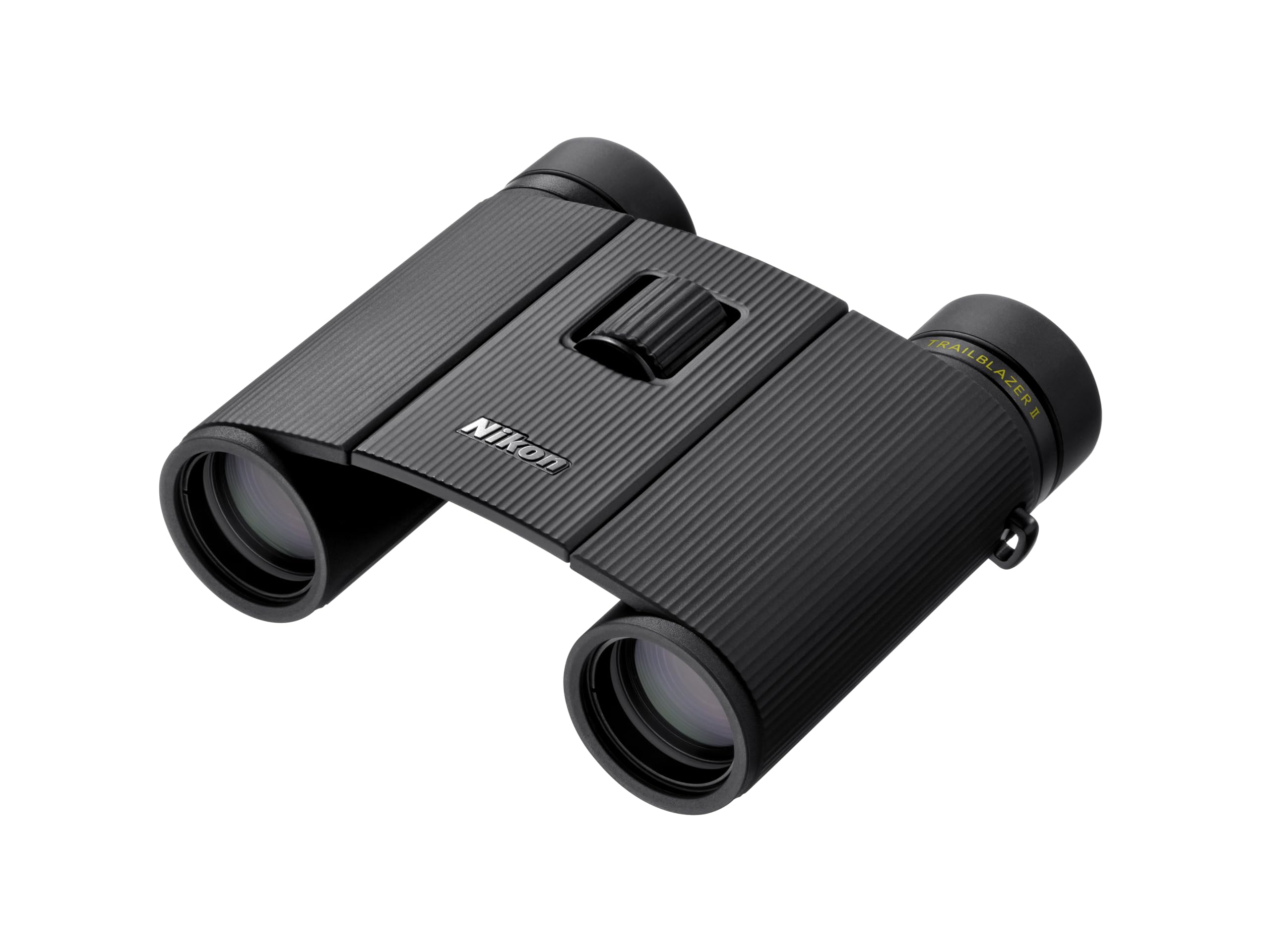
3. Nikon Trailblazer II 10×25
The Nikon Trailblazer II 10×25 offers the widest 342-foot field of view at just 10.9 ounces.
Tracking a bird in flight is all about seeing the whole scene, and the Trailblazer II gives you an expansive 6.5-degree angular field of view — 342 feet at 1000 yards, a 9% wider sweep than the Nocs Standard Issue’s 315 feet. That extra width means less frantic repositioning when a subject is moving. It also outputs a slightly bigger exit pupil (the bright circle you see) than the Nocs at 2.5mm versus 2.4mm, which helps a touch in dim forest light.
The body is a polycarbonate chassis wrapped in textured rubber armor, and it tips the scale at just 10.9 oz (308.01g), making it one of the lightest pairs here. Owners say it is “perfect for our trip to Alaska,” praising how compact and powerful it feels, and it folds down small for a pack pocket. Value is what wins people over most — it delivers sharp optics and all-weather sealing at a price that undercuts the premium tier dramatically.
The recurring gripes are the small stuff: eyepiece covers that fall off easily and no objective lens covers included, so budget for aftermarket caps if you want full protection. A couple of owners noted occasional missing front caps on arrival, which feels like quality-control noise rather than a design flaw. For a light 10×25 that shows you more of the mountain, this is the one.
casual viewing: the widest, brightest sweeping view in a 10×25 body that disappears into a pack.
rough handling: you want dust protection — the lens covers are the weak point by owner consensus.
4. Vortex Vanquish Reverse Porro Prism Binoculars

The Vortex Vanquish 10×26 pairs a 2-meter close focus with a transferable lifetime warranty.
The Vanquish pairs 10x magnification with 26mm objective lenses, making it one of Vortex’s smallest and lightest designs. Fully multi-coated lenses boost light transmission for the crisp images owners describe as having no aberration (color fringing or blur). The close focus of 2 meters — owners confirmed viewing a spider at about 6 feet — makes it surprisingly useful for butterflies and trailside details, not just distant ridges.
At 16mm of eye relief, it is the most glasses-friendly of the mid-range 10x pair, beating the 10mm found on the Nocs Standard Issue and Nikon Trailblazer II. The reverse Porro design is fully rubber armored for a non-slip grip, and the nitrogen-purged, O-ring-sealed body is waterproof and fogproof. The headline feature is the unlimited, unconditional, lifetime VIP warranty — a fully transferable promise to repair or replace a damaged or defective unit.
Quality is what wins people over — nearly ninety owners single it out — and clarity and compact size follow. One honest nuance: the focus mechanism earns praise for ease but a few owners find it slightly coarse. Owners also say it is “much lighter and easier to control than my big binoculars,” which is exactly the point on a long climb.
bright wide views
- 16mm eye relief is genuinely comfortable for eyeglass wearers
- True 2-meter close focus makes it a dual-purpose nature glass
- Transferable lifetime warranty removes the fear of trail damage
bulky for pocket
- Focus wheel can feel a bit coarse for fine adjustments
- 294-foot field of view is the narrowest in this group
5. Nikon TRAVELITE EX 8×25

The Nikon TRAVELITE EX 8×25 gives a steadier, brighter image that repeated owners prefer after a climb.
If your hands shake after a long climb, this is the pair that fixes the problem. The TRAVELITE EX uses 8x magnification on a 25mm objective, and owners who switched from a 10×25 say the steadier hold is the reason they would buy it a third time. The larger 3.13mm exit pupil (the circle of light your eye sees) also gives a brighter image in forest shade than most 10×25 compacts.
The die-cast aluminum body is wrapped in rubber armor for shock resistance and grip, which matters when you are pulling it out of a stuff sack at a windy overlook. It is nitrogen-purged and O-ring sealed, waterproof to 2 meters for 5 minutes and completely fogproof, so a river crossing won’t end your viewing. Owners keep it in cars and on windowsills for birdwatching, and call it the “balance” of price, ruggedness, portability, and weight.
The aspherical eyepiece lenses minimize image distortion for edge-to-edge clarity, and the high-eyepoint construction with turn-and-slide eyecups makes it workable for glasses wearers at 11.1mm of eye relief. Quality is the top praise by a wide margin, with image quality and weight close behind. There is no real catch here — the honest limitation is simply that 8x won’t pull in a distant peak like a 10x will.
day trips: a bright, forgiving 8x hold that repeated owners describe as the perfect travel balance.
dim conditions: your main goal is resolving distant animals — you will want the extra reach of a 10x.
6. Pentax AD 8×25 WP

The Pentax AD 8×25 WP offers a standout 21mm of eye relief for glasses wearers.
That means you keep your glasses on, twist the eyecups out, and see the complete bright field without strain. Owners confirm it is “great for eyeglass wearers” and works well in both bright and dim light, from sunrise to sunset.
The fiber-reinforced polycarbonate body is rigid yet light, and owners say it fits easily in a coat pocket. Premium multi-layer coatings boost light transmission for crisp, true-to-life images, and the nitrogen-filled construction is waterproof to JIS Class 6, submersible to 1 meter — reassuring on a boat or wet ridgeline. One owner who compared it against premium brands said it “holds up to a Zeiss at half the price.”
What wins people over is the overall quality, with compact size and image quality close behind. The honest quirks: the strap attachment can cause an odd hang (that is fixable by mounting it upside-down), and the included case is a tight fit. The focus wheel feels slightly spongy to a few picky owners, but it stays responsive. For glasses wearers who refuse to compromise on image, this is the stand-out.
eyeglass wearers: no other compact here matches the 21mm of eye relief for a full, easy view.
fast focusing: plan around a tight case and a slightly awkward strap loop.
7. Nocs Provisions Field Issue Compact 10×32
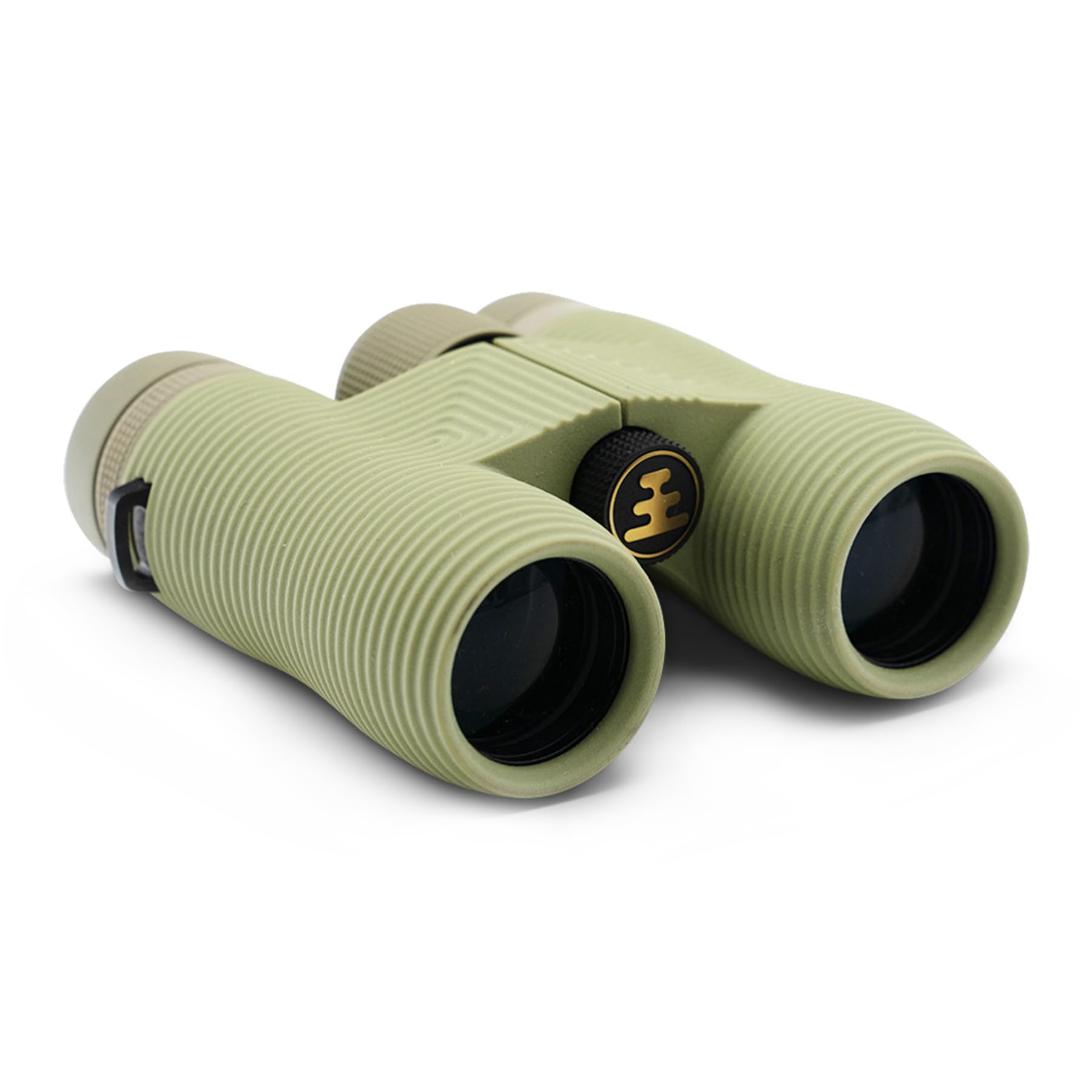
The Nocs Field Issue 10×32 adds 32mm light-gathering reach in a still-packable 16.7-ounce body.
When you need more light-gathering than a 25mm lens can offer but still want to keep the pack light, the Field Issue steps up with 32mm objective lenses. The larger glass pulls in noticeably more light, which helped one traveler spot distant wildlife across the Pantanal in Brazil with easy focus. At 16.7 oz it is heavier than a 10×25, but the bigger image and the ultra-precise oversized focus wheel are worth the extra ounces if wildlife is your priority.
The HiFi fully-coated optics deliver rich color across a 315-foot field of view at 1000 yards, and the Swiss-designed Bak4p prism keeps the image bright edge to edge. It shares the rugged IPX7 waterproofing (submersible in up to three feet of water for 30 minutes) and nitrogen sealing of the smaller Standard Issue, along with the patented Rugged Wave Grip and multi-stop twist-up eyecups. At 16.8mm of eye relief, it is also one of the more glasses-friendly 10x options here.
Clarity is the thing everyone raves about, with functionality and easy adjustment close behind. Owners call it “perfect for travel and birding,” noting how light it feels and how beautiful the field of view is for spotting. The only recurring sour note is the same as any good binocular: lens caps can be lost easily. If a 25mm lens feels anemic to you, this is the upgrade without going to a full-size body.
bigger objective punch: you want 10x reach with a genuinely brighter 32mm objective in a still-packable build.
heavy for compact: the caps are the one thing owners say can wander off.
8. Celestron TrailSeeker 8×32

The Celestron TrailSeeker 8×32 uses phase and dielectric coatings for contrast that beats pricier models.
Built for the hiker who cares less about the number of ounces than the quality of the view, the TrailSeeker pairs 8x magnification with 32mm objectives in a magnesium alloy frame that stays light while feeling rock-solid. The BaK-4 prisms with phase and dielectric coatings — treatments that increase light transmission through the prism system — deliver the sharper, higher-contrast image that owners say actually beat pricier Steiners they have used. Lenses are clear with no fringing, they note.
The metal multi-stop twist-up eyecups are sturdier than plastic and adjust in stops for use with or without glasses, which is why a glasses-wearing reviewer specifically bought it for backpacking trips in search of “optical quality, affordability, ruggedness.” It comes with a harness strap, and the magnesium body is fully waterproof for any weather. The 15mm eye relief is comfortable, though shorter than the Pentax’s 21mm.
Optical quality is what wins people over, and owners describe being “surprised at how good these are for the price.” The recurring small complaints: dust caps fall off easily and the neck strap can slip from its buckle, so a replacement strap is a sensible accessory. It is not a pocket-size 8×25, but for weight-conscious birders who want a true quality leap, it is the closest thing to a full-size view that still fits a pack.
birding balance
- Phase and dielectric coatings add real contrast and resolution
- Magnesium body is light yet fully waterproof
- Metal multi-stop eyecups last longer than plastic
less pocketable
- Dust caps are easy to lose — secure them early
- Neck strap can slip from the buckle
- 32mm objectives are bigger than a pure pocket glass
9. ZEISS Terra ED Pocket Binoculars

The pocket giant that delivers 88% light transmission in a nearly indestructible shell.
When the light is flat and gray and other compacts go mushy, the Terra ED keeps delivering. The SCHOTT ED glass (a special low-dispersion glass that reduces color fringing) with a hydrophobic multi-coating achieves 88% light transmission, and owners say it offers sharp, natural color with no fringing — one even rated it at 95% of a much pricier Swarovski. The ZEISS T* coating is tuned per lens for high-contrast images, especially at twilight.
The large, smooth focus wheel is the standout daily feature; your index finger lands on it naturally, and a 1.25-turn focuser snaps from near to far in a blink. The 8×25 format with a 3.1mm exit pupil is bright for its class, and the 5-foot close focus lets you study a butterfly as easily as a distant peak. The glass-fiber-reinforced waterproof casing is compact, light, and “nearly indestructible,” according to the maker — easy to drop into any bag.
Quality is what wins people over, with image quality and value close behind, and owners note it is “great for hiking and camping, very light.” At 16mm of eye relief it is comfortable for glasses wearers, and the twist eyecups make adjustment quick. The honest caveat: a few owners find the focus wheel stiffer than they would like, and no lens caps are included. For the hiker who wants the finest optics that still vanish into a jacket, this is the indulgence that pays off on every trip.
serious enthusiasts: you want premium twilight clarity and a fast, intuitive focus in the most pocketable premium build.
budget-conscious: you want a softer-feeling focus wheel and included lens caps — this one offers neither.
Understanding the Specs
Eye Relief and Exit Pupil
Eye relief is the space between your eye and the eyepiece where the full image is visible — important if you wear glasses. A 10mm rating is usable, but 15mm to 21mm is far more comfortable. The exit pupil is the circle of light that reaches your eye, calculated by dividing the lens size by the magnification. A bigger exit pupil, like 3.1mm on an 8×25, gives a brighter image in dim forest light than a 2.5mm on a 10×25.
Waterproofing and Fogproofing
Outdoor binoculars are nitrogen or argon purged and O-ring sealed. When the seal holds, moisture cannot enter the body, which stops the lenses from fogging internally when you move from a cold summit into a warm tent. An IPX7 rating means the unit survives submersion in up to three feet of water for 30 minutes. Some models guarantee waterproofing to a specific depth for a few minutes — a strong clue about the build quality.
FAQ
Is 10×25 or 8×25 better for backpacking?
Will compact binoculars work if I wear glasses?
What does IPX7 waterproofing actually mean on the trail?
How much should backpacking binoculars weigh?
What is a Bak4 prism and why does it matter?
Why do some binoculars have a wider field of view than others?
How close can these binoculars focus for butterflies or details?
Do all waterproof binoculars come with a good warranty?
Can I take smartphone photos through these binoculars?
What is the difference between multi-coated and fully multi-coated?
Final Thoughts: The Verdict
For most hikers, the backpacking binoculars winner is the Leupold BX-1 Rogue 10×25 because it pairs the clearest all-round image with comfortable 15mm eye relief and a fully waterproof build at a price that undercuts the premium tier. If you wear glasses and want the most forgiving view, the Pentax AD 8×25 WP and its 21mm of eye relief is the savvy pick. And if you want brighter optics without stepping up to a full-size body, the Nocs Field Issue 10×32 is the one to reach for on a wildlife-focused trip.
How We Picked
We do not accept paid placement. Every pick is matched to a real buyer and a real use-case; we do not hands-on test units.
Sources & Methodology
Specifications: manufacturer listings and product documentation. Review insights: verified customer reviews, as of August 2026. Pricing: not shown on this page (it changes often); check the current price via the retailer link.
As an Amazon Associate, Gadgets Feed earns from qualifying purchases. This does not affect which products we feature.