
Our readers keep the lights on and my morning glass full of iced black tea. As an Amazon Associate, I earn from qualifying purchases.
Specs are compiled from manufacturer listings and verified buyer reviews and can change over time — please confirm the key details on the product page before buying.
A backpacking camera bag needs to solve two problems at once. It must keep your expensive camera gear safe from bumps and weather. And it must not feel like you are carrying a block of iron for miles. The wrong bag tips over the moment you set it down, buries your camera under straps, or rubs your shoulders raw after the first mile. This guide looks at seven bags that actually balance protection with packability, so you spend more time shooting and less time digging for your gear.
I’m Min — the founder and writer behind Gadgets Feed. This guide is built by comparing the manufacturers’ published specifications and the patterns across verified customer reviews, so you get each pick’s real strengths and trade-offs instead of marketing spin.
A well-chosen backpacking camera bag makes the difference between a great day of shooting and a frustrating one where you leave gear behind or fight your pack all day.
Our Picks at a Glance


How To Choose The Best Backpacking Camera Bag
Most beginner buyers pick a bag based on how many lenses it claims to hold. Then they regret it on their first real hike because the weight distribution, access port, and weather protection are wrong for trail use. A smart choice starts with three specific decisions.
Access Style — Do Not Reach Behind You
A bag that forces you to take it off, lay it in the dirt, and unzip the front every time you want to switch lenses becomes a liability on a hike. Side-access bags (bags with a zipper on one side) let you swing the bag around your waist and grab your camera without putting it down. Back-panel access (where the bag opens against your back) keeps the back dry and the straps clean. The Thule and Think Tank models use back-panel access, while the K&F CONCEPT and PGYTECH use side entry. Your preference here determines whether you stay in the flow of shooting or stop constantly.
Capacity vs. Packed Weight — The 2-Kilogram Rule
A 25-liter bag sounds roomy, but that volume is worthless if the bag itself weighs 2 kilograms empty. Once you load a full-frame body, a 70-200mm f/2.8, a wide zoom, and a tripod, the empty bag weight starts mattering. The Think Tank Backlight Sprint weighs 1 kilogram empty, the PGYTECH OneGo Lite 22L weighs 2 kilograms, and the K&F CONCEPT comes in at 1.78 kilograms. A lighter bag means you can carry one more lens or a liter of water for the same total weight.
Weather and Durability on the Trail
Look for water-resistant zippers (like the YKK zippers, zippers made by a respected Japanese brand, on the PGYTECH), a dedicated rain cover that stays in a stow pocket, and a base that does not collapse when you set the bag on wet ground. The MOSISO and K&F CONCEPT include rain covers. Buyers of the MOSISO report it lasted three years of heavy abuse in dirt and snow, while the K&F CONCEPT had no zipper issues after two years. Avoid bags with non-waterproof zippers and no rain cover if you shoot in drizzle or near waterfalls.
Quick Comparison
| Model | Best For | Capacity (Liters) | Empty Weight | Access Type | Amazon |
|---|---|---|---|---|---|
| Thule Aspect DSLR Camera Bag Backpack★ Best Overall | Heavy haulers who carry drones + big kits | Not specified | Not specified | Back-panel | $188.95Amazon |
| K&F CONCEPT Professional Camera BackpackExpandable Pick | Photographers wanting expandable capacity | Up to 25L | 1.78 kg | Side + Top | $94.99$99.99Amazon |
| PGYTECH OneGo Lite 22L Camera Backpack | Daily carry + weekend adventure | 22L | 2 kg | Side + 180° Flip | $129.95Amazon |
| MOSISO Camera Backpack 17.3″ | Budget-friendly all-weather workhorse | 17.3″ device size | 3.2 lbs | Top + Front flap | $69.34$72.99Amazon |
| Lowepro Flipside Trek BP 250 AW | Hikers who keep straps clean | Not specified | Not specified | Back-panel (lumbar) | $144.00Amazon |
| Think Tank Backlight Sprint | Minimalists who hike fast | 15-18L | 1 kg | Back-panel | $159.75Amazon |
| BREVITE Jumper Compact Camera Backpack | Travelers wanting a non-camera look | 23L | 2 lbs | Top + Rolled front | $219.99Amazon |
In‑Depth Reviews
1. Thule Aspect DSLR Camera Bag Backpack, Black
Our pick — over 4.5★ from 850+ verified ratings; the strongest balance of quality and price.
The Thule Aspect wraps a heavy-haul capacity in a back-panel access pack that stays comfortable over miles.
The Thule Aspect lets you carry a whole kit and still access gear without setting the bag on the ground. Buyers report it fits a Sony A7III, 5 lenses, an A6000 with 2 lenses, a tripod, a monopod, a water bottle, and accessories — all in one bag. The back-panel access means you keep the back panel (the side that rests against you) clean and your straps dry. The removable padded hip belt (a belt that wraps around your hips) shifts weight off your shoulders when the pack is heavy.
The bag protects up to a 15.6-inch laptop plus an iPad in a separate back compartment. Velcro dividers let you create customized compartments, and the air-mesh back panel keeps airflow moving so your back does not soak with sweat on warm hikes. A few owners mention the camera compartment takes some trial to set up because it opens at only one end. But once arranged, it holds a Canon Mark IV with a 70-200mm f/2.8 plus three other lenses and a top compartment for a Canon 80D with battery grip.
At 100% nylon fabric, the bag feels lighter than its bulky look suggests. The detachable hip belt streamlines the load when you do not need extra support. One reviewer points out that the side-access flap can be tricky for quick organization. But the trade-off is that the main compartment barely shifts with a lens-mounted body inside.
The heavy-lift payoff: The Thule Aspect is for the photographer who carries a full-frame kit plus a second body and a tripod — the person who needs one bag that packs like a carry-on but feels like a daypack when loaded. The only trade-off is that the camera compartment setup requires patience the first time. If you carry a smaller mirrorless setup, the Think Tank or PGYTECH below will feel less bulky for the same utility.
Ideal for: shooters who bring backup bodies and long glass on multi-day backpacking trips
Consider something else if: you want the lightest possible pack or need a simple side-access system for quick lens swaps
2. K&F CONCEPT Professional Camera Backpack, Expandable to 25L
The K&F CONCEPT expands from a 50:50 split to an 80:20 cargo hold by pushing the internal partition.
This bag adapts to your kit rather than forcing you to rearrange. The “Magic Chamber” converts the interior via a push-pull divider. You get a 50:50 split for camera and lenses on one side and personal gear on the other. Or you get an 80:20 split when you need more space for a big lens or a drone.
A dedicated side-access zipper lets you grab your camera without taking the pack off. The top opening gives you access to the upper compartment for snacks or a filter pouch. The front pouch expands to about 4 liters — enough for batteries, filters, or a small drone. Hidden support fibers in the walls resist compression. The bag is 1.78 kilograms empty, while the PGYTECH OneGo Lite 22L weighs 2 kilograms empty. Customers note it is durable after 2 years with no rips, tears, or zipper issues. The included rain cover keeps everything dry when the sky opens up.
One regular note from reviewers: the Velcro dividers do not stay in place as well as the stiffer dividers on the Thule. If you rearrange your kit frequently, you might find yourself reseating the dividers after each hike.
The expandable advantage: The K&F CONCEPT works for a lightweight mirrorless day hike and can expand to hold a full cinema-style kit (a Canon C70, multiple lenses, monitor, V-mount battery) on a bigger trip. The main drawback is the Velcro dividers that shift under heavy loads. If you want a similar capacity with stiffer dividers, look at the Brevite Jumper below.
Best for: photographers who carry variable amounts of gear and want a bag that grows and shrinks with the shoot
Better to skip if: you hate re-seating Velcro dividers or carry a fixed kit that never changes
3. PGYTECH OneGo Lite 22L Camera Backpack, Matte Black
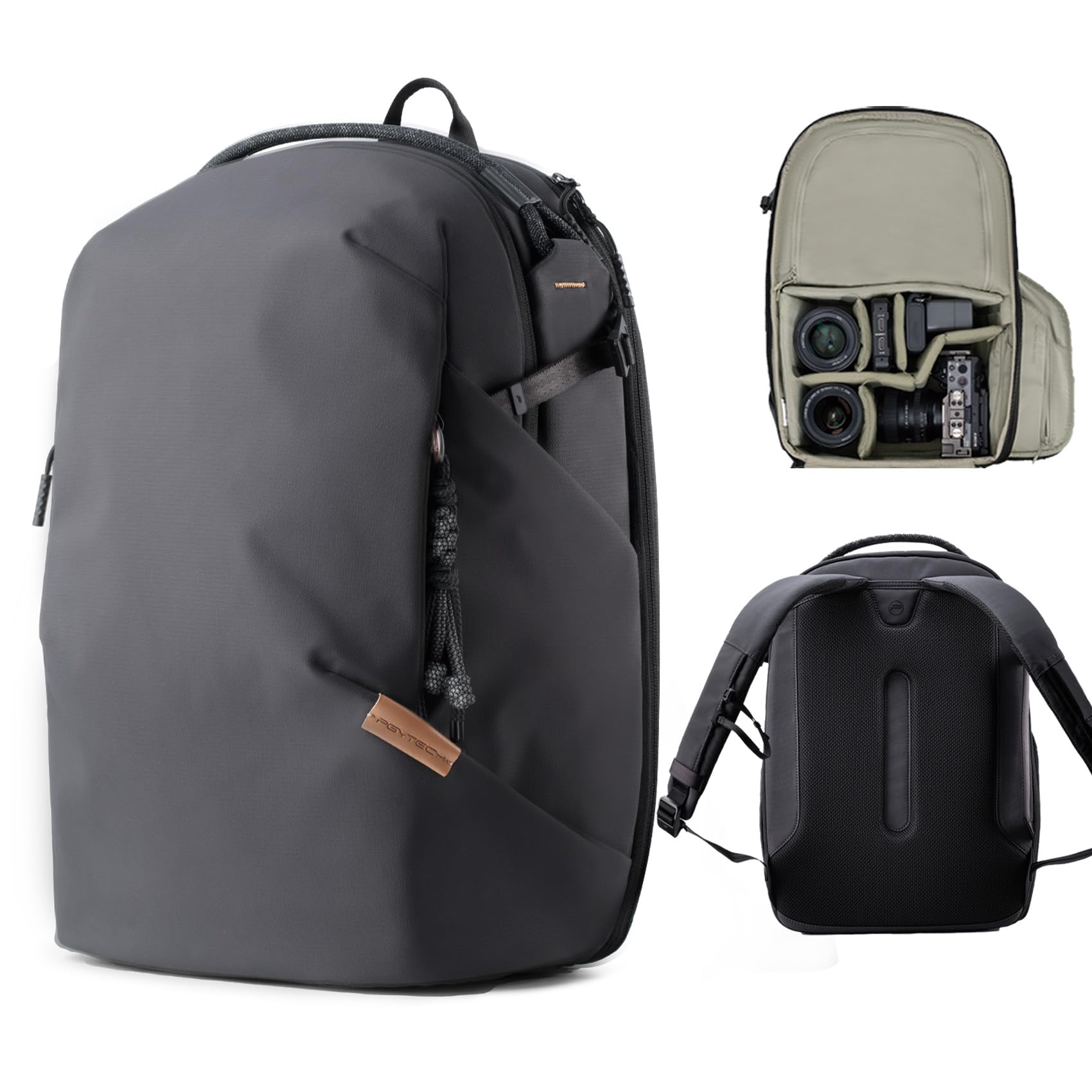
The PGYTECH OneGo Lite looks like a clean urban backpack but hides a full camera compartment with side access.
This bag protects your gear without advertising that you are carrying thousands of dollars in glass. The 22-liter capacity measures 22L versus the K&F CONCEPT at 25L, and the bag weighs 2 kilograms empty versus the K&F CONCEPT at 1.78 kilograms. You trade some capacity and weight savings for a much more discreet silhouette. Reviewers point out fitting a Nikon Z7 with a 24-70mm, a 70-200mm f/2.8, and a 14-24mm f/2.8 inside the camera compartment, with room in the top section for a DJI Mini drone and an iPad M5 Pro.
The 180° flip-open lid (a lid that opens the full width of the bag) makes packing easy — you lay the bag flat and load it from above. Side-entry access to the camera compartment lets you grab your body without taking the pack off. The removable padded dividers let you reconfigure for a drone or for clothes. The YKK zippers are water-resistant, and a scratch-resistant padded base keeps the bag upright without collapsing. Reviewers praise the sleek look and comfort for daily carry, but note the sternum strap is too short for broad chests and the front pouch is hard to access when the bag is fully loaded.
The build quality is a step up from budget options — the materials feel dense and durable. One reviewer gave it 9 out of 10, noting that the compartment layout is almost perfect for a camera-laptop-all-round bag, with a MacBook fitting snugly. The bag stands upright on its own, a feature that sounds minor until you set it down on wet ground and it does not tip over.
What works
- Water-resistant YKK zippers and padded base keep gear dry and upright
- Fits a full-frame body, two f/2.8 zooms, and a drone without looking bulky
- Removable dividers convert to a daily backpack for clothes or groceries
The compromises
- Front pouch is difficult to access when the bag is full
- Chest strap is short and not suited for broad chests
- No tablet sleeve — you have to use the laptop compartment for both devices
Go for this if: you want a camera bag that does not scream “camera bag” and fits perfectly into a daily commute or a city hike
Look elsewhere if: you need a dedicated tablet sleeve or plan to carry very heavy loads (the straps are meant for moderate weight, not expedition-level gear)
4. MOSISO Camera Backpack, DSLR/SLR/Mirrorless 17.3″, Space Gray

The MOSISO packs rain-cover protection, a hard shell, and a 17.3-inch laptop pocket into a sub-premium price point.
For photographers who need to fit a 17.3-inch laptop and a standard DSLR kit without spending mid-range money, this bag delivers. The laptop compartment measures 17.3 inches and is separate from the camera section, so your computer does not get scratched by lens rings. The front flap uses a PU hard shell (a semi-rigid polyurethane panel) that resists strikes and scratches. A waterproof PU leather flap on the top pouch keeps the top compartment dry in a drizzle.
At 17.3 inches of device maximum, this bag is 11% wider than the Thule Aspect (which handles a 15.6-inch laptop), so it fits larger laptops that other camera bags cannot. The main camera compartment is 11.5 x 8.8 x 5.9 inches with removable modular dividers, giving you custom compartments for a body, three lenses, and a flash. One reviewer noted it lasted 3 years of heavy abuse including dirt and snow. The top zipper and shoulder strap eventually failed from overloading, but the main camera compartment stayed intact and the SD card pocket was a favorite feature.
The bag includes a waterproof rain cover stowed in a dedicated pocket, a side strap for a monopod or tripod, and a back trolley belt for rolling luggage. The breathable mesh back panel helps air flow so your back does not get sweaty on long walks. The main thing to know: the bag is not crush-proof for checked baggage. If you plan to fly and check the bag, the semi-rigid front panel will not protect your gear from being squashed in cargo.
The value argument: The MOSISO proves you do not have to spend triple digits to get reliable protection and a laptop compartment for a large 17-inch machine. Its weakness is that the hard shell is semi-rigid — good for day hikes and carry-on flights, not for checked luggage. If you fly with camera gear as a carry-on, this is a solid pick. If you need a crush-proof bag that could survive being thrown in a cargo hold, you need a Pelican or a premium bag with a rigid frame.
Best for: budget-conscious photographers who carry a large laptop plus a DSLR kit and want a rain cover included
Not for: anyone who plans to check this bag on a plane or needs a fully waterproof (not just covered) main compartment
5. Lowepro Flipside Trek BP 250 AW, Grey/Dark Green

The Flipside’s lumbar access lets you swap lenses without taking the bag off your shoulders or laying it in mud.
Lowepro designed the Flipside Trek around a specific hiking problem. You are on a trail, the ground is wet or dirty, and you need your camera without setting the bag down. The back-panel lumbar access (access at the lower-back area) opens toward your lower back. You rotate the bag around your waist, unzip, and grab your camera. The straps never touch the ground. The ActiveZone suspension system and padded straps make heavy loads feel lighter on long ascents.
The interior splits into separate camera and open-space compartments. The camera section fits 2 Rebel bodies and a 100-400mm lens for a day hike, or a Fuji XT-3 with 4 lenses for travel. The CradleFit padded pocket suspends a tablet in the full-height back pocket. External attachment points let you add tripods or other gear. Buyers appreciate the comfortable carry on day hikes and the discreet hiking look that does not broadcast expensive camera gear.
The biggest complaints center on the side pockets — reviewers report that 16-20 oz water bottles slide out when you bend over, and the front pocket has an internal hump that limits space. The waist straps are chunkier than ideal for some users and not removable. One 3-star review noted the tapered shape wastes interior space and the top straps can rub your neck. The bag is smaller than some buyers expect, suited for a day or weekend trip rather than a full expedition.
The reasoning
- Lumbar access keeps straps clean and lets you work without putting the bag on the ground
- ActiveZone suspension makes heavy loads feel lighter on long hikes
- CradleFit tablet pocket protects a device in the back compartment
The trade-offs
- Side pockets do not hold standard water bottles securely — they slide out when you lean forward
- Non-removable waist straps feel bulky for everyday use
- Tapered interior wastes some space; smaller than the stated dimensions suggest
Best for: day hikers who need to access camera gear without setting the bag on wet or muddy ground
Move on if: you need a bag that securely carries water bottles on the outside or want a larger capacity for multi-day trips
6. Think Tank Backlight Sprint Lightweight Slim Camera Daypack, Montane Green
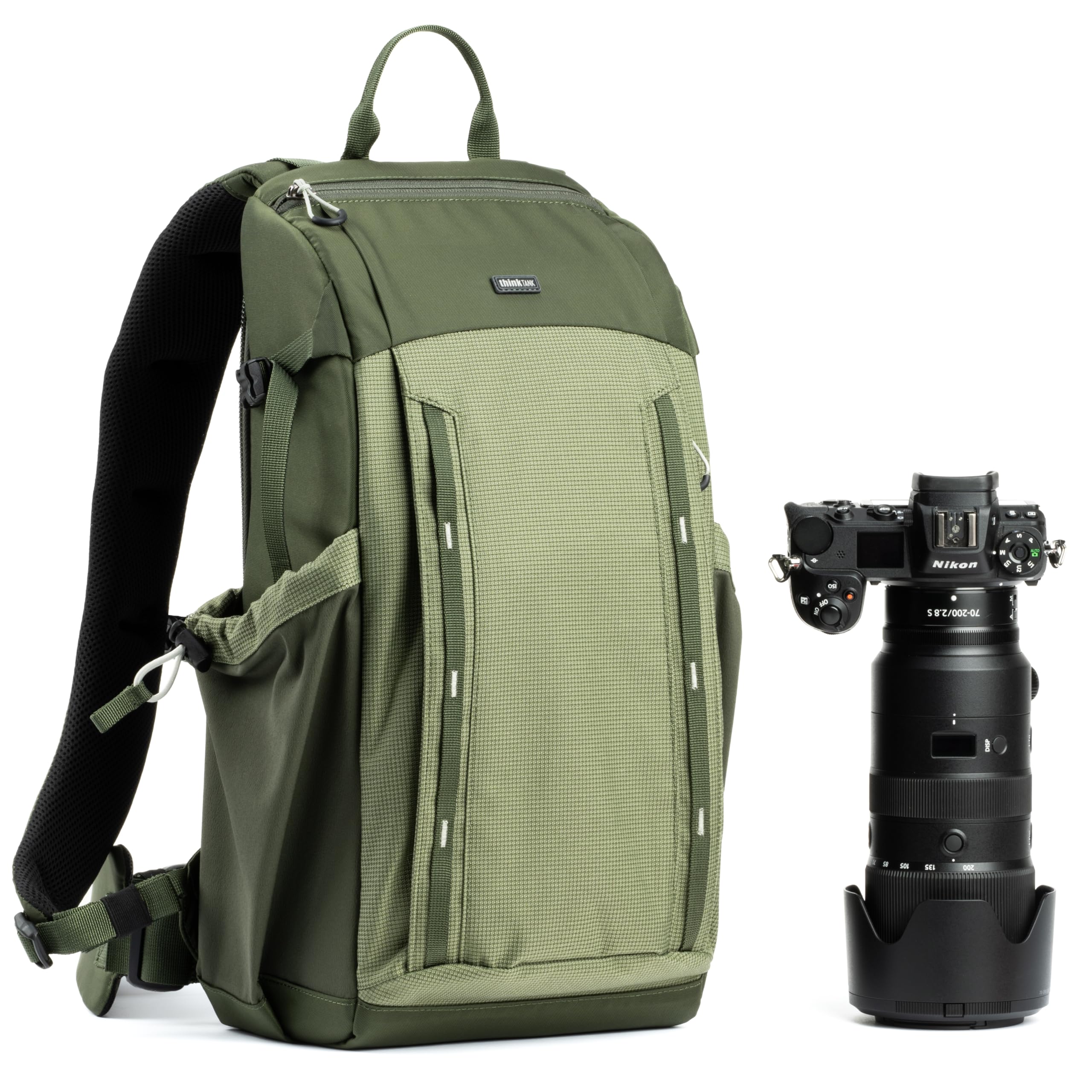
At just 1 kilogram, the Backlight Sprint is the lightest bag here that still fits a full-frame body and a 200-600mm lens.
Think Tank built the Backlight Sprint for the photographer who counts every ounce. The bag weighs exactly 1 kilogram empty — that is half the weight of the PGYTECH OneGo Lite 22L at 2 kilograms and 44% lighter than the K&F CONCEPT at 1.78 kilograms. Despite the lightweight design, the interior adjusts to fit a Sony a7V with both a 70-200mm and a 200-600mm lens, or a full-size Canon body with 4 lenses and accessories, according to reviewers. The back-panel access lets you get your gear without taking the pack off and getting the harness dirty.
The front pocket offers 2 liters of capacity for personal items and opens vertically on the right side for easy access without removing the bag. Simplified tripod carry fits on either side using a pocket and upper compression straps. The padded waist belt distributes the load well on hikes — one reviewer carried 6 miles with heavy kit and reported no discomfort. The bag is slim at 6.75 inches deep, so it does not stick out far from your back and maintains a low profile on narrow trails.
A few shoppers say the bag is sparse on small-item organization — there are not many dedicated pockets for memory cards, keys, or batteries, so you will need pouches or cases for small accessories. One reviewer returned the bag because it was too bulky and conspicuous for carrying a telephoto lens, and noted the lining and adhesive felt less premium than the price suggests. But for the minimalist who wants an ultralight pack for fast hiking with a full-frame kit, this bag is tough to top on weight alone.
The weight argument: The Backlight Sprint is the clear choice for photographers who prioritize grams saved above all else — think trail runners, bikepackers, and day hikers covering 10-15 miles. The trade-off is less organizational pocketing and a semi-soft interior that relies on your packing skill. If you prefer dedicated slots for every battery and card, the K&F CONCEPT or Brevite Jumper offer more structure for a weight penalty.
Ideal for: minimalist photographers who hike fast and carry only what they need
Skip if: you want a fully organized bag with dedicated pockets for every small accessory
7. BREVITE Jumper Compact Camera Backpack 2026 Edition, 23L (Triple Black)
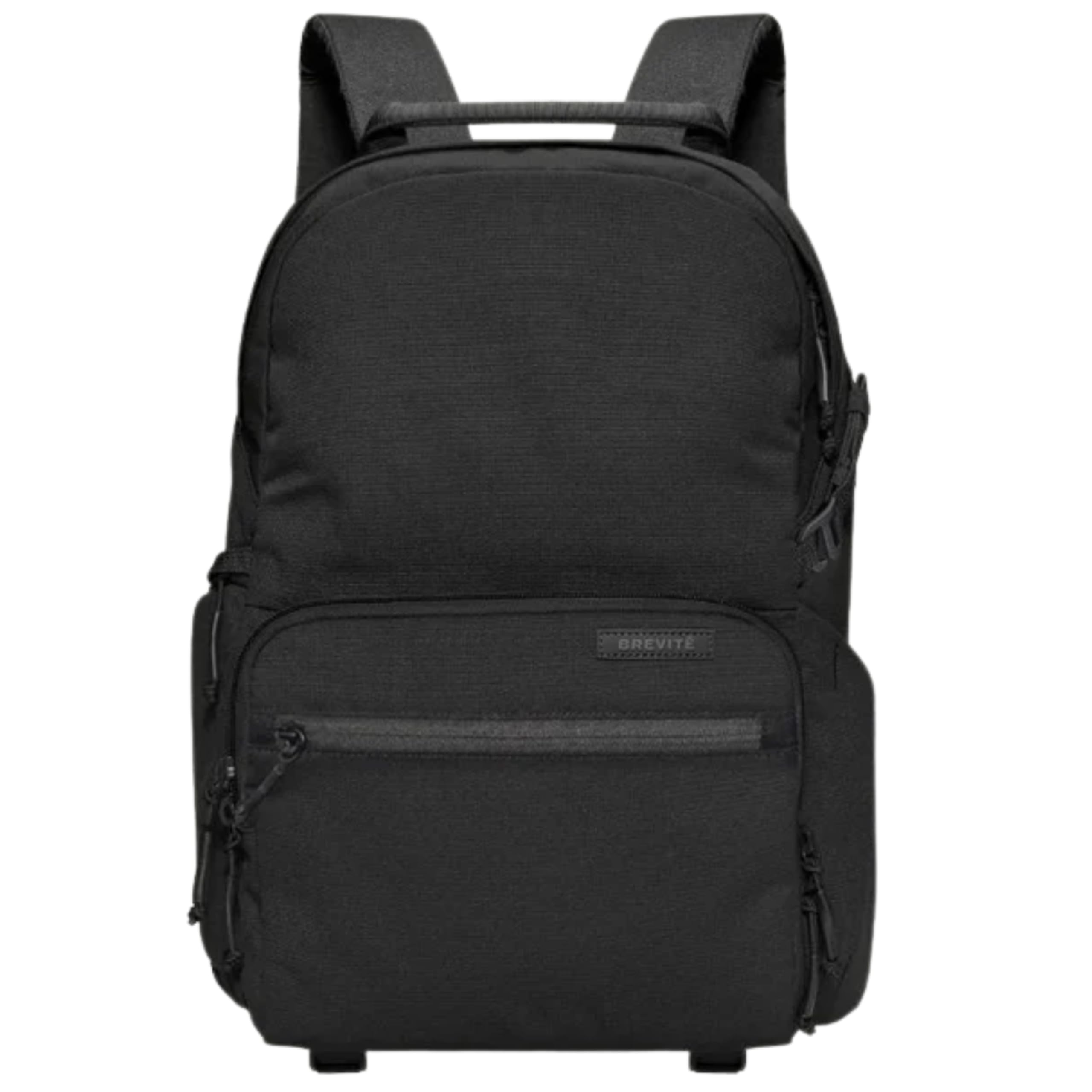
The Brevite Jumper looks like a simple fashion backpack from the outside but hides a full custom camera organizer inside.
The 2026 edition of the Jumper was redesigned using feedback from 10,000+ photographers over 5 years, according to the brand. The result is a 23-liter pack with stiffer camera dividers and reinforced ergonomic straps that distribute weight more comfortably than the previous version, the company states. The bag weighs 2 pounds empty, which is lighter than both the Thule Aspect and the PGYTECH OneGo Lite — impressive for a 23-liter capacity. The dividers create customizable compartments that hold a full-frame camera, a drone, and two additional lenses, with room for a 16-inch laptop in the back sleeve.
Buyers report the design is intentionally discreet — it looks like a regular everyday backpack, which means you are less likely to attract attention in crowded markets or on public transit. One reviewer fits a Sony A7II plus 3 lenses and a Mavic Pro comfortably inside, and another packs a Panasonic S1H with cage, two zooms, and a 15-inch laptop. The bag is TSA-approved as a carry-on and includes a luggage passthrough and a back-panel passport pocket for travel convenience.
The catch is the straps. Multiple reviewers report that the straps are disappointing for petite frames and heavy loads — they lack the curve and foam density of premium hiking packs. A heavy load (full-frame body plus long lens plus laptop) can dig into your shoulders after a few miles. The bag also lacks a removable waist strap or sternum strap, and the back fabric does not breathe as well as mesh panels on dedicated hiking bags like the Lowepro. It is best as a travel bag and daily carry that occasionally handles a light hike, not an expedition workhorse.
Why it works
- Designed to look like a normal backpack, not a camera bag — great for urban travel
- Stiffer dividers keep gear securely in place without shifting
- Fits a 16-inch laptop, full-frame body, drone, and two lenses in 23 liters
The trade-offs
- Straps are not comfortable for heavy loads or long hikes, especially for petite users
- No removable waist strap or sternum strap for load distribution
- Back panel is not breathable mesh — your back gets sweaty on warm days
The winner for: city travelers and hybrid shooters who want one bag that works for a flight, a coffee shop laptop session, and a light day hike without looking like a photographer on duty
The reason not to buy: if you hike more than 5 miles with a heavy kit, the strap comfort becomes a real issue — look at the Think Tank Backlight Sprint or the Lowepro Flipside instead
Understanding the Specs
Back-Panel vs. Side Access
Back-panel access (also called lumbar access or rear-panel access) lets you open the bag against your back while it is still strapped around your waist. You rotate the bag to your front, unzip, and pull your camera out. The straps never touch the ground, which matters when you are standing in mud, snow, or sand. Side access uses a zipper on one side of the bag, letting you reach your camera by swinging the bag around your shoulder but not fully taking it off. Side is faster for quick lens swaps; back-panel is better for keeping your gear clean on wet terrain.
Empty Bag Weight and Why It Matters
The weight of the bag before you put any gear in it directly reduces how much camera and lens you can carry for the same total backpack weight. A bag that weighs 2 kilograms empty eats up 2 pounds of your comfortable carry limit before you even add a body and two lenses. The lightest bag here (Think Tank Backlight Sprint at 1 kg) saves you 1 kilogram versus the heaviest (PGYTECH OneGo Lite at 2 kg) — that is the difference between bringing a spare lens and a larger water bottle or leaving them behind.
FAQ
Can I fit a 17-inch laptop inside a backpacking camera bag?
Is a rain cover included with every backpacking camera bag?
Will a DJI Mavic drone fit in one of these bags?
What is the difference between a regular camera backpack and a backpacking camera bag?
How do I know if the bag will fit my DSLR or mirrorless camera?
Does a backpacking camera bag protect my gear if I fall or bump into rocks?
Can I use one of these bags as my only backpack for a multi-day backpacking trip?
Is it safe to fly with a backpacking camera bag as a carry-on?
Final Thoughts: The Verdict
If you want one dependable pick, the best backpacking camera bag winner is the Thule Aspect DSLR Camera Bag Backpack because it combines heavy-haul capacity with back-panel access that keeps you shooting on the trail without setting a bag in the dirt. If you want expandable capacity that adapts to different kit sizes, grab the K&F CONCEPT Professional Camera Backpack. And for a lightweight minimalist
Related Guides
Product prices and availability are accurate as of the date/time indicated and are subject to change. Any price and availability information displayed on Amazon at the time of purchase will apply to the purchase of this product. As an Amazon Associate I earn from qualifying purchases.
CERTAIN CONTENT THAT APPEARS ON THIS SITE COMES FROM AMAZON. THIS CONTENT IS PROVIDED "AS IS" AND IS SUBJECT TO CHANGE OR REMOVAL AT ANY TIME.
Amazon and the Amazon logo are trademarks of Amazon.com, Inc. or its affiliates.