
Our readers keep the lights on and my morning glass full of iced black tea. As an Amazon Associate, I earn from qualifying purchases.
Specs are compiled from manufacturer listings and verified buyer reviews and can change over time — please confirm the key details on the product page before buying.
You are hours into a hike, your tent is up, and the only thing standing between you and a hot meal is a tiny stove that might take forever — or worse, sputter out in the wind. The best backpacking camp stove gets you fed fast, weighs close to nothing, and handles gusty ridgelines without a meltdown. This guide compares five proven models on exactly what matters when the sun drops and your food depends on it.
I’m Min — the founder and writer behind Gadgets Feed. This guide is built by comparing the manufacturers’ published specifications and the patterns across verified customer reviews, so you get each pick’s real strengths and trade-offs instead of marketing spin.
If you are tired of wasting fuel, fighting wind, or carrying more burner than your pack can handle, the right backpacking camp stove exists — and this breakdown shows exactly which one fits your trail style.
Quick Picks
- SOTO WindMaster Canister Stove with 4Flex — Best Overall
- MSR PocketRocket Deluxe — Premium Pick
- Jetboil MightyMo — Best Value
- Jetboil MicroMo — All-in-One Favorite
- Jetboil Flash Java — Coffee-Lover’s Pick
How To Choose The Best Backpacking Camp Stove
Backpacking stoves live or die on three things: how fast they heat your water, how well they hold a flame in the wind, and how little they weigh in your pack. A good one should push water to a rolling boil in under four minutes and fold small enough to hide inside a mug. The rest is about fuel economy and simmer control — nice extras if you want actual cooking instead of just boiling.
Weight and Packability
Every ounce counts when you are carrying it for miles. The lightest stoves hover around 2.3 ounces, while full cooking systems (pot and burner combined) can reach 13.9 ounces. Decide whether you are pairing the burner with your own lightweight pot or want a complete all-in-one system that saves setup time.
Wind and Cold Performance
A stove that shuts off in a breeze is useless at a windy campsite. Look for an integrated pressure regulator that keeps fuel flowing steadily as the canister temp drops or when the tank gets low. Burner heads with a concave shape or a built-in windscreen help, though a separate folding windscreen is a cheap backup for extreme conditions.
Fuel Type and Efficiency
Most ultralight backpacking stoves run on isobutane-propane canisters. A regulated stove delivers consistent output as the canister empties, so you get the same boil speed on day ten as you did on day one. Better fuel efficiency also means you carry fewer canisters, saving both weight and waste in the long run.
Quick Comparison
On smaller screens, swipe sideways to see the full table.
| Model | Best For | Weight | Max Energy Output | Dimensions (L x W x H) | Amazon |
|---|---|---|---|---|---|
| SOTO WindMaster | Windy ridgelines | 2.3 oz | 3260 Watts | 0.71″ x 6.5″ x 4″ | $69.95Amazon |
| MSR PocketRocket Deluxe | Cold-weather reliability | 2.9 oz | — | 2.2″ x 1.5″ x 3.3″ | $79.85$84.95Amazon |
| Jetboil MightyMo | Lightweight simmer control | 3.36 oz | 2900 Watts | 4.1″ x 4.1″ x 3.75″ | $63.94Amazon |
| Jetboil MicroMo | All-in-one precision cooking | 0.75 lbs | — | 9″ x 6″ x 5″ | $135.99Amazon |
| Jetboil Flash Java | Fast coffee and meals | 13.9 oz | — | — | $159.99Amazon |
In‑Depth Reviews
1. SOTO WindMaster Canister Stove with 4Flex
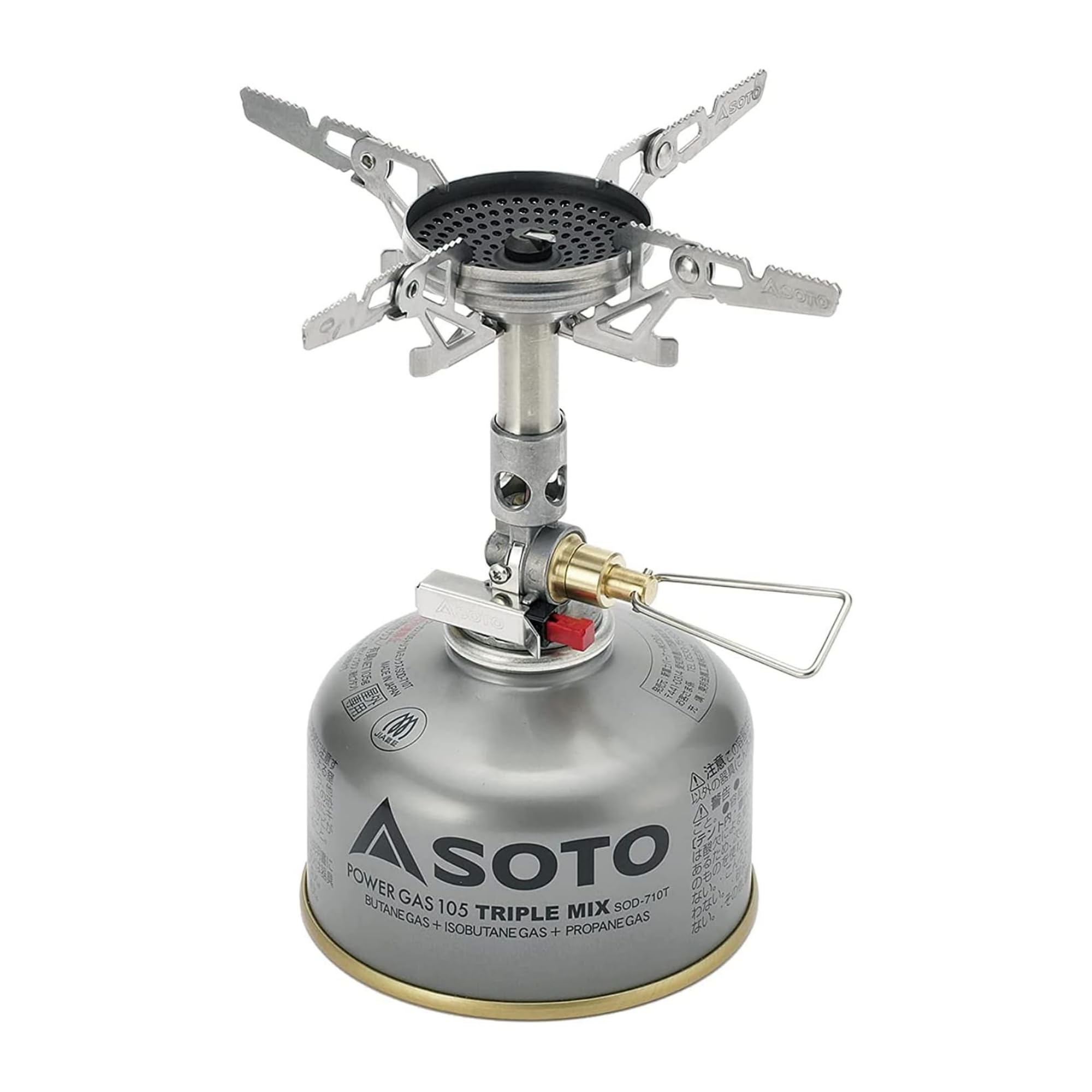
The one that keeps a steady flame when the ridgeline tries to ruin dinner.
This is the stove that buyers report “boils 500ml faster and more fuel-efficient than BRS-3000T and Polaris” — and at 2.3 ounces, it does not make you pay for that speed with extra pack weight. The concave burner head acts like a built-in windscreen, wrapping the flame close to your pot so gusts barely touch it.
You can cook on an 8-inch skillet without tipping, thanks to the 4Flex pot support. Reviewers consistently note a “replaceable piezo igniter” (a built-in spark lighter you can swap out) that works reliably trip after trip. The whole burner, including the 4Flex arms, fits sideways inside a Toaks 750ml pot, making it among the most packable wind-fighters available. The catch: it feels relatively delicate, so you need to handle it with care rather than stuffing it loose at the bottom of your pack. Buyers also point out a double O-ring that prevents gas spurting when you screw on the canister — a nice safety detail on an already well-thought-out stove.
Why hikers love it
- Industry-leading wind resistance built into the burner shape
- Weighs just 2.3 oz — one of the lightest regulated stoves you can buy
- Boils 1 cup in about 1.5 minutes, faster than most peers
- Fuel regulator keeps output consistent even with a near-empty canister
The honest downsides
- Construction feels slightly delicate — treat it as precision gear, not a beater
- Arms of the 4Flex support are not rigid; you need to align them carefully
- Price sits a bit above entry-level stove options
Best for: Anyone who camps above tree line, in coastal wind, or on exposed mountain ridges — this stove genuinely works when the breeze picks up.
Look elsewhere if: You want a cheap stove you can throw loose in a pack without worry — the WindMaster earns its place with refined design, not brute toughness.
2. MSR PocketRocket Deluxe

A classic ultralight that flexed its muscles at 30°F on El Capitan and still delivered a boil.
At 2.9 ounces, the PocketRocket Deluxe is lighter than the Jetboil MightyMo at 3.36 ounces — a measurable pack-weight difference when every gram counts. Its built-in pressure regulator keeps the flame strong across a range of conditions, and owners mention it “boiled water at 30°F on El Capitan,” proving cold-weather chops that match stoves costing more. It boils a full liter of water in 3.5 minutes, even when the canister is low or the temperature drops below 40°F.
The push-start piezo igniter sits protected inside the burner rather than exposed on the side, so it survives a few knocks inside your pack. Folding to a tiny 2.2 x 1.5 x 3.3 inches, it fits inside a 700 mL cup alongside a canister and a lighter, according to one reviewer. The broad burner does a decent job resisting wind, and the simmer control lets you cook more than just dehydrated pasta. The trade-off: that same exposed burner is noticeably affected by a stiff breeze compared to the SOTO WindMaster’s concave design — you may still want a separate windscreen for exposed spots.
What stands out
- Pressure regulator keeps output steady at low fuel and low temps
- Compact folded size fits inside a mug with a small canister
- Protected piezo igniter is more durable than exposed models
- Simmer valve lets you do real cooking, not just boiling
What to watch
- Wind performance is good but not great — a breeze can push the flame around
- No built-in windscreen like the SOTO WindMaster
- Price is mid-range but still higher than non-regulated stoves
Reach for this if: You carry a separate windscreen anyway, want a proven brand, and need a stove that lights reliably in cold and high elevation — the PocketRocket Deluxe is battle-tested.
skip it if: You primarily cook in exposed, windy terrain without a shelter — the lack of an integrated windscreen means you will notice the difference.
3. Jetboil MightyMo

A lightweight burner that simmers like a kitchen stove but fights a bit in the breeze.
The MightyMo’s biggest calling card is its four-turn regulator, which offers “incremental heat adjustments from light simmer to full boil” — meaning you can sauté vegetables or keep a sauce from scorching, not just boil water. Customers note it “boils water fast, fits in drawer systems, and looks good on camera,” confirming its main strength is raw speed with decent fuel efficiency.
The push-button igniter is reliable down to 20°F. The honest catch: multiple reviewers point out the flame is “highly susceptible to wind,” and one reviewer had the regulator break on the first trip (the stove still functioned, just not as smoothly). If you expect gusty camps, budget for a separate windbreak.
Where it shines
- Genuine simmer control — rare for an ultralight backpacking stove
- Open platform fits a standard skillet, not just proprietary pots
- Push-button igniter consistent down to 20°F
- Boils water in roughly 3 minutes with good fuel efficiency
Where it struggles
- Poor wind resistance — a breeze kills the flame
- Heavier than both the SOTO WindMaster and MSR PocketRocket Deluxe
- Regulator reliability mixed in some buyer reports
Who it fits: The backcountry cook who wants actual meal flexibility (simmer, sauté, sauce) and does not mind carrying a lightweight windscreen for breezy days.
Who should pass: Hikers who frequently camp on exposed peaks or ridgelines where every gust counts — the MightyMo’s flame is easy to blow out.
4. Jetboil MicroMo

An integrated system that gives you real temperature control without carrying a separate pot.
The MicroMo bundles a lightweight 0.8-liter FluxRing cooking cup (a cup with heat-exchanging fins on the bottom) directly with the burner, creating a closed system that shoppers say “boils water in ~2.5 minutes, saving fuel weight.” It is Jetboil’s lightest aluminum model, but at 0.75 pounds (12 ounces), it is not a bare-bones burner — it is a complete cooking system. The valve is engineered for “class-leading simmer control,” which separates it from Jetboil’s older Flash model that is largely boil-only, and buyers report 4 oz fuel canisters fit neatly inside the cup for a tidy carry.
The drink-through lid has a pour spout and strainer, so you can eat noodles or sip coffee straight from the pot. The integrated cozy and insulating sleeve mean you hold the cup without burning your hands — a small upgrade that matters on cold mornings. The catch: 0.8 liters serves one person well but is too small for two full dehydrated meals. And because it is a closed system, you either cook in the FluxRing cup or you lose the efficiency — you cannot swap in a large skillet. The performance also depends on the burner-to-pot seal, which is excellent but introduces one more part to keep clean.
Key strengths
- Boils 0.8L in roughly 2.5 minutes — very fuel efficient
- Simmer control for actual cooking beyond boiling water
- Drink-through lid with strainer doubles as eating cup
- Integrated cozy and insulating sleeve protect your hands
Key limits
- 0.8L capacity is tight for two people eating from the same pot
- Heavier and bulkier than standalone burner + pot combos
- You are locked into using the proprietary FluxRing cup
Grab this for: Solo backpackers who want a no-fuss, integrated system that boils fast, simmers well, and lets you eat directly from the pot — all packed into one item.
Skip it for: Pair cooking or anyone who wants ultralight minimalism — the MicroMo weighs 12 ounces, far more than a burner-only setup.
5. Jetboil Flash Java
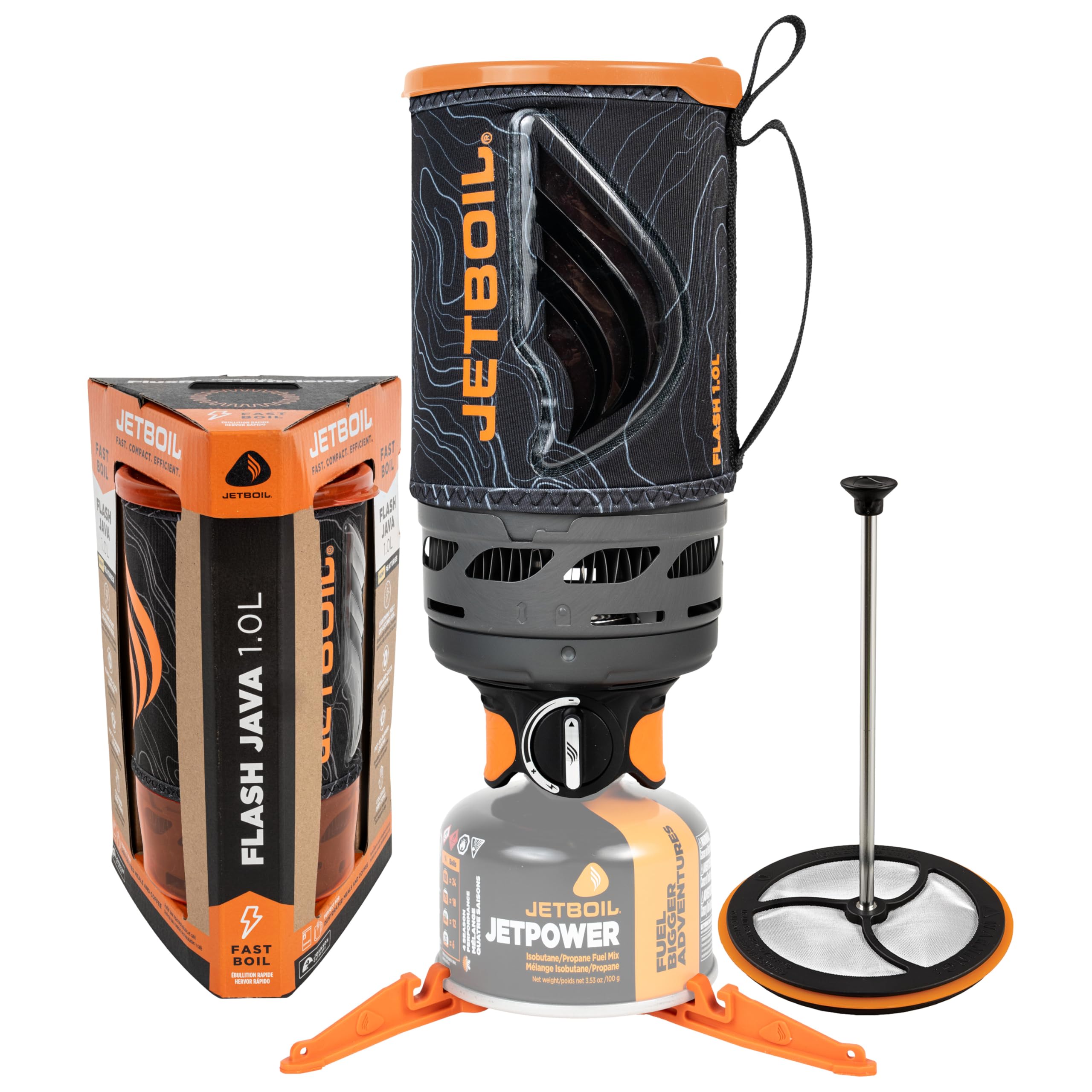
The all-in-one that goes from empty to fresh-pressed coffee in about two minutes.
The Flash Java is a complete system built for one purpose — fast boiling and great coffee in the backcountry. The 1-liter cook pot with a “new turn and click knob igniter” lights automatically like a home stove, boiling 16 ounces of water in just 2 minutes. The included silicone French press fits right into the pot, so you can brew a proper cup without carrying extra gear. Buyers confirm it: “Had coffee in the middle of Yellowstone National Park” — the stove is a hit with morning-oriented campers.
Safe-Touch Zones on the rubberized grip area stay cool during use, so you do not need to hunt for a bandana to hold the pot. The locking system has three visual indicators, giving you a positive click before you light up — no wobbles, no leaks. At 13.9 ounces, the Flash Java is the heaviest stove on this list, but everything packs inside the 1-liter cup: the burner, a 100g fuel canister, the bottom cup (which doubles as a measuring cup or bowl), and the coffee press. The catch is that weight — it is 13.9 ounces versus the 2.3 ounces of a bare burner like the SOTO WindMaster, so this is a trade of portability for convenience and a complete coffee kit.
What makes it special
- Automatic one-step ignition — twist the knob and the flame is on
- Integrated French press produces real coffee, not instant
- Fastest boil time of the group — 2 minutes for 16 oz
- Everything nests inside the pot for organized packing
What holds it back
- 13.9 oz weight is heavy compared to standalone burners
- Primarily a boil-and-coffee machine — less suited for simmer cooking
- Fuel canister must be small (100g) to fit inside the pot
Grab it for: Coffee-first hikers, car campers, and anyone who wants a single box that makes breakfast in two minutes flat without extra gadgets.
Steer clear for: Gram-counting thru-hikers — at 13.9 ounces, this is a luxury item on a stripped-down pack.
Understanding the Specs
Pressure Regulation
A regulated stove uses a small valve to keep the fuel pressure steady as the canister empties or the temperature drops. Without a regulator, the flame gets weaker as you use up the gas, leaving you waiting longer for dinner when you are already tired and hungry. Regulated stoves like the MSR PocketRocket Deluxe and the SOTO WindMaster maintain consistent output from the first boil to the last.
Energy Output (Watts/BTU)
Energy output tells you how much heat the burner can push into your pot. More Watts means faster boil times — the SOTO WindMaster outputs 3260 Watts versus the Jetboil MightyMo’s 2900 Watts. But raw power is not the only factor: a stove with a windscreen or a concave burner can put that heat directly into the pot rather than letting it blow away, making efficiency just as important as peak output.
Piezo Ignition
A piezo igniter is a small ceramic component that creates a spark when you push a button or turn a knob — no lighter or matches needed. Stoves with reliable piezo ignition, like the SOTO WindMaster’s replaceable igniter or the MSR PocketRocket Deluxe’s protected version, save you the hassle of packing a fire starter and fumbling in the dark or rain. Models without it require a separate flame source.
Fuel Canister Compatibility
Nearly all ultralight backpacking stoves use threaded isobutane-propane canisters (often called Lindal valves). A stove with a built-in regulator and a double O-ring seal (like the SOTO WindMaster) screws onto these canisters without gas spurting or leaking. Some all-in-one systems like the Jetboil MicroMo are designed to work best with the brand’s own canisters, though they accept standard threaded cans as well.
FAQ
Can I use any isobutane canister with my backpacking stove?
How many boils can I get from one fuel canister?
Is a windproof stove worth the extra cost?
Will these stoves work well in cold weather?
How do I maintain my backpacking stove?
Can I use a large pot on these ultralight stoves?
Do I need to buy a separate windscreen?
Is a lighter stove always the best choice for backpacking?
Final Thoughts: The Verdict
For most buyers, the backpacking camp stove winner is the SOTO WindMaster because it combines exceptional wind resistance, consistent heat output, and a 2.3-ounce weight in one precise package. If you want cold-weather reliability and a proven brand, grab the MSR PocketRocket Deluxe. And for all-in-one coffee brewing and near-instant boils, the Jetboil Flash Java delivers a complete campside experience you will actually look forward to in the morning.
How We Picked
We do not accept paid placement, and we did not hands-on test every unit. Instead, we match each pick to a real buyer and use-case by comparing the manufacturers’ published specifications against the patterns in verified customer reviews — so you get each pick’s real strengths and trade-offs instead of marketing copy.
Sources & Methodology
Specifications: manufacturer listings and product documentation. Review insights: verified customer reviews, as of July 2026. Pricing: not shown on this page (it changes often); check the current price via the retailer link.
As an Amazon Associate, Gadgets Feed earns from qualifying purchases. This does not affect which products we feature.
Product prices and availability are accurate as of the date/time indicated and are subject to change. Any price and availability information displayed on Amazon at the time of purchase will apply to the purchase of this product. As an Amazon Associate I earn from qualifying purchases.
CERTAIN CONTENT THAT APPEARS ON THIS SITE COMES FROM AMAZON. THIS CONTENT IS PROVIDED "AS IS" AND IS SUBJECT TO CHANGE OR REMOVAL AT ANY TIME.
Amazon and the Amazon logo are trademarks of Amazon.com, Inc. or its affiliates.