
Our readers keep the lights on and my morning glass full of iced black tea. As an Amazon Associate, I earn from qualifying purchases.
You are miles from an outlet, your phone is down to 15%, and the sun is your only power source. The difference between a great backpacking solar charger and a disappointing one is not just wattage — it is whether the panel actually delivers usable power while you are moving, folds small enough to fit inside your pack, and survives a rain shower or a dusty trail without quitting.
I’m Min — the co-founder and writer behind Gadgets Feed. This guide is built by comparing the manufacturers’ published specifications and the patterns across verified customer reviews, so you get each pick’s real strengths and trade-offs instead of marketing spin.
Whether you are recharging a power bank at camp or topping off your phone on a ridge, the backpacking solar charger that works for you depends on how you hike, how much sun you see, and how much weight you are willing to carry.
How To Choose The Best Backpacking Solar Charger
Picking the right solar charger for backpacking comes down to four factors that matter more than brand names or flashy promises. Here is what to look for before you buy.
Wattage vs. Real-World Output
A 28W panel sounds twice as powerful as a 14W panel, but the actual charging speed you get depends on sun angle, cloud cover, and whether the panel uses Maximum Power Point Tracking (MPPT — a smart chip that adjusts voltage to get the most power from changing light) or a simpler PWM (pulse width modulation) controller. Look for panels with a digital ammeter (a small screen that shows the current in amps) so you can tilt the panel until you see the highest number. That is your true output in real time.
Weight and Packed Size
Every ounce counts when you are carrying everything on your back. A panel that weighs under 2 lbs and folds smaller than a tablet is ideal for multi-day trips. Heavier panels with rigid glass or aluminum frames deliver more power per square foot but belong in car-camping setups, not backpacking packs. Also check the folded dimensions — a panel that is 7 by 5 inches is far easier to stow than one that is 11 by 8 inches.
Water and Dust Resistance
IP ratings (Ingress Protection — a two-digit standard for how well a device resists solids and liquids) tell you how much weather the panel can handle. IP44 means it survives splashes from any direction. IP67 means it can be dunked in a meter of water for 30 minutes. IP68 goes even deeper. For backpacking, IP44 is the minimum you should accept, but IP67 or IP68 gives you real peace of mind when a thunderstorm rolls in.
Port Selection and Charging Speed
USB-C Power Delivery (a fast-charging standard that can push up to 60W or more over a USB-C cable) is becoming the norm for modern phones and power banks. If your panel has only USB-A ports, you are capped at 5V/2.4A (about 12W) per port. A panel with both USB-C and USB-A gives you flexibility and future-proofing. If you plan to charge a power bank instead of a phone directly (which you should — it is more efficient), make sure the panel’s output matches or exceeds your power bank’s input limit.
Quick Comparison
On smaller screens, swipe sideways to see the full table.
| Model | Category | Best For | Key Spec | Amazon |
|---|---|---|---|---|
| FlexSolar 36W | Mid-Range | High-power camp charging | 36W / 7.2 Amps | $55.99$69.99Amazon |
| BigBlue 25W Ultra-Light | Mid-Range | Ultralight backpacking | 25W / 0.84 lbs | $59.49$69.99Amazon |
| BigBlue 28W Digital Ammeter | Mid-Range | Real-time current monitoring | 28W / 25.4% efficiency | $65.22$68.96Amazon |
| Anker Solix PS30 | Mid-Range | Trusted brand durability | 30W / 6 Amps | $79.99Amazon |
| NESTOUT 14W | Premium | Modular design + style | 14W / 0.61 kg | from $89.99Amazon |
| NESTOUT 28W (USB-A) | Premium | Modular system charging | 28W / 4.8 Amps | $129.99Amazon |
| NESTOUT 28W USB-C | Premium | USB-C + modular gear | 28W / 0.91 kg | from $89.99Amazon |
In‑Depth Reviews
1. FlexSolar 36W Ultra-Portable Solar Panel Charger
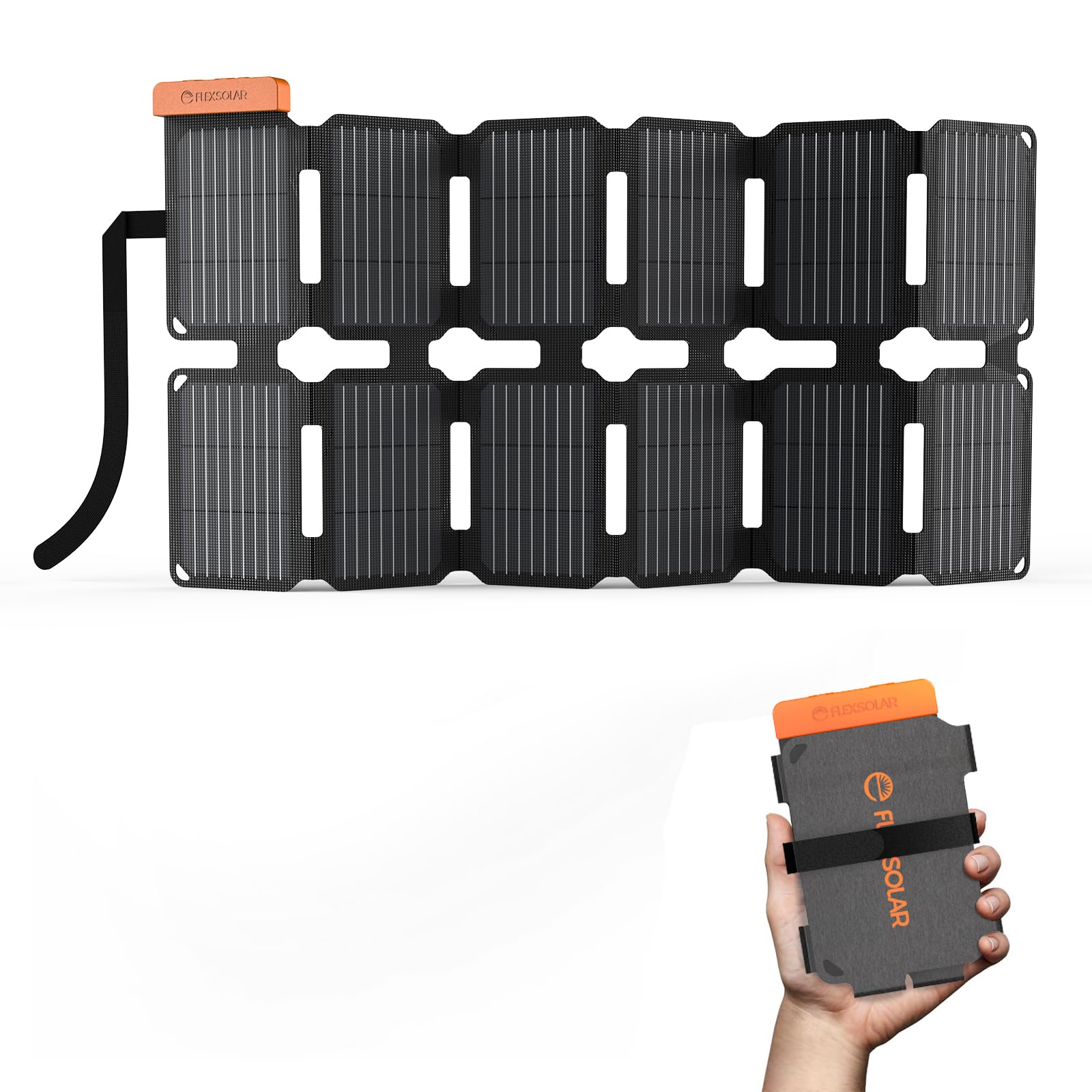
The FlexSolar 36W earns the top spot because it delivers more than double the amperage of most backpacking panels — 7.2 Amps versus the roughly 1 Amp you get from the BigBlue 28W with Digital Ammeter, a gap that means your power bank fills in hours instead of a full day. This is the panel for backpackers who set up camp for a night or two and need serious energy replenishment before the next push, not just a trickle top-off while hiking.
Despite its 36W rating, it folds to just 7.7 by 5.1 inches and weighs 1.7 lbs, making it far more packable than its power output suggests. The IP67 water resistance (it survives immersion up to 1 meter for 30 minutes) and 24% photovoltaic efficiency mean you can leave it out in changing weather without worry. Buyers report it is “compact when folded correctly” and that it “quickly recharges a 10,000mAh power bank” — a real-world validation that the 7.2-amp output is not just a theoretical number.
The honest trade-off is weight: at 1.7 lbs, it is 0.86 lbs heavier than the BigBlue 25W Ultra-Light (a 2x gap), so ultralight hikers counting every gram may prefer a leaner option. But if you prioritize raw charging speed at camp over carrying the absolute minimum, this is the one to buy.
Why it’s great
- 36W delivers 7.2 Amps — fastest charging in this class
- IP67 waterproof rating handles heavy rain and dust
- 24% efficiency with MPPT maximizes output in partial shade
Good to know
- Heavier than ultralight competitors at 1.7 lbs
- Some owners mention actual output below rated 36W
2. [Upgraded] BigBlue Ultra-Light Portable 25W Solar Panel Charger

Where the FlexSolar dominates on pure power, the BigBlue 25W Ultra-Light wins on weight — at 0.84 lbs it is less than half the weight of the FlexSolar (a 2.0x gap), making it the panel you can actually forget is in your pack until you need it. Its 25W rating is 44% lower than the FlexSolar’s 36W, but for backpackers who value every ounce, that trade-off is often worth it.
The IP68 water resistance (fully submersible beyond 1 meter, versus the FlexSolar’s IP67) gives you 55% more protection against the elements, which matters if you are crossing streams or hiking in persistent drizzle. The 25.4% efficiency (6% higher than the FlexSolar’s 24%) means it squeezes slightly more power from the same sunlight. Customers note it “charged a 10,000 portable power bank in about 6 hours in the sun” — slower than the FlexSolar but still practical for an overnight camp.
Choose this over the FlexSolar if your trips are long, your pack weight is tight, and you are willing to accept slower charging in exchange for nearly zero carrying burden.
Where it shines
- Ultra-light at 0.84 lbs — pocketable for long trails
- IP68 waterproof — survives full submersion
- 25.4% efficiency is best-in-class for this weight tier
Worth noting
- Max output is closer to 15W from USB-C (5V x 3A)
- Reviewers point out missing accessories on delivery
3. BigBlue Portable Solar Charger 28W with Digital Ammeter

If you are the kind of backpacker who likes knowing exactly how much power you are pulling from the sun, the BigBlue 28W with its integrated digital ammeter gives you real-time feedback that helps you tilt the panel for maximum output. In bright sun, shoppers say “2.3-2.4A” on the display — enough to charge two 10,000mAh power banks in hours without guessing whether you are in the sweet spot.
The 25.4% sunlight-to-power conversion is among the highest in this price bracket, and the IP44 water resistance (splash-proof, not submersible) handles light rain at camp. The 1.47 lb weight splits the difference between ultralight and high-power panels. One reviewer who has owned it for five years says it “still works, outputs 4A” — a testament to the build quality and the 18-month manufacturer warranty backing it.
One standout callout: the zippered device pocket can trap heat and cause phones to overheat in direct sun, so it is smarter to charge a power bank and keep the battery in the shade while the panel stays in the light.
What stands out
- Digital ammeter shows real-time charging current
- 25.4% efficiency — top-tier conversion rate
- Built-in zippered compartment holds cables and batteries
The trade-offs
- IP44 splash protection — not fully waterproof
- Black device pocket can overheat electronics in direct sun
4. Anker Solix PS30 Solar Panel, 30W

The single number that matters most in this category — amperage — is 6 Amps on the Anker Solix PS30, which puts it just behind the FlexSolar’s 7.2 Amps but ahead of every other panel here. That 6-amp output means it can refill a drained phone from 15% to 100% in about 1.5 hours, according to buyers, which is genuinely fast for a foldable panel.
The catch you accept is weight: at 2.2 lbs, it is the heaviest panel in this lineup, making it a better fit for shorter backpacking trips or base-camp setups than ultra-distance thru-hikes. The IP65 rating (dust-tight and protected against low-pressure water jets) is solid but not as reassuring as IP67 or IP68 on panels that cost about the same. Some buyers report that the hinges can feel fragile over time.
What you get for that weight is Anker’s reliable power delivery and a fold pattern that packs neatly. If brand trust and consistent USB-C 15W output matter more to you than shaving ounces, this is a safe, well-built choice that delivers solid performance for the price.
The upsides
- 30W with 6 Amps — fast charging for phones and power banks
- IP65 weather-resistant — handles rain and dust
- Trusted Anker quality and 18-month warranty
Keep in mind
- Heaviest in class at 2.2 lbs — less ideal for long hikes
- Hinges reported as fragile by some buyers
5. NESTOUT Portable Solar Panel, 14W (2 Panel)
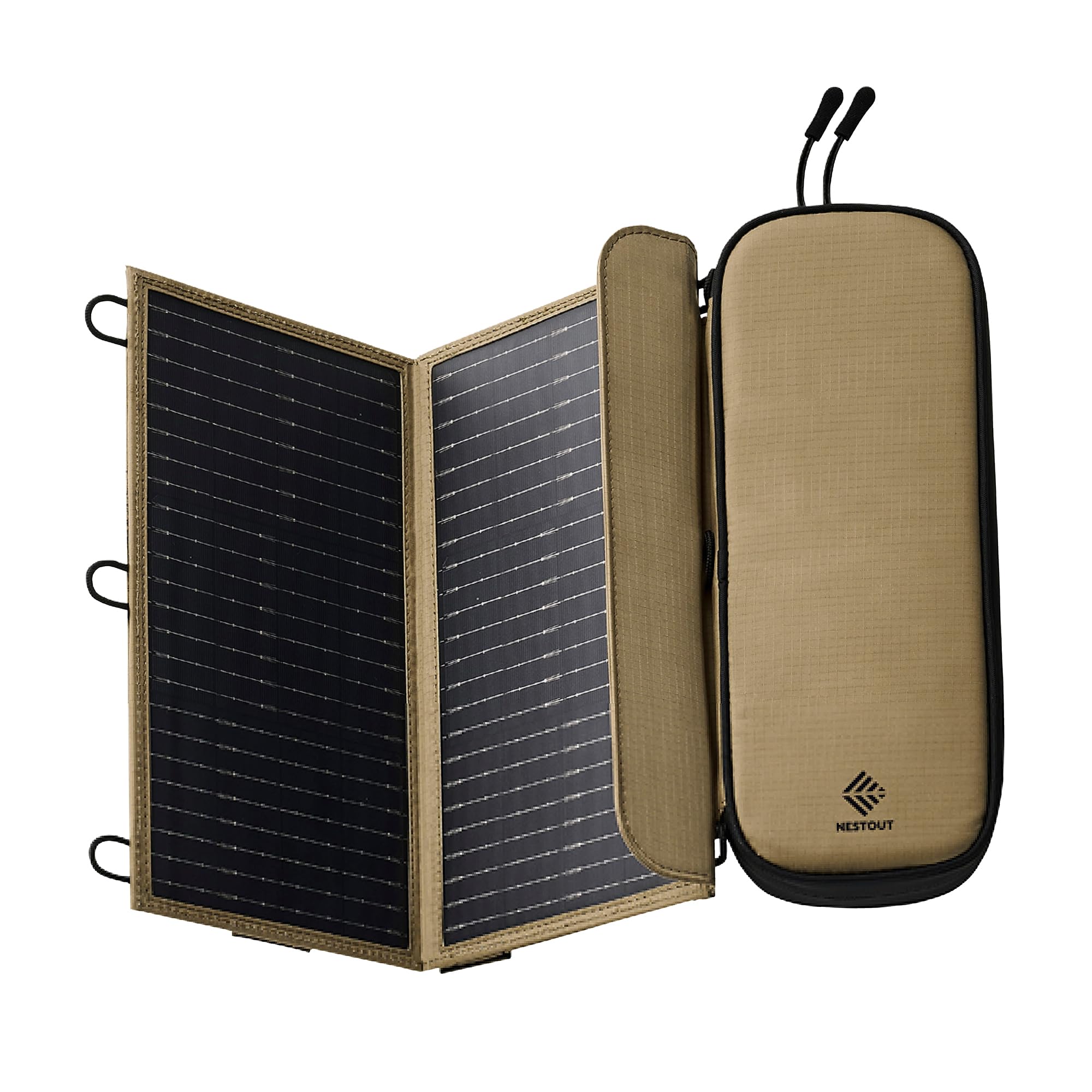
At 14W, the NESTOUT 2-panel charger is the lowest wattage option here, but what you actually get is a beautifully built system designed for ultralight trips where you only need to keep a phone and a small power bank alive. The included adjustable stand lets you tilt the panel toward the sun without propping it on rocks, and the ripstop nylon construction feels premium in hand.
What you give up is speed — 14W is about half the power of the BigBlue 28W, so a power bank that fills in 3 hours on a higher-wattage panel will take 6+ hours here. The digital ammeter helps you hunt for the best angle, and the built-in storage pocket keeps cables tidy. Owners mention it is “small, light, well-built” and that the entire system “fits on a battle belt” for true minimalist carry.
The exact buyer it is perfect for: the day-hiker or weekend backpacker who carries a single phone and a 5,000mAh battery, values design and packability over raw wattage, and wants a panel that looks as good as it works.
Why we’d pick it
- Ultra-compact foldable design with adjustable stand
- Built-in digital ammeter for real-time positioning feedback
- Ripstop nylon construction — durable and water-repellent
A few caveats
- 14W max — slowest charging in this lineup
- Includes USB-C port but no USB-A to USB-C cable
6. ELECOM NESTOUT Portable Solar Panel, 28W (4-Panel, USB-A)

The NESTOUT 28W with dual USB-A ports is for the backpacker who wants a modular power ecosystem — the panel works seamlessly with NESTOUT’s own 5,000mAh battery pack and lantern, all of which fit inside the panel’s built-in pouch for a clean, all-in-one carry. It is an iF Design Gold Award winner, and the craft shows in the water-resistant zipper and ripstop nylon that survive bushwhacking and rain.
The 4.8-amp total output across two USB-A ports is respectable, but the lack of USB-C means you are stuck at older charging standards (5V/2.4A max per port). The built-in current checker LED display lets you see exactly how much power you are pulling, and the adjustable stands help you dial in the angle. Customers note it “charges a power bank in ~2.5-3 hours” and that the modular integration saves space compared to carrying separate accessories.
Buyers also mention the instructions are in Japanese only, so expect some trial and error on setup — its one weakness is that the lack of USB-C limits compatibility with modern devices.
Strong points
- 28W with dual USB-A ports and 4.8A total output
- Modular design integrates with NESTOUT battery and lantern
- Water-resistant ripstop nylon with adjustable stands
Before you buy
- No USB-C port — limited to older USB-A charging speeds
- Instructions in Japanese; setup may require trial and error
7. NESTOUT Portable Solar Panel, 28W USB-C (4 Panel)
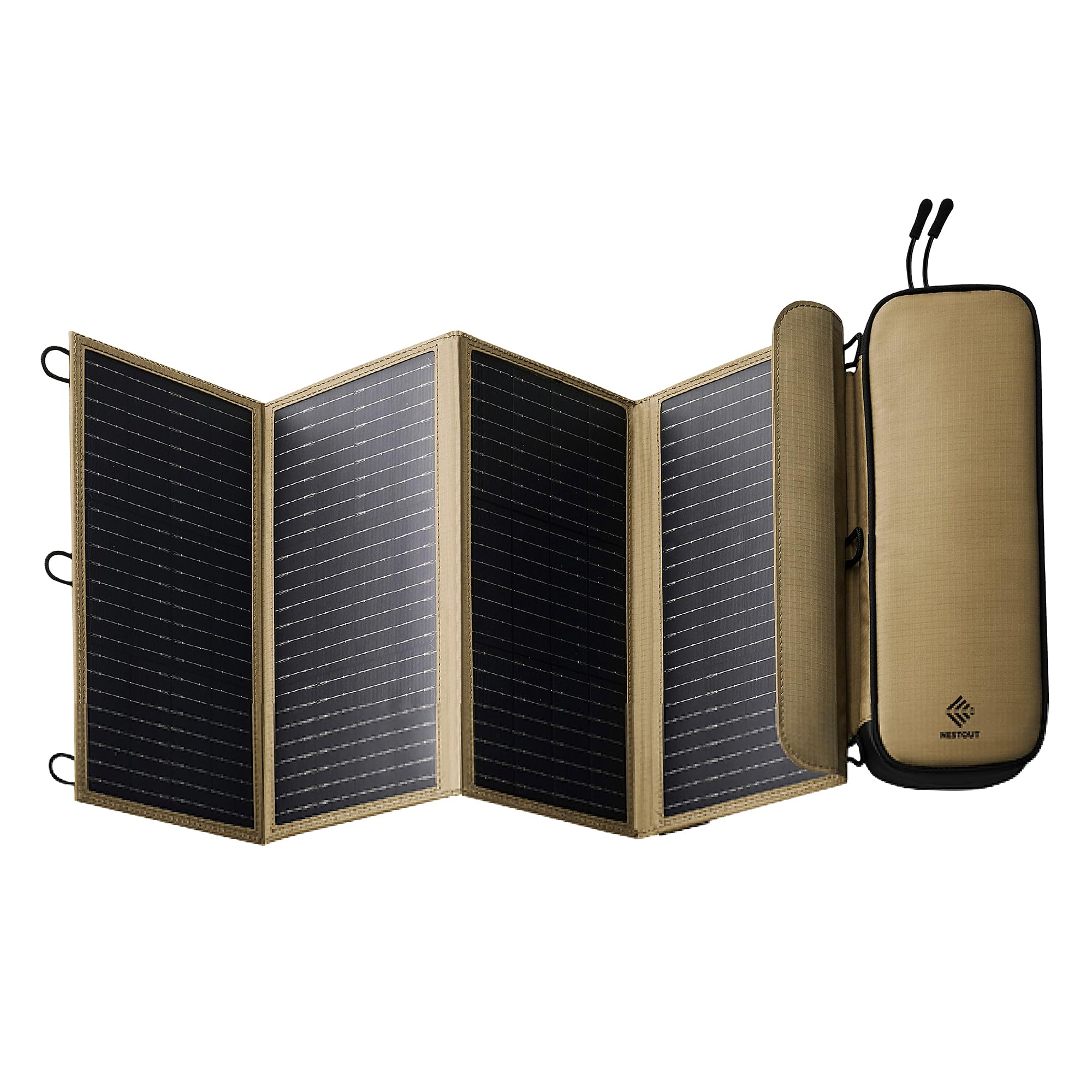
At a higher price than most competitors, the NESTOUT 28W offers premium build and USB-C convenience, but its value proposition is weaker than the BigBlue 28W which matches its wattage for far less money. The 0.91 kg (2.0 lb) weight undercuts the Anker Solix PS30 at 2.2 lbs, making it a lighter premium choice for those who prioritize design.
What that extra money gets you is the same iF Gold Award build quality, the same adjustable stands and ripstop nylon, plus the convenience of USB-C charging for newer phones, power banks, and GPS units. The digital ammeter still helps you track output, and the modular compatibility with NESTOUT accessories means you can build a full power system that packs into a single pouch. Buyers find it “well-built” and say it “charges a power bank in ~2.5-3 hours.”
The one clear reason to choose it: you want the most refined module-based system with modern USB-C support and are willing to pay a premium for the design and integration — but be aware that the 28W maximum is matched by the BigBlue 28W at a fraction of the cost.
What we like
- 28W with USB-C and USB-A for modern device compatibility
- iF Design Gold Award — premium build and aesthetics
- Modular system with adjustable stands and storage pouch
The downsides
- Higher price tag than comparable 28W panels
- Reaches advertised capacity only with both ports active
Understanding the Specs
Wattage and Amperage
Wattage (W) tells you the total power a panel can produce under ideal sun. Amperage (Amps, or A) tells you how fast that power flows to your device. A higher amp number means faster charging. For example, a panel delivering 7.2 Amps refills a 10,000mAh power bank much faster than one delivering 1 Amp — think hours instead of a full day. Always compare both numbers, not just wattage alone.
IP Water Resistance Rating
IP (Ingress Protection) ratings use two digits: the first for dust protection (4 = splash-proof, 6 = dust-tight), the second for water protection (4 = splashes, 7 = 30-min immersion at 1 meter, 8 = deeper/longer immersion). For backpacking, IP44 is the minimum. IP67 handles a dropped panel in a puddle. IP68 survives a stream crossing. Do not confuse “water-resistant” with “waterproof” — read the full rating.
Conversion Efficiency
This percentage tells you how much of the sunlight hitting the panel gets turned into electricity. Most good backpacking panels land between 22% and 25.4%. A 25% panel does not charge significantly faster than a 23% panel of the same size — the real-world difference is small. Focus more on wattage and amperage unless you are comparing two panels with identical size and different efficiency claims.
MPPT vs. PWM Charging
MPPT (Maximum Power Point Tracking) is a smart controller that adjusts voltage to pull the most power from changing light conditions — useful when clouds pass or you are in partial shade. PWM (Pulse Width Modulation) is simpler and cheaper but less efficient in imperfect sun. For backpacking, MPPT is worth the extra cost if you expect variable weather or tree cover.
FAQ
How long does a backpacking solar charger take to charge my phone?
Can I use a solar charger while hiking, or do I need to stop?
Why does my solar charger stop working when a cloud passes?
Should I charge my phone directly or use a power bank?
Final Thoughts: The Verdict
For most backpackers, the backpacking solar charger winner is the FlexSolar 36W because it delivers the highest amperage (7.2 Amps) for camp charging while remaining packable at 1.7 lbs with IP67 weather protection. If you want the absolute lightest carry for long trails, grab the BigBlue 25W Ultra-Light at 0.84 lbs with IP68 waterproofing. And for the best balance of price, real-time feedback, and proven durability, the standout is the BigBlue 28W with Digital Ammeter.
Product prices and availability are accurate as of the date/time indicated and are subject to change. Any price and availability information displayed on Amazon at the time of purchase will apply to the purchase of this product. As an Amazon Associate I earn from qualifying purchases.
CERTAIN CONTENT THAT APPEARS ON THIS SITE COMES FROM AMAZON. THIS CONTENT IS PROVIDED "AS IS" AND IS SUBJECT TO CHANGE OR REMOVAL AT ANY TIME.
Amazon and the Amazon logo are trademarks of Amazon.com, Inc. or its affiliates.