
Our readers keep the lights on and my morning glass full of iced black tea. As an Amazon Associate, I earn from qualifying purchases.
Specs are compiled from manufacturer listings and verified buyer reviews and can change over time — please confirm the key details on the product page before buying.
When you’re miles from an outlet, a solar panel only earns its place in your pack if it reliably tops up your phone, camera, or power bank. The real trade-off is weight versus wattage: a 2.4 lb panel that folds to the size of a paperback is a different tool than a 13.89 lb quad-fold that can run a laptop or recharge a power station. Here are the best backpacking solar panel options by what they actually deliver on the trail, not just what the spec sheet promises.
I’m Min — the founder and writer behind Gadgets Feed. This guide is built by comparing the manufacturers’ published specifications and the patterns across verified customer reviews, so you get each pick’s real strengths and trade-offs instead of marketing spin.
Match the panel’s weight and wattage to your trip’s charging demands. backpacking solar panel choices range from ultralight 25W pocket panels to 200W behemoths for basecamp power, so matching size to your trip is everything.
Our Picks at a Glance


How To Choose The Best Backpacking Solar Panel
Before you buy, you need to know one thing: solar panels only make power in direct, unobstructed sunlight, and the rated wattage is measured in perfect lab conditions you will rarely find on a trail. Your real decision is about matching panel size to your charging needs and your pack space.
Match wattage to what you carry
For keeping a phone and a power bank topped up each day, a 30W panel is the balance. A 60W panel adds a DC port (a round plug for direct charging) so you can charge a small power station or laptop. The 200W option is really for basecamp or vehicle use, where weight matters less than total energy.
Check the output ports, not just the wattage
USB-C PD (Power Delivery) ports charge modern devices much faster than older USB-A ports. If your phone or power bank accepts USB-C, a panel with a USB-C PD port at 45W or 60W will be far more useful than a higher-wattage panel that only has USB-A outputs.
Weigh portability against durability
Look for panels that fold into a compact package and include carabiners or a strap for hanging from your pack. Check the waterproof rating: IP67 means it survives dust and immersion, while IP65 handles splashes. Remember that the junction box where cables plug in is rarely waterproof, even on weatherproof panels.
Quick Comparison
| Model | Best For | Max Power | Weight | Output Ports | Amazon |
|---|---|---|---|---|---|
| 30W Portable Solar Panel Charger★ Best Overall | Best Overall value | 30W | 2.4 lbs | USB-A, USB-C | Amazon |
| SOLUPUP 30WBest Value | Compact dual-device charging | 30W | 2.4 lb | USB-A, USB-C | Amazon |
| FlexSolar 30WCompact Pick | Ultralight packability | 30W | 1.4 lbs | USB-A, USB-C | Amazon |
| FlexSolar 36W | High-efficiency multi-port | 36W | 1.7 lbs | USB-A, USB-C, DC | Amazon |
| BigBlue 25W | Pocket-size ultralight | 25W | 0.84 lbs | USB-A, USB-C | Amazon |
| LUMOPAL 60W | High-power portable charging | 60W | 3.42 lb | USB-A, USB-C, DC | Amazon |
| Anker SOLIX PS30 | Trusted brand portability | 30W | 2.2 pounds | USB-A, USB-C | Amazon |
| BigBlue 60W X60 | Power station compatibility | 60W | 4lbs | USB-C PD, USB-A, DC | Amazon |
| Renogy 200W E.Flex | Basecamp and vehicle power | 200W | 13.89 lbs | USB-C PD, USB-A, MC4 | Amazon |
In‑Depth Reviews
1. 30W Portable Solar Panel Charger
Our pick — 4.5★ from 750+ verified ratings; the strongest balance of quality and price.
The 30W foldable that balances trail weight with real charging muscle
It delivers the best power-to-weight ratio in the 30W class. At just 2.4 lbs with a folded size of 11.6″ x 6.5″ x 1.77″, it slips into a backpack pocket and still charges two devices at once through its USB and Type-C outputs, each rated at 5V/3A max.
Its 24% conversion efficiency can fully charge a 5000mAh phone in about 2 hours of direct sun. The build uses aluminum, monocrystalline silicon, and tempered glass, and the IP67 rating means it shrugs off dust and rain, though the connection box itself is not waterproof.
What wins people over is the value: the crowd favorite here has drawn hundreds of ratings, and the mix of adapters, carabiners, and a 50cm USB to Type-C cable makes it plug-and-play out of the bag. It is not for laptops or power stations — this is strictly for phones, power banks, and small electronics — so think of it as your daily trail charger, not a basecamp powerhouse.
Owners praise most
- Value for money gets the most thumbs-up, with 43 buyers calling it out
- Folds easily and sets up in seconds, earning 27 setup mentions
- Good build quality and weather resistance for the price
Reality check on charging
- Charging speed gets mixed feedback — real-world output varies with sun angle
- Needs weighting in wind to stay put, per several owners
the balance: Buy this if you want one panel that handles phone and power bank duty for a multi-day trip without breaking your pack weight budget.
Know the limit: skip it if you plan to charge a laptop or a large power station — it lacks the DC output those need.
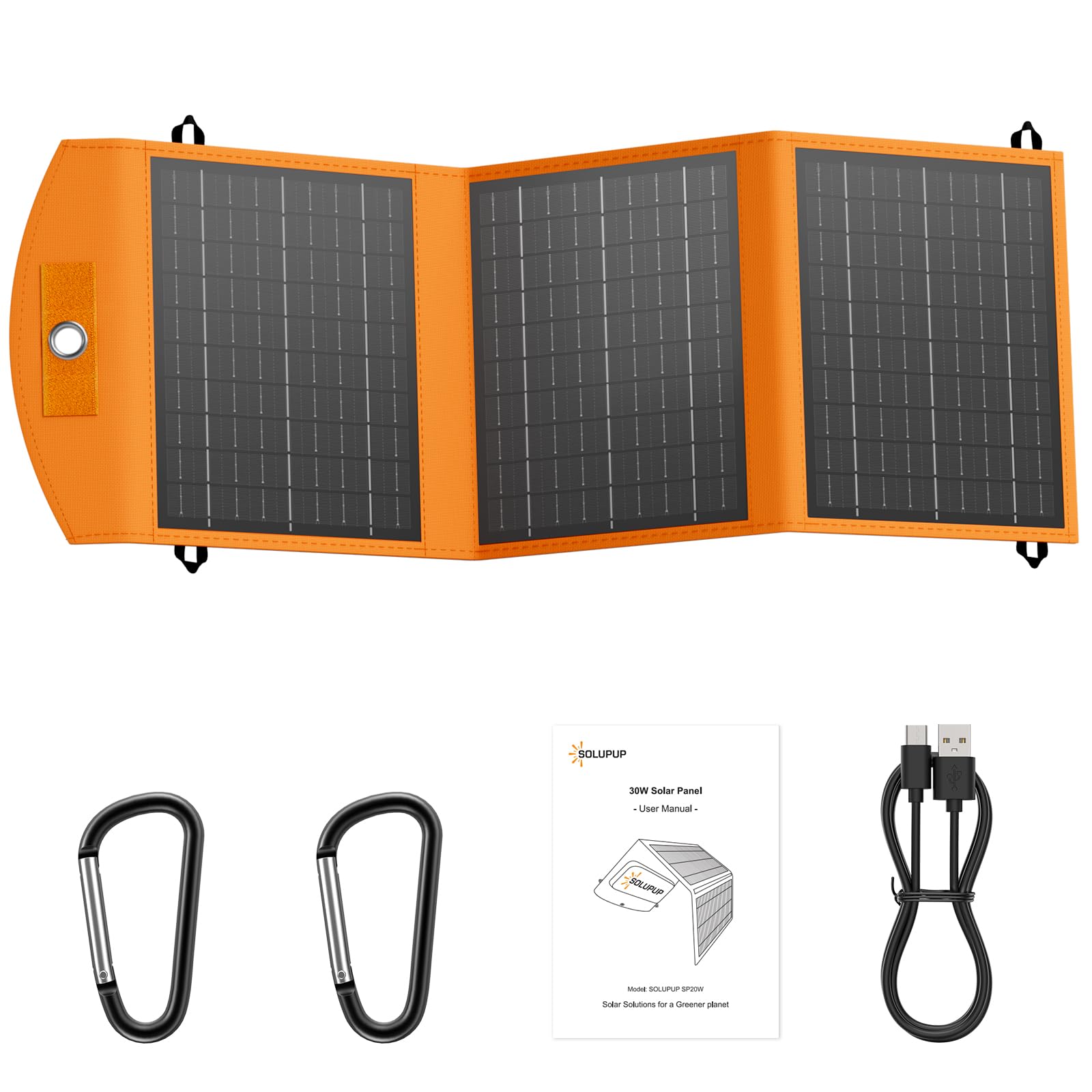
2. SOLUPUP Solar Panels 30W
A compact workhorse that turns your backpack into a moving power station
If you want a panel that lives on your pack rather than in it, this is the one. The SOLUPUP weighs just 2.4 lb and folds to a compact 10.63 inches, and the included carabiners (metal clips) let you attach it to your bag so it charges while you walk — a setup that makes it a true companion for day hikes and weekend getaways.
The monocrystalline silicon cells hit a 23%+ conversion efficiency, which beats many panels of the same wattage. Its dual USB-A and Type-C ports (5V/3A, 15W max) can charge an iPhone and a power bank simultaneously, and the IPX5 waterproof and dustproof rating handles rain and grit.
Owners call it an “emergency must” for phones and laptops, with one buyer purchasing a second unit. The honest catch: charging in full sun is steady but not fast — buyers report it takes about 2 hours to go from 30% to 100% on a phone, so plan it as a top-up panel, not a quick-charge station.
Portability first: The clip-on design and light weight are what buyers mention most, making this the pick for hikers who want power on the move.
Pace yourself: If you need rapid charging, the 2-hour partial top-up pace is the trade-off to expect.
3. FlexSolar 30W Foldable
The featherweight that climbs without wheezing — under 1.5 lbs
For ultralight backpackers, every ounce counts, and this FlexSolar delivers a serious 30W in a package that weighs just 1.4 lbs. Folded, it measures 8.0 x 12.4 x 1.6 inches — about the footprint of a MacBook Air — so it disappears into a pack or sits flat in your hand while you hike.
The engineering is interesting: it uses ETFE film instead of the cheaper PET film, which gives light transmission up to 90% and energy conversion up to 24%. That same ETFE lamination makes the whole panel more sealed and gives it an IP67 dustproof and waterproof rating, plus better wear resistance over time.
Built-in QC3.0 quick charge on the USB-A port and a USB-C port let you top up phones, power banks, fans, and tablets. Owners note it works even under cloud cover and can charge an iPhone in the shade, though a full 20,000mAh power bank takes most of a day. One honest con: the USB ports are exposed when folded, so treat them gently in your pack.
Weight winner: At 1.4 lbs it is lighter than most 30W rivals while keeping the same power class.
Watch the ports: Exposed USB ports when folded is the one design quirk owners flag.
4. FlexSolar 36W Ultra-Portable
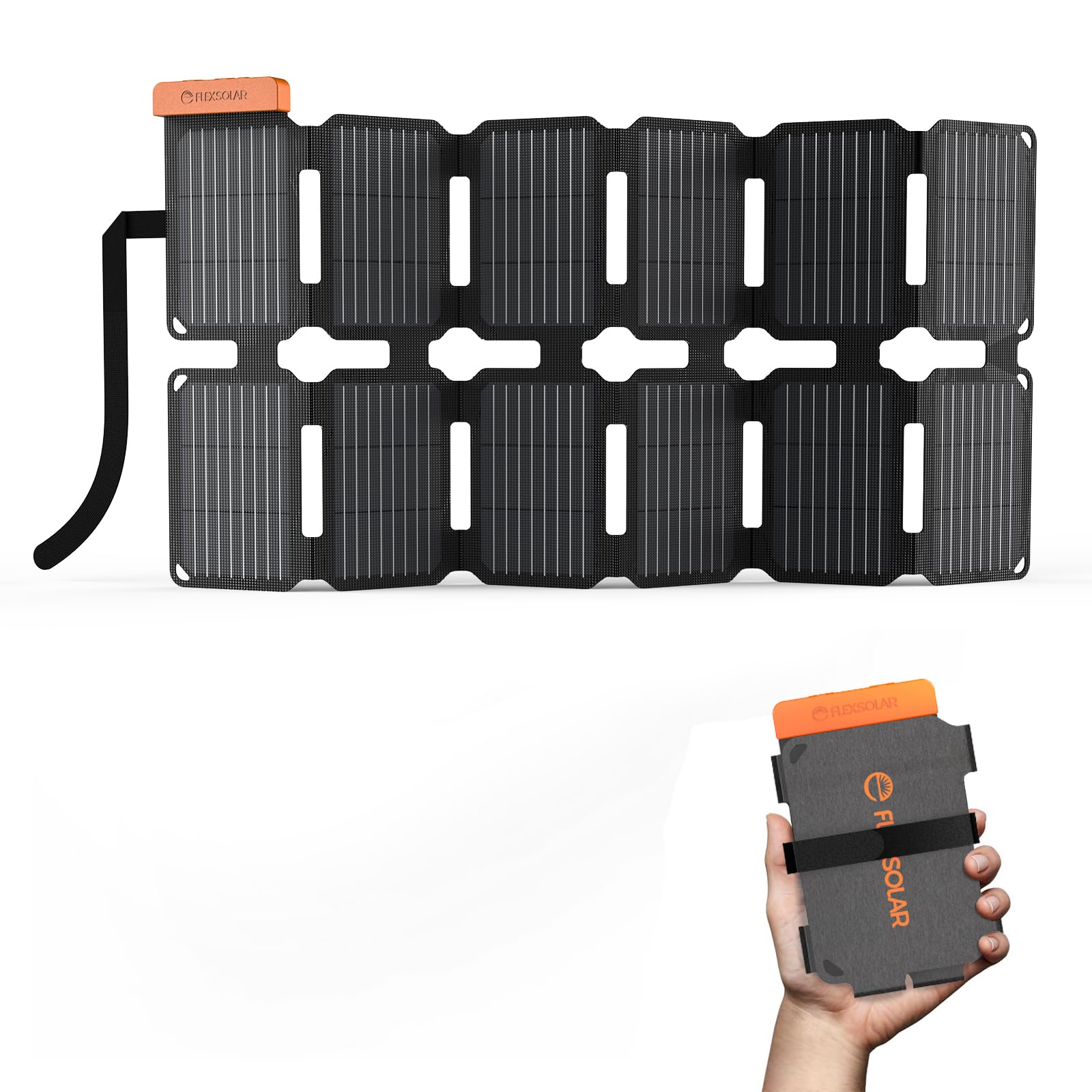
More watts per fold with a rare DC port for small electronics
This 36W panel packs 6 extra watts over the standard 30W class without much bulk: it folds to a compact 7.7 x 5.1 inches at just 1.7 lbs, smaller than most tablets. That makes it a smart middle ground for hikers who want a bit more headroom than a 30W panel offers.
Its defining feature is the triple-output setup: USB-A, USB-C, and a DC 5.5mm x 2.1mm port. The DC output is the differentiator — it lets you power small DC devices directly, not just USB gadgets. Advanced MPPT technology (an intelligent controller that boost energy harvest even in partial shade) squeezes more out of tricky light conditions.
The build is built to flex: a triple-layer construction with a UV-stabilized EVA layer and impact-absorbing polymer baseplate survives 2,000+ fold cycles, and hidden busbar cells reduce micro-crack failures. IP67 weatherproofing means it handles dust and water immersion up to 1m for 30 minutes. The honest note: owners say it is “a bit heavy for backpacking” and better suited to car camping, and the USB-C port can’t fully use the 36W — you need the DC cable for that.
Versatile output: The DC port plus USB-A and USB-C makes it the most flexible small panel here.
Reality on wattage: USB-C tops out around 18W in practice; the full power needs the DC cable.
5. BigBlue 25W Ultra-Light

Pocket-size power for the gram-counting thru-hiker
This is the panel for the truly weight-conscious. At just 0.84 lbs (13.44 ounces) and folding down to 4.65 x 6.42 x 1.38 inches, it is the size of a small iPad and nearly disappears in a side pocket. For a thru-hiker who counts every gram, this is the one that actually makes the cut.
Don’t let the modest 25W fool you — the N-type solar cells with no front metal lines capture more sunlight and run cooler, pushing conversion efficiency up to 25.4%. The USB-A (5V/2.4A) and USB-C (5V/3A) ports charge two devices at once, and the IP68 rating means it endures splashes, spills, and light rain.
On an Everest Base Camp hike, it recharged a 10,000mAh power bank in about 6 hours of sun. Charging speed is the honest caveat — it’s a top-up panel, not a fast-charger, and some owners note real-world output runs lower than the 25W label. A few also flag that returned units occasionally arrive missing carabiners, so check the box on delivery.
Why it wins
- Charging speed gets the most positive buzz at 19 mentions
- Compact size praised by 13 owners — genuinely pocket-friendly
- Proven on real thru-hikes including Everest Base Camp
Keep in mind
- Performance with the 25W label is optimistic; expect less in real sun
- An occasional delivery is missing accessories — verify contents
Pack it always: Choose this when weight is your top priority and you just need daily phone and power bank top-ups.
Not for big draws: Look elsewhere if you need to charge laptops or power stations on the trail.
6. LUMOPAL 60W Foldable
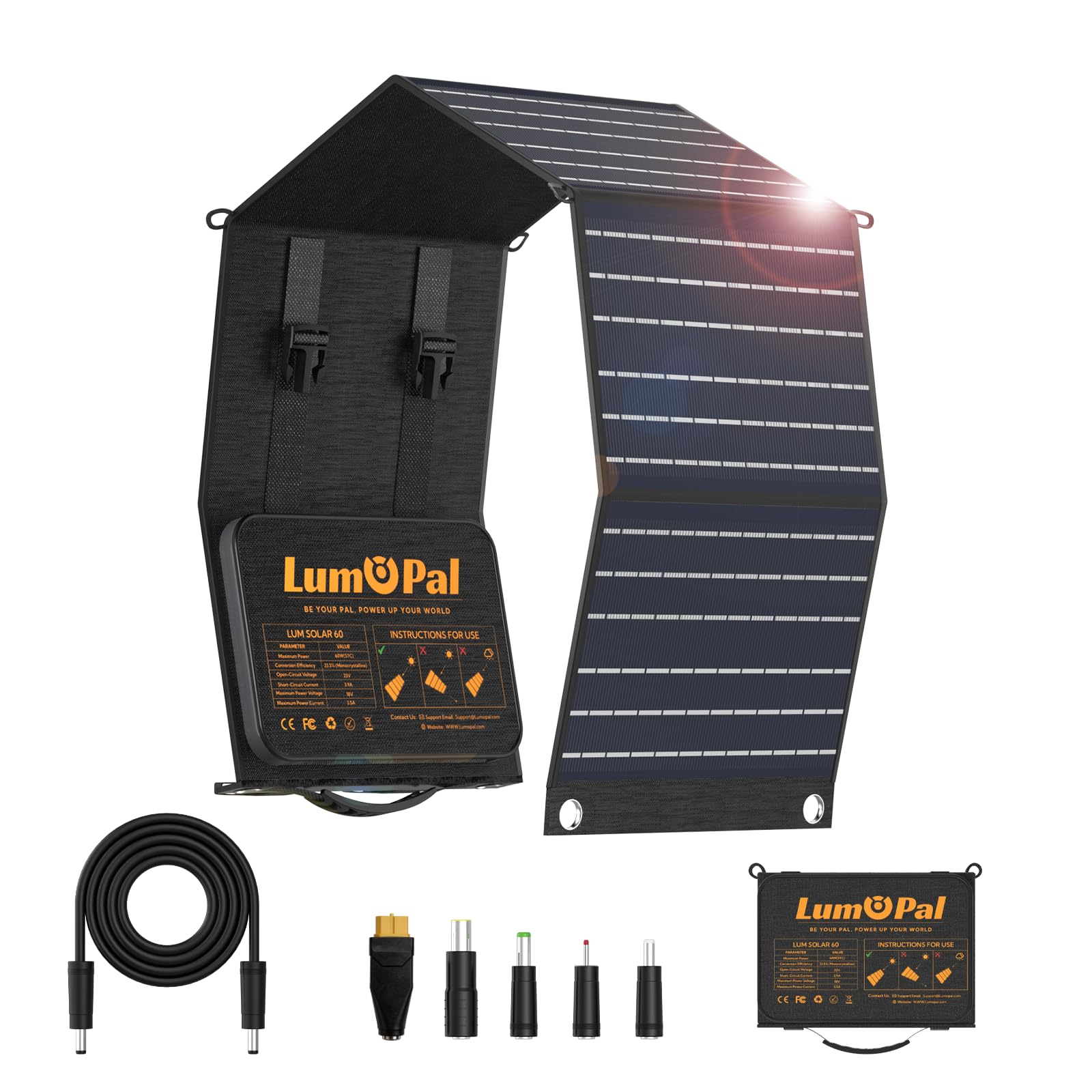
Serious wattage that still folds down to a 6.7-inch square
When you need to charge a power station or a big battery bank, a 30W panel just won’t cut it — this 60W LUMOPAL steps up. It folds to just 6.7 x 9.5 inches and weighs 3.42 lb, which is heavy for a backpack but reasonable for a basecamp or kayak-camping setup where you’re not carrying it all day.
The output flexibility is the story: a PD USB-C port delivers up to 60W max, two QC3.0 USB-A ports offer 22W max each, and an 18-20V DC port handles power stations. That DC port is the key — it’s what lets you feed a portable power station directly, something the smaller panels can’t do.
With a 23.5% conversion rate on monocrystalline silicon, it’s efficient, and the ETFT lamination with an IP65 rating stands up to abrasion and weather. Owners mention it fully charges a large battery in under 3 hours of direct sun, even in cloudy weather. The honest trade-off: real output tends to cap around 35-40W, and there’s no kickstand, so you’ll need to prop it at the right angle yourself.
Powerhouse for camp: The DC port plus 60W rating makes it the bridge between small panels and real power stations.
Angle it yourself: The lack of a built-in stand is the recurring owner complaint.
7. Anker SOLIX PS30

The brand-name 30W that fits a backpack like it was made for it
Anker’s reputation for reliable electronics carries over here. The PS30 is a 30W foldable panel at 2.2 pounds with USB-A and USB-C ports (the modern oval connector), and owners consistently say it “fits perfectly in my backpack.” The included carabiners make it easy to hang at the optimal sun angle, which is the kind of small detail that matters on a long day.
It’s rated IP65 for weather resistance, meaning it holds up to rain and dust, and the aluminum, monocrystalline silicon, and tempered glass construction feels solid. Anker backs it with an 18-month warranty, which is one of the longer coverage periods in this lineup.
Owners praise its build and portability, with some charging an iPhone from 50% to full in about 2 hours. The honest caveat: real-world output often runs below the 30W rating — some customers note barely 10W of charge input — so treat the wattage as a ceiling, not a guarantee. It’s also note the positive portability takes a back seat to mixed power-output feedback overall.
Pack it and go: Portability gets the most praise — this is a set-and-hang panel for daily device top-ups.
Manage expectations: Real output frequently lands under the 30W label, so don’t plan around maximum power.
8. BigBlue 60W X60
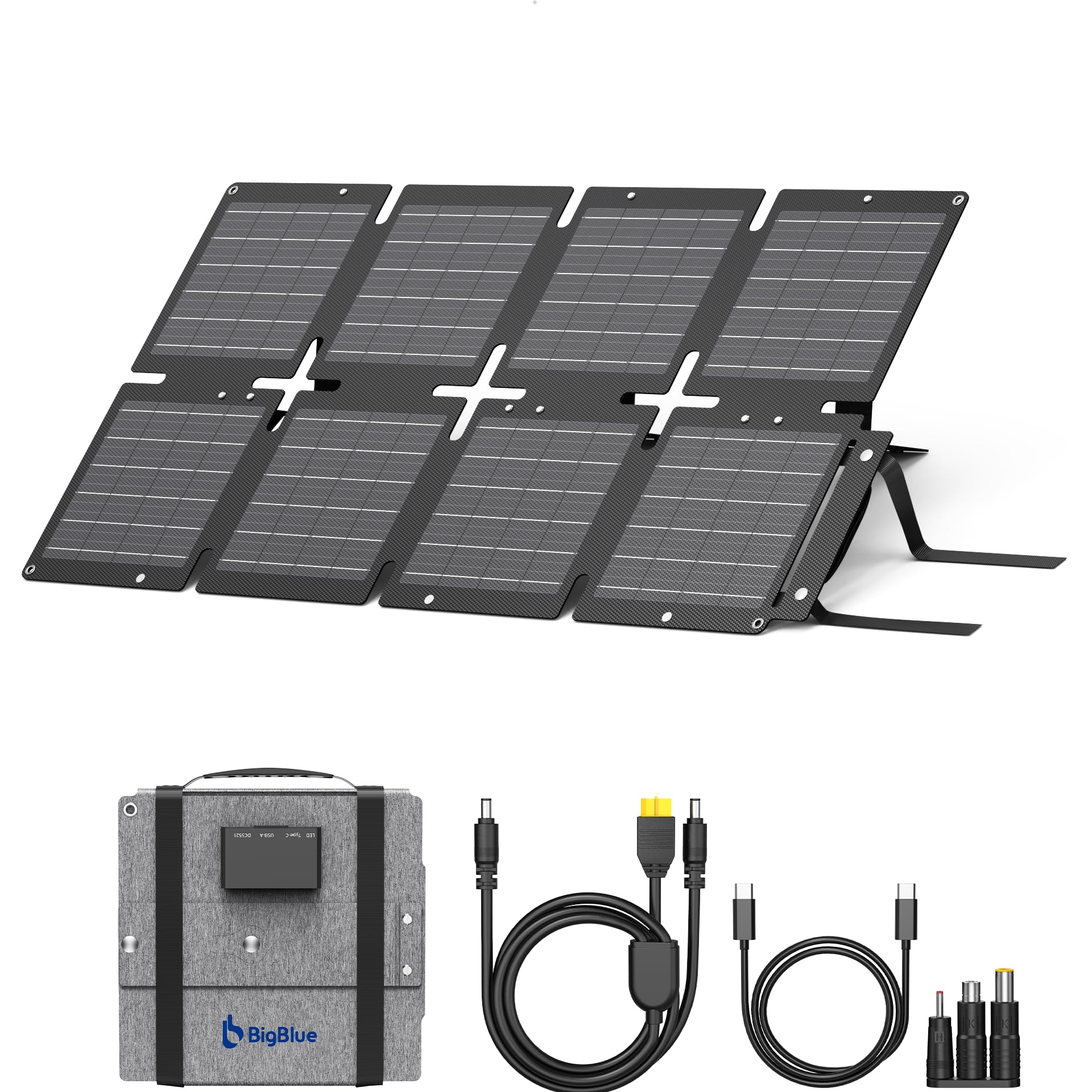
The 60W panel built to feed your power station, not just your phone
This is the panel you bring when you’re pairing with a portable power station rather than relying on it alone. The BigBlue X60 features a DC 5521 port plus a DC5521 to XT60/DC5521 cable and adapters for DC7909, DC8020, and DC35135, meaning it connects to most small power stations from the start. That compatibility is its superpower.
It also offers rapid dual-port charging with a 45W PD USB-C port and a 20W USB-A port, so you can fast-charge a phone or tablet directly. The N-type solar cells hit an impressive 24.7% efficiency — one of the highest in this lineup — and the built-in kickstands let you fine-tune the sun angle for peak output.
Reviewers point out real-world output of 40-50W, including 45-46W to Ryobi 18V batteries via the DC port. It folds down to about the size of a bible at 10.16 x 8.43 x 2.36 inches. The trade-offs: at roughly 4 lbs it’s heavier than smaller panels, and a few owners note the attached controller feels fragile.
What wins owners over
- Performance tops the charts — 16 owners praise its real output
- The DC adapter kit covers nearly every small power station
- 24.7% N-type efficiency is genuinely class-leading
Watch these
- The controller and port cover feel delicate per several owners
- At 4 lbs it’s a car-camp or short-haul panel, not a thru-hike one
Feed your station: Choose this when you carry a power station and want a panel that actually connects to it cleanly.
Too heavy for long trails: For multi-day backpacking with only a phone, the smaller panels above serve better.
9. Renogy 200W E.Flex
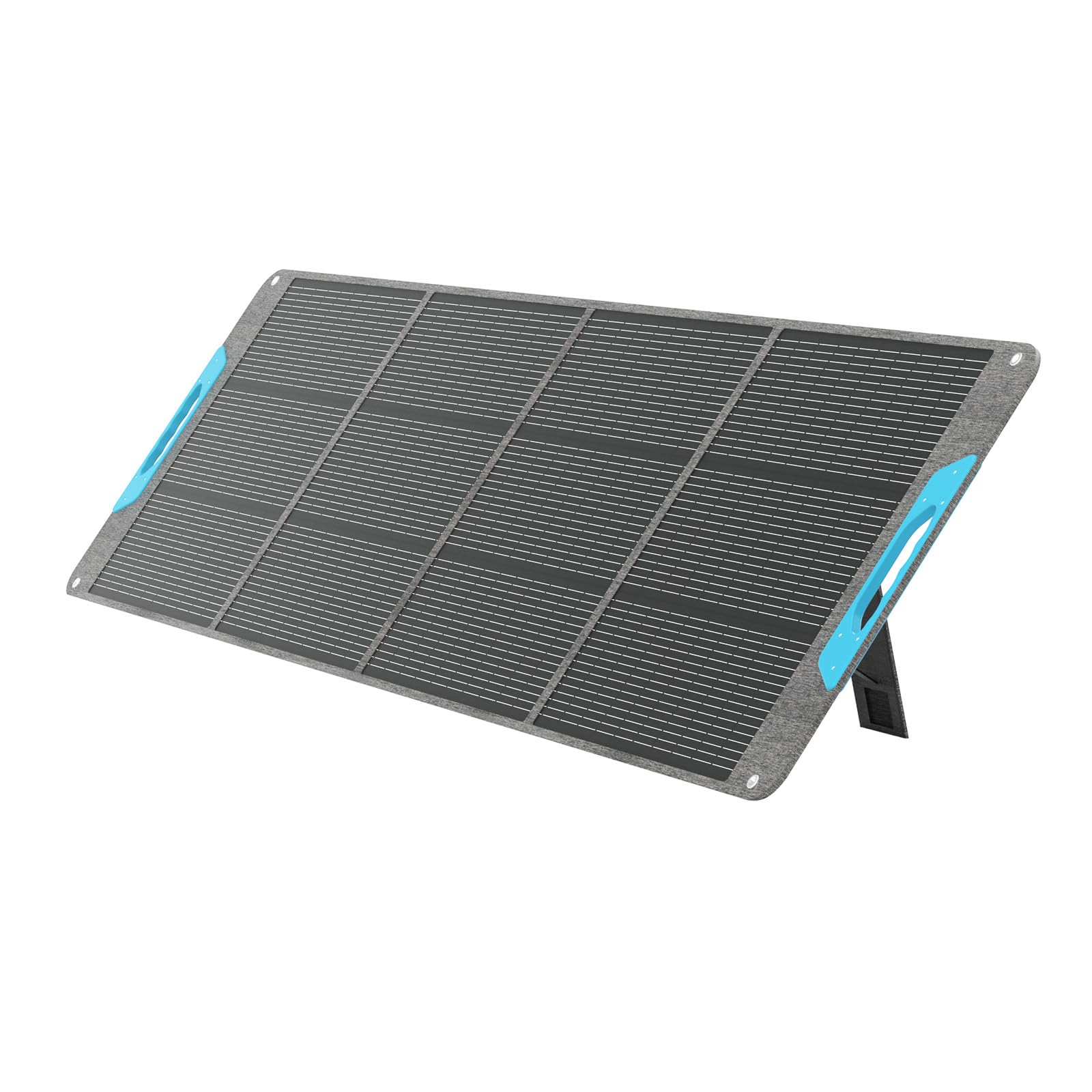
The 200W monster that turns basecamp into an off-grid power plant
This is not a backpacking panel in the traditional sense — it’s the panel you bring for basecamp, van life, or vehicle setups where 200W of power matters more than pack weight. At 13.89 lbs, Renogy says it’s the lightest in its class, and it folds down to 23.72 x 22.99 x 1.97 inches, roughly backpack-sized.
The 25% efficiency from 16BB N-Type cell technology is genuinely impressive, outperforming standard 9BB 200W panels that typically hit 22.5%. This means more power from the same sunlight, which matters in cloudy conditions or limited spaces. It charges 3 devices simultaneously: a USB-C PD port (45W max) and two USB-A ports (18W and 15W), plus an MC4 output for power stations or 12V battery systems.
Owners are emphatic: quality and functionality are its most-praised traits, with one reporting 90% efficiency on a hot sunny day and another using it to run a 60W laptop load while charging. The quad-fold design includes four kickstands and a 3-angle adjustment (40°/50°/60°) to dial in the sun. It’s IP65-rated, UL 61730 certified, and backed by a 2-year warranty. The trade-off: at 13.89 lbs and roughly 4 feet wide unfolded, this is for the car, not your back.
Why it leads its class
- Quality is the top praise at 128 mentions — owners call it among the best
- 25% efficiency beats standard 200W panels (22.5%)
- MC4 output handles power stations and 12V battery systems
Reality check
- Power output gets mixed feedback — real-world varies by sun and angle
- The kickstands are “janky in wind” per some owners, so secure it well
Bring the power: Choose this for basecamp, RV, or emergency home backup where 200W is the point.
Leave it at the car: At 13.89 lbs, this is not for anyone carrying a panel on foot for miles.
Understanding the Specs
Conversion Efficiency
This percentage tells you how much sunlight becomes electricity. A 24% efficient panel beats a 20% one of the same wattage, meaning faster charging in the same sun. Look for 23-25% on modern monocrystalline panels — that’s the range where good trail gear lives.
Output Ports and Wattage
The wattage is the ceiling, but the ports are what you actually use. USB-C PD (Power Delivery) charges modern phones and power banks fast. A DC port open up power stations and small electronics. Match your panel’s ports to the devices you actually carry.
FAQ
What wattage solar panel do I need for backpacking?
Why does my solar panel not deliver its rated wattage?
What is the difference between USB-A and USB-C ports on a solar panel?
Can a solar panel charge a power station directly?
How long does it take to charge a phone from a solar panel?
What does IP67 or IP65 mean on a solar panel?
Is a heavier 60W panel better than a light 30W panel for hiking?
How do I angle a solar panel for the best charging?
Final Thoughts: The Verdict
The backpacking solar panel winner for most hikers is the 30W Portable Solar Panel Charger because it balances a manageable 2.4 lbs with dual-device charging and strong value. If you want pocket-size portability above all, the BigBlue 25W at 0.84 lbs is the featherweight to grab, and for basecamp or power-station work, the BigBlue 60W X60 is the one to reach for. The crowd favorite 30W panel has drawn over 700 ratings, making it the safest bet for a first purchase — just remember real sun always delivers less than the label promises, so buy for the weight and ports you need, not the wattage dream.
How We Picked
We do not accept paid placement. Every pick is matched to a real buyer and a real use-case; we do not hands-on test units.
Sources & Methodology
Specifications: manufacturer listings and product documentation. Review insights: verified customer reviews, as of August 2026. Pricing: not shown on this page (it changes often); check the current price via the retailer link.
As an Amazon Associate, Gadgets Feed earns from qualifying purchases. This does not affect which products we feature.