
Our readers keep the lights on and my morning glass full of iced black tea. As an Amazon Associate, I earn from qualifying purchases.
Specs are compiled from manufacturer listings and verified buyer reviews and can change over time — please confirm the key details on the product page before buying.
When the power goes out, your fridge is the first thing you worry about. So buy enough stored energy (watt-hours, the size of the battery’s tank) to cover your fridge plus the few things you actually need. Then check the continuous watt rating (the power it can supply nonstop) against the biggest appliance you plan to run. Every pick below does that job. They differ in how much they store, how loud they run, and how fast they refill once the grid comes back.
I’m Min — the founder and writer behind Gadgets Feed. This guide is built by comparing the manufacturers’ published specifications and the patterns across verified customer reviews, so you get each pick’s real strengths and trade-offs instead of marketing spin.
You will see storage in Wh (watt-hours, the size of the tank), output in W (watts, how hard it can push at once), and cycle life (how many full drains it survives before capacity fades). Each pick below is read through those three numbers and through what people say after living with it, which is what this guide to the backup batteries for power outages is built around.
Our Picks at a Glance

How To Choose The Best Backup Batteries For Power Outages
Most people buy the wrong size. They either grab a unit too small to start a fridge compressor, or they pay for capacity they will never drain. Do this in three steps and you will land in the right pick on the first try.
Start with watt-hours, not watts
Watt-hours (Wh) are the size of the fuel tank. A 1024Wh battery holds roughly the energy equivalent of running a 100W load for about ten hours, which is why a small unit and a large unit with the same 2400W rating behave completely differently overnight. Larger tanks like 2048Wh or 3072Wh are what carry you through a two-to-three-day outage without rationing.
Check continuous watts and surge separately
Continuous watts are what the unit pushes all day. Surge (or peak) watts are the momentary burst a fridge compressor or a power tool needs to start. A unit rated 2400W continuous and 4000W peak can start appliances that a 2400W-only box would trip on. Match the surge number to your biggest motor-driven appliance, not the continuous number.
Then look at how it refills
During a long outage, recharge speed matters as much as capacity. Wall charging gets you back to full in about an hour on the faster units. Solar input keeps you topped up indefinitely if the sun cooperates, and car charging covers the road. Check all three before you commit, because an outage rarely ends on your schedule.
Quick Comparison
| Model | Best For | Capacity | Continuous Output | Battery Chemistry | Amazon |
|---|---|---|---|---|---|
| BLUETTI Elite 200 V2★ Best Overall | Whole-home essentials | 2073.6 Wh | 2600 W | LiFePO4 | Amazon |
| DJI Power 1000 V2Fastest Refill | Fast top-ups between storms | 1024 Wh | 2600 W | LFP | Amazon |
| EBL Acc2400Most Ports | Multi-device campsite and job site | 1843.2 Wh | 2400 W | LiFePO4 | Amazon |
| BLAVOR S1600 | Solar without an extra panel | 1024 Wh | 1600 W | LiFePO4 | Amazon |
| Jackery Solar Generator 1000 v2 | Lightweight apartment backup | 1024 Wh | 1500 W | LFP | Amazon |
| EF ECOFLOW DELTA 3 Max | High-watt appliance running | 2048 Wh | 3400 W (X-Boost) | LiFePO4 | Amazon |
| PECRON F3000LFP | Expandable long outages | 3072 Wh | 3600 W | LiFePO4 | Amazon |
| Jackery Explorer 2000 v2 | Carrying a 2kWh tank alone | 2042 Wh | 2200 W | LiFePO4 | Amazon |
| Anker SOLIX C2000 Gen 2 | Fast recharge and quiet standby | 2048 Wh | 2400 W | LiFePO4 | Amazon |
| EF ECOFLOW DELTA 3800 Gen4 | Multi-day whole-home runtime | 3763 Wh | 3600 W | LFP | Amazon |
In‑Depth Reviews
1. BLUETTI Elite 200 V2 Portable Power Station 2073.6Wh 2600W Solar Generator
Our pick — 4.5+★ from 950+ verified ratings; the strongest balance of quality and price.
The big blue box that keeps the fridge cold and the heater humming for three days straight.
This is the pick to start with because it balances a genuinely large tank against real storm-day power. It holds 2073.6 Wh of LiFePO4 storage and pushes 2600 W continuously out of four AC outlets. In practical terms, that is a full-size fridge plus a router, a lamp, and a phone charger running at once without breaking a sweat. It also carries a 3900 W power-lifting mode (a short burst above the continuous rating) so heavier appliances like a coffee maker can start without tripping the unit.
It earns the top spot because it wastes very little power while it waits. Standby draw (the trickle it uses when plugged in but idle) sits at just 10 W, which the maker describes as three times lower than similar power stations. That means the battery is not quietly bleeding energy between outages. Buyers report it can run a 120V 60W diesel heater for 10 hours a day across 3.3 days — 13% longer than similar products. When the fridge is the priority, the same tank carries a lot of hours per charge. According to owner reports, the 2600 W inverter (the part that turns stored power into usable AC) handles a 10,000 BTU portable AC unit alongside multiple refrigerators.
Recharging is where it pulls ahead of lighter units. Turbo Mode (switched on through the BLUETTI app) takes it from 0 to 80% in 1 hour at 1800 W AC input. Standard Mode fills it fully in 1.6 hours at up to 1440 W AC. Silent Mode uses 800 W AC or solar to finish in 3 hours at 16–30 dB (decibels, a sound measure) — quiet enough to sleep in the same room. Dual AC and DC charging hits 80% in 50 minutes, and a 1000 W solar array fills it in 2.4 hours. The battery is rated for over 6,000 cycles, and the maker ties a 17-year lifespan claim to that automotive-grade cell. It weighs 53.4 pounds, so plan to wheel it or lift it with two hands rather than carry it up stairs.
What earns the top slot
- 2073.6 Wh tank with 2600 W continuous output covers a fridge plus several essentials at once
- Three charging modes let you choose speed, quiet, or battery health — 0–80% in 1 hour on Turbo
- 16–30 dB in Silent Mode is genuinely quiet enough for a bedroom during an overnight outage
- Over 6,000 cycles and a 17-year lifespan claim mean it should outlast several cheaper units
Where it asks something of you
- At 53.4 pounds it is a two-hand lift, not a carry-around unit
- Silent Mode trades speed for quiet, so a slow refill is the cost of a quiet night
Best for: a household that wants one box to run the fridge, the heater, and the router through a multi-day outage without rationing. Think twice if: you need something you can toss in a car trunk alone — the 53.4 pounds will fight you.
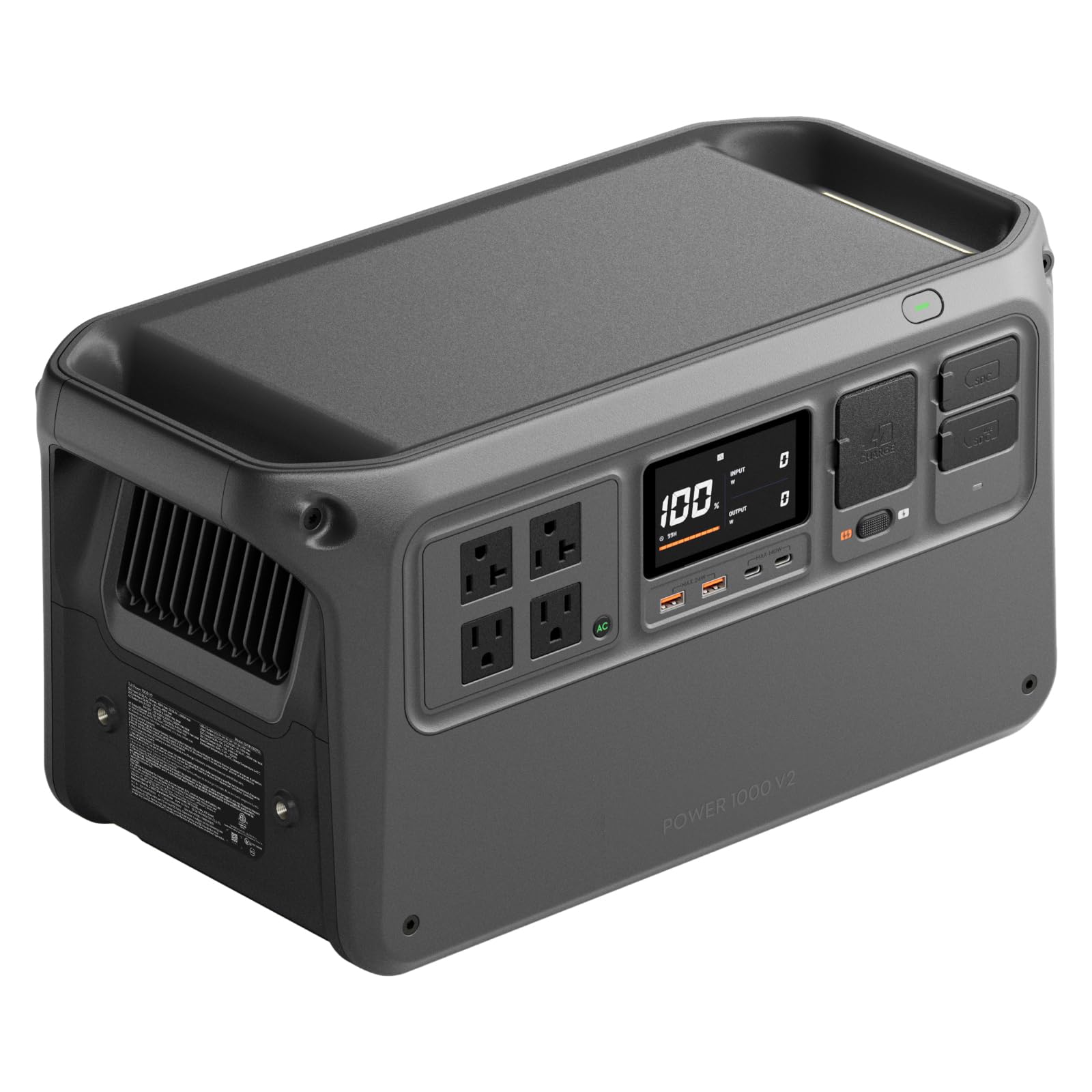
2. DJI Power 1000 V2 Portable Power Station, 1024Wh LFP Battery
Half the tank of the BLUETTI, but it refills to 80% before your coffee finishes brewing.
If your outage pattern is short and frequent rather than long and rare, this is the smarter shape of battery. It stores 1024 Wh in an LFP pack and puts out 2600 W — the same continuous watt figure as the BLUETTI above, despite carrying roughly half the stored energy. That 2600 W matters more than you would think: it means heavy-starting appliances that would choke a 1500 W unit spin up fine here. Owners mention a peak in-rush current of up to 4500 W, the brief spike a motor draws at startup. For a fridge compressor or a circular saw, that headroom is the difference between starting and tripping.
The recharge number is the headline. It goes from empty to 80% in 37 minutes on AC, which means a blackout that ends in the afternoon leaves you with a full tank by dinner. It also runs as low as 26 dB — dryer-than-a-library quiet — so it can sit in a bedroom or an RV without announcing itself. The UPS switchover is 10 ms, fast enough that a desktop computer will not reboot when the grid drops. And there is a detail worth flagging for photographers and drone pilots: dual 140W USB-C ports deliver 280W total, and the review pages single out how quickly it charges drone batteries. Those same pages split on charging reliability, though — the recurring gripe is that charging occasionally stops, so treat a wonky wall outlet as a suspect before blaming the unit.
Two trade-offs to plan around. The LFP battery is rated for a 10-year lifespan. But 1024 Wh will not carry a fridge past a day and a half of heavy use. And the MPPT (the solar charge controller that squeezes the most power from a panel) and car charging modules are not built in. Connecting a solar panel or a car battery needs a separate compatible adapter, so add that to your outage kit if solar is part of your plan. At 17.64 inches long it also takes up more shelf than the smaller 1024 Wh units in this roundup.
The read on it: the highest watt-per-pound deal for short outages, built for people who value a fast refill over a giant tank.
The honest catch: solar and car charging need an adapter you buy separately, so the low-fuss solar story is not complete from the start.
Reach for this if: your outages are hours, not days, and you want to be back at full charge inside 40 minutes. Look elsewhere if: you need a week of fridge runtime — 1024 Wh cannot stretch that far.
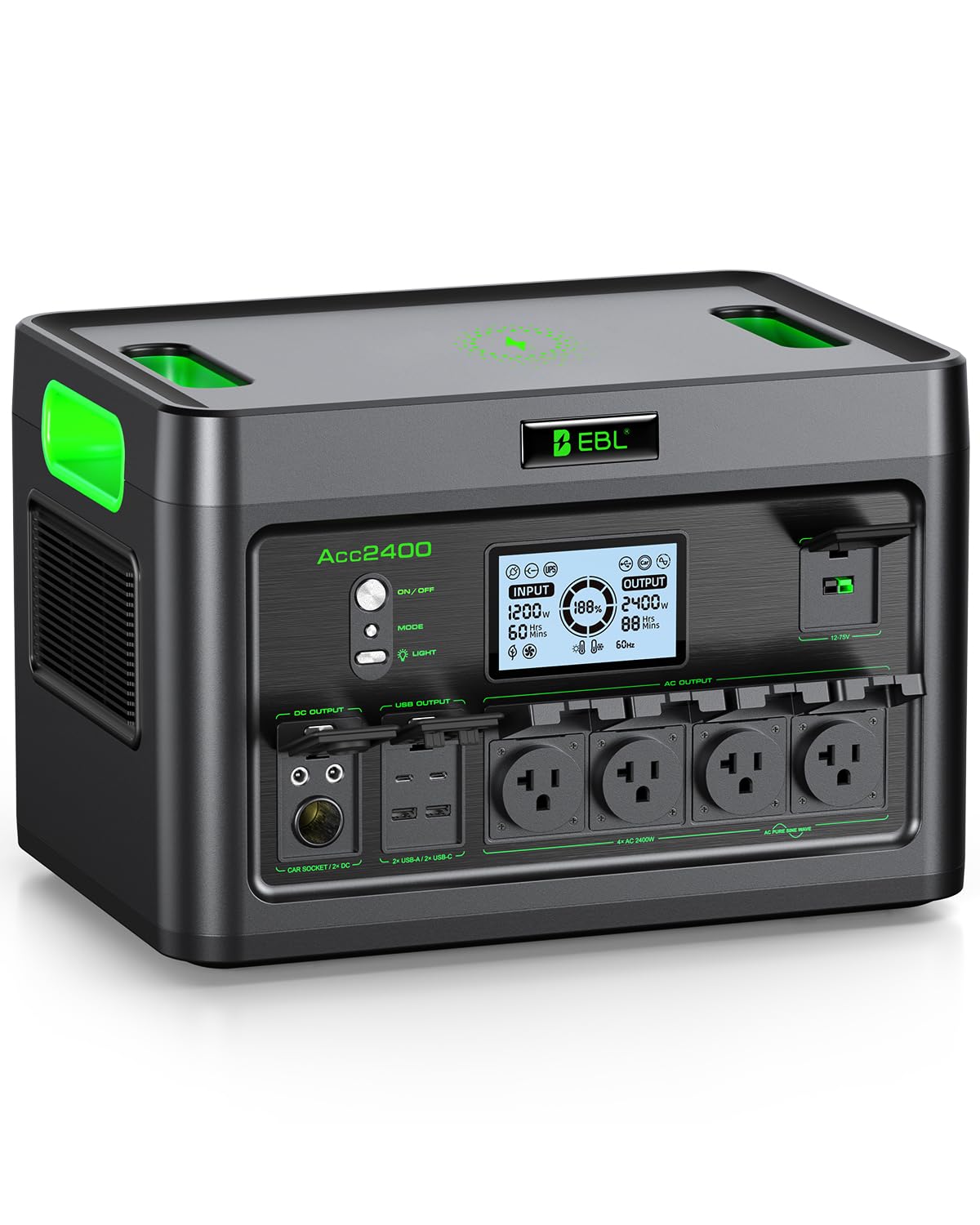
3. EBL 2400W Portable Power Station LiFePO4 Battery for Home Use
Twelve things plugged in at once — the family-campsite box that never makes anyone wait their turn.
Where the two picks above lean on raw capacity or recharge speed, this one wins on how many devices it can host. It carries 1843.2 Wh and delivers 2400 W across four AC ports, with a full spread alongside: 2 USB-A ports, 2 fast-charging USB-C ports, 1 car port, 2 DC ports, and 1 wireless charging panel. Twelve devices can charge at the same time, which is the number that matters when you are running a job site or a campsite and everyone wants a socket. The wireless charging pad on top means a phone can drop and charge with no cable hunting in the dark.
The emergency power mode switches to backup in 0.1 seconds, which protects a running computer from a sudden shutdown and the data loss that follows. Owners confirm it does that job well — the aspect mentions here cluster tightly around raw power and value, and the review consensus describes it as perfect for computer backup systems. There is a clear display for remaining battery and status, and a four-mode LED light that covers a dark room or a tent once the sun drops. The battery runs on LiFePO4 cells rated for over 3,500 charge-discharge cycles and a 10+ year service life, with built-in protection against overcharging, over-discharging, short circuits, and high heat.
Weighing 55 pounds with dual-side handles, this is a move-it-with-both-hands unit rather than a carry-on. The one honest split in owner feedback is runtime: some say it lasts longer than expected, others report it does not match the advertised figure. That is the usual story with any battery — heavy loads drain faster than the label implies — so size it against your real appliances, not the optimistic number. Note too that this is the heaviest-of-its-class shape: the BLUETTI above carries 2073.6 Wh at 53.4 pounds, so this unit gives you more ports but a slightly smaller tank for a similar lift.
Room for everyone: the pick for a family campsite or a work van where four AC plugs and a wireless pad end the outlet queue. Plan around: the 55-pound weight and the runtime that varies with your load — do not expect the advertised hours with a space heater attached.
4. BLAVOR 1600W Solar Generator, 1024Wh Power Station with Built-In 40W Panel
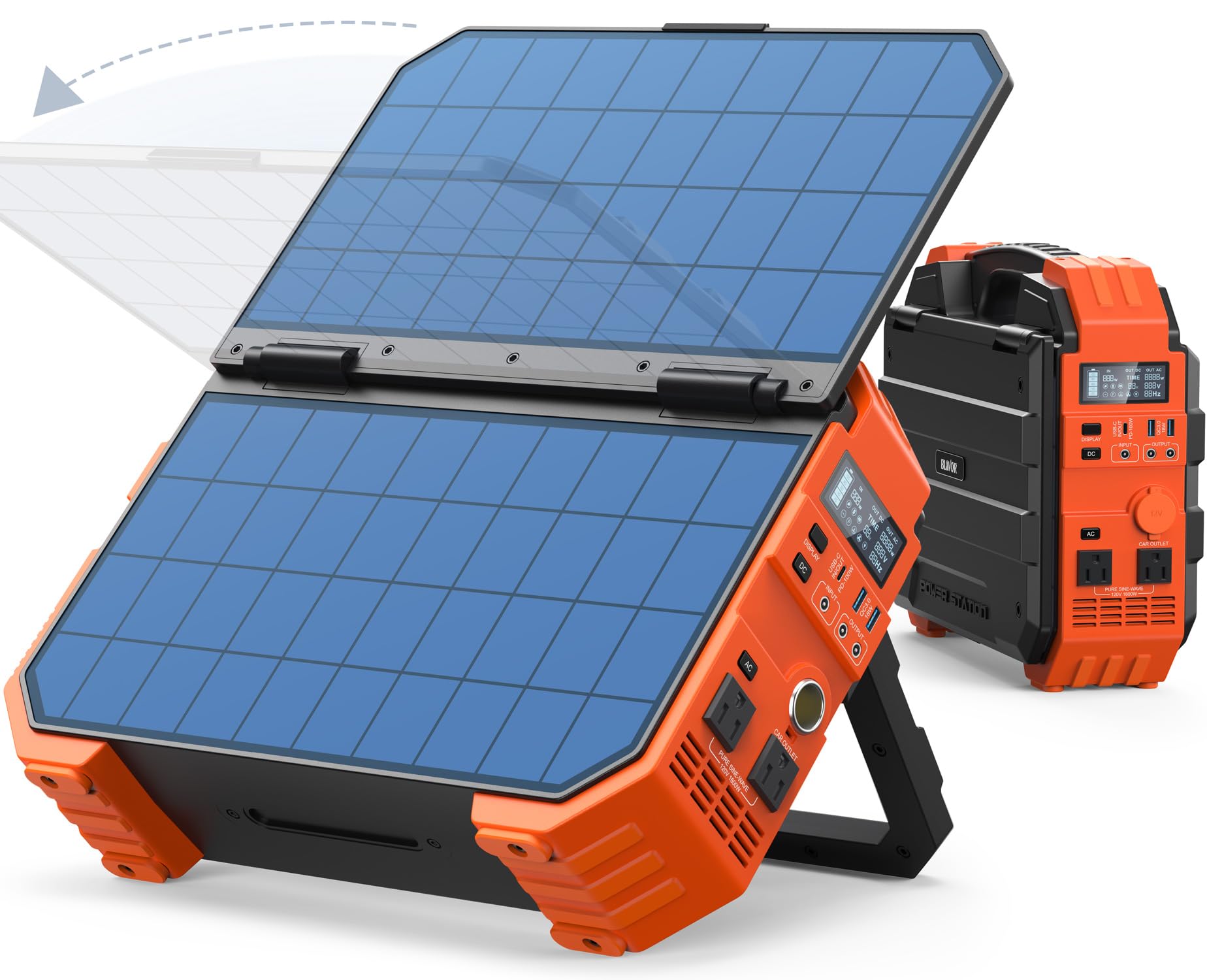
The only one here that unfolds its own solar panel — no separate glass sheet to lug or lose.
A 40W solar panel is built right into this unit and folds out to catch sun, which solves the most annoying part of solar backup: remembering, storing, and protecting a separate panel. It stores 1024 Wh, puts out 1600 W continuously with 3200 W of peak power for the surge a fridge needs to start, and gives you eight output ports to keep the essentials running together. At 26 pounds it is the easiest lift in this roundup and the one you can genuinely move from a closet to a balcony to a campsite alone. The built-in panel and 100W USB-C port round out the picture — that USB-C port fast-charges laptops and tablets, and the LCD shows input, output, and remaining battery so you always know where you stand.
The battery is LiFePO4 rated for more than 3,500 charge cycles, with a smart battery-management system guarding against overheating, overload, and short circuits. Recharging comes four ways: wall outlet, car socket, the built-in 40W panel, or a compatible external panel up to 200W (sold separately). Owners describe the wall and DC chargers as genuinely fast and single out the portability — it is the unit people actually carry around a campsite rather than leave in a corner. The review pages note it handles a mini fridge, laptops, phones, and lights without issue, which is the honest scope of a 1024 Wh tank.
Here is the catch worth naming plainly. A 40W built-in panel is a trickle, not a firehose — it is for keeping the battery topped up in sunshine, not for fast refills after a heavy night. If solar is your main recharge plan, budget for the separate external panel to hit that 200W input. And with 1600 W continuous, a big microwave or a high-draw heater is beyond its comfortable range — the current draw simply exceeds what this box is built to push. For lights, laptops, phones, and a fridge, it is well inside its lane.
What stands out: a solar panel that travels inside the box, in the lightest package on this list at 26 pounds.
What to weigh: 1600 W continuous is the lowest here, so leave the heavy appliances to a bigger unit.
Pick it for: apartment balconies, camping, and anyone who wants sun top-ups without a separate panel. Skip it for: running a microwave or space heater — this one is built for the essentials, not the heavy hitters.
5. Jackery Solar Generator 1000 v2 and 100W Solar Panel, 1024Wh, 1500W AC
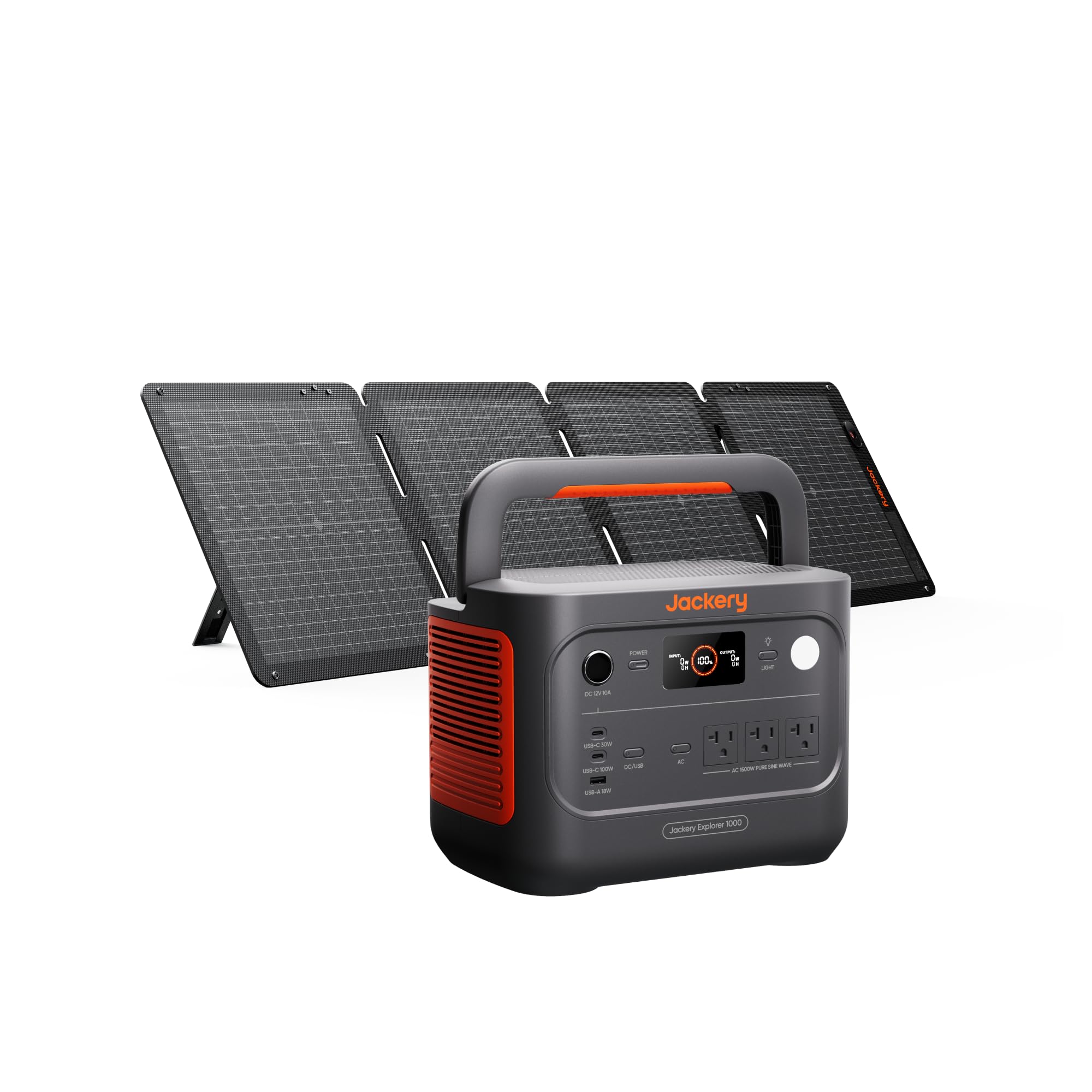
A 1024Wh generator you can carry one-handed, with the matching solar panel in the same box.
Most of the units here need two hands and a plan. This one ships with its own 100W solar panel and weighs 23.3 lbs, so it moves from closet to balcony to car without a second person. It holds 1024 Wh, delivers 1500 W AC output with a 3000 W surge peak, and reaches 50-minute charging from 0 to 100% when you switch on emergency charging in the Jackery app. The default mode takes 1.25 hours to protect battery health, which tells you the fast mode is a trade you opt into rather than a permanent setting. Two USB-C ports, one USB-A, a DC car port, two pure sine wave AC ports, and built-in LED lights cover the essentials.
The LFP battery is rated to keep over 70% of its original capacity after 4,000 charge cycles — a lifespan the maker frames as beyond 10 years. A 10ms UPS switchover keeps a router or computer alive through a grid drop, and PD 100W USB-C fast-charges a laptop. You can set a 30 dB overnight charging mode in the app, which means it can refill in a bedroom without waking you. Owners point to a fridge running for most of a day on a single charge, which is the realistic ceiling for a 1024 Wh box. The one honest split in feedback is power output — some find it less punchy than the watt figure suggests, so keep the biggest motor-driven appliance off it.
One thing that catches buyers off guard: the generator and the solar panel ship separately, so if the panel arrives after the battery, your solar plan waits. The 50-minute charge also requires enabling emergency charging each time you plug in, which is a deliberate step, not an automatic one.
A fit for: renters and campers who want solar included and a generator light enough to move alone. Not the one for: running a big microwave or AC — 1500 W continuous is the lowest ceiling alongside the BLAVOR.
6. EF ECOFLOW DELTA 3 Max Portable Power Station, 2048Wh LFP Battery, 2400W
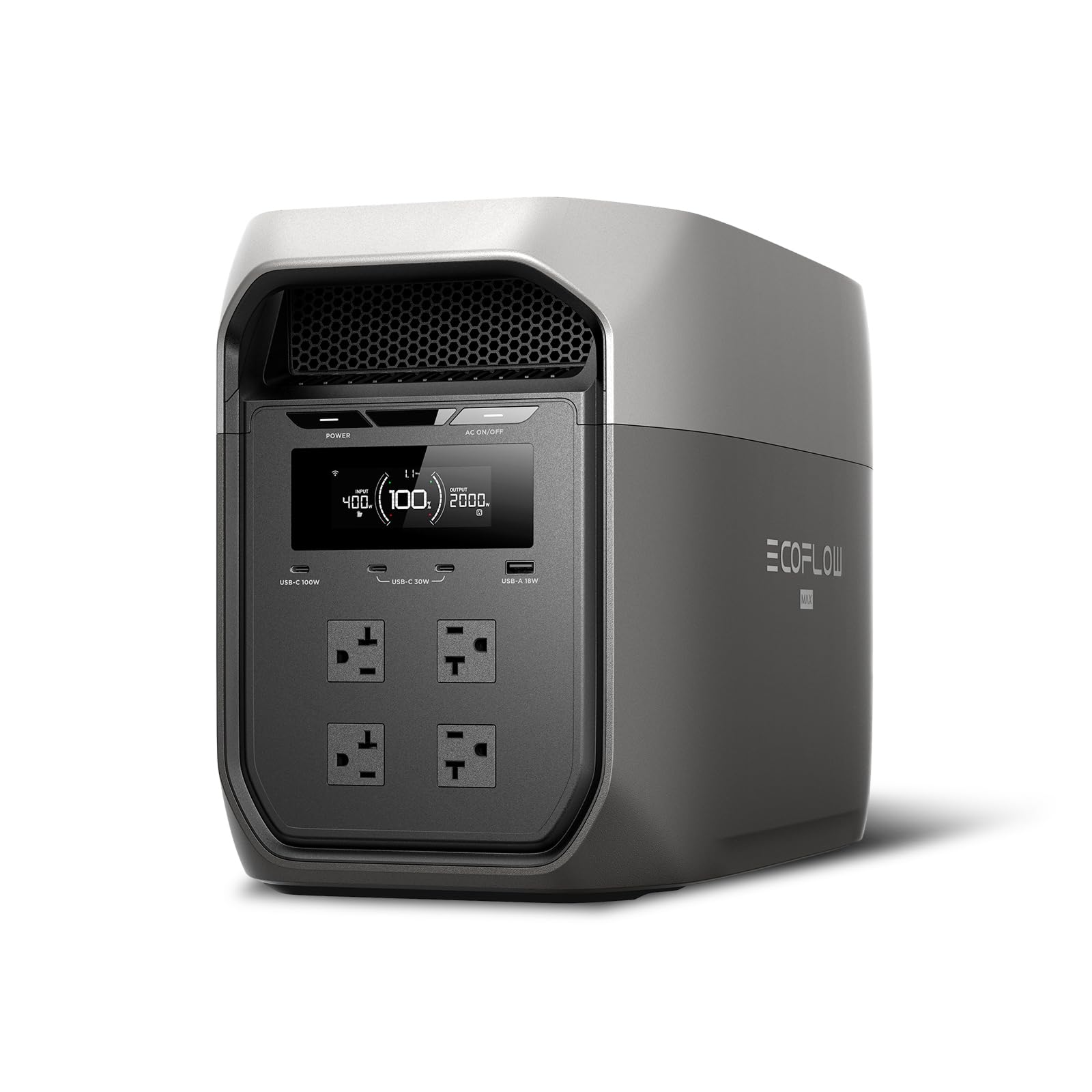
The 2048Wh tank with the muscle to run a microwave without flinching.
If your outage worry is not the fridge but the whole kitchen, this is the unit built for it. It stores 2048 Wh in an LFP battery and offers up to 3400 W continuous in X-Boost mode — a software-driven boost that lets it run high-demand appliances the maker says covers 99% of what people plug in. Microwaves, power tools, and fridges all land in its range where a 1500 W box would stall. The transfer time is under 10 ms, so computers and sensitive electronics ride out the switch, and the unit runs quietly enough that nights stay peaceful. Owners flag a roughly 12-hour TV runtime as a real reference point for light loads, and describe it as easy to move despite the capacity. At 2048 Wh with a 0–80% charge in about an hour through X-Stream technology, it refills fast enough to be ready for a second round.
One useful advantage over the BLUETTI and PECRON giants: this one carries that 2048 Wh in a lighter, more patrol-friendly body, so you can move it from home to RV without a helper. The battery is built for a 10-year daily-use claim, backed by a 5-year service period — the longest support window in this roundup. The app tracks energy use in real time and lets you schedule charging and discharging, which is genuinely handy if you want to charge overnight cheaply and run appliances by day.
The honest limit is storage. 2048 Wh is a large tank, but it sits below the PECRON at 3072 Wh and the DELTA 3800 at 3763 Wh, so a multi-day outage with heavy appliance use will still need a dash of rationing. It also leans on X-Boost for its top watt figure — 2400 W is the base rating, and 3400 W comes with the boost engaged. Treat the boosted number as the headroom, not the everyday ceiling.
Where it excels: running high-draw appliances like microwaves and power tools without reaching for a bigger box.
The fine print: the big wattage number is the X-Boost headroom — base output is 2400 W, so match it to what you actually plug in.
For you if: the microwave and the power tools are non-negotiable during an outage. Go bigger if: you need to ride out several days of heavy draw — 2048 Wh will want company.
7. PECRON Portable Power Station F3000LFP, 3072Wh Solar Generator, 3600W
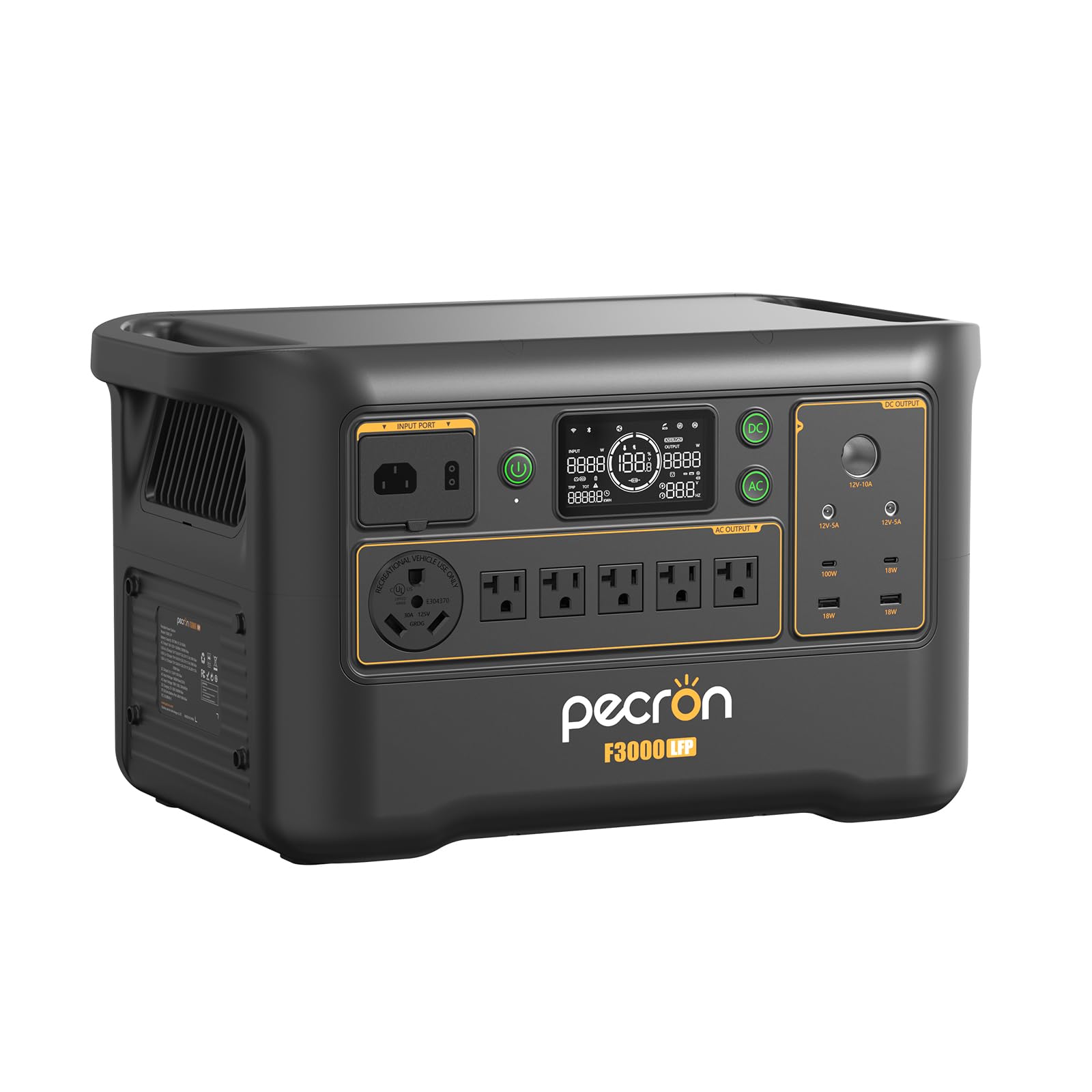
Three thousand watt-hours that you can stack higher when the next storm looks worse than the last.
This is the biggest tank in this roundup that you can still call portable, and it is built for people who plan for the worst case. It holds 3072 Wh of LiFePO4 storage (lithium iron phosphate, a long-life battery chemistry) and pushes 3600 W of pure sine wave output (clean AC power that electronics like) across 13 ports. Those ports are 6 AC outlets, 2 USB-C at 100W PD (Power Delivery, a fast-charging standard), 2 USB-A at 18W, a carport, and 2 DC 5525 outputs. That is enough to run a refrigerator and an air conditioner together, and the maker positions it as 2–3 days of home essentials on a single charge. The expansion story is the real differentiator: it can grow to 10752 Wh by adding compatible batteries, so it scales with your worry rather than forcing a replacement purchase later.
Recharge is a 0–100% run in 2 hours via AC input at 1800W max, which the maker frames as faster than many rivals. Three recharge paths — AC, solar (1600W max, 25–120V input), and car — cover home and road. UPS mode switches in 8–20 ms to protect computers, and the app shows real-time power use. Reliability is what owners praise most here, followed closely by overall quality; the recurring theme in review pages is that the AC and DC outputs simply work, with one buyer calling it the best generator they have owned. It is also the heaviest practical pick at 63.3 pounds, so the wheels-and-crew approach applies.
The honest trade-off is charging consistency. Some customers note intermittent charging issues against the expected four-hour full charge from zero, so test your wall outlet and cable before assuming a fault. Noise and weight also draw mixed-to-negative remarks — a heavy box with a fan that is not invisible. If you want expansion headroom and do not mind the 63.3-pound lift, this is the value play at this capacity tier.
The case for it
- 3072 Wh expandable to 10752 Wh means it grows with your needs, not against them
- 3600 W across 13 ports runs a fridge and an AC at the same time
- 2-hour AC recharge at 1800W max keeps the tank ready for the next outage
- UPS switching in 8–20 ms protects computers and medical devices
What to know going in
- At 63.3 pounds it is a two-person move up stairs
- Intermittent charging issues appear in some reports, so verify the outlet first
- The expansion battery needs a separate cascade cable sold on its own
Suits you if: multi-day outages and a growing appliance list are the real fear, and you want a tank you can enlarge. Pass if: you need to carry it up and down stairs — 63.3 pounds says leave it on the ground floor.
8. Jackery Explorer 2000 v2 Portable Power Station, 2042Wh, 2200W AC Output

Two thousand watt-hours that does not need a second person to move it.
A 2042 Wh tank usually comes with a back-ache. This one carries it in 39.5 pounds using a cell-to-body structure borrowed from electric vehicles, where the cells are built into the frame rather than stacked in a separate pack. That is what lets the maker claim it is 41% lighter and 34% smaller than typical 2kWh LiFePO4 units. Three AC ports deliver 2200 W total, enough to run a medium-sized fridge with a large fan and a dehumidifier at the same time, and a USB-C PD 100W port fast-charges a laptop without extra gear. The UL1778 testing is the certification that matters for uninterruptible power supplies, so the 20 ms switchover carries real weight for anyone running a computer or medical device.
Recharging hits 0–80% in 66 minutes on AC, or 102 minutes to full using the emergency super-charging mode in the app. Solar reaches full in as few as 6 hours with 400W panels, and a silent charging mode fills it in 5 hours at 30 dB — quiet enough for a bedroom. Reviewers point out running a CPAP for three nights without a recharge and describe it as a lifeline when the power drops, which lines up with a 2042 Wh tank under light loads. The LiFePO4 battery is rated to hold for up to 10 years, and with no fumes it can live indoors like any appliance.
The honest flip side: weight draws mixed feedback. At 39.5 pounds it is the lightest way to get 2kWh here, but 2kWh will still feel heavy when lifted high. And 2200 W continuous means a big microwave can trip it, so run heavy appliances one at a time. It also sits above the DELTA 3 Max on weight but below it on boosted wattage — a fair trade of muscle for portability.
Worth it for: the person who wants serious storage but cannot lift 60 pounds — this is the one-hand-possible 2kWh. Skip if: the microwave is a must during outages — 2200 W will not carry it alongside a fridge.
9. Anker SOLIX C2000 Gen 2 Solar Powered Generator 2,048Wh, 2,400W
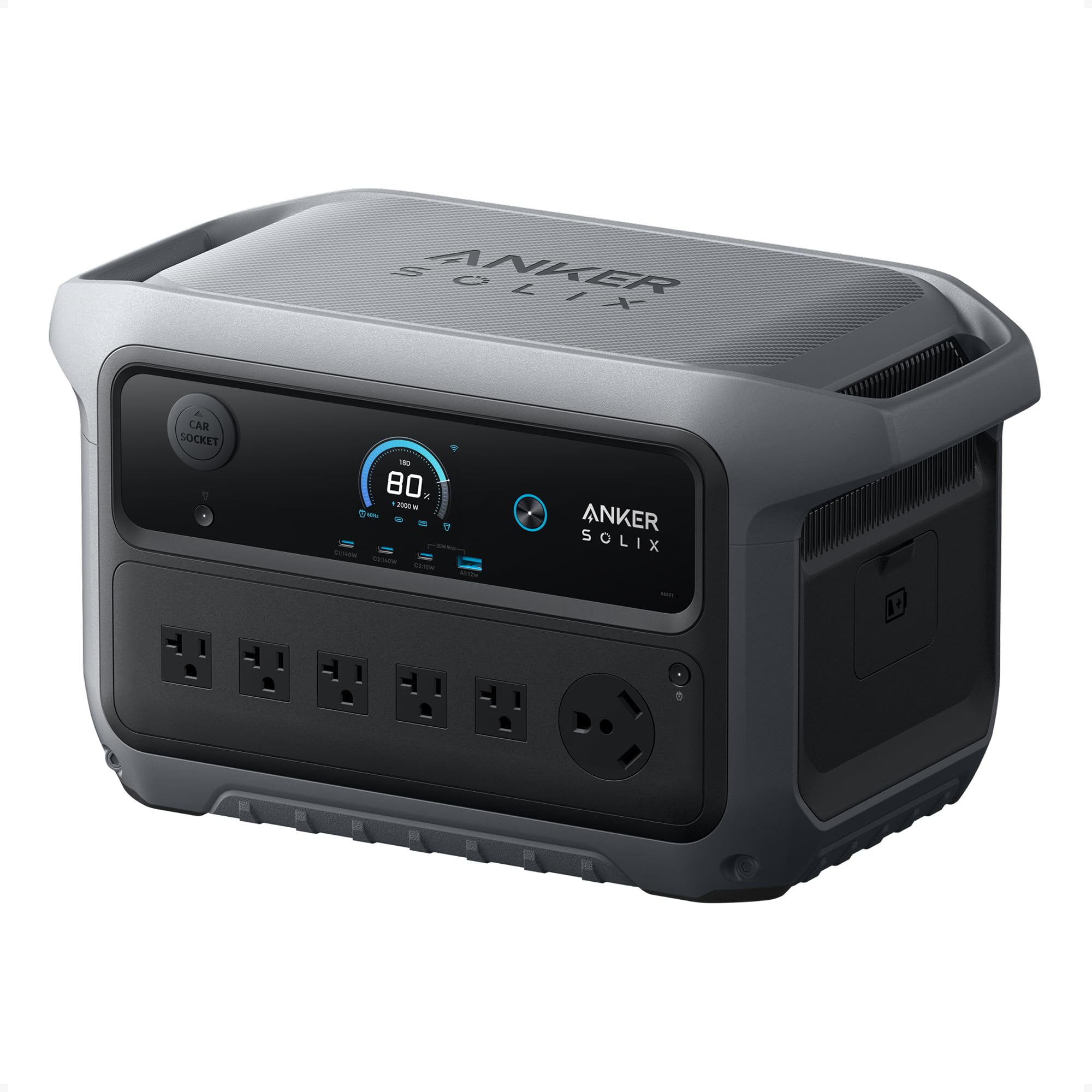
A 2048Wh tank that refills in 58 minutes and sips just 9W while it waits for the storm.
The standby number is the one to lead with, because it is the number you live with 364 days a year. This unit draws only 9 W on standby, which the maker says lets it run a dual-door fridge for up to 32 hours. Add an expansion battery to push capacity to 4kWh and the same fridge runs up to 64 hours. It stores 2048 Wh, outputs 2400 W rated with a 4000 W peak (a short burst for motor startup), and can drive most window and RV air conditioners. Fully charged in 58 minutes over AC and solar, it is the fastest full refill in this roundup, and the 800W UltraFast Alternator maxes out in 3 hours on a car. At 41.7 lb and 18.1 × 9.8 × 10.1 inches, it is 25% lighter and 29% smaller than similar units — small enough that shoppers say sliding it under a counter or TV stand.
What people value most is the long, quiet run: the review pages describe a TV, fridge, and WiFi running for over 10 hours, and call it excellent backup for outages. Behind that is the LiFePO4 battery, which typically holds up over years of full drains. It is compact enough to double as a camping and RV unit rather than a home-bound brick.
The honest catch is weight — some find it pretty heavy despite the compact form, so it is a bench, not a backpack. Solar charging also needs a panel you buy separately, and expansion costs extra. That noted, the combination of the fastest refill here and a tiny standby draw makes it the pick for people who want to be ready again fast.
What wins people over: a full charge in 58 minutes and a 9W standby that barely touches the tank between outages.
The recurring gripe: the weight — compact, but you will not want to lug it far.
The one to choose if: a fast refill and low standby waste matter more to you than a bigger tank. Choose differently if: you need 3kWh or more of storage out of a single box — the expansion is extra, not included.
10. EF ECOFLOW 3763Wh DELTA 3800 Gen4 Power Station with XT60 Solar Cable

The heaviest-duty tank here — the one built to keep a whole house humming for days.
This is the answer for the household that refuses to compromise during a long outage. It stores 3763 Wh and pushes 3600 W continuous with up to 7200 W surge (a short burst for motor startup), enough to run a refrigerator, a microwave, power tools, and more at the same time. ECOFLOW rates the fridge runtime at up to 70 hours, which they frame as 32.6% longer than the industry average for comparable 3–4kWh power stations — the longest in this class. Expansion goes from 4kWh up to 12kWh via compatible smart extra batteries, so you can scale to whole-home backup as the need grows. The 3W standby draw, described as 14W no-load, lets the maker claim it can sit idle for 52 days and 6 hours low-maintenance.
Owner experience backs up the runtime story: the review pages point to fast 2.7-hour recharge and long battery life. The UPS switchover (the handoff to battery power) is under 10 ms, so the grid drop never reaches your devices. LFP cells retain up to 99% charge after a year in storage — which matters because a backup battery is only useful if it is still charged when the lights go out. Recharge from 0–100% takes 146 minutes, and six charging methods (AC wall, solar, alternator, generator, solar + generator, solar + alternator) cover whatever you have available. Portability draws positive remarks too, which is unusual for a tank this size, though at 67.5 pounds it is the heaviest unit here by a clear margin.
The honest catch is weight and reliability chatter. Buyers report occasional issues with the pulling handle breaking after first use, so lift it by the body when you move it and treat the handle as the secondary grip. It is also the priciest and heaviest pick — suited to a full-home backup plan, not to weekend camping. If your plan is a single fridge and a few lights, this is more capacity than you need; if it is a whole house for three days, it is the right tool.
Why this much storage matters
- 3763 Wh with 3600 W continuous and 7200 W surge handles nearly everything in a home
- Expands from 4kWh up to 12kWh when your needs outgrow the base tank
- Up to 99% charge retained after a year in storage keeps it ready for the next outage
- Six recharge methods and a 146-minute 0–100% fill cover home and road
What the weight and size mean for you
- At 67.5 pounds it is a two-person move and the heaviest unit in this roundup
- The pulling handle has been reported to break after first use, so lift it by the body
Best suited to: a whole-home backup plan where days-long runtime and expansion to 12kWh matter more than mobility. Skip if: you need to carry it between floors or take it camping — 67.5 pounds rules that out.
Understanding the Specs
Watt-Hours (Wh): Your Runtime Fuel Tank
Wh tells you how long the unit runs at a given draw. A 1024 Wh station running a 100W load lasts roughly ten hours; a 3763 Wh tank stretches that scene out much further. The bigger the tank, the less you watch the gauge during an outage. Match capacity to the appliances you truly need, not to the biggest number on the shelf.
Continuous vs. Surge Watts
Continuous watts are the steady draw a unit handles all day. Surge or peak watts are the brief burst a motor or compressor needs to start. A fridge may need several times its running watts for a split second, so a box rated higher on peak can start appliances a lower-rated unit would trip on. Check the surge figure for anything with a motor in it.
LiFePO4: Chemistry That Lasts
LiFePO4 (lithium iron phosphate) is the battery chemistry most of these units use. It holds its capacity over thousands of charge-discharge cycleswithout the faster fade of older lithium packs, which means the tank you buy stays close to its rated size for years. Cycle ratings here run from 3,500 up to over 6,000, so the lifespan claim tracks directly to that number.
UPS Switch Time in Milliseconds
A UPS (uninterruptible power supply) mode keeps your devices running when the grid drops by switching to battery in a few thousandths of a second — that is what “10ms” means. Anything under 20 ms is generally fast enough that a computer or router will not reboot. The faster the switch, the less chance of losing work or resetting a device.
Recharge Speed and Input Methods
How fast a unit refills matters as much as how much it holds during a long outage. Wall charging runs from around an hour on the faster units to a few hours on the slower. Solar input, given as a wattage figure like 200W or 1000W, keeps you topped up indefinitely if the sun cooperates. Car charging covers road trips. Check all three before you commit.
Standby Draw and Self-Discharge
Standby draw is the small amount of power a unit uses while sitting idle. A 10W standby wastes far less than a 30W one over the weeks between outages. Low self-discharge, meanwhile, means the battery keeps its charge in storage — some units here retain up to 99% after a year, so it is ready when the lights actually go out.
FAQ
How many watt-hours do I need to run a refrigerator during an outage?
Will a 1024Wh power station run a full-size fridge?
What is the difference between continuous watts and peak watts?
Can these power stations run a CPAP machine overnight?
How does UPS mode protect my computer during a blackout?
What is LiFePO4 and why does it matter for a backup battery?
Can I recharge these with solar panels during a long outage?
How much does portability affect which backup battery I should buy?
Can I expand the capacity of these power stations later?
Do these backup batteries make noise while running?
Final Thoughts: The Verdict
The one pick that balances storage, power, and quiet operation most cleanly is the BLUETTI Elite 200 V2. Its 2073.6 Wh LiFePO4 tank and 2600 W output cover a fridge plus several essentials. The 10W standby and 16–30 dB Silent Mode mean it earns its keep before and during an outage. If your outages are short and frequent, the DJI Power 1000 V2 refills to 80% in 37 minutes and carries the same 2600 W output in roughly half the storage. And for a whole-home, multi-day backup plan where runtime is the whole point, the EF ECOFLOW DELTA 3800 Gen4 carries 3763 Wh expandable to 12kWh and up to 70 hours of fridge runtime — the right tool when the goal is keeping the whole house running, not just the essentials.
How We Picked
We do not accept paid placement. Every pick is matched to a real buyer and a real use-case; we do not hands-on test units.
Sources & Methodology
Specifications: manufacturer listings and product documentation. Review insights: verified customer reviews, as of November 2026. Pricing: not shown on this page (it changes often); check the current price via the retailer link.
As an Amazon Associate, Gadgets Feed earns from qualifying purchases. This does not affect which products we feature.