
Our readers keep the lights on and my morning glass full of iced black tea. As an Amazon Associate, I earn from qualifying purchases.
Specs are compiled from manufacturer listings and verified buyer reviews and can change over time — please confirm the key details on the product page before buying.
When the lights go out, your refrigerator full of food, the modem keeping you online, and the medical device that needs constant power all hang in the balance. A home backup battery does what a gas generator cannot: it starts instantly, runs silently, and never needs fuel you forgot to buy. The question is which capacity, charging speed, and expansion option actually fits your home while staying affordable or your back.
I’m Min — the founder and writer behind Gadgets Feed. This guide is built by comparing the manufacturers’ published specifications and the patterns across verified customer reviews, so you get each pick’s real strengths and trade-offs instead of marketing spin.
After sifting through dozens of models built around the safe, long-lasting LiFePO4 (lithium iron phosphate) chemistry, these eight power stations stand out as the smartest choices for a reliable backup battery for home use — each one matched to a different budget, load size, and expansion plan.
Quick Picks
- Jackery HomePower 3000 — Best Overall
- PECRON F3000LFP — Best Value
- Anker SOLIX C2000 Gen 2 — Fastest Charging
- BLUETTI AC200L — Expandable Powerhouse
- EF ECOFLOW DELTA 3 Max — Premium Performer
- AFERIY P310 — Budget Giant
- GROWATT HELIOS 3600 — Whole-Home Ready
- BLUETTI Apex 300 — Future-Proof Split-Phase
How To Choose The Best Backup Battery For Home
Picking a home backup battery is less about brand loyalty and more about matching three real numbers: how much power your appliances pull at once (watts), how long you need them to run (watt-hours), and how quickly you can refill the battery when the grid comes back. A battery that is too small will shut off when your fridge compressor kicks in; one that is oversized will cost you more than you need to spend. Focus on these specs first.
Capacity and Output — the Real-World Numbers
Capacity is measured in watt-hours (Wh), and it tells you how much total energy the battery can store. A 2048Wh unit, for example, can run a 200W fridge for about 10 hours. Output wattage (how many watts the inverter can push at once) determines which appliances you can start — a refrigerator might pull 600W to 800W when the compressor starts, so you need an inverter rated above that surge. Look for continuous AC output of at least 2400W for basic home essentials, and consider 3600W if you want to run a microwave or a space heater.
Expandability and Battery Chemistry
Home backup needs often grow. Many of these power stations let you add external battery packs to double or triple your capacity without buying a whole new unit. LiFePO4 (lithium iron phosphate) is the standard now because it lasts for thousands of charge cycles — typically 3000 to 6000 cycles before the battery degrades to 80% capacity. Unlike older lithium-ion chemistries, LiFePO4 is much more stable and less prone to overheating, making it the safe choice for indoor home use.
Charging Speed and Solar Input
When the power comes back for only a few hours, you want the battery to refill as fast as possible. AC charging input wattage (how many watts the battery can accept from a wall outlet) varies widely — from 1200W to 2400W among these picks. Solar input matters if you plan to recharge from panels during an extended outage; higher solar input means you can capture more energy on a cloudy day. A model that supports 1600W solar input, for instance, can refill much faster than one limited to 1200W.
Transfer Speed (UPS function)
If you plug sensitive electronics like a computer or a modem directly into the battery, the transfer time — how fast the battery switches from grid power to battery power — matters. A battery rated at ≤10ms transfer will keep your computer running without a glitch during a flicker. A slower transfer (≤20ms) might cause some monitors or devices to briefly reset. For whole-home backup through a transfer switch, the transfer speed is less critical because the switch itself handles the handoff.
Quick Comparison
| Model | Best For | Capacity (Wh) | AC Output (W) | Weight (Lbs) | Amazon |
|---|---|---|---|---|---|
| Jackery HomePower 3000 | Lightest 3kWh + 30A RV port | 3072 | 3600 (7200 surge) | 59.5 | $1,299.00Amazon |
| PECRON F3000LFP | Best capacity-to-price ratio | 3072 | 3600 | 63.3 | $849.00Amazon |
| Anker SOLIX C2000 Gen 2 | Ultra-fast 58-min charge | 2048 | 2400 (4000 peak) | 41.7 | $899.99$1,499.00Amazon |
| BLUETTI AC200L | Best expandable value | 2048 | 2400 (3600 Power Lifting) | 61.4 | $799.00$1,099.00Amazon |
| EF ECOFLOW DELTA 3 Max | Fastest recharge + 10ms UPS | 2048 | 2400 (3400 X-Boost) | — | $799.00$1,199.00Amazon |
| AFERIY P310 | Massive 3.8kWh at budget price | 3840 | 3600 (7200 peak) | 104.7 | $1,169.00$1,299.00Amazon |
| GROWATT HELIOS 3600 | Whole-house 240V parallel setup | 3600 | 3600 (7200 parallel) | 149 | $1,599.00$2,099.00Limited time dealAmazon |
| BLUETTI Apex 300 | 240V split-phase + future expansion | 2764.8 | 3840 (7680 surge) | 66.1 | $1,699.00Amazon |
In‑Depth Reviews
1. Jackery HomePower 3000
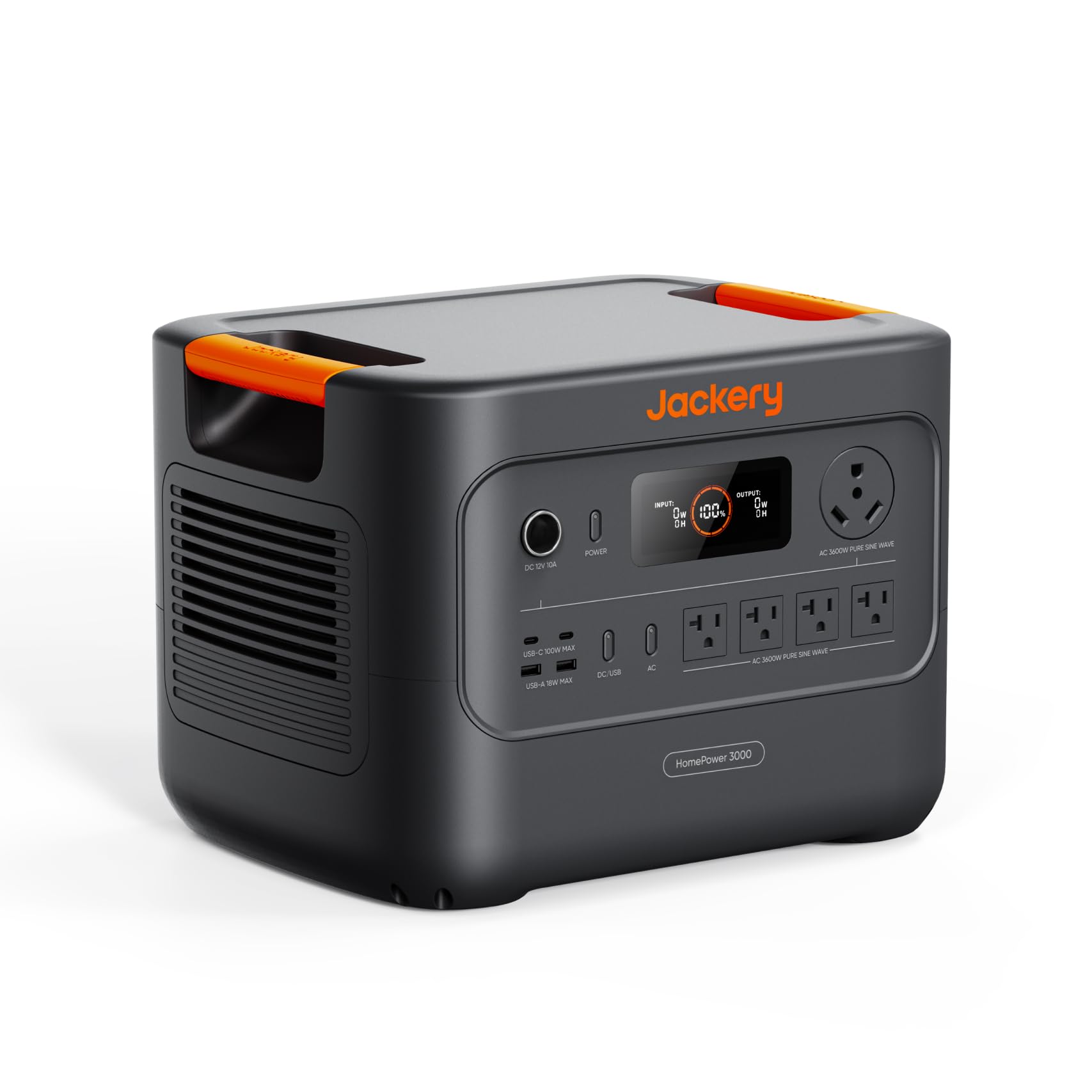
The 3-kilowatt-hour battery that feels half its size and runs your fridge for days.
A 3072Wh capacity and a 3600W continuous output (7200W surge) give you enough juice to power a refrigerator for 1 to 2 days, according to Jackery, while keeping a household running for up to 15 hours on essentials like a fan, WiFi router, and lights. The real standout here is the weight — at 59.5 pounds and with dimensions of 16.4 x 12.8 x 12 inches, Jackery claims this is the world’s first 3kWh portable power station with CTB technology, making it 47% smaller and 43% lighter than comparable models of the same capacity. That means you can actually move it from the garage to the kitchen without planning a lifting session.
Jackery includes a TT-30 RV port for plug-and-play camper power, plus dual 100W PD USB-C ports for fast-charging phones, tablets, and drones. The ≤20ms UPS transfer is UL-certified, so security cameras and medical refrigerators stay online during a flicker. Buyers report it works great for dry camping in a 30-foot travel trailer, running a 43-inch TV, microwave, and Starlink for days without air conditioning. One owner noted it is “about 60 lbs to carry, but has the good side grips” and uses it as a quiet alternative to dragging out a gas generator during short outages. The catch is the fan noise — one reviewer measured it around 60 decibels whenever there is a power draw, making it too noisy for daily office UPS use. At this capacity, it is a dedicated emergency companion, not a desktop accessory.
Compared to the PECRON F3000LFP below (same 3072Wh and 3600W output), the Jackery is noticeably lighter — 59.5 lbs versus 63.3 lbs — and it recharges faster at 1.7 hours via hybrid AC/DC versus PECRON’s 2 hours. The Jackery also comes from a more established brand with a wider service network, which matters for a multi-year investment. If you want the lightest 3kWh battery that can still run a 30A RV outlet and charge in under two hours, this is it.
Why it wins
- Lightest (59.5 lb) and most compact 3kWh LiFePO4 battery available
- Fast hybrid recharge — 1.7 hours from 0% to 100%
- Built-in TT-30 RV outlet, no adapters needed
- 4,000 cycles to 70% capacity with ChargeShield 2.0 tech
Honest trade-offs
- Fan noise (~60 dB) makes it unsuitable for quiet office UPS duty
- ≤20ms UPS transfers slower than the ≤10ms rivals, may briefly reset some sensitive monitors
Grab this when: you want the most portable 3kWh battery for home backup and RV trips, and you do not mind a quiet fan hum during charging.
Think twice if: you need a near-silent UPS for a home office — the fan noise will bother you every time the CPU kicks on.
2. PECRON F3000LFP
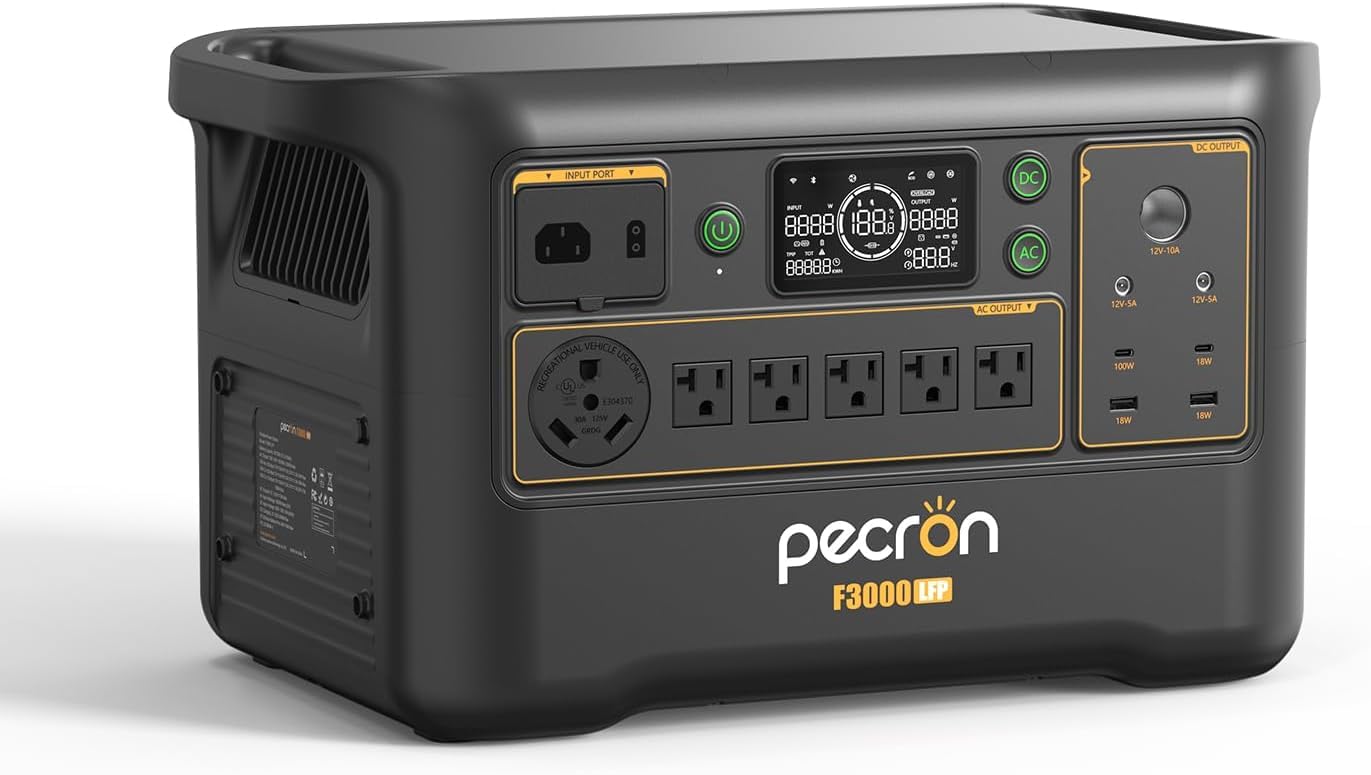
The 3kWh battery that undercuts the competition on price without skimping on output.
Its 3600W pure sine wave inverter can run 13 devices simultaneously, including heavy-duty appliances like refrigerators, air conditioners, and power tools. The battery uses LiFePO4 cells and supports expansion up to 10752Wh with external battery packs, letting you start with the base unit and scale later.
Charging is competitive: 0% to 100% in 2 hours via AC input at 1800W max, which PECRON claims is 30% faster than others. Solar input goes up to 1600W at 25-120V, so a decent solar panel array can refill it in a day. The UPS switch is rated at 8-20ms, fast enough to keep computers and medical devices running during an outage. Owners mention it works well for multiple power outages — one owner said it has been through at least 40 outages over five months with no issues, and another noted it is “compact for what it is” at 19.3 x 11.6 x 11.1 inches and 63.3 pounds. The fan noise during charging is audible, described by one reviewer as “having a fan nearby,” and the unit’s internal power consumption (30W per hour with the main button left on) means you should turn it off when not in use to preserve the battery.
Compared to the Jackery, the PECRON is about 4 pounds heavier and takes slightly longer to recharge (2 hours vs 1.7 hours), but it offers 1600W solar input versus the Jackery’s unspecified solar rate — a clear advantage for off-grid charging. The verifiable comparison fact: the PECRON’s 3600W AC output is identical to the Jackery’s 3600W, but at a better per-watt price. If your priority is maximizing capacity and output per dollar, and you do not mind a slightly heavier unit, this is the smarter buy.
What you get for the cost
- 3072Wh / 3600W at a lower price than comparable 3kWh units
- 1600W max solar input — among the highest in this class
- 13 ports including 6 AC outlets and 2 USB-C (100W PD)
- Expandable to 10752Wh with extra battery packs
Where it cuts corners
- Fan runs often and is noticeable — not silent during charging
- Internal consumption of ~30W per hour when main power is left on
- App interface feels less polished than EcoFlow or Jackery
Pick this if: you want the most watt-hours and watt-output for your budget, plan to add solar panels, and do not mind a slightly heavier battery.
Skip this if: you need whisper-quiet operation in a living space — the fan will be audible at any charging load above 800W.
3. Anker SOLIX C2000 Gen 2

Fully charged in under an hour — the fastest refill in this entire lineup.
If your biggest worry is that a short grid window will not be enough to top off the battery, the Anker SOLIX C2000 Gen 2 solves that with a full 0-100% charge in just 58 minutes. That is top-tier for a 2048Wh unit. It also delivers 2400W rated continuous output and 4000W peak, enough to start most window and RV air conditioners. The LiFePO4 battery sips only 9W on standby, which Anker says lets it power a dual-door fridge for up to 32 hours on a single charge — and if you add the expansion battery to reach 4kWh, that jumps to 64 hours.
At 41.7 pounds and with dimensions of 18.1 x 9.8 x 10.1 inches, it is 25% lighter and 29% smaller than similar products, according to Anker, making it the most portable 2kWh option here. Six charging methods include AC, solar, and an 800W alternator input that claims 3 hours to full — 8 times faster than a standard car socket. Buyers praise its efficiency: one reviewer noted consistent 5-7 day fridge runtime during a cross-country trip, and another noted it easily powered a TV, fridge, and WiFi for over 10 hours during a power outage. The unit is quiet enough for indoor use, with one owner describing it as “very quiet” and only hearing the fan during charging. The only downside is the weight — 45 pounds is manageable with two handles, but you will want a roll-around case for regular movement.
Next to the BLUETTI AC200L (same 2048Wh capacity and 2400W output), the Anker is 19.7 pounds lighter (41.7 vs 61.4) and charges nearly twice as fast — 58 minutes versus the BLUETTI’s 45 minutes for 0-80% plus additional time for the full 100%. The Anker also offers alternator charging at 800W, which the BLUETTI does not natively support. If your power outages are short and you need a battery that refills in the gaps between grid outages, the C2000 Gen 2 is the obvious pick.
Speed and portability
- Full charge in 58 minutes — fastest of any 2kWh battery here
- 41.7 lb weight is 25% lighter than comparable 2kWh units
- 800W alternator input for 3-hour car recharge
- Only 9W standby power consumption
The compromises
- 2048Wh capacity is below the 3kWh class; may not run a full home for 24+ hours
- 2400W continuous output limits simultaneous heavy loads like two space heaters
- No 30A RV outlet — uses standard 5-15R household plugs
Best for: anyone who faces brief, frequent power flickers and wants a battery that refills in under an hour, or for car campers who need alternator charging.
Not for: whole-home backup requiring 3000Wh+ capacity or 30A RV hookups — consider the Jackery or PECRON instead.
4. BLUETTI AC200L

The modular battery that grows from 2kWh to 8kWh as your backup needs expand.
The BLUETTI AC200L starts at 2048Wh but expands up to 8192Wh by connecting up to 4 external battery packs — including 2x B300K (2764Wh each), 2x B210 (2150Wh each), 2x B300 (3072Wh each), or 1x B230 (2048Wh each). That future-proofing makes it among the most versatile platforms for home backup that can start small and scale.
Charging is fast: 0-80% in 45 minutes via 2400W AC input, and full charge from solar in 1.7-2.2 hours at up to 1200W solar input. The ≤10ms UPS backup keeps sensitive electronics running without interruption. Customers note real-world results: one owner runs a “Bluetti AC200L + 2x B300 batteries (8,192Wh)” that powers home security, a 64″ OLED TV, fridge, freezer, modem, router, Tivo, and lamps for about 10 hours. Another reviewer has used it for two years with 200-800W solar panels and notes it runs a 1500W kettle and a 12000 BTU air conditioner (about 4 hours on solar). The unit weighs 61.4 pounds and measures 16.5 x 11 x 14.4 inches — portable but heavy. A few buyers warn that the warranty requires keeping the original box, and third-party purchases may reduce coverage to 24 months unless registered, contradicting Bluetti’s 60-month claim. Read the fine print before you buy.
When you compare it to the PECRON F3000LFP (3072Wh and 3600W from the start), the BLUETTI starts with 50% less capacity (2048Wh vs 3072Wh) and 33% less AC output (2400W vs 3600W). But the BLUETTI charges faster on AC at 2400W vs PECRON’s 1800W, and its ≤10ms UPS is quicker than PECRON’s 8-20ms. If you plan to buy one battery now and add more later, the BLUETTI’s modular expansion path is more flexible — you can reach 8192Wh without replacing the base unit, while the PECRON caps at 10752Wh with a different expansion path.
Modular strengths
- Expandable from 2048Wh to 8192Wh via multiple battery pack types
- 2400W AC input charges 0-80% in 45 minutes
- ≤10ms UPS backup for sensitive electronics
- 30A RV outlet and 48V/8A DC port for RV charging
Watch for
- Base capacity (2048Wh) is lower than 3kWh rivals — you may need expansion sooner
- Proprietary power cord, not a standard IEC cable
- Warranty is 24 months unless registered, despite Bluetti’s 60-month advertising
Ideal for: buyers who want to buy one battery now and add capacity later as their budget or needs grow — the AC200L is the most expandable 2kWh platform in this list.
Be cautious if: you need higher base capacity from the start (look at the PECRON or Jackery) or want a longer warranty without registration hassle.
5. EF ECOFLOW DELTA 3 Max
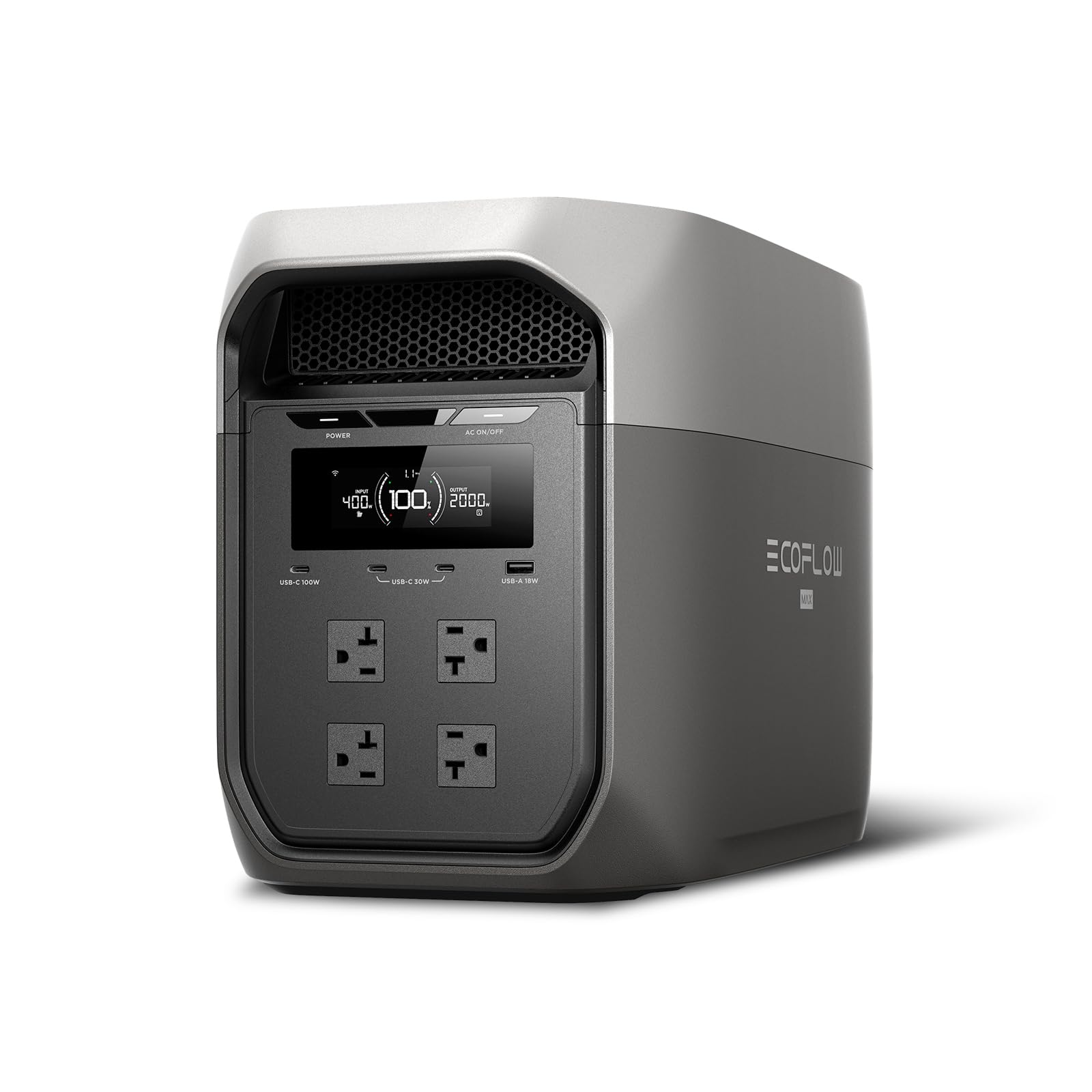
The battery that switches faster than most dedicated UPS units — 10 milliseconds flat.
The EF ECOFLOW DELTA 3 Max combines a 2048Wh LiFePO4 battery with a 2400W continuous output (3400W X-Boost for high-demand appliances like fridges and microwaves) and what might be the most useful feature for home office setups: a ≤10ms transfer time when the grid goes out. That means computers, monitors, and medical devices never blink during a flicker — one buyer mentioned the “10ms transfer makes my Delta 3 max and my Delta 3 classic a couple excellent UPS substitutes.” The unit charges from 0-80% in just 1.13 hours thanks to EcoFlow’s X-Stream technology, and supports both AC and solar input.
At 9.4 x 12 x 19.44 inches, the design is upright and space-saving, with carrying handles on each end. The EcoFlow app allows real-time energy monitoring, smart priority scheduling, and a storm guard mode that one reviewer called “great” for emergency preparedness. Buyers praise the build quality and the quiet fan operation — one said “during wall charging at 1700W, the fan did turn on… but it was very quiet.” The unit is made from aluminum and plastic, feels solid, and comes with a 5-year service plan. A minor complaint: the front panel buttons blend into the dark face, making them hard to find in dim light without feeling around. Also, the 12V car outlet is located on the back with the inputs, which is an odd placement for a portable unit.
The DELTA 3 Max shares the same 2048Wh capacity and 2400W base output as the BLUETTI AC200L and Anker SOLIX C2000 Gen 2, but it stands apart on transfer speed — 10ms is among the fastest in any portable power station, rivaling dedicated UPS gear. The Anker charges faster (58 min to full vs 1.13 hours to 80%), but the DELTA 3 Max offers a richer app ecosystem and a proven track record with storm guard features. For a home office that demands interruption-free backup, this is the strongest contender.
Why it stands out
- ≤10ms UPS transfer — fastest in this comparison, ideal for computers
- 0-80% charge in just 1.13 hours
- 3400W X-Boost mode handles high-demand appliances
- App with storm guard and energy scheduling features
Minor gripes
- Buttons on the front panel are hard to see in low light
- 12V car outlet is on the back with inputs, not convenient for quick access
- No 30A RV outlet — uses standard household plugs
Reach for this if: you run a home office with a desktop PC and modem that cannot tolerate even a brief power blip — the 10ms UPS is the killer feature.
Look elsewhere if: you need a 30A RV outlet or larger base capacity; this is a 2kWh unit, so plan for its limits.
6. AFERIY P310

Nearly 4kWh of storage at a price that undercuts every premium brand by hundreds.
The AFERIY P310 is the capacity king at this price point: 3840Wh (3.8kWh) from the start with 3600W continuous output (7200W peak), expandable up to 11.5kWh with external battery packs. For comparison, that is nearly double the 2048Wh of the BLUETTI AC200L and the Anker C2000 Gen 2, at a price that is often lower. The LiFePO4 battery includes 15 output ports — 6 AC outlets, USB-C with PD 3.0, USB-A, DC5521/DC, XT60, and a 12V car socket — covering almost any device you can plug in. The UPS transfer is rated at <10ms, fast enough for computers and security cameras.
Reviewers point out that this unit powers a whole RV (minus air conditioning) with ease, and the 7-year warranty is among the longest in the industry. One owner noted it runs “my entire RV” and that the company’s customer support was responsive when the display had a loose connection — they offered a replacement or on-site repair. Another reviewer mentioned the fan noise is higher than EcoFlow or Jackery, but said “it didn’t bother me like I thought it might.” The unit is heavy at 104.7 pounds and large at 27.32 x 15.9 x 23.11 inches, so it lives on a cart or a dedicated shelf rather than moving around the house. A few early buyers had display issues that resolved after moving the unit, suggesting a loose internal connector.
When you line it up against the Jackery HomePower 3000 (3072Wh, 3600W, 59.5 lbs), the AFERIY offers 25% more base capacity (3840Wh vs 3072Wh) for a lower per-watt-hour cost, but it weighs 45 pounds more and takes up far more floor space. The trade-off is clear: if you have a fixed location for the battery and value maximum capacity per dollar, the P310 is the smart money pick. If you need to move it between rooms or take it camping, the Jackery or Anker will be much more manageable.
Capacity for cost
- 3840Wh base capacity — highest in this lineup without expansion
- Expandable to 11.5kWh for serious whole-home backup
- <10ms UPS transfer for sensitive electronics
- 7-year warranty is top-tier for this price tier
Physical trade-offs
- 104.7 lbs — not portable in any practical sense
- Large footprint (27.3 x 15.9 x 23.1 inches) needs dedicated space
- Fan is louder than premium brands, as noted in reviews
Buy this if: you want the most battery capacity for your money, have a semi-permanent spot for it (garage, basement), and do not mind a bit more fan noise.
Avoid this if: you need to frequently move the battery or want the quietest operation — the weight and fan are real daily considerations.
7. GROWATT HELIOS 3600
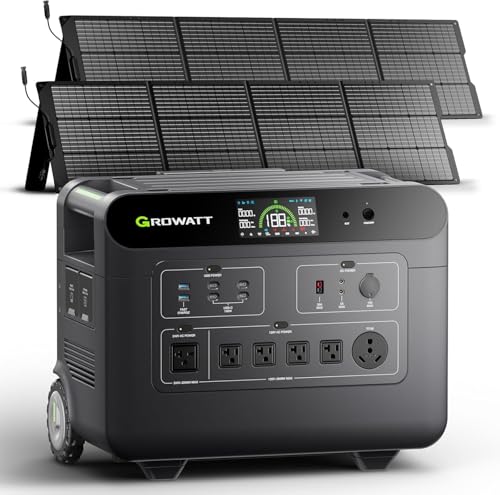
Comes with two 200W solar panels and can parallel two units for 240V whole-house power.
The GROWATT HELIOS 3600 is the only package in this lineup that ships with solar panels included — two 200W panels provide solar power generation right from the start. The base unit delivers 3600Wh of capacity and 3600W continuous output, expandable up to 36kWh with additional battery units. The standout feature: two HELIOS 3600 units can be connected in parallel to produce 7200W at 240V split-phase, which can run well pumps, central air, and other heavy 240V appliances — essentially whole-house backup without a generator.
Solar charging is a priority here, with up to 2000W high-efficiency solar input (99% MPPT efficiency), so you can refill the battery quickly from panels. The transfer switch operates at 15ms for EPS (emergency power switching), and the unit works in temperatures as low as -22°F, making it suitable for cold climates. The dimensions are 20.4 x 12.3 x 16.5 inches, and the weight is 149 pounds — this is a stationary unit that rolls on wheels. Shoppers say it runs a fridge, router, Starlink, and TV for 24-30 hours, and one owner had an electrician install a separate panel to run the whole downstairs, later adding a second unit for 240V operation. The Bluetooth/WiFi app has been hit-or-miss for some users, but the battery itself performs reliably. A few units were damaged in shipping, but GROWATT honored the warranty and replaced them quickly.
The biggest differentiator between the GROWATT and every other battery here is the native 240V split-phase capability through parallel connection. The BLUETTI Apex 300 (below) also offers 120V/240V output, but it does so through a single unit at 3840W continuous. The GROWATT’s 7200W at 240V is more suitable for whole-house backup scenarios. If you are serious about replacing a gas generator and running 240V loads, the HELIOS 3600 is the most straightforward path.
Whole-house advantages
- Parallel two units for 7200W 240V split-phase — supports whole-house loads
- Includes two 200W solar panels right in the box
- 2000W solar input — highest in this comparison
- Cold-start capability down to -22°F
Consider carefully
- 149 lbs — needs a permanent spot or a heavy-duty cart
- App connectivity (Bluetooth/WiFi) has been unreliable for some owners
- Manual is thin on details; users often need to search online for specifics
Ideal for: homeowners who want a solar-powered backup that can eventually run the entire house including 240V appliances, and do not mind a large stationary unit.
Too much if: you only need to power a few essentials — the weight and complexity of a dual-unit parallel setup are overkill for basic fridge-and-router backup.
8. BLUETTI Apex 300
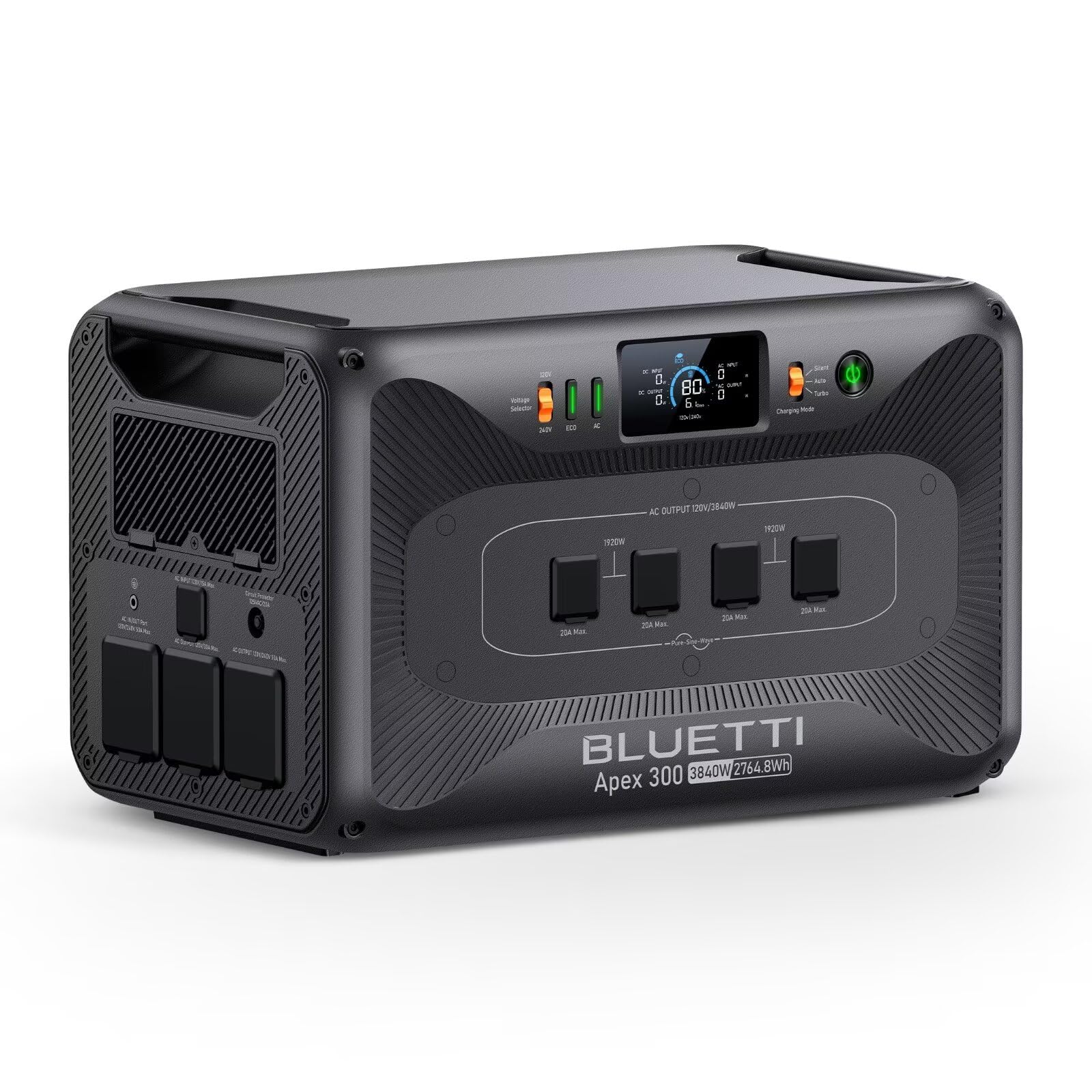
A single unit that switches between 120V and 240V — no parallel cables needed.
The BLUETTI Apex 300 is designed for homeowners who need 240V split-phase output from a single device, without buying a second unit or dealing with parallel connection cables. It delivers 3840W continuous AC output (7680W surge) from a 2764.8Wh LiFePO4 battery base, expandable with B300K or B500K batteries. The key feature is the ability to power 120V appliances and switch to 240V for heavier home or RV loads through the app or onboard controls — one system that covers both voltage needs.
Charging is flexible: high AC/generator input, large-scale solar capture via the optional Solar X4K (150-500 Voc), alternator charging with the Charger 1/Charger 2 accessories, and TurboBoost 2000W fast charging. The ≤10ms UPS backup and silent operation (22dB) make it suitable for sensitive electronics. The unit has 14 ports and weighs 66.1 pounds with dimensions of 20.67 x 12.87 x 12.6 inches. Buyers report it works great for 240V split-phase emergency backup — one owner uses it with a transfer switch and three batteries to power a 50-amp transfer box, noting “power went out a couple of times and the system works great.” The pass-through charging feature (120V AC output while charging the battery with 240V AC) was a key reason one buyer chose this over competitors. The solar input limitation (60 Voc on the integrated PV) means you may need the separate Solar X4K accessory if your solar array runs higher voltage, which is an added cost to consider.
Unlike the GROWATT HELIOS 3600 which requires two units for 240V, the Apex 300 delivers 120V/240V from a single unit at a lower weight (66.1 lbs vs 149 lbs). The GROWATT can reach 7200W at 240V with two units, while the Apex 300 tops out at 3840W continuous (7680W surge) at 240V. If you need 240V now and do not want to buy two batteries, the Apex 300 is the more practical starting point. If you need more than 3840W at 240V for heavy loads like a well pump plus central air, the GROWATT’s dual-unit parallel setup wins on raw power.
Single-unit versatility
- 120V/240V output from one unit — no parallel cables or second battery needed
- ≤10ms UPS and silent operation at 22dB
- 6000+ cycles with BLUETOPUS AI-BMS for exceptional battery lifespan
- Expandable with B300K or B500K for future capacity upgrades
Plan for
- Solar input of 60 Voc maximum on the built-in PV port — may require the add-on Solar X4K for high-voltage panels
- Base capacity is 2764.8Wh, less than the 3072-3840Wh of similarly priced rivals
- Expansion batteries and accessories add cost quickly
Choose this when: you need 240V split-phase backup from a single portable unit, plan to grow the system over time, and value silent operation.
Pass if: your solar array runs above 60 Voc and you do not want to buy the separate Solar X4K, or if you need more than 3840W continuous at 240V (look at the GROWATT dual-unit setup).
Understanding the Specs
Watt-Hours (Wh) — the Energy Tank
Watt-hours tell you how much total energy the battery holds. Think of it as the size of your gas tank. A 2048Wh battery can run a 200W refrigerator for about 10 hours. A 3072Wh battery runs that same fridge for about 15 hours. When reading specs, keep in mind that the inverter itself uses some power to stay on (10-30W idle), so your real-world runtime is always a bit less than the math suggests.
AC Output Watts — the Instant Power
Watts measure how much power the battery can deliver at one moment. Your refrigerator might need 800W when the compressor kicks on (peak), then drop to 200W while running. If your battery is rated for 2400W continuous, it can handle the start-up surge of most home appliances — but not two space heaters at once (each pulls ~1500W). Look at both continuous and surge ratings. A battery with 3600W continuous gives you more headroom for running multiple devices simultaneously.
UPS Transfer Speed (ms) — the Flicker Guard
When the grid drops, the battery must switch from passing through grid power to supplying its own power. This transfer takes a few milliseconds (ms). A ≤10ms switch is fast enough that your computer, router, and TV never notice the outage. A ≤20ms switch might cause some monitors to briefly go black — not ideal for home office setups. If you plan to plug sensitive electronics directly into the battery, prioritize ≤10ms models like the EcoFlow DELTA 3 Max, the AFERIY P310, or the BLUETTI Apex 300.
Solar Input (W) — the Off-Grid Lifeline
How many watts the battery can accept from solar panels determines how fast you can recharge from the sun. More solar input means you capture energy even on partly cloudy days. A battery with 1600W solar input can refill from a 1600W panel array in about two good sun hours. Lower-solar-input units (1200W or less) may need a full day of sun to recharge from zero. If you plan extended off-grid backup, look for at least 1200W solar input — the PECRON F300F3000LFP (1600W) and the GROWATT HELIOS 3600 (2000W) lead this category by a clear margin.
FAQ
Can a home backup battery replace a gas generator?
How long will a 2048Wh battery run my refrigerator?
What is the difference between LiFePO4 and standard lithium-ion?
Do I need a transfer switch or can I just plug appliances in directly?
Can I charge a home backup battery with solar panels?
How heavy are these batteries — can I move them around?
What does “UPS” mean on a power station?
Can I use a home backup battery in an apartment?
How do I maintain a LiFePO4 battery when I am not using it?
Is a 240V backup battery worth the extra cost?
Final Thoughts: The Verdict
Across the board, the backup battery for home winner is the Jackery HomePower 3000 because it packs a full 3072Wh and 3600W into the lightest and most compact 3kWh body on the market, with a fast 1.7-hour recharge and a built-in 30A RV outlet that simplifies both home backup and camper power. If you want the best value per watt-hour and plan to add solar panels later, grab the PECRON F3000LFP. And for whole-house 240V backup without a generator, the standout is the GROWATT HELIOS 3600 with its included solar panels and dual-unit parallel capability.
How We Picked
We do not accept paid placement. Every pick is matched to a real buyer and a real use-case; we do not hands-on test units.
Sources & Methodology
Specifications: manufacturer listings and product documentation. Review insights: verified customer reviews, as of July 2026. Pricing: not shown on this page (it changes often); check the current price via the retailer link.
As an Amazon Associate, Gadgets Feed earns from qualifying purchases. This does not affect which products we feature.
Product prices and availability are accurate as of the date/time indicated and are subject to change. Any price and availability information displayed on Amazon at the time of purchase will apply to the purchase of this product. As an Amazon Associate I earn from qualifying purchases.
CERTAIN CONTENT THAT APPEARS ON THIS SITE COMES FROM AMAZON. THIS CONTENT IS PROVIDED "AS IS" AND IS SUBJECT TO CHANGE OR REMOVAL AT ANY TIME.
Amazon and the Amazon logo are trademarks of Amazon.com, Inc. or its affiliates.