
Our readers keep the lights on and my morning glass full of iced black tea. As an Amazon Associate, I earn from qualifying purchases.
Specs are compiled from manufacturer listings and verified buyer reviews and can change over time — please confirm the key details on the product page before buying.
When the power goes out during a storm, your main sump pump goes silent with it — and the water keeps rising. A backup battery system is the difference between a dry basement and a costly flood cleanup. The right pick keeps pumping for hours when you need it most.
I’m Min — the founder and writer behind Gadgets Feed. This guide is built by comparing the manufacturers’ published specifications and the patterns across verified customer reviews, so you get each pick’s real strengths and trade-offs instead of marketing spin.
if you want the longest runtime, the easiest install, or the most rugged build, this roundup of the backup battery for sump pumps covers the essential options to keep you dry through any outage.
Our Picks at a Glance


How To Choose The Best Backup Battery For Sump Pumps
Picking the right system means matching your basement’s water load, pit size, and budget to a setup that won’t quit in a blackout. Here are the three specs that matter most.
Pump Horsepower and Flow Rate
Horsepower tells you how hard the pump can push water upward against gravity. A 1/2 HP pump handles higher lift heights and pumps more gallons per minute than a 1/3 HP unit, which matters if your discharge pipe runs up a tall wall or you get heavy inflow. The flow rate, measured in Gallons Per Minute (GPM), tells you how fast it clears the pit so the backup kicks on less often.
Battery Type and Capacity
Most systems use a deep-cycle 12-volt battery, but the chemistry matters. Wet-cell (flooded) batteries need you to top off distilled water every few months. AGM (Absorbent Glass Mat) batteries are maintenance-free and won’t spill, but cost more. Capacity is in amp-hours (AH) — higher numbers give you longer pumping before the battery runs out.
Compatibility and Pit Fit
Measure your sump pit diameter before you buy. Many combo systems need an 18-inch or wider basin to fit the primary pump, backup pump, and floats. If your pit is on the smaller side, compact designs or separate add-on backups work better. Also check whether the discharge pipe size matches your existing plumbing.
Quick Comparison
| Model | Best For | Horsepower | Max Flow Rate | Max Lift Height | Amazon |
|---|---|---|---|---|---|
| WAYNE WSS30VN★ Best Overall | Heavy water inflow + quiet operation | 0.5 HP | 85 GPM | — | Amazon |
| Basement Watchdog BWSPBest Value Add-On | Compact add-on backup | 0.25 HP | 2,890 GPH (0 ft lift) | 10 ft | Amazon |
| Basement Sentry STBC101 | Budget-friendly combo with fast charger | — | 40 GPM | — | Amazon |
| Basement Watchdog DFK961 | Long-term reliability + high lift | 1/3 HP | 62 GPM | 22 ft | Amazon |
| Basement Watchdog CITS-50 | Smart monitoring + WiFi alerts | 0.5 HP | 73.3 GPM | 25 ft | Amazon |
| Westinghouse WH50BBU | Premium build + stainless steel | 0.5 HP | 87 GPM | 30 ft | Amazon |
| Zoeller 508-0006 | Pro-grade self-testing system | 0.33 HP | 43 GPM | — | Amazon |
In‑Depth Reviews
1. WAYNE WSS30VN
Our pick — over 4.5★ from 800+ verified ratings; the strongest balance of quality and price.
The powerhouse combo that pumps harder and quieter than most.
This 1/2 HP system moves 85 Gallons Per Minute — compared to the Basement Sentry STBC101’s 40 GPM — so it clears heavy inflow fast. The primary pump handles up to 5,100 GPH, and the backup stretches to 10,000 gallons on a single charge from the required Wayne WSB1275 battery (sold separately). Buyers report it has run trouble-free for three years in high-water basements, calling it the quietest sump pump they have ever heard.
The pre-assembled unit drops into a 16-inch or larger basin and needs no weep hole drilling, keeping install time under 15 minutes. At 44 pounds, it is heavy — but that weight comes from solid polypropylene build and a 3-year warranty that backs the made-in-USA construction.
One trade-off: customer support got poor marks from a few buyers who could not get email replies. If you want a turnkey solution with brawn and near-silent operation, this is the one.
Why it leads
- top-tier 85 GPM flow rate clears the pit fast
- Extremely quiet operation praised by homeowners
- Pre-assembled for quick 15-minute drop-in
- 3-year warranty, assembled in the USA
One stumble
- Customer support responsiveness raised concerns in reviews
- Heavy at 44 pounds
Best for: Anyone with high water inflow who values quiet, powerful pumping and a straightforward install.
Look elsewhere if: You need a responsive phone/email support team or have a pit under 16 inches.
2. Basement Watchdog BWSP
A compact, lightweight backup that adds confidence without the bulk.
At just 12 pounds and with a 0.25 HP motor, this add-on system is 12 pounds compared to the WAYNE combo’s 44 pounds, making it ideal for small or narrow sump pits where a full combo won’t fit.
The control panel lights up with a warning and on-screen instructions if something goes wrong, and it is WiFi-capable via a separate module for phone alerts. One reviewer noted their unit replaced an 8-year-old system whose controller failed, calling the new one identical and reliable. The copper-wound motor and thermoplastic housing are built to outlast cast iron, per that same long-term owner.
Battery (sold separately) needs distilled water every six months; budget for a new battery every 3 to 4 years for continuous readiness.
Smart buy for: Homeowners who already have a primary pump and just want a lightweight, dependable backup that fits tight pits.
The trade-off: Lower flow than full 1/2 HP combos; WiFi module is extra.
3. Basement Sentry STBC101

An all-in-one budget-friendly combo with a fast-charging battery box.
This system combines a primary pump and a battery backup pump, controller, alarm, charger, float switch, and battery box in one pre-assembled package. The 2x faster battery charger and battery box design aim to extend battery life, though the battery (Basement Sentry STB75B) is sold separately. The flow rate of 40 GPM, compared to the WAYNE’s 85 GPM, so it suits moderate water loads rather than heavy, continuous inflow.
A notable feature: the regulated charger prevents overcharging — a problem other 12V backup pumps can have, according to one reviewer whose system has worked great after 2 years. The same buyer reported that a lightning-damaged control board was replaced quickly by customer service.
Mixed reviews on packaging: a few units arrived with broken or damaged parts, so inspect upon delivery and test right away.
Standout perks
- Comes with everything except the battery
- 2x faster charger extends battery life
- Very quiet operation
Watch out for
- 40 GPM is lower than premium options
- Some deliveries showed damage
Reach for this if: You need an affordable all-in-one kit and have moderate water volume in your pit.
Pass if: You expect heavy, prolonged rainfall or want a higher flow rate.
4. Basement Watchdog DFK961

The 20-year veteran that just keeps pumping — and lifting higher than most.
With a maximum lift height of 22 feet, this 1/3 HP combo beats the Basement Watchdog BWSP add-on’s 10-foot lift by a 2.2x margin, making it the better pick for homes where the discharge pipe runs up a full story. The cast iron and cast aluminum primary pump handles 3,700 GPH at zero lift, while the backup manages 2,000 GPH at the same level.
Owners mention astonishing longevity: one owner had 20 years trouble-free from their unit, replacing the battery every 5 years at roughly /year. The monitoring system sounds an alarm and lights up an LED with instructions if the backup activates, so you know immediately when something needs attention.
At 18.5 pounds it is lighter than the WAYNE combo but still solidly built. Some installers may find the multiple floats and wiring tricky, but the manufacturer’s phone support helped one reviewer through the setup.
Why it wins for longevity
- 22 ft lift handles high discharge lines
- Owner-reported 20-year lifespan
- Cast iron primary is durable and reliable
- Easy drop-in replacement
One hitch
- Price is higher than competing 1/3 HP units
- Multiple wires and floats need careful installation
Who it fits: Homeowners who prioritize proven long-term reliability and need to pump water up a tall riser.
Who should skip: Anyone on a tight budget or looking for a simpler, fewer-wire setup.
5. Basement Watchdog CITS-50

A 1/2 HP combo with smart alerts — your basement’s dedicated watchdog.
This system’s 1/2 HP primary pumps 73.3 GPM at zero lift (4,400 GPH), and the backup pushes 48 GPM (2,890 GPH). It lifts water up to 25 feet, beating the DFK961’s 22 ft and the WAYNE’s unspecified limit. The big draw is the WiFi-capable controller: add the separate CONNECT Module for real-time text, email, or push alerts through the Basement Watchdog app.
The controller monitors pump, power, and battery conditions 24/7. If the pump runs too often or power cuts out, you get a warning on your phone before water reaches the floor. One buyer appreciated the built-in check valve that saved buying one separately, and called the install straightforward with good instructions.
That said, the presets are tied to floats that thread through the pit lid, which can be awkward in tight sumps. A small number of users reported float assembly issues leading to main pump failure within months — so test the float freedom carefully after installation.
Smart features
- WiFi-ready for remote phone alerts
- Pre-assembled with check valve included
- 25 ft max lift — best in this list
- Runs on one battery or two for more runtime
Potential headaches
- Float cord routing through lid is fiddly
- A few users saw main pump failure within months
Best for: Tech-savvy homeowners who want remote alerts and 1/2 HP pumping with the highest lift.
Best avoided: If you dislike complex float setups or prefer a simpler drop-in system.
6. Westinghouse WH50BBU
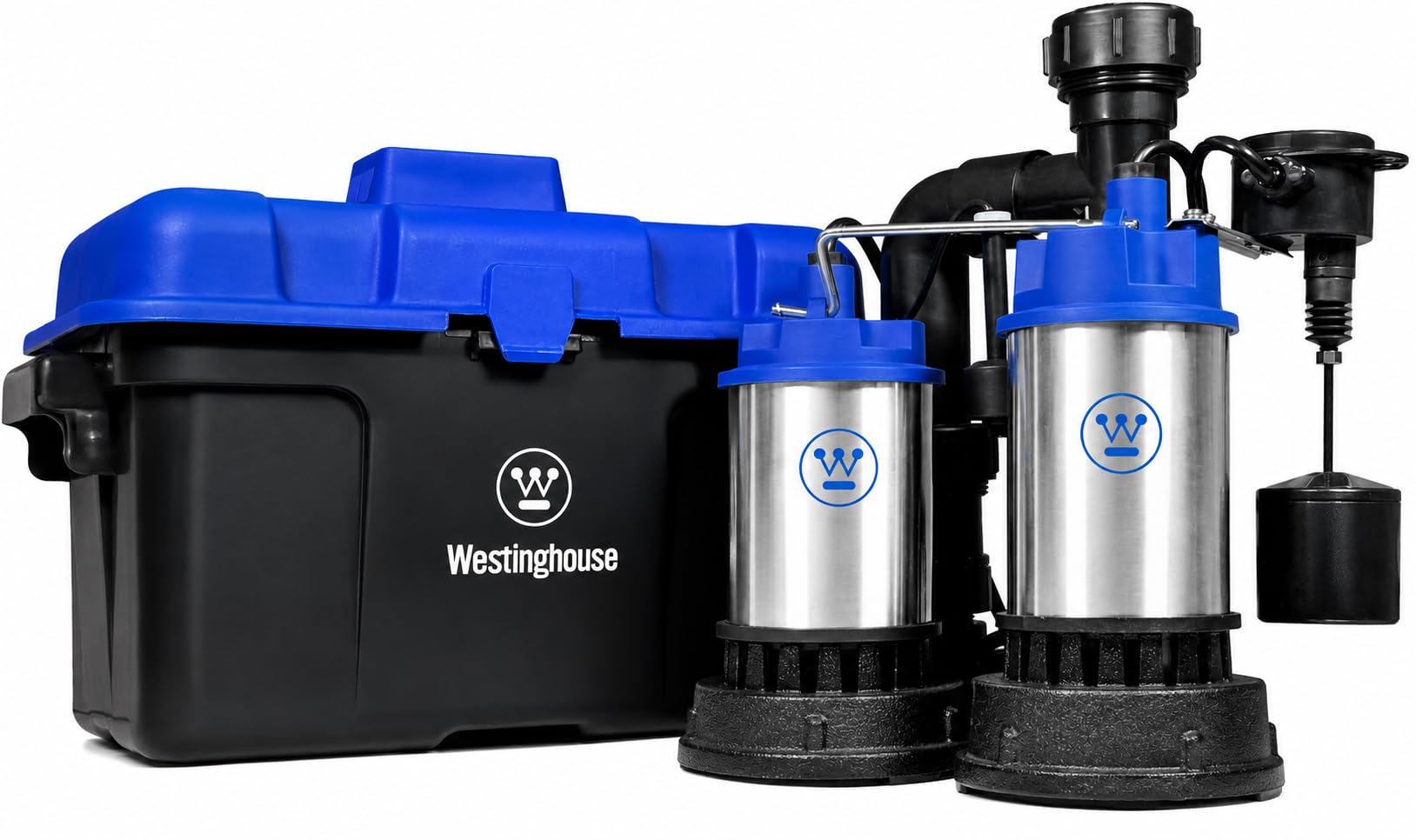
Stainless steel guts for those who want maximum corrosion resistance.
Both pumps in this 1/2 HP system feature stainless steel housings, so rust is not a concern even in damp pits — a step up from the plastic or cast iron builds elsewhere. It delivers 87 GPM, the highest flow rate in this roundup, beating the WAYNE’s 85 GPM by a small but real margin. The Westinghouse also lifts up to 30 feet, making it the strongest vertical performer here.
The AC primary pump runs an energy-efficient PSC motor with thermal overload protection, and the DC backup automatically activates when power is lost. Buyers call the build quality “heavy, solid” and remark on how quiet it runs compared to their old units. The top suction design prevents airlock and reduces clogging from debris.
At 50 pounds, it is the heaviest pick — so be ready for that weight during install. The charger adapter cable is short per one buyer, which can limit where you place the battery box.
What you get
- Highest flow rate: 87 GPM
- Top lift: 30 feet
- Stainless steel resists corrosion
- Very quiet operation
The downsides
- Heaviest at 50 pounds
- Short charger adapter cable noted by reviewers
Reach for this if: You want the best flow and lift numbers plus a rust-proof build for long-term confidence.
skip it if: You have a small pit or need a lightweight system for easy handling.
7. Zoeller 508-0006 AquaNot Spin 508 ProPak
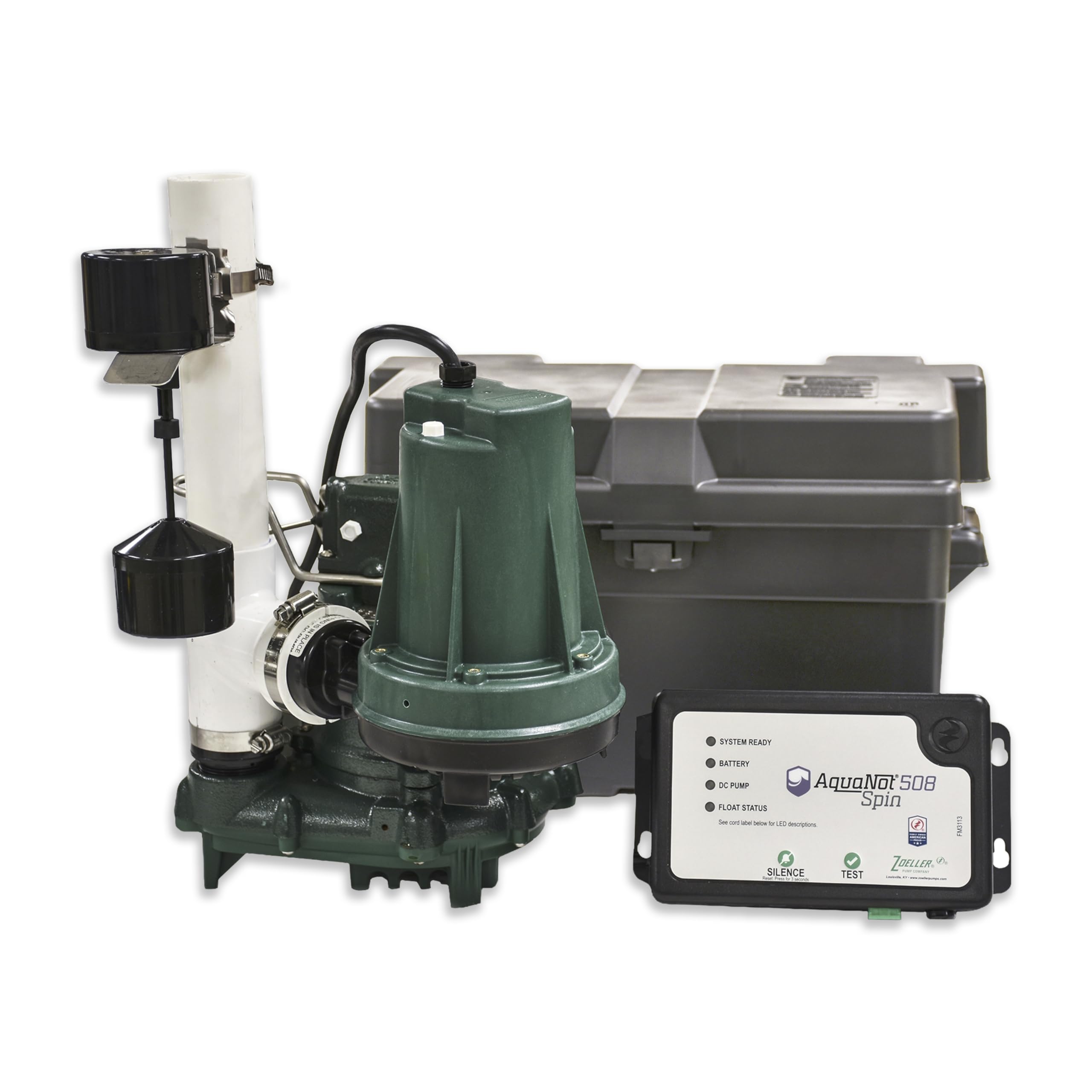
The self-diagnosing system that runs 48+ hours on a single charge.
Zoeller’s ProPak is built around continuous self-testing: the controller checks for power outages, high water, switch obstructions, and pump faults automatically so you do not have to remember. The DC backup pump delivers up to 5.5 hours of continuous pumping, and at a 10% duty cycle it stretches to 48+ hours — meaning it can protect your basement through multi-day outages.
It comes pre-plumbed with 1-1/2-inch Schedule 40 PVC, includes a check valve and float switch, and is 100% factory tested. The 3/10 HP primary is less powerful than the 1/2 HP units above, but the system focuses on reliability and smart monitoring rather than raw flow. One reviewer called it very quiet compared to their previous Everbilt, and a long-term owner confirmed it was still going strong 3 years later.
The price is the highest in this lineup, and a few buyers reported arriving with a broken check valve or a bent foot — so inspect the box carefully upon delivery.
Pro features
- Self-testing controller catches issues early
- 48+ hours of backup runtime at 10% duty cycle
- Pre-plumbed with high-quality PVC
- Quiet operation and Zoeller reputation for reliability
Watch out
- Highest price on this list
- Some units arrived with damage
- Primary motor is only 3/10 HP
Who needs this: Those who want the longest battery runtime and automatic self-diagnostics for total confidence.
Who does not: Shoppers on a budget or anyone who needs a higher-flow primary pump.
Understanding the Specs
Horsepower (HP)
This tells you the motor’s strength. A 1/2 HP motor pushes water harder and higher than a 1/3 HP motor, so it handles longer discharge pipes (like running up to a second floor) and higher water inflow. The trade-off is more power draw — but since the backup runs on a battery, higher HP means you get less runtime before the battery drains.
Gallons Per Minute (GPM)
This is how fast the pump clears water out of your sump pit. A higher GPM number (like 85 or 87 on the premium picks) empties the pit faster so the backup pump cycles on less often, extending battery life. For moderate water, 30-40 GPM is enough; for heavy clay-soil basements or storm-prone areas, look toward 60+ GPM.
FAQ
Will any deep-cycle 12V battery work with these systems?
How long does a backup battery last during a power outage?
Do I need to buy the battery separately?
Can I install a battery backup system myself?
What size sump pit do I need for these systems?
How often should I maintain the backup battery?
Can I connect the backup to my phone for alerts?
Will the backup pump turn on automatically when power goes out?
What is the difference between a combo system and an add-on backup?
Final Thoughts: The Verdict
For the majority of shoppers, the backup battery for sump pumps winner is the WAYNE WSS30VN because it combines a powerful 85 GPM flow rate with whisper-quiet operation and a simple 15-minute installation. If you want a rugged, time-tested system with a 22-ft lift, grab the Basement Watchdog DFK961. And for the best smart-home integration with remote alerts, the standout is the Basement Watchdog CITS-50.
How We Picked
We do not accept paid placement. Every pick is matched to a real buyer and a real use-case; we do not hands-on test units.
Sources & Methodology
Specifications: manufacturer listings and product documentation. Review insights: verified customer reviews, as of July 2026. Pricing: not shown on this page (it changes often); check the current price via the retailer link.
As an Amazon Associate, Gadgets Feed earns from qualifying purchases. This does not affect which products we feature.