
Our readers keep the lights on and my morning glass full of iced black tea. As an Amazon Associate, I earn from qualifying purchases.
Specs are compiled from manufacturer listings and verified buyer reviews and can change over time — please confirm the key details on the product page before buying.
The single most important thing to understand about adding a backup camera to your aftermarket stereo is that not every camera sends a signal your stereo can understand. Most aftermarket stereos expect a simple RCA (the yellow round plug) composite video signal, while many modern cameras now use HD digital formats. Pick the wrong one and you will get a black screen, no matter how many wires you connect. This guide focuses exclusively on cameras with RCA video output that actually match the input on your stereo — no adapters, no guesswork.
I’m Min — the founder and writer behind Gadgets Feed. This guide is built by comparing the manufacturers’ published specifications and the patterns across verified customer reviews, so you get each pick’s real strengths and trade-offs instead of marketing spin.
Whether you are installing into a pickup, sedan, or SUV, finding the right backup camera for aftermarket stereo depends on matching the video signal type, checking the field of view, and making sure the mounting style fits your vehicle’s license plate area or tailgate.
Quick Picks
- GreenYi AHD 1080P Backup Camera with Dynamic Trajectory Guide Line (B0F18SW48X) — Top Performer
- GreenYi AHD 1080P Reverse/Front/Side Camera (B0BXP6J65L) — High Definition
- vampolo AHD 1080P License Plate Backup Camera (B0DP41J8QD) — Best Value
- eRapta ERT01 HD Backup Camera (B074KZSVD6) — Budget Star
- Leadsign Emblem Backup Camera for Ford F-Series (B096LP4MJW) — OEM Swap
- KENWOOD CMOS-230LP Universal Backup Camera (B0CPJMH4WL) — Brand Pick
How To Choose The Best Backup Camera For Aftermarket Stereo
Buying a backup camera for an aftermarket stereo is simpler than you think once you know two things: what video signal your stereo accepts, and where you want the camera mounted. Every product below has an RCA connector, but some send a standard CVBS signal while others send a higher-definition AHD signal that only certain stereos can display.
Match the Video Signal Type First
Check your stereo’s specifications for “AHD compatible” or “CVBS input.” Most aftermarket stereos accept CVBS (Composite Video Baseband Signal), the standard composite video that has been around for decades. AHD (Analog High Definition) cameras offer sharper images — 1080p versus standard definition — but your stereo must explicitly support AHD at the correct frame rate (usually 25Hz/PAL). If you plug an AHD camera into a CVBS-only stereo, you will see nothing.
Field of View and Mounting Style
Field of view, measured in degrees, determines how much of the area behind your vehicle appears on screen — 170 degrees is the widest common option and covers nearly everything behind the bumper. The mounting style affects how the camera looks: license plate cameras bolt onto your plate bracket, flush mount cameras sit flush in the tailgate or bumper for a clean factory-like appearance, and emblem replacement cameras swap out your vehicle’s rear badge entirely for a stealthy OEM look.
Night Vision and Weather Resistance
Look for cameras with an IP67 or IP69K waterproof rating so rain, snow, and car washes do not kill the electronics. Night vision performance depends on the camera’s lux rating and the number of infrared LEDs — lower lux numbers mean the camera can see in darker conditions without your reverse lights.
Quick Comparison
| Model | Best For | Effective Resolution | Field of View | Waterproof Rating | Amazon |
|---|---|---|---|---|---|
| GreenYi AHD 1080P | Best Overall | 2073600 Pixels | 170 Degrees | IP68 | $34.99Amazon |
| GreenYi AHD 1080P (B0BXP6J65L) | Best Overall | 2073600 Pixels | 170 Degrees | IP68 | $32.99Amazon |
| vampolo AHD 1080P | Best Picture | 1080 Pixels | 170 Degrees | Nano waterproof glue | $25.99Amazon |
| eRapta ERT01 | Best Budget | 720 Pixels | 148 Degrees | IP69K | $25.99Amazon |
| Leadsign Emblem | Best OEM Look | 960 Pixels | 170 Degrees | IP69K | $103.98Amazon |
| KENWOOD CMOS-230LP | Brand Assurance | 330000 Pixels | 128 Degrees | Waterproof | $119.00Amazon |
In‑Depth Reviews
1. GreenYi AHD 1080P Backup Camera with Dynamic Trajectory Guide Line (B0F18SW48X)

A compact flush-mount camera that packs true 1080p clarity and steering-line smarts into a tiny metal body.
What you get here that cheaper cameras miss is the dynamic trajectory guideline — the guide lines on your screen actually turn left and right as you turn the steering wheel, without needing any extra gyro box from the stereo. That works because GreenYi embedded the steering-angle logic directly into the camera chip. The image is sharp too: a 1/3-inch CMOS sensor delivering 2073600 effective pixels through a 170-degree fisheye lens, so you see the full width of the bumper and both blind spots at once.
The metal camera body rotates using a mini wrench instead of relying on shims or wedges, which buyers report makes it much easier to dial in the exact tilt angle on first install. Unlike the eRapta ERT01 below which tops out at 720 pixels, the GreenYi outputs genuine 1920×1080 when connected to a stereo that supports AHD 25Hz/PAL. If your stereo only accepts standard CVBS, cut the two switcher cables on the harness to fall back to CVBS at 30Hz. One reviewer noted the image with CVBS is “excellent” but stressed you must check your head unit’s supported formats before you hide the wires inside the panel.
The camera is rated IP68 waterproof — the same spec used on many marine electronics. Buyers confirm it survives car washes and heavy rain without fogging up. The kit includes a 26.2-foot double-shielded video cable, which is enough to reach the front of a full-size SUV without splicing extensions.
Camera on rails: The dynamic guide lines sync with your steering in real time, which is a feature usually reserved for expensive OEM systems — makes backing into a tight spot feel intuitive immediately.
The signal check: This camera defaults to AHD signal. If your aftermarket stereo does not support AHD, you must cut the wires to switch to CVBS — do this before final installation because cutting the wires after routing them is frustrating.
Best for: Anyone with an AHD-compatible aftermarket stereo who wants a near-factory look with dynamic steering lines and real 1080p clarity.
Watch out for: The 4-pin plug uses its own pin layout — you cannot plug this into an existing vehicle harness; you must run the supplied cable.
2. GreenYi AHD 1080P Reverse/Front/Side Camera (B0BXP6J65L)

An AHD-only specialist that swaps between rear, front, or side duty with a simple wire cut.
This GreenYi model is the cleaner sibling of the dynamic-guideline version above — it drops the moving lines and instead offers three switcher cables that let you change the image orientation (mirror vs non-mirror), toggle between AHD and CVBS signal, or turn off the static guide lines entirely. That last option is a big deal if your aftermarket stereo already generates its own grid lines, because overlapping guide lines look confusing and cluttered. One reviewer called the ability to turn off the static lines “huge” for exactly that reason.
The effective still resolution is identical to the other GreenYi at 2073600 pixels, and the 170-degree field of view uses the same fisheye lens. But the night vision spec here is stronger — a 0.01 Lux starlight rating means it can produce a visible image in nearly total darkness, far better than the 0.1 Lux rating on the eRapta ERT01 or the 0.05 Lux on the Leadsign emblem camera. Owners mention the image is “clean and noise-free” even on a 10-inch Android head unit, and the camera body rotates 360 degrees so you can mount it horizontally or vertically without needing an adapter.
The catch: this camera outputs AHD 1080P 25Hz/PAL only by default. If your stereo does not support AHD, you cut the orange cable to switch to CVBS, but the resolution drops to 1280×720 and the viewing angle narrows to 120 degrees. It is also slightly heavier than other cameras this size — customers note the metal housing feels “well built” but adds noticeable heft.
Why it earns its spot
- Starlight 0.01 Lux night vision beats most competitors for near-dark visibility.
- Three switcher cables let you disable guide lines, flip the image for front-view use, or fall back to CVBS.
- Rotatable metal body mounts anywhere — bumper, grille, tailgate, or side mirror.
The compromise
- AHD-only unless you cut the orange cable, which drops resolution and narrows the viewing angle.
- No dynamic steering lines — you must rely on your stereo’s own guidelines.
Choose this if: You have an AHD-compatible stereo and want the best night vision available plus the flexibility to mount the camera anywhere on the vehicle.
Skip it for: A standard CVBS-only stereo — the AHD-to-CVBS fallback reduces clarity and cuts the field of view significantly.
3. vampolo AHD 1080P License Plate Backup Camera (B0DP41J8QD)

An AHD camera that costs like a budget model but out-resolves the eRapta by a large margin.
This is the single biggest resolution jump in the list: the vampolo delivers 1080 effective pixels compared to the eRapta’s 720 pixels — a 50% increase that you will see immediately on any 1080p-capable screen. One reviewer who installed it onto a 10-inch 1080p screen called the day and night quality “better than a camera,” then noted the cable was long enough for a Honda Accord with four to five feet of excess to hide. The 170-degree field of view edges out the eRapta’s 148 degrees by 15%, so you pick up more of the side blind spots when reversing.
The housing is a rugged alloy with nano waterproof glue filling the internals, so moisture does not creep in around the lens barrel. It defaults to HD (CVBS) for universal compatibility — most stereos will show an image immediately. You can switch it to AHD by cutting the control coil, but the instructions require some careful reading; reviewers point out the manual takes some analysis. A potential headache: the camera needs a resistor or switch to work with aftermarket LED tail lights because the LEDs can cause interference with the power draw.
Shoppers say “crisp image even in low light” on a 20-year-old Nissan Armada connected to a Kenwood double-DIN stereo, and several noted the image holds up well in rain and through automatic car washes. At 7.87 inches long, the camera body extends a bit beyond a standard license plate frame — double-check that your plate area has enough clearance before cutting holes.
Maximum clarity for the money: 1080p effective resolution at a price point where most competitors deliver only 720p — that visible sharpness makes license plates readable at night.
LED tail light gotcha: The power draw of aftermarket LEDs can confuse the camera’s voltage sensing; plan for a resistor inline or a relay if your truck has LED tails.
Buy this if: You want genuine 1080p resolution without paying premium prices, and your stereo supports either CVBS or AHD signal.
skip it if: You do not want to deal with the LED tail-light wiring workaround — the eRapta below is more plug-and-play with LEDs.
4. eRapta ERT01 HD Backup Camera (B074KZSVD6)
The reliable cheap camera that so many repeat-buyers trust for a second or third vehicle.
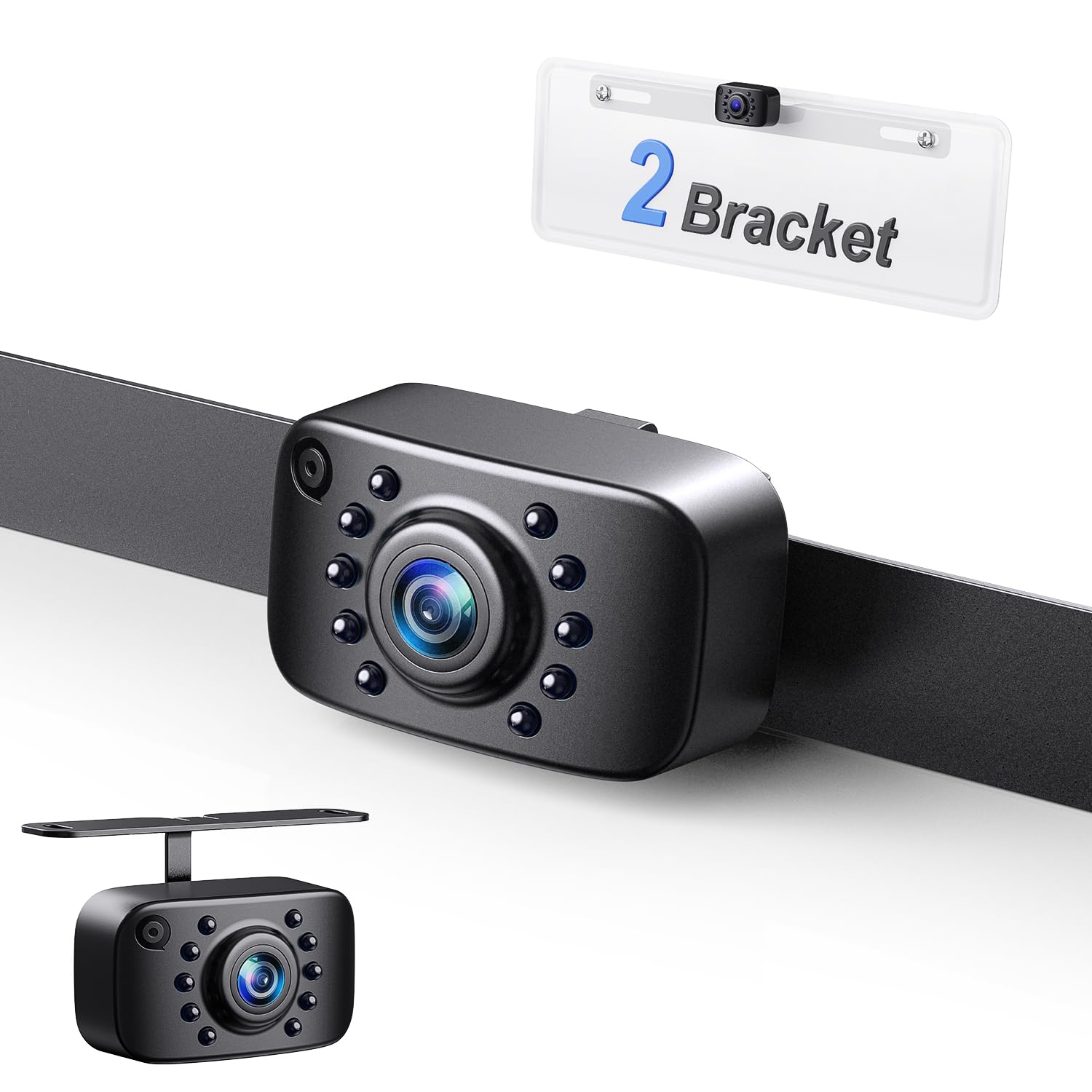
One buyer wrote “I have bought and used three of these eRapta backup cameras over the last 4 years, and I have to say that I am very satisfied with them” — that is the kind of repeat loyalty you rarely see for a product at this price tier. The ERT01 uses a standard CVBS signal (no AHD), which means it works with literally any aftermarket stereo that has a yellow RCA input, no wire cutting or signal switching needed. At 720 effective still resolution, the picture is standard definition — noticeably softer than the 1080p vampolo above — but buyers consistently say it is good enough to see what is behind them, and night vision is “surprisingly very good” thanks to the 10 built-in LED lights and 0.1 Lux sensitivity.
The camera body measures 9.4 inches long by 0.8 inches wide and just 1 inch tall — that slim profile fits behind a license plate without bulging out too far. It also includes two metal brackets, one for mounting behind the plate and a second bracket for trunk, bumper, or side-mirror mounting. The 148-degree field of view is narrower than the 170-degree cameras above, but it still covers the lane width behind most sedans and small SUVs. The waterproof rating is IP69K, which is actually a step above the IP68 found on the GreenYi models — it can handle high-pressure hot water jets, so automatic car washes are no concern.
Buyers report that the camera calibration varies noticeably between units — one might lean warm and saturated while another looks cool and washed out. The manufacturer appears to have loose quality control on color balance, but as several reviewers point out, it does not affect the actual ability to see obstacles when reversing.
The consistent performer
- Works with any RCA-equipped stereo immediately — no signal switching, no compatibility guesswork.
- IP69K rating is the highest waterproof standard here, surviving pressure washers.
- Two included brackets give you flexible mounting positions beyond just the license plate.
The corners cut
- 720p resolution is standard definition — noticeably softer than AHD 1080p options.
- Color/contrast calibration varies between units; you may get a slightly different tint from one camera to the next.
Reach for this if: You want a dead-simple CVBS camera that works with any stereo immediately, and you value waterproof toughness over maximum sharpness.
Look elsewhere if: You have a large high-resolution stereo screen where 720p will look pixelated — the vampolo or GreenYi will look noticeably clearer.
5. Leadsign Emblem Backup Camera for Ford F-Series (B096LP4MJW)
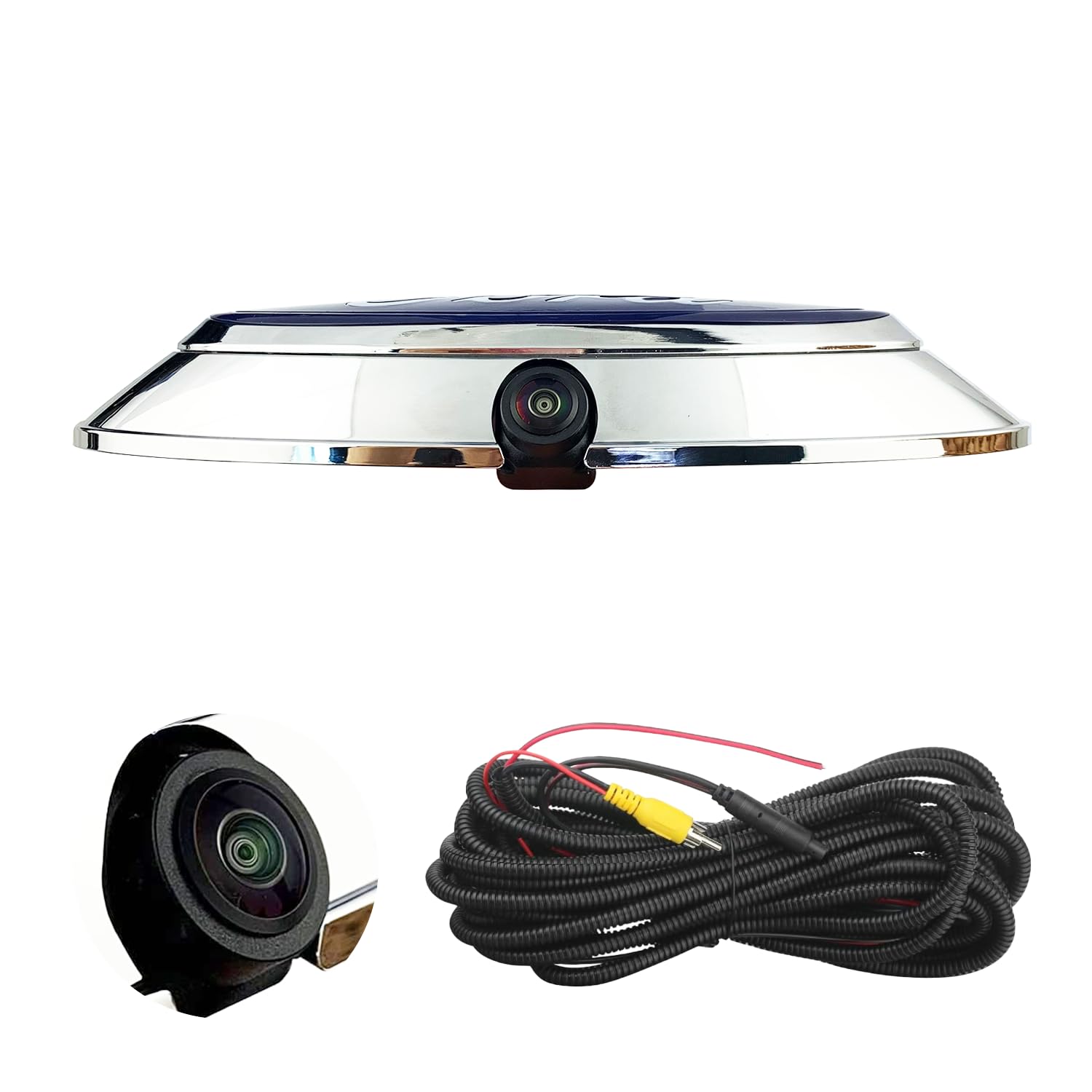
A factory-faithful emblem replacement that hides the camera inside your Ford’s rear badge.
If you drive a Ford F-150, F-250, F-350, F-450, or F-550 from 2004 to 2016, this is the only camera on the list that will look like it came from the factory. It replaces the entire rear Ford emblem with a new housing that has a pre-loaded camera inside, so there is no separate camera pod sticking out of the tailgate. The effective still resolution is 960 pixels — sharper than the eRapta’s 720 pixels but not as crisp as the 1080p vampolo or GreenYi options. The 170-degree field of view covers the truck’s full rear blind spot, and the IP69K waterproofing matches the eRapta for high-pressure resistance.
Wiring is straightforward: the kit comes with a 26-foot extension cable, and buyers confirm it is long enough to reach the front of the truck with plenty of slack. One reviewer who installed it on a 2011 F-150 said it worked “perfectly” with their CarPlay stereo. The camera outputs standard CVBS video through an RCA connector, so no AHD compatibility checking is needed — just plug the yellow RCA into your stereo and connect the red wire to your reverse light’s positive. The camera loops at the tailgate let you control grid lines and mirror image without additional wiring.
The main complaint from buyers is that the camera is angled slightly low from the factory, pointing more at the ground than at the horizon. One buyer mentioned it “doesn’t capture the full view of behind you but still decent,” so you may need to shim the housing tilt upward. The emblem attaches with adhesive rather than a mechanical bracket, which a few buyers felt was less secure than a bolted mount.
Invisible camera: Replaces the factory Ford emblem so the camera is completely hidden — no aftermarket look at all.
Tilt check needed: The pre-set angle points downward more than expected; you may need to add a thin spacer under the top edge to raise the view.
Best for: Ford F-Series owners who want a clean OEM appearance and do not want a camera pod bolted to their tailgate.
Not right for: Any non-Ford vehicle or anyone who wants the highest possible 1080p resolution — the 960-pixel sensor is clear but not the sharpest on this list.
6. KENWOOD CMOS-230LP Universal Backup Camera (B0CPJMH4WL)

The compact cube from a car-audio giant that prioritizes easy pairing with Kenwood decks.
Kenwood is one of the biggest names in aftermarket car stereos, so it makes sense that their own backup camera integrates cleanly with their head units. The CMOS-230LP has a 128-degree field of view — significantly narrower than the 170-degree cameras above — so you will not see as far to the sides. However, the camera is tiny: each side measures just 15/16 of an inch, so it fits almost anywhere without looking bulky. The effective still resolution is 330,000 pixels, which works out to roughly standard definition — comparable to the eRapta’s 720p but a different measurement method.
The kit includes a license plate mounting bracket plus a 24-foot cable harness with a built-in power supply, meaning you do not need a separate power module. Buyers with Kenwood decks report “excellent picture quality” and an easy install that looks clean. One owner reported it is “not as clear as some other cameras I’ve used, but it works just fine for a rearview camera.” For someone who already owns a Kenwood stereo and wants a guaranteed match without dealing with third-party compatibility issues, that trade-off is often worth it.
The camera is waterproof and designed to withstand harsh weather, though the datasheet does not specify an IP rating number like IP68 or IP69K. It comes with a one-year warranty from Kenwood, which is better coverage than most no-name cameras offer. The main downside beyond the narrower angle is the price — this costs roughly four times as much as the eRapta while delivering lower resolution and a smaller viewing area.
Why it belongs here
- Plug-and-play with Kenwood aftermarket stereos — zero configuration, just connect the RCA plug.
- Extremely compact 15/16-inch cube mounts almost anywhere without looking intrusive.
- One-year manufacturer warranty provides more protection than generic imports.
What you give up
- 128-degree field of view is 25% narrower than the 170-degree competitors — you miss more of the side blind spots.
- 330,000-pixel sensor is standard definition; it will not look sharp on a large screen.
Choose this if: You already run a Kenwood head unit and prize low-maintenance integration and the confidence of a brand warranty.
Pass on this if: Field of view or maximum picture sharpness matters more to you than brand pairing — the GreenYi or vampolo options deliver both at a lower price.
Understanding the Specs
Video Signal Type: CVBS vs AHD
The video signal type determines whether your stereo can display the camera’s image at all. CVBS (Composite Video Baseband Signal) is the standard yellow RCA composite video that every aftermarket stereo accepts — it is standard definition, usually around 480i or 576i depending on your region. AHD (Analog High Definition) is a newer format that sends a 720p or 1080p signal through the same RCA cable, but your stereo must explicitly support AHD at 25Hz/PAL to decode it. If you plug an AHD-only camera into a CVBS-only stereo, the screen stays black. Some cameras, like the two GreenYi models, include switcher cables that let you toggle between AHD and CVBS, giving you a fallback option if your stereo does not support the higher definition format.
Field of View and Its Real Effect
Field of view is measured across the diagonal of the camera’s lens and tells you how wide the image will be. A 170-degree camera shows almost everything from your left rear quarter panel to your right rear quarter panel, including the area directly behind the bumper. A 148-degree camera, like the eRapta, still shows the lane behind you but leaves slightly larger blind spots on the sides. A 128-degree camera, like the KENWOOD, shows a narrower corridor — you may miss a child or pet standing near the rear corner of your vehicle. For larger vehicles like SUVs, trucks, and vans, a wider field of view (170 degrees) is significantly safer because your rear blind spot is physically larger.
FAQ
Will any backup camera with an RCA plug work with my aftermarket stereo?
Can I install a backup camera myself without professional help?
How do I know if my aftermarket stereo supports AHD backup cameras?
What does IP68 and IP69K mean for a backup camera?
How long does the video cable need to be for a full-size truck or SUV?
Can I use a backup camera as a front or side-view camera?
Do I need to drill holes to install a license plate backup camera?
Why does my backup camera show a black screen even though everything is plugged in?
What is the difference between dynamic and static guide lines?
How do aftermarket LED tail lights affect backup camera performance?
Final Thoughts: The Verdict
For most people, the backup camera for aftermarket stereo winner is the GreenYi AHD 1080P with dynamic trajectory guide lines because it delivers genuine 1080p clarity, a 170-degree fisheye view, and moving guide lines that sync with your steering — all in a compact flush-mount metal body that looks factory-installed. If you want the absolute sharpest image for a simple license-plate install and your stereo supports AHD, grab the vampolo AHD 1080P. And for a glove-friendly CVBS camera that works with any stereo immediately and survives pressure washers, the standout is the eRapta ERT01 for sheer value and reliability.
How We Picked
We do not accept paid placement. Every pick is matched to a real buyer and a real use-case; we do not hands-on test units.
Sources & Methodology
Specifications: manufacturer listings and product documentation. Review insights: verified customer reviews, as of July 2026. Pricing: not shown on this page (it changes often); check the current price via the retailer link.
As an Amazon Associate, Gadgets Feed earns from qualifying purchases. This does not affect which products we feature.
Product prices and availability are accurate as of the date/time indicated and are subject to change. Any price and availability information displayed on Amazon at the time of purchase will apply to the purchase of this product. As an Amazon Associate I earn from qualifying purchases.
CERTAIN CONTENT THAT APPEARS ON THIS SITE COMES FROM AMAZON. THIS CONTENT IS PROVIDED "AS IS" AND IS SUBJECT TO CHANGE OR REMOVAL AT ANY TIME.
Amazon and the Amazon logo are trademarks of Amazon.com, Inc. or its affiliates.