
Every file you create—photos, documents, project files, music libraries—represents hours of work or irreplaceable memories. A single drive failure or accidental deletion can erase it all in a moment. That is why a dedicated backup external hard drive is not a luxury; it is the anchor of any serious digital workflow, providing a physical, offline copy you control completely.
I’m Rikta — the co-founder and writer behind Gadgets Feed. I spend my days analyzing storage controller specs, comparing NAND and platter densities, and tracking real-world transfer benchmarks across dozens of drive models to find the ones that genuinely protect your data. (And Homer 🐱 sat on the Seagate box until I promised not to recycle it.)
Whether you are backing up a creative portfolio or a family archive, the right drive balances capacity, transfer speed, and durability. This guide covers seven models that represent the best backup external hard drive options across capacity and performance tiers, helping you make an informed choice for your data.
How To Choose The Best Backup External Hard Drive
Selecting a backup drive means thinking beyond raw capacity. You need to match the interface speed to your computer, understand the recording technology inside the platters, and decide whether portability or maximum storage density matters more for your daily workflow.
Capacity and Recording Technology
The advertised terabyte count tells only half the story. Most modern HDDs use Shingled Magnetic Recording (SMR) to pack more data onto each platter. SMR drives are inexpensive and excellent for sequential backups but can slow to a crawl during random write operations or when you rewrite large blocks of data. For pure backup use—where you write once and read occasionally—SMR is perfectly fine. If you constantly edit files directly on the drive, look for a drive that uses Conventional Magnetic Recording (CMR).
Interface Speed and Real-World Throughput
Every portable HDD on this list uses USB 3.0 or USB 3.2 Gen 1, capped at a theoretical 5 Gbps. In practice, mechanical hard drives top out around 120-160 MB/s sequential read/write. That is fast enough to back up a 50 GB project in under ten minutes but not fast enough to saturate a modern USB-C port. The bottleneck is the physical platter, not the wire, so paying extra for a Thunderbolt enclosure on a spinning drive gains you nothing.
Form Factor and Power
Portable 2.5-inch drives draw power entirely from the USB bus, which makes them ideal for laptops and travel. Desktop-grade 3.5-inch drives require an external power adapter but can house larger platters for capacities of 6 TB and beyond. For a backup strategy that stays on your desk, the bulkier desktop form factor gives you more terabytes per dollar. For a drive you carry between home and office, a lightweight 2.5-inch unit is the better fit.
Quick Comparison
On smaller screens, swipe sideways to see the full table.
| Model | Category | Best For | Key Spec | Amazon |
|---|---|---|---|---|
| Samsung T7 | Premium SSD | Speed and durability | 1,050 MB/s read speed | Amazon |
| Seagate 4TB Portable | Premium HDD | Massive archival storage | 4 TB capacity | Amazon |
| WD 5TB Elements | Premium HDD | High capacity on a budget | 5 TB capacity | Amazon |
| WD 2TB Elements | Mid-Range HDD | General-purpose backup | USB 3.2 Gen 1 | Amazon |
| Toshiba Canvio Advance | Mid-Range HDD | Software-driven backup | Automatic backup software | Amazon |
| Seagate 2TB Portable | Mid-Range HDD | Console and PC compatibility | Works with PS5 and Xbox | Amazon |
| Toshiba Canvio Basics | Value HDD | Entry-level external storage | 1 TB in slim profile | Amazon |
In‑Depth Reviews
1. Samsung T7 Portable SSD

The Samsung T7 is the outlier on this list because it uses NAND flash instead of spinning platters, making it the fastest backup drive by a wide margin. Its PCIe NVMe interface delivers sequential reads of 1,050 MB/s and writes of 1,000 MB/s—roughly ten times the throughput of a typical portable HDD. For creative professionals who move large video projects or RAW photo catalogs, this speed difference transforms a ten-minute data transfer into a one-minute wait.
The T7 also offers practical durability that no HDD can match. The aluminum unibody construction is shock-resistant up to a six-foot drop, and the drive includes AES 256-bit hardware encryption for security. It ships in FAT32 format, so you will want to reformat it to NTFS (Windows) or APFS (Mac) for optimal performance. The included USB-C cable is short at 1.5 feet, so a longer third-party cable is a useful add-on for desktop setups.
Capacity options go up to 4 TB, and the drive runs whisper-quiet with no moving parts. The Samsung Magician software provides firmware updates and performance monitoring. Given its speed, encryption, and rugged build, the T7 is the strongest choice if your workflow demands fast, secure, and portable backup.
Why it’s great
- Vast read/write speeds (1,050/1,000 MB/s) dramatically reduce backup time
- Rugged aluminum unibody with 6-foot drop resistance
- Hardware AES 256-bit encryption protects sensitive data
- Compact, quiet, and runs cool even during sustained use
Good to know
- Included USB-C cable is only 1.5 feet long
- Higher cost per gigabyte compared to HDD alternatives
- Must reformat for full performance on modern operating systems
2. Seagate 4TB Portable External Hard Drive
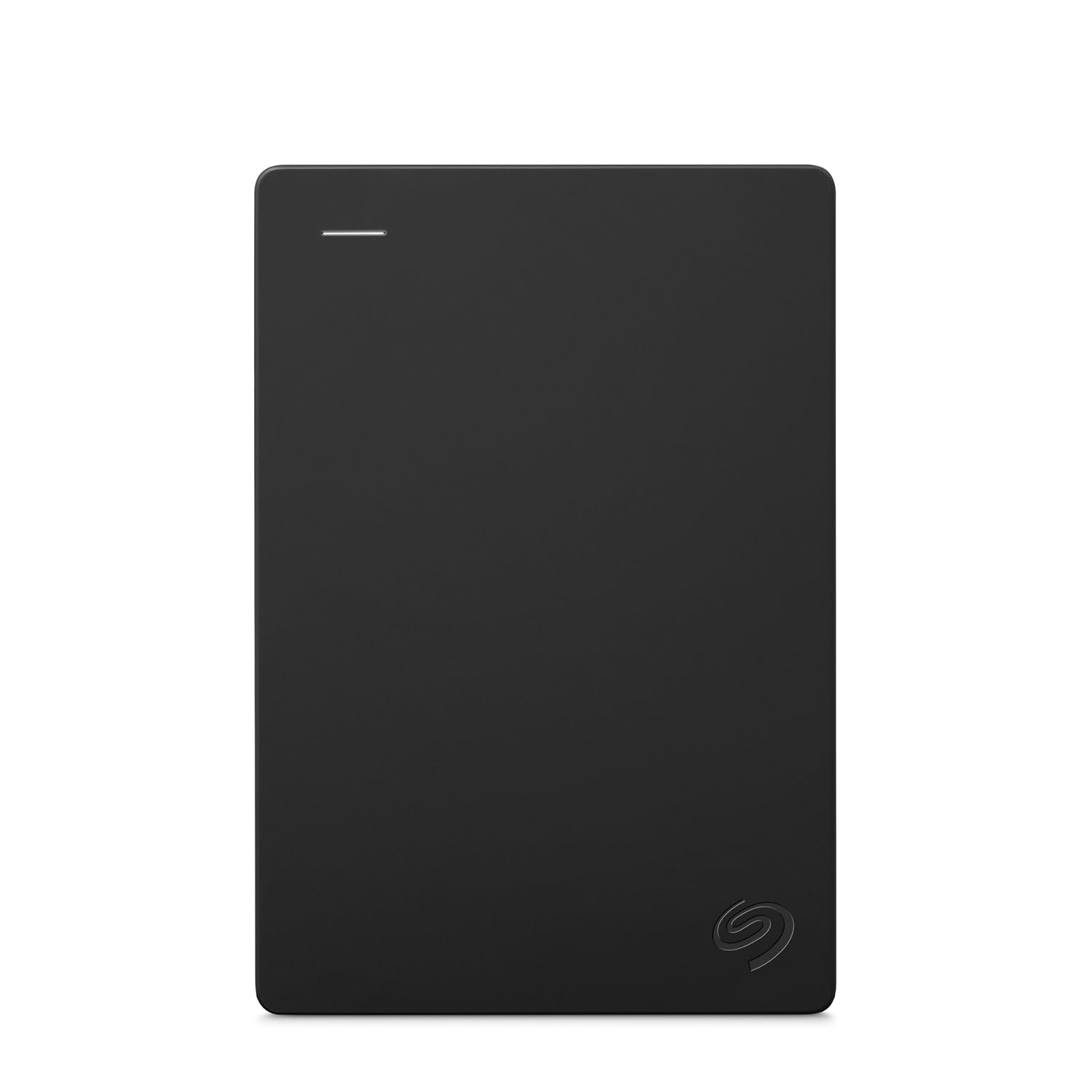
Seagate’s 4TB portable drive is the sweet spot for users who need a single archive drive for an entire media library. It uses an SMR platter design to pack four terabytes into a slim, bus-powered enclosure. Plug it into a USB 3.0 port and it is recognized instantly on Windows with no driver installation. Mac users will need a quick Disk Utility reformat to APFS or ExFAT before Time Machine recognizes it.
The drive includes Seagate’s 1-year Rescue Service, giving you a data recovery option if the drive fails. That peace of mind matters for a backup drive. The real-world sequential transfer rate sits at about 120 MB/s, which is standard for a 2.5-inch HDD. Write performance does drop after sustained use once the SMR cache fills—expect around 25 MB/s for large, continuous writes. That makes it ideal for archival backup rather than live project work.
It is compatible with PlayStation 5 and Xbox Series S consoles for game storage expansion, adding versatility beyond PC backup. The enclosure is plastic but feels solid, and the drive runs nearly silent in operation. For sheer capacity at a reasonable cost, the Seagate 4TB covers all the bases for mass storage.
Why it’s great
- 4 TB capacity in a lightweight, bus-powered enclosure
- Works with Windows, Mac, PlayStation, and Xbox
- Includes 1-year Rescue data recovery service
- Simple drag-and-drop operation with no software required on Windows
Good to know
- SMR cache causes write speeds to slow after 100 GB of sustained writing
- Requires reformatting for full Mac compatibility
- Plastic enclosure is less rugged than premium metal alternatives
3. Western Digital 5TB Elements Portable External Hard Drive

The WD Elements series has been a workhorse in external storage for years, and the 5TB model is its densest portable offering. The 2.5-inch form factor houses five terabytes of SMR storage while drawing power entirely from the USB bus. The SuperSpeed USB 3.2 Gen 1 interface (5 Gbps) handles sequential transfers around 110-130 MB/s, matching the physical limit of the platter. It is pre-formatted NTFS for Windows and works out of the box.
This drive is physically larger than a typical 1TB or 2TB portable drive, but it remains pocketable for a laptop bag. User reviews note that the included USB-A cable is a weak point—it can fail after repeated use, so having a spare high-quality USB 3.0 cable is smart. The enclosure is dark matte plastic that resists fingerprints and scratches well.
For Mac users, the 5TB Elements requires reformatting to HFS+ or APFS, which takes a minute in Disk Utility. The drive runs whisper quiet and stays cool to the touch during normal backup operations. If your goal is the highest portable capacity at the lowest cost, the 5TB Elements delivers exactly that without extra fluff or software.
Why it’s great
- Massive 5 TB portable capacity without needing external power
- Reliable, established platform with consistent user satisfaction
- Plug-and-play simplicity for Windows systems
- Excellent cost per terabyte ratio in portable form
Good to know
- Included USB cable is not the most durable
- Not a true travel drive; handling with care is recommended
- Requires reformatting for Mac Time Machine compatibility
4. WD 2TB Elements Portable External Hard Drive

The 2TB WD Elements is a textbook mid-range portable HDD. It uses the same proven platform as its 5TB sibling but in a smaller, lighter package. The USB 3.2 Gen 1 interface delivers the same 5 Gbps ceiling, and the drive achieves typical sequential reads around 120 MB/s. What stands out is its consistency—reviews consistently report reliable operation across Windows, Mac, and even gaming consoles without glitches.
This 2TB version is ideal for users who need a dedicated backup drive for a single laptop or for offloading photos and documents. It is compact enough to slide into a jacket pocket. One quirk: Windows users on older machines may need to click “Stop using this drive” when swapping between drives to avoid initial backup failures. That is a minor USB enumeration issue, not a drive defect.
The drive runs quiet and stays cool because the 2TB platter density keeps thermal output low. It does not include any backup software, which the minimalist approach many users prefer. For someone who wants a no-fuss, proven backup drive at a fair price, the 2TB Elements is the standard.
Why it’s great
- Proven reliability across millions of units sold
- Compact and lightweight for everyday carry
- Quiet operation with low heat output
- Compatible with Windows, Mac, and gaming consoles
Good to know
- No included backup software or encryption tools
- May need a powered USB hub on some systems for stable recognition
- Plastic enclosure feels basic compared to textured alternatives
5. Toshiba Canvio Advance 2TB Portable External Hard Drive

Toshiba’s Canvio Advance steps up from the basic Canvio Basics by adding genuine software value. The drive ships with a free downloadable automatic backup utility for Windows that can schedule regular backups without third-party tools. It also includes password protection software to lock the drive content if it gets lost or stolen. These features make it the best option for users who want software-driven backup without paying for a cloud subscription.
The hardware itself is a solid 2TB 2.5-inch SMR drive with a USB 3.0 interface delivering 5 Gbps. The enclosure has a textured white finish that stands out from the sea of black drives. It is compact and lightweight at under 150 grams. One catch: the backup software only works on Windows. Mac users must reformat the drive and rely on Time Machine for scheduling. The included setup link has been known to break, so you may need to navigate to Toshiba’s support site manually.
User reviews consistently note the drive runs cool and silent during operation. The 2-year warranty doubles what many budget drives offer, adding long-term confidence. If you prefer having a software assistant for your backup schedule, the Canvio Advance delivers that convenience without a premium markup.
Why it’s great
- Automatic backup software included for Windows (free download)
- Hardware password protection for data security
- Attractive textured design in multiple color options
- Generous 2-year manufacturer warranty
Good to know
- Backup software works only on Windows PCs
- Setup link may be broken; requires manual driver search
- Lower raw value vs. larger capacity alternatives at similar price tier
6. Seagate 2TB Portable External Hard Drive
Seagate’s 2TB portable drive is built around the same SMR platform as its 4TB sibling but in a smaller capacity that appeals to college students, casual users, and console gamers. It is one of the few portable HDDs that explicitly lists compatibility with Sony PlayStation 5 and Microsoft Xbox Series S, making it a viable extended storage device for game libraries. The drive is recognized automatically on Windows and works with Mac after a quick reformat to ExFAT or APFS.
The drive ships with Seagate’s 1-year Rescue Service, which covers data recovery if the drive fails. That is a meaningful addition for a backup drive. The USB 3.0 interface delivers a sequential data transfer rate rated at 130 MB/s, and users confirm it handles large file transfers reliably. The compact black enclosure is lightweight and unobtrusive on a desk or in a bag.
One limitation: because it uses SMR, sustained write performance drops after the drive’s cache fills. For daily backups of a few gigabytes, you will never notice it. For moving hundreds of gigs at once, expect the write speed to settle around 25 MB/s after the first 100 GB. This is a general SMR trait, not a defect. For most backup scenarios, the Seagate 2TB does exactly what its label promises.
Why it’s great
- Officially compatible with PlayStation 5 and Xbox Series S|X
- Includes 1-year Rescue data recovery service
- Plug-and-play simplicity on Windows computers
- Lightweight and easy to carry between devices
Good to know
- SMR drive slows significantly during sustained writes over 100 GB
- Mac users must reformat before use
- Plastic enclosure feels utilitarian
7. Toshiba Canvio Basics 1TB Portable External Hard Drive

The Toshiba Canvio Basics 1TB is the most straightforward entry in this list. It offers a single terabyte of portable storage in a matte, smudge-resistant black enclosure. The USB 3.0 interface reaches the standard 5 Gbps ceiling, and the drive delivers sequential transfers of about 100-120 MB/s. There is no bundled software, no encryption tools, and no backup utility—just the drive, a USB 3.0 cable, and a quick-start guide. For users who prefer a bare-bones device, that is a virtue.
The drive is pre-formatted NTFS for Windows, so Mac users will need to reformat before use. The 2.5-inch form factor makes it extremely portable, and user reviews consistently mention it runs cool even after hours of continuous downloads. The build quality is solid polycarbonate with a clean, minimalist look. The 1 TB capacity is enough for thousands of photos, dozens of full system backups, or a moderate music and document library.
Where this drive really shines is as a first backup drive for someone who has never owned external storage. It removes all complexity: plug it in, drag files over, done. The 1-year warranty is standard, and the drive is USB 2.0 compatible for older computers. If your backup needs are modest and you want the simplest possible solution, the Canvio Basics 1TB is the answer.
Why it’s great
- Simplest plug-and-play operation available
- Matte finish resists fingerprints and smudges
- Runs cool and quiet during extended use
- Very affordable entry point for first-time external drive buyers
Good to know
- 1 TB fills quickly for media libraries or full system disk images
- No included backup software or encryption tools
- Must reformat for Mac compatibility
FAQ
Can I use an SMR external hard drive for Time Machine backups?
Why does my external hard drive show less capacity than advertised?
Should I reformat a new external hard drive for Mac compatibility?
Final Thoughts: The Verdict
For most users, the backup external hard drive winner is the WD 2TB Elements Portable because it delivers the best balance of proven reliability, adequate 2TB capacity, and a competitive price per terabyte for everyday backup tasks. If you prioritize blistering speed and future-proof durability over raw capacity, grab the Samsung T7 Portable SSD. And for mass archival storage where every terabyte matters, nothing beats the Seagate 4TB Portable for maximizing your storage budget in a portable form factor.