
A storm rolls in, the lights go dark, and suddenly your refrigerator is silent, your sump pump is useless, and your family’s comfort hangs on a single decision. The difference between a minor inconvenience and a full-blown emergency often comes down to one machine: a backup generator that can keep your home running when the grid fails. But with ratings like starting watts, running watts, fuel types, and transfer switch compatibility flooding every product page, finding the right match for your actual home load is the real challenge.
I’m Min — the co-founder and writer behind Gadgets Feed. I’ve spent countless hours researching the generator market, analyzing technical specifications from engine displacement and THD to fuel consumption rates and CO detection systems, so you can cut through the noise and buy with confidence.
After comparing over a dozen models across every power tier, from portable inverter units to whole-house standby systems, I’ve assembled the definitive guide to finding the best backup generator for home use that actually fits your budget and electrical demands.
How To Choose The Best Backup Generator For Home Use
Selecting the right generator starts with understanding your home’s actual electrical load. A model that’s too small will trip under load, while an oversized unit wastes fuel and money. Focus on three core decisions: power output, fuel type, and whether you need automatic standby or a portable unit you wheel out during an outage.
Power Output: Starting vs. Running Watts
Every motor-driven appliance — refrigerator compressor, well pump, window AC — requires a surge of power to start, often 2-3 times its running wattage. Add up the running watts of everything you want to power simultaneously, then add the single largest starting wattage to that total. That number is your minimum generator capacity. For most homes, 5,000 to 7,500 running watts covers essentials; whole-house protection requires 12,000 watts or more.
Fuel Type: Gasoline, Propane, or Dual Fuel
Gasoline offers maximum power density but degrades in storage and is harder to source during regional emergencies. Propane burns cleaner, stores indefinitely, and is safer for carburetors, but delivers roughly 10-15% less peak wattage. Dual-fuel generators give you both options in one machine, letting you start on gasoline for maximum output and switch to propane for longer, cleaner runtime. Natural gas is the gold standard for standby units, but requires a fixed gas line installation.
Transfer Switch: Portable vs. Automatic Standby
A portable generator with extension cords is the simplest setup, but a manual transfer switch lets you backfeed selected circuits through your panel safely. For true whole-home convenience, an automatic standby generator with an ATS detects grid failure, starts itself, and transfers power in seconds — no extension cords, no waking up in the dark. This is the premium solution, but also the most expensive and requires professional installation.
Quick Comparison
On smaller screens, swipe sideways to see the full table.
| Model | Category | Best For | Key Spec | Amazon |
|---|---|---|---|---|
| Generac Guardian 22kW | Standby | Whole-Home Automation | 22,000W / 999cc Engine | Amazon |
| Westinghouse 12500W | Portable | Heavy Home Backup | 12,500W Peak / 457cc | Amazon |
| DuroStar DS13000MX | Portable | Whole-Home Power Backup | 13,000W / 500cc Dual Fuel | Amazon |
| AIVOLT 11250W | Inverter | Quiet High Power | 11,250W / Inverter Tech | Amazon |
| EF ECOFLOW Delta Pro | Power Station | Fume-Free Indoor Backup | 3,600Wh / 3,600W Output | Amazon |
| ABOK Ark3600 | Power Station | Expandable Solar Backup | 3,840Wh / 3,600W Output | Amazon |
| AIVOLT 8000W | Inverter | Quiet Mid-Power Backup | 8,000W / 62 dBA | Amazon |
| Anker SOLIX C2000 Gen 2 | Power Station | Fast-Charging Portable Power | 2,048Wh / 2,400W Output | Amazon |
| WEN DF680iX | Inverter | EV Charging Backup | 6,800W / 240V Bonded Neutral | Amazon |
| Champion 4500W | Inverter | Light Home & RV Use | 4,500W / 61 dBA | Amazon |
| WEN DF480iX | Inverter | Budget Dual-Fuel Inverter | 4,800W / 78.5 lbs | Amazon |
In‑Depth Reviews
1. Generac Guardian 22kW Home Standby Generator
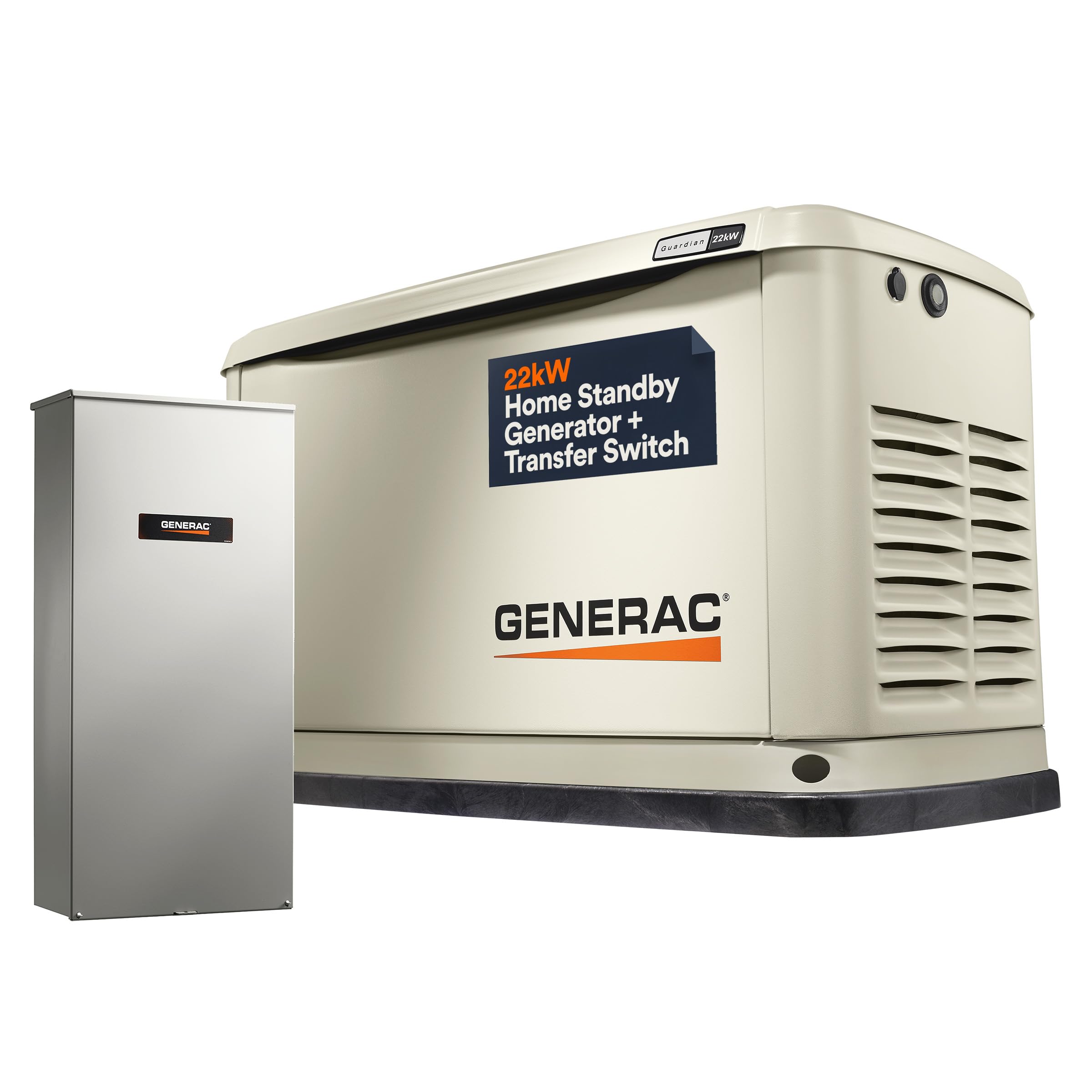
The Generac Guardian 22kW is the gold standard for whole-house automatic backup, combining a 999cc G-Force engine with a 200-amp NEMA 3R smart transfer switch. True Power Technology delivers under 5% total harmonic distortion, meaning clean enough power for sensitive electronics like variable-speed HVAC systems and medical devices without any additional filtering.
This standby unit runs on natural gas or liquid propane, with Mobile Link Wi-Fi letting you monitor generator status, run time, and maintenance alerts directly from your phone. The automatic transfer switch senses grid failure, starts the generator, and restores power in about 10 seconds — no manual intervention required even if you’re away from home.
Professional installation by a licensed electrician is mandatory, but once commissioned, the 5-year limited warranty and purpose-built G-Force engine design provide long-term peace of mind for full-house coverage. Owners report seamless power restoration for everything from central AC to well pumps, with remote monitoring that flags issues before they become emergencies.
Why it’s great
- True whole-home automation with 200A transfer switch
- Remote monitoring via Mobile Link app
- 5-year warranty and US engineering
Good to know
- Requires professional installation and gas line
- Wi-Fi connectivity is required for initial setup
2. Westinghouse 12500 Peak Watt Dual Fuel Portable Generator

The Westinghouse 12500W delivers 9,500 running watts on gasoline and 8,500 running watts on propane, powered by a 457cc 4-stroke OHV engine with a long-lasting cast iron sleeve. The 6.6-gallon fuel tank provides up to 12 hours of runtime at 50% load, and the remote start key fob lets you fire it up from inside the house during a storm.
This unit is transfer switch ready with a 120/240V 50-amp outlet, plus two GFCI 120V 20-amp household receptacles with rubber covers. The CO sensor automatically shuts down the generator if dangerous carbon monoxide levels accumulate, and the included tool kit, oil funnel, and battery charger minimize setup time.
Consumer Reports and Popular Mechanics have both rated this model as a top pick for home backup. Users note it handles simultaneous well pump and water heater loads without issue, though the open-frame design means it’s loud — expect a deep hum around 70+ dBA under load. The 212-pound weight requires careful positioning, but the wheel kit makes rolling it manageable on flat ground.
Why it’s great
- Remote start key fob for convenience
- Rated highest by independent test labs
- Dual fuel with 50A transfer switch outlet
Good to know
- Very heavy at 212 pounds
- Open frame is quite loud
3. DuroStar DS13000MX 13,000-Watt Dual Fuel Generator

The DuroStar DS13000MX packs a 500cc engine that produces 13,000 peak watts and 10,000 running watts on gasoline, with slightly lower output on propane. The push-button electric start combined with a front-facing fuel selector makes switching between gas and propane effortless, and the included remote control lets you start or stop the generator from a distance.
This unit is built for full-home backup with a 50-amp outlet ready for transfer switch connection. The all-metal construction and reinforced power panel are designed to withstand harsh weather, and the CO Alert system adds an extra safety layer by automatically shutting down the generator if carbon monoxide reaches dangerous levels.
Users consistently report that the DS13000MX powers an entire home including a 1.5-ton AC unit, fridge, stove, and water heater with only brief strain when the AC compressor kicks on. The 220-pound weight is substantial, but the included wheel and handle kit makes it manageable for one person to move across a driveway.
Why it’s great
- Runs 1.5-ton AC plus full home loads
- Remote start key fob included
- Dual fuel with CO detection
Good to know
- 220 pounds is heavy to position
- Not an inverter — higher THD
4. AIVOLT 11250W Dual Fuel Inverter Generator
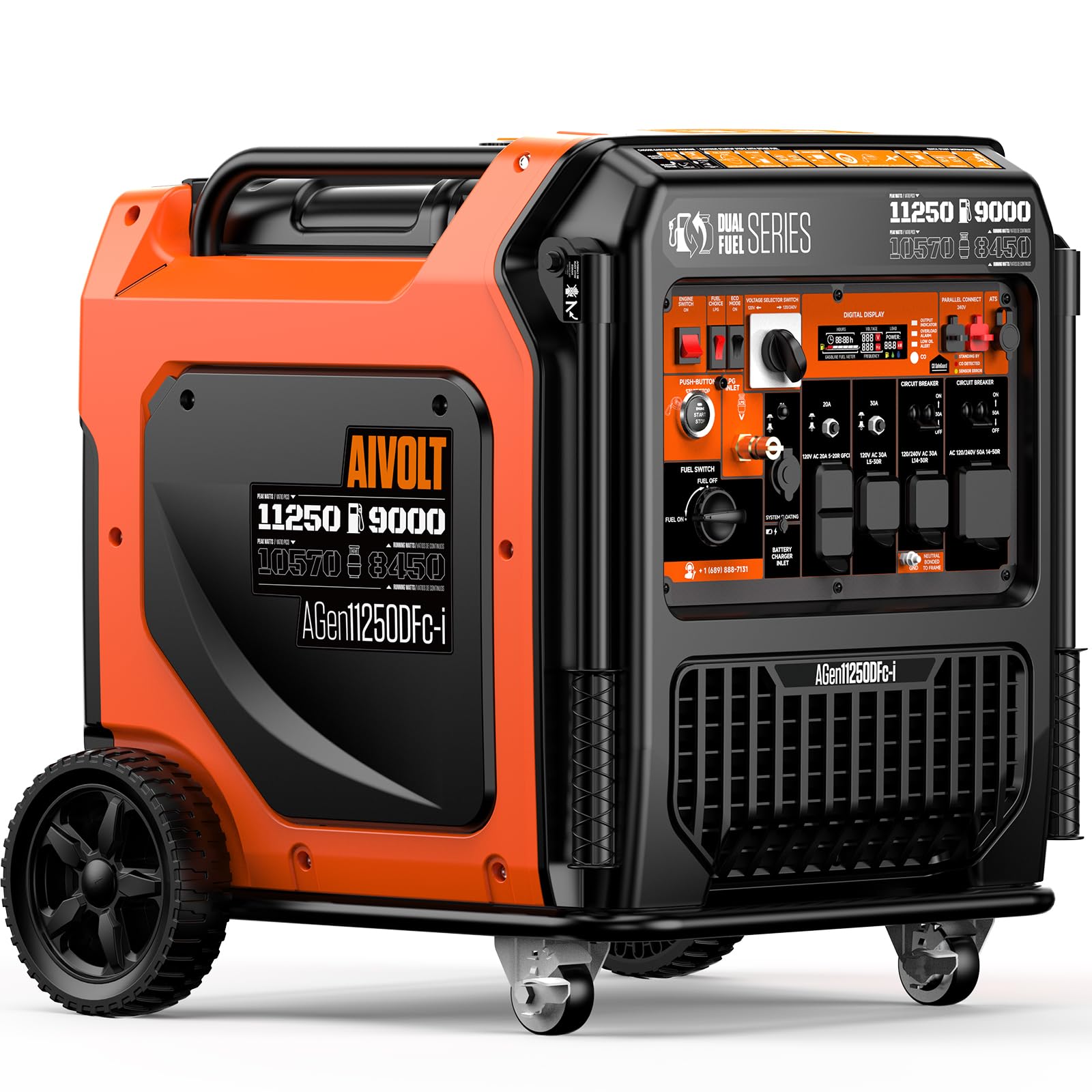
The AIVOLT 11250W is one of the most powerful inverter generators available, delivering 11,250 starting watts and 9,000 running watts on gasoline with clean inverter power (under 3% THD) that’s safe for sensitive electronics. The dual-fuel system includes automatic fuel-switching technology, letting you swap between gasoline and propane without shutting down or making manual adjustments.
This unit is CARB compliant and approved in all 50 states, with an ultra-quiet operation around 60 dBA at 23 feet — comparable to a normal conversation. The 5-in-1 LCD display tracks fuel consumption, output, voltage, frequency, and runtime, while the remote start key fob adds convenience for cold mornings or quick deployment during an outage.
Users running food trucks report this generator handles 32 cu ft fridges, prep tables, and 24,000 BTU AC units simultaneously. The 50-amp RV outlet makes it ideal for large RVs, and the parallel-ready capability allows pairing with another unit for 22,500W of combined output. Quality control is a note — some units arrive with minor defects, so testing within the first 30 days is recommended.
Why it’s great
- Inverter-clean power for electronics
- Automatic fuel switching between gas and propane
- 50-state CARB compliant
Good to know
- Some units reported with initial defects
- Support is based in China
5. EF ECOFLOW Delta Pro 3600Wh Power Station
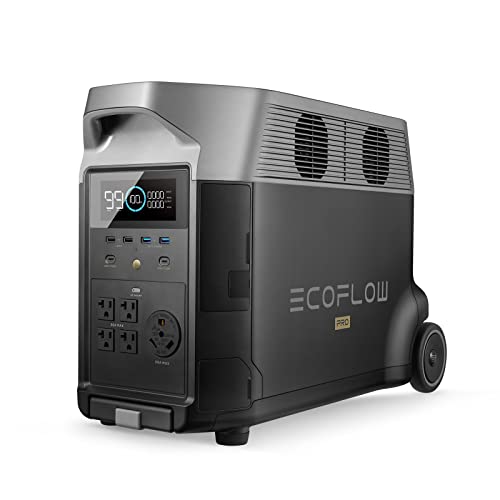
The EcoFlow Delta Pro is a 3,600Wh LiFePO4 battery station that outputs 3,600W AC continuously, with X-Boost technology allowing it to handle surges up to 4,500W for motor-driven appliances. X-Stream fast charging fills the unit from zero to 100% in just 2.7 hours from a standard wall outlet, or in 1.8 hours using a 240V outlet.
With five 120V AC outlets, multiple USB-C and USB-A ports, and support for up to 4,000W of solar input, the Delta Pro can power a refrigerator, freezer, lights, and internet router for over 24 hours on a single charge. The LiFePO4 battery chemistry delivers over 3,500 cycles to 80% capacity, translating to roughly 10 years of daily use before significant degradation.
The EcoFlow app provides real-time monitoring of charge level, input/output rates, and individual device consumption via Bluetooth or Wi-Fi. Users running medical equipment like oxygen concentrators report over 10 hours of continuous runtime, and the seamless grid-to-battery switching (under 20ms) makes it a true UPS for sensitive electronics.
Why it’s great
- Fast 2.7-hour full recharge
- 3,500+ cycle LiFePO4 battery
- Seamless UPS switching for electronics
Good to know
- 99 pounds is heavy for a battery
- Expansion batteries are expensive
6. ABOK Ark3600 3840Wh Power Station
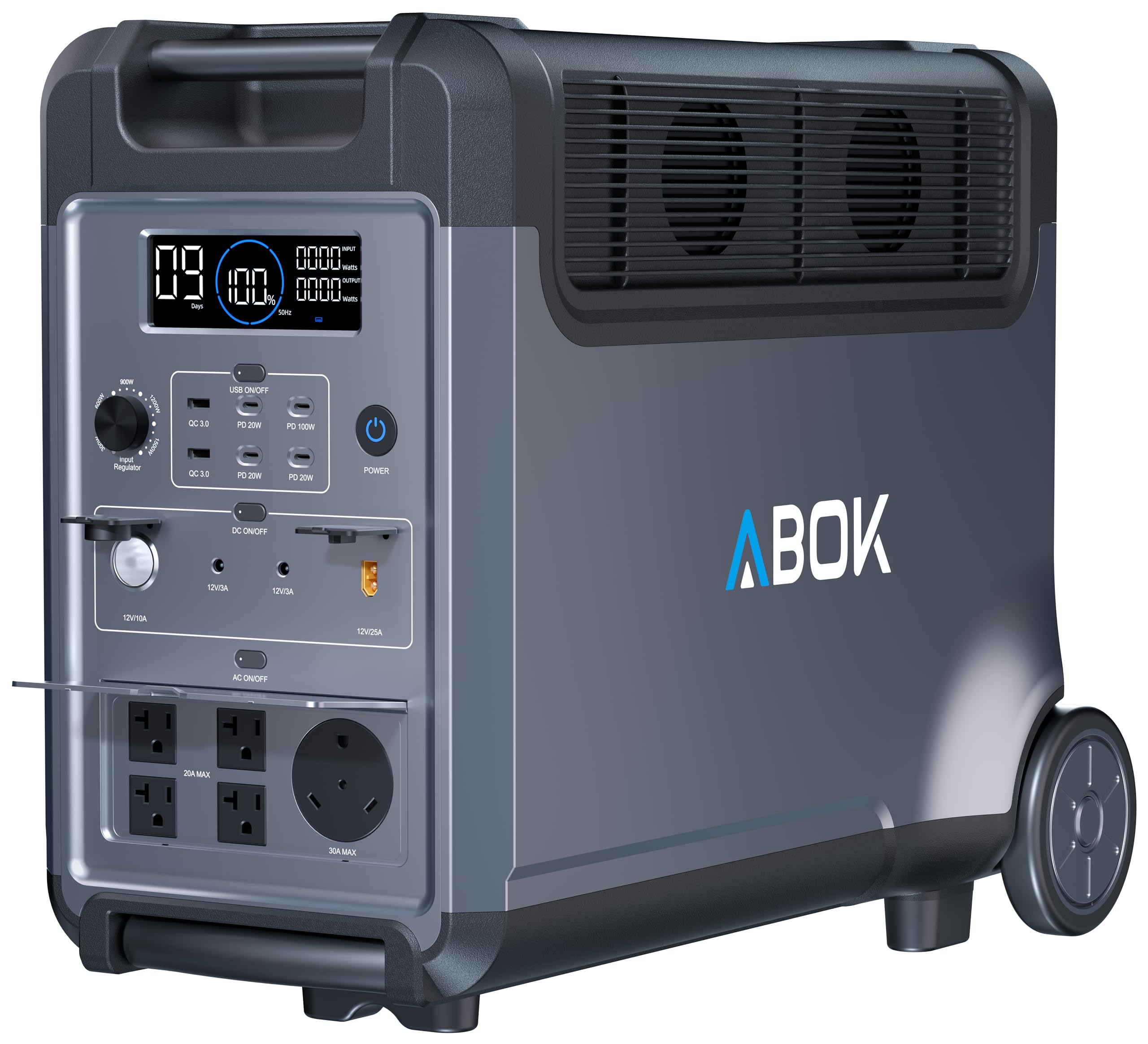
The ABOK Ark3600 features a 3,840Wh LiFePO4 battery that’s expandable up to 11,520Wh with additional units, providing enough capacity to run a refrigerator continuously for over 30 hours. The 3,600W rated output (4,500W peak) handles 99% of household appliances, including window AC units, sump pumps, and microwave ovens simultaneously.
With 15 output ports including a 30A AC outlet, three USB-C ports (one 100W PD), and an XT60 output for solar, this station is built for versatility. The telescoping handle and durable wheels make the 92-pound unit easy to transport, and the Bluetooth app lets you monitor power consumption and adjust settings remotely.
Users praise the value proposition, noting that the Ark3600 costs significantly less than comparable capacity stations from bigger brands while offering similar build quality and expandability. The 30-day return guarantee and 2+3 year service plan provide reasonable peace of mind, though the lack of a 240V outlet limits some high-power applications.
Why it’s great
- Expandable to 11,520Wh capacity
- Excellent value per watt-hour
- Telescoping handle and wheels for portability
Good to know
- No 240V outlet option
- Charging slow below 32°F
7. AIVOLT 8000W Dual Fuel Inverter Generator

The AIVOLT 8000W inverter generator uses a 322cc 4-stroke OHV copper-winding engine to deliver 8,000 starting watts and 6,100 running watts at just 62 dBA — quiet enough for residential neighborhoods without disturbing neighbors. The inverter technology produces clean power with under 3% THD, making it safe for laptops, TVs, and other sensitive electronics.
The multifunction control panel includes two 120V 20A GFCI outlets, a 240V 30A twist lock, a 120V 50A industrial outlet, and a 12V DC cigarette port with USB adapter. The 5-in-1 LCD display provides real-time monitoring of fuel consumption, output wattage, voltage, frequency, and runtime hours.
Users report the 8000W model runs a 400W portable AC with 1,500W startup surge plus multiple electronics without issue. The automatic fuel-switching technology allows seamless transition between gasoline and propane while running, and the CO Alert system adds critical safety protection. Some users note the noise level is louder than the 57 dBA rating suggests — expect 72 dBA at 5 feet under moderate load.
Why it’s great
- Quiet 62 dBA operation
- Clean inverter power for electronics
- Automatic fuel switching between gas and propane
Good to know
- Measured noise higher than advertised
- Needs cooldown before restarting when hot
8. Anker SOLIX C2000 Gen 2 Power Station
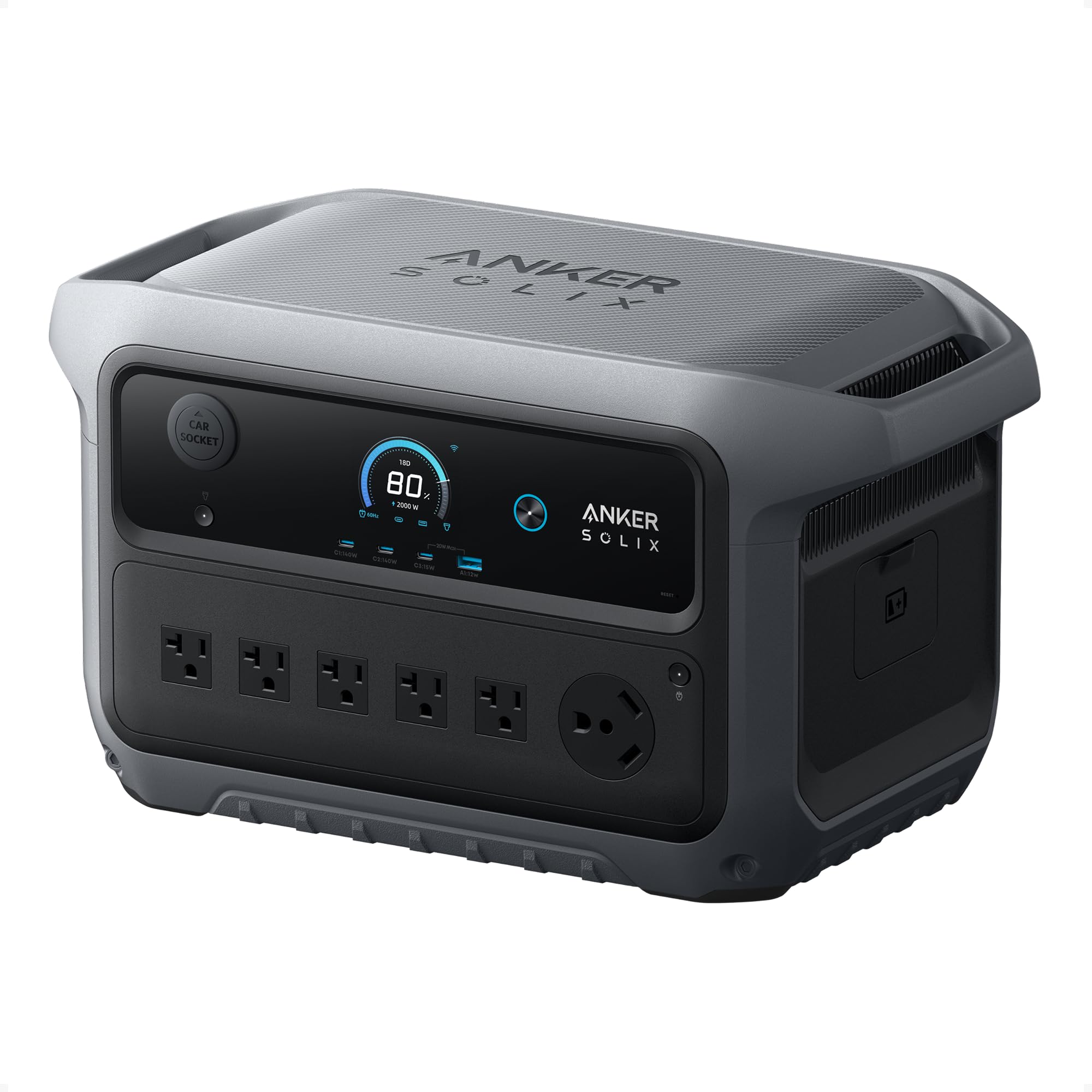
The Anker SOLIX C2000 Gen 2 is the fastest-charging power station in its class, reaching 100% capacity in just 58 minutes via AC input. The 2,048Wh LiFePO4 battery delivers 2,400W continuously with 4,000W peak output, enough to start and run most window and RV air conditioners.
At only 41.7 pounds and 18.1 x 9.8 x 10.1 inches, this unit is 25% lighter and 29% smaller than comparable 2kWh stations, making it genuinely portable for moving between rooms or taking on road trips. The 800W alternator charging capability lets you recharge from your vehicle in 3 hours — 8 times faster than a standard car socket.
Users report the C2000 Gen 2 powers a 30-quart car fridge for 5-7 days on a single charge, and during outages it keeps a TV, refrigerator, WiFi router, and lights running for over 10 hours. The standby power consumption is just 9W, and the companion app provides detailed usage analytics and remote monitoring.
Why it’s great
- Full charge in 58 minutes
- Only 41.7 pounds — highly portable
- 800W alternator charging for vehicles
Good to know
- 2kWh capacity limits runtime for large homes
- Solar charging input limited to 600W
9. WEN DF680iX 6800-Watt Dual Fuel Inverter

The WEN DF680iX is a dual-fuel inverter generator with a bonded-neutral 240V configuration that provides low-power Level 2 charging for battery and hybrid electric vehicles. The 224cc engine delivers 6,800 surge watts and 5,100 rated watts on gasoline, with slightly less on propane (6,000 surge / 4,500 rated).
The inverter technology keeps THD below 3%, and the WEN Watchdog CO Shutdown Sensor automatically turns off the generator if dangerous carbon monoxide levels are detected. The fuel shut-off feature lets you run the carburetor dry before storage, preventing gumming and extending engine life.
Users at off-grid cabins report the DF680iX runs efficiently on a 40-pound propane tank for an entire weekend, powering water pumps and cabin essentials in Eco mode. The bonded-neutral 240V configuration is a rare feature in this price range, making it suitable for EV owners who need emergency charging capability during extended outages.
Why it’s great
- 240V bonded-neutral for EV charging
- Inverter-clean power under 3% THD
- Fuel shut-off for long-term storage
Good to know
- Some units shipped with 240V outlet failures
- Customer service responsiveness is inconsistent
10. Champion 4500-Watt RV Ready Inverter Generator

The Champion 4500W inverter generator is a lightweight powerhouse at 92 pounds, producing 4,500 starting watts and 3,500 running watts with quiet technology rated at just 61 dBA — quieter than a typical vacuum cleaner. The 212cc engine runs up to 14 hours on 2.3 gallons of gasoline, making it one of the most fuel-efficient generators in its class.
The Intelligauge display monitors voltage, frequency, and operating hours, while the CO Shield carbon monoxide auto shutoff system provides critical safety. Economy Mode adjusts engine speed based on load, reducing fuel consumption and noise during light-duty operation. The parallel kit capability lets you link two Champion inverters to double output power.
Commercial users report running this generator 24/7 for months in food trucks and at construction sites with only weekly oil changes, having replaced unreliable 6,000W units that shut down multiple times daily. RV owners find it runs their 23-foot camper’s AC alongside other appliances without issue. The 3-year limited warranty and lifetime technical support add significant long-term value.
Why it’s great
- Industry-leading fuel efficiency (14 hrs on 2.3 gal)
- Lightweight at 92 pounds
- Free lifetime technical support
Good to know
- Gasoline only — no propane option
- Not as quiet as premium Honda models
11. WEN DF480iX 4800-Watt Dual Fuel Inverter
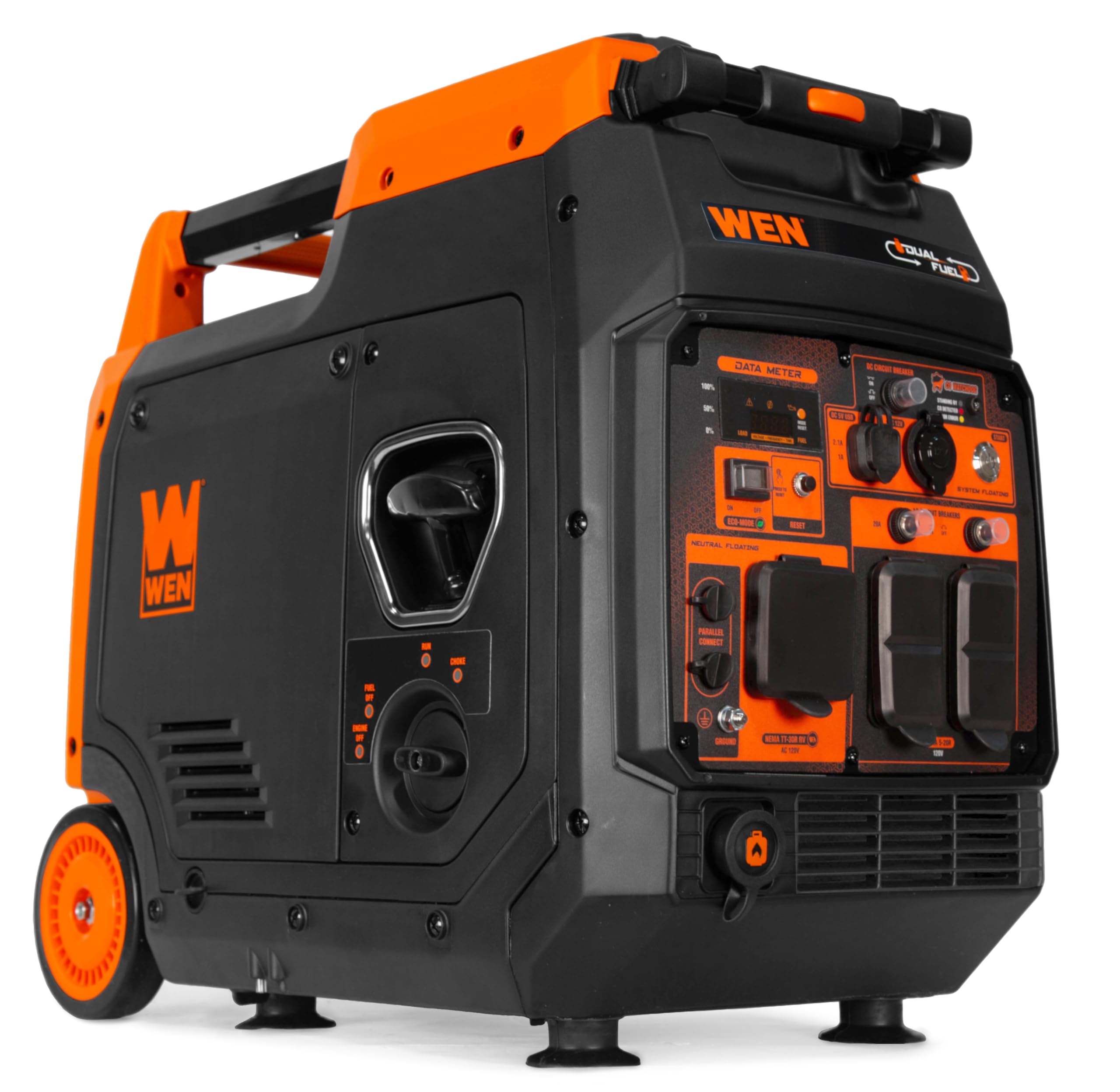
The WEN DF480iX is the most affordable dual-fuel inverter generator in this guide, offering 4,800 surge watts and 4,000 rated watts on gasoline (4,320 surge / 4,000 rated on propane) at just 78.5 pounds — light enough for a 76-year-old user to lift into a vehicle. The 224cc 4-stroke engine produces clean inverter power safe for smartphones, laptops, and tablets.
The CO Watchdog sensor automatically shuts down the generator if carbon monoxide reaches dangerous levels, and the fuel shut-off feature lets you run the carburetor dry to prevent fuel degradation during storage. The telescoping pull handle and onboard wheels make positioning effortless, and the control panel includes four 120V 20A outlets, one TT-30R RV receptacle, and two USB ports.
Users report the DF480iX runs essential home loads — lights, refrigerator, portable AC, TV, and modem — for a full week during extended outages. Running on propane, it operates for over 8 hours per tank while staying quiet enough for normal conversation nearby. The magnetic dip stick catches metal shards during break-in, and the three-year warranty provides solid coverage for the price point.
Why it’s great
- Lightest dual-fuel inverter at 78.5 lbs
- Excellent value — cheapest dual-fuel inverter
- RV-ready TT-30R outlet included
Good to know
- No automatic fuel switchover
- Hidden oil drain plug can be tricky to access
FAQ
How many watts do I need to run a refrigerator and a freezer during an outage?
Can I plug a generator directly into a wall outlet to power my house?
How often do I need to change the oil in a portable generator?
Is it better to store gasoline or propane for generator fuel?
Final Thoughts: The Verdict
For most users, the best backup generator for home use winner is the Generac Guardian 22kW because it offers true whole-home automation with zero manual intervention — it starts itself, transfers power, and monitors itself remotely. If you want silent, fume-free indoor operation with fast recharge, grab the EF ECOFLOW Delta Pro. And for a budget-friendly portable that still offers dual-fuel flexibility and inverter-clean power, nothing beats the WEN DF480iX.