
Our readers keep the lights on and my morning glass full of iced black tea. As an Amazon Associate, I earn from qualifying purchases.
Specs are compiled from manufacturer listings and verified buyer reviews and can change over time — please confirm the key details on the product page before buying.
When the power cuts, your fridge is the first thing you worry about. A good backup generator keeps it running and your food safe, but the wrong one leaves you in the dark with warm groceries. The best backup generator for refrigerator duty is quiet enough to run near living spaces, light enough to move, and powerful enough to start the compressor without a struggle.
I’m Min — the founder and writer behind Gadgets Feed. This guide is built by comparing the manufacturers’ published specifications and the patterns across verified customer reviews, so you get each pick’s real strengths and trade-offs instead of marketing spin.
After cross-referencing wattage, runtime, noise ratings, and real owner experiences across six models, this roundup of the backup generator for refrigerator breaks down exactly what keeps your food cold and your home powered with the least hassle.
Quick Picks
- WEN Quiet and Lightweight 4800-Watt RV-Ready — Best Overall
- Cummins Onan P4500I Portable Inverter Generator — Premium Pick
- WEN Quiet and Lightweight 3600-Watt Dual Fuel — Fuel Flexible
- Pulsar PGD40ISCO Ultra Light Quiet 4000W — Ultra Light Power
- Westinghouse 2550 Peak Watt Super Quiet & — Compact Dual-Fuel
- PowerSmart 3800W Portable Inverter Generator — Budget Workhorse
How To Choose The Best Backup Generator For Refrigerator
Picking a generator for fridge backup is simpler than you think once you know the three rules: match the wattage, decide if you want clean power for electronics, and figure out how long you need it to run. A standard refrigerator needs about 600-800 running watts but can spike to 2000+ surge watts when the compressor kicks on. An inverter generator delivers stable power, stays quiet, and is usually lighter than a conventional open-frame unit.
Running Watts vs Surge Watts
Your fridge has two power numbers. The running watts are what it draws to keep things cold once it is cycling normally. The surge watts (also called starting watts) are the extra burst of power needed to start the compressor motor. A generator must handle the surge number first, then settle into the running number. If the generator cannot supply the surge, the fridge may not start at all, or the generator may stall. Any model listed here delivers at least 1900 running watts and 2550 peak watts, which clears the bar for most household fridges.
Clean Power for Electronics
Modern refrigerators often have digital control boards, sensors, and displays. These are sensitive electronics. A conventional generator can produce “dirty” power with harmonic distortion that damages those boards over time. An inverter generator outputs clean sine wave power (less than 3% total harmonic distortion), meaning the electricity is as stable as your wall outlet. If you want your fridge’s control panel to survive multiple outages, an inverter model is the safe bet.
Runtime and Fuel Type
How long the generator runs on a single tank matters more than peak wattage if you face multi-day outages. Gasoline generators typically run 4-12 hours depending on load and tank size. Dual-fuel models also run on propane, which stores indefinitely without going bad. Economy mode helps extend runtime by letting the engine idle down when the load is light, which is exactly what happens when a fridge cycles on and off. If you live in an area prone to week-long outages, prioritize runtime and consider a dual-fuel model so you can stockpile propane.
Quick Comparison
| Model | Best For | Rated Watts | Weight | Runtime | Amazon |
|---|---|---|---|---|---|
| WEN 4800-Watt | Serious Home Backup | 4000 | 72.7 Pounds | 8 Hours per Tank | $634.99Amazon |
| Cummins Onan P4500I | Premium RV & Home | 3700 | 98 Pounds | — | $1,425.38Amazon |
| WEN DF360iX Dual Fuel | Fuel Flexibility | 2900 (Gas) / 2600 (Propane) | 49 Pounds | — | $612.99Amazon |
| Pulsar PGD40ISCO | Ultra Light Power | 3200 | 47.3 Pounds | 4 Hours at Half Load | $498.00Amazon |
| Westinghouse 2550 | Dual-Fuel Compact | 1900 | 43.2 Pounds | 12 Hours on 1.16 Gal Tank | $434.65$529.00Amazon |
| PowerSmart 3800W | Budget Workhorse | 3200 | 52 Pounds | 4.5 Hours at 50% Load | from $549.99Amazon |
In‑Depth Reviews
1. WEN Quiet and Lightweight 4800-Watt RV-Ready Portable Inverter Generator with Fuel Shut Off (56477i)

The heavyweight that keeps your whole kitchen running through multi-day outages.
No other generator on this list gives you more headroom for a fridge plus everything else. The clean power (less than 3% THD, meaning total harmonic distortion, how much the electrical waveform is distorted vs. your wall outlet) protects your fridge’s digital control board just as it protects a laptop or smartphone. But the trade-off for all that capacity is weight — at 72.7 pounds, this is a heavier unit, though the onboard wheels and telescoping pull handle make moving it around the garage or yard manageable.
Buyers report this generator “ran 8 hours per tank” and that it handled a “refrigerator and medium freezer for a year without issues.” One reviewer noted it powered their “fridge smoothly and quietly in the garage” with regular monthly starts and oil checks. The WEN Watchdog CO Shutdown Sensor automatically turns the generator off if dangerous levels of carbon monoxide build up, which is a critical safety feature when running near a house.
With its four three-prong 120V receptacles and a dedicated TT-30R RV outlet, you have plenty of connection options without needing extra adapters. At 4000 rated watts, it holds a 2.1x power advantage over the Westinghouse 2550 (which puts out 1900 rated watts), so you never have to worry about not having enough juice for a fridge plus other essentials.
Powerhouse Performer: If your goal is to power a fridge plus a freezer, lights, and a router for days on end without hunting for a second generator, this WEN is the most capable single-unit solution in the list.
Honest Trade-Off: At 72.7 pounds, it is 68% heavier than the Westinghouse 2550 (43.2 pounds), so if you plan to lift it into a truck bed or carry it up stairs regularly, look for a lighter model.
Reach for this if: you want one generator that handles your fridge, freezer, lights, and possibly an A/C during long outages without any wattage anxiety.
Look elsewhere if: you need a truly portable unit you can lift and carry solo without the wheels doing the work, or if you live in a small apartment with no garage.
2. Cummins Onan P4500I Portable Inverter Generator
The generator that starts itself so you stay warm in bed during a storm.
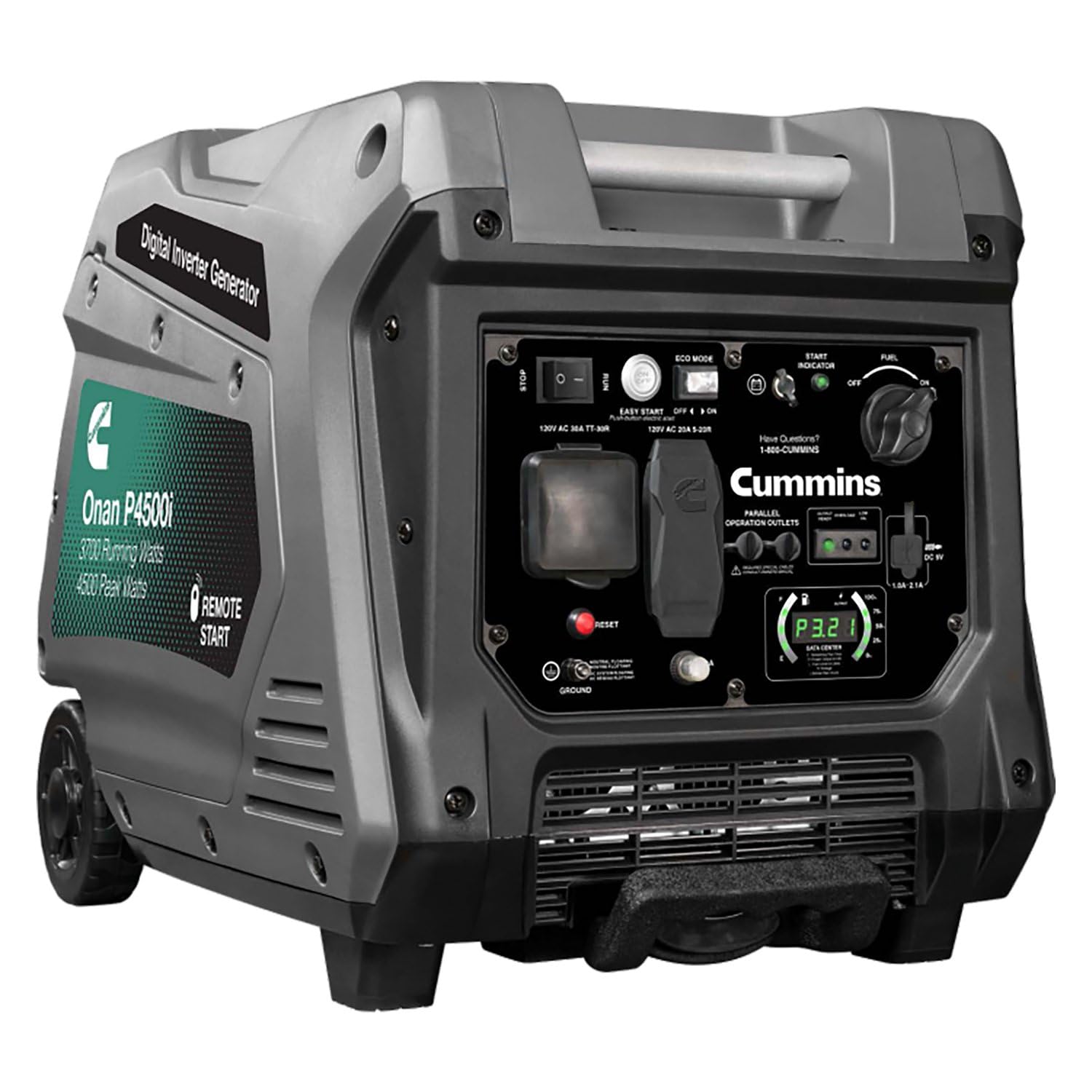
Quieter than the WEN 4800 and the only model here with a remote start you can trigger from indoors. The Cummins Onan P4500I gives you 3700 rated watts from a 224cc OHV (overhead valve) 4-stroke engine, but the standout feature here is the remote start. You press a button from inside the house or the RV and the generator fires up — no walking out in the rain or cold. Owners mention this unit “ran flawlessly in -15°F temps,” which makes it a serious contender for winter storm backup. It also has a pull cord backup if the battery ever fails, which some reviewers noted can be an issue (one owner found the battery would not hold a charge for the remote start).
At 98 pounds, this is the heaviest generator on the list, but it includes a handle and wheels that roll surprisingly well on gravel according to owners. The noise level is impressively low for a unit this size — one buyer mentioned it is “so quiet it doesn’t affect anyone at our campsite.” A TT-30R outlet handles RV hookups, and dual 5V USB ports keep phones and tablets charged. The unit uses gasoline only, so if you want propane flexibility, this is not the pick.
The Cummins brand carries a reputation for durability in the RV and commercial generator world. If you own a camper or travel trailer, the parallel capability lets you link a second P4500I for up to 50 amps of total power, which is a nice upgrade path.
Remote-Ready: The push-button electric start with remote control makes this the easiest generator to operate, especially during cold weather or middle-of-the-night outages.
Heft for Heft: At 98 pounds, you trade portability for that sturdy engine and remote system — plan to roll it on its wheels rather than carry it.
Best for: RV owners who want a premium, quiet, remote-start generator they can parallel later for more power, and homeowners who want to start the generator from inside the house.
skip it if: you need a dual-fuel unit or if you are on a tight budget and do not care about remote start.
3. WEN Quiet and Lightweight 3600-Watt Dual Fuel RV-Ready Portable Inverter Generator with Fuel Shut Off and CO Watchdog (DF360iX)

Runs on whichever fuel you can find — gas or propane — so you are never stuck.
Lighter than the WEN 4800 (49 pounds vs 72.7 pounds) and far more flexible at the pump. This WEN is a dual-fuel inverter generator that produces 3600 surge watts and 2900 rated watts on gasoline, or 3500 surge watts and 2600 rated watts on propane. The beauty of dual fuel is that propane stores indefinitely without degrading, so you can keep cans of propane in the shed for years and they will still work when a storm hits. Gasoline, on the other hand, needs stabilizer and goes stale in months. Buyers confirm this unit “started on propane with no issues” and that it “provided adequate power for my small RV” while being “very quiet at 50% power or less.”
At 49 pounds, it splits the difference between the lighter Westinghouse (43.2 pounds) and the heavier PowerSmart (52 pounds). It is light enough for one person to lift into a car trunk or move around the garage. The WEN Watchdog CO Shutdown Sensor is built in, and the fuel shut-off feature lets you burn the remaining fuel out of the carburetor before storage, which prevents gumming. The panel includes a digital display that shows voltage, frequency, runtime, and load — a helpful touch for knowing exactly what your fridge is drawing.
One owner noted that “both 20A outlets hold plugs loosely” as a minor build quality gripe, but the majority of reviews praise its reliability and quiet operation. If you want one generator that runs on either fuel without needing a conversion kit, this is the pick.
Fuel Freedom: The ability to switch between gasoline and propane gives you confidence when gas stations are closed after a storm — you can run on whatever is available.
Minor Quibble: A few owners found the 120V outlet grip a bit loose; it works fine but does not feel as secure as other brands.
Grab this for: long-term emergency prep where propane storage makes sense, or if you want a lightweight generator that also powers your RV without adapters.
Pass on it if: you need maximum wattage (above 2900 running) and are fine sticking with gasoline only.
4. Pulsar PGD40ISCO Ultra Light Quiet 4000W Portable Gas Inverter Generator

The lightest 4000-watt generator you can pick up and carry one-handed.
This Pulsar puts out 4000 peak watts (the short burst to start motors) and 3200 rated watts (the continuous supply) yet weighs only 47.3 pounds, which is remarkable for this power level. By comparison, the WEN 4800 (72.7 pounds) has more output but weighs significantly more. The Pulsar is ideal if you need to move your generator between a garage, a shed, and a campsite without installing wheels. Its 145cc engine runs at 59 dBA (decibels A-weighted — a standard noise measurement scale), which is about as loud as a normal conversation, and it is parallel-ready so you can link two units for more power later.
Customers note that this generator “reached 410 hrs with only spark plug and air filter changes” and that it is “reliable” and “starts first pull” even at altitudes up to 8000 feet. One owner noted that the white color is a plus for visibility and that it easily powers a “13,500 BTU camper AC with a soft start.” However, the same reviewer pointed out it is “not the quietest” and “louder than the Predator 3500 or Honda eu2000.” The runtime is 4 hours at half load on a 1-gallon tank, which is 4 hours versus the Westinghouse 2550’s 12 hours — so you may need to refuel more often during long outages.
It lacks wheels, so if you plan to move it across rough terrain or a large yard, you will want a wheel kit or a dolly. For most fridge-only backup scenarios though, the low weight makes it simple to keep near an exterior wall and just pick up when needed.
Portability Winner: At 47.3 pounds with 4000 peak watts, this is the best power-to-weight ratio in the lineup — easy to lift, easy to move.
Runtime Reality: A 4-hour runtime at half load means you will be out in the yard refueling more often during a multi-day outage compared to the Westinghouse 2550 with its 12-hour runtime.
Choose this if: you want serious power in a genuinely portable package that one person can easily lift, and you do not mind refueling every few hours.
pass on it if: you need the quietest possible operation or all-night runtime without getting up to add gas.
5. Westinghouse 2550 Peak Watt Super Quiet & Lightweight Portable Inverter Generator

A dual-fuel generator so light and quiet it can live near your fridge without complaint.
The Westinghouse 2550 puts out 2550 peak watts (the burst to start a motor) and 1900 rated watts (continuous power) on gas or propane, which is the lowest rated wattage on this list but still well above the 800-1000 running watts a typical fridge draws. The real advantages here are its 42.4-pound weight and its 12-hour runtime on a 1.16-gallon gas tank (in economy mode). That runtime is 12 hours versus the Pulsar’s 4 hours, so you can literally sleep through an entire night without refueling. Buyers describe it as a “dual-fuel inverter for emergencies” that “weighs under 50 lbs” and runs “quiet” enough for camping near neighbors.
It runs as low as 52 dBA noise output, making it the quietest unit in the list. The TT-30R RV outlet is built in, along with two 120V 20-amp outlets and two USB ports. A CO sensor automatically shuts the generator down if carbon monoxide builds up, which is a strong safety feature. One reviewer had a defective unit that never started, but the majority of owners praise its reliability and easy setup — it comes with oil, an oil funnel, a tool kit, and a propane hose right in the box.
The 1900 rated watts mean you cannot run a fridge plus a large window A/C unit simultaneously, but for strictly fridge and a few lights, it is more than enough. At 43.2 pounds, it is the second-lightest generator here and is genuinely easy to carry with one hand.
Runtime Champion: Up to 12 hours on a single 1.16-gallon tank in economy mode means you go to bed with a running generator and wake up with it still humming — no 3 A.M. refuel trips.
Wattage Ceiling: With 1900 rated watts, you are limited to a fridge plus a few small devices; skip this if you plan to also run a freezer, space heater, or A/C from the same unit.
Ideal for: small homes or apartments where quiet operation and all-night runtime matter more than running everything in the house, and for campers who want dual-fuel flexibility.
Not for you if: you need to power a fridge plus high-draw appliances like a freezer or window A/C at the same time.
6. PowerSmart 3800W Portable Inverter Generator, 59 dBA Super Quiet Gas Powered
Gets the job done without draining your wallet — reliable, quiet, and easy to start.
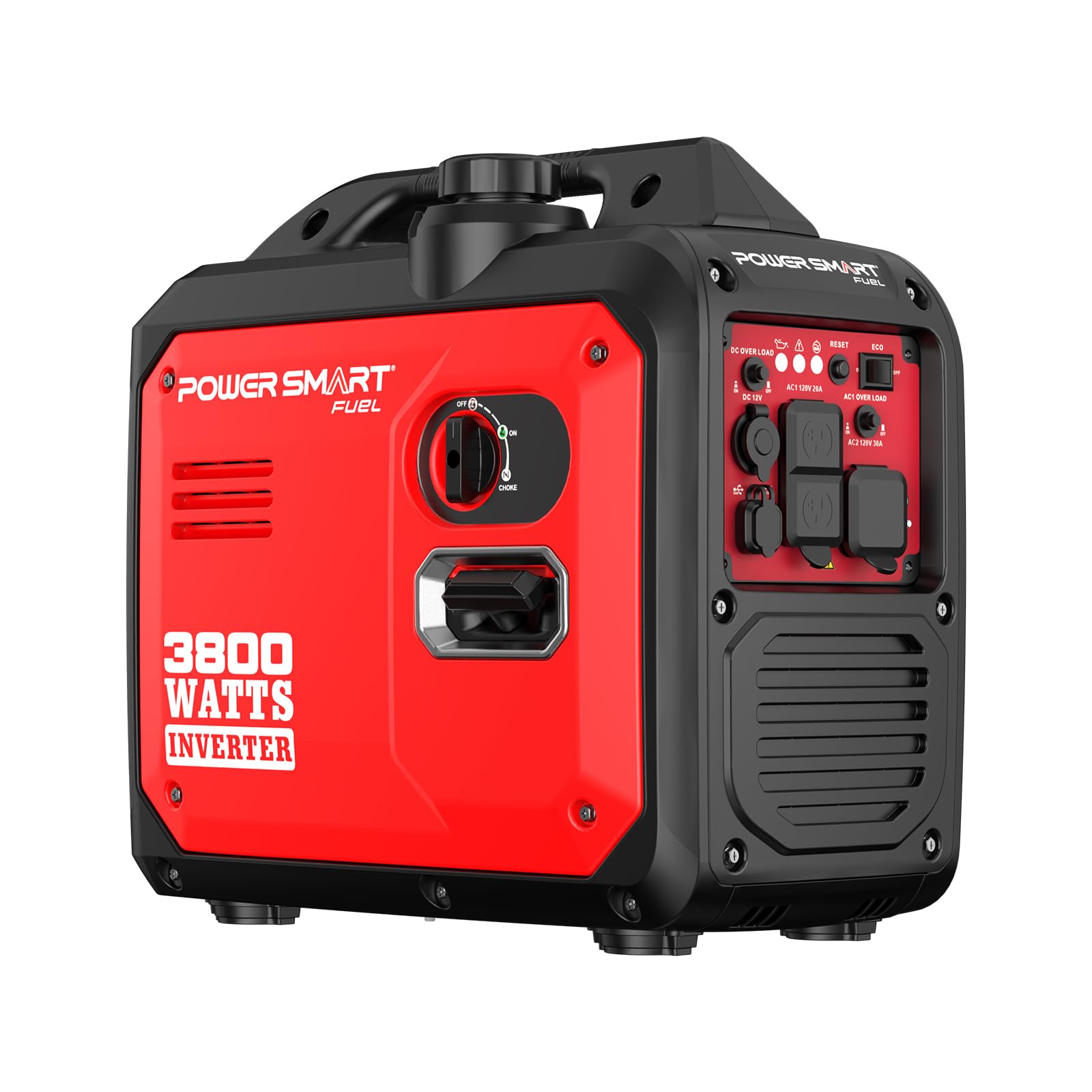
Cheaper than the WEN 4800 and the Cummins Onan, yet still delivers 3800 surge watts and 3200 rated watts from a 143cc 4-stroke OHV engine, all at 59 dBA — roughly the noise level of a normal conversation. It is a straightforward inverter generator with clean sine wave power (less than 3% THD) to protect your fridge’s electronics. One owner reported it “ran 24+ hours continuously without issues,” which is a strong sign of reliability for a unit at this price tier. Another said “straight from the start it started up” with “one easy pull” and that it is “nice and quiet” for power outages and camping.
At 52 pounds, it is heavier than the Westinghouse 2550 (43.2 pounds) but lighter than the WEN 4800 (72.7 pounds). It does not have dual-fuel capability — it runs on gasoline only — and the runtime is 4.5 hours at 50% load from a 1.19-gallon tank. That is enough for an evening outage or overnight sleep, but for multi-day events you will be refueling regularly. The parallel-ready feature lets you double output by connecting a second unit (kit sold separately).
The included components are minimal — just a wrench — so you will want to add a funnel and spare oil. The recoil start system is simple and most reviewers point out it fires on the first or second pull. If you want a reliable, no-frills inverter generator for your fridge at the lowest entry price, this is the pick.
Budget-Ready: At 3200 rated watts with inverter clean power at the lowest price point, this generator proves you do not need to spend premium money for a fridge-friendly inverter generator.
Fuel-Only: Gasoline only and a 4.5-hour runtime mean you need to plan for refueling during long outages, and there is no propane option.
Perfect if: you are on a tighter budget and need a reliable inverter generator that easily handles a fridge plus a few extra devices, and you are comfortable with gas-only operation.
Not the one if: you want dual-fuel flexibility or need all-night runtime without waking up to refill the tank.
Understanding the Specs
Running Watts vs Surge Watts
These are the two numbers that define whether a generator can start your fridge. Running watts (also called rated watts) are what the generator continuously supplies. Surge watts (or peak watts) are a short burst the generator can deliver for a few seconds to start a motor. A fridge typically pulls 600-800 running watts but spikes to 1200-2000+ surge watts when the compressor kicks on. If a generator’s surge wattage falls below your fridge’s starting spike, the generator will struggle or stall. Every generator in this list has at least 1900 running watts and 2550 surge watts, which comfortably clears the bar for standard household fridges.
Clean Sine Wave Power (THD)
Total harmonic distortion (THD) measures how “clean” the electrical waveform from a generator is. Wall outlets produce under 5% THD. An inverter generator typically outputs less than 3% THD, meaning the power is stable and safe for sensitive electronics like the digital control boards in modern refrigerators, laptops, and smart appliances. A conventional open-frame generator can exceed 10% THD, which may damage those electronics over time. When choosing a generator for a fridge with a computer board, an inverter model with under 3% THD is the right choice.
FAQ
What size generator do I need to run a refrigerator?
Can a 2000-watt generator run a refrigerator?
Is an inverter generator better for a refrigerator?
How long will a generator run a refrigerator on a full tank?
Can I run a generator in the garage during a power outage?
What is the difference between dual-fuel and gasoline-only generators?
How many watts does a refrigerator need to start?
Is a generator with parallel capability worth it for fridge backup?
How do I maintain a generator for refrigerator backup?
What does the CO watchdog sensor do on a generator?
Final Thoughts: The Verdict
For most people, the best backup generator for refrigerator duty is the WEN Quiet and Lightweight 4800-Watt Inverter Generator because it delivers the most capable power output (4800 surge / 4000 rated watts) while staying quiet enough for residential use and including a CO watchdog sensor for safety. If you want dual-fuel flexibility and a lighter weight, grab the WEN DF360iX Dual Fuel. And for a budget-friendly inverter option that still handles a fridge easily, the PowerSmart 3800W shows you do not have to spend premium money for clean, reliable backup power.
How We Picked
We do not accept paid placement. Every pick is matched to a real buyer and a real use-case; we do not hands-on test units.
Sources & Methodology
Specifications: manufacturer listings and product documentation. Review insights: verified customer reviews, as of July 2026. Pricing: not shown on this page (it changes often); check the current price via the retailer link.
As an Amazon Associate, Gadgets Feed earns from qualifying purchases. This does not affect which products we feature.
Related Guides
Product prices and availability are accurate as of the date/time indicated and are subject to change. Any price and availability information displayed on Amazon at the time of purchase will apply to the purchase of this product. As an Amazon Associate I earn from qualifying purchases.
CERTAIN CONTENT THAT APPEARS ON THIS SITE COMES FROM AMAZON. THIS CONTENT IS PROVIDED "AS IS" AND IS SUBJECT TO CHANGE OR REMOVAL AT ANY TIME.
Amazon and the Amazon logo are trademarks of Amazon.com, Inc. or its affiliates.