
Our readers keep the lights on and my morning glass full of iced black tea. As an Amazon Associate, I earn from qualifying purchases.
Specs are compiled from manufacturer listings and verified buyer reviews and can change over time — please confirm the key details on the product page before buying.
When the power goes out during a storm, your sump pump stops — and your basement starts flooding. A battery backup system is your insurance policy: it automatically takes over when the grid fails, keeping water moving until power returns. The real question isn’t if you need one, but which type fits your pit, your pump, and your confidence.
I’m Min — the founder and writer behind Gadgets Feed. This guide is built by comparing the manufacturers’ published specifications and the patterns across verified customer reviews, so you get each pick’s real strengths and trade-offs instead of marketing spin.
You need a system that matches your pump’s draw and your sump pit’s size, so we’ve broken down the best backup power supply for sump pump options by what truly matters: flow rate, battery compatibility, and real-world reliability.
Our Picks at a Glance


How To Choose The Best Backup Power Supply For Sump Pump
Choosing a backup system starts with understanding the two main designs. A dedicated 12V DC backup pump sits in the pit next to your primary pump, while an inverter-based system converts battery power to AC to run your existing pump. Your choice depends on your pit’s diameter and your pump’s power needs.
Think about the Battery First
Most backup systems ship without a battery, so budget for a separate deep-cycle AGM or lithium unit. Look for systems compatible with deep-cycle AGM or lithium batteries, since those handle repeated draining and recharging far better than a standard car battery. Check the charger’s amp rating, too, because a higher charge current rebuilds your reserve faster after an outage.
Match the Flow Rate to Your Risk
Flow rate, measured in gallons per hour (GPH), tells you how fast the backup can move water. Higher GPH ratings handle heavy rain or snowmelt inflow without the pit overflowing. A backup clearing the pit in under a minute suits most homes; flood-prone areas need higher flow.
Pay Attention to the Switches
A float switch activates the pump when water rises, and a dual-switch setup adds redundancy. A dual float switch provides redundancy — if one jams, the other still activates. Some systems also offer an LCD display or remote monitor, which is a real convenience when the unit sits in a dark basement corner you rarely visit.
Quick Comparison
| Model | Best For | System Type | Flow Rate | Battery Type | Amazon |
|---|---|---|---|---|---|
| Wayne WSS30VN★ Best Overall | Complete Combo Setup | 1/2 HP AC + 12V DC | 85 gpm | 75 AH Required | Amazon |
| Basement Watchdog BWECompact Value | Compact DC Backup | 12V DC Pump | 1000 gpm | AGM or Wet-Cell | Amazon |
| VEVOR 2000WDual Pump Power | Dual Pump Inverter | 2000W Inverter | — | 12V Deep Cycle | Amazon |
| OLTEANP 1500W | Smart Charging | 1500W Inverter | — | LiFePO4, AGM, GEL | Amazon |
| VIOPUMPO 2500W | High-Wattage Loads | 2500W Inverter | — | Deep Cycle Lithium | Amazon |
| PumpSpy BU-2000 | Silent Operation | 2000W Inverter | — | 12V Deep Cycle | Amazon |
| WAYNE ESP25n | Heavy Inflow | 12V DC Pump | 45 gpm | 75 AH Required | Amazon |
| Zoeller 508 | Brand Match with M53 | 12V DC Pump | 40 gpm | Deep Cycle Required | Amazon |
| Westinghouse WH50BBU | Primary + Backup Combo | 1/2 HP AC + 12V DC | 87 gpm | Not Included | Amazon |
| Pump Sentry 822PS | Quick Switchover | 1200W Inverter | — | 90-200 AH Marine | Amazon |
In-Depth Reviews
1. Wayne Preassembled Primary & Battery Backup Sump Pump Combo System
Our pick — over 4.5★ from 800+ verified ratings; the strongest balance of quality and price.
The complete hands-off solution that turns your basement into a fortress.
If you want one box that handles both everyday pumping and emergency backup, this Wayne combo is the answer. It pairs a 1/2 HP AC primary pump with a 12V DC backup, moving up to 5,100 GPH on AC power and clearing up to 10,000 gallons on a single battery charge. That flow rate of 85 gpm is over 11 times the 1000 gpm rating of the Basement Watchdog BWE — a massive gap when heavy rain hits.
The whole system arrives pre-assembled, so you skip the fiddly wiring and pipe fitting. Homeowners report completing the drop-in install in 15 minutes or less, with no need to drill a weep hole, as long as you have a 16-inch diameter or larger sump basin. The trade-off is bulk: at 44 pounds and 13.5″L x 9″W x 15.5″H, it’s roughly 5 times heavier than the Basement Watchdog’s 9-pound compact unit, and its wide base barely fits some 18-inch round pits.
Buyers report the DC backup “excels” — one notes it empties an 18″x30″ sump in about 30 seconds against a 7-foot head, running all day on a 100Ah AGM battery without voltage drop. The recurring advice: use a sealed battery, since the built-in charger may overcharge unsealed ones.
What wins people over
- Performance is the top praise — owners consistently note the powerful, quiet AC pump.
- Installation is the second biggest win — everything arrives pre-built and ready to drop in.
- Tested to 1 million cycles, backed by a 3-year warranty.
Know before you buy
- The massive base needs a 16″ or larger basin — check your pit first.
- The check valve has several plastic/rubber failure points; a minor leak may need tightening.
Reach for this if: you’re replacing everything and want a single, pre-built system that just drops into a large pit.
Look elsewhere if: your sump basin is under 16 inches wide — this heavy unit won’t fit.
2. The Basement Watchdog Emergency Battery Backup Sump Pump System w/Copper-Wound Motor
A featherweight 9-pound backup that fits the tightest sump pits.
This Basement Watchdog shines where space is scarce. At just 4.5″L x 8.5″W x 6.5″H and 9 pounds, it’s a fraction of the Wayne combo’s size (13.5″L x 9″W x 15.5″H at 44 pounds), making it a practical add-on to an existing primary pump even in narrow pits. The copper-wound motor is paired with a dual float switch for redundancy — if one switch sticks, the other still fires.
Ratings-wise, it pumps 42 GPM (2,500 GPH) at 0 ft lift and 25 GPM (1,500 GPH) at 10 ft, with a maximum lifting height of 10 feet. The control panel monitors pump, power, and battery conditions around the clock, delivering visual and audible alerts. One owner installed it in 1.5 hours as a DIY project and credits it with preventing basement flooding after a prior sump failure.
The honest caveat is battery compatibility. While it accepts both maintenance-free AGM and wet-cell batteries, owners note the battery life is mixed and it requires its own style of battery — you can’t just grab any 12V unit. The automatic 0.4-Amp charger keeps the reserve topped up, but the proprietary requirement is worth planning around.
Reliability first: Reliability is the most-discussed strength here, followed closely by overall quality — and the dual float switch is the specific feature buyers cite for that confidence.
The fit note: If you need a backup for a tight pit and don’t mind sourcing the right battery, this is the compact pick to beat.
3. VEVOR 2000W Sump Pump Battery Backup System
An inverter that keeps two sump pumps running when the grid drops.
This VEVOR is built for homes with more than one pump to protect. Its 2000W output with 18.2A operating current and dual outlets lets a single unit power two sump pumps at once, switching automatically to battery the moment AC power fails. The pure sine wave output means the power is clean and grid-like, so sensitive pump electronics aren’t stressed.
The defining feature here is the LCD display with LED indicators — you can watch voltage, power, and battery level in real time. Charging is equally quick: a 20A charging current refills a 100AH battery in about 5 hours, which the maker notes is four times faster than a 5A charger. The 3-Pin plug design avoids the hassle and risk of hardwiring.
Buyers found the switchover flawless, with one flipping the breaker off and seeing immediate activation. The honest trade-offs: the manual reads like a direct translation and can be confusing, and the cooling fans run almost constantly, creating a hum some find noticeable. A single unit failed within days of arrival, though that stands against a strong majority of positive experiences.
What earns its place
- Performance is the top praise — it’s lauded for flawless wall-to-battery switchover.
- Ease of installation is second — plug-in design means no hardwiring.
- Multi-layer protection covers overload, short circuit, overcharge, and overheat.
What to watch
- The manual is poorly translated and can be hard to follow.
- Fans run nearly continuously, adding a low background noise.
Best suited for: households running two pumps who want plug-and-play installation and clear visual status.
Not for: anyone who can’t tolerate a constant fan hum in a finished basement space.
4. OLTEANP 1500W Sump Pump Battery Backup System
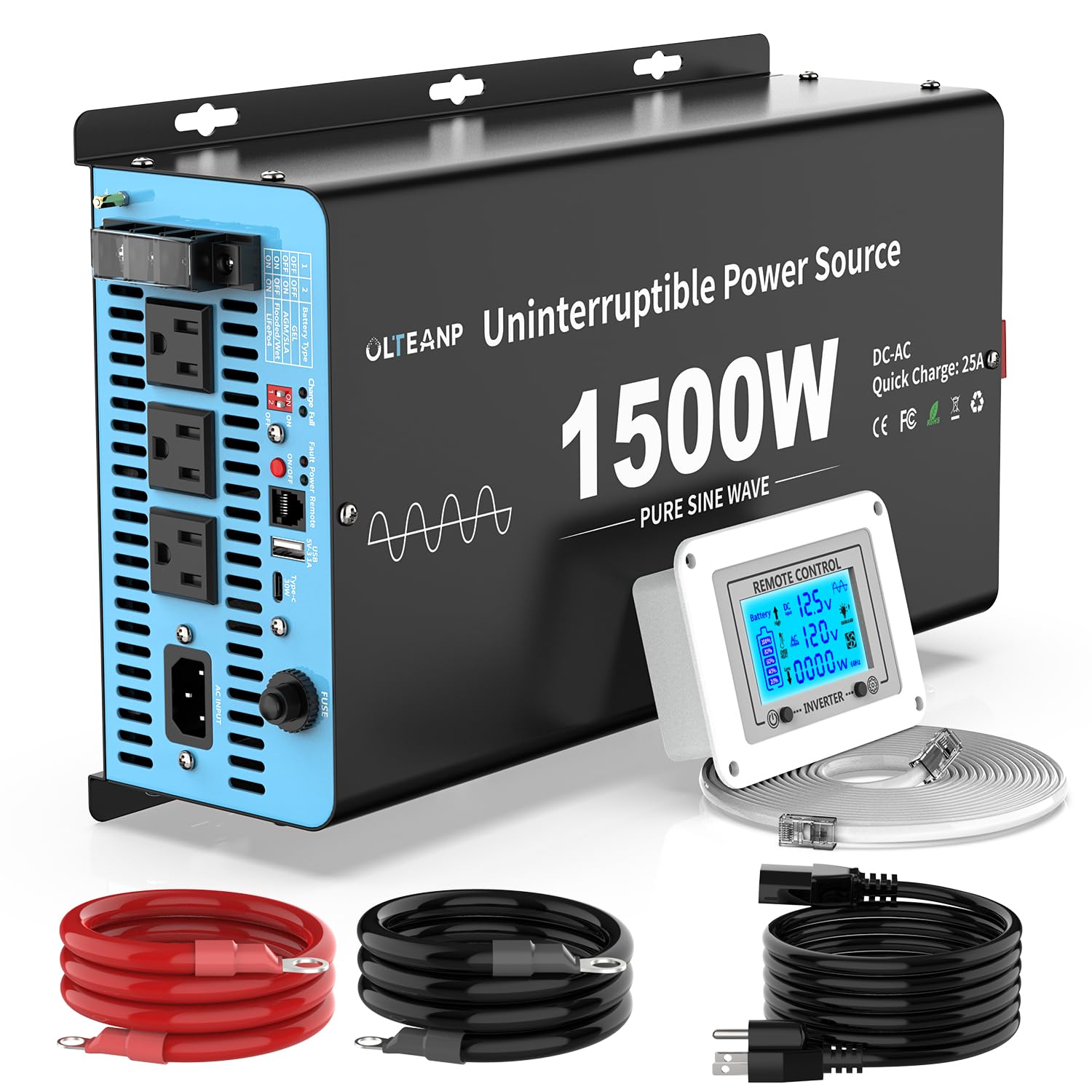
The inverter that baby-sits its own battery with a 25A smart charger.
This OLTEANP unit earns its keep through intelligent battery management. The built-in 25A multi-stage charger tune performance and extends battery lifespan, topping up compatible LiFePO4, AGM, GEL, and flooded deep-cycle batteries. When utility power dies, it instantly transfers to the 12V battery, then recharges automatically once power returns.
The 1500W pure sine wave output runs a standard residential sump pump smoothly, and you get 3 AC outlets, a USB port, and a Type-C port — so you can keep phones and small devices alive during an outage. The wired remote controller with LCD display shows battery voltage, load level, and operating mode, and the unit supports wall mounting or flat placement.
One owner notes the auto shutoff voltage (10.2V) is too low for AGM batteries, which are effectively dead around 11.8V, so match your battery chemistry carefully.
The standout: Performance dominates the feedback — this inverter handles heavy sustained loads without complaint, and the built-in charger is a genuine convenience.
The catch: After a full battery drain with a lithium battery, you’ll need to manually power the unit back on when AC returns.
5. VIOPUMPO 2500W Sump Pump Backup Battery System

The heavy hitter that drives any load with grid-clean power.
For homes where the sump pump shares a circuit with other essentials, this VIOPUMPO 2500W unit brings serious headroom. Its pure sine wave output is explicitly designed to drive any type of load — resistive and inductive — with the highest conversion efficiency and lowest losses. The built-in 25A charger supports fast and trickle charging for deep-cycle lithium, AGM, and other deep-cycle batteries, with overcharge protection to extend battery life.
The high-definition LCD remote lets you check voltage, power, and battery charge status from across the room. Installation needs no special wiring — assemble the AC and DC cables, plug the pump into the AC socket, and you’re set. Side fixing holes allow flat or wall-mounted placement.
Buyers praise how flawlessly it charges the backup battery and maintains the correct voltage, with one noting an instant AC-to-DC switch kept the pump running through an outage. The most common gripe is the noisy fan that comes on frequently — a minor annoyance against otherwise strong approval.
Functionality wins: The top aspect is pure functionality — owners highlight reliable outage performance and easy setup.
Consider this: If you need to power multiple devices or a high-draw pump, this wattage headroom is worth the premium.
6. PumpSpy 2000W Sump Pump Battery Backup System

Silent, American-made, and armed with a smart cooling system.
This PumpSpy unit is the quiet performer of the group. It generates a stable pure sine wave 120 VAC waveform at 2000 watts, capable of powering two primary sump pumps with a combined draw not exceeding 16.6 amps. The overcharge prevention uses a trickle charge to keep the battery ready, while the smart cooling feature extends life expectancy.
Built in aluminum and tested in Kalamazoo, Michigan, it measures 17.5 x 6.75 x 4 inches and weighs 10.5 pounds. Two grounded outlets and a USB charge port add versatility — you can run lights, phones, or monitors during an outage. It also works as a general power inverter for other backup needs.
The installation experience is a highlight — it comes with everything needed, including mounting screws for wood and concrete plus a concrete bit. Buyers describe it as a life-saver during storms, with one noting it ran their two sump pumps with confidence. The one caution: a buyer who didn’t realize the battery is sold separately felt misled, so read the description carefully before buying.
Ease of use: Functionality and ease of installation lead the feedback — owners call the setup straightforward and the quality top-notch.
Remember: This is a box that connects to a battery you must buy separately — factor that into your budget.
7. WAYNE ESP25n 12 Volt Battery Back Up Sump Pump
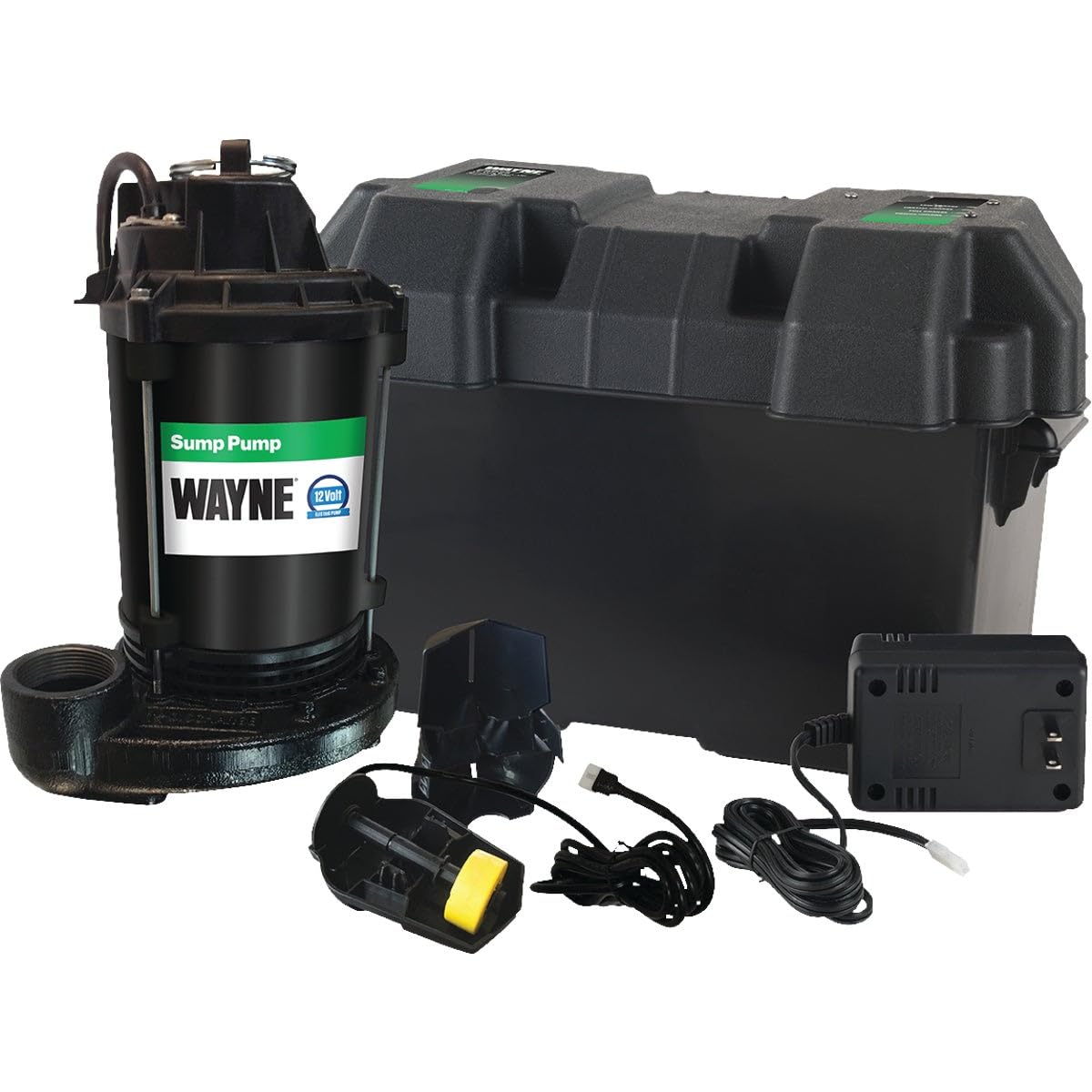
A cast-iron backup that handles even the heaviest water inflow.
When water comes in fast, this WAYNE ESP25n keeps up. It pumps up to 2,700 GPH and can move up to 10,000 gallons on a single battery charge. The epoxy-coated steel housing with a cast-iron base and corrosion-resistant thermoplastic impeller are built for maximum water flow and long-term durability.
It fits in 14-inch diameter or larger sump basins with no weep hole drilling needed. The protective battery case includes an LED display and audible alarm to warn of problems. Owners mention it handles worst-case 30+ GPM inflow at a 9-foot head, though battery life runs short in that extreme scenario since the pump won’t cycle off — still, it buys hours to start a generator.
The quality is the most-praised aspect, with owners noting the trickle charger, battery strength LEDs, and test switch. The battery box lid doesn’t snap shut — it just rests — which is a minor annoyance for a premium-feeling unit.
The strengths
- Quality is the #1 praise — the cast-iron build feels substantial.
- Easy ~20-30 minute install with the included Y-joint and check valve.
- Battery lasts about 5 years and can run the pump for days.
The weaknesses
- Battery box lid doesn’t snap shut securely.
- Battery sold separately — budget for a 75AH or 100AH unit.
Grab it if: you want a rugged DC backup that matches the primary pump’s heavy-flow demands.
skip it if: you’d rather not manage a separate battery purchase and want an all-in-one inverter.
8. Zoeller 508-0005 Aquanot 508 Battery Back-Up System
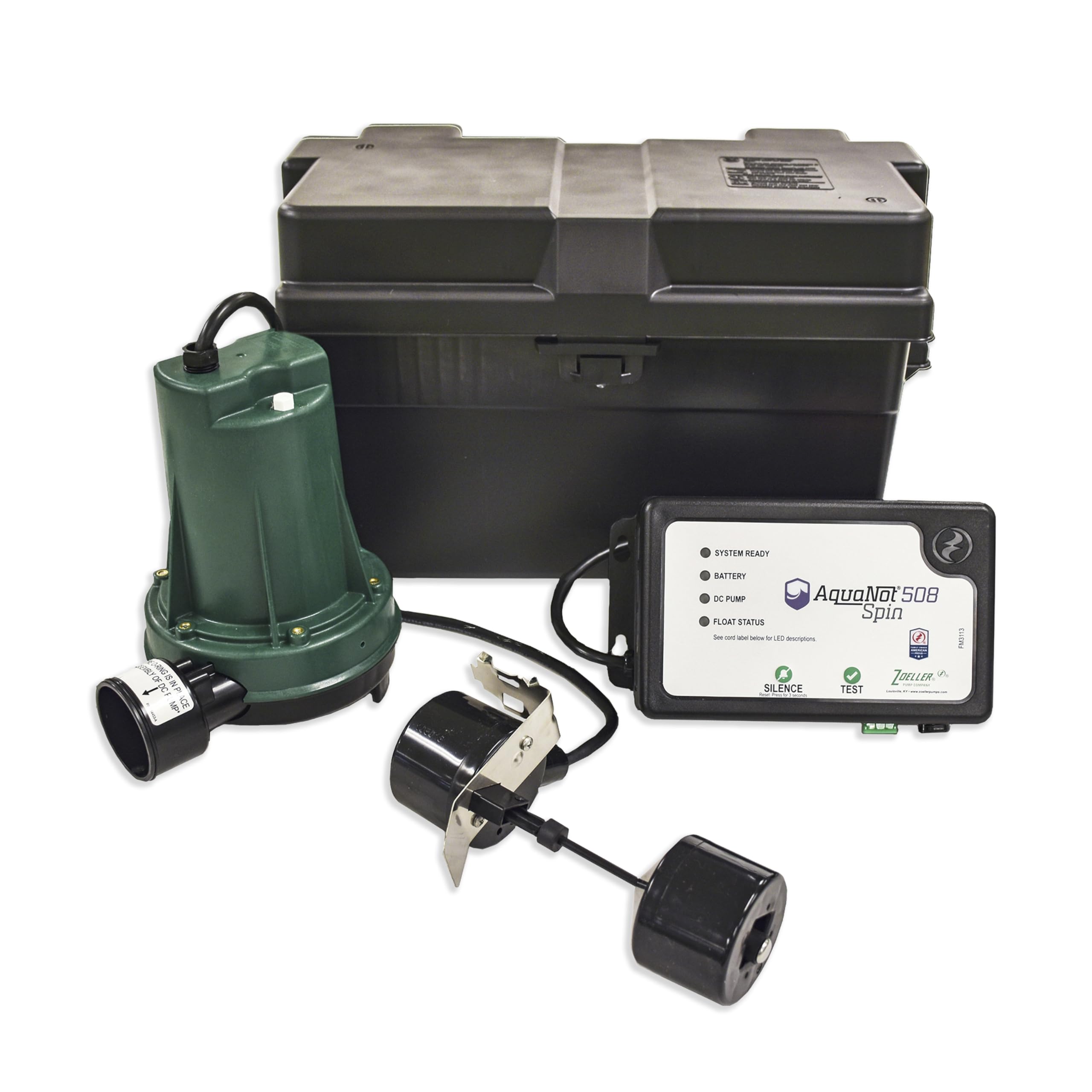
The hand-built, USA-tested backup made to match a Zoeller M53.
For owners of a Zoeller M53 primary pump, this is the natural partner. The 12-volt, 0.33 hp pump has a highly efficient noncorrosive construction with an integrated check valve and quick disconnect discharge. The aluminum seal pocket and cooling plate help manage heat during extended runs.
It integrates cleanly with the M53, and buyers confirm the pre-drilled relief hole and built-in flapper mean you don’t need an extra check valve. At 40 gpm, the flow rate is modest compared to the Wayne ESP25n’s 45 gpm or the Basement Watchdog’s 1000 gpm rating, but it’s adequate for most residential backup duty. The pump is hand-built and 100% tested in the USA.
One owner reported surviving a 3-hour outage with 300+ pump cycles and the battery still having 6 more hours of life. The warranty is notable: 12 months from installation, extended to 36 months if you buy an Aquanot battery from Zoeller. The fit is tight in some crocks, and one buyer found only one of the included clamps was worth keeping.
Reliable match: Reliability tops the feedback, with clear instructions and quiet operation also praised.
Plan for: This is product-only — you’ll need a deep-cycle battery (Trojan is recommended) and possibly a 2-inch to 1.5-inch adapter.
9. Westinghouse 1/2 HP Sump Pump with Battery Back Up
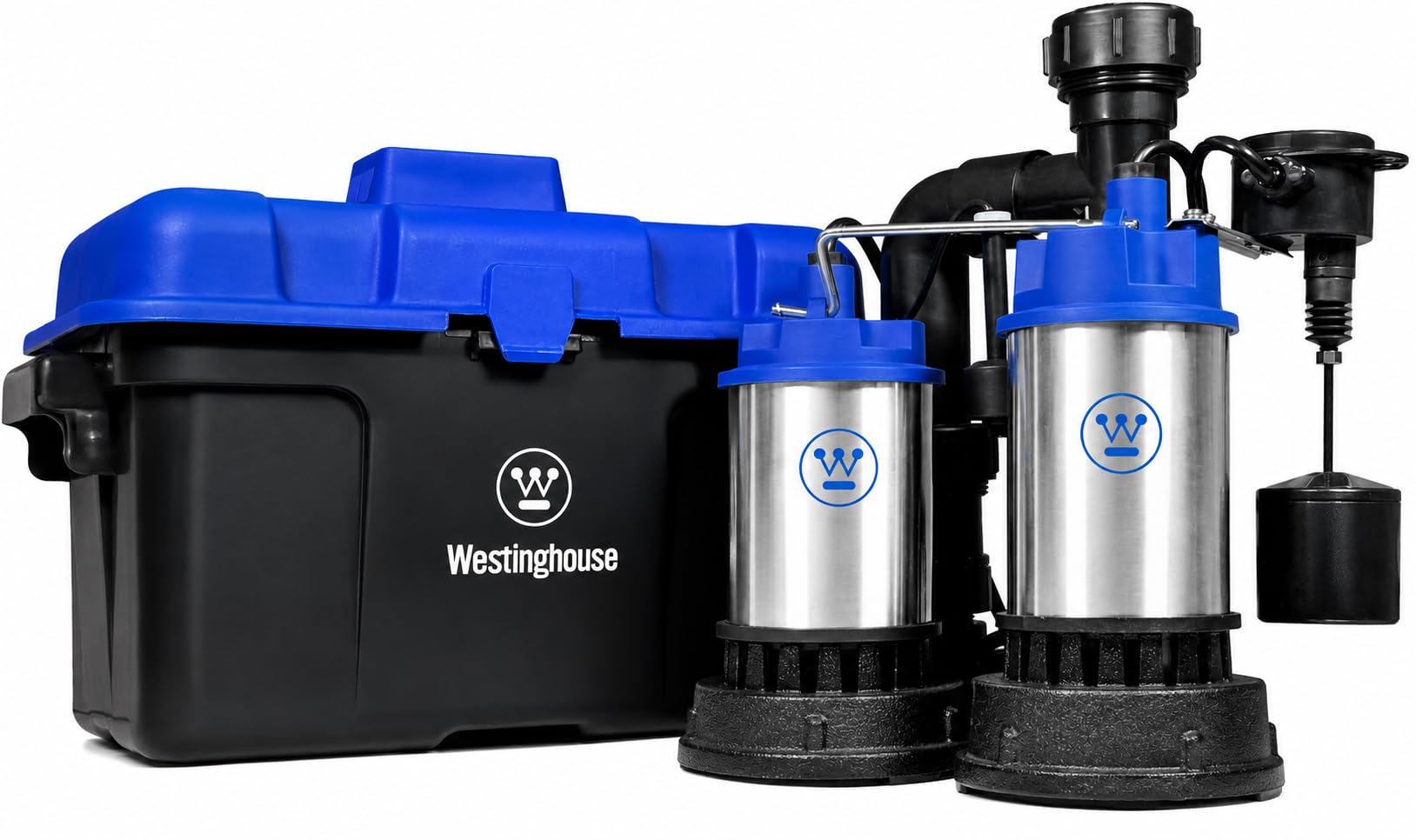
The stainless-steel combo that empties a pit in about 10 seconds.
This Westinghouse WH50BBU is a full primary-plus-backup system with serious build quality. Both pumps feature corrosion-resistant stainless steel housings, and the energy-efficient PSC motor includes thermal overload protection, lubricated ball bearings, and a sealed shaft. The top suction design prevents airlock and reduces debris buildup.
At 87 gpm, its flow rate edges out the Wayne combo’s 85 gpm — the highest of any combination system here. Owners confirm it empties a large pit completely in about 10 seconds. The compact footprint is helpful for tight pits, and the dual floats provide redundancy. Maximum lifting height is 30 feet, far above the Basement Watchdog’s 10 feet.
The trade-off for that power is the price — it sits at the premium end of this list. Buyers call it heavy and solid, “not a cheap plastic thing,” with easy installation and quieter operation than older units. The only recurring complaint is the short cable on the charger adapter.
Build quality: Quality is the standout — owners repeatedly praise the metal construction over flimsy plastic alternatives.
Worth it if: you want a premium dual system with exceptional lift capability and don’t mind paying for it.
10. Pump Sentry 822PS Sump Pump Backup System
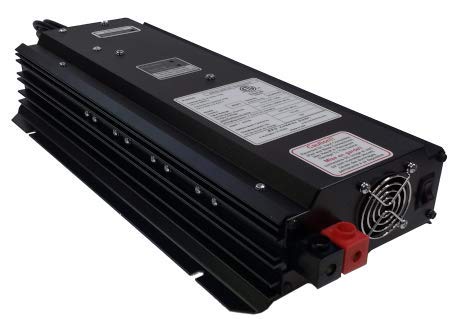
The rugged aluminum box that switches to battery in under a second.
This Pump Sentry is a purpose-built inverter for sump pumps, housed in rugged aluminum for durability. At 1200 watts, it’s designed to operate most sump pumps up to 9 amps, with indicators for power output, battery charge, and battery replace. UL and CSA accreditation speaks to the safety and reliability of the design.
It automatically switches to battery when AC power goes out and recharges when power returns. A 12-volt deep-cycle marine battery with 90 to 200 amp-hours is required (sold separately), and battery cables are included. Owners describe a 10-minute installation and a smooth switchover.
Customers note flawless operation across multiple outages, with one using it as a backup for a greenhouse where sensitive plants depended on it. Another found the 110AH battery paired with this unit provided about 20 hours of run time. The caveat is the price — it’s the most expensive non-combo system here, and some feel it’s steep for what it does.
Reliability king: Reliability is the most-praised aspect by a wide margin, with installation close behind.
The premium: You’re paying for American-made, UL-accredited quality and instant switchover — worth it if you can justify the cost.
Understanding the Specs
GPH and GPM Flow Rate
Flow rate tells you how fast the backup can move water — gallons per hour (GPH) or gallons per minute (GPM). Higher flow means the pump can keep pace with heavy rain or snowmelt inflow. For most homes, a backup that clears the pit in under a minute is sufficient; flood-prone areas should aim for the highest rating you can afford.
Battery Chemistry and Amp-Hours
The battery’s amp-hour (Ah) rating determines how long the backup runs. Deep-cycle AGM and lithium batteries handle repeated draining best. The charger’s amp rating matters too — a 25A charger refills a battery roughly five times faster than a 5A unit, so you’re ready for the next outage sooner.
FAQ
What size battery do I need for my sump pump backup?
Can I use a regular car battery for my sump pump backup?
How long will a battery backup run my sump pump?
What is the difference between pure sine wave and modified sine wave inverters?
Will any of these systems work with a pedestal sump pump?
Do these backup systems come with a battery included?
How long does installation typically take?
Can a backup system power other devices during an outage?
Final Thoughts: The Verdict
For most buyers, the backup power supply for sump pump winner is the Wayne WSS30VN combo because it handles both primary and backup duty in one pre-built drop-in system with the strongest performance. If you want an inverter that powers two pumps with a clear LCD readout, grab the VEVOR 2000W. And for tight spaces where the primary pump already works, the Basement Watchdog BWE is the compact backup to reach for.
How We Picked
We do not accept paid placement. Every pick is matched to a real buyer and a real use-case; we do not hands-on test units.
Sources & Methodology
Specifications: manufacturer listings and product documentation. Review insights: verified customer reviews, as of August 2026. Pricing: not shown on this page (it changes often); check the current price via the retailer link.
As an Amazon Associate, Gadgets Feed earns from qualifying purchases. This does not affect which products we feature.