
Our readers keep the lights on and my morning glass full of iced black tea. As an Amazon Associate, I earn from qualifying purchases.
Specs are compiled from manufacturer listings and verified buyer reviews and can change over time — please confirm the key details on the product page before buying.
When a storm knocks out power, your primary sump pump stops working. A backup battery system automatically switches to battery power, keeping your basement dry during grid failures. This guide reviews top battery backup systems and batteries, covering runtime, pumping capacity, and maintenance-free claims.
I’m Min — the founder and writer behind Gadgets Feed. This guide is built by comparing the manufacturers’ published specifications and the patterns across verified customer reviews, so you get each pick’s real strengths and trade-offs instead of marketing spin.
You need a backup battery that keeps your basement dry during outages. We cover dual-pump systems and standalone batteries to help you choose.
Our Picks at a Glance


How To Choose The Best Backup Sump Pump Battery
First, decide if you’re protecting against power outages, pump failures, or both. Some systems pair a secondary 12-volt pump right next to your main AC pump, while others are an inverter that runs your existing pump on battery power. Identify your scenario before purchasing.
Match the flow rate to your pit
Flow rate, in GPM or GPH, is the key spec for backup pumps. A higher rate empties your sump pit faster and cycles the pump less, which preserves battery life. For a typical home, look for a backup pump that can move roughly 20–40 GPM so it can keep pace with heavy rainfall and a high water table.
Decode battery capacity and chemistry
Battery capacity is measured in amp-hours (Ah), which tells you how much energy the battery stores. A 75Ah battery is a common starting point for backup pumps, while 100Ah batteries roughly double your potential runtime. Sealed AGM (Absorbent Glass Mat) batteries are the standard choice here because they are maintenance-free, meaning you never add water or acid, and they can sit on a trickle charger without leaking.
Decide between dual-pump and inverter systems
A dual-pump system adds a dedicated 12-volt backup pump next to your primary pump. It runs automatically when the power fails, but the backup pump must physically fit in your sump basin. An inverter system connects to your existing pump and delivers pure sine wave power (a clean, stable electrical signal) during an outage, which is more flexible and can also run other devices, but you must confirm your pump’s wattage matches the inverter’s rating.
Quick Comparison
| Model | Best For | System Type | Flow Rate | Battery Requirement | Amazon |
|---|---|---|---|---|---|
| Wayne WSS30VN Combo★ Best Overall | Whole-system confidence | 1/2 HP Primary + DC Backup | 85 GPM | WSB1275 75 Ah (sold separately) | Amazon |
| Basement Watchdog BWECompact Backup | Compact emergency backup | 1 HP DC Backup Pump | 1000 GPM | Standby battery (sold separately) | Amazon |
| OLTEANP 1500W InverterSmart Inverter | Flexible inverter backup | 1500W Pure Sine Inverter | Runs existing pump | 12V deep-cycle (sold separately) | Amazon |
| Basement Watchdog BW-27AGM | Maintenance-free replacement | Standalone AGM Battery | — | Built-in (this is the battery) | Amazon |
| Superior Pump 92900 | Budget backup pump | 12V DC Backup Pump | 23 GPM | 12V battery (sold separately) | Amazon |
| Wayne WSB1275 Battery | Wayne system compatibility | Standalone AGM Battery | — | Built-in (this is the battery) | Amazon |
| PumpSpy BU-2000 | Dual-pump inverter power | 2000W Pure Sine Inverter | Runs 2 pumps | 12V deep-cycle (sold separately) | Amazon |
| Viopumpo 2500W | High-wattage inverter needs | 2500W Pure Sine Inverter | Runs existing pump | 12V battery (sold separately) | Amazon |
| Zoeller Aquanot 508 | Pro-grade DC backup | 0.33 HP DC Backup Pump | 40 GPM | Zoeller Aquanot battery (sold separately) | Amazon |
| Westinghouse WH50BBU | Stainless steel durability | 1/2 HP Primary + DC Backup | 87 GPM | 12V battery (sold separately) | Amazon |
In‑Depth Reviews
1. Wayne Preassembled Primary & Battery Backup Sump Pump Combo System
Our pick — over 4.5★ from 800+ verified ratings; the strongest balance of quality and price.
The complete dual-pump package that drops in and keeps a basement dry through the worst weather.
This is the rare setup that handles both failure scenarios at once: a 1/2 HP AC primary pump for everyday drainage and a 12-volt DC backup that activates when the power dies. The whole system is preassembled, so you skip the wiring and the weep-hole drilling and can install it in 15 minutes or less, dropping it into any sump basin 16 inches in diameter or larger.
The raw numbers are what make it a true workhorse. Its 85 GPM flow rate clears a pit fast, and the backup is rated to pump up to 5,100 GPH while removing up to 10,000 gallons on a single battery charge. Buyers report the DC backup excels in practice — it emptied an 18×30-inch sump in about 30 seconds against a 7-foot head and ran all day on a 100Ah AGM battery without a voltage drop. That is the kind of real-world endurance that turns a backup into a primary defense.
This unit is big and heavy, so measure your basin first. At 44 pounds and 13.5″L x 9″W x 15.5″H, some owners said it barely fit an 18-inch round pit. It also requires the Wayne WSB1275 75 Ah battery, sold separately, and the full package costs a premium. What wins buyers over is the confidence: assembled in the USA, tested to 1 million cycles, and backed by a 3-year warranty.
What owners praise most
- Performance is the #1 mentioned strength — 119 owners single it out
- Installation is a close second at 117 mentions, all-positive
- Quiet operation and whisper-quiet DC backup run
The honest caveats
- Battery sold separately adds to the total cost
- Large base may not fit compact sump pits
- A few owners hit durability issues at the 6-month mark
Reach for this if: you want one preassembled system that handles both primary pumping and battery backup without extra wiring.
Look elsewhere if: your sump pit is under 16 inches wide or you want a budget-friendly standalone battery option.
2. The Basement Watchdog Emergency Battery Backup Sump Pump System w/Copper-Wound Motor
A featherweight 9-pound backup that slips into narrow pits and delivers days of intermittent pumping.
If your sump pit is small, this is the backup that fits where bulkier systems cannot. At just 9 pounds and 4.5″L x 8.5″W x 6.5″H, it is a fraction of the size of the Wayne combo above — roughly one-third the footprint — making it the go-to for tight or narrow basins. Despite the small size, it packs a 1 HP copper-wound motor that pumps 42 GPM at 0 feet of lift and still moves 25 GPM at 10 feet, so it handles serious water volume.
The 1.5-hour DIY install is a recurring theme, and the dual float switch gives you redundancy so the pump activates even if one switch sticks. A user-friendly control panel monitors pump, power, and battery conditions 24/7 with visual alerts and audible alarms, plus a test button that empties the pit quickly. Owners mention it prevented basement flooding after a prior sump failure, which is the exact job this system exists for.
The honest downside is battery compatibility. This system works with both maintenance-free AGM and wet-cell batteries, but owners note it tends to require proprietary Basement Watchdog batteries, which can be pricier than generic options. The automatic 0.4-Amp charger keeps the battery topped up, and with days of intermittent pumping on a single charge, this is a solid mid-range pick for anyone who prioritizes a compact footprint over raw capacity.
Who it suits: homeowners with small sump pits who want a reliable, compact backup with clear monitoring. Fit note: battery life is the most-discussed topic — expect to budget for a quality replacement battery down the line.
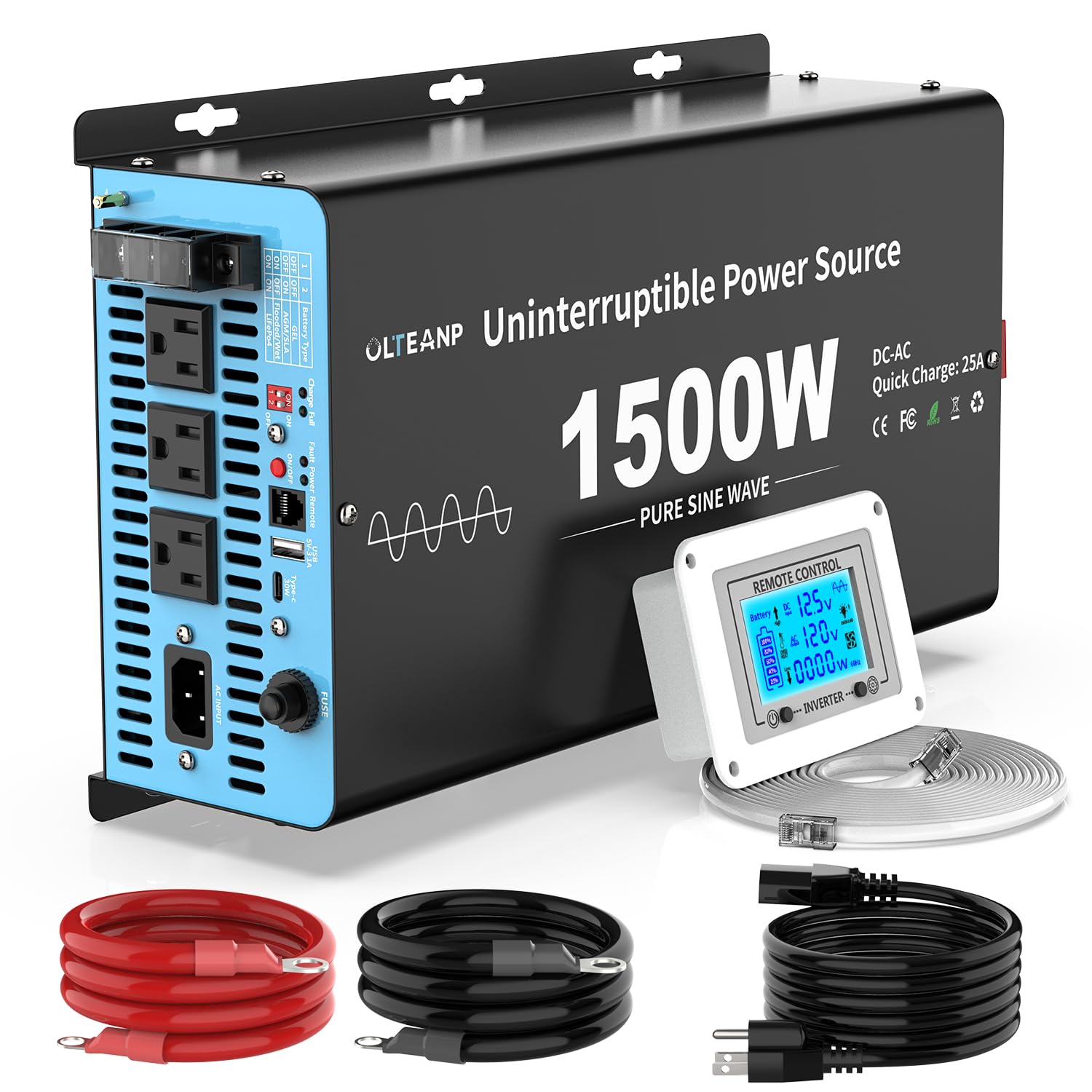
3. OLTEANP 1500W Sump Pump Battery Backup System
An inverter, charger, and auto-transfer switch in one box that runs your existing pump on battery power.
Instead of adding a second pump, this system turns your existing sump pump into a battery-backed machine. The 1500W pure sine wave inverter produces clean, stable power that runs standard residential pumps smoothly, and it automatically switches from grid to battery the instant utility power fails. When the power comes back, the built-in 25A multi-stage charger recharges your battery automatically to keep it ready for the next storm.
What surprises owners is the headroom. The LCD remote monitor gives you real-time battery voltage, load level, and operating mode, plus 3 AC outlets, a USB port, and a Type-C port for powering phones and other essentials during an outage.
The main quirk to know: after a full battery drain, the inverter may require a manual power-on when AC returns, rather than auto-restarting. It is also a mid-range investment at 1500W, so it suits homes with a single, reasonably sized pump rather than heavy commercial loads. Compatibility with LiFePO4, AGM, GEL, and flooded batteries gives you flexibility on the 12V deep-cycle battery you pair it with.
Best fit: DIYers who want a flexible inverter that backs up the pump and also powers small devices during outages. Watch for: you will need a separate 12V deep-cycle battery rated to handle your pump’s wattage.
4. The Basement Watchdog Maintenance Free (AGM) Standby Battery

The sealed, no-fuss battery that drops into an aging Basement Watchdog system in about 3 minutes.
If your backup pump works fine but the battery has given up, this is the direct replacement. This AGM (Absorbent Glass Mat) standby battery is completely maintenance-free — no acid, no distilled water, no venting concerns — and it hooks up in roughly 3 minutes for owners replacing older lead-acid units. One buyer swapped out an 8-year-old battery that came with the original system, and another paired it with an old Watchdog pump that was 15 years old.
Runtime depends on which system you pair it with. On the Basement Watchdog Emergency (BWE) and Combination systems, it delivers up to 80 hours of protection on a 10% duty cycle (meaning the pump runs 10% of the time). On the Big Dog, it offers up to 40 hours; on the Special + and Big Combination systems, it provides up to 48 hours. That means days of intermittent pumping to keep your basement dry through a long outage.
A couple of fit notes worth knowing. First, this battery is heavy — it weighs in around 22.6 kg — so be ready to lug it to the pit. Second, battery life gets genuinely mixed feedback: some customers note needing a replacement after about 5 months, while others get years of service. If you want a drop-in, brand-matched replacement that skips the acid-filling hassle, this is the straightforward choice, just be prepared for variable longevity.
The takeaway: a brand-matched AGM replacement battery with standout up-to-80-hour runtime potential and a 3-minute install. The fit note: lifespan is the most-discussed topic, so treat it as a consumable with variable service life.
5. Superior Pump 92900 12V Battery Back Up Submersible Sump Pump
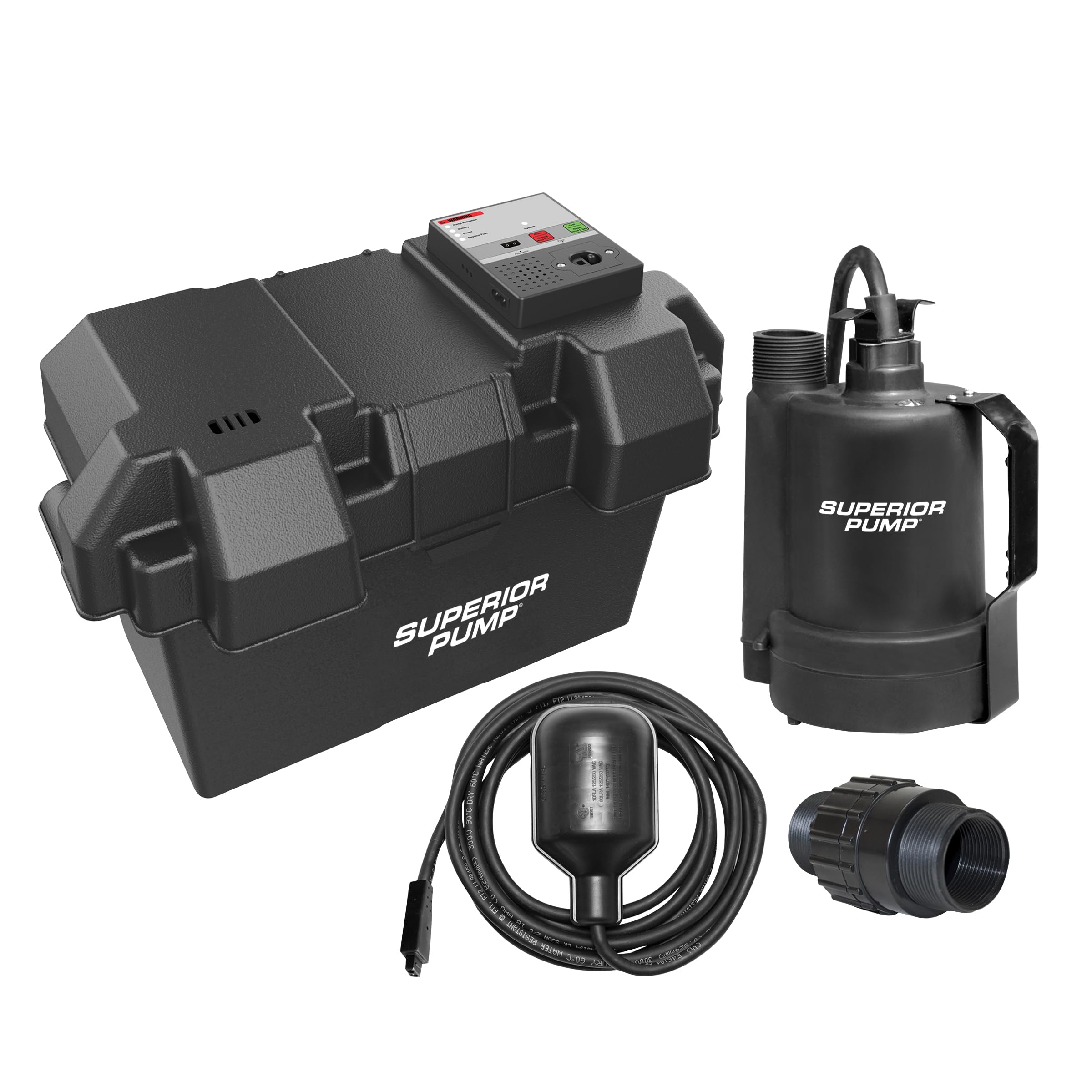
A budget-minded 12V backup that clears a pit fast and paid for itself the week it was installed.
This is the entry-level option that handles the core job — keeping a basement dry when the power fails — at a friendlier cost than full dual-pump systems. It moves up to 1,380 gallons per hour (about 23 GPM) and can lift water up to 25 feet of vertical height, which covers most residential setups. The tethered float switch automatically turns the pump on and off, and the 10-foot cord gives you flexibility on placement.
Reviewers point out immediate validation. One owner installed it and the power went out later that same week — the pump worked exactly as expected and “paid for itself immediately.” Others say it is easy to install, not very noisy, and a better value than expected. The thermoplastic construction is tough, and every unit is 100% factory tested, so it arrives ready to drop into the crock.
The catch is an honest one: durability gets mixed feedback, and some owners express concerns about long-term longevity. For the price, though, it is the value pick that jumps in when your main pump or power fails.
Choose it if: you want a dependable, affordable backup pump and you already own a suitable 12V deep-cycle battery. Think twice if: you expect extreme, frequent duty cycles that demand maximum build durability.
6. Wayne Maintenance Free Standby Battery for Backup Sump Pumps (WSB1275)
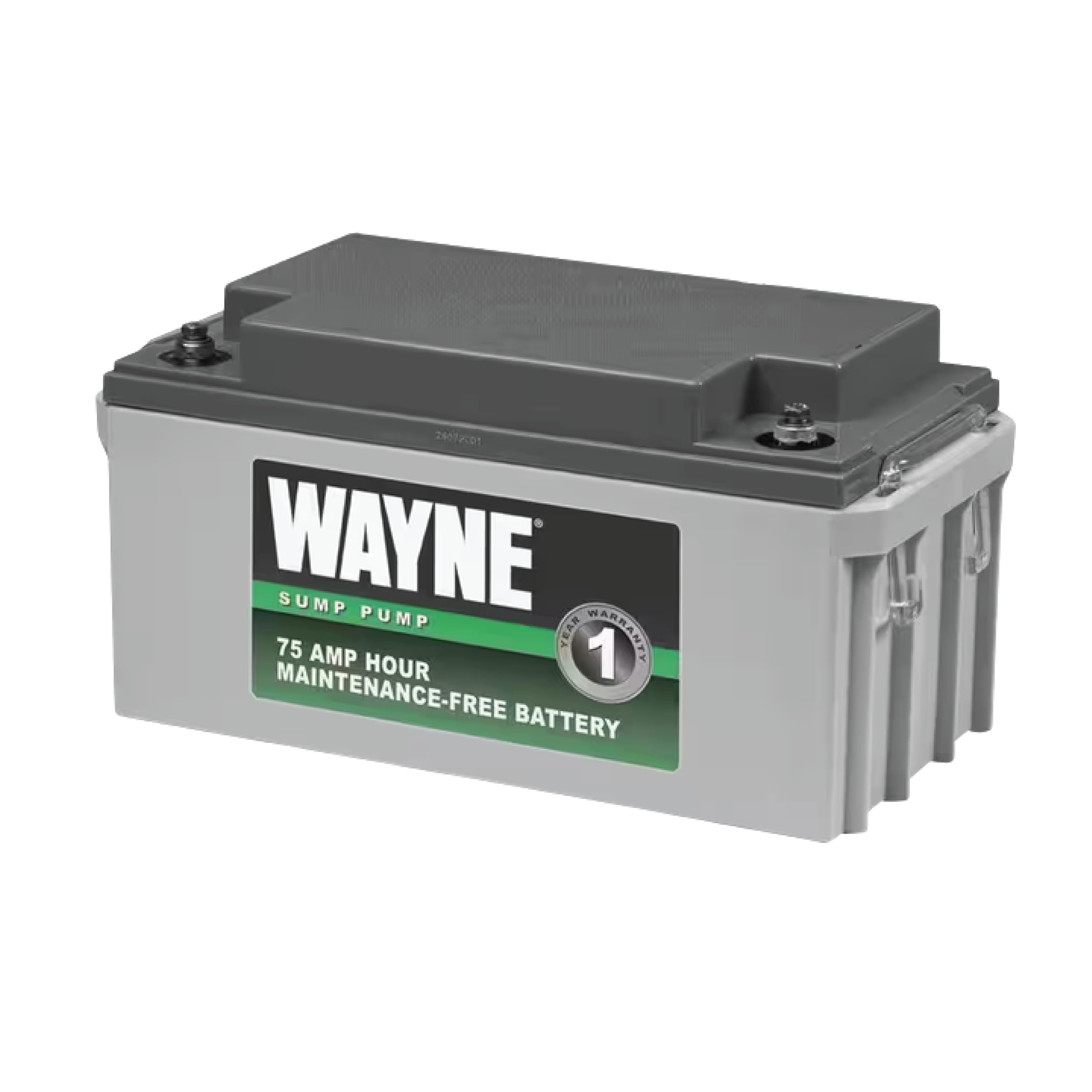
The exact 75Ah sealed battery Wayne systems are designed around, arriving fully charged and ready to run.
This is the factory-matched battery for the Wayne backup pump systems, specifically the ESP25N, WSS30VN, and WBPS50 models. Being the OEM (Original Equipment Manufacturer) battery means it is designed to the exact voltage and capacity specs of those systems, so you get a plug-and-play fit without guesswork. It is a 12V/75Ah sealed lead acid battery that ships fully charged with carry handles and is rechargeable for repeated use.
Shoppers say it cycles a Wayne backup pump multiple times on battery power with reliable security, and the maintenance-free design means no mixing acid and no adding water — just install it and forget it. On the back of this battery, the Wayne system can pump up to 5,100 GPH and remove up to 10,000 gallons on a single charge, which is the capacity story that matters during a long outage.
The honest trade-off is the price-to-life ratio. Battery life is the most-discussed aspect, and the feedback splits: some buyers report lasting about 6-7 years, one got 8 years, and others found it failed to hold a charge after 18 months. A few also note it is pricier than comparable non-branded batteries of the same capacity. If you want the guaranteed-compatible, carry-handle convenience of the exact battery Wayne recommends, this is it.
The read: a premium-priced OEM battery with great compatibility and genuinely mixed service life — some owners get 7-8 years, others far less. Best for: Wayne system owners who value guaranteed fit over chasing the lowest price.
7. PumpSpy 2000W Sump Pump Battery Backup System

A 2000W pure sine wave inverter that can power two sump pumps at once during an outage.
This is a serious piece of backup hardware for homes with two pumps or a pump plus other critical gear. The 2000W output generates a stable pure sine wave 120 VAC waveform, and it can power two primary sump pumps simultaneously as long as their combined current draw does not exceed 16.6 Amps. That dual-pump headroom makes it a compelling choice for larger basements or light commercial settings.
The build quality is a genuine standout. It is tested and packaged in Kalamazoo, Michigan, with CE certification for electrical safety, and owners describe it as American-made with everything included for installation — even the screws for wood or concrete and a concrete bit. It measures 17.5 x 6.75 x 4 inches and weighs 10.5 pounds, so it is a substantial unit that mounts easily on a wall. The smart cooling feature and trickle-charge maintenance keep the battery ready and extend its life.
Understand this: the battery is sold separately, and at least one owner missed that detail and felt the unit was “just a box” without it. It has two grounded outlets plus a USB charge port, so it works as a general power inverter for lights, phones, and monitors, not just the pump. For confidence with two sump pumps, this delivers.
Why it stands out
- 2000W capacity handles two pumps at once
- All-inclusive install kit with wall-mount hardware
- Trickle-charge keeps battery topped up between storms
Know before you buy
- Battery is sold separately, adding to the total cost
- Larger footprint needs wall space
Reach for it if: you have two sump pumps or want a high-wattage inverter that also powers essential devices. skip it if: you expected a battery included — this one requires a separate 12V deep-cycle battery.
8. Viopumpo 2500 Watt Sump Pump Battery Backup System

A 2500W professional inverter with an adjustable input voltage that extends lithium battery life.
This inverter stands out for a feature few others offer: an adjustable input voltage function (9.5V-11V) that lets you tune the cutoff to match lithium batteries, reducing drain and protecting battery health. That flexibility is a big deal for owners who want to run their pump on a LiFePO4 battery without the inverter shutting off prematurely. It is pure sine wave output at 2500 watts with 25A operating current and 3 AC outputs, so it can support multiple sump pumps at once.
The build quality and real-world performance earn strong owner praise. One buyer ran a 1400W hair dryer on a single 100Ah battery while the display showed stable 118-121V pure sine wave. Another powered a coal furnace fan for about 20 hours through an outage. The high-definition LCD remote gives clear voltage, power, and battery charge status at a glance, and the self-recovery overload protector plus overheating, short-circuit, low-voltage, and overcharge protections cover the safety bases. There is even a 5V/3.1A USB port and a 30W Type-C port for charging devices.
The only real complaint is minor: the three outlets sit close together, so a large plug can block the adjacent outlet, leaving just one usable at a time. Installation is genuinely easy — no additional wiring, just assemble the AC and DC cables — and the 12-month warranty plus email support add confidence. This is the pick if you want maximum wattage headroom and battery-type flexibility in one box.
Best for: buyers who want 2500W of headroom, lithium-battery compatibility, and three outlets for multi-device backup. The catch: outlets are tightly spaced, and the battery is sold separately.
9. Zoeller Aquanot 508 Battery Back-Up System
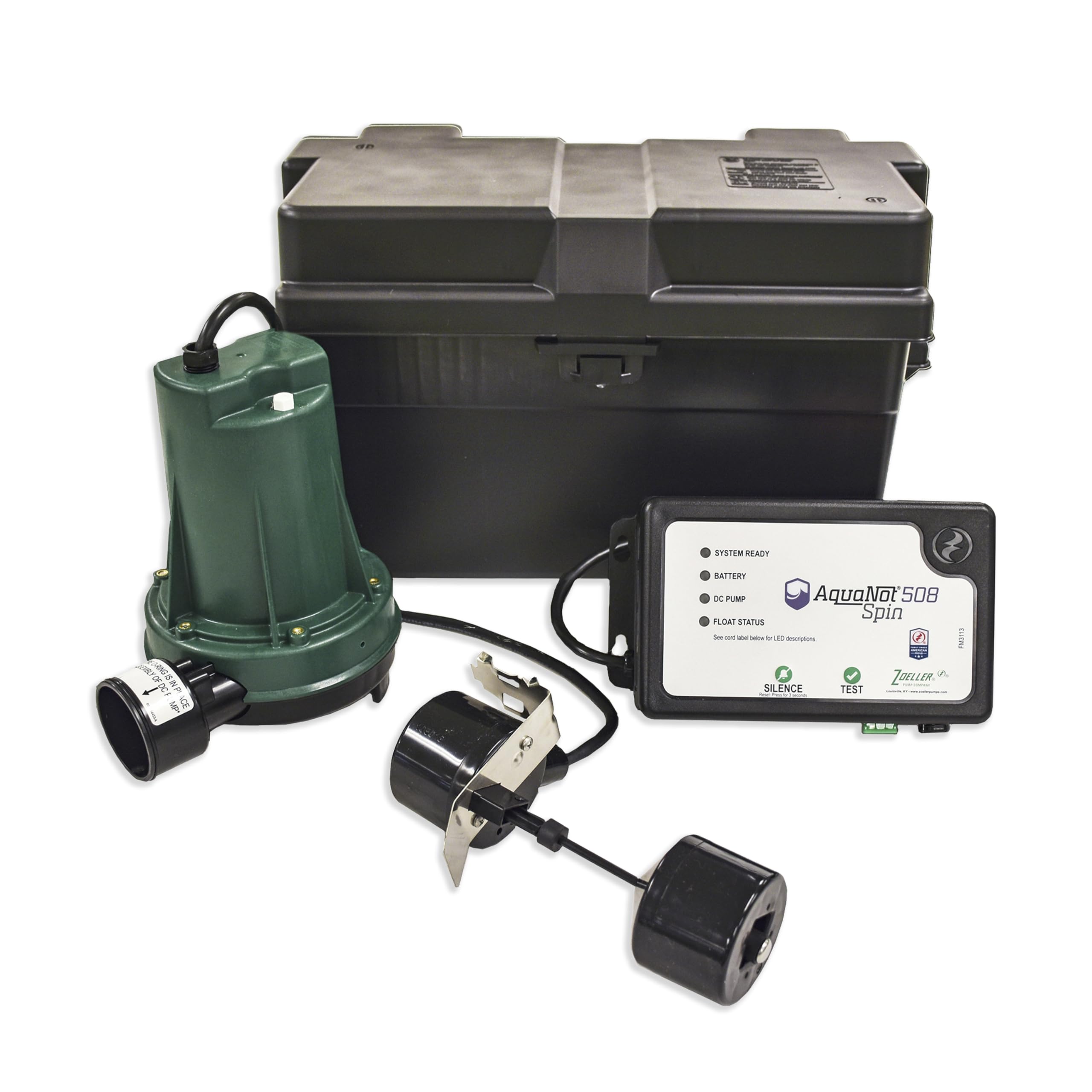
The hand-built, 100% USA-tested backup pump that Zoeller engineered with an integrated check valve.
Zoeller is a name professional plumbers trust, and this 0.33 HP DC backup pump carries that reputation. It is hand-built and 100% tested in the USA, with a highly efficient noncorrosive pump construction that resists the wear that kills lesser units. The integrated check valve means you do not need to drill a relief hole or add a separate valve, simplifying installation and removing a common failure point.
The numbers back up the pro-grade billing. It pumps 40 GPM, and in a real 3-hour outage test, it cycled 300+ times and still had roughly 6 hours of battery reserve left. Owners rate the quality and reliability highly, noting it fits an 18-inch well alongside a primary pump and works right from the start. The quick-disconnect discharge and aluminum seal pocket with cooling plate are the kind of engineering details that extend service life.
The trade-offs are typical for pro gear. The warranty is 12 months from installation (or 18 months from manufacture), but it extends to 36 months if you also buy a Zoeller Aquanot battery and use the complete system — a meaningful incentive to stay in the brand ecosystem. It needs a separate deep-cycle battery, and some owners found the included clamp weak and needed a proper 2″ to 1.5″ conversion fitting. Durability and value get mixed feedback, but for a dependable, high-quality backup pump, the Zoeller name carries weight.
The verdict: a quality-first, USA-built backup pump with a no-drill integrated check valve, matched best with a Zoeller Aquanot battery to open up the 36-month warranty. The fit note: its 10.5-pound build barely fits some sump crocks.
10. Westinghouse 1/2 HP Sump Pump with 12 Volt Battery Back Up
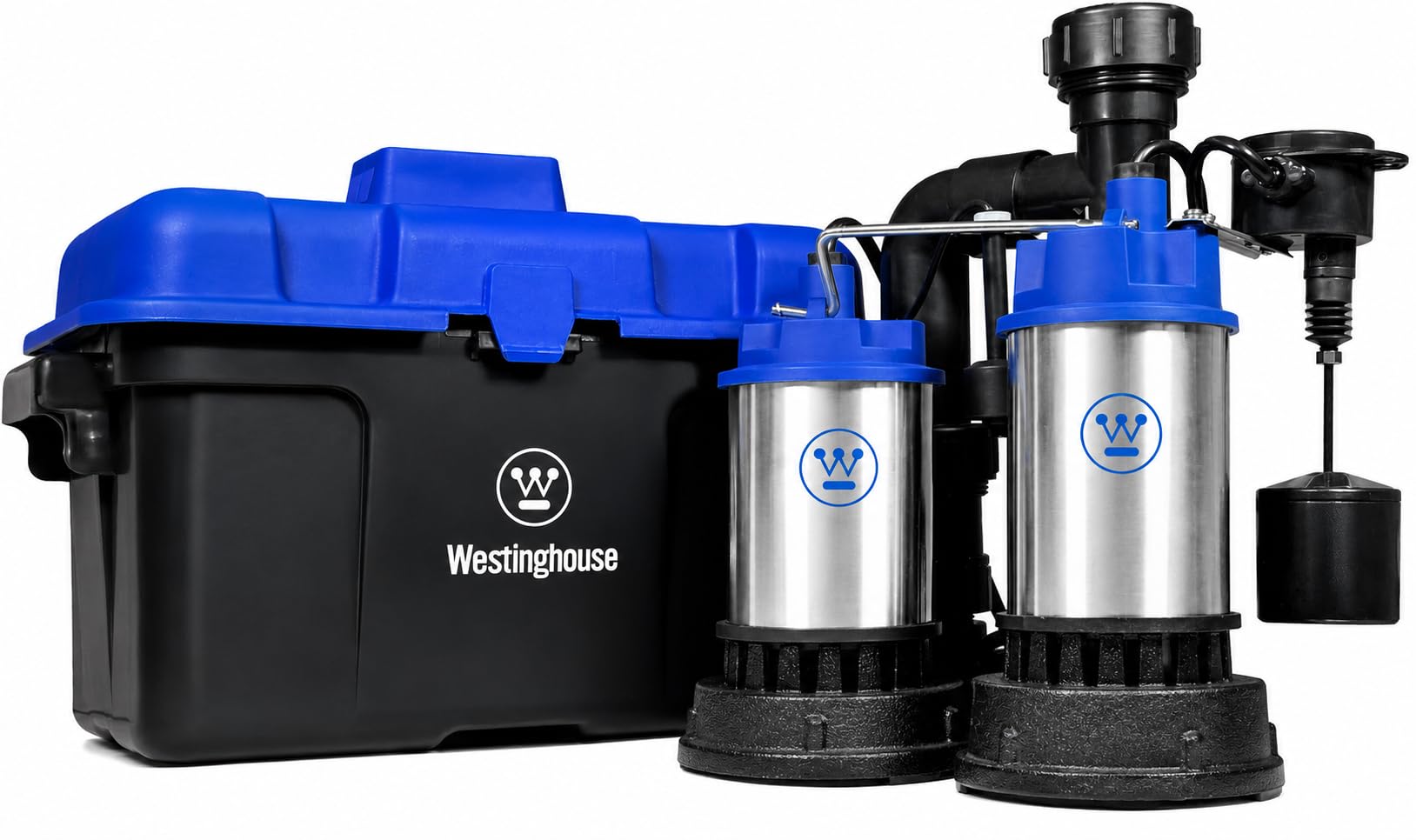
A dual-pump system wrapped in corrosion-resistant stainless steel with a top-suction design.
This is the premium dual-pump setup for buyers who want serious material quality. Both the AC primary and DC backup pumps feature corrosion-resistant stainless steel housings — owners immediately notice it is not cheap flimsy plastic — and the energy-efficient PSC motor (a type of motor that runs quietly and uses less electricity) includes thermal overload protection, lubricated ball bearings, and a sealed shaft. The top-suction intake design helps prevent airlock and reduces debris buildup for consistent, clog-resistant flow.
The performance is heavy-duty: the system pumps up to 5,200 gallons per hour with an 87 GPM flow rate, and the primary pump alone can lift water up to 30 feet. One reviewer noted it completely emptied a large pit in about 10 seconds. The compact footprint was also a plus for owners with tight pits, and the two-float design provides reliable automatic activation. A built-in alarm system alerts you if something goes wrong.
The honest notes: the battery is sold separately, and owners mention the charger adapter cable is short, so plan outlet placement accordingly. Longevity is untested by early buyers, but the cast iron and stainless steel construction inspires confidence. For a complete primary-plus-backup system with premium materials and quiet operation, this Westinghouse is the top-shelf option.
The strengths
- Corrosion-resistant stainless steel housings on both pumps
- 87 GPM with top-suction anti-airlock design
- Compact footprint suits tight pits
The trade-offs
- Battery not included, adding to the total cost
- Charger adapter cable is noticeably short
Choose it for: premium stainless steel durability and a complete dual-pump system in a compact frame. Consider it if: you are comfortable buying the matching Westinghouse battery separately and placing the charger near an outlet.
Understanding the Specs
Gallons Per Hour (GPH) & Flow Rate
This is the single most important number on a backup pump. It tells you how much water the pump can move, usually measured in gallons per minute (GPM) or gallons per hour (GPH). A higher rate empties your sump pit faster, which means the pump cycles less and preserves battery life. Compare the backup’s flow rate to your primary pump’s rate to ensure the backup can keep up during heavy inflow.
Battery Capacity (Ah) & Chemistry
Amp-hours (Ah) measure how much energy a battery stores — the higher the number, the longer your pump can run on a single charge. A 75Ah battery is a common starting point, while 100Ah roughly doubles your runtime potential. Sealed AGM (Absorbent Glass Mat) batteries are the standard for backup pumps because they are maintenance-free, never need acid or water, and can sit on a trickle charger safely.
FAQ
How long will a backup sump pump battery run during an outage?
What is the difference between a dual-pump system and an inverter system?
What does a maintenance-free battery mean?
Can I use any 12V battery with my backup sump pump system?
What size battery do I need for my backup sump pump?
How often should I test my backup sump pump battery?
What is a pure sine wave inverter and why does it matter?
Why does my backup sump pump battery lose charge so quickly?
Can a backup pump battery also power other devices during an outage?
How long does a backup sump pump battery last before it needs replacing?
Final Thoughts: The Verdict
For most people, the backup sump pump battery winner is the Wayne Preassembled Combo System because it solves both failure scenarios with one preassembled, drop-in package and a 3-year warranty. If you want flexible inverter power that also charges your phone and runs other devices, grab the OLTEANP 1500W. And for a compact, reliable backup that fits a tight pit, the Basement Watchdog BWE is the one to reach for.
How We Picked
We do not accept paid placement. Every pick is matched to a real buyer and a real use-case; we do not hands-on test units.
Sources & Methodology
Specifications: manufacturer listings and product documentation. Review insights: verified customer reviews, as of August 2026. Pricing: not shown on this page (it changes often); check the current price via the retailer link.
As an Amazon Associate, Gadgets Feed earns from qualifying purchases. This does not affect which products we feature.