
Our readers keep the lights on and my morning glass full of iced black tea. As an Amazon Associate, I earn from qualifying purchases.
Specs are compiled from manufacturer listings and verified buyer reviews and can change over time — please confirm the key details on the product page before buying.
The core question for any backyard composter is simple: do you want to heave a shovel through a steaming pile, or just crank a handle and walk away? If you are in the second camp, a tumbler is your answer, and if you have a big yard with lots of leaves, a static bin can be the cheaper workhorse. This guide breaks down the best options for turning kitchen scraps and yard waste into garden gold, focusing on the real-world trade-offs that decide whether you actually stick with composting or abandon it by fall.
I’m Min — the founder and writer behind Gadgets Feed. This guide is built by comparing the manufacturers’ published specifications and the patterns across verified customer reviews, so you get each pick’s real strengths and trade-offs instead of marketing spin.
You want a backyard composter that fits your space, your strength, and your patience for assembly — here is how to choose the right one for your garden.
Our Picks at a Glance


How To Choose The Best Backyard Composter
Every bin type solves a different problem. A tumbler makes turning easy but asks you to batch your waste, while a static bin swallows endless leaves but needs manual mixing. Your first decision is which chore you hate more.
Match the design to your effort level
Tumblers rotate on an axle or a stand, so you mix the compost by spinning a drum instead of forking a pile. Static bins sit on the ground, hold far more volume, and rely on you to stir occasionally. If you want finished compost in weeks, a tumbler’s regular rotation is the edge; if you have a mountain of autumn leaves, a static bin’s sheer size wins.
Check the assembly before you buy
The biggest surprise in this category is build time. Some quality tumblers bolt together in under an hour, while others demand two hours of screw sorting and a drill to fix misaligned holes. Read the assembly notes in each review below honestly — a great bin you never build is useless.
Think about winter and wind
Plastic bins left outside face two enemies: UV rays that make them brittle, and gusts that knock empty bins over. High-impact plastic and a low profile help, but many owners anchor their bins with stakes or a brick on the lid. Ask whether your yard is exposed before you pick an ultralight model.
Quick Comparison
| Model | Best For | Capacity | Type | Assembly Time | Amazon |
|---|---|---|---|---|---|
| RSI Maze Compost Tumbler★ Best Overall | Serious composters | 65 Gallons | Tumbler | ~2 Hours | Amazon |
| F2C Compost BinBest Value | Budget gardeners | 120 Gallons | Static | 5 Minutes | Amazon |
| VIVOSUN 500 Gallon BinMax Capacity | Massive leaf piles | 500 Gallons | Static | 30 Minutes | Amazon |
| EJWOX 80 Gallon Bin | Dog waste compost | 80 Gallons | Static | 6 Parts | Amazon |
| Hourleey Dual Chamber | Couples, no bending | 43 Gallons | Tumbler | ~56 Screws | Amazon |
| EJWOX Tumbler w/ Thermometer | Heat-checking tinkerers | 160 Liters | Tumbler | 45 Minutes | Amazon |
| FCMP Rolling Single | No-assembly beginners | 37 Gallons | Tumbler | No Assembly | Amazon |
| FCMP Dual-Chamber | Small households | 37 Gallons | Tumbler | 15 Minutes | Amazon |
In‑Depth Reviews
1. RSI MCT-MC Maze Compost Tumbler, Black
Our pick — 4.5★ from 600+ verified ratings; the strongest balance of quality and price.
The heavy-lifting champion that keeps composting through snow and ice.
This is the one you buy when you want a real machine, not a toy. The geared handle is the standout — it turns the drum smoothly even when the 65-gallon barrel is packed, which means you are not fighting the load on every rotation. The design includes adjustable built-in air vents in the drum, so you control airflow to speed up or slow down decomposition depending on the season.
Owners consistently praise the build quality, and the secret is in the engineering: a heavy steel base, thick plastic bin, and a framework designed not to rust. The trade-off is the assembly — plan for about two hours, with a drill nearby, because some cart handle holes arrive misaligned and need enlarging. Buyers report that once it is up, the crank is reachable even from a seated position, and the two compartments let one side cook while you fill the other.
It is a premium price, but the crowd favorite earns it with top-notch gears and brakes that shrug off brutal winters. The wheelbarrow accessory is handy but its handle is lower quality than the rest — a minor dent in an otherwise superb package.
What Wins People Over
- Geared handle keeps turning easy when fully loaded
- Rust-resistant framework survives winter weather
- Adjustable air vents give you control over the process
Where You Earn It
- Assembly runs about two hours with some hole misalignment
- Premium price tag puts it above casual composters
Reach for this if: you want a durable, high-capacity tumbler that works year-round and you do not dread a Saturday build.
Look elsewhere if: you want to be composting within ten minutes of unboxing.
2. F2C Compost Bin Outdoor Composter BPA Free Material -120 Gallon (450L)
A five-minute setup that swallows 120 gallons of waste for almost nothing.
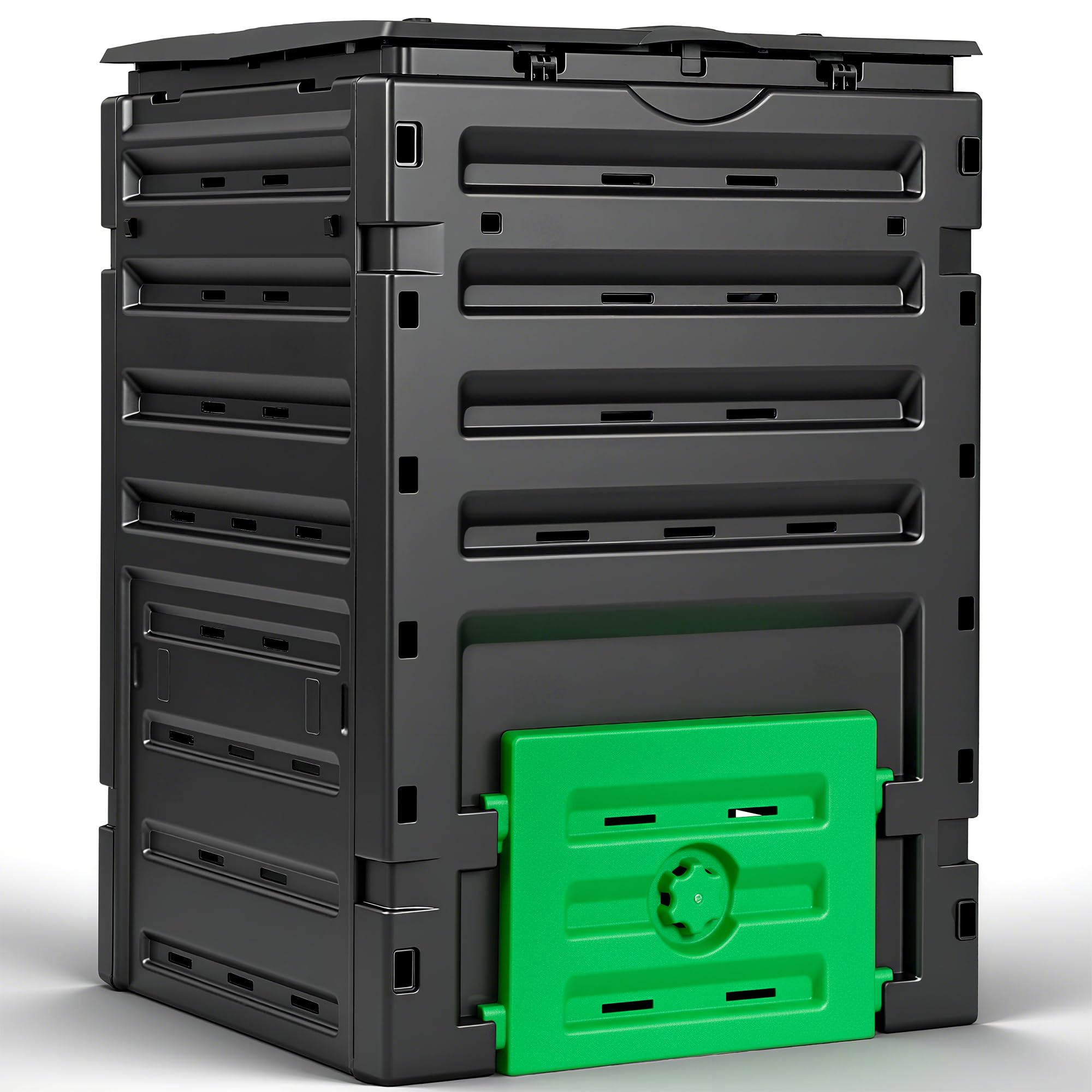
If your main objection to composting is the assembly dread, this bin eliminates it entirely. Owners assemble it in five minutes with a rubber mallet — no screws, no drill, no sorting hardware. The trick is its open-bottom design, which lets worms and soil microbes work from underneath, effectively giving you a pseudo-vermicomposting setup without the fuss of maintaining a worm farm.
The black polypropylene body holds heat and regulates moisture to speed up decomposition, and the 80 air vents plus deep fins provide circulation without any digging. It is flimsy — owners are blunt that the plastic is thin and the lid tabs can break — but it works. The pull-up door at the bottom makes shoveling out finished compost easy, though it stays open until the bin empties.
One shared trick: the lid needs a stone or brick on top to keep critters out and anchor it in the wind. For the price, this is the entry point that gets most people actually composting, and several owners bought a second unit.
Five-minute marvel: The easiest possible start for a first-time composter who wants maximum volume for minimal money.
Honest limit: The thin plastic and lid tabs demand gentle treatment, and a breeze can topple an empty bin without weight on top.
3. VIVOSUN 500 Gallon Outdoor Compost Bin, Expandable Composter
The expandable giant that eats whole seasons of leaves in one go.
This bin is the answer to the “I have too much yard waste” problem. At 500 gallons, it dwarfs the RSI’s 65-gallon drum by a 7.7x margin, and its 63″L x 63″W x 35.4″H footprint gives you a serious pile that decomposes in bulk. The adjustable diameter is the clever part — with five anchor bars and ten connecting buckles, you can shrink it down for a small load or expand it for autumn.
The HDPE material resists corrosion and weathering, and owners mention it handles tough winters while the full-surface holes keep air circulating to prevent the anaerobic smell that kills static piles. It is light and simple to set up in about 30 minutes, and the included free garden gloves — which are waterproof — protect your hands during assembly.
The honest catch is stability. Owners note the bin can flop inward if it is not full, and the included stakes are not quite enough — plan for a fourth stake or a heavy base. It has no lid, so critters can wander in, and the pliable sides make solo setup a two-person job. Many owners buy two so one pile cooks while the other fills.
Bulky workhorse: Buy this for the sheer volume and adjustable size, not for a tidy, critter-proof system.
Budget stakes: The plastic is durable for years, but the included supports are the weak link — keep an extra stake on hand.
4. EJWOX 80 Gallon Large Capacity Static Compost Bin

A snap-together bin that handles the nastiest job — dog waste — without complaint.
Forget the screwdriver: this bin builds from just six parts in minutes. The snap-together sides lock into place with a rubber mallet, no professional tools needed, and the 80-gallon capacity processes a large volume of leaves, grass, and kitchen scraps. The strategically placed air vents on all sides keep oxygen flowing to accelerate the fermentation into quality soil.
Where this bin earns its reputation is with pet waste. Owners specifically use it for dog poop composting, working well in hot southern sun with sawdust and compost starter. The lid fits with four pins and snaps shut to resist wind, and the bottom holes accept stakes to hold it steady.
The recurring concern is the plastic’s brittleness. Some owners find the lid does not snap tightly, and the material can be too thin to hold a brick’s weight. It is flimsy but functional — a cheap-looking black box that sits unobtrusively in a corner. If you want the easiest way to compost food waste without thinking, this is it.
No-screw solution: The fastest path from box to working bin for a single person plus chickens or dogs.
Thin walls: Treat the lid gently; it fits but does not always seal snugly against persistent critters.
5. Hourleey Compost Bin Outdoor, 43 Gallon Dual Chamber Tumbling Composting Bin

No bending over, no smell — just grab the fins and spin.
This tumbler is built for the person who hates hunching over a pile. The 360° tumbling design uses deep flaps and grooves on the panels so you rotate the whole drum with a comfortable grip, and the large openings make adding scraps a one-hand job. Owners love that they never have to bend over, and the two separate compartments mean one side finishes while you stuff the other.
You get 43 gallons of turning space (27.6 × 25.8 × 36 inches), which handles the kitchen scraps and yard waste of a two-person household without overflowing. The high-grade metal frame and sturdy plastic body resist corrosion, so it survives rain and snow without rusting through. As you spin it, the deep fins break up clumps and mix in oxygen, which speeds up decomposition so you get usable compost sooner.
The assembly is the sticking point — roughly 56 screws and instructions that owners call confusing. The trick is to attach the door last and separate the longer screws from the nuts before you start. The enclosed design traps moisture, so without a careful green-to-brown balance, you can get a sludgy mess, and the small sliding panels are tricky to fully empty.
Why It Shines
- Ergonomic fins mean no bending to rotate
- Dual chambers deliver continuous compost
- Sturdy metal frame resists corrosion
Why It Tests You
- Assembly demands patience with ~56 screws
- Moisture control is fussy without the right mix
Best for the couple: who wants a tidy, no-bend system that produces steady compost for a small garden.
skip it if: you would rather spend 15 minutes building than an hour sorting screws.
6. EJWOX Upgraded Tumbling Composter with Compost Thermometer

Take the guesswork out of hot composting with a built-in temperature gauge.
This is the tumbler for the data-driven gardener. The built-in compost thermometer sits in the drum, telling you whether your pile is in the active heat zone or has gone cold and needs more greens. It removes the guesswork from a process that usually relies on feel, and helps you decide what to add and what to hold back.
The 160-liter capacity is solid for a household, and the galvanized steel frame gives it a sturdy base — owners confirm it sits very stable and has a smooth spin. The deep groove design at 50mm depth makes rotation easy, and the 2021 upgrade reduced the screw count, so assembly is faster than older versions, though the picture-only directions still leave some scratching their heads.
The thermometer’s accuracy draws mixed reports — some owners find it reads low even when the pile is clearly hot — so treat it as a guide, not gospel. For pest control, a bungee cord across the doors keeps rats out, and adding extra browns prevents the smell when you compost dairy or meat. It is a fun spin, and many owners say it is the cheapest option for a 43-gallon tumbler with these features.
Guided composting: A great pick if you want a temperature readout to learn what a healthy pile feels like.
Not a lab tool: The thermometer may under-report heat, so keep using your senses alongside the gauge.
7. FCMP Outdoor HOTFROG Rolling Single Chamber Batch Tumbling Composter

Unbox it, set it on the stand, and start composting the same afternoon.
This is the rare composter that arrives ready to use — no assembly, no screws, just take it out and put it on the stand. The rolling design is the headline feature: instead of shoveling compost into a wheelbarrow, you roll the whole drum to where you need it. That mobility is a genuine quality-of-life upgrade over static bins.
The 37-gallon capacity (5 cubic feet) is made from BPA-free, UV-inhibited recycled polyethylene, so the all-plastic construction has no metal frame to rust — a point owners specifically contrast with metal-framed rivals. The large opening and removable door make it beginner-friendly, and the deep fins on the body double as ergonomic handholds for turning.
Turning takes effort because there are no wheels or a pole to leverage — you push the drum by hand, and it is heavy when full. The air holes leak fine materials like sawdust and coffee grounds, so consider a liner. In hot, sunny conditions with proper balance, compost can finish in as little as two weeks, and owners praise how sealed and rodent-proof it stays.
Beginner’s dream: The fastest route from unboxing to an active, critter-proof compost batch.
Full-drum workout: Rotating a packed 37 gallons takes real effort, and fine scraps may fall through the vents.
8. FCMP Outdoor HOTFROG 37-Gallon Dual-Chamber Tumbling Composter
Two drums that keep your compost pipeline full without ever stopping production.
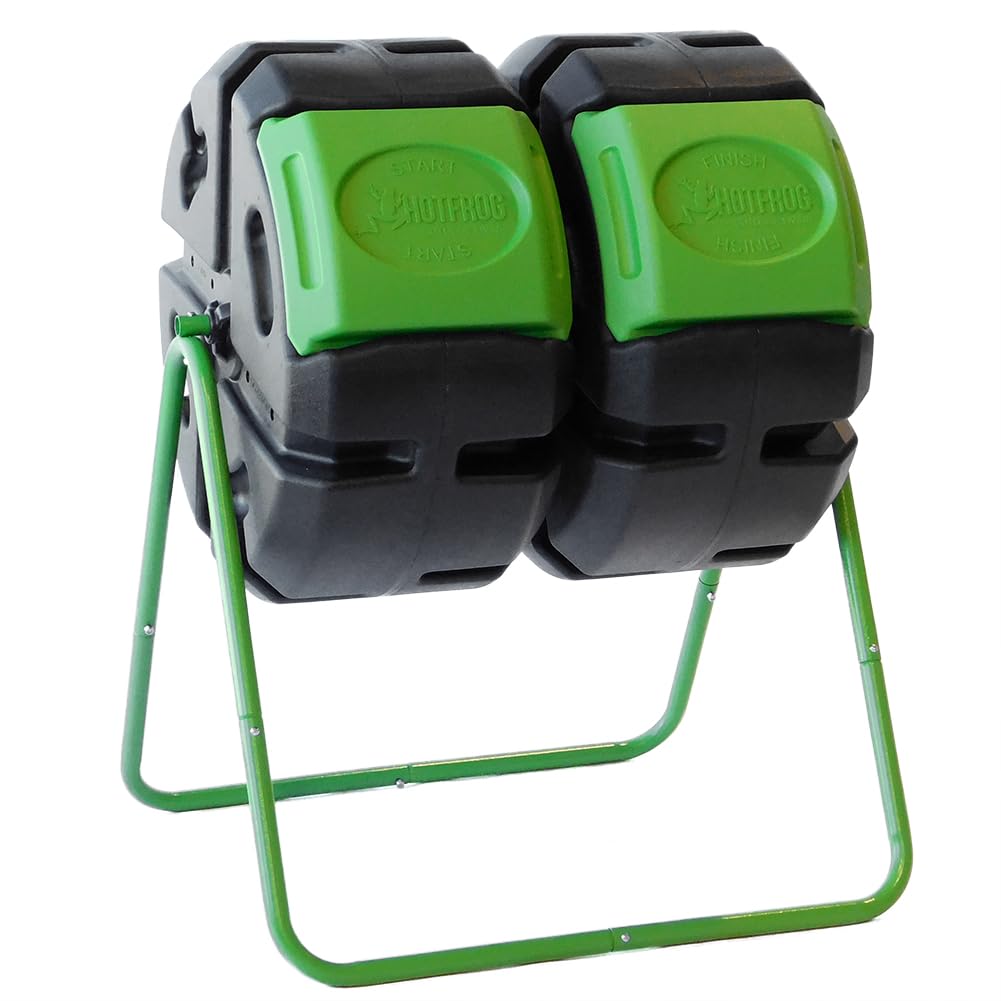
This is the upgrade from the single-chamber HOTFROG, and the dual-body design is the reason. Two equally sized drums let you fill one side while the other finishes its cycle, creating a continuous flow of compost for a small household. The whole assembly is compact at about a 30-inch cube, so it fits on a back porch without dominating the space.
Construction pairs BPA-free, UV-inhibited recycled polyethylene drums with a corrosion-resistant powder-coated galvanized steel frame. Customers note an easy 15-minute build of eight screws, and the sliding doors are removable for a wide opening to dump in scraps. The doors are labeled “Start” and “Finish,” which is intuitive enough that even a six-year-old can spin the drum.
The spin is smooth even when full, and the height leaves room for a tray underneath to catch finished compost. The trade-off is those questionable screws and bolts — a few owners swap them out, and the sliding doors can be slightly stiff at first. Still, it processes kitchen waste, coffee grounds, tea bags, and eggshells quickly, gaining heat in full sun to speed decomposition.
Continuous gardener: Ideal if you want a steady drip of finished compost rather than waiting for one big batch.
Hardware watch: The included screws work but feel budget — replacing them with stainless is an easy upgrade.
Understanding the Specs
Capacity in Gallons
This tells you how much waste the bin holds, but bigger is not always better. A 500-gallon static bin holds a season of leaves but demands you mix it by hand. A 43-gallon tumbler holds less but spins the whole batch for you. Match capacity to your waste volume — a couple produces far less than a homestead with chickens and a vegetable patch.
Aeration and Air Vents
Compost needs oxygen to break down without stinking. Tumblers mix air in every time you spin. Static bins rely on vents — holes in the walls — plus the open bottom for soil contact. More vents mean faster breakdown. The reason aeration matters is that a pile starved of oxygen goes anaerobic and smells like rotten eggs, which is the fastest way to quit composting.
FAQ
How many gallons do I need for a family of four?
Which is better, a tumbler or a static open-bottom bin?
How long does it take to get finished compost?
Will a composter work in cold winter weather?
How do I keep animals and pests out of the composter?
What is the difference between 43-gallon and 160-liter tumblers?
Can I compost dog waste in a backyard bin?
Why does my compost bin smell bad?
Final Thoughts: The Verdict
For most people, the best Backyard Composter is the RSI Maze Compost Tumbler because its geared handle and rust-resistant build turn a chore into a smooth routine that survives harsh winters. If you want a cheap way to start with zero assembly pain, the F2C 120-Gallon Bin builds in five minutes and swallows a huge volume. And for a family that just wants steady compost from kitchen scraps without back strain, the Hourleey Dual-Chamber keeps one side cooking while you fill the other.
How We Picked
We do not accept paid placement. Every pick is matched to a real buyer and a real use-case; we do not hands-on test units.
Sources & Methodology
Specifications: manufacturer listings and product documentation. Review insights: verified customer reviews, as of August 2026. Pricing: not shown on this page (it changes often); check the current price via the retailer link.
As an Amazon Associate, Gadgets Feed earns from qualifying purchases. This does not affect which products we feature.