
Our readers keep the lights on and my morning glass full of iced black tea. As an Amazon Associate, I earn from qualifying purchases.
Specs are compiled from manufacturer listings and verified buyer reviews and can change over time — please confirm the key details on the product page before buying.
Your hitter can take 50 reps before dinner without a pitcher, a catcher, or a trip to the batting cage — a backyard pitching machine turns your own yard, garage, or basement into a practice space. Pick one that fits your space, your player’s age, and the pitches you want to see. A machine that throws 90 mph fastballs in a 20-foot yard is useless, and one that only lobs soft toss won’t help a travel-ball kid. Here are nine machines, what each really throws, and who each is built for.
I’m Min — the founder and writer behind Gadgets Feed. This guide is built by comparing the manufacturers’ published specifications and the patterns across verified customer reviews, so you get each pick’s real strengths and trade-offs instead of marketing spin.
Some machines launch lite balls at speeds a real pitcher can’t match, while others are built to groove soft toss into a net in a tight space. Your player’s level and your available space decide the pick, so here are the best backyard pitching machine options for daily practice.
Our Picks at a Glance


How To Choose The Best Backyard Pitching Machine
A machine that works for a 9-year-old in a driveway won’t work for a 15-year-old travel player, and the spec sheet rarely says so. Three specs decide whether a machine earns its keep: pitch speed and release distance, the ball it takes, and the room you have to catch what it launches.
Speed means nothing without distance
A machine rated “up to 50 mph” releases that ball from a set distance, and reaction time is what your hitter actually trains. The Personal Pitcher Pro simulates 15–95 mph based on distance and reaction time, so you set the speed and stand the right number of feet away. The Heater Slider Lite 360 pitches lite balls up to 80 MPH at 46 feet. Same ballpark of speed, different feel at the plate. Ask one question: how far can I stand from the machine and still catch the ball? That distance picks your machine more than any number on the box does.
Ball type decides your setup
Lite and dimpled balls cut the flight and stay catchable in a modest yard. Regulation baseballs fly true but demand a real backstop or cage. The Louisville Slugger Blue Flame Pro takes tennis balls, dimple balls, plastic balls, softballs, and baseballs in one machine, which makes it the flexible choice if your practice changes day to day. Several machines are calibrated to one brand’s ball only, and PowerNet warns that using balls other than their Launch F-lite Ultra Lite baseballs and softballs voids the warranty. Check which balls your machine will actually eat before you buy.
Room, feeder, and storage
Automatic feeders keep you swinging without reloading, but they add size and weight. The Heater Heavy-Duty uses a 12-ball feeder that drops a ball every 8 seconds, and that feeder can be removed for manual feeding. The Furlihong 6902BHA tosses a ball every 6 seconds from its motor. The more automated the machine, the heavier it usually gets, so decide whether you’re carrying it out every session or parking it in the garage.
Quick Comparison
| Model | Best For | Pitch Speed | Ball Type | Weight | Amazon |
|---|---|---|---|---|---|
| Personal Pitcher Pro (w/48 Balls)★ Best Overall | Small-space practice | 15–95 mph simulated | Plastic golf ball size | 6 pounds | Amazon |
| Heater Sports Slider Lite 360Best Value | Youth teams on a budget | Up to 80 MPH at 46 ft | Lite balls | 13 pounds | Amazon |
| Louisville Slugger Blue Flame ProMost Versatile | Mixed-hit versatility | 30–58 MPH (to 65 lite) | Baseballs, softballs, dimple, tennis | 20 pounds | Amazon |
| Furlihong 6902BHA | Solo soft-toss reps | 1–4 speed settings | Baseballs & softballs | 11.6 pounds | Amazon |
| PowerNet Launch F-lite | Two-sport households | 40–90 MPH at 25 ft | Launch F-lite only | 13 kg | Amazon |
| Personal Pitcher Pro Starter Package | All-in-one kit buyers | 4 speed settings | Wiffle / focus balls | 9 pounds | Amazon |
| Heater Sports Heavy-Duty | Batting & fielding drills | 10–52 MPH (to 80 lite) | Baseballs & lite balls | 42.7 pounds | Amazon |
| Mound Yeti Single Wheel | Coaches & facilities | 30–60 mph | Baseballs & softballs | 50 lbs | Amazon |
| JUGS PS50 | Little League programs | Up to 50 mph | Regulation baseballs & softballs | 50 lb | Amazon |
In‑Depth Reviews
1. Personal Pitcher® Pro Pitching Machine w/48 Small Golf Ball Size Balls
Our pick — 4.5★ from 150+ verified ratings; the strongest balance of quality and price.
The six-pound machine that turns a basement into a batting cage.
Weighing less than 6lbs, this is the machine that fits where every other one on this list doesn’t. It uses Personal Pitcher Small Balls — plastic balls the size of a golf ball — so a basement, garage, or driveway works as your training space. It mounts onto any standard camera tripod, and it runs on an included 4-hour rechargeable battery or its AC adapter. The whole thing arrives with 48 lightweight balls, and picking those up between sessions is its own kind of cardio.
What you get for the space is real variety. Four speed settings simulate 15–95mph based on how far you stand and how fast you react, so the distance from the machine is part of the dial. It throws left and right handed curve balls, and the Pro Timing Light helps your hitter load properly. Those perforated balls won’t crack a wooden bat, so you can swing your game bat without worry. Buyers report running a basement setup with a 30-foot distance between machine and hitter for an eleven-year-old intermediate player.
The honest catch is the balls. The included set handles hitting fine, but the general verdict on aftermarket extras runs inconsistent, and buying straight from the manufacturer is the safer route for replacements. Learning the rear speed switches takes a session or two, and you’ll want a long extension cord if you’re not running on battery. Indoors, it wants 30+ feet for the faster pitches, so a short room limits you to soft toss and the lower settings.
Where it earns its keep
- Under 6 pounds and tripod-mounted — you can carry it out with one hand and set up in a playroom, garage, or basement.
- 4 speed settings simulate 15–95mph, and it throws both left and right handed curve balls.
- At 48 balls included, it holds far more than the Heater Slider Lite 360’s single ball — a 48.0x gap in included items.
- Ships with a 4-hour rechargeable battery and an AC adapter.
What to plan around
- Only works with Personal Pitcher’s small plastic golf-size balls, and off-brand replacement balls run inconsistent.
- Fast pitches need 30+ feet of indoor space.
- The rear speed switches take practice to get used to.
- Picking up 48 balls after a session is a workout of its own.
Buy it if: you need real pitch variety in a small space and want a machine light enough to move room to room.
Think twice if: your player needs regulation baseballs — this throws small plastic balls only.
2. Heater Sports Slider Lite 360 Baseball Pitching Machine with Automatic Ball Feeder
An entry-level machine that throws fastballs and curveballs for a starter price.
You get real pitch variety from a starter-tier machine: the Slider Lite 360 throws lite balls up to 80 MPH at 46 feet, and its pivot head is built to throw accurate curveballs as well as fastballs. The tubular steel legs have rubber tips for grip on any surface, and it folds for storage. It sets up quickly. One owner who runs it on a Ryobi 40v 6ah battery with a 300w inverter reports about 90 minutes of runtime, so you can use it in a park with no outlet in sight.
When it’s dialed in, the thing works. It runs a carousel feeder on its own, and the wheel’s roughly 5-second recovery between pitches matches the feeder timing well, so you’re not standing around waving at a dead machine. Taping the net poles and sticking to Heater’s white softee balls protects the unit — those are the two habits owners keep coming back to.
Here’s the rub: this is a single-wheel machine, and it’s not built like the premium two-wheel units that cost several times as much. Durability is the most-cited complaint, with reports of the motor giving out and the front cracking after a ball strike, so treating it gently matters. It also demands Heater Sports balls — other brands can slow the motor dramatically. For solo work and a couple of kids, it’s an honest starter machine.
Who this suits: a parent who wants a budget-friendly machine for one or two young hitters in a cage or yard, and doesn’t mind the weight of feeding it carefully.
Where it falls short: it needs a 25lb weight or sandbag on the tripod base for stability, and durability is the recurring gripe — that’s the honest trade for the lower price.
Worth it when: first-time machine pitch training is the goal and simplicity matters most.
skip it if: you need a machine that survives heavy, daily team use.
3. Louisville Slugger Blue Flame Pro Pitching Machine
A mechanical arm machine that covers pitching, fly balls, and hard grounders in one unit.
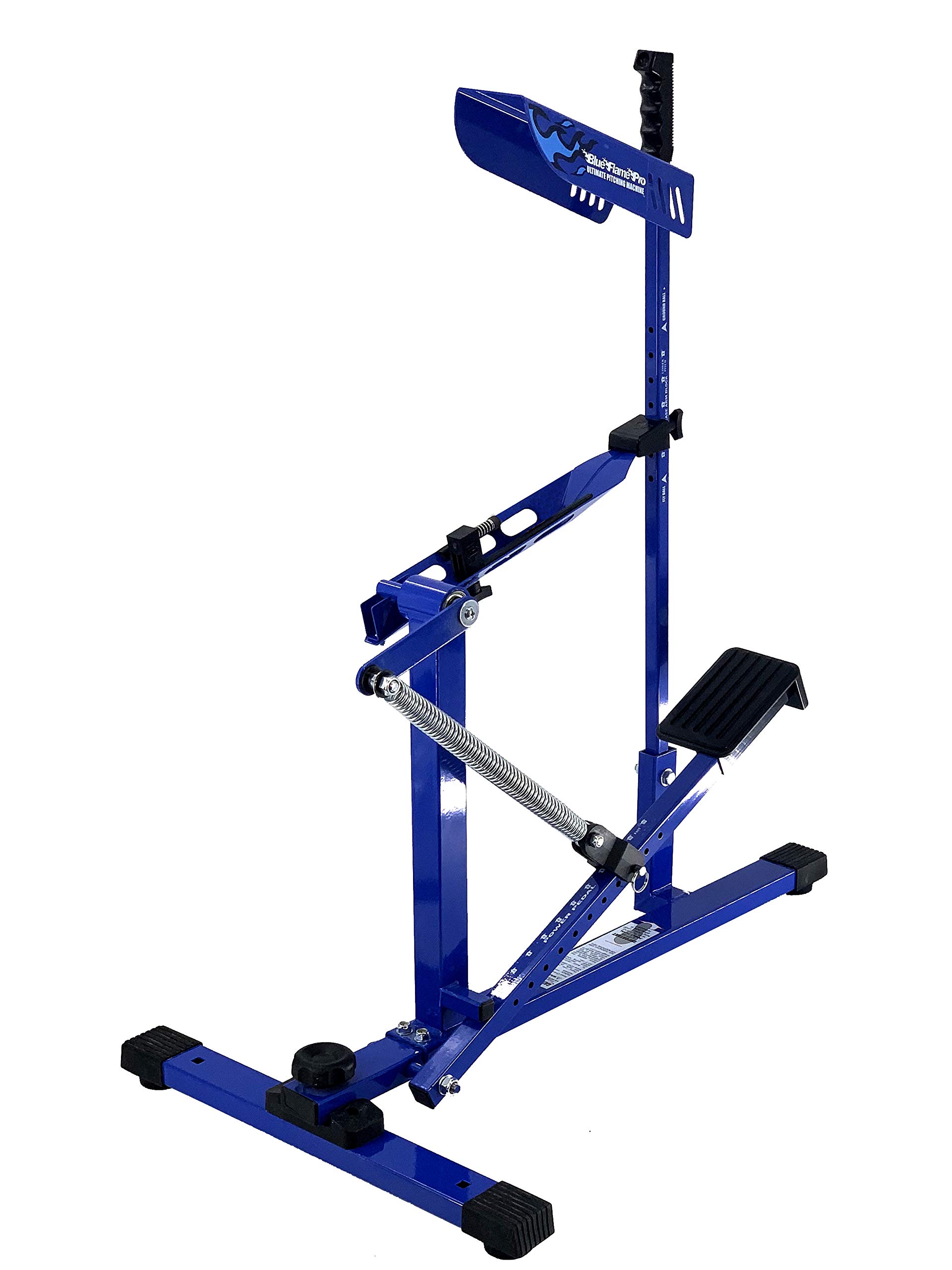
One machine that does a little of everything is the Blue Flame Pro. It delivers 30–58 MPH with baseballs and up to 65 MPH using restricted-flight balls, and it throws level pitches, fly balls, or hard grounders. That spread matters because unlike the JUGS PS50, which is built to throw regulation baseballs and softballs only, this one takes tennis balls, dimple balls, plastic balls, softballs, and baseballs — so you can drill pop flies with tennis balls and switch to baseballs later without buying a second machine. It’s used by Babe Ruth League and Pony Baseball & Softball programs nationwide.
One person can move it: at 20 pounds and just 33 x 8.75 x 5.5 inches, it’s notably lighter than the Personal Pitcher Pro’s heftier travel setup if you multiply the weight gap across a full load-out. The new ergonomic pedal takes less force to fire, and you can change the settings fairly easily once you learn the mechanism. One buyer runs it in a backyard batting cage with real baseballs for grounders, fly balls, and pitches.
This is a mechanical arm machine, not an electric one, and that changes how you use it. The spring-driven arm needs 5–10 pitches to get dialed in, and adjustments between pitches are slow because the spring jars the machine on each throw. Speed adjustment is slightly tricky, and the included mounting hardware is inadequate — the rear end needs stabilization you’ll provide yourself with lag screws or a hold-down. The spring is the durability question mark that a handful of owners have hit. It’s still a great fit for a coach throwing to one or two kids.
The case for it: no power cord, no outlet, no battery — you pedal, it pitches, and it takes any ball you own, which is a huge advantage for a backyard setup.
The trade-off: it’s a manual machine, so a full practice session means you’re standing on the pedal the whole time, and the spring arm won’t survive rough handling indefinitely.
Best for: a coach or parent who wants one machine for pitching, fielding, and fly-ball drills without batteries or cords.
Look elsewhere if: you want a machine to crank out pitch after pitch with an auto feeder and hands-free operation.
4. Furlihong 6902BHA Rechargeable Baseball/Softball Toss Machine

A soft-toss machine for the kid who trains alone before the game starts.
This is not a pitching machine in the traditional sense, and that’s the point. The Furlihong 6902BHA is a rechargeable toss machine that tosses a ball every 6 seconds from its own battery, so a hitter can take soft-toss reps without a partner. Height adjusts from 1.2 m to 1.7 m for baseball and 0.4 m to 0.6 m for softball, and it has 1–4 speed settings across two ball tunnels for baseball and softball. It saves your back from bending over a tee for 100 reps, and it’s the sort of tool that shines for winter soft-toss training when nothing else is available.
One owner whose son plays travel ball uses it in the backyard with a hitting net for quick reps before a game, and the toss doesn’t fire directly at the hitter — it comes at an angle that works the stance and contact. The battery is a standout: a full charge can run hundreds of hits without a recharge, and one buyer reports it lasting a month of daily use before it needed topping up. At 11.6 pounds, the body is easy to set down on the grass and doesn’t need assembly every session.
The frustration here is real and honest: it tosses, it doesn’t pitch. One buyer’s complaint sums up the disconnect — “this machine should be able to pitch also.” The included ball feeder net has also drawn mixed feedback, with a buyer saying the net caused issues while the toss itself worked fine. And the tosses vary in speed and location, which is either good training for adjusting to different pitches or annoying if you wanted repeatable soft toss.
Where it wins: nobody within 30 feet catches more soft-toss reps for a young hitter than this machine does on a single charge.
What it won’t do: speed and movement pitching are out of reach — this is a contact and stance trainer, not a game-simulator.
Reach for this if: your player trains solo in the yard and you want battery-powered soft-toss reps without a second person.
Look elsewhere if: you need real pitch speeds, curveballs, or an auto feeder.
5. PowerNet Launch F-lite Softball & Baseball Pitching Machine Bundle

One machine that swaps between baseball and softball practice in minutes.
Two sets of tripod base legs are interchangeable on the Launch F-lite, and swapping them changes the pitch height so one machine serves both baseball and softball. It’s calibrated to simulate 40 to 90 MPH at 25 feet across four adjustable settings, and it comes with 12 Launch F-lite balls — 6 baseballs and 6 softballs. It’s designed for coaches and parents running batting practice at home or on the field, and it’s what athletes like Corbin Carroll and German Marquez are associated with. For a household with one baseball kid and one softball kid, that’s a lot of flexibility in one box.
Owners praise the versatility and the setup. One coach notes it’s sturdy and reliable for a program spanning 16u down to 10u, and another says it works well for three kids with easy baseball-to-softball switching and adjustable speed for ages 6 and 11. It’s quick to assemble, extra screws are included, and the machine stays stable on its legs once it’s set. Pop flies are launchable for fielding drills.
Two things to keep in mind. First, top speed is the most-disputed spec here: one buyer with a radar clocked only 27 mph at max, well short of the advertised 40–90, while another was satisfied at the highest setting. Second, it’s built for Launch F-lite balls only — PowerNet states other brands can hurt durability and performance and that using them voids the warranty. Durability itself is mixed, with a report of one unit failing after a season. It’s a versatile pick, but the speed claims are worth testing early within the return window.
Why families like it
- One machine for baseball and softball via interchangeable tripod legs.
- Simulates 40 to 90 MPH at 25 feet across four adjustable speed settings.
- 12 Launch F-lite balls included — 6 baseballs and 6 softballs.
- Quick assembly and a stable, accurate throw when it’s dialed in.
Where it stumbles
- Top speed may fall short of the advertised 40–90 MPH — test it early.
- Requires PowerNet Launch F-lite balls only; other balls void the warranty.
- Durability gets mixed feedback, with a report of failure after one season.
- Pop flys are hard to catch, per owners.
Buy it if: you have both baseball and softball players in the house and want one machine to cover them.
Look elsewhere if: you need guaranteed high-end speed or a machine that runs on any ball you already own.
6. Personal Pitcher Pro Starter Package — Small Wiffle Ball Machine for Baseball & Softball
The everything-in-the-box version of the Personal Pitcher Pro.
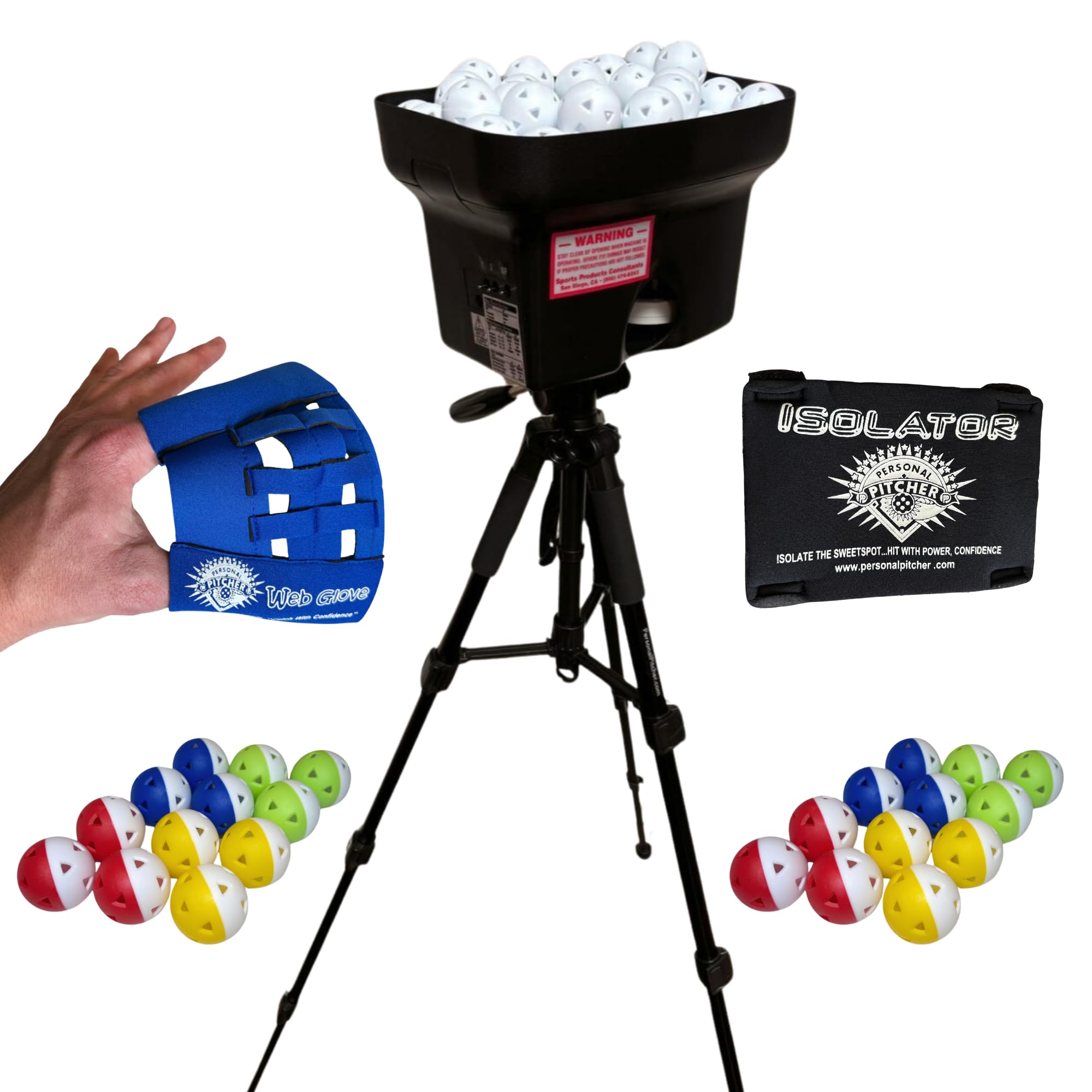
This starter package bundles the Personal Pitcher Pro machine with the gear that usually gets bought separately, and it weighs 9 pounds as a kit. The brand’s own tripod — lightweight, collapsible, and adjustable — is included, which solves the “which tripod fits?” problem that the standalone Pro leaves you to figure out. There’s also a WebGlov, a catch-training glove designed by Chris Richard to fit over the index finger and thumb, an Isolator Pad that straps to a bat’s balance to give a “pop” feedback on contact, and 2 dozen focus balls that vary in speed and location to train pitch recognition.
The whole package is aimed at the young or new player. It builds eye-hand coordination and offers different speeds and settings for varying difficulty, making it a genuine training tool rather than a novelty. One buyer’s 10-year-old was hitting 70–80 MPH pitches after a week, and a basement tripod setup about 28 feet from the plate suits a 12-year-old refining his swing. Quality is the standout — the kit’s components are what owners rave about most by far.
The honest caveat is the balls. Ball movement gets mixed feedback, and colored balls are less accurate than the white wiffle balls — the colored ones break randomly, which is either useful for teaching plate discipline or plain frustrating depending on the day. There’s also the occasional negative unit; one reviewer noted it not throwing straight from day one. Buying straight from the manufacturer for replacement balls keeps consistency in your favor.
The draw: you get the machine, the tripod, the catch glove, the bat feedback pad, and two dozen balls in one purchase — nothing else to figure out.
The catch: the colored training balls can be wild, and quality control isn’t perfect on every unit, so buy where returns are easy.
Right call for: a parent who wants a full training setup for a young or beginner player in one order.
Think twice if: you only need the machine and already own a tripod and balls — the standalone Pro saves you the extras.
7. Heater Sports Heavy-Duty Baseball Pitching Machine with Bonus Ball Feeder

The all-metal workhorse that drops a ball every 8 seconds so you never reload.
The Heavy-Duty earns its name in materials and in automation. It’s built with an all-metal housing and pitches regular baseballs from 10 to 52 MPH on a 0-10 speed control dial, while Heater Sports Lite Baseballs push speeds to 20–80 MPH. The automatic 12-ball feeder drops a baseball every 8 seconds and can be removed for manual feeding. A pivot-head knob adjusts delivery for grounders and pop flies on the fly. For a full batting and fielding session, that combination is tough to top in the enthusiast tier.
Owners mention the machine settles in around 48-51mph baseballs with normal baseballs, and it’s recommended for ages 7–12 rather than professional-level hitters. It works in 22–26 ft cages, and the pitches stay in the strike zone with realistic variability. One buyer used it for a new machine-pitch division and found the auto feeder fairly accurate, and another found it excelling at grounder practice and sending fly balls to the outfield. The all-metal build scuffs baseballs a bit unless you use leather, which is a small trade.
The two things to plan for: weight and break-in. At 42.7 pounds, it’s heavy enough that it stays where you set it — this isn’t a machine you carry out each session. The pitching wheel ships uninflated and must be inflated before use, and speeds 1–5 are essentially useless at 24 feet, so the useful range starts around speed 6. Durability gets mixed feedback, and one owner reported their pitching wheel disintegrating unevenly within three months, causing a significant loss of accuracy. Treating the wheel well and using the right balls is the difference between seasons of use and a premature replacement.
What makes it a keeper
- All-metal housing built to take regular baseballs.
- 12-ball auto feeder drops a ball every 8 seconds — no reloading between reps.
- Pitch speed adjustable from 10 to 52 MPH on a 0-10 dial.
- Pivot head adjusts for grounders and pop flies.
What to watch
- 42.7 pounds — it’s a permanent fixture, not a portable unit.
- The pitching wheel ships uninflated and must be inflated first.
- Durability is mixed; wheel breakdown has caused accuracy dips.
- Speeds 1–5 are too slow to matter at close range.
Set it up and leave it: if you have a permanent cage or a covered spot and want automated, mixed-skill sessions for kids 7–12.
pass on it if: you need to pack a machine up and move it every session.
8. Mound Yeti Baseball Softball Pitching Machine Single Wheel Trainer
A steel single-wheel machine built to last a whole high-school career.
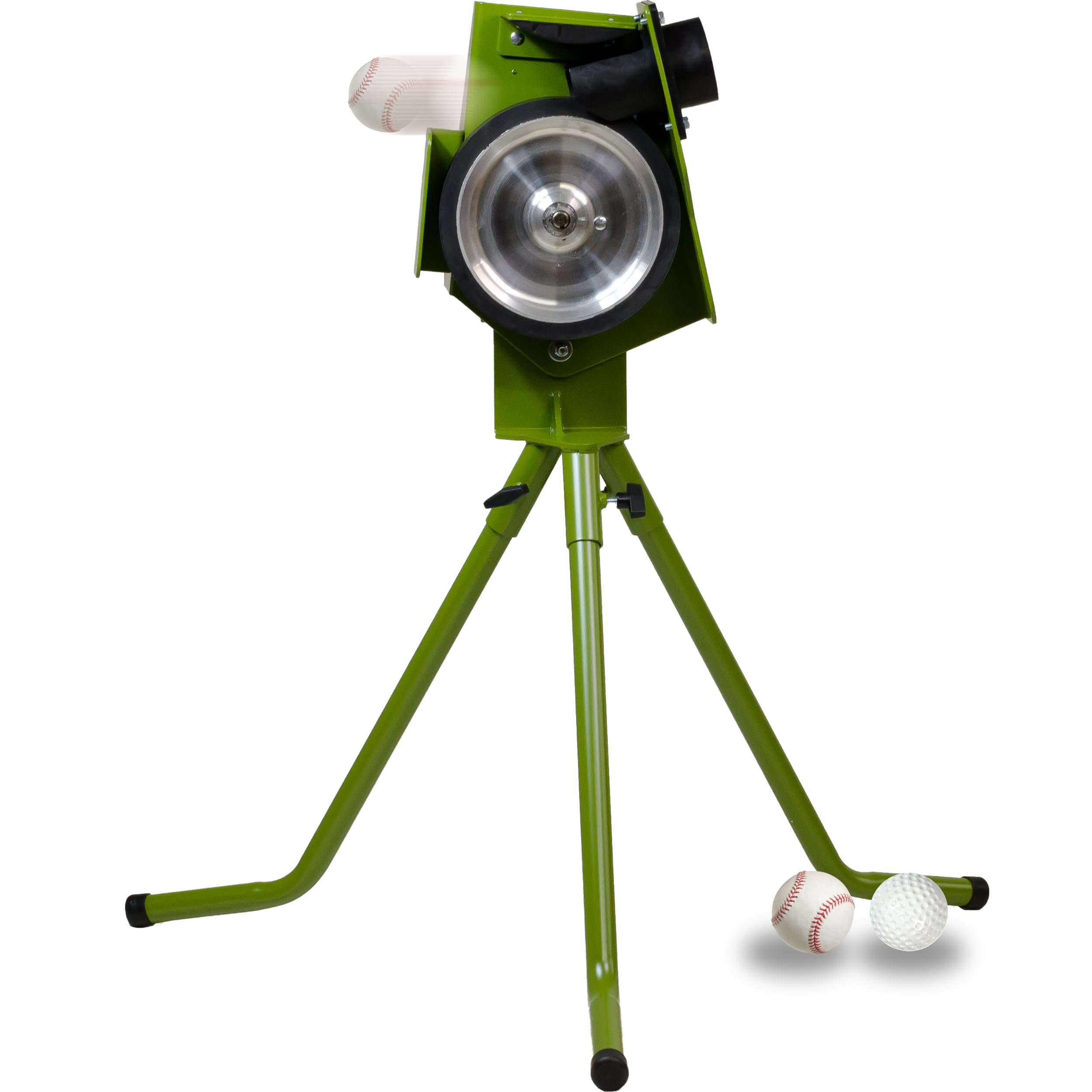
The Mound Yeti is the machine you buy when you want one unit that hangs around for years. It’s a 50-pound steel single-wheel trainer with variable speed from 30-60 mph and 2 chutes so you can alternate between baseballs and softballs without re-rigging anything. The reversible heavy-duty steel legs let you vary the pitch height for each sport, and the ball comes out with a baseball release height of 37.5 inches and a softball release height of 27.5 inches. It’s backed by a 2-year limited warranty — one of the few long warranties in this list. It throws fastballs and grounders, making it a natural fit for both machine-pitch leagues and a coach running fielding drills.
For a coach or a facility, that’s a serious tool. It’s stable, it holds up, and the construction is built for real volume. It works great with a Jackery power bank if you don’t have an outlet nearby, which widens where you can set up. Owners running 50–60 pitches per kid report timing gains within a single day, and the design holds up to 50 balls a day for a 13-year-old building gains over a couple of weeks.
Be ready for the weight. At 50 pounds it’s a two-person lift for most, and getting it into a truck is a chore — one owner calls that out directly. The speed knob is touchy — you turn it slowly to hit your number — and a coach notes the speed display is a meaningless reference rather than an actual mph reading. Use only genuine leather or dimple balls; synthetic balls leave residue that takes an hour to clean off the wheels. It’s also not tall enough for every batting cage opening, so measure yours first.
Built for: teams and facilities that need dependable two-sport pitching for a few players a day, with a steel frame that shrugs off volume.
The real limit: heavy and fiddly to dial in — this is not a machine a child sets up alone, and the touchy knob rewards patience.
The confident pick for: a coach or a family treating the machine as a long-term investment and leaving it in place.
Not for you if: you need something one adult can load into a car and move weekly.
9. JUGS PS50 Baseball and Softball Pitching Machine

The name-brand machine that throws regulation baseballs and softballs at little-league speeds.
The JUGS PS50 is the premium pick and it exists for one reason: it throws regulation size and weight baseballs and softballs up to 50 mph, and it does it from a machine built like a tank. Unlike the Furlihong toss machine, which only does soft toss, this one pitches to a distance. It carries 50 lb. solid-steel construction, a new digital readout display, and a special non-marking 9-inch pneumatic tire. Quick-Snap legs and a grip-and-go handle make it easier to move than its weight suggests, and it’s covered by a 1-year guarantee. It’s a go-to for little league baseball and fastpitch softball programs, and it even throws arcing tosses for slowpitch.
Owners call it out for exactly what it is: easy to assemble, easy to operate, and built with control over pitch, yaw, and speed. A family with three boys (ages 8, 11, and 14) reports using it in the backyard and on the diamond for pop flies, grounders, and batting, adjusting speed for bunts through line drives to running catches. The patented “Always see the ball” delivery system keeps the ball in sight through the throw, which several owners say is part of what makes it easy to trust.
The precision costs you in care. It wants JUGS balls — other brands don’t feed as well — and around 44 mph is the realistic ceiling on a radar even when the display says 50+. Owners recommend powering down between batters, cleaning the balls and the wheel, sanding the wheel after each use, and locking two bolts on the top of the ball feeder to keep them from loosening. It’s also heavier than it looks at 50 pounds, and the motor runs louder at higher speeds. For little-league and fastpitch families who want one machine that will be there for seasons, it earns its premium billing.
The JUGS advantage
- Throws regulation size and weight baseballs and softballs up to 50 mph.
- 50 lb. solid-steel construction with a digital readout display.
- Quick-Snap legs and grip-and-go handle for easier transport.
- Patented “Always see the ball” delivery system.
The upkeep reality
- Wants JUGS balls — other brands don’t feed as smoothly.
- Real-world top speed lands around 44 mph on a radar.
- Needs routine cleaning, wheel sanding, and bolt checks.
- 50 pounds and louder at higher speeds.
Reach for this if: you want a name-brand machine for little league or fastpitch and don’t mind a small maintenance routine.
Pass if: you want zero upkeep or need speeds beyond little-league pace.
Understanding the Specs
Pitch Speed and Release Distance
A machine’s mph rating only tells half the story because reaction time depends on how far the ball travels before it reaches the plate. The Personal Pitcher Pro simulates 15–95 mph based on distance and reaction time, so the number moves with where you stand. The PowerNet Launch F-lite simulates 40 to 90 MPH at 25 feet — a much closer release than the Heater Slider Lite 360’s 80 MPH at 46 feet. Compare machines on speed and distance together, never on a single mph number alone.
Ball Type and Backstop Needs
Lite, dimpled, and plastic golf-size balls cut the ball’s flight so a normal yard can contain it, while regulation baseballs fly farther and need a real backstop or cage. The Louisville Slugger Blue Flame Pro takes tennis balls, dimple balls, plastic balls, softballs, and baseballs in one unit. Several machines are calibrated to one brand’s ball only — the PowerNet Launch F-lite warns that other brands void the warranty. Match the ball to your yard before you match the machine to your budget.
FAQ
Can a backyard pitching machine throw real baseballs or softballs?
How much space do I need for a pitching machine in the backyard?
Do I need a net or cage with a pitching machine?
What is the difference between a pitching machine and a toss machine?
How many balls should a pitching machine hold at once?
Why does my machine throw better with one ball brand than another?
Can I run a pitching machine off a battery?
How long do these pitching machines usually last?
Is a pitching machine worth it compared to a real pitcher?
Can a pitching machine train fielding and fly balls too?
Final Thoughts: The Verdict
For most families, the backyard pitching machine winner is the Personal Pitcher Pro because it puts real pitch variety — fastballs, sliders, curveballs, and four speed settings that simulate 15–95mph — into a basement, garage, or driveway at under 6 pounds. If your player needs regulation baseballs and little-league speeds with name-brand reliability, the JUGS PS50 is the one to reach for. And if you want one machine that swaps between baseball and softball without re-rigging, the PowerNet Launch F-lite covers both sports in a single purchase.
One last nudge worth acting on: the machines that reward patience most are the ones with auto feeders, because they’re the ones that let a hitter take a full bucket of swings without you standing in the middle of it. Whatever you pick, buy the balls the maker recommends from day one — every durability and accuracy complaint on this list traces back to the wrong ball more often than the wrong machine.
How We Picked
We do not accept paid placement. Every pick is matched to a real buyer and a real use-case; we do not hands-on test units.
Sources & Methodology
Specifications: manufacturer listings and product documentation. Review insights: verified customer reviews, as of September 2026. Pricing: not shown on this page (it changes often); check the current price via the retailer link.
As an Amazon Associate, Gadgets Feed earns from qualifying purchases. This does not affect which products we feature.