
A backyard telescope lives or dies on two things: how much light the objective gathers and how steady the mount holds it. That 90mm aperture in the box means nothing if every breeze turns your view of Saturn into a blurry streak. The right pick balances optical resolution, focal length, and a mount that doesn’t shake — turning your patio or lawn into an honest observatory.
I’m Min — the co-founder and writer behind Gadgets Feed. I’ve spent hundreds of hours cross-referencing aperture sizes, coating types, and mount designs so you don’t have to decode specs alone at 2 a.m.
After crunching the data on nearly a dozen models, these are the models that deliver real planetary detail and deep-sky glimpses without wasting your money. This guide gives you the best backyard telescope for your specific viewing goals and experience level.
How To Choose The Best Backyard Telescope
Selecting the right telescope for your backyard comes down to understanding how aperture, focal length, mount type, and optical coatings interact. More magnification is a marketing trick — clear, bright views come from light-gathering ability and a stable platform.
Aperture Is Everything
Aperture is the diameter of the main lens (refractor) or mirror (reflector), measured in millimeters. A 90mm aperture collects roughly 40% more light than a 70mm aperture, making faint nebulae and globular clusters visible from your driveway. Reflectors give more aperture per dollar than refractors because mirrors cost less to manufacture than large glass lenses.
Mount Stability Determines Your Sanity
A wobbly mount turns a 200x view into a seasick experience. Alt-azimuth (AZ) mounts are intuitive — just pan up-down and left-right — but budget AZ mounts often use thin tripods that vibrate in a light wind. Equatorial (EQ) mounts tilt to align with Earth’s rotation, allowing one-knob tracking of celestial objects. Dobsonian bases are the most stable because they’re low and wide, but they’re tabletop-only on the Celestron StarSense model reviewed here.
Optical Coatings and Glass Quality
Fully multi-coated (FMC) optics pass over 99% of light through each lens surface, boosting contrast on the Moon and planets. Extra-low dispersion (ED) glass, like the S-FPL51 element in the SVBONY SV503, cuts chromatic aberration — that purple fringe around bright objects — to nearly zero. For backyard use under light pollution, ED or FMC glass makes the difference between seeing Jupiter’s cloud bands and a fuzzy blob.
Quick Comparison
On smaller screens, swipe sideways to see the full table.
| Model | Category | Best For | Key Spec | Amazon |
|---|---|---|---|---|
| Celestron NexStar 6SE | Premium | Automated deep-sky tours | 150mm SCT, 1500mm FL, GoTo | Amazon |
| Celestron StarSense 150AZ | Premium | App-guided Dobsonian views | 150mm reflector, f/4.3 | Amazon |
| SVBONY SV503 102ED | Premium | APO-quality astrophotography | 102mm ED, f/7, dual-speed | Amazon |
| MEEZAA 150EQ | Mid-range | Wide-field deep-sky viewing | 150mm reflector, f/4.3 | Amazon |
| Gskyer 130EQ | Mid-range | Learning equatorial tracking | 130mm reflector, 650mm FL | Amazon |
| Hawkko 90/900 | Mid-range | Zooming in on planets | 90mm refractor, 900mm FL | Amazon |
| MEEZAA 90/800 | Mid-range | Budget 90mm refractor | 90mm, 800mm FL, f/8.9 | Amazon |
| Koolpte 90mm AZ | Entry-level | Quick family stargazing | 90mm refractor, 700mm FL | Amazon |
| Celticbird 80/900 | Entry-level | First refractor for kids | 80mm refractor, 900mm FL | Amazon |
In‑Depth Reviews
1. Celestron NexStar 6SE

The NexStar 6SE uses a 150mm Schmidt-Cassegrain optical tube with a 1500mm focal length and StarBright XLT coatings that deliver 97% light transmission. That 1500mm focal length gives you enough reach to split close double stars and resolve Jupiter’s Great Red Spot on a steady night, all in a 30-pound package that fits on a small patio table.
The fully automated GoTo mount with SkyAlign lets you type in an object from a 40,000-entry database, and the mount slews to it and tracks automatically. Users report that the alignment process takes about five minutes once you enter date, time, and location. The single-fork arm and stainless steel tripod dampen vibrations in under two seconds at 200x magnification.
Stock 25mm Kellner eyepiece provides 60x for wide-field sweeping of the Orion Nebula or Andromeda Galaxy. The 6SE also accepts a T-ring adapter for prime-focus planetary imaging. Dew forms on the corrector plate quickly in humid backyards, so a dew shield is almost mandatory. The mount’s gears can exhibit slight periodic error for long-exposure astrophotography, but visual observers and lucky-imagers won’t notice.
Why it’s great
- Six-inch aperture resolves lunar rilles and Saturn’s Cassini Division
- GoTo mount with 40,000-object database eliminates manual star-hopping
- Compact tube fits in a small car trunk for trips to darker skies
Good to know
- Requires external 12V power for the GoTo system (AA batteries drain fast)
- Stock eyepiece is entry-level; upgrading to a 32mm Plössl improves wide-field views
2. Celestron StarSense Explorer 150AZ
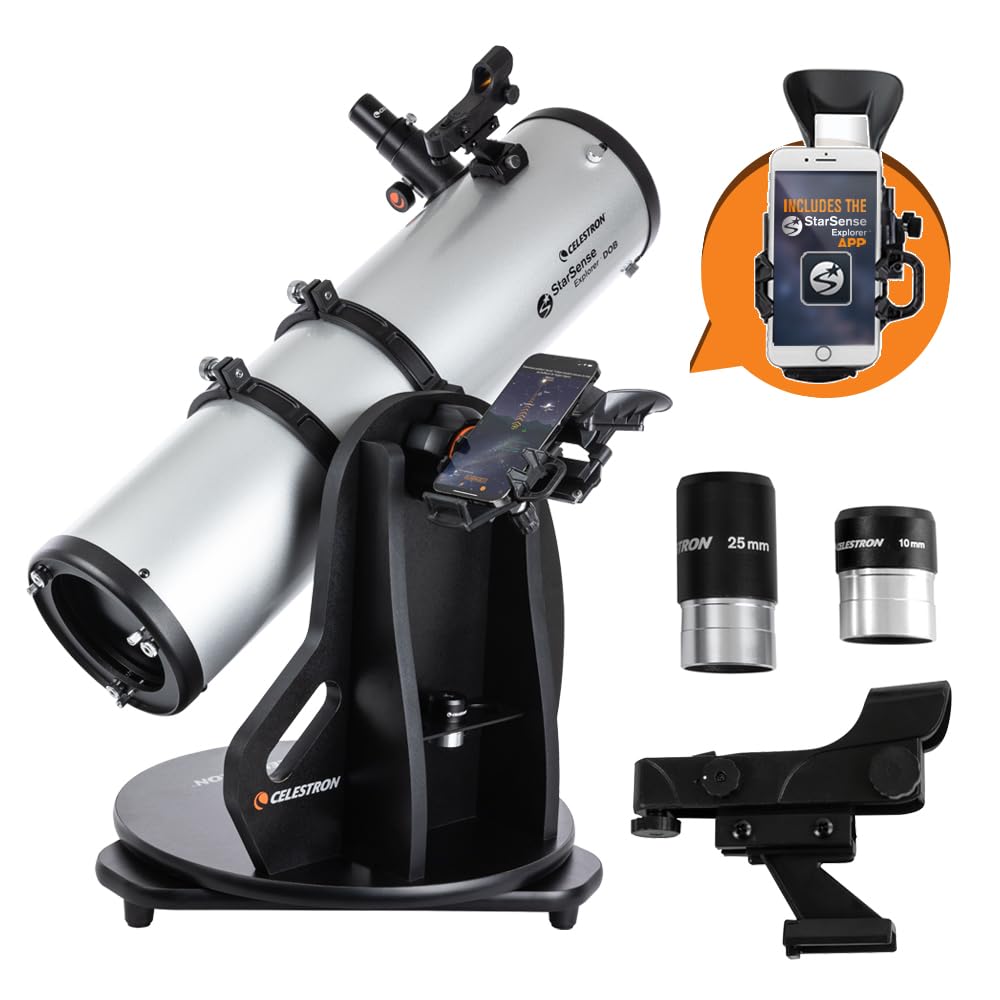
The StarSense Explorer 150AZ is a 150mm (6-inch) Newtonian reflector on a tabletop Dobsonian base with a 650mm focal length (f/4.3). The short focal ratio makes it a true “light bucket” for deep-sky objects — the Orion Nebula appears with visible structure even under suburban skies. The parabolic primary mirror has aluminum coatings with SiO₂ overcoat for 92% reflectivity.
What sets this model apart is the StarSense smartphone dock and app. Instead of a traditional computerized mount, you dock your phone, launch the app, and it analyzes star patterns overhead to show you exactly where the telescope is pointed. The app generates a list of tonight’s best targets; you physically push the tube until the on-screen bullseye turns green. It removes the frustration of hunting for faint objects manually.
The included 25mm (26x) and 10mm (65x) Kellner eyepieces cover low-power sweeping and medium-zoom lunar/planetary viewing. The tabletop base is stable but heavy — the pressboard base weighs about 15 pounds alone. Users with tall viewing chairs may find the eyepiece height too low for comfortable seated observation. The StarPointer red-dot finder is adequate but benefits from a right-angle finder for neck-friendly use.
Why it’s great
- Smartphone app turns any night into a guided tour without a computer
- 150mm parabolic mirror delivers bright, contrasty views of galaxies and nebulae
- Dobsonian base is rock-solid with zero vibration damping issues
Good to know
- Tabletop design requires a sturdy table or stool — not backyard-ground-friendly
- Pressboard base can split if screws are overtightened
3. SVBONY SV503 102ED

The SVBONY SV503 is a 102mm f/7 ED refractor with an S-FPL51 extra-low dispersion glass element. This is the optical technology that brings color fringing down to near-apochromatic levels — on the Moon, the terminator line stays pure white without the purple haze common in budget achromats. At 714mm focal length, it provides a 1.45° field of view, perfect for framing the Pleiades or the Andromeda Galaxy core.
The dual-speed 1:10 focuser allows micro-adjustments that are critical for astrophotography. The 360° field rotator lets you align a DSLR sensor without rotating the entire tube. The 90mm focus travel accommodates heavy filter wheels and field flatteners. The all-metal construction weighs 8.7 pounds, so you’ll need a sturdy equatorial mount rated for at least 15 pounds — the SV503 is an optical tube assembly only, with no tripod included.
Star tests show no false color inside or outside of focus, and the scope handles 275x magnification on planets during good seeing. The retractable 133mm lens hood blocks stray light from nearby street lamps and reduces dew formation on the front element. This is a specialist tool for the backyard astronomer who prioritizes image quality over simplicity, and it pairs well with an EQ6-class mount for deep-sky imaging.
Why it’s great
- FPL51 ED glass eliminates nearly all chromatic aberration on bright targets
- Dual-speed 1:10 focuser enables precise focus for planetary imaging
- 360° rotator and 90mm draw tube make camera setup effortless
Good to know
- Sold as OTA only — you must supply a mount, tripod, eyepieces, and diagonal
- More expensive than equivalent reflectors of the same aperture
4. MEEZAA 150EQ
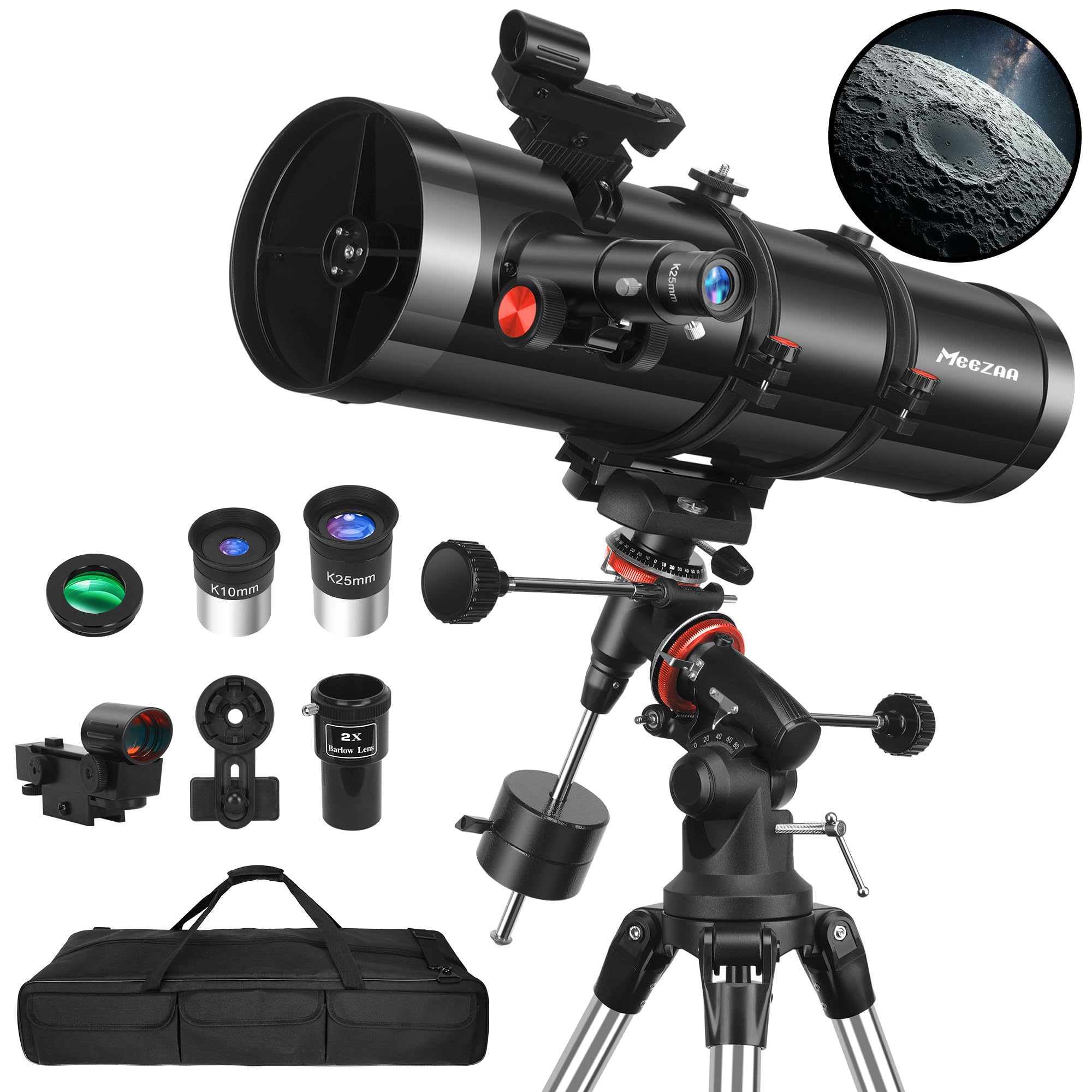
The MEEZAA 150EQ packs a 150mm (6-inch) parabolic Newtonian reflector with a 650mm focal length into a package that includes a German equatorial mount and stainless steel tripod. The f/4.3 focal ratio means you collect light fast for faint globular clusters like M13 in Hercules. The included 25mm eyepiece gives 26x for sweeping the Milky Way star clouds.
The equatorial mount features slow-motion control knobs with flexible cables for smooth tracking once aligned. The tripod has an accessory tray big enough for eyepieces. The moon filter reduces glare on the bright lunar surface, and the red-dot finder helps beginners roughly aim the tube before fine-tuning through the main eyepiece.
Assembly takes about 30 minutes and requires careful attention to counterweight balance. The entry-level Kellner eyepieces are functional but not sharp at the edges; many users swap them for a 15mm or 9mm Plössl within weeks. The plastic focuser can sag under heavy 2-inch eyepieces or a DSLR. Still, for the aperture per dollar, this scope shows you more than any refractor near its price point.
Why it’s great
- 150mm aperture resolves globular clusters and bright nebulae from suburbia
- Slow-motion EQ controls help beginners learn sidereal tracking
- Included moon filter and phone adapter add immediate utility
Good to know
- Equatorial mount is basic and may slip if not properly balanced
- Stock eyepieces are low-quality Kellner designs — budget for replacements
5. Gskyer 130EQ

The Gskyer 130EQ is a 130mm (5.1-inch) Newtonian reflector with a 650mm focal length at f/5. Its aperture is big enough to split the Double Cluster in Perseus and reveal the Andromeda Galaxy as an elongated smudge even from light-polluted backyards. The all-glass optics with high-transmission coatings improve contrast on the Moon’s terminator.
The German equatorial mount has slow-motion control rods that let you track objects manually once the mount is roughly polar-aligned. The included 3x Barlow lens triples your eyepiece magnification, pushing the 10mm eyepiece to 195x — enough to see Cassini’s Division in Saturn’s rings on a steady night. A wireless Bluetooth remote lets you capture smartphone images without touching the eyepiece.
The 30-pound weight makes it feel solid, but the equatorial mount’s plastic elements can flex under heavy eyepieces. The 24-inch optical tube is compact for easy transport. Users find the manual instructions confusing and recommend watching a video guide for first-time EQ alignment. The toothless focusing base is smooth but requires routine tightening to prevent focus drift.
Why it’s great
- 130mm aperture collects enough light for bright galaxies and nebulae
- Bluetooth remote and phone adapter make casual astrophotography easy
- Toothless focuser provides smooth, backlash-free focus adjustments
Good to know
- EQ mount slips if not perfectly balanced — requires patience to set up
- Manual has confusing English instructions; online tutorials are more helpful
6. Hawkko 90mm 900mm

The Hawkko 90mm refractor uses a 900mm focal length (f/10) and full multi-layer coatings to deliver high-contrast planetary views. The longer focal ratio reduces chromatic aberration naturally — the Moon shows a clean white limb with only faint fringing at 180x with the 10mm eyepiece and 3x Barlow. The 1.39° field of view with the 25mm eyepiece fits the entire Pleiades cluster comfortably.
The AZ mount and stainless steel tripod support smooth 360° rotation with slow-motion knobs for fine tracking. Assembly takes under 15 minutes. The included phone adapter works with most smartphone cases, and the accessory tray keeps eyepieces organized.
The finder scope is a straight-through design that requires contorting your neck for objects near zenith. The 5-kilogram weight is manageable for backyard sessions. Jupiter’s cloud bands are visible at 90x, and Saturn’s rings separate cleanly from the planet at 120x. The 900mm focal length means you’ll need a sturdy mount — the included tripod is adequate for calm conditions but shakes in a breeze.
Why it’s great
- 900mm focal length provides high native magnification for planets
- FMC optics deliver sharp lunar and planetary contrast
- Complete accessory kit includes everything for first night out
Good to know
- Straight-through finder is uncomfortable for overhead objects
- AZ mount can wobble in windy conditions
7. MEEZAA 90mm 800mm

The MEEZAA 90/800 features a 90mm achromatic refractor with an 800mm focal length (f/8.9) and fully multi-coated glass. At f/8.9, chromatic aberration on bright objects like the Moon is moderate but manageable — you’ll see a faint blue halo around the lunar limb at 200x, but the center remains sharp. The 800mm focal length delivers 32x with the 25mm eyepiece and 80x with the 10mm.
The AZ mount and stainless steel tripod adjust from 28 to 46 inches. The built-in accessory tray keeps your eyepieces within reach. Assembly takes 10 minutes with the paper manual. The included 3x Barlow lens pushes magnification to 240x on Jupiter, though atmospheric conditions rarely support that much power.
Users report the 90mm aperture reveals the four Galilean moons of Jupiter easily, and the Andromeda Galaxy appears as a faint elongated smudge from suburban backyards. The carrying bag fits all components for storage. The tripod legs are thin and can wobble during focusing — pressing down on the tray stabilizes them. This is a solid entry point for someone learning the sky without spending premium money.
Why it’s great
- 90mm aperture captures more light than typical 70mm beginner scopes
- Complete bundle with phone adapter and carry bag is ready out of the box
- Fully multi-coated optics provide above-average contrast for the price
Good to know
- Thin tripod legs introduce vibration at high magnification
- Moderate chromatic aberration visible on the Moon at 200x
8. Koolpte 90mm AZ
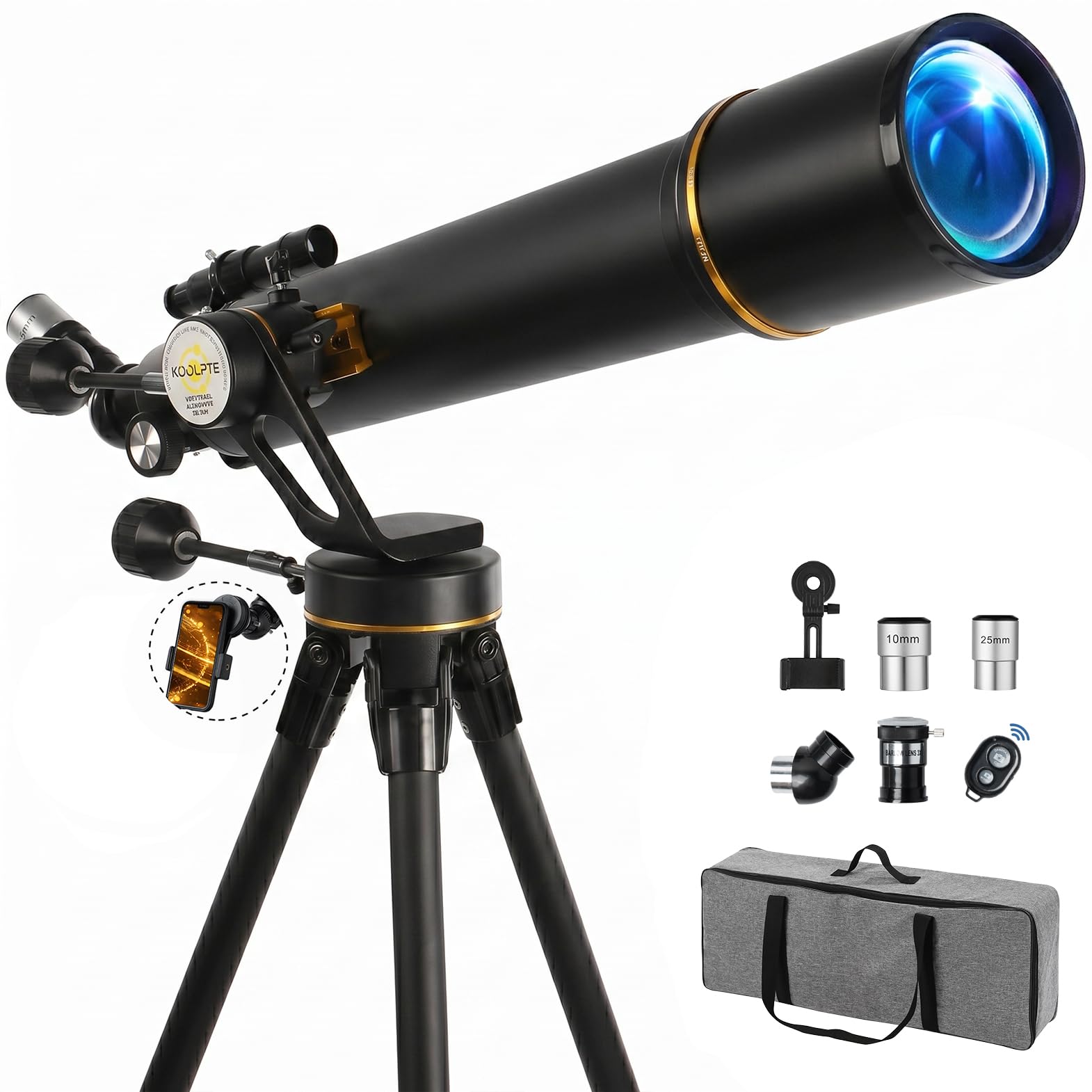
The Koolpte 90mm uses a 90mm aperture and 700mm focal length (f/7.8) with fully multi-coated glass that transmits 99% of light per surface. The shorter 700mm focal length gives a wider field than most 90mm beginners, making it easier to locate targets. The Moon appears crisp with visible rilles and crater floors at 70x with the 10mm eyepiece.
The Vertisteel AZ mount features “Follow and Stop” slow-motion controls that prevent overshooting when tracking — you push the tube to the general area, then use the knobs for fine centering. The included wireless remote lets you trigger smartphone captures hands-free, which reduces shake in the phone adapter.
Setup takes under 10 minutes with no tools. The carrying bag packs the 4.8-kilogram telescope and tripod. The 90mm aperture gathers enough light to see Jupiter’s cloud bands and Saturn’s rings at 105x with the included 3x Barlow and 10mm eyepiece. The thin tripod legs are the weak point — they flex under the scope’s weight when the altitude knob isn’t fully tightened. Users at 6 feet tall may find the tripod too short for comfortable zenith viewing.
Why it’s great
- Vertisteel AZ mount offers smooth, backlash-free tracking
- 90mm aperture and FMC optics provide bright lunar and planetary views
- Wireless remote and phone adapter simplify image sharing
Good to know
- Tripod leg adjustments are stiff and require force to loosen
- Tall users may need a short stool for comfortable overhead viewing
9. Celticbird 80mm 900mm

The Celticbird 80/900 is a classic long-focus refractor with an 80mm aperture and 900mm focal length (f/11.25). At f/11.25, chromatic aberration is virtually absent — the lunar terminator appears pure white without false color. The long focal length provides high native magnification: the 10mm eyepiece gives 90x, enough to see Jupiter’s northern and southern equatorial belts.
The AZ mount and aluminum tripod adjust from 20 to 45 inches, suiting both kids and adults. The 5×24 finder scope has crosshairs for accurate pointing. The bag carries all accessories for travel. Assembly is straightforward with the included manual and online video.
The 80mm aperture limits light gathering — the Andromeda Galaxy appears as a dim smudge, and globular clusters show only a faint speckled texture. Stars beyond magnitude 10 are difficult to see from suburban skies. The mount is adequate but basic — the legs are thin aluminum with plastic joints. The phone adapter works for bright targets like the Moon but struggles with dim objects. This is a capable first telescope for a child or absolute beginner focused on lunar and planetary observation.
Why it’s great
- F/11.25 focal ratio delivers near-zero chromatic aberration on the Moon
- 900mm focal length provides high platform magnification without a Barlow
- Lightweight bag makes it easy to carry to a darker backyard corner
Good to know
- 80mm aperture limits deep-sky views to only the brightest objects
- Thin aluminum tripod legs introduce wobble in light wind
FAQ
Is a 90mm refractor enough to see Saturn’s rings from my backyard?
Which mount type is best for a beginner with no technical background?
Do I need a light pollution filter for suburban backyard viewing?
Final Thoughts: The Verdict
For most users, the best backyard telescope winner is the Celestron NexStar 6SE because its 150mm Schmidt-Cassegrain optics and fully automated GoTo mount eliminate the two biggest frustrations for backyard stargazers: finding targets and tracking them. If you want app-guided simplicity and a massive light bucket, grab the Celestron StarSense Explorer 150AZ. And for pure planetary and astrophotography image quality, nothing beats the near-APO performance of the SVBONY SV503 102ED on a solid equatorial mount.