
A backyard wildlife camera turns your property into a living nature documentary, revealing the nocturnal visitors that pass through while you sleep. But the wrong choice — poor night vision, slow trigger speeds, or a dead battery after a few days — leaves you with blurry shots of empty grass. Getting this decision right means knowing exactly which specs translate to crisp, reliable captures from dusk to dawn.
I’m Min — the co-founder and writer behind Gadgets Feed. My research dives deep into the sensor quality, IR illumination ranges, trigger latency figures, and power management systems that separate an effective trail camera from a frustrating paperweight, helping you cut through the marketing noise with real performance data.
The goal of this guide is to distill hundreds of hours of spec analysis into a clear, actionable verdict on the best backyard wildlife camera for your specific setup and budget.
How To Choose The Best Backyard Wildlife Camera
Picking the right trail camera for your yard involves understanding a few critical performance levers. Megapixel count grabs headlines, but trigger latency, IR flash type, and power delivery determine whether you actually see the fox at 2 AM.
Trigger Speed and Detection Zones
A camera that fires 0.1 seconds after motion is detected will capture a deer mid-stride, while a slower 0.5-second camera may only catch an empty frame. Models with three PIR sensors (center plus two side) offer wider lateral detection, reducing the chance an animal walks past the trigger zone unnoticed. For backyard use where animals move unpredictably, a fast trigger with multi-zone coverage is your single most important spec.
Night Vision Type and Range
Low-glow IR (typically 850nm) produces brighter night images but emits a faint red glow visible to some animals, potentially altering natural behavior. No-glow IR (940nm) is completely invisible to both humans and wildlife, making it the preferred choice for discreet backyard observation. The effective range — often 65 to 100 feet — depends on the number and quality of IR LEDs, not just the marketing claim. A higher-grade f/1.6 aperture lens paired with 940nm LEDs delivers usable illumination without startling your subjects.
Power Management and Connectivity
Solar panels with built-in rechargeable batteries (typically 5200mAh) eliminate battery swaps for months at a time, provided the panel gets some direct sun. For shaded yards, a camera that accepts standard AA alkaline or lithium cells — or supports an external solar panel accessory — ensures you aren’t climbing a tree every week. Connectivity choices range from zero (manual SD card retrieval) to local WiFi/BT for on-site previews, to full cellular transmission. Backyard users typically benefit from solar-powered local WiFi models, which offer remote image access without monthly subscription fees.
Quick Comparison
On smaller screens, swipe sideways to see the full table.
| Model | Category | Best For | Key Spec | Amazon |
|---|---|---|---|---|
| MAXDONE Solar Trail Camera | Solar WiFi | Zero-maintenance solar setup | 5200mAh battery + 0.1s trigger | Amazon |
| Tactacam Reveal X 3.0 | Cellular | Remote property monitoring | Auto-connect 4G LTE + no SD card | Amazon |
| Meidase P70 2 Pack | Non-WiFi | Value two-pack coverage | 100ft no-glow night vision | Amazon |
| XTU Solar Trail Camera | Solar WiFi | Multi-battery backup flexibility | Solar + USB-C + 4xAA backup | Amazon |
| GardePro E5S | Non-WiFi | Budget-friendly simplicity | 3 PIR sensors, 0.1s trigger | Amazon |
| Misstech 4K Solar | Solar WiFi | Built-in screen previews | On-camera screen + MapPin GPS | Amazon |
| ARCCTV Solar Camera | 360° PTZ | Full yard pan-tilt coverage | 355° pan, 2.4G/5G WiFi | Amazon |
In‑Depth Reviews
1. MAXDONE Solar Trail Camera WiFi Bluetooth

The MAXDONE hits an ideal balance for backyard users by pairing a 5200mAh rechargeable lithium battery with a high-efficiency solar panel, eliminating the need for disposable battery swaps throughout the season. Its WiFi 6 and Bluetooth connectivity let you preview and download images directly to your phone from up to 55 feet away, though it generates its own hotspot rather than connecting to home WiFi — an important distinction for setup. The bundled 32GB TF card means the camera is ready to run out of the box with no additional purchases.
The 0.1-second trigger speed, driven by its PIR motion detection, catches fast-moving deer and raccoons without empty frames, while the 65-foot low-glow IR night vision records clear details in complete darkness. The IP66 waterproof housing handles rain, snow, and heat, making it a genuinely set-and-forget system for year-round yard monitoring. Enhanced features like time-lapse recording, programmable detection zones, and password protection add utility without complexity.
Multiple reviewers confirm the solar panel keeps the battery at 100% charge even during partial sun, and the app-based image transfer eliminates the chore of pulling an SD card. The key caveat is that the camera does not support cellular or home WiFi connections — you must be within 40-55 feet to access the footage. For a backyard camera that stays within that range, this is a non-issue and a tremendous value.
Why it’s great
- Solar panel consistently maintains full battery charge with no manual intervention.
- Included 32GB TF card removes the need for an immediate accessory purchase.
- Adjustable motion sensitivity and detection zones reduce false triggers from wind or foliage.
Good to know
- WiFi hotspot connection only — does not connect to home router for remote off-property viewing.
- Bluetooth required for initial setup, which can be finicky if phone is not within 0.5 feet.
2. Tactacam Reveal X 3.0 Cellular Trail Camera
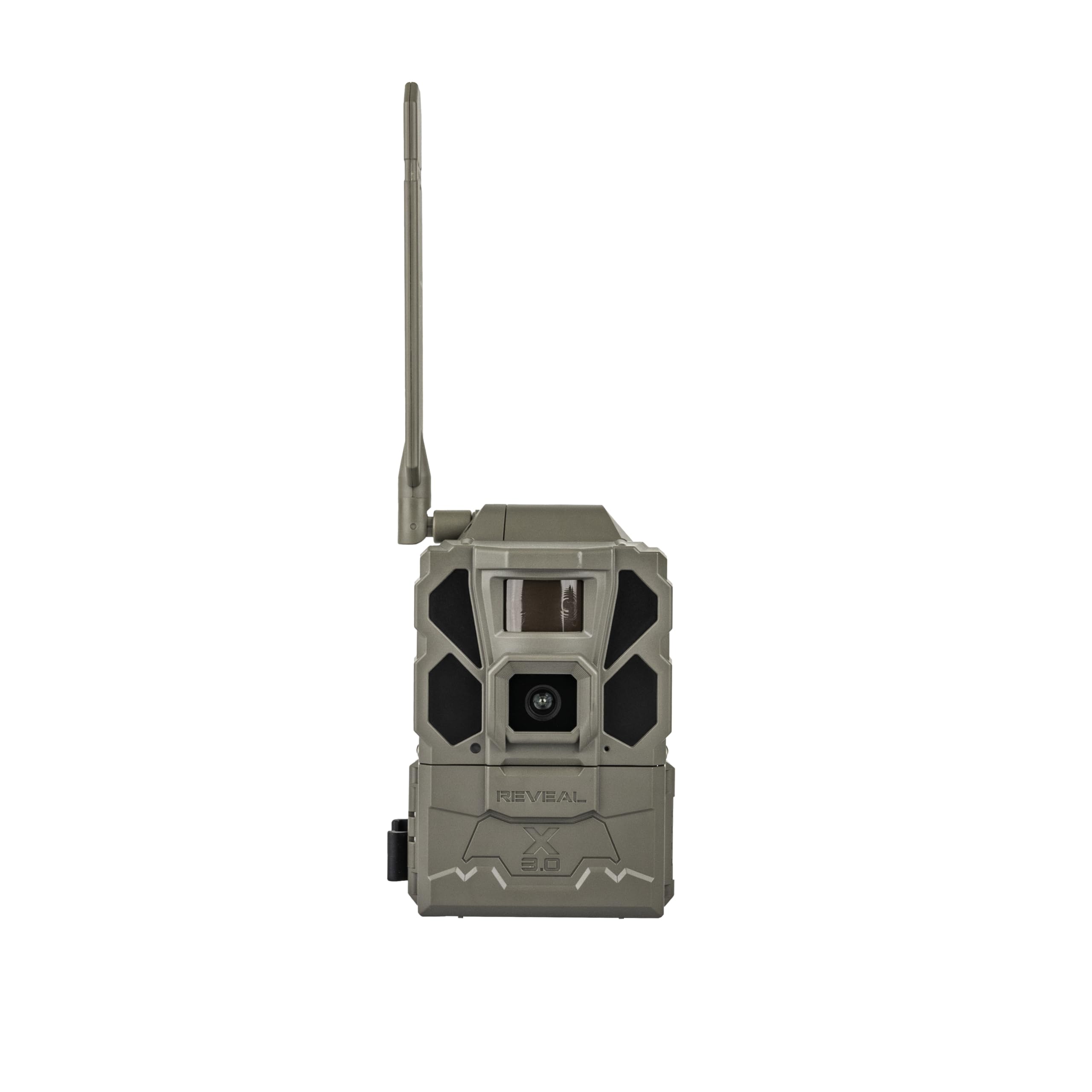
The Tactacam Reveal X 3.0 is a premium cellular trail camera that redefines convenience for property monitoring by automatically connecting to AT&T or Verizon LTE networks via a built-in multi-carrier SIM. It does not require an SD card — images are stored internally and transmitted directly to the REVEAL app on your phone, eliminating card retrieval entirely. The sub-half-second trigger with 3-shot burst mode captures fast-moving game with multiple frames per event, maximizing your chance of a clear shot.
Battery life is class-leading, with independent testing confirming up to six months of runtime on a single set of lithium cells. Pairing the camera with the optional Tactacam lithium power pack or solar panel extends deployment to a full year without a visit. The built-in GPS logs the camera’s location in the app, invaluable for users managing multiple units across larger properties or remote acreage.
Reviewers consistently praise the simple 10-minute setup via QR code scanning and the sharp day-and-night image quality. The 1080p video and 4K photo resolution produce detailed captures, and the low-glow IR flash does not spook animals. The primary ongoing cost is the monthly cellular subscription for image transmission, but for users who need real-time alerts from a camera far from the house, this is the most reliable solution available.
Why it’s great
- Auto-switches between AT&T and Verizon for the strongest signal in any location.
- No SD card required — images transmit directly to your phone via the REVEAL app.
- Up to six months of battery life, extendable to a full year with solar accessory.
Good to know
- Requires a monthly cellular subscription plan for image transmission.
- 60-degree field of view is narrower than many non-cellular models.
3. Meidase 2 Pack Trail Camera P70
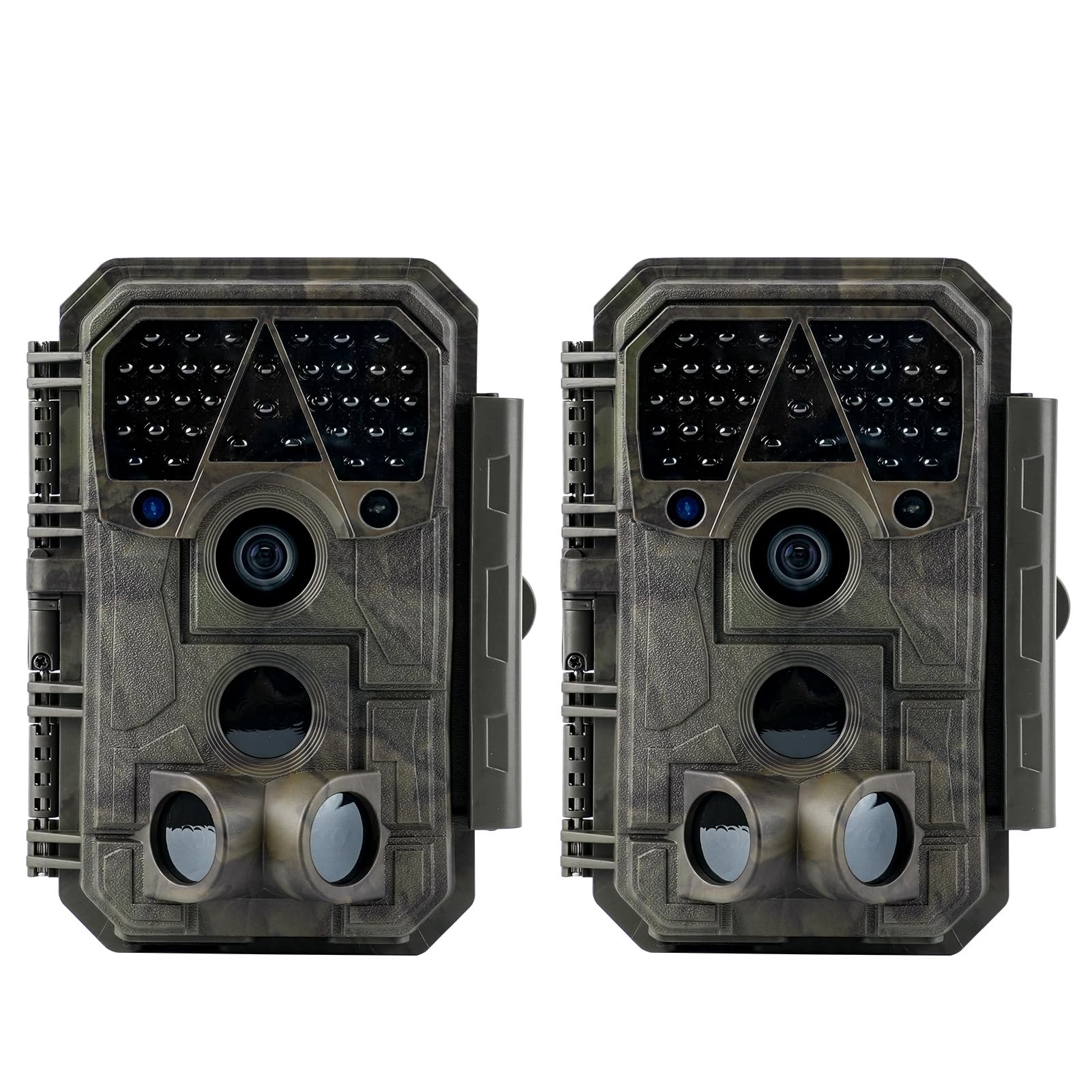
The Meidase P70 is a straightforward, no-connectivity trail camera that excels at its core job: capturing crisp 64MP images and 1296p HD video day and night. The two-pack pricing makes this the most cost-effective way to cover multiple corners of a large backyard or property perimeter with identical hardware. The 0.1-second trigger speed, aided by two additional side PIR sensors, ensures animals entering from the periphery are detected as quickly as those crossing the center.
The no-glow 940nm IR LEDs provide completely invisible night illumination up to 100 feet, making it the strongest performer in this test for discreet nocturnal observation. The f/1.6 aperture optical lens collects more light than standard trail camera lenses, delivering brighter night images with less noise. The 2.4-inch color display and intuitive menu buttons allow on-camera setup without requiring a phone or app.
Users report excellent battery life in the field, particularly with Energizer lithium AA cells, and the H.264 video encoding produces manageable file sizes for easy transfer via USB cable. The main consideration is the manual SD card retrieval required — there is no WiFi, Bluetooth, or cellular connectivity. For users who don’t mind checking cards every few weeks, the P70 delivers premium image quality and dual-unit coverage at a mid-range price point.
Why it’s great
- Two cameras in one box for complete property coverage at a single price.
- 100-foot no-glow IR night vision is invisible to wildlife and humans.
- H.264 encoding reduces file sizes without sacrificing video quality.
Good to know
- No WiFi or cellular connectivity — requires SD card retrieval for photo access.
- Requires 8 AA batteries per camera and does not include built-in rechargeable battery.
4. XTU 4K 64MP Solar Trail Camera with WiFi
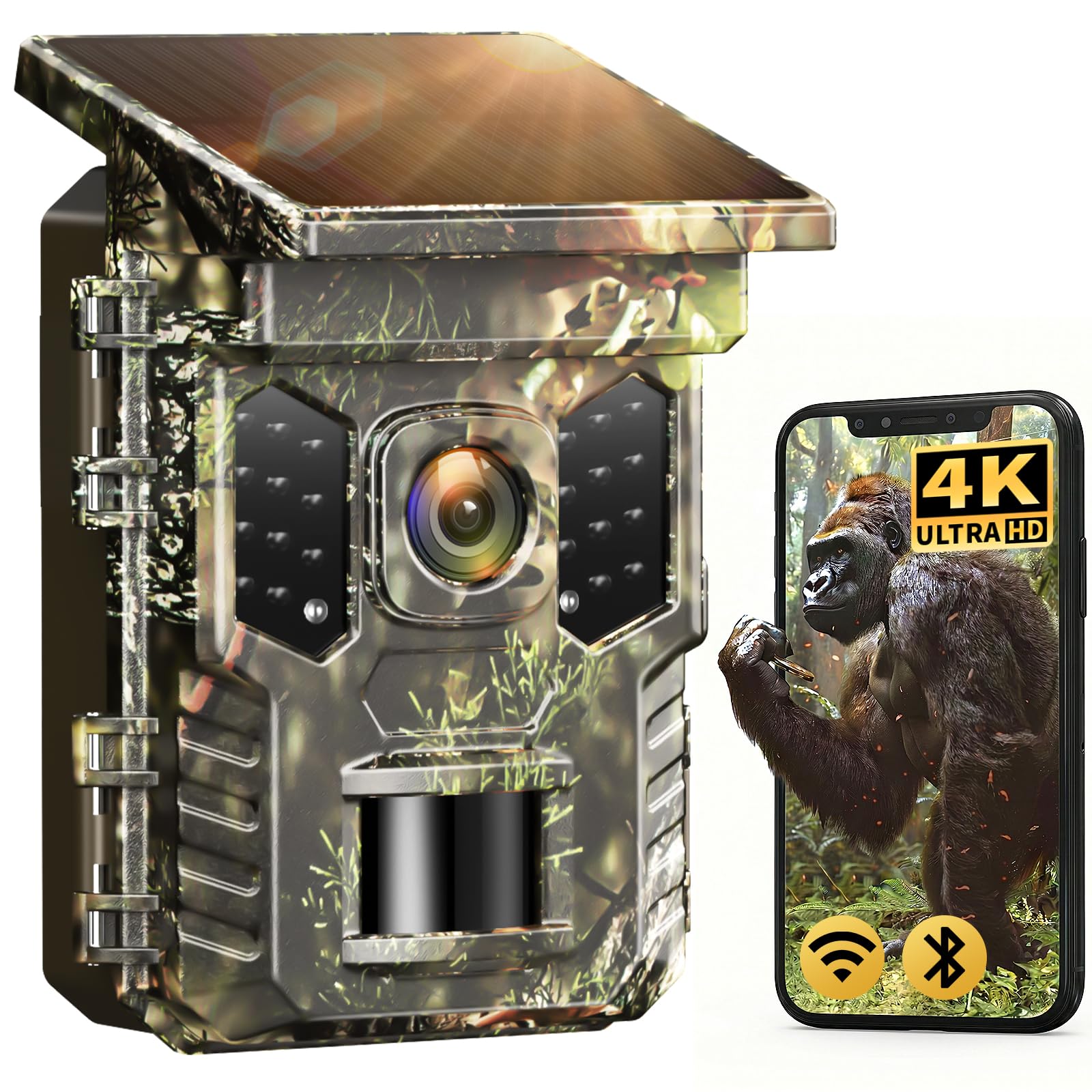
The XTU solar trail camera offers the most flexible power architecture in this roundup, combining an internal rechargeable battery with a solar panel, USB-C quick charging, a DC 6V external port, and a 4xAA backup battery slot. This redundancy ensures the camera keeps recording through cloudy stretches, cold nights, or when you simply forget to retrieve it. The 0.2-second trigger speed and 70-foot detection range deliver reliable captures for most backyard wildlife scenarios.
The 4K video and 64MP photo output produce detailed images, and the dual 850nm IR LEDs provide low-glow night vision up to 65 feet. The camera supports the “TrailCamGO” app for on-site WiFi preview within 49 feet, though the connection is a local hotspot rather than home WiFi. Adjustable trigger intervals, burst mode from 1 to 5 shots, and scheduled time-lapse recording give you granular control over capture frequency to conserve storage and battery.
Reviews highlight good daytime image clarity and easy app setup, but some users report inconsistent night vision quality and occasional SD card compatibility issues. The solar panel is effective in direct sun but may require supplemental charging in heavily shaded spots. For a user who values power redundancy and is comfortable with minor firmware quirks, the XTU provides exceptional flexibility at a competitive price.
Why it’s great
- Four power modes (solar, USB-C, DC 6V, AA backup) for near-uninterrupted operation.
- Adjustable burst mode and trigger intervals reduce empty captures and save battery.
- Supports Micro SD up to 256GB for extended storage without frequent card swaps.
Good to know
- Night vision quality is noticeably weaker than top-tier models in this test.
- Some units have reported SD card errors and quality control inconsistencies after a few weeks.
5. GardePro E5S Trail Camera

The GardePro E5S is a budget-focused trail camera that punches above its price point by concentrating resources on the features that matter most: a 0.1-second trigger speed supported by three PIR sensors for wide-angle detection, and a 100-foot low-glow IR night vision array. It captures 64MP stills and 1296p HD video, delivering usable image quality for identification and observation without the premium price tag of cellular or solar models.
The non-cellular, non-WiFi design means zero monthly fees and minimal power draw, allowing a set of 8 AA lithium batteries to last an entire season in moderate-traffic areas. The IP66 waterproof rating and 1/4-inch-20 mounting thread give flexibility for tree, post, or fence placement. An optional GardePro SP350 solar panel can be added later for continuous power, making this a camera you can gradually upgrade.
Customers consistently praise the crisp photo quality and intuitive menu system. The 2.4-inch playback screen is small but functional for quick checks in the field. Some early units included the wrong model in the box (E5 instead of E5S), so buyers should verify the sticker. For a pure, simple, reliable trail camera that requires zero app setup and zero subscriptions, the E5S is the strongest entry-level choice on this list.
Why it’s great
- Triple PIR sensors provide faster side-angle detection than dual-sensor budget cameras.
- Extremely low power consumption allows a full season on one set of lithium AA cells.
- Compatible with an add-on solar panel for a gradual upgrade path.
Good to know
- No wireless connectivity of any kind — requires SD card removal for photo access.
- Some reports of boxes containing the lower-spec E5 model instead of the advertised E5S.
6. Misstech 4K UHD Solar Trail Camera
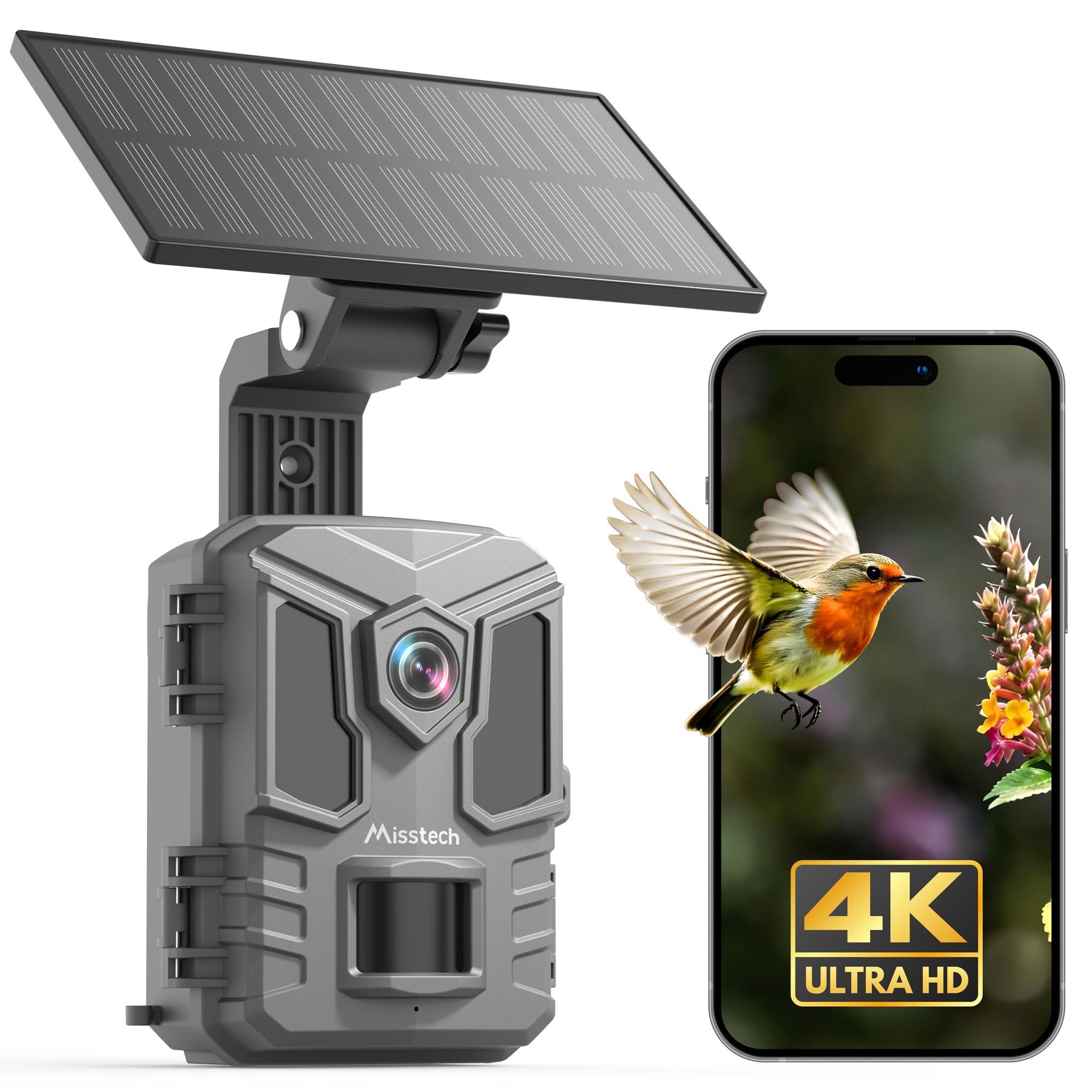
The Misstech 4K solar camera stands out for its built-in screen, which allows you to preview photos and videos directly on the camera without needing a phone. This is a genuine convenience for users who want a quick visual check without fumbling with an app connection. The 64MP/4K capture with an f/1.6 wide-aperture lens delivers sharp detail in low light, and the “Trailcam Go” app provides Bluetooth-based local preview within 30 to 50 meters in open conditions.
The solar panel and internal rechargeable battery are designed for set-and-forget operation in sunny yards, though user reports indicate the panel charges slowly, relying on the internal battery for cloudy stretches. The included 8GB Micro SD card is enough for initial testing, but most users will want to upgrade to 128GB for longer deployments. The MapPin feature logs the camera’s GPS location in the app — a small but genuinely helpful tool if you manage multiple cameras across a property.
Customer reviews frequently mention excellent daytime image quality and responsive app connectivity. However, a notable number of users report that the Bluetooth/WiFi range is only a few feet for reliable image transfer, not the 30-50 meters suggested. The camera itself works well as a local-recording unit, but the wireless range limitation means the “remote viewing” feature may not perform as expected in larger yards.
Why it’s great
- Built-in color screen provides immediate on-camera photo previews without a phone.
- MapPin GPS feature logs camera location for easy retrieval across multiple units.
- Time-lapse video creation is useful for observing long-term seasonal changes.
Good to know
- Bluetooth/WiFi range for app image transfer is significantly shorter than advertised for some users.
- Included 8GB card fills quickly at 4K resolution; a larger card upgrade is recommended.
7. ARCCTV Solar Security Cameras Wireless Outdoor (2 Pack)
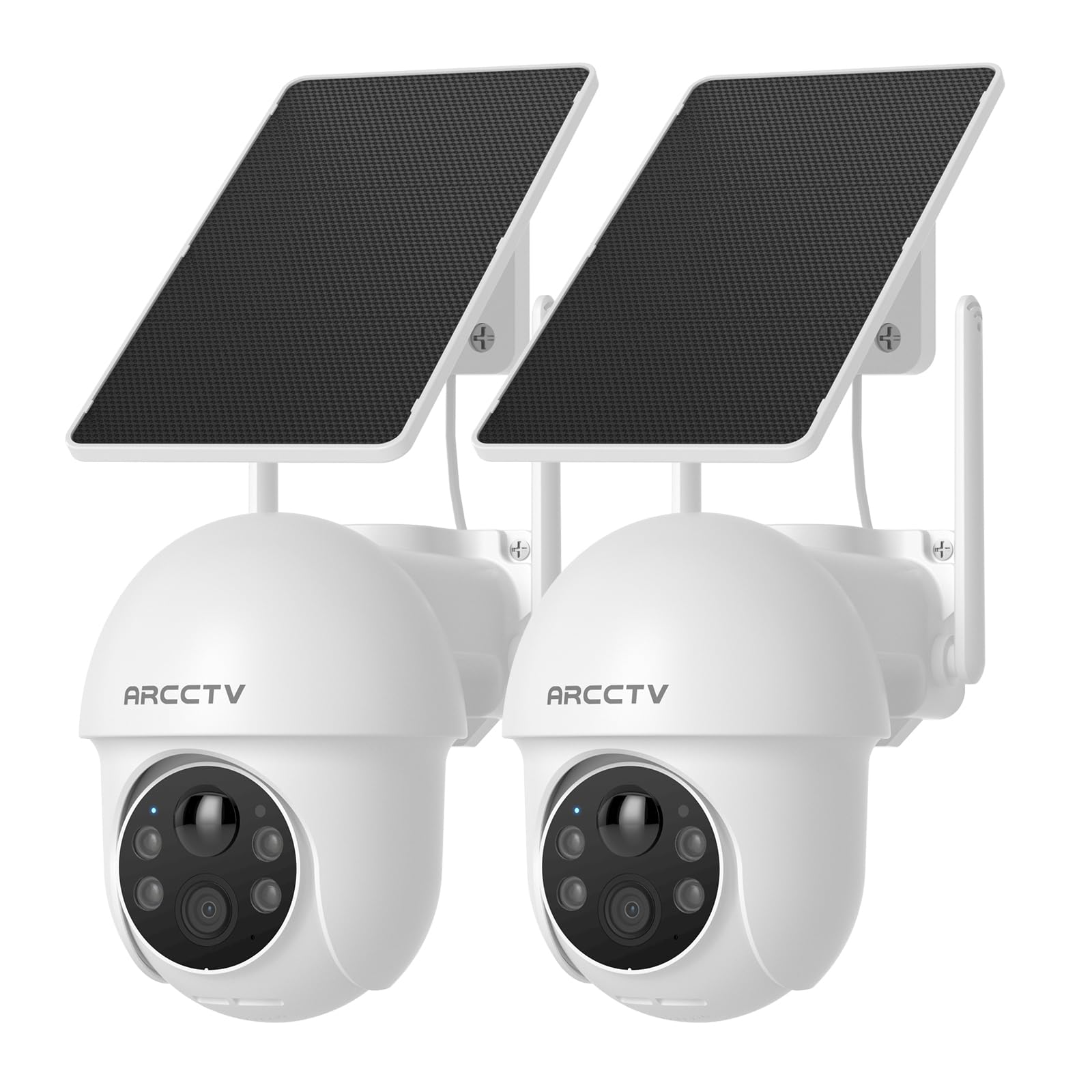
The ARCCTV system redefines what a backyard wildlife camera can be by adding a motorized pan-tilt head with 355° horizontal and 90° vertical rotation, controlled remotely via the ARCCTV app. This 4MP (2560×1440) camera provides 2X the resolution of standard 1080p security cams, capturing detailed color footage both day and night. Its dual-band WiFi (2.4GHz and 5GHz) connects to your home router, enabling real-time live streaming and instant push notifications to your phone from anywhere.
The detachable high-efficiency solar panel maintains the internal battery even during cloudy weather, and the two-pack configuration covers front and back yards simultaneously without wiring. Color night vision with a built-in spotlight illuminates the yard without startling animals as much as a floodlight would, and the two-way audio lets you communicate with visitors or deter pests. Storage is flexible — use a microSD card up to 128GB with no monthly fees, or subscribe to cloud storage for AI event tagging.
Reviews praise the straightforward 5-minute installation and impressive picture quality. The siren feature adds a layer of active deterrence, and the app integration is smooth on both 2.4G and 5G networks. However, some users report occasional WiFi disconnections and solar panel durability issues after a few months. This camera is best suited for someone who wants a hybrid security-wildlife monitor with active remote control, rather than a passive trail camera that just records to a card.
Why it’s great
- Motorized 355° pan and 90° tilt eliminates blind spots and covers a full yard from one mount.
- Dual-band WiFi connects to home router for real-time live streaming from anywhere.
- Color night vision with spotlight provides usable footage without scaring wildlife.
Good to know
- Not a true trail camera — requires WiFi connection and may lose connectivity outdoors.
- Some reports of solar panels failing after a few months, requiring indoor charging.
FAQ
Will a solar trail camera work in a shaded backyard?
What is the difference between low-glow and no-glow night vision?
Do I need a WiFi or cellular trail camera for my backyard?
How many megapixels do I actually need for clear wildlife identification?
Final Thoughts: The Verdict
For most users, the best backyard wildlife camera winner is the MAXDONE Solar Trail Camera because it combines a 5200mAh solar battery with a 0.1-second trigger, local WiFi image transfer, and a pre-installed 32GB card — all at a price that undercuts nearly every competitor with comparable features. If you need real-time remote alerts from a camera placed far from your home WiFi, grab the Tactacam Reveal X 3.0. And for covering two corners of a large property with no connectivity hassles and superb no-glow night vision, nothing beats the Meidase P70 2 Pack.