
Our readers keep the lights on and my morning glass full of iced black tea. As an Amazon Associate, I earn from qualifying purchases.
Specs are compiled from manufacturer listings and verified buyer reviews and can change over time — please confirm the key details on the product page before buying.
Most baking soda volcano kits fizz once and then gather dust. You want one that your child reaches for again and again, whether for a school project, a rainy afternoon, or a science gift that actually gets used. The best baking soda volcano kit makes that repeat play easy without creating a mess you dread cleaning up.
I’m Min — the founder and writer behind Gadgets Feed. This guide is built by comparing the manufacturers’ published specifications and the patterns across verified customer reviews, so you get each pick’s real strengths and trade-offs instead of marketing spin.
These seven kits range from preschool-friendly sets to 18-inch showstoppers. Your best choice depends on whether your child wants endless experiments, a giant build, or a quick eruption with easy cleanup.
Our Picks at a Glance


How To Choose The Best Baking Soda Volcano Kit
The right kit for your kid depends on their age, patience, and what they really want to do — build a giant volcano over a weekend or mix powders and watch fizzing right now. Here is what to look for.
Age Range and Safety
Most kits target ages 8 and up, but a few are designed for kids as young as 4. Check the manufacturer minimum age (given in months) — it tells you if small pieces or complex steps need adult help. Safety-first materials give you confidence, especially with younger children who may taste things.
Number of Experiments
A kit with 66 or 150 experiments lasts far longer than one with just a single volcano. The extras — slime, crystal growing, color-changing reactions — keep a curious kid engaged for weeks. If you want one afternoon of fun, a smaller set works. If you want a science shelf that stays busy, go bigger.
Replayability and Cleanup
Some kits let you erupt the same volcano again and again with your own baking soda and vinegar. Others include single-use powder packets. Look for a built-in “lava” catch lip or a washable base — that feature turns a sticky mess into a quick rinse. Reusable tools like beakers and test tubes also add long-term value.
Quick Comparison
| Model | Best For | Total Experiments | Min Age (Months) | Item Weight | Amazon |
|---|---|---|---|---|---|
| Butterfly EduFields 150+ Science Kits★ Best Overall | Maximum variety & long-term play | 150+ | 60 | 16 oz | Amazon |
| UNGLINGA 150 ExperimentsTop Performer | Dense experiment count & quality tools | 150 | 96 | — | Amazon |
| Learning Resources Fizzy Volcano | Preschoolers & easy setup | 10 | 48 | 0.75 lbs | Amazon |
| Wow in The World Everlasting Volcano | Reusable eruptions & slime lava | 3 types | 48 | — | Amazon |
| JOPSHEEN 110+ Science Experiments | Budget-friendly variety | 110+ | 96 | — | Amazon |
| Discovery Super Reactions Science Kit | Chemistry concepts & DIY experiments | 66 | 96 | 2 lbs | Amazon |
| National Geographic Jumbo Volcano | Science fair projects & giant eruptions | 6+ | 96 | 5.39 lbs | Amazon |
In‑Depth Reviews
1. Butterfly EduFields 150+ Science Kits For Kids Age 8-13
Our pick — 4.5★ from 950+ verified ratings; the strongest balance of quality and price.
The all-in-one STEM kit that turns your kitchen into a lab for months.
You get more than 150 different experiments in one box — the highest count on this list and more than the JOPSHEEN’s 110 or the UNGLINGA’s 150 because Butterfly EduFields includes extras like bubble science, glow-in-dark powder, and a perfume experiment. That range means a single kit covers multiple afternoons and multiple interests, not just one eruption and done. A buyer described the perfume as “non-toxic, fine for sensitive skin,” according to their review.
The included components are substantial: a volcano mold, test tubes, measuring cups, food coloring, glow-in-dark powder, bubble solution, and a 150+ experiment bonus booklet. At 16 ounces the kit is light enough to carry around, and the instructions are step-by-step with illustrations so a parent and child can follow together. The manufacturer maximum age of 1088 months (over 90 years) is a playful way of saying this kit grows with the kid — it won’t be outgrown.
Safety-first design meeting U.S. ASTM standards is a solid reassurance. The catch? Assembly is required — you and your child will need to set up each experiment. Also, a few buyers noted the food coloring leaked during shipping, so have a backup on hand. But for sheer volume of activities, this is the deepest well in the list.
Why it dominates the shelf: No other kit here packs 150+ different experiments into a single affordable box — the closest rival caps at 110. That depth keeps a curious kid busy for months, not minutes.
Reach for it if: You want maximum variety — the kind of kit that still has new experiments to try weeks later.
Look elsewhere if: Your child is under 6 or you want a single quick volcano with no assembly — the Learning Resources Fizzy Volcano is simpler and faster.
2. UNGLINGA 150 Experiments Science Kits for Kids Boys Girls
A dense experiment library with well-made tools and a detailed guide.
You build and erupt a volcano, make a balloon rocket, create bubble potions, and explore surface tension and chemical reactions — 150 experiments total, matching the Butterfly EduFields count. But UNGLINGA takes a different approach: the included plastic tools feel sturdier, and the well-illustrated manual walks through each reaction step-by-step. The theme is chemistry-focused, so kids get a real feel for acid-base reactions and gas expansion.
The manufacturer minimum age is 96 months (8 years), but buyers report it works great with adult supervision for kids as young as 4 or 5. One buyer called it “perfect for 5 yr old grandson.” At 11.03 x 3.55 x 8.67 inches the box is compact enough to store on a shelf, but the 150 experiments inside mean hours of hands-on play. Unlike some kits where you supply most materials, UNGLINGA includes almost everything you need — you only grab household staples like water and vinegar.
The main trade-off: the manufacturer maximum age is 960 months (80 years), which is a fun number but really means the kit is targeted at elementary and middle-school ages. For older teens looking for more advanced chemistry, the Discovery kit below may be a better fit.
What stands out
- 150 experiments with very few extra household items needed
- Clear, illustrated step-by-step guide that builds real science concepts
- Sturdy plastic equipment that holds up to repeated use
One thing to know
- The box is a bit narrow — 3.55 inches deep — so storing all 150 experiment materials neatly takes some organization
Grab this if: You want a science kit with near-endless experiments and well-made tools that last through months of play.
skip it if: Your child is under 6 and you want a preschool-friendly kit — the Learning Resources Fizzy Volcano is designed for small hands and simpler experiments.
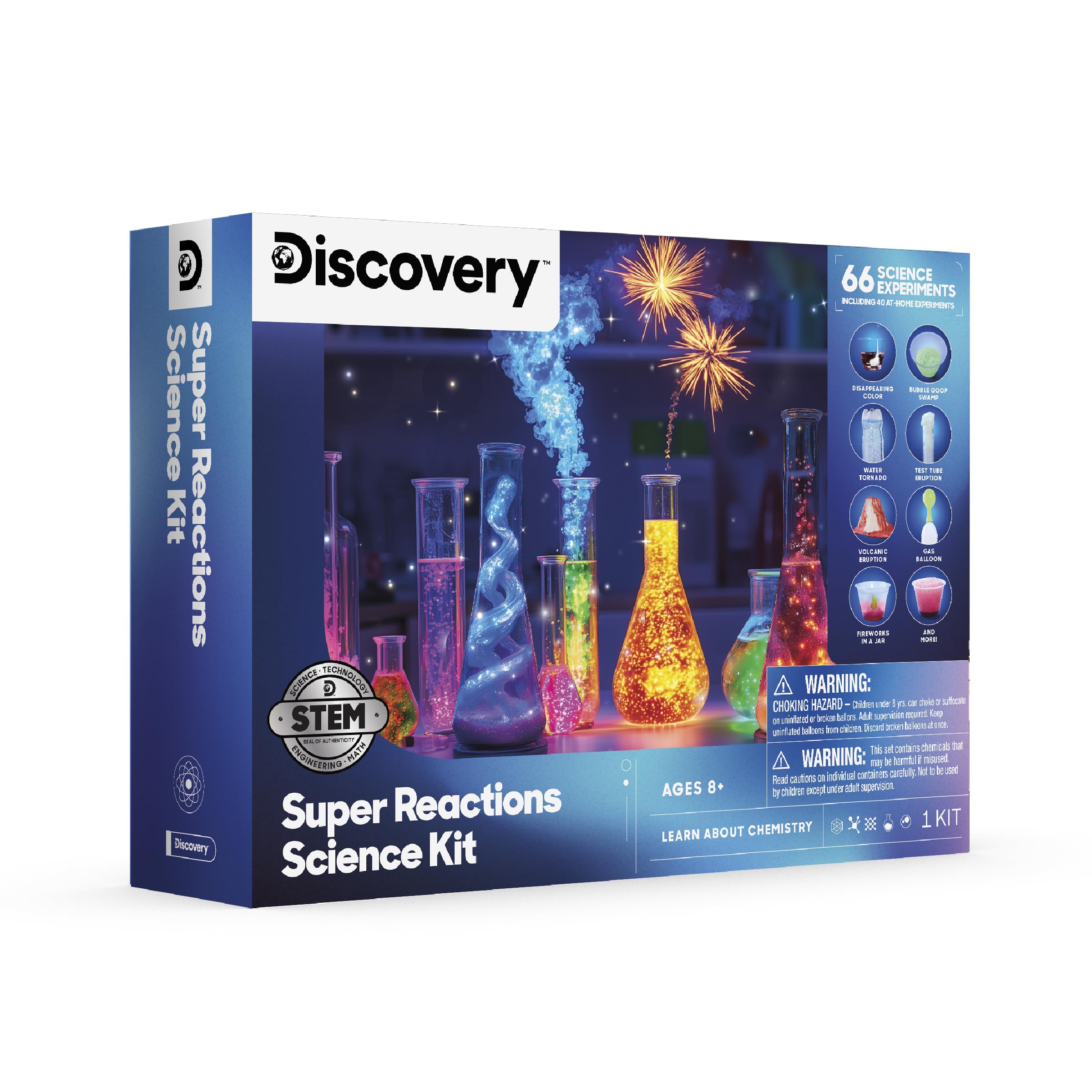
3. Discovery Super Reactions Science Kit – 66 Experiments STEM Lab
For the kid who wants to know the science behind the fizz, not just watch it.
This kit explains why baking soda and vinegar fizz, not just that they do. You get 26 guided experiments plus 40 bonus DIY ideas — but the focus is on acid-base reactions, pH indicators (using red cabbage and phenol red), states of matter, and gas expansion. At 2 pounds, it’s the heaviest standard kit here, with tools like test tubes, a volcano mold, citric acid, slime mix, and popping crystals.
A reviewer noted the “instruction booklet lacks chemical explanations,” so a parent comfortable explaining the science will get the most out of this kit. The volcano build uses plaster and paint — more hands-on than the plastic mold in the Butterfly EduFields kit. The manufacturer minimum age is 96 months (8 years), and that feels right — younger kids may struggle with the multi-step procedures.
One honest downside: reviewers mention a skunk odor from one of the included scents that lingers and is hard to remove. Play with proper ventilation, and consider skipping that experiment if sensitivity is a concern.
The learning edge: Unlike kits that just deliver an eruption, this one explains what pH is and why indicators change color — giving a genuine foundation in chemistry, not just a spectacle.
Best for: The curious 8-12 year old who asks “why” after every eruption — this kit answers.
Not ideal for: Quick one-afternoon fun — the experiments take planning and adult supervision, especially the plaster volcano build.
4. National Geographic Jumbo Volcano Science Kit – 18″ Giant Volcano

A show-stopping 18-inch volcano that dominates any science fair table.
The finished volcano stands 18 inches tall and weighs 5.39 pounds — roughly three times the weight of the Discovery kit — so its visual impact is massive. The kit comes with a cardboard frame, plaster wrap, plaster mix, two paint colors, a paintbrush, and eruption powder for up to six eruptions. Pop crystals add crackling sounds during the eruption, which reviewers’ kids love. Owners mention the build process takes several days due to layering and drying time, but the result “held up for a few explosions.”
The included genuine geode and pumice specimens add a nice touch for rock hounds. The learning guide explains how real volcanoes work, and the kit supports additional eruptions using household baking soda and vinegar once the included powder runs out. One reviewer noted the plaster ran out before the entire volcano was covered, so consider buying extra plaster if you want full coverage.
The trade-off is clear: this kit requires patience. The building step is part of the fun, but if your child wants instant results, a simpler plastic volcano model will satisfy faster. For a science fair project or a weekend-long parent-child build, it’s tough to top the wow factor.
Why it wins
- 18-inch finished volcano that genuinely impresses classmates and family
- Includes real rock specimens (geode and pumice) plus pop crystals for sound effects
- Supports multiple eruptions with included powder and household ingredients
The catch
- Build process takes days, not minutes — not a spontaneous activity
- Some kits run low on plaster before full coverage
Perfect for: The science fair competitor or the child who loves constructing a project over a full weekend.
Not for: The instant-gratification kid — the Butterfly EduFields kit delivers eruptions with zero build time.
5. JOPSHEEN 110+ Science Experiments Kits for Kids

A budget-friendly experiment library that doesn’t skimp on variety.
If you want lots of experiments without spending very much, JOPSHEEN delivers 110+ activities — volcano eruption, rainbow rain, wiggly worms, lava flows — at a price that leaves room for additional supplies. That is 40 fewer experiments than the Butterfly EduFields kit, but still enough for weeks of after-school science play. The kit includes scientific lab tools sized for young hands, and the step-by-step instructions are easy to follow.
The item dimensions are 10.23 x 7.48 x 3.35 inches, which is 44% larger than the Wow in The World Everlasting Volcano box (7.1 x 4 x 9 inches). That larger box means more materials are included, though you will still need some household items like vinegar and baking soda for certain experiments. Customers note the experiments are “safe for little kids and easy but so much fun.”
The honest limitation: the kit is from a smaller brand (JOPSHEEN), so the plastic tools may not feel as premium as the Discovery or UNGLINGA kits. Also, the experiment guide isn’t as illustrated as the Butterfly EduFields manual. But for the price-to-experiment ratio, this is tough to top.
The value math: At roughly half the experiments of the top picks but at a proportionally lower price, you still get over 100 activities — enough for weeks of after-school science play.
Pick this if: Budget is the main concern but you still want a real variety of experiments, not just a single volcano.
Look elsewhere if: You want premium tools and a beautifully illustrated manual — the Butterfly EduFields kit is worth the extra spend for the better guide and more experiments.
6. Wow in The World Everlasting Volcano

The volcano that erupts again and again with three different kinds of lava.
This is the only kit built around true replayability. You get three eruption modes: a color-changing slime eruption, a soft rubber balls eruption, and the classic vinegar-and-baking-soda eruption (baking soda and vinegar sold separately). The volcano model includes a lip around the base that catches the “lava” for easier cleanup — a feature parents appreciate. The 8-page illustrated “Wow-To Guide” teaches how real volcanoes work, and the kit includes exclusive audio content from the “Wow in the World” podcast.
Reviewers point out an “8-year-old volcano enthusiast loves it” — the reusable rubber balls are easy to clean and add a different sensory experience than traditional fizzing. The slime adds visual effects but is sticky; keep it away from carpets. At 7.1 x 4 x 9 inches, the box is compact, and the volcano model is tabletop-sized, not floor-sized. The manufacturer minimum age is 48 months (4 years), matching the Learning Resources Fizzy Volcano as the most preschool-friendly option here.
The catch: the classic eruption requires you to buy baking soda and vinegar separately — the kit only includes the slime and rubber pellets. After you exhaust the included slime, you are left with just the rubber-ball and standard baking soda eruptions. For pure longevity, a 150-experiment kit offers more variety over time.
What makes it special
- Three different eruption types keep the experience fresh for repeat play
- Lava-catch lip makes cleanup noticeably easier than most volcano kits
- Designed for ages 4+, so siblings of different ages can play together
What to watch
- Slime is very sticky — reviewers warn to keep it away from fabric
- Baking soda and vinegar not included, so you will need to stock up
Reach for it if: Your child under 8 loves the idea of a reusable volcano they can erupt repeatedly without rebuilding.
Not the best if: You want dozens of different experiment types — this is a focused volcano toy, not a general science lab.
7. Learning Resources Fizzy Volcano – 13 Pieces, Ages 4+

The simplest, fastest eruption for the youngest scientists — no build required.
No assembly needed — you can be erupting within seconds of opening the box. The 13-piece set includes kid-sized lab tools: color lenses, a test tube, a beaker, a funnel, and a dropper — all sized for small hands. The manufacturer minimum age is just 48 months (4 years), and the 9.1x gap in maximum age compared to the Butterfly EduFields kit (120 months vs 1088 months) shows it is specifically designed for little ones. Shoppers say the “simple instructions” make it easy.
One parent called it “my four year old’s favorite toy EVER,” adding that the child begs to “make a volcano” every day. The mess is minimal — vinegar and baking soda rinse off easily. At 0.75 pounds and measuring 10 x 8.5 x 5 inches, it’s light and easy to store or carry to a classroom. The 10 experiments are a small fraction of the 150+ offered by the Butterfly EduFields kit, but for a 4-year-old, that is plenty — they will happily repeat the same eruption.
The trade-off is obvious: 10 experiments is a small fraction of the 150+ offered by kits like Butterfly EduFields or UNGLINGA. For a 4-year-old, that is plenty — they will happily repeat the same eruption. But older kids (8+) will want more variety and depth. The included tools are well-made for the age group, but they won’t satisfy a tween looking for real chemistry.
The age advantage: No other kit on this list targets a 4-year-old as directly — the 48-month minimum age is half that of most other kits, and the simple tools match small motor skills.
Buy this if: You have a preschooler who loves watching things fizz and you want a low-mess, low-fuss entry into science.
pass on it if: Your child is 8 or older — the Butterfly EduFields kit offers 15 times more experiments for not much more.
Understanding the Specs
Experiment Count
This is the single most practical number in a volcano kit. A kit with 10 experiments gives you about 10 afternoons of play. A kit with 150+ experiments can last months, and the variety keeps curious kids engaged across different scientific concepts — chemistry, physics, biology, geology. If you want maximum value and longevity, look for the highest experiment count within your budget.
Manufacturer Minimum Age (Months)
This number tells you the youngest age the manufacturer considers safe for the kit’s materials and complexity. 48 months (4 years) is the lowest you will find — those kits use larger parts, simpler instructions, and non-toxic materials. 96 months (8 years) is typical for kits with more chemicals, smaller tools, and multi-step experiments. Ignoring this number can lead to frustration or safety issues with small pieces.
FAQ
Do I need to buy extra baking soda and vinegar for these kits?
Which kit is best for a 4-year-old who just wants to see an eruption?
How many times can I erupt the National Geographic Jumbo Volcano?
What is the difference between the Butterfly EduFields 150+ kit and the UNGLINGA 150 kit?
Are the materials in these kits safe for kids with sensitive skin?
Which volcano kit is best for a school science fair project?
Will these kits work with just baking soda and vinegar if I run out of the included powders?
What does the manufacturer maximum age in months mean?
Final Thoughts: The Verdict
For most families, the best baking soda volcano kit overall is the Butterfly EduFields 150+ Science Kit because it packs the most experiments (150+) into a single affordable box, backed by a safety-first design and detailed instructions. If you want a deeper chemistry education for an older child, grab the Discovery Super Reactions Science Kit. And for a show-stopping science fair project that kids build themselves, the standout is the National Geographic Jumbo Volcano.
How We Picked
We do not accept paid placement. Every pick is matched to a real buyer and a real use-case; we do not hands-on test units.
Sources & Methodology
Specifications: manufacturer listings and product documentation. Review insights: verified customer reviews, as of July 2026. Pricing: not shown on this page (it changes often); check the current price via the retailer link.
As an Amazon Associate, Gadgets Feed earns from qualifying purchases. This does not affect which products we feature.