
The most critical spec for a first bike isn’t a top speed or a brake system — it’s the seat height range and the frame geometry that determines whether a toddler’s feet can actually plant flat on the ground. For a 12-month-old learning to walk, the bike functions as a walker with wheels: the seat must drop low enough that both feet rest firmly on the floor, and the frame must be narrow enough that tiny legs can straddle it without strain. When the seat sits too high by even an inch, the child’s center of gravity shifts and the bike tips, negating the entire purpose of balance training.
I’m Min — the co-founder and writer behind Gadgets Feed. For this guide, I analyzed the frame lengths, seat height minimums, wheel types, and material construction of seven models specifically marketed for 12-to-24-month riders to isolate which bikes actually fit a one-year-old’s proportions rather than simply claiming a broad age range.
Bikes that claim a “1-3 year” range are often sized for the oldest end of that window; a true balance bike for 1 year olds must dip the seat below 10 inches to accommodate the inseam of a newly walking child, or it’s a premature purchase that sits in the garage for six months before it fits.
How To Choose The Best Balance Bike For 1 Year Olds
A balance bike for a one-year-old is fundamentally different from the same bike for a three-year-old. The child’s inseam — not their age — is the single deciding factor. Most 12-month-olds have an inseam between 9 and 11 inches. If the bike’s minimum seat height is above that range, the child cannot safely reach the ground, which creates a leaning hazard rather than a learning tool. Beyond seat height, three other specifications separate a usable first bike from a decorative toy.
Seat Height Range Is Non-Negotiable
A bike with a seat that adjusts from 8.5 inches to 12 inches fits a 12-month-old immediately and can grow with them through age 2 or 3. A bike that starts at 11 inches is already too tall for a child under 18 months unless they are in the 95th height percentile. Measure your child’s inseam before purchasing — have them stand against a wall, and measure from the floor to their crotch. The bike seat should be set 0.5 to 1 inch below that measurement so their knees bend slightly when seated.
Wheel Construction and Floor Safety
One-year-olds ride predominantly indoors — on hardwood, tile, laminate, and low-pile carpet. Hard plastic wheels are loud, slide on smooth floors, and scuff surfaces. EVA foam wheels are quiet, grippy enough for indoor surfaces, and leave no marks. Airless rubber tires (like the Retrospec Cub’s puncture-proof units) offer the best traction on mixed surfaces but add rotational weight that can make a 12-month-old’s pushes feel sluggish. For a child under 18 months, lightweight EVA wheels strike the ideal balance between grip, noise, and rolling resistance.
Weight and Frame Geometry
A 7-pound bike feels heavy to an adult but is often unwieldy for a toddler who has only been walking for a few months. Bikes under 4 pounds (like the SEREED at 3.6 pounds) allow the child to pick the bike up, turn it around, and mount it independently. The frame style matters equally: a low step-over height — measured from the ground to the top tube — should be under 9 inches so the child can step through the frame rather than swing a leg over. Step-through frames prevent tripping and make mounting less intimidating for a first-time rider.
Quick Comparison
On smaller screens, swipe sideways to see the full table.
| Model | Category | Best For | Key Spec | Amazon |
|---|---|---|---|---|
| Kinderfeets Tiny Tot | 2-in-1 | Smallest riders (12 months) | 8.5″ min seat height | Amazon |
| Retrospec Cub | Premium | Mixed terrain use | 11″ min seat height | Amazon |
| Radio Flyer Steady Start | 3-Wheel | Stability-first teaching | Wide front + dual rear tires | Amazon |
| Liberry Baby Balance | Mid-Range | Indoor floor safety | 9.7″ min seat height | Amazon |
| PerKidern (Colorful) | Mid-Range | Adjustable seat range | 10.6″ to 13.4″ seat | Amazon |
| PerKidern (Brown) | Mid-Range | Extended frame length | 3″ taller frame | Amazon |
| SEREED Colorful Lighting | Budget-Friendly | Lowest weight for toddlers | 3.6 lbs weight | Amazon |
In‑Depth Reviews
1. Kinderfeets Tiny Tot 2-in-1 Wooden Balance Bike
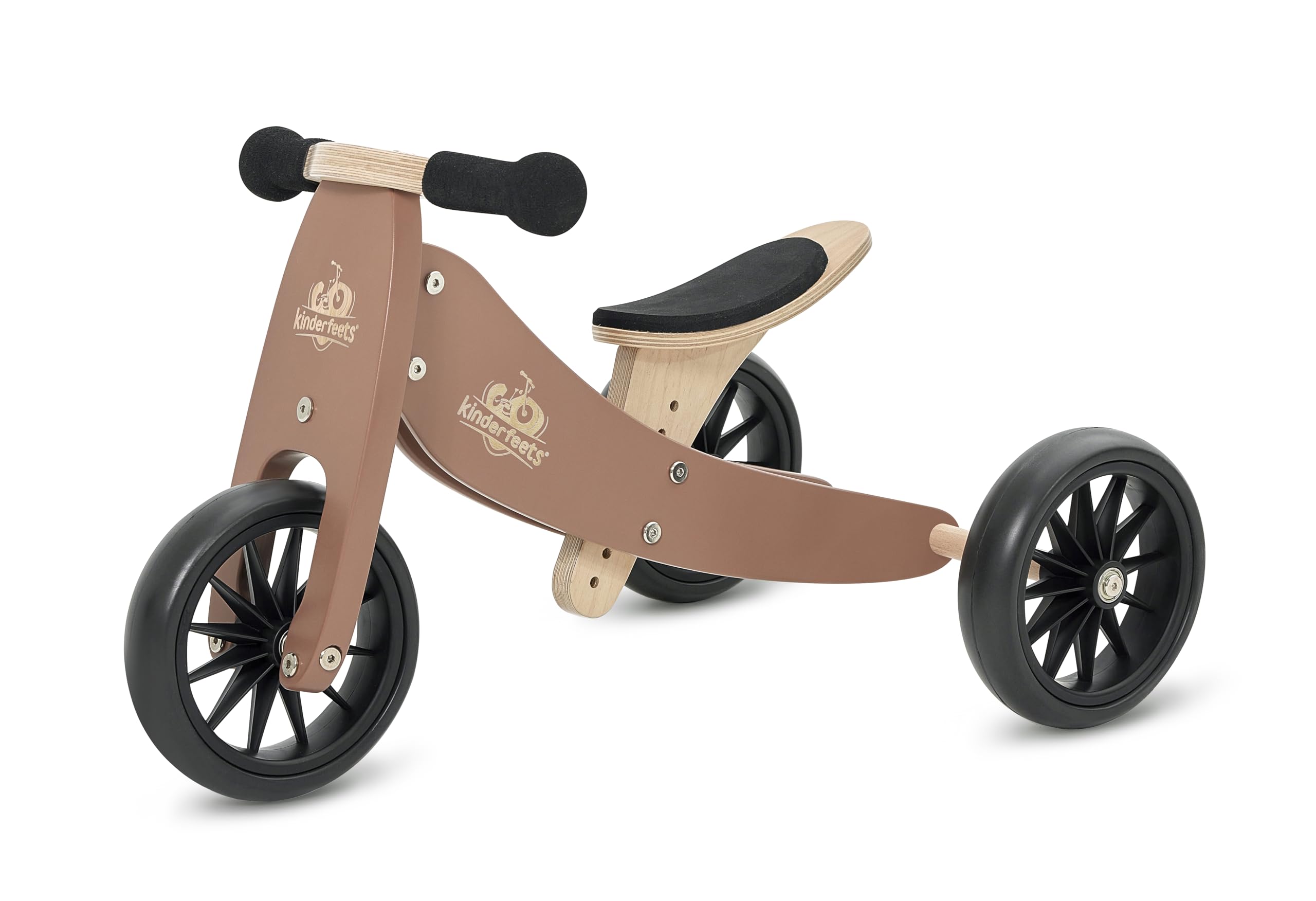
The Kinderfeets Tiny Tot is the only bike on this list whose minimum seat height drops to 8.5 inches, which means it genuinely fits a 12-month-old on day one — no “grow into it” waiting period required. The birchwood frame is handcrafted and coated with water-based lacquers, so the natural wood grain remains visible while the surface stays smooth and splinter-free for tiny hands. The 2-in-1 conversion is genuinely useful: the tricycle mode (rear wheel axle in the wide position) gives a brand-new walker four points of ground contact for maximum stability, then the axle shifts inward to convert the rear wheels together, creating a standard two-wheel balance bike once the child’s walking gait becomes confident.
At 5 pounds, the wooden frame is slightly heavier than the lightest aluminum options but still light enough that a 14-month-old can lift the front wheel over a rug edge. The 7-inch airless tires are smooth rather than treaded — this sacrifices grip on loose gravel but makes indoor rolling friction-free on hardwood and tile. The seat cushion is padded and the handlebar grips are nontoxic rubber, so there is no chemical off-gassing when the bike sits in a playroom. ASTM and CE certifications confirm the lacquer and construction meet toddler safety standards, which matters more for wooden components than for steel or aluminum frames that are inherently inert.
The main trade-off is the price point, which sits at the top of this category. The bike also lacks a steering limiter — the handlebars rotate a full 360 degrees, which can cause the front wheel to turn sideways under a wobbly rider. Parents should supervise closely during the first weeks until the child develops the arm strength to steer deliberately. The paint on the birchwood is less impact-resistant than powder-coated steel; if the bike is dragged across concrete, the lacquer will scuff and the wood may dent.
Why it’s great
- Lowest minimum seat height (8.5 inches) on the market — fits true 12-month-olds immediately
- Tricycle-to-balance-bike conversion gives parents two modes in one frame
- Birchwood construction with water-based lacquer is free of VOCs and sharp edges
Good to know
- No steering limiter — handlebars can spin full 360°, which may cause tip-overs during early use
- Wood scuffs and dents more easily than metal frames
- Premium price compared to alloy and steel competitors
2. Retrospec Cub Toddler Balance Bike

The Retrospec Cub is built for parents who need a bike that survives outdoor use across pavement, grass, and packed dirt without flat tires or bearing failure. The airless, puncture-proof rubber tires are the defining feature here — they never go flat, they provide meaningful traction on loose surfaces, and they absorb vibration better than any EVA or plastic wheel on this list. The seat adjusts from 11 to 14.5 inches using a quick-release clamp under the saddle, which is tool-free once the initial setup screws are tightened, so the bike can be raised as the child grows without needing a wrench.
The low step-over frame is the standout ergonomic win: the top tube sits well below 10 inches, so a 12-month-old can step through rather than swing a leg over. The alloy steel frame is powder-coated in a matte finish (the Eggshell color is a muted off-white that hides scuffs well). Rounded edges and recessed bolt heads eliminate pinch points at the handlebar clamp and seat post junction. The rear coaster brake is a nice-to-have but functionally irrelevant for 1-year-olds who stop by putting their feet down — the brake becomes useful only when the child transitions to coasting at age 2 or 3.
The minimum seat height of 11 inches is the limiting factor — this bike will not fit the average 12-month-old. A child needs an inseam of roughly 10.5 inches before their feet touch the ground at the lowest setting, which typically occurs around 15 to 18 months depending on growth rate. The weight is also noticeably higher than the aluminum-frame options; at roughly 6.5 pounds, the Cub feels solid but a newly walking toddler may struggle to lift and turn it independently. The assembly requires affixing the handlebars, seat post, and front wheel — the instructions are clear but you need a 5mm hex key (included) and about 15 minutes.
Why it’s great
- Puncture-proof airless tires never go flat and perform well on grass, dirt, and pavement
- Low step-over frame allows emerging walkers to mount without leg-swinging
- Tool-free seat adjustment for growth across 15 months to 3 years
Good to know
- 11-inch minimum seat height is too tall for most 12-month-olds — best for 15+ months
- Heavier than aluminum-frame competitors at approximately 6.5 pounds
- Assembly requires tools for initial handlebar and wheel attachment
3. Radio Flyer Steady Start Balance Bike

The Radio Flyer Steady Start uses a deliberately unconventional wheel layout — one wide front tire and two rear tires spaced closely together — to create a self-standing platform that does not require a kickstand or parental hand-holding to stay upright. This three-point contact system is the most forgiving geometry for a child who is still unsteady on their feet: the bike will not fall over when the child dismounts abruptly, and it resists tipping during the crucial phase when the toddler is still figuring out how to sit and scoot simultaneously. The seat is padded with thick foam and adjusts tool-free via a lever under the saddle, so it can be raised in 2-second increments as legs lengthen.
The treaded rubber tires are wider than any other bike in this lineup — approximately 1.5 inches across — which spreads the bike’s weight and reduces the sinking sensation on grass or loose mulch. The alloy steel frame is painted in the signature Radio Flyer red with a glossy finish that wipes clean with a damp cloth. The bike weighs 7 pounds, which is the heaviest on this list, but the extra mass is concentrated low in the frame, so the center of gravity stays planted. Parents report that the bike rolls silently on hardwood and carpet — the rubber compound does not produce the hollow thumping sound that EVA foam wheels create on floor transitions.
The fixed handlebar height is the main compromise — the grips cannot be raised or adjusted relative to the frame. For a very tall 2-year-old (over 38 inches), the handlebar position may feel low relative to the seat in its highest setting. The three-wheel design also means the bike is wider at the rear than a standard two-wheel balance bike, which can make it harder to fit through narrow doorways or store in a tight closet. The absence of a steering limiter is less problematic here because the dual rear wheels resist sideways tipping even when the front wheel turns sharply.
Why it’s great
- Three-wheel layout is inherently stable — the bike stands on its own without a kickstand or hand
- Tool-free padded seat adjusts in seconds for quick growth accommodation
- Wide treaded tires roll quietly on indoor floors and don’t slip on hardwood
Good to know
- Fixed handlebar height — cannot be raised for taller toddlers
- 7-pound frame is the heaviest in this category; some 12-month-olds may struggle to maneuver it
- Rear wheel housing adds width that complicates door clearance and storage
4. Liberry Baby Balance Bike
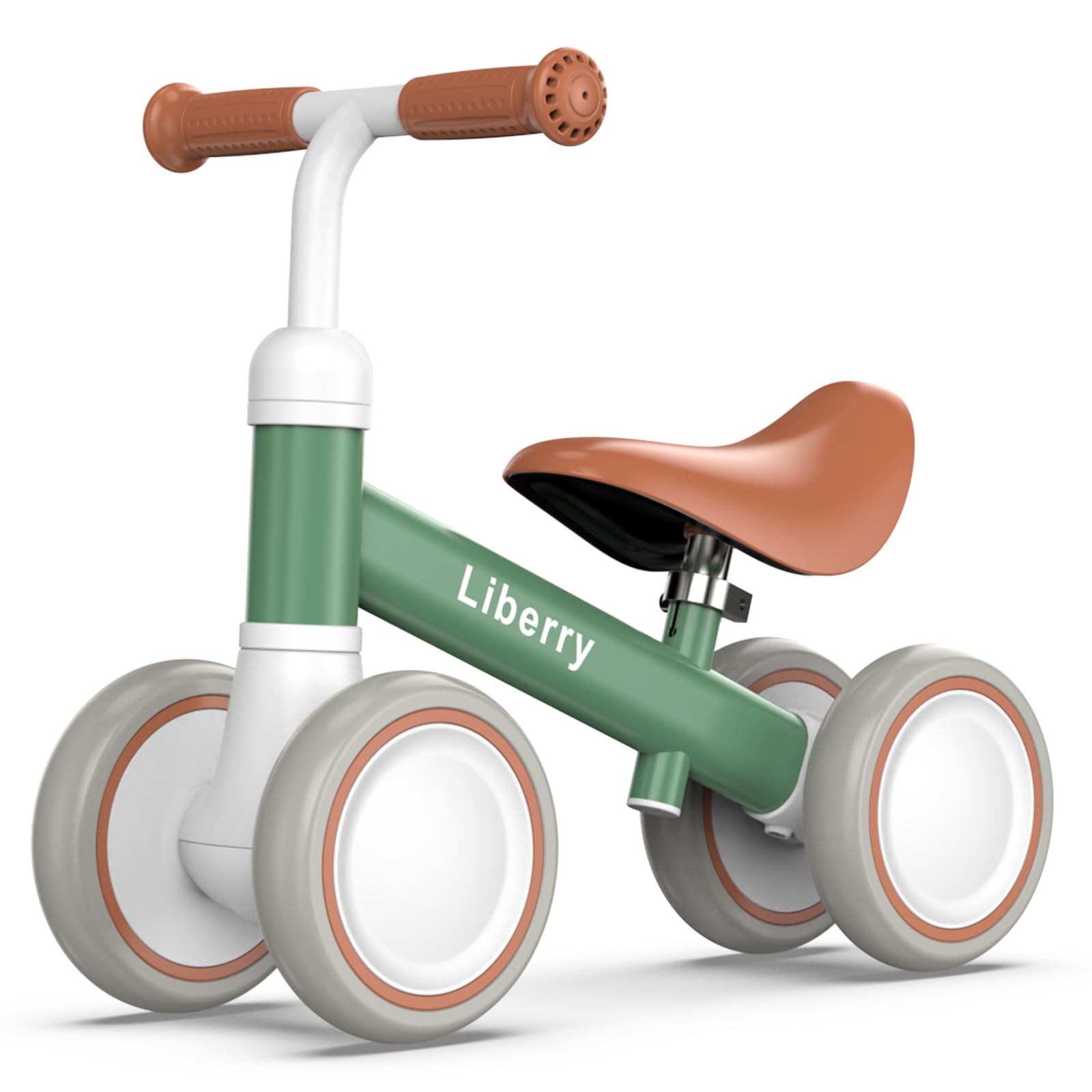
The Liberry Baby Balance Bike is optimized for indoor use with specifications that prioritize floor protection, noise reduction, and a comfortable grip for small hands. The EVA tires are the quietest in this tier — they produce almost no sound on hardwood, tile, or laminate, and they leave zero scuff marks even after aggressive scooting across a white vinyl floor. The seat adjusts from 9.7 to 11 inches, which is a narrower range than the competition but deliberately calibrated for children between 12 and 24 months rather than stretching coverage into age 3. The rubber handlebar grips are thicker than the standard foam grips found on budget bikes — foam grips tear when chewed or clawed, whereas rubber survives the gnawing and squeezing that 1-year-olds subject handlebars to during mounting attempts.
The alloy steel frame uses an integrated body weld rather than bolted joints, which minimizes the risk of screws loosening over time. The 135-degree steering limiter is built into the headset and prevents the handlebars from spinning sideways — this is a critical safety feature for a 12-month-old rider who lacks the core strength to correct a sudden wheel turn. The included letter stickers let parents personalize the bike with the child’s name, which is a small touch but helps the child identify the bike as “theirs” and increases engagement during the first learning sessions. The maximum weight capacity of 55 pounds is generous for a bike in this price bracket and means the frame will not flex or sag as the child approaches age 3.
The seat adjustment range is the most limited here — at 9.7 to 11 inches, the bike fits children with inseams between roughly 9 and 10.5 inches. A child who grows quickly or has long legs may outgrow the maximum seat height before they master gliding. The bike also lacks any sort of footrest or platform for coasting; once the child progresses to lifting their feet, there is nowhere to rest them except the frame, which sits too high for a 12-month-old’s legs to reach comfortably. The 6.4-pound weight is mid-range for this category but noticebly heavier than the SEREED or PerKidern options, so very small riders may need help repositioning the bike after falls.
Why it’s great
- EVA tires are completely silent and mark-free on hardwood, tile, vinyl, and laminate
- 135° steering limiter prevents handlebar over-rotation and tip-overs
- Rubber handlebar grips resist tearing from teething and rough play
Good to know
- Seat only adjusts up to 11 inches — outgrown by tall or fast-growing toddlers before age 3
- No footrest platform for gliding phase — legs dangle once feet are lifted
- Heavier than aluminum-frame alternatives at 6.4 pounds
5. PerKidern Baby Balance Bike (Colorful Lighting)

The PerKidern Colorful Lighting model is distinguished by its wide seat adjustment range — 10.6 to 13.4 inches — and its 77-pound weight limit, which is nearly 40 percent higher than the category average. The seat adjustment span is the widest on this list, accommodating children from roughly 15 months (once their inseam reaches 10 inches) all the way through age 4 or 5 depending on growth rate. The PU seat cushion is contoured to prevent the child from sliding forward or backward, which is a common complaint on flat, unpadded saddles where the rider’s hip angle changes as they scoot. The 135-degree steering limiter is paired with a fully enclosed wheel housing — the EVA wheels are seated inside a plastic shell that eliminates the gap between the wheel and the frame, making it impossible for toes to get caught during riding.
The carbon steel frame is heavier than aluminum (the bike weighs 4.16 pounds) but still manageable for a 1-year-old to carry short distances. The frame geometry is intentionally compact: the wheelbase is shorter than the PerKidern brown model below, which makes the turning radius tighter and the bike more maneuverable in tight indoor spaces like hallways and between furniture. The EVA tires are non-slip and wear-resistant, and they produce a faint humming sound on smooth floors rather than a rattling or thumping noise. The lighted wheels are the named feature here — they require no batteries and activate through centrifugal force when the wheels spin, providing a visual reward that encourages the child to keep pushing. However, the lights are dim and only visible in low-light conditions; in a brightly lit playroom, they are barely noticeable.
The minimum seat height of 10.6 inches means this bike does not fit a standard 12-month-old at the lowest setting. A child needs an inseam of roughly 10 inches to ride comfortably — the average 12-month-old has an inseam of 9 to 9.5 inches, meaning most first-time buyers will need to wait two to three months before the bike fits. The assembly is more involved than the tool-free options: you need a Phillips-head screwdriver to attach the handlebars to the stem and to secure the seat post. The included tool kit is basic but functional, though the instructions rely heavily on pictograms rather than written text, which can be confusing for first-time builders.
Why it’s great
- Seat adjusts from 10.6 to 13.4 inches — one of the widest range fits on the list
- 135° steering limiter and enclosed wheels prevent toe pinching and sideways falls
- 77-pound weight capacity far exceeds category average, adding years of usable life
Good to know
- 10.6-inch minimum seat height is too tall for most 12-month-old riders
- LED light wheels require low-light conditions to be visible and noticeable
- Assembly requires a screwdriver and pictogram-based instructions
6. PerKidern Baby Balance Bike (Brown)

The brown PerKidern model is the lankier sibling of the Colorful Lighting version — the frame is extended by 2 inches in length and raised by 3 inches in height compared to the standard PerKidern geometry, which positions it for children at the taller end of the 12-to-24-month range or for those with proportionally longer legs. The saddle is a special contoured PU unit designed with a raised rear lip and a dipped center that prevents the child from sliding backward when they lean forward to push — this is a common issue on flat saddles where the child’s momentum during scooting shifts their weight backward off the seat. The frame is carbon steel with a powder-coated brown finish that hides dirt and scratches better than lighter colors, and the handlebar grips are soft EVA foam rather than rubber, which is slightly less durable but more forgiving on bare hands during winter months.
The four high-density EVA wheels are identical in composition to the Colorful Lighting model but are mounted on a wider stance to match the extended frame. The added wheelbase length improves straight-line stability — the bike tracks straighter when the child pushes hard, reducing the wobble that occurs on shorter frames. The assembly takes roughly five steps and requires a screwdriver, but the instructions are printed on a single card with labeled diagrams for each bolt location. At 4.6 pounds, the bike is still under 5 pounds, so the added length does not translate to excessive carrying weight — a 15-month-old can still lift the bike over a raised door threshold or into a toy bin.
The raised frame geometry (3 inches taller than standard) exacerbates the step-over height problem. A 12-month-old needs to lift their leg higher to swing over the top tube compared to the lower-frame PerKidern or Liberry models. This bike is best suited for children who are already walking confidently (typically 14 months or older) and who have an inseam of at least 11 inches. The absence of a footrest or gliding platform is also more noticeable here because the frame sits higher — when the child lifts their feet, there is no comfortable place to rest heels without hitting the ground. The saddle adjustment mechanism uses a hex bolt rather than a quick-release lever, which means changing the seat height requires a tool every time — less convenient for frequent adjustments as the child grows rapidly between 12 and 18 months.
Why it’s great
- Extended frame (+2 inches) provides better straight-line tracking and stability during fast scooting
- Contoured PU saddle prevents backward sliding with raised rear lip design
- Under 5 pounds despite the larger frame dimensions — lightweight and easy to carry
Good to know
- Raised frame height (+3 inches) makes step-over more difficult for shorter 12-month-olds
- Seat height adjustment requires a hex bolt tool — no quick-release convenience
- No footrest platform for when the child progresses to the gliding phase
7. SEREED Colorful Lighting Baby Balance Bike

The SEREED Colorful Lighting balance bike is the lightest model on this list at 3.6 pounds, achieved through an aluminum alloy frame that sheds nearly a full pound compared to the carbon steel alternatives. The weight difference is immediately apparent when a 12-month-old tries to maneuver the bike — they can pick it up by the handlebars, drag it to their preferred riding spot, and right it after a fall without needing an adult to intervene. The bike uses a fixed seat height (no adjustment mechanism), which keeps the weight low and eliminates the tolerance issues that can develop in adjustable seat clamps over time. The seat height is set at approximately 10 inches from the ground, which fits children with an inseam around 9.5 inches — right at the average for a 12-month-old.
The Colorful Lighting element consists of small LEDs embedded in the wheel hubs that illuminate when the wheels spin via centrifugal force — no batteries are needed, and the lights only glow when the bike is in motion. This creates a natural speed reward: the faster the child pushes, the brighter the wheels glow, which encourages continued movement and builds leg strength. The EVA tires are silent on hardwood and do not mark floors, making the bike fully indoor-ready from the moment it is assembled. The steering is limited to 135 degrees, preventing the handlebars from turning sideways when the child leans the bike to one side during mounting. The frame material is listed as “fender material: aluminum” and “frame material type: aluminum” in the specifications, which suggests a consistent light-metal build rather than a mixed-material construction.
The fixed seat height is the double-edged sword here. There is no way to raise the seat as the child grows — once their inseam exceeds 11 inches, they will outgrow the bike, which typically happens around 18 to 20 months depending on growth rate. The bike also lacks any padding on the saddle; the seat is a formed plastic shell with no cushioning, which can become uncomfortable during long riding sessions on bumpy surfaces. The assembly is tool-free and takes roughly one minute — the handlebars slide into the stem and lock with a thumb screw, and the front wheel attaches with a threaded axle nut. However, the instructions are printed in small type and use vague diagrams; most parents will figure it out intuitively without the manual. The bike does not include any warranty or replacement parts program — if a wheel LED fails or a grip tears, the entire bike is a single purchase.
Why it’s great
- Lightest bike on the list at 3.6 pounds — ideal for newly walking toddlers to maneuver independently
- Aluminum frame resists rust and keeps weight low compared to steel alternatives
- No-battery LED wheels provide a visual speed reward that motivates active scooting
Good to know
- Fixed seat height — cannot be adjusted as child grows; outgrown by 18-20 months typically
- Hard plastic saddle with no padding gets uncomfortable on longer rides
- LED components are not user-serviceable — if a wheel hub fails, the bike has no repair path
FAQ
How do I know if my 1-year-old is tall enough for a balance bike?
Should I buy a balance bike with or without a steering limiter?
What is the ideal weight for a balance bike for a 1-year-old?
Do 1-year-olds need a footrest on a balance bike?
Final Thoughts: The Verdict
For most users, the balance bike for 1 year olds winner is the Kinderfeets Tiny Tot because its 8.5-inch minimum seat height is the only spec that guarantees a true 12-month-old fit with room for the tricycle-to-bike conversion as confidence grows. If you want puncture-proof tires and a low step-over frame that handles outdoor pavement and grass, grab the Retrospec Cub. And for the best value where stability and self-standing design are the priority, nothing beats the Radio Flyer Steady Start with its three-wheel layout that never tips over during mounting or dismounting.