
Choosing a first ride for an 18-month-old isn’t about speed or flashy features — it’s about finding a frame low enough for short legs to plant flat on the ground, wheels that won’t slip on hardwood, and a weight that a toddler can actually lift and steer. Most parents buy a bike that’s too tall or too heavy, turning what should be a confidence-building tool into a wobbly frustration machine. The right balance bike for this specific age group puts stability and ground-contact above all else.
I’m Min — the co-founder and writer behind Gadgets Feed. I’ve spent hundreds of hours cross-referencing technical specifications, poring over real owner experiences, and comparing build quality metrics like seat-height range, wheel width, frame materials, and weight limits to separate the genuinely toddler-friendly designs from the ones that just look small.
This guide focuses exclusively on models that accommodate a minimum inseam of around 10 inches and keep the total weight under 8 pounds, ensuring a safe, confidence-boosting introduction to motion. My goal is to help you find the very best balance bike for 18 month old that fits your child’s unique proportions and your home’s reality.
How To Choose The Best Balance Bike For 18 Month Old
An 18-month-old is not a miniature preschooler. Their center of gravity is higher relative to their height, their stride is short, and their grip strength is limited. A balance bike that works for a 3-year-old will feel like a monster truck to a toddler just past their first birthday. You need to match the bike to the specific biomechanics of a child who is still perfecting their walking gait.
Seat Height Range is the Non-Negotiable Spec
Ignore the “age range” label on the box — it’s a marketing estimate at best. The real metric is the minimum seat height. For an 18-month-old with an average inseam of 10–12 inches, the seat must drop to at most 11 inches from the ground, and ideally closer to 9.5 inches. If the lowest seat setting is above 12 inches, your child’s feet won’t touch flat, and they’ll tip sideways the moment they lean. Measure your child’s inseam before you shop, then cross-reference it against the bike’s published seat-height range.
Weight and Frame Geometry
A toddler has roughly the same lifting capacity as a small house cat. If the bike weighs more than 8 pounds, most 18-month-olds will struggle to pick it up after a fall, and the extra mass makes steering corrections harder. Look for frames made of alloy steel or birchwood — both offer a good strength-to-weight ratio at this size. Avoid thick-walled steel tubing that looks rugged but adds unhelpful heft. A low step-over height (the distance from the ground to the top tube) is also critical; it should be under 10 inches so your child can mount and dismount independently.
Wheel Design: Stability Over Speed
At 18 months, the goal is not gliding — the goal is getting comfortable with the sensation of feet-off-the-ground for brief moments. Wide, puncture-proof EVA foam or PU wheels provide a stable platform without the risk of flats. A 3.5-inch-wide rear wheel dramatically reduces tipping compared to standard 2-inch bicycle wheels. Some designs use a dual-rear-wheel configuration or a tricycle-style three-wheel setup, which trades maneuverability for rock-solid stability. For a beginner who is still wobbly on two feet, that extra stability is worth the trade-off.
Quick Comparison
On smaller screens, swipe sideways to see the full table.
| Model | Category | Best For | Key Spec | Amazon |
|---|---|---|---|---|
| Kinderfeets Tiny Tot Plus | Wooden Premium | Long-term investment (18mos–4yrs) | 10–13 in. seat height, 9 in. airless tires | Amazon |
| Retrospec Cub | Steel Premium | Puncture-proof durability | 11–14.5 in. seat height, 10 lb. frame | Amazon |
| Yvolution Y Velo Junior | Convertible 3-to-2 | Transition from 3 wheels to 2 | 11–14.2 in. seat height, 7.7 lb. frame | Amazon |
| KRIDDO Mini Cruiser | Lightweight Steel | Short toddlers (12–24 months) | 3.6 in. wide PU wheels, 55 lb. max | Amazon |
| Radio Flyer Steady Start | 3-Wheel Stable | First-time fliers on varied surfaces | Wide front + dual rear wheels, 7 lb. | Amazon |
| Libberry Baby Balance Bike | 4-Wheel Stable | Indoor-first riding on smooth floors | 9.7–11 in. seat height, 6.4 lb. frame | Amazon |
| Bobike Toddler Balance Bike | Value Steel | Budget-friendly entry | Enclosed non-slip wheels, 135° steering | Amazon |
In‑Depth Reviews
1. Kinderfeets Tiny Tot Plus Balance Bike

The Kinderfeets Tiny Tot Plus is the rare balance bike that doesn’t compromise on longevity or ergonomics. Its birchwood frame keeps the bike light enough for a 20-pound toddler to manage, while the 9-inch airless tires provide excellent grip on pavement and packed dirt without the risk of a flat mid-ride. The seat adjusts from 10 to 13 inches — the lowest available setting among the premium options — which means even a petite 18-month-old with a 10-inch inseam can stand flat-footed.
What sets this bike apart is the two-in-one design. It ships as a stable tricycle, then converts to a standard balance bike when your child’s confidence and coordination improve. That transition usually happens around age 2 to 2.5, giving you roughly two and a half years of use from a single purchase. The water-based lacquer and non-toxic grips are a thoughtful touch for a child who will inevitably chew on the handlebars.
Assembly takes about 10 minutes with the included hex key. The 55-pound weight limit is generous for this category, and the extra-wide wheelbase on the trike configuration makes tipping virtually impossible — even on uneven grass. The main trade-off is the price point, but the per-month cost lands lower than most steel options when you factor in the convertible feature.
Why it’s great
- Convertible 3-to-2 wheel design extends usable life to 4+ years
- Lowest minimum seat height (10 in.) in the premium tier
- Lightweight birchwood frame is easy for toddlers to maneuver
Good to know
- Premium price point compared to steel alternatives
- Wooden frame can show scuffs and scratches over time
2. Retrospec Cub Toddler Balance Bike
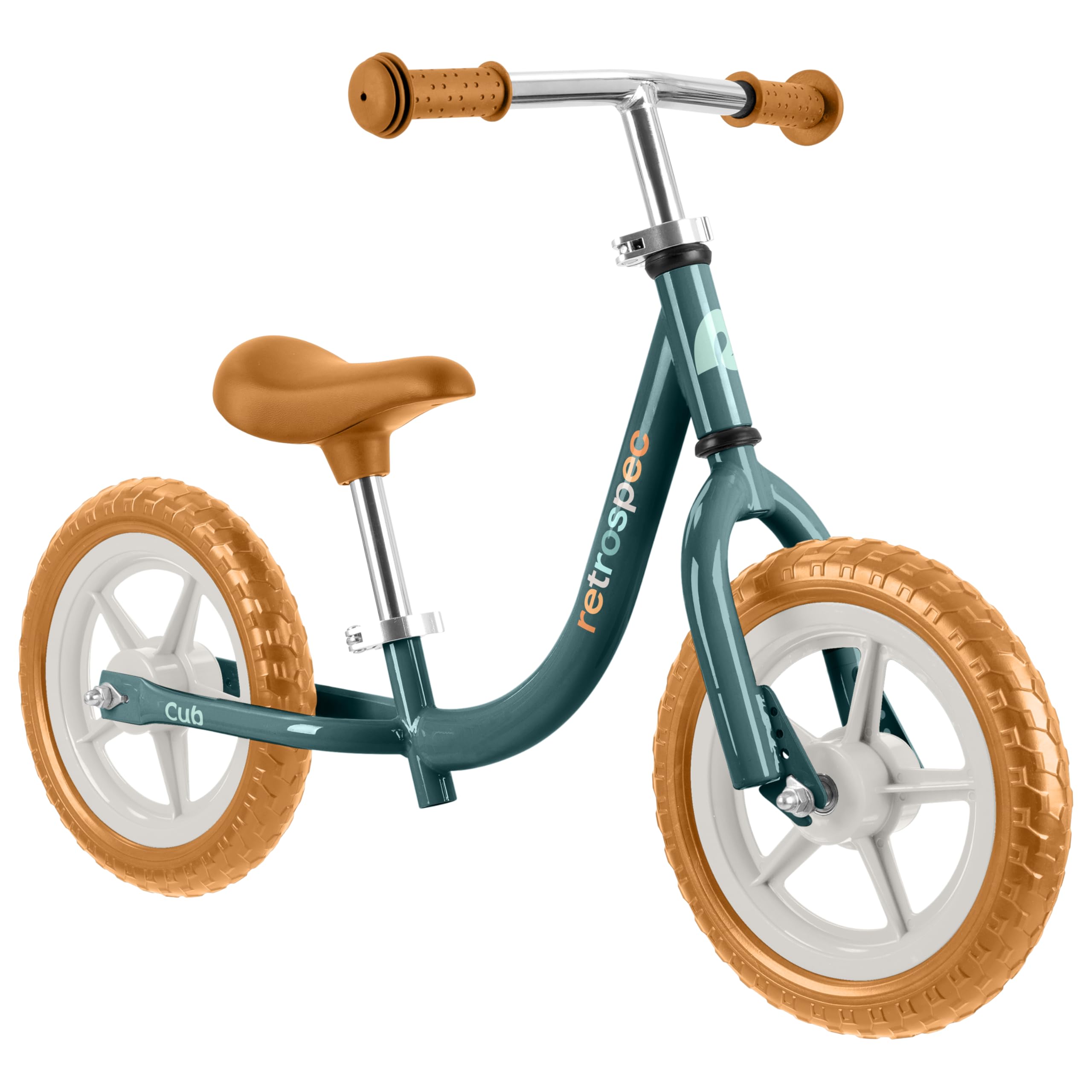
The Retrospec Cub is built for the parent who wants zero maintenance. The airless, puncture-proof tires are the headline feature — they never need inflation, never get flats from glass or thorns, and provide consistent grip across pavement, grass, and light gravel. The alloy steel frame is sturdy without being punishingly heavy, though at 10 pounds it’s on the upper edge of what a small 18-month-old can easily lift after a tip-over.
The seat height range of 11 to 14.5 inches is wide enough to accommodate growth from early walking to confident gliding, but the 11-inch minimum means this bike works best for toddlers with an inseam of at least 11.5 inches. For a taller 18-month-old or a 2-year-old, this is an excellent fit. The low step-over frame design — inspired by classic BMX geometry — makes mounting and dismounting instinctive even for beginners who still use both hands.
Assembly is straightforward with the included tools, and owners report that the quick-release seat clamp allows adjustment without hunting for a wrench. The rounded edges and non-slip grips meet ASTM safety standards. The main consideration is that 10-pound weight: if your child is on the smaller side (under 22 pounds), the KRIDDO or Liberry options will feel more manageable.
Why it’s great
- Maintenance-free, puncture-proof tires handle all surfaces
- Wide 11–14.5 in. seat height range for long-term use
- Low step-over frame promotes independent mounting
Good to know
- 10 lb. frame may feel heavy for very small toddlers
- Minimum seat height of 11 in. excludes shorter inseams
3. Yvolution Y Velo Junior Balance Bike

The Y Velo Junior’s defining feature is the iconic dual-rear-wheel design that converts to a single wheel as your child builds confidence. Start with the training-wheel mode for ultra-stable first rides — the double-width rear wheel makes leaning sideways virtually impossible. After a few weeks or months, remove the extra wheel to transition to standard two-wheel balance mode. This setup gives parents control over the difficulty curve without buying a second bike.
The frame is alloy steel at just 7.7 pounds, making it one of the lightest metal options suitable for an 18-month-old. The adjustable seat ranges from 11 to 14.2 inches, and the handlebars also adjust, accommodating children up to 44 pounds. The larger wheel diameter and higher ground clearance improve performance on uneven surfaces like grass or low curbs — something the ultra-low Liberry and Bobike models struggle with.
Assembly takes roughly 10 to 15 minutes, and the conversion between modes requires no tools. Customer feedback consistently mentions that the bike feels “sturdy without being heavy” and that the dual-wheel mode gives anxious toddlers the confidence to try scooting. The trade-off is that the 11-inch minimum seat height may be borderline for smaller 18-month-olds; measure your child’s inseam before committing.
Why it’s great
- Tool-free conversion from 3 wheels to 2 builds skills progressively
- 7.7 lb. frame is among the lightest steel options
- Larger wheels handle grass and bumps better than ultra-compact models
Good to know
- 11 in. minimum seat height may not suit very short toddlers
- 44 lb. weight limit is lower than some competitors
4. KRIDDO Mini Cruiser Balance Bike

The KRIDDO Mini Cruiser was purpose-built for the 12-to-24-month window, and it shows in every dimension. The 3.6-inch-wide PU rear wheel provides a massive contact patch that resists tipping even when a toddler abruptly changes direction or stops short. The frame geometry keeps the center of gravity lower than most steel bikes in this class, which directly translates to fewer tip-overs during the learning phase.
At 24.4 inches long and with a very low standover height, this bike fits children with inseams as short as 9 to 10 inches. The handlebars include soft TPR grips that are easy for tiny hands to hold, and the seat is wide PU foam — comfortable even for extended indoor riding sessions. The maximum weight rating of 55 pounds is generous for a bike in this size class, and the carbon steel frame is powder-coated to resist scratches from the inevitable living-room crashes.
The main consideration is that the seat design does not have a quick-release mechanism — you’ll need a wrench to adjust it. The non-adjustable handlebars are a minor limitation, but for the 12-to-24-month window, most children won’t outgrow the fixed position. Owners consistently praise the stability and the “sturdy feel” for the short-toddler demographic.
Why it’s great
- Extra-wide 3.6 in. PU wheel provides exceptional stability
- Very low standover height fits 9 in.+ inseams
- 55 lb. max weight gives years of safe use
Good to know
- Seat height adjustment requires a wrench
- Fixed handlebars may limit long-term ergonomic fit
5. Radio Flyer Steady Start Balance Bike

Radio Flyer’s Steady Start takes a completely different approach to stability: instead of a single wide rear wheel, it uses a wide front wheel plus dual rear wheels, creating a tricycle footprint that supports itself without a kickstand. This geometry means the bike stands upright even when your child lets go of it, reducing the frustration of picking up a fallen bike after every stop. The treaded wheels are quiet on hardwood and carpet, making this the most indoor-friendly option in the lineup.
The tool-free adjustable seat and comfort handgrips are thoughtful additions for a child who is still growing quickly. The seat height range accommodates inseams from roughly 10.5 to 13 inches, though Radio Flyer does not publish the exact minimum spec — based on customer feedback, it fits most 18-month-olds comfortably. The alloy steel frame weighs about 7 pounds, which is manageable for toddlers in the 24-to-30-pound range.
The tricycle configuration does limit maneuverability in tight spaces compared to a two-wheel design — turning radius is wider, and sharp corners require a three-point turn. But for a child who has never sat on any wheeled toy before, the planted feel of three points of contact is a massive confidence builder. Consider this bike if your primary riding surface is indoor floors or smooth pavement and your child is easily spooked by wobbling.
Why it’s great
- Self-standing 3-wheel design eliminates tip-overs at rest
- Quiet treaded wheels perform well on hardwood and carpet
- Tool-free seat adjustment makes it easy to dial in fit
Good to know
- Wider turning radius requires more space for maneuvering
- Not ideal for uneven outdoor terrain like gravel or grass
6. Liberry Baby Balance Bike
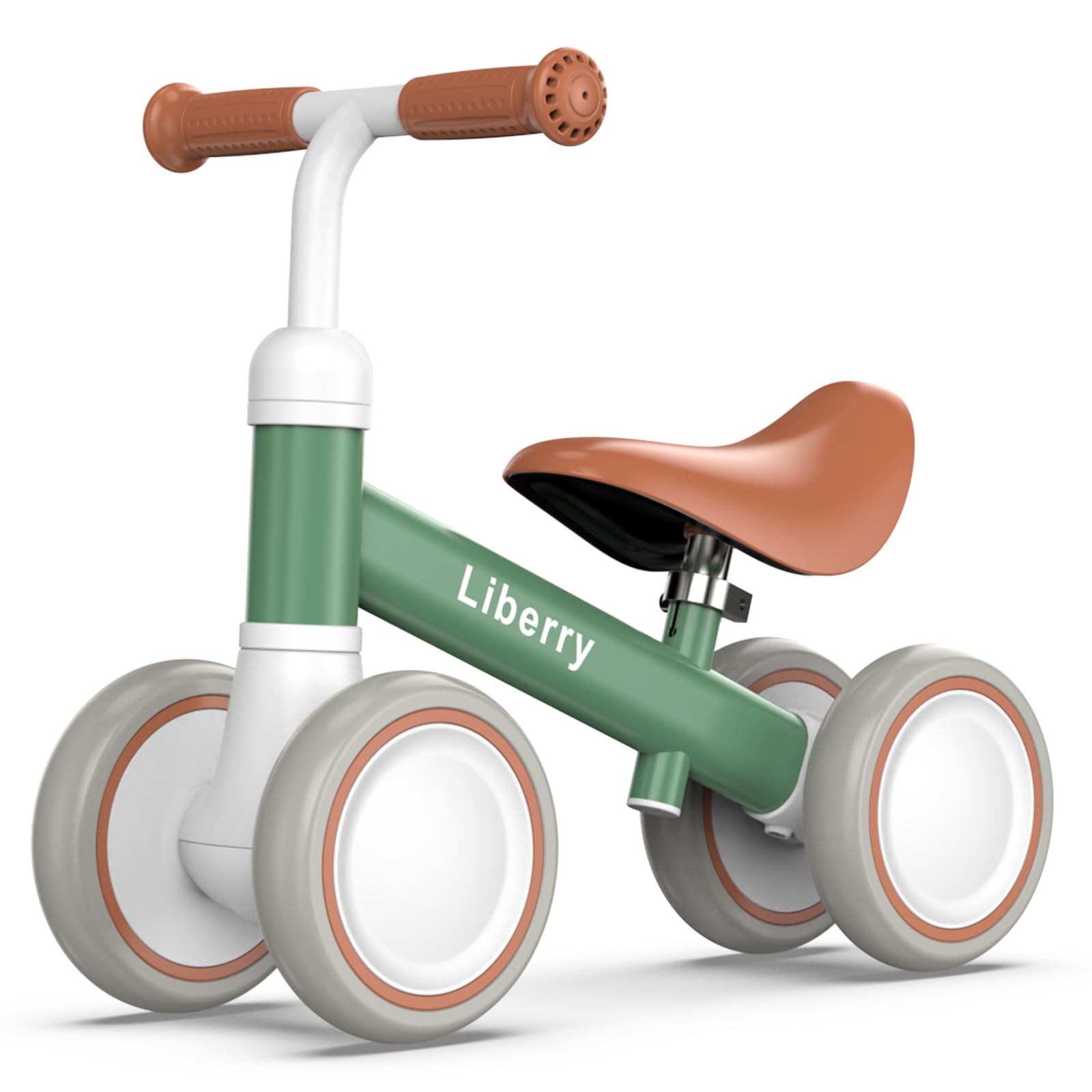
The Liberry Baby Balance Bike is designed around the “four wheels good” philosophy — a four-wheel configuration with two small rear wheels that gives it a stability advantage over any two-wheel balance bike in this price range. The seat adjusts from 9.7 to 11 inches, which is the lowest minimum seat height available across all seven products in this guide. For an 18-month-old with a 9.5-inch inseam, this is the only option that will allow them to stand securely with both feet flat.
At 6.4 pounds, it’s the lightest bike here by a full pound — critical for a small child who is still building the core strength to steer and lift. The EVA tires run silently on hardwood floors, and the four-wheel layout means there’s zero risk of the bike tipping sideways when the child leans even slightly. The maximum weight of 55 pounds leaves plenty of headroom, and the included letter stickers allow personalization that toddlers love.
The ground clearance is lower than the Y Velo or Retrospec, so this bike is best suited to flat surfaces — indoor floors, paved paths, and smooth concrete. It will scrape on grass or gravel. Additionally, the handlebars are not adjustable, which is fine for the intended 12–24 month window but limits growth beyond that. Owners overwhelmingly praise it for the “wobble-free confidence” it gives first-time riders.
Why it’s great
- Lowest minimum seat height (9.7 in.) in the lineup
- Lightest bike at 6.4 lb., ideal for small toddlers
- Four-wheel design eliminates tipping risk
Good to know
- Low ground clearance unsuitable for grass or gravel
- Non-adjustable handlebars limit long-term fit
7. Bobike Toddler Balance Bike

The Bobike is the entry-level choice that doesn’t cut corners on safety. The 135-degree steering limit prevents the front wheel from rotating too far and potentially causing a sideways spill — a feature typically found on bikes at higher price points. The enclosed non-slip wheels are fully covered, so there’s no risk of loose clothing or small fingers getting caught in spokes. The alloy steel frame is ASTM F963-11 and EN71 certified, meeting both US and European toy safety standards.
The adjustable seat covers a range that fits most 18-month-olds through 4-year-olds, and the bike weighs under 7 pounds despite the full steel construction. Assembly is straightforward with the included manual, though a few customers noted that the instructions could be clearer. The 40-pound maximum weight capacity is lower than most competitors — a consideration if your toddler is in the upper weight percentiles.
The biggest strength of the Bobike is the value-for-safety proposition. You get the essential safety features (steering limiter, enclosed wheels, non-slip surfaces) at a price point that undercuts most of the competition. The trade-off comes in the smaller details: the handlebar grips are basic foam rather than rubber, and the paint finish is less chip-resistant than premium options. But for a starter bike that will be outgrown in 12 to 18 months, those compromises are reasonable.
Why it’s great
- 135° steering limiter prevents dangerous over-rotation
- Enclosed wheels protect fingers and clothing
- Lightweight steel frame with dual-safety certification
Good to know
- 40 lb. max weight limit is lower than most alternatives
- Basic foam grips and paint finish feel less premium
FAQ
My 18-month-old just started walking. Is it too early for a balance bike?
Do I need a helmet for indoor riding?
Should I buy a model with training wheels or a standard two-wheel balance bike?
Final Thoughts: The Verdict
For most users, the balance bike for 18 month old winner is the Kinderfeets Tiny Tot Plus because it combines the lowest practical seat height with a convertible 3-to-2 wheel design that extends its usable life well past the toddler years. If you want puncture-proof, maintenance-free wheels and a tough steel frame, grab the Retrospec Cub. And for the most stable, wobble-free start possible, nothing beats the Libberry Baby Balance Bike with its 9.7-inch minimum seat height and lightweight 6.4-pound frame.