
At four years old, the transition from wobbly toddler to confident glider happens fast — but only if the bike fits correctly. A balance bike that’s too small cramps a child’s stride, while one too large forces them to tip-toe rather than plant their feet flat. The wrong choice stalls progress; the right one turns walking into gliding within the first hour. For kids this age, the ideal balance bike sits somewhere between 14 and 16 inches in wheel size, offering a seat height between 14 and 21 inches to accommodate growing legs without sacrificing stability.
I’m Min — the co-founder and writer behind Gadgets Feed. I’ve spent countless hours analyzing the technical specs, materials, and real-world performance of dozens of toddler balance bikes, cross-referencing frame weights, wheel types, adjustability ranges, and customer feedback to separate the genuinely durable models from those that simply look good in photos.
Shopping for a balance bike for 4 year olds means focusing on the seat height range, wheel material, and frame weight — three specs that determine whether your child learns balance in weeks or struggles for months.
How To Choose The Best Balance Bike For 4 Year Olds
A four-year-old’s anatomy requires a bike that keeps both feet flat on the ground while seated, with knees slightly bent during the stride. The three non-negotiable specs are seat height range, wheel material, and overall weight — everything else is secondary for this age group.
Seat Height Is Everything at Age Four
For a typical four-year-old with an inseam of roughly 16 to 20 inches, the minimum seat height must be at or below 14 inches. A bike with a seat starting at 16 inches forces the child onto tiptoes, which defeats the core purpose of learning balance by striding. Look for models offering at least 4 inches of vertical adjustability so the bike grows with your child through age five or six.
Pneumatic vs. Foam Tires — The Outdoor Reality Check
EVA foam tires are puncture-proof, noiseless, and scratch-friendly for indoor use, but they transmit every bump on gravel or grass directly to a child’s spine. Pneumatic rubber tires absorb shock, grip uneven terrain, and provide the smooth roll that builds momentum and confidence outdoors. For a four-year-old who will ride on pavement, grass, and dirt, pneumatic tires justify their slightly higher price through comfort and control.
Frame Weight Determines Who Really Steers the Bike
A balance bike weighing over 10 pounds becomes a parent-toting chore rather than a child-controlled vehicle. A four-year-old needs to lift, turn, and stop the bike independently — a frame under 9 pounds allows genuine autonomous control. Carbon steel offers durability at a weight penalty, while fiber-reinforced composite frames can match steel strength at nearly half the weight.
Quick Comparison
On smaller screens, swipe sideways to see the full table.
| Model | Category | Best For | Key Spec | Amazon |
|---|---|---|---|---|
| Bicystar 14 Inch | Premium | Outdoor grip & comfort | Pneumatic rubber tires, seat 14–21″ | Amazon |
| Ridego 14 Inch | Mid-Range | Ultra-lightweight build | 8.6 lbs fiber composite frame | Amazon |
| OHIIK 2-in-1 | Premium | Long-term convertible use | Balance-to-pedal conversion, hand brake | Amazon |
| Bicystar 14 Inch (Dark Blue) | Premium | Older sibling & growing kids | Seat adjusts 14–21″, handlebar 25–27″ | Amazon |
| KRIDDO Toddler Balance Bike | Budget-Friendly | Personalized customization | Dual-bearing wheels, unicorn plates | Amazon |
| SEREED Toddler Balance Bike | Entry-Level | Budget without sacrificing safety | 11.8–16.5″ seat height, 7.8 lbs | Amazon |
In‑Depth Reviews
1. Bicystar 14 Inch Toddler Balance Bike (Blue)
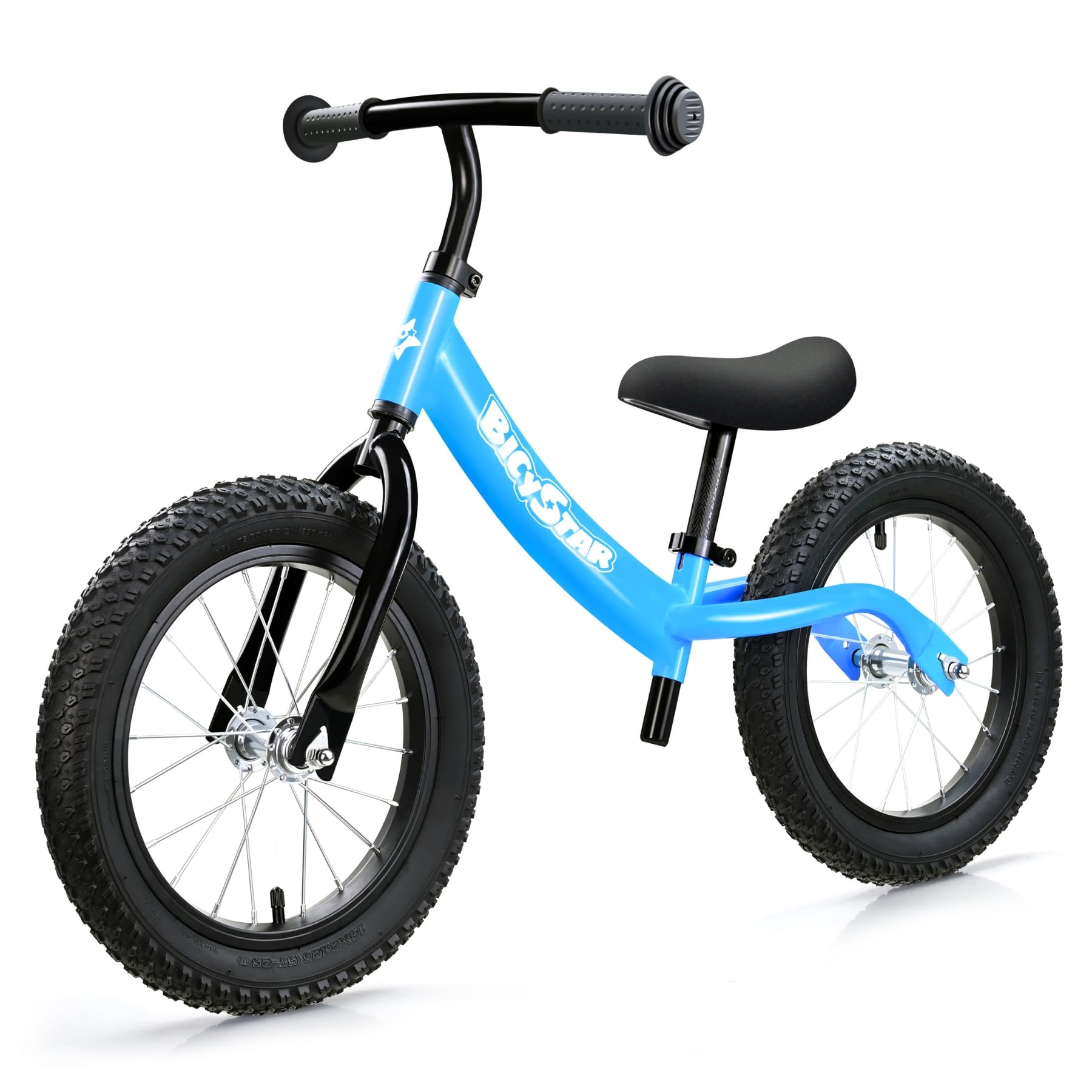
The Bicystar 14 Inch hits the sweet spot for a four-year-old by using real pneumatic rubber tires instead of EVA foam — a choice that directly improves shock absorption on gravel, grass, and cracked pavement. Its carbon steel frame supports up to 110 pounds, yet the bike weighs only 8.5 pounds, letting a four-year-old steer and stop without parent intervention. The seat range of 13 to 21 inches accommodates inseams from 13.5 to 22 inches, meaning a tall four-year-old can use it comfortably now and through age six.
The inclusion of a coasting footrest and padded saddle adds comfort during gliding phases, while the quick-release seat mechanism allows tool-free height adjustments in seconds. Customers consistently note the 10-minute assembly time and the fact that the wide carbon steel frame never felt tippy during aggressive toddler turns. The 8-year frame warranty and 2-year tire warranty back the build quality without demanding a premium price.
For parents who want a bike their child can ride confidently on mixed terrain without outgrowing it within one season, the Bicystar delivers the longest usable inseam range in this price bracket. The glowing reviews from 4-year-old parents specifically mention that their kids learned to glide within the first two days, which is exactly the outcome a balance bike should deliver.
Why it’s great
- Pneumatic rubber tires provide superior outdoor grip and shock absorption compared to foam alternatives.
- Seat height range of 13–21 inches fits four-year-olds now and leaves room to grow through age six.
- At 8.5 pounds, the carbon steel frame is light enough for independent child control.
Good to know
- No footrest is included with this specific model; child coasts with feet up or uses optional footrest.
- The blue colorway is attractive but only one color option is available.
2. Ridego 14 Inch Balance Bike
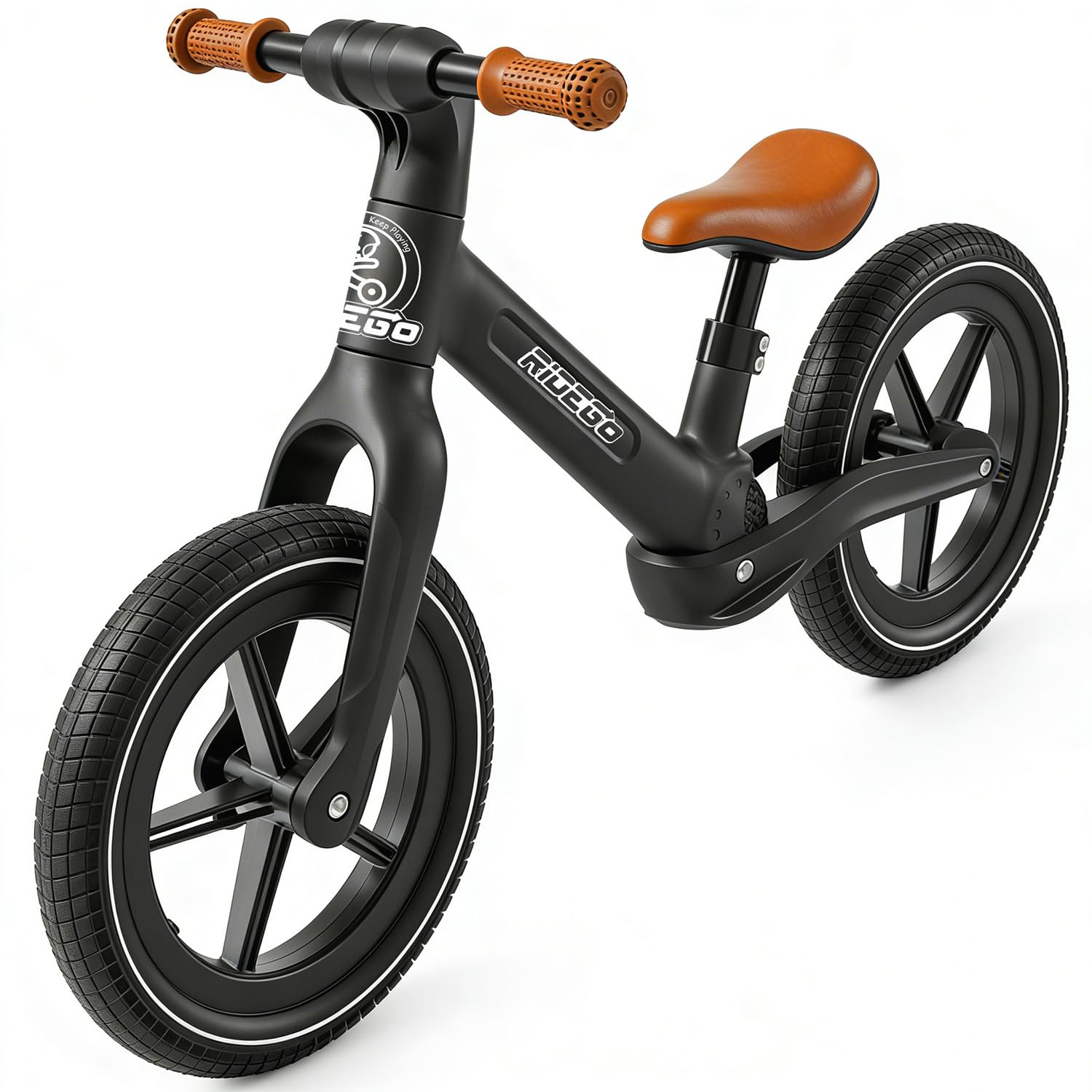
The Ridego 14 Inch distinguishes itself through a glass-reinforced nylon composite frame that weighs just 8.6 pounds — lighter than most steel alternatives while resisting rust and impact damage. This matters at age four because a lighter frame translates directly to easier gliding control, quicker stops, and less frustration when the child needs to lift the bike over a curb. The inflatable rubber tires absorb bumps on grass and gravel, providing a smoother ride than any foam-tire bike can offer at this weight.
The seat adjusts from 14.2 to 18.3 inches, which aligns well with a typical four-year-old’s inseam, though the upper range is slightly shorter than the Bicystar’s 21-inch max. The soft wide saddle keeps children comfortable during longer gliding sessions, and the non-slip rubber grips ensure sweaty hands don’t slide off during sharp turns. Customers point out that assembly is straightforward with the included tool kit, and the bike’s black finish hides dirt well between rides.
Parents of taller four-year-olds should confirm the 18.3-inch max seat height before purchasing, but for average-height kids in this age group, the Ridego offers the best strength-to-weight ratio at a mid-range investment. The five-star reviews consistently highlight how quickly children master gliding, which is the ultimate validation of proper geometry and low inertia.
Why it’s great
- Fiber-reinforced composite frame is rust-proof, impact-resistant, and at 8.6 lbs, easy for a four-year-old to maneuver.
- Inflatable rubber tires deliver excellent traction and shock absorption on uneven outdoor terrain.
- Wide padded saddle keeps longer riding sessions comfortable for developing riders.
Good to know
- Maximum seat height of 18.3 inches may be too short for taller four-year-olds above the 85th percentile in height.
- Only available in black, which limits personalization options for kids who prefer bright colors.
3. OHIIK 2-in-1 Balance Bike

The OHIIK 2-in-1 redefines the balance bike category by offering a convertible system that switches from balance mode to pedal mode in roughly 60 seconds without tools. For the parent of a four-year-old who wants one bike to serve both the gliding phase and the transition to pedaling, this eliminates the need to buy two separate bicycles. The 14-inch wheel size fits ages 3 to 5 years, and the adjustable seat and handlebar accommodate growth without any tools required — a quick-release mechanism makes mid-season adjustments effortless.
The inclusion of a real hand brake (not just a coaster foot brake) teaches children proper braking technique early, which is a genuine safety advantage when they eventually switch to a pedal bike. The 360-degree steering feature allows the handlebar to spin fully, which prevents injury during falls by letting the bar turn rather than jamming into the child’s torso. Training wheels, a kickstand, a pump, and pedal kits are all included in the box, so there are no hidden purchases needed to get the full 2-in-1 experience.
At a higher investment, the OHIIK rewards families who plan to keep the same child on the same bike through both the balance and pedal stages. Customers especially appreciate that tall four-year-olds with a 43-inch height can ride comfortably on the shortest setting while still having room to grow into the pedal configuration. The 360-degree steering is also praised for preventing handlebar-related injuries during the inevitable tumbles that come with learning.
Why it’s great
- Converts from balance bike to pedal bike in roughly 60 seconds, serving two developmental stages in one frame.
- Hand brake teaches proper stopping technique earlier than coaster brake models.
- Comes complete with training wheels, kickstand, pump, and pedal kit — no extra purchases needed.
Good to know
- Pedal mode may feel cramped for kids with long legs due to pedal-to-handlebar spacing.
- Higher sticker investment compared to dedicated balance bikes, though it replaces two purchases.
4. Bicystar 14 Inch Balance Bike (Dark Blue)
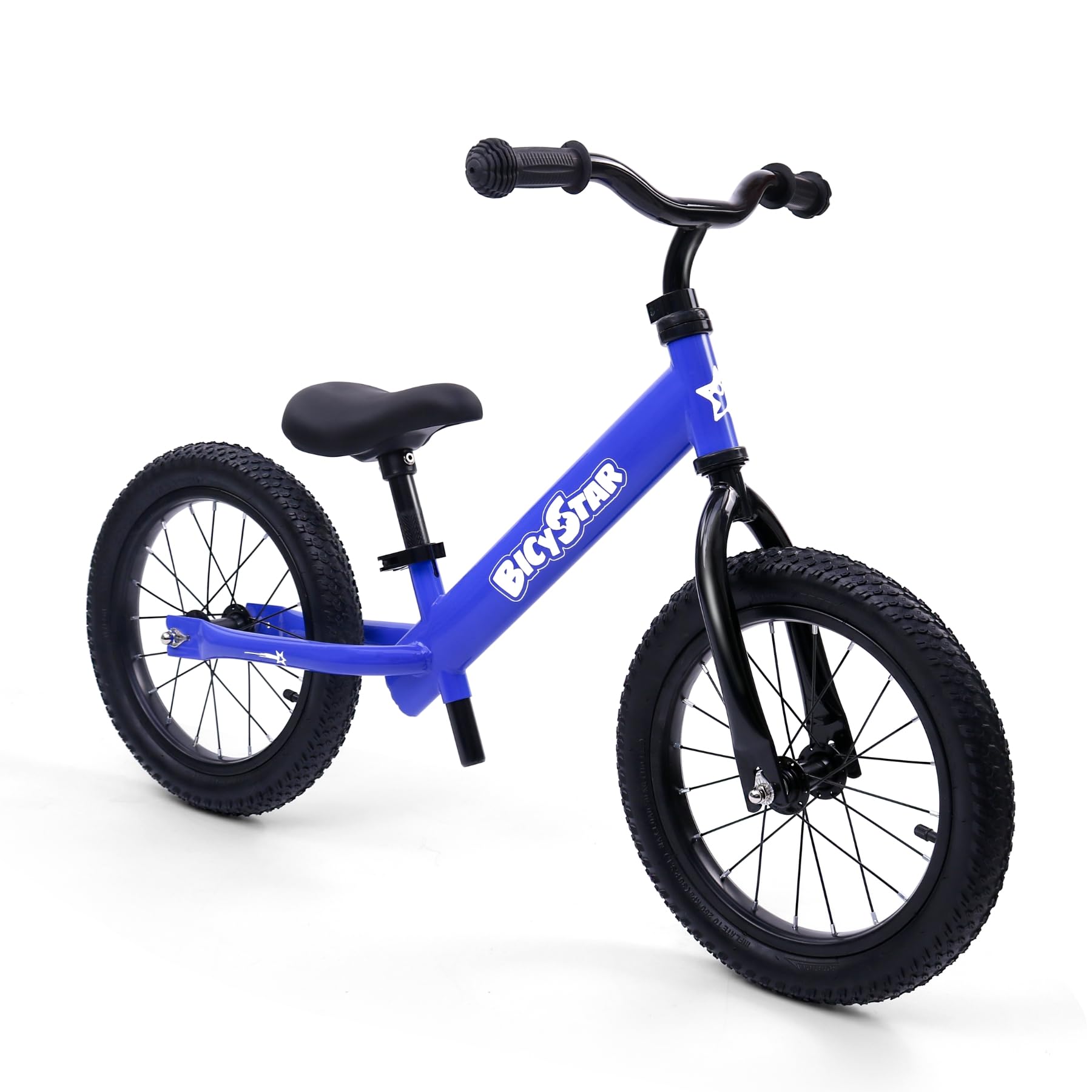
This Dark Blue variant of the Bicystar 14 Inch focuses on older kids within the 3–6 year range, with a handlebar height adjustable from 25 to 27 inches — significantly taller than the 21-inch max on many competitors. This makes it the best fit for a tall four-year-old who has already outgrown standard 12-inch balance bikes but isn’t ready for a 16-inch pedal bike. The pneumatic rubber tires provide the same grip and shock absorption as the blue model, ensuring a smooth ride on pavement and grass alike.
The carbon steel frame carries a 110-pound weight capacity, and the bike tips the scales at 8.5 pounds, which keeps it manageable for a four-year-old to steer independently. The padded seat and soft rubber grips reduce fatigue during longer gliding sessions, and the coasting footrest gives children a place to park their feet once they’ve mastered balance. Customers report that the bike arrives mostly assembled — the handlebar and front wheel are the only parts requiring installation — and the included tool kit makes quick work of setup.
Parents should note that the minimum seat height is 14 inches rather than the 13 inches found on some models, so a smaller four-year-old with an inseam under 14 inches may need to wait a few months. But for kids who already have some leg length, this Dark Blue Bicystar offers the best handlebar height range in its class, allowing the bike to remain comfortable even as the child approaches kindergarten.
Why it’s great
- Handlebar adjusts to 27 inches — the tallest in this comparison, ideal for longer-limbed four-year-olds.
- Pneumatic tires absorb shock effectively on mixed terrain, providing a comfortable ride.
- At 8.5 pounds, the carbon steel frame balances durability with light weight for child control.
Good to know
- Minimum seat height of 14 inches may be too tall for smaller four-year-olds with short inseams.
- Only one color (Dark Blue) is offered in this specific variant.
5. KRIDDO Toddler Balance Bike
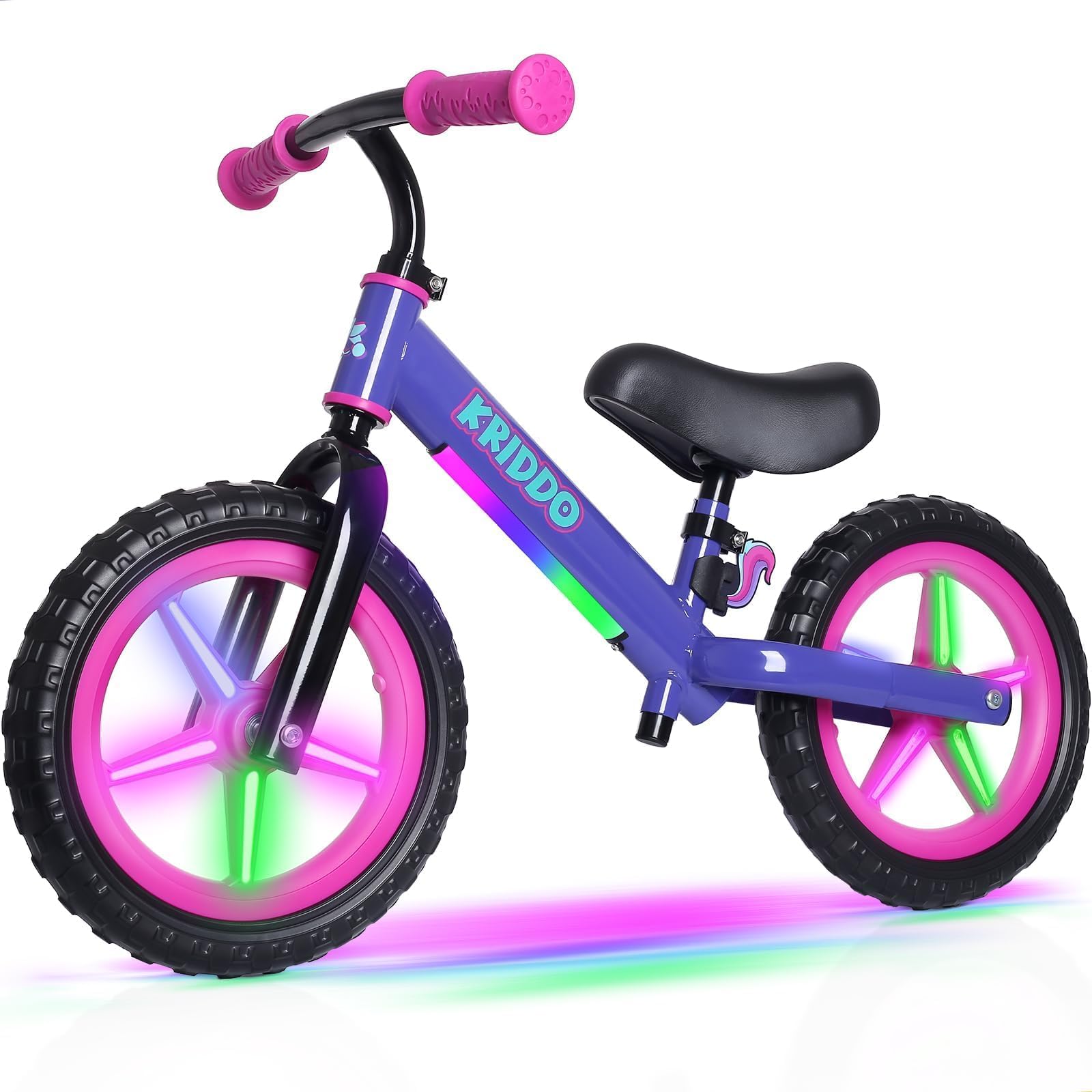
The KRIDDO Toddler Balance Bike leans into personalization with two interchangeable decorative plates — a flower and a unicorn tail — that attach under the seat, letting a four-year-old customize their ride without stickers that peel off. The dual-bearing wheel system reduces rolling resistance, meaning less effort per stride and a longer glide before the child needs to push again. This mechanical efficiency directly benefits younger or less confident riders who tire easily on higher-friction wheels.
The 12-inch puncture-proof EVA tires work on grass, pavement, carpet, and wood floors without scratching indoor surfaces, making the KRIDDO a viable indoor-outdoor hybrid for rainy days when riding moves inside. The seat adjusts from 14.17 to 18.5 inches, and the handlebar from 20.08 to 21.65 inches, which fits a four-year-old well but offers less upward range than the 14-inch models. The carbon steel frame supports up to 110 pounds while keeping the bike lightweight enough for toddler handling.
Where the KRIDDO falls short is tire type — EVA foam lacks the grip and shock absorption of pneumatic rubber on gravel or rough grass, so it’s best suited for smoother surfaces. However, the dual-bearing wheels and cute design plates make it a strong choice for the four-year-old who rides primarily on pavement or indoors and values aesthetics as much as function.
Why it’s great
- Dual-bearing wheels reduce rolling resistance, making gliding easier for younger or less confident riders.
- Interchangeable decorative plates let children personalize their bike without damaging stickers.
- EVA tires are puncture-proof and safe for indoor riding on wood floors without scratching.
Good to know
- EVA foam tires provide less shock absorption and grip than pneumatic rubber tires on rough outdoor terrain.
- 12-inch wheels are one size smaller than the 14-inch models, which may feel small for taller four-year-olds.
6. SEREED Toddler Balance Bike

The SEREED Toddler Balance Bike offers the lowest entry point without sacrificing the core safety features that matter at age four. The carbon steel frame supports up to 110 pounds, and the quick-release mechanism on both the seat and handlebar allows tool-free height adjustments as your child grows. The seat adjusts from 11.8 to 16.5 inches, which is lower than most competitors — ideal for the smaller four-year-old who needs both feet flat on the ground for confidence.
Weighing just 7.8 pounds, the SEREED is the lightest bike in this roundup, making it the easiest for a four-year-old to lift, turn, and carry independently. The EVA foam tires are noiseless and anti-slip on indoor floors, though they lack the shock absorption of pneumatic rubber on outdoor grass or gravel. The included customizable plate and sticker set lets children personalize the front of the bike with their name, adding a sense of ownership that encourages regular riding.
For parents on a tighter budget, the SEREED delivers surprising build quality at its price point — customers specifically mention that the frame feels sturdier than expected and that assembly takes under 15 minutes. The trade-off is that the 11-inch EVA wheels are smaller than the 14-inch pneumatic options, so this bike is best suited for shorter four-year-olds who ride primarily on smooth pavement or indoors rather than rough trails.
Why it’s great
- At 7.8 pounds, it’s the lightest model in the comparison — easiest for a small four-year-old to control.
- Tool-free seat and handlebar adjustment simplifies height changes as the child grows.
- Customizable name plate and stickers add personalization that motivates daily riding.
Good to know
- 11-inch EVA foam wheels are smaller and offer less outdoor grip than 14-inch pneumatic rubber tires.
- Seat height max of 16.5 inches may be outgrown quickly by a taller four-year-old.
FAQ
Should I buy a 12-inch or 14-inch balance bike for my 4 year old?
Is a balance bike with a hand brake necessary for a 4 year old?
Final Thoughts: The Verdict
For most users, the balance bike for 4 year olds winner is the Bicystar 14 Inch Toddler Balance Bike because its pneumatic rubber tires, broad 13–21 inch seat range, and lightweight 8.5-pound frame deliver the best combination of outdoor performance and growth room. If you want an ultra-light bike with a rust-proof composite frame, grab the Ridego 14 Inch Balance Bike. And for a family planning to skip the separate pedal purchase entirely, nothing beats the OHIIK 2-in-1 Balance Bike for long-term versatility.