
Our readers keep the lights on and my morning glass full of iced black tea. As an Amazon Associate, I earn from qualifying purchases.
Specs are compiled from manufacturer listings and verified buyer reviews and can change over time — please confirm the key details on the product page before buying.
A balance bike for a 5-year-old isn’t just a smaller bike without pedals. It is the fastest, most natural way to teach a child the core skill of balancing on two wheels, so that when they do get a pedal bike, your sidewalk is free of tears and skinned knees. At this age, fit is everything — you need a frame that lifts their feet flat to the ground and a seat that adjusts high enough to keep pace with a growth spurt.
I’m Min — the founder and writer behind Gadgets Feed. This guide is built by comparing the manufacturers’ published specifications and the patterns across verified customer reviews, so you get each pick’s real strengths and trade-offs instead of marketing spin.
These seven contenders were chosen because their seat ranges and wheel sizes actually fit the 5-year-old body, not just the label. Here is your straight-to-the-point look at the balance bike for 5 year old that will have your kid scooting with confidence in a single afternoon.
Our Picks at a Glance

How To Choose The Best Balance Bike For 5 Year Old
Once your child hits five, the tiny 12-inch plastic bikes they rode at three are too short. The wrong bike here means bent knees or tiptoeing — both destroy a child’s confidence. Focus on these three points to get the fit right the first time.
Seat Height and Inseam Range
This is the single most important number. For a 5-year-old, the seat should drop low enough that both feet sit flat on the ground — not the balls of the feet, flat. Look for a minimum seat height around 14 inches. A bike that adjusts up to 18 to 22 inches gives you a year or two of growth. If the data shows a range, compare the low end to your child’s inseam measurement (taken from the floor to their crotch in bare feet).
Tire Type: Air Rubber vs. Foam vs. Solid
Air-filled rubber tires (often called pneumatic tires) absorb bumps and grip loose gravel or wet pavement far better than foam or solid rubber. For a 5-year-old who wants to explore the park trail, not just the driveway, air tires make the difference between a smooth glide and a rattled kid. The trade-off is that air tubes can puncture, so check the product’s data for included pumps or spare tubes.
Frame Material and Overall Weight
A 5-year-old needs a bike they can steer, lift, and stop on their own. Carbon steel frames are strong and cheap but heavy — expect 8 to 12 pounds. Magnesium alloy and glass-reinforced nylon shave weight to around 8 to 9 pounds, which makes a real difference when your child has to carry the bike over a curb or through a doorway. You will be carrying it sometimes too, so a lighter frame saves your back on the walk to the park.
Quick Comparison
| Model | Best For | Seat Height Range | Weight | Wheel Size | Amazon |
|---|---|---|---|---|---|
| bicystar 14 Inch (Blue)★ Best Overall | Lightweight starter | 13″–21″ | 8.5 lb | 14 inch | Amazon |
| Birtech 14 Inch (Green)Premium Pick | Quality alloy frame | 17.7″–20.5″ | 8.8 lb | 14 inch | Amazon |
| Ridego 14 Inch (Black) | Nylon frame durability | 14.2″–18.3″ | 8.16 lb | 14 inch | Amazon |
| Bueuwe 16 Inch | Older / taller kids | 17.9″–22.4″ | 6.6 lb | 16 inch | Amazon |
| GASLIKE 16 Inch (Yellow) | Big-kid trail riding | 17.9″–22.4″ | 14 lb | 16 inch | Amazon |
| bicystar 16 Inch (Blue) | BMX-style big kid | 15″–22.6″ | 12.13 lb | 16 inch | Amazon |
| OHIIK 2-in-1 (Pink) | Balance-to-pedal transition | Adjustable (not listed) | — | 16 inch | Amazon |
In‑Depth Reviews
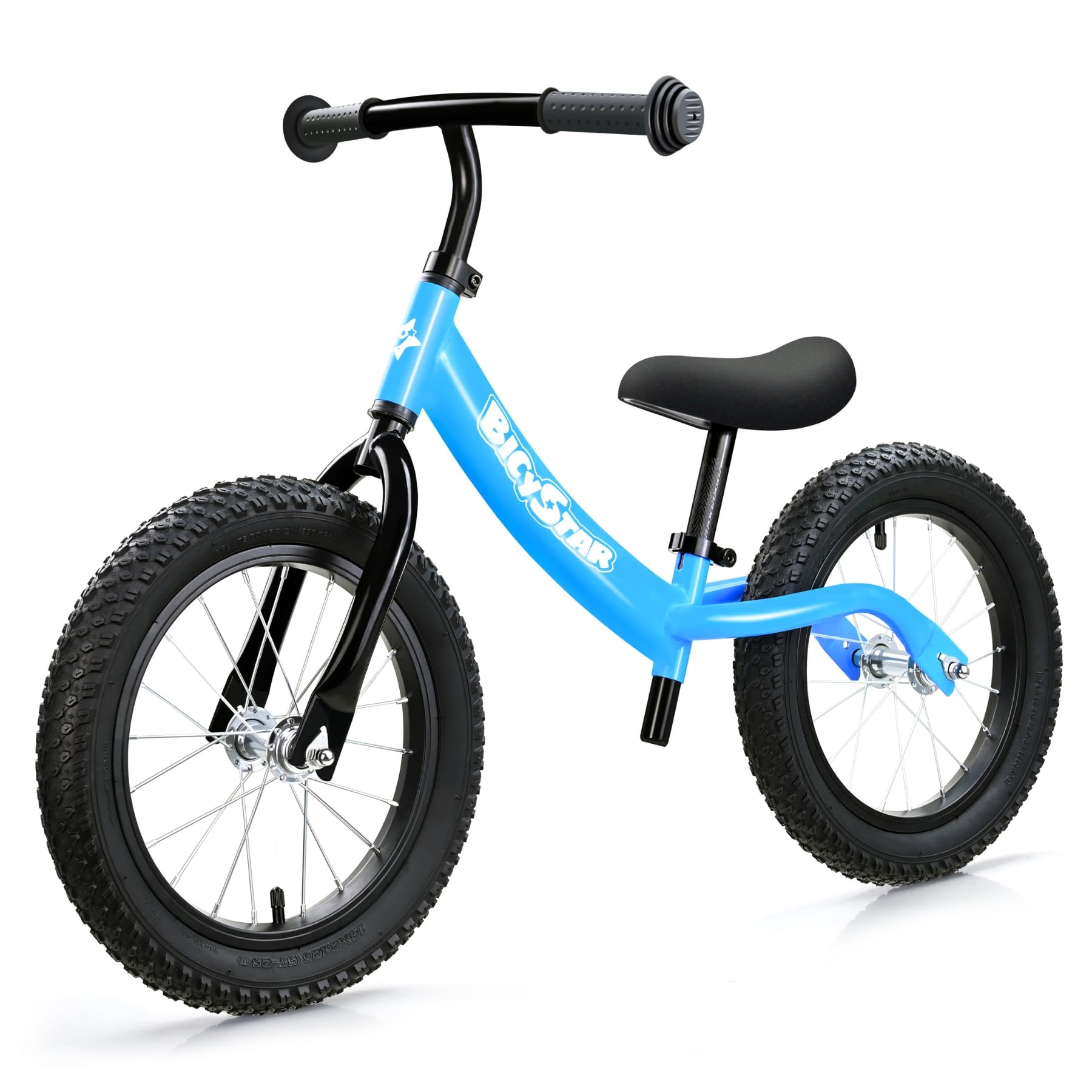
1. bicystar 14 Inch Balance Bike (Blue)
Our pick — over 4.5★ from 350+ verified ratings; the strongest balance of quality and price.
A featherlight 8.5-pounder that gives a 5-year-old instant control.
The defining spec here is the seat range — 13 to 21 inches — which covers a 4-year-old all the way to a tall 6-year-old, so you are not shopping again next year. Real air rubber tires grip gravel and grass without the slippery feel of foam, which matters when your kid wants to ride the park trail, not just the driveway.
The 110-pound weight limit and carbon steel frame mean this bike will survive siblings. Owners note that quality and assembly lead the conversation — buyers report it is comparable to a Stryder but lighter, and the 8-year frame warranty is rare at this tier. The main recurring caveat is the seat durability on first use, so give the clamp an extra check before the first ride.
Why it wins
- Seat range 13″–21″ fits the widest age span
- 8.5 lb is easy for a 5-year-old to lift and steer
- Backed by 8-year frame warranty
One honest gripe
- Several owners mention the seat clamp broke on day one — tighten carefully
Reach for this if: you want the best-reviewed, lightest 14-inch model with a seat range that actually grows with a 5-year-old.
Look elsewhere if: your child is over 51 inches tall or needs a pedal-ready bike right now — this is pure balance training.
2. Birtech 14″ Kids Balance Bike (Green)
A magnesium alloy frame that shaves weight without sacrificing toughness.
At 4 kg (roughly 8.8 lb), this bike is nearly a pound lighter than the Ridego and noticeably lighter than steel-frame competitors — a real difference when your kid is wobbling down a slope. The air tires provide good traction on paved roads and unpaved trails, and the matte finish paint resists chipping after months of use. Quality is the most-praised feature, with 23 mentions from owners.
Adjusting the seat is tool-free via a snap-adjuster — a small convenience that saves you hunting for a wrench. The main trade-off is the tires: a few owners received tubes with holes on arrival, so inflate them fully before the first ride and consider having a spare tube on hand. Buyers call it “affordable, well-made” and especially good for short-legged 6-year-olds.
The standout
- Magnesium alloy frame is light and corrosion-resistant
- Tool-free seat adjustment makes daily changes easy
- Build quality praised by 23 owners
The catch
- Tire tubes can arrive with leaks — inflate and test before your child rides
Snag this if: you want the lightest possible frame at this size and prefer a metal build over composite.
Think twice if: you do not want to deal with inflating air tires — this bike requires it.
3. Ridego 14 Inch Balance Bike (Black)

A glass-reinforced nylon frame that resists corrosion and weighs just 8.16 lb.
The Ridego uses a fiber-reinforced composite frame that is both lighter than the bicystar (8.16 lb vs 8.5 lb) and immune to rust — a real advantage if your bike lives in a damp garage. The seat adjusts from 14.2 to 18.3 inches, which suits a typical 5-year-old (36 inches tall and up) but will not stretch as far into a 7-year-old’s height as some competitors.
The all-terrain air rubber tires have a deep anti-slip tread, so grass and gravel are manageable. Quality is the most-mentioned positive (44 mentions), and owners say the clear assembly instructions get it together quickly. The durability feedback is mixed — some find it sturdy, while a few note the composite material feels plastic-like.
What you gain
- Composite frame won’t rust and stays light at 8.16 lb
- Deep-tread air tires grip grass and gravel well
- 44 owners praise the overall quality
What to know
- Seat range is shorter than the bicystar — less room to grow
- Material feels less premium to some owners than metal alternatives
Best for: parents who want a rust-proof, ultra-light balance bike for paved paths and light off-road use.
Skip if: your child is already over 46 inches tall — the seat maxes out at 18.3 inches.
4. Bueuwe 16 Inch Balance Bike (Black)

A 16-inch wheel bike built for the taller 5-year-old who has outgrown smaller frames.
The seat range (17.9 to 22.4 inches) fits kids from 4 years up to 4.3 feet tall, and the 16-inch pneumatic tires roll smoothly over pavement, grass, and cobblestone.
The high carbon steel frame is rated for up to 45 kg (about 99 lb), so it can handle a sturdy 6-year-old. Build quality is the top praise at 19 mentions, and owners call it perfect for a 6-year-old who has outgrown a smaller bike. The honest downsides: the handlebar tightness draws a few complaints (six owners flag it), and durability feedback is mixed on the wheel bearings. Still, for a tall child, the price-to-fit ratio is generous.
Why it stands out
- Ultra-light at 6.6 lb — easiest for a child to control
- Tall seat range fits kids up to 4.3 feet
- 19 owners praise the build quality
Watch for
- Handlebars may loosen during use — check the clamp regularly
- Some reports of wheel bearing wear over time
Best for: tall or older 5-year-olds (up to 4.3 ft) who need a lightweight 16-inch frame.
Not for: a short 5-year-old with an inseam under 17 inches — the seat does not go low enough.
5. GASLIKE 16 Inch Balance Bike (Yellow)
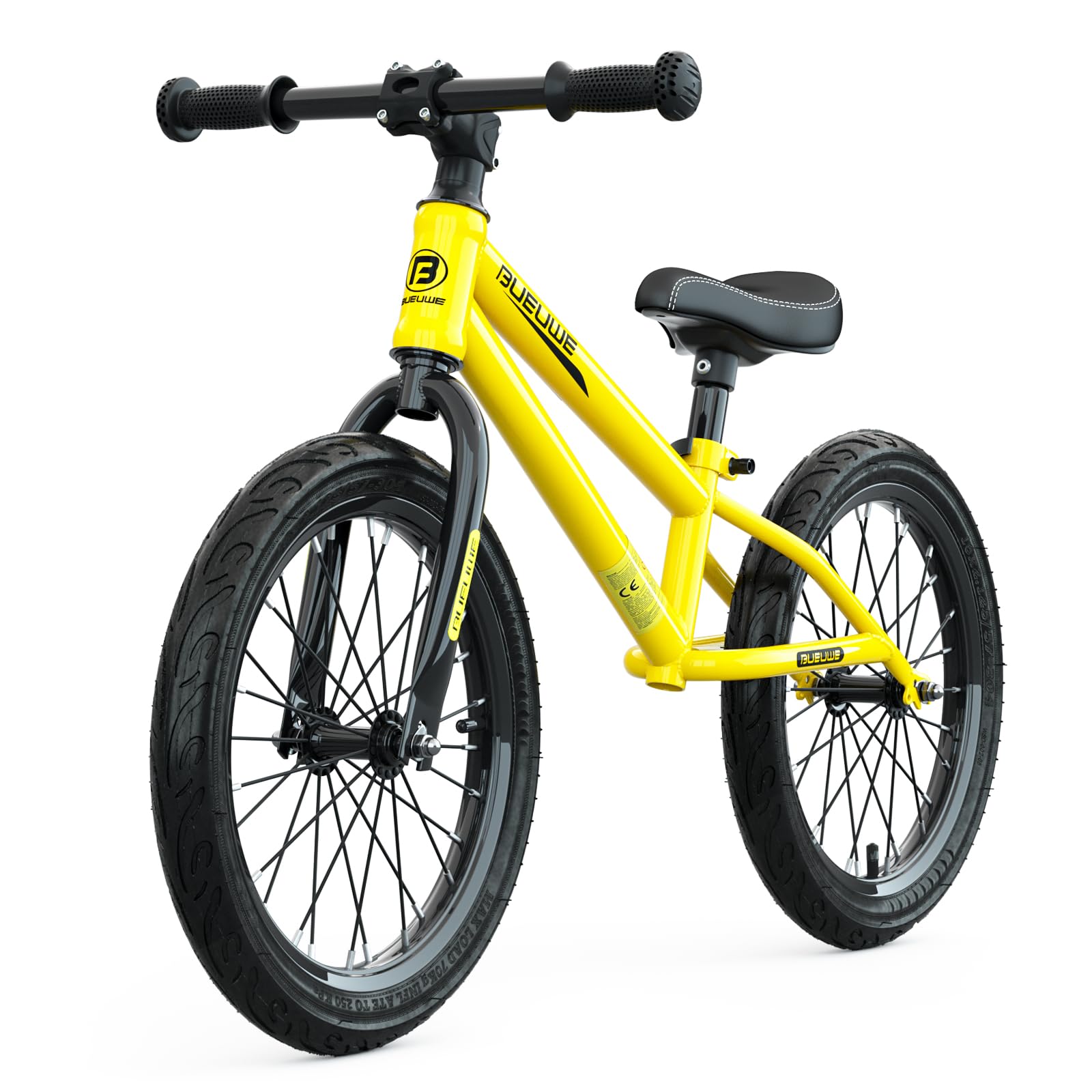
A beefy triangular frame that brings big-kid stability to uneven terrain.
The 16-inch pneumatic tires and triangular carbon steel frame give this bike a planted feel on grass, gravel, and pavement that the lighter 14-inch models cannot match. The seat adjusts from 17.9 to 22.4 inches, and the quick-release clamp lets you change height without tools. At 6.36 kg (about 14 lb), it is the heaviest bike here — but that weight translates to a solid, rattle-free ride.
Quality is the top praise (27 mentions), and owners call it sturdy and comfortable for a 5- to 8-year-old. The tool-free adjustable seat and included pump are thoughtful extras. The biggest gripes are the lack of handlebar height adjustment (the bars do not raise) and occasional tire valve issues — a few owners found the valve hard to access for inflation. It is noticeably heavier than both the Bueuwe and bicystar 16-inch models, so think of it as a trail bike, not a sidewalk cruiser.
Its edge
- Triangular frame feels very stable on bumpy terrain
- Pneumatic tires absorb shocks well for a smooth ride
- 27 owners highlight the overall quality
Its limit
- Handlebars do not adjust in height — can feel cramped for very tall kids
- Heaviest option at 14 lb, less ideal for small 5-year-olds
Best for: an active 5-year-old who will ride on gravel, grass, and bumpy paths rather than smooth pavement.
Not for: a lightweight or small rider who struggles to lift a 14-lb bike.
6. bicystar 16 Inch Balance Bike (Blue)
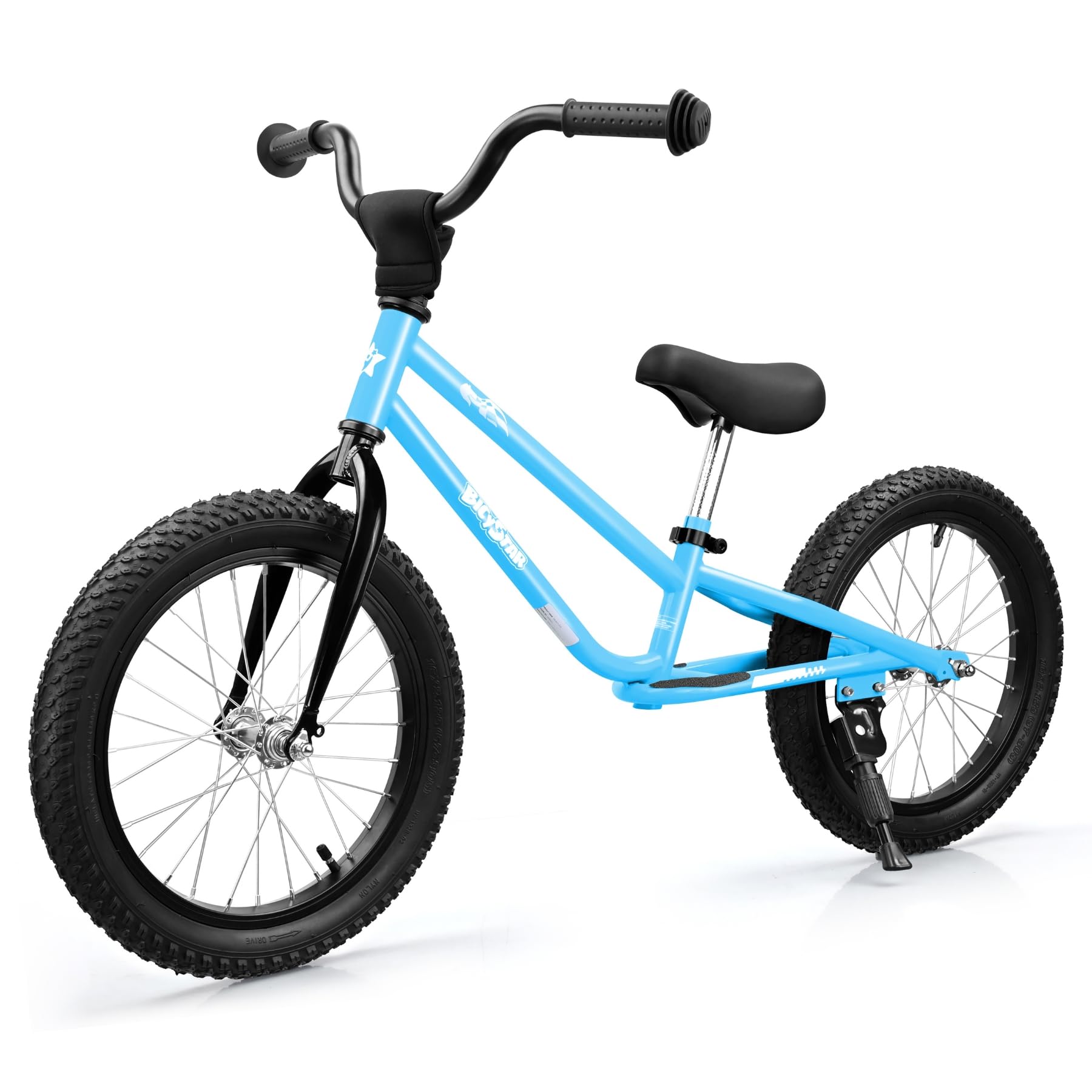
A BMX-styled 16-inch bike that grows from a short 5-year-old to a tall 8-year-old.
The seat range here is the widest in the 16-inch category at 15 to 22.6 inches — that is enough room to fit a 41.5-inch child and still leave space for a 51-inch kid. This beats the taller 17.9-inch minimum of the Bueuwe and GASLIKE by a meaningful margin. The carbon steel frame holds up to 110 lb, and at 12.13 lb it is lighter than the GASLIKE but heavier than the Bueuwe.
Buyers mention “quality” 49 times and “assembly” 30 times, calling it straightforward. The BMX-style air tires (pneumatic rubber tires with a tread pattern) give you real control on sidewalks and trails. One reviewer notes that a child rode this bike for one week and then moved to a normal pedal bike without training wheels. The frame comes with an 8-year warranty. A few customers note the handlebar adjustment is slightly tricky at first.
what separates it
- Widest seat range in 16-inch class: 15″–22.6″
- BMX-style air tires deliver a smooth, controlled ride
- 49 owners call out quality; 30 praise easy assembly
One thing to note
- Handlebar adjustment takes a minute to figure out
Best for: a 5-year-old who still has room to grow — the seat goes low for short kids and high for tall ones.
Not for: parents who prioritize absolute minimum weight — the 12.13 lb frame is solid but not the lightest.
7. OHIIK 2-in-1 Balance Bike (Pink)

A balance bike that converts to a pedal bike when your child is ready for the next step.
This 2-in-1 design ships with pedal kit, training wheels, kickstand, footrest, and pump — everything is in the box. In balance bike mode, your child coasts and brakes with the rear coaster brake. When they master balancing, you bolt on the pedals and training wheels (or skip the training wheels entirely). The 16-inch wheel size fits ages 5 to 8, and the adjustable seat and handlebar require no tools.
Build quality is the most-praised aspect at 48 mentions, and owners call it well-made and sturdy for the transition years. The assembly instructions get mixed feedback — some find them confusing, so watching the assembly video is a smart move. The drum brake is a nice addition that the pure balance bikes lack. A few owners note that the pedal-handlebar spacing can feel cramped for long-legged kids, so check your child’s height against the 36-inch minimum.
The advantage
- Converts from balance to pedal bike with included kit
- Rear coaster brake gives safety the pure balance bikes lack
- Build quality praised by 48 owners
The trade-off
- Assembly instructions can be confusing — watch the video
- Pedal-handlebar distance may be short for tall kids
Reach for this if: you want one bike that starts as a balance trainer and becomes a pedal bike without buying a second model.
skip it if: your child is already 50+ inches or you prefer a dedicated balance bike for simplicity.
Understanding the Specs
Seat Height Range
This is the one number that matters more than the bike’s label age. A 5-year-old needs to sit with both feet flat — not tiptoes. If the minimum seat height is above your child’s inseam, they cannot start safely. Look for a range that starts around 14 inches for a typical 5-year-old and extends to at least 18 inches so you do not replace the bike in a year. The bicystar 14-inch covers 13 to 21 inches, the widest spread in the 14-inch class.
Frame Material & Weight
Carbon steel is heavy and strong — expect 8 to 14 pounds. Magnesium alloy and glass-reinforced nylon shave weight to around 8 to 9 pounds, which makes a real difference when a child lifts the bike over a curb. A lighter bike is easier to steer and stop for a beginner. If you are carrying the bike to the park, the weight matters for your back too. The Bueuwe 16-inch is the lightest here at 6.6 lb, while the GASLIKE is the heaviest at 14 lb.
Air Tires (Pneumatic)
Air-filled rubber tires absorb bumps and provide grip on loose surfaces, making the ride smoother and more stable than foam or solid rubber. The trade-off is that air tubes can puncture, so look for bikes that include a pump (the GASLIKE and OHIIK do) or have easy-to-replace tubes. The bicystar and Ridego both use air rubber tires with deep tread for all-terrain use.
Adjustability & Footrest
A quick-release seat clamp lets you raise the seat as your child grows without tools — a small feature that makes a big difference in daily use. A footrest (also called a coasting platform) gives a place for a child’s feet when they are gliding, which builds confidence. The bicystar 14-inch and the Ridego include a footrest; the GASLIKE does not. The OHIIK 2-in-1 includes both a footrest and training wheels for the pedal phase.
FAQ
What seat height range does a 5-year-old need on a balance bike?
Can a 5-year-old use a 12-inch balance bike?
Are air tires better than foam tires for a 5-year-old?
How much should a balance bike weigh for a 5-year-old?
Is a 2-in-1 balance-to-pedal bike worth it for a 5-year-old?
How long does a child typically use a balance bike?
What is the difference between a 14-inch and a 16-inch balance bike?
Do balance bikes need brakes?
How do I measure my child’s inseam for a balance bike?
Can a heavy child ride a balance bike?
Final Thoughts: The Verdict
For most families, the balance bike for 5 year old winner is the bicystar 14 Inch (Blue) because its 13–21 inch seat range, 8.5 lb weight, and 110 lb capacity cover nearly every 5-year-old body type and leave room to grow. If you need a 16-inch model for a taller rider, grab the bicystar 16 Inch (Blue) — the seat goes from 15 to 22.6 inches, the widest 16-inch range on this list. And for the child who is ready to transition from balancing to pedaling, the OHIIK 2-in-1 includes the pedal kit, training wheels, and brake in one box, saving you a second purchase. Whichever you choose, your 5-year-old will be gliding confidently within a week.
How We Picked
We do not accept paid placement. Every pick is matched to a real buyer and a real use-case; we do not hands-on test units.
Sources & Methodology
Specifications: manufacturer listings and product documentation. Review insights: verified customer reviews, as of July 2026. Pricing: not shown on this page (it changes often); check the current price via the retailer link.
As an Amazon Associate, Gadgets Feed earns from qualifying purchases. This does not affect which products we feature.