
Our readers keep the lights on and my morning glass full of iced black tea. As an Amazon Associate, I earn from qualifying purchases.
Specs are compiled from manufacturer listings and verified buyer reviews and can change over time — please confirm the key details on the product page before buying.
Standing still for hours at a desk is tough on your legs, back, and focus. A balance board turns that static stance into gentle, constant micro-movement that keeps your body engaged and your mind sharp while you type.
I’m Min — the founder and writer behind Gadgets Feed. This guide is built by comparing the manufacturers’ published specifications and the patterns across verified customer reviews, so you get each pick’s real strengths and trade-offs instead of marketing spin.
You want a balance board for standing desk that keeps you comfortable for hours, but you also need to know which one actually fits your work style and budget. This breakdown sorts the wobbly trainers for core work from the subtle rockers for all-day comfort, so you can pick the right one without guesswork.
Our Picks at a Glance

How To Choose The Best Balance Board For Standing Desk
The right board keeps you moving without breaking your concentration. You want just enough instability to engage your muscles, but not so much that you are fighting for balance instead of working.
Pick a Motion Style That Matches Your Focus Needs
Boards generally come in two flavors: rocker boards that tilt front-to-back or side-to-side, and wobble boards that move in a full 360-degree circle. The full-circle motion engages more muscles and burns more energy, but it demands more attention, so it suits shorter, higher-energy sessions. A gentler rocker is easier to use all day long without distracting you from typing or meetings.
Check the Deck Size and Weight Limit
When you stand for hours, a wider deck gives your feet room to shift position naturally, which keeps you comfortable. The weight capacity tells you if the board is built for your body — lighter boards rated around 250 pounds are fine for many users, while sturdier models support up to 400 or 450 pounds for heavier or more active use.
Quick Comparison
| Model | Best For | Motion Type | Max Weight | Deck Size | Amazon |
|---|---|---|---|---|---|
| Whirly Board Wide 360°★ Best Overall | Intense full-body desk workouts | 360° Spin | 400 lb | 28″L x 10″W | Amazon |
| StrongTek WoodenBest Value | Budget-friendly PT & stability | 360° Wobble | 350 lb | 17.5″L x 13.5″W | Amazon |
| PROIRON WobblePortable Pick | Portable grip & handle workouts | 360° Wobble | 330.7 lb | 16.34″ dia | Amazon |
| Yes4All Wobble Board | Soft, gentle all-day standing | 360° Wobble | 180 kg | 20″L x 13.9″W | Amazon |
| Gaiam Evolve | Subtle rocking for focus | Rocker | 250 lb | 27″L x 12″W | Amazon |
| Sportneer 7-Mode | Versatile multi-challenge training | 360° + Roller | 450 lb | 30.09″L x 11.8″W | Amazon |
| GoBalance App Board | Fun, gamified family workouts | 360° (Smart) | 450 lb | 18.1″L x 14.2″W | Amazon |
| UPLIFT Motion-X | Premium bamboo all-day desk use | 360° Wobble | 250 lb | 27″L x 12.5″W | Amazon |
| FluidStance Plane | Sustainable USA-made desk rocking | 360° Rocker | 250 lb | 24″L x 12″W | Amazon |
In‑Depth Reviews
1. Whirly Board Wide 360°
Our pick — over 4.5★ from 350+ verified ratings; the strongest balance of quality and price.
The full-spin maple deck that turns desk hours into a core workout
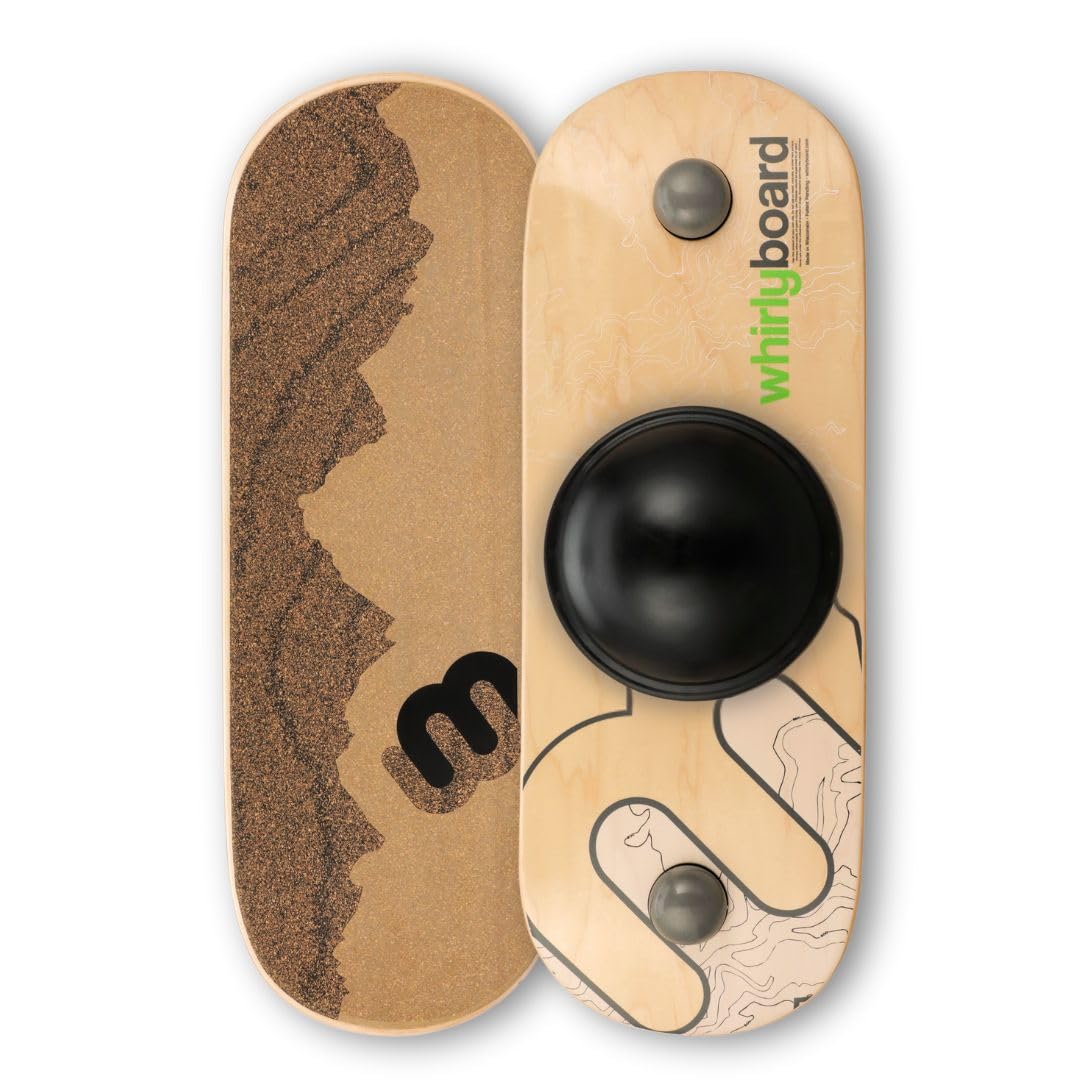
If you want your balance board to pull double duty as serious exercise equipment, the Whirly Board is the one. Its defining trick is the 360-degree spinning motion created by three semi-spherical balance points, which lets you spin, rock, tilt, and bounce instead of just tipping forward and back like a basic rocker.
The 28″L x 10″W Canadian maple deck is built from premium 8-ply wood — the same stuff pro skateboards use — so it handles intense daily use without flexing out. It supports up to 400 pounds, which beats the StrongTek’s 350-pound limit, and the natural cork grip tape gives you solid traction for barefoot or socked standing. Buyers report it “reduces fatigue at standing desk; improves posture; no typing impact” — the motion stays mostly in your lower body, so your typing stays accurate.
The honest trade-off is the learning curve. This is an advanced trainer — the review pages are clear that beginners should start with feet close together and hold a desk for support, and it should never go on slippery floors without a mat. It is not a low-maintenance mat; it is an active workout that happens to live under your desk.
wide stance stability
- The thing everyone raves about is build quality — owners consistently call the solid maple construction out as top-tier
- Genuinely dynamic 360° spin motion engages more muscles than tilt-only boards
- Handcrafted in Northern Wisconsin with a lifetime replacement guarantee
bulky footprint
- Steep learning curve — most buyers needed support or the optional stabilizing ring at first
- Not safe on bare wood, tile, or cement without a separate mat
wide-base pick: the desk worker who wants a real core and balance workout built into the workday, not just a fatigue mat.
space hog: it is demanding — expect a few days of wobbly adjustment before the 360° motion feels natural.
2. StrongTek Wooden Balance Board
The smart middle step between a beginner rocker and a hard wobble
The StrongTek earns its spot for people who want more challenge than a basic rocker but less intimidation than a round-base board. Its cross-style base gives you 360-degree directional wobble (tilting in every direction) while keeping a larger floor contact area, so the motion feels controlled and approachable rather than chaotic.
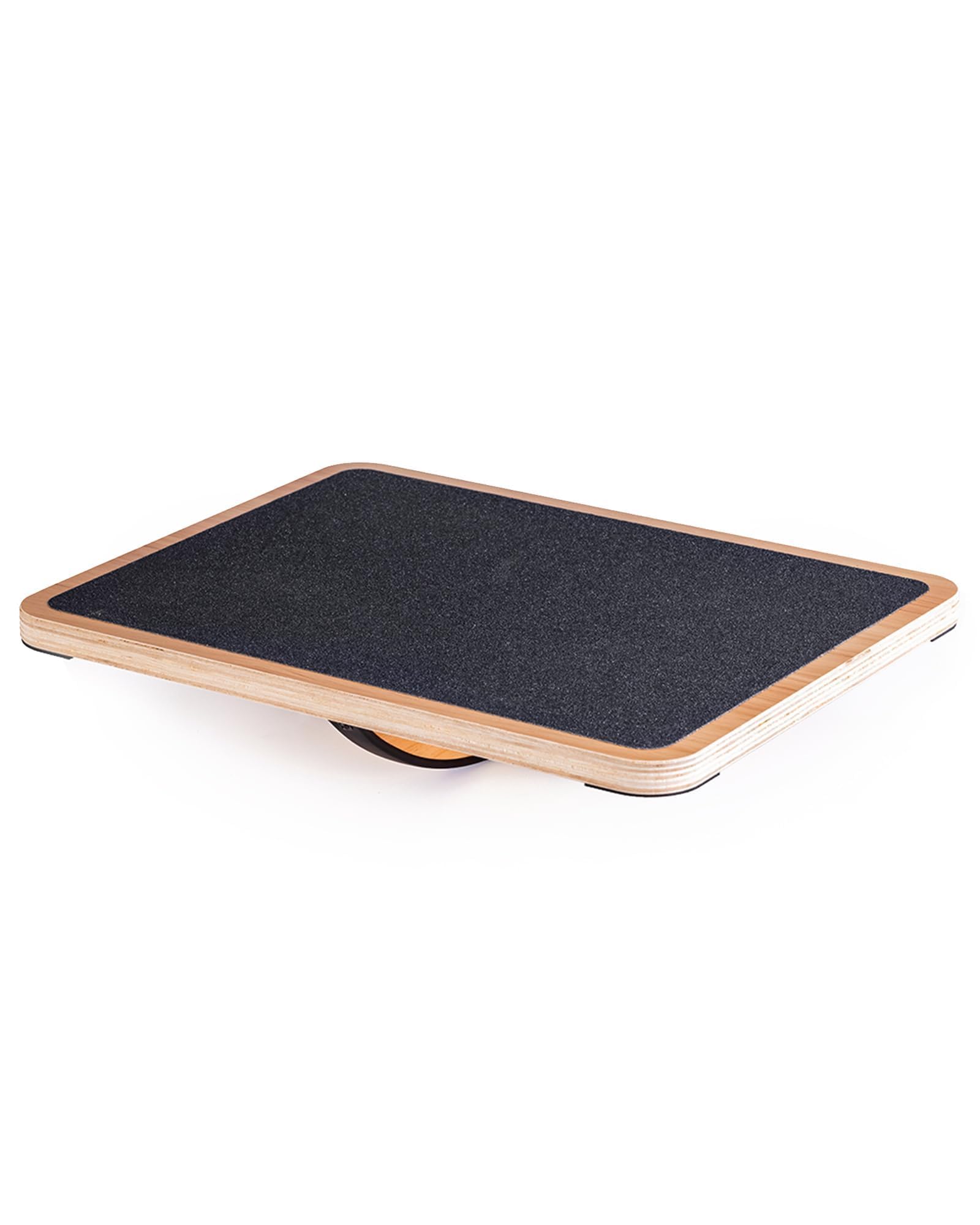
At 17.5″L x 13.5″W x 3″H, it is noticeably more compact than the Whirly Board’s 28-inch deck — a 60% size gap — which makes it easier to tuck away or slide under a desk. The textured top keeps your feet planted as you shift weight, and the sturdy lauan hardwood plywood platform supports up to 350 pounds. Owners mention it is a “sturdy, well-made balance board for post-knee-surgery PT and hiking” training, and many use it for calf stretches and standing desk mobilization.
The recurring gripe is the bottom corner protectors — the sticky backing on those pads comes loose over time, which is minor but worth knowing. Everything else about the build earns consistent praise, and it stores neatly on its side when the workday ends.
solid wood feel: this is the board for the person who wants one tool that scales from ankle rehab to daily desk wobbling without ever feeling out of control. The 350-pound capacity and compact footprint make it a genuinely versatile pick.
plain design: the corner pad adhesive is the weak link — treat it gently and it is a non-issue.
3. PROIRON Wobble Balance Board
The lightweight board with handles that open up push-ups and twists
The PROIRON stands out for its built-in dual handles, which most boards simply do not have. Those handles do double duty — they make the 16.34-inch board easy to carry between rooms, and they open up grip-based exercises like push-ups and Russian twists that turn your balance trainer into a fuller home gym tool.
The spherical bottom allows 360-degree rotation with a 0-22 degree tilt angle, so you can dial in difficulty as you improve. A 12-screw connection firmly links the top and base, supporting up to 330.7 pounds, and the TPE base grips the floor and protects it from scratches. The bump-textured top provides traction while offering a mild foot massage as you stand.
Owners in their 60s and 70s specifically praise it for rebuilding ankle strength and balance — one 65-year-old buyer uses it daily for healthy aging, and a 71-year-old gets on it every day. The catch is that the surface can feel a bit slippery for some, so socks are not recommended; bare feet or shoes give the best grip. It is light and easy to transport, which makes it a strong travel companion.
value pick: you want a portable board that doubles as an upper-body exercise prop, and you are rebuilding balance after a layoff.
premium feel: you plan to stand on it in socks — the top needs bare feet or shoes for secure footing.
4. Yes4All Wobble Balance Board
The cushioned foam deck that stays comfy for hours-long standing
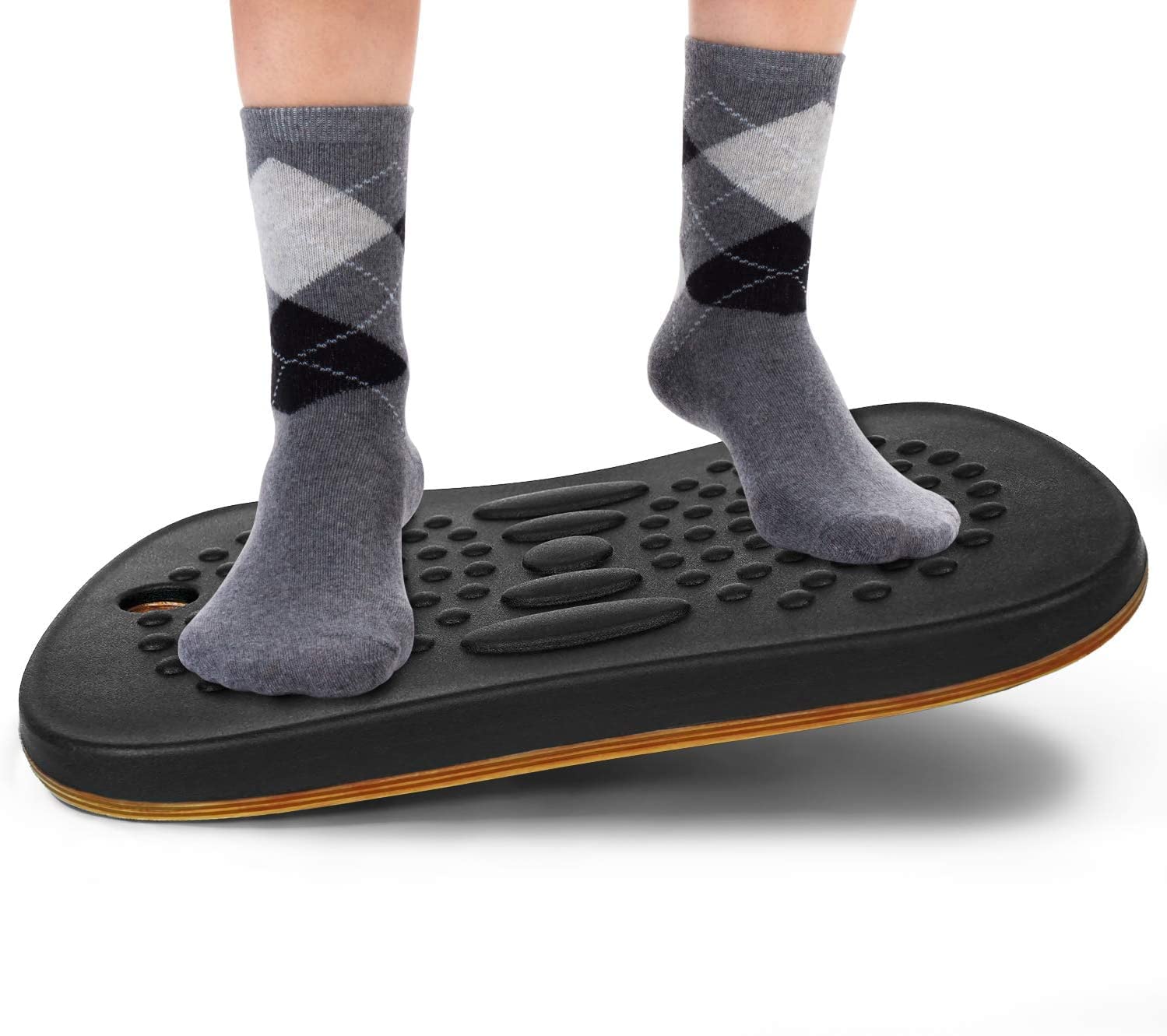
Most balance boards are hard wood or plastic under your feet, which gets uncomfortable fast. The Yes4All is different — its top is a soft, durable closed-cell EVA foam that provides cushioning while you work. The 20″L x 13.9″W surface is roomy enough for natural stance shifts, and the textured top adds grip even during sweaty workouts.
What wins people over here is stability. Buyers describe it as “stable enough to stand on for hours” with a gentle wobble that keeps you moving without demanding constant focus. It is easy to step on and off, comfortable in socks, and grips carpet well, which makes it one of the least intimidating boards for all-day desk use. It supports up to 180 kg, covering most body weights with room to spare.
The trade-off is that some experienced users find it almost too easy to balance — one owner called it a “wobbly anti-fatigue mat” and moved on to a more challenging trainer. If your goal is gentle, fatigue-reducing movement rather than a hard core workout, that softness is exactly the point. For seniors or anyone wanting something easy on the joints, this is the more forgiving option.
compact size: the deck reads slightly narrow to some feet, with edges hanging off for larger shoe sizes — check the 20-inch length against your stance.
limited tilt: if comfort beats challenge for you, this cushioned board is the one to grab.
5. Gaiam Evolve Balance Board
The long stable rocker built for subtle, focus-friendly movement
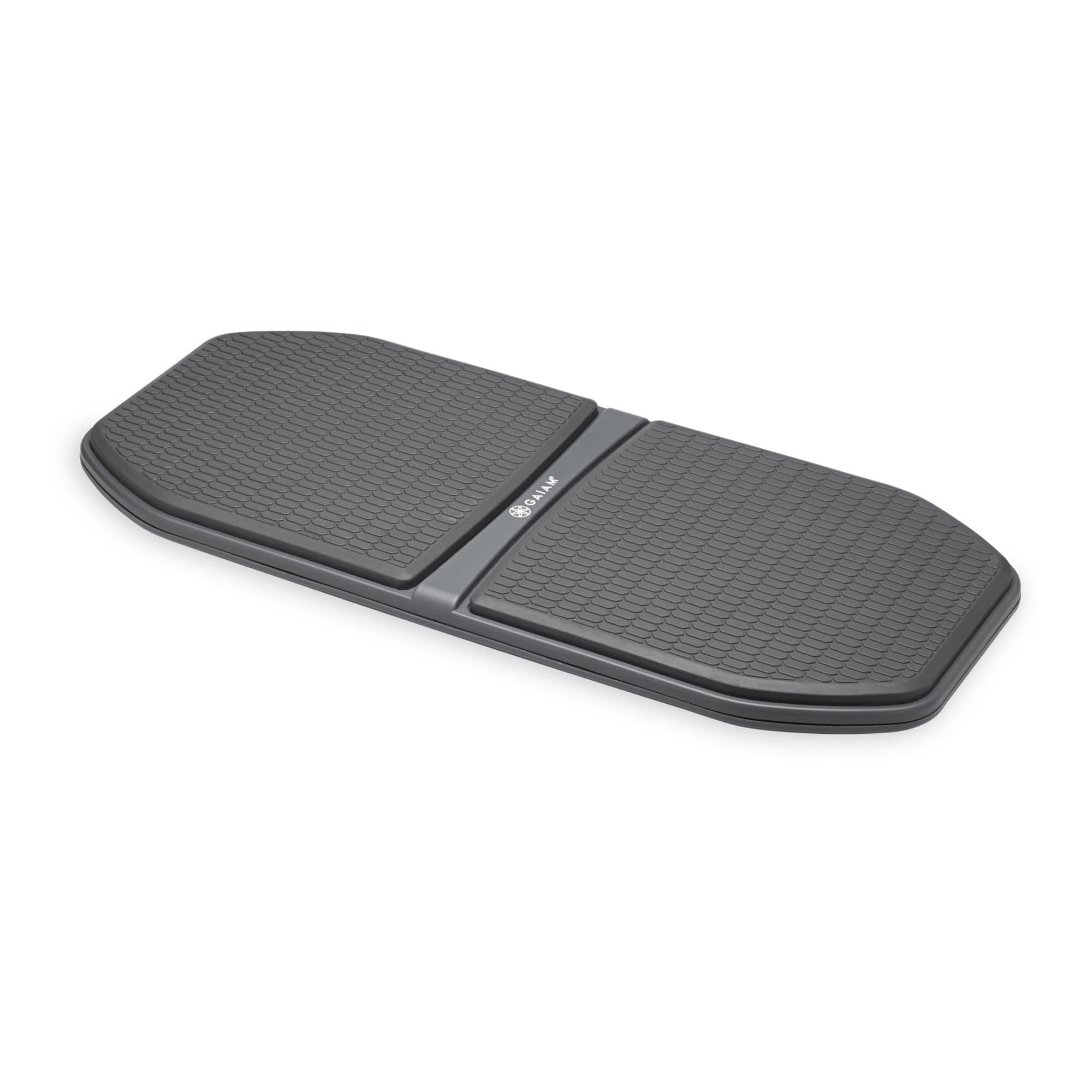
The Gaiam Evolve is engineered for the person who wants movement without distraction. Its fluid rocking motion — forward/back or side-to-side — creates low-impact movement that engages stabilizing muscles in the back, core, legs, and ankles, all while keeping your mind on your work. The 27″L x 12″W platform is one of the longer decks here, giving you room to shift your stance freely.
The honeycomb non-slip texture secures your feet on both hard floors and carpet, and the ergonomic design promotes neutral ankle positioning. It supports up to 250 pounds. Customers note it lets them stand for 4-5 hours at a stretch, prevents knee locking, and even doubles as a footrest when you sit. For sales associates, clerks, or anyone on their feet all day, the gentle motion keeps energy up without breaking focus.
The durability feedback is the one thing to weigh here. The most-cited complaint is the top cushion peeling near the center after a few months of heavy use, and a few reviewers point out a creaking noise developing over time. It is lightweight and easy to balance on, but it is not built to survive aggressive workouts — it is a desk companion, not a gym tool.
eco choice: the focused stander who wants subtle motion and a wide stable deck for all-day comfort.
tight budget: the soft top can peel under heavy daily use — treat it as a desk accessory, not an intense trainer.
6. Sportneer 7-Mode Balance Board

A 7-in-1 trainer that grows with you from wobbly beginner to expert
The Sportneer is the Swiss Army knife of this list. It ships with a roller and a 2.8-inch ball, plus four magnetic removable stoppers, letting you switch between 7 distinct challenge modes without any tools. You can start easy and progress to advanced by simply reconfiguring the pieces — which is why owners call it endlessly versatile.
Built from birch wood with a sturdy 450-pound weight capacity, it is the strongest board here alongside the GoBalance. The textured non-slip EVA surface (a soft, grippy foam) grips well whether you are in shoes or barefoot, and the padded top feels like a paddle-board underfoot. The 30.09″L x 11.8″W deck is long enough for a natural stance, yet narrower than the big 360 boards, which owners say makes it easier to store.
It is genuinely fun — families report it getting heavy use from kids burning off indoor energy, and adults use it as a surf or snowboard trainer. The main durability concern is the half-circle rails, which some find hard to remove without a bit of effort. But the quiet foam top and the huge range of difficulty levels make it the pick for a household of different skill levels.
seven modes
- 7 tool-free difficulty modes — from beginner wobble to advanced roller challenges
- Quiet, cushioned EVA top that is comfortable barefoot or in socks
- Magnetic snap-in fences stay secure yet reconfigure in seconds
learning curve
- Half-circle rails lack indentions, making them a bit stubborn to remove
- Some shoppers say breakage on arrival, so inspect the pieces early
versatile: you want one board the whole family can share, from kids to athletes, with adjustable difficulty.
simple user: you need a dead-simple single-mode board — the modular pieces add a little setup fuss.
7. GoBalance App-Enabled Board

The smart board that turns balance training into a video game
The GoBalance is the only board here with a brain. A built-in Bluetooth sensor connects to a free app on your iOS or Android phone, delivering real-time feedback as you move. It ships with 12 free interactive games and 4 sports training modes, which turns a solo wobble session into something that actually feels like play. You can even connect up to 4 boards to one app for multiplayer family challenges.
The 18.1″L x 14.2″W deck is wide and tune for plank exercises, crafted from sturdy wood with a removable TPE soft yoga mat on top. It supports up to 450 pounds, so it is built for teens and adults alike. Buyers report it is excellent for kids building leg and ankle strength, with the real-time feedback boosting confidence — and the game quality earns comparisons to classic console gaming.
The app is where opinions split. Some buyers hit connection issues that needed re-pairing, and a few note the app freezes. The grip pad is not tacky enough for socks — it works best on carpet or with shoes. And while 12 games are free, some workout programs require payment, which caught a few owners off guard. If you want a board that rewards movement with actual play, this is a unique option; if you just want to stand and rock, the app adds complexity you may not need.
data lover: families or gamers who want exercise disguised as entertainment, and kids who need motivation to train.
analog fan: the app experience is hit-or-miss — expect occasional Bluetooth re-pairs and paid workout upgrades.
8. UPLIFT Desk Motion-X
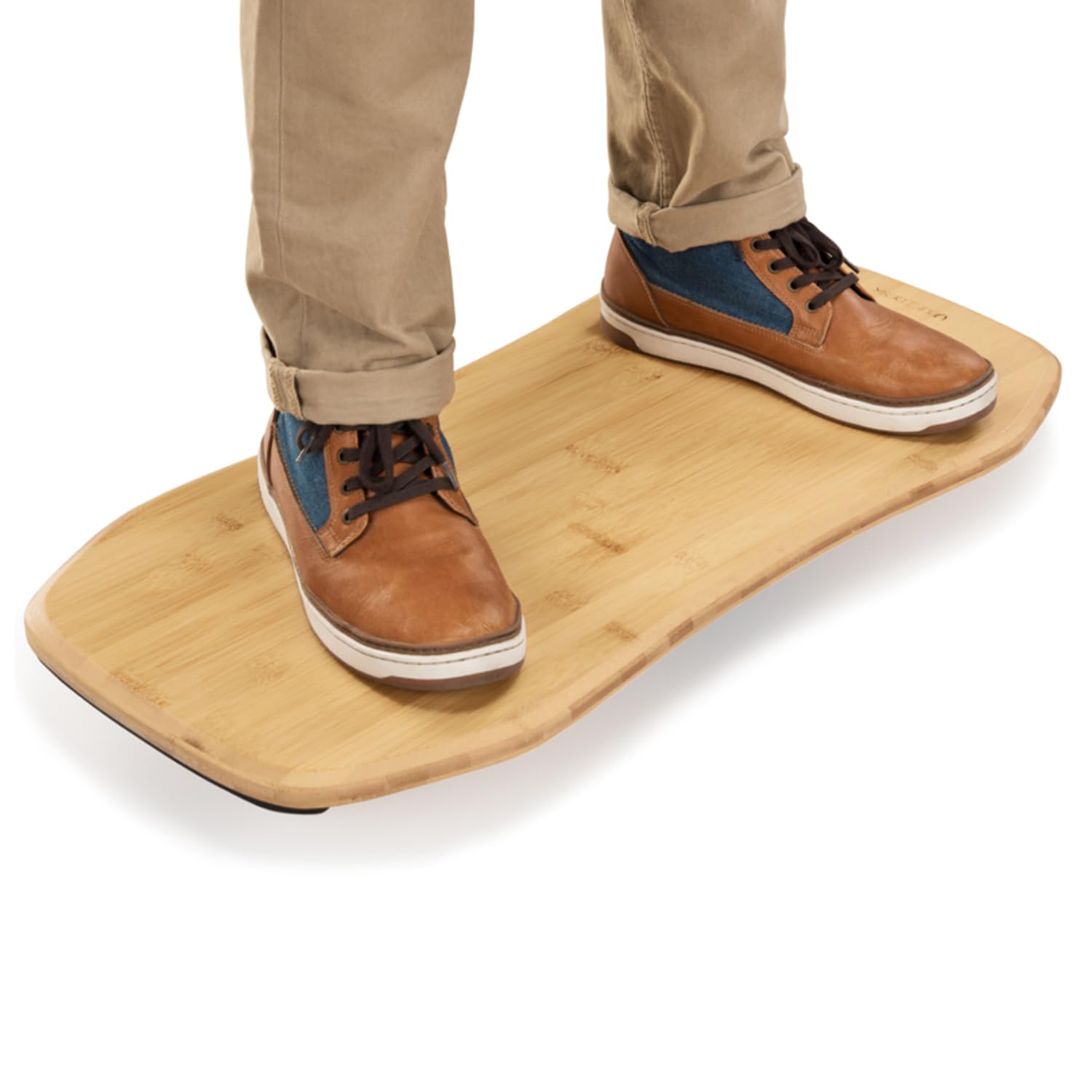
The hand-finished bamboo deck built for serious desk longevity
The UPLIFT Motion-X is the premium pick for the standing-desk purist. It is crafted from thick, sustainably-sourced bamboo with a smooth hand-finished surface, and that ⅝-inch thick deck delivers a durability that cheaper boards can not match. The molded base and floor-friendly grips keep motion controlled while protecting your flooring.
The 27″L x 12.5″W deck gives you a wide, stable surface that supports natural standing balance while still allowing freedom to move. It rocks, tilts, and swivels in fluid multidirectional motion to encourage circulation and reduce lower-body stiffness. It supports up to 250 pounds, and it is backed by the UPLIFT Desk 15-year coverage — a warranty that tells you the maker expects it to last.
Owners mention it is “immediately” comfortable — one owner went from 30 minutes of standing to hours a day with minimal discomfort, and another calls it fun without being distracting to work. The one wish from owners is that it were slightly more challenging; this is a controlled, work-friendly wobble, not an intense trainer. If you want premium materials and a board that will outlive your current desk setup, this is it.
desk integration: the bamboo build quality and 15-year warranty make this the most confident long-term buy on the list.
pricey add-on: the gentle motion may feel too easy for seasoned wobble users — it prioritizes all-day comfort over challenge.
9. FluidStance Plane

The recycled-material rocker that is hand-assembled in California
The FluidStance Plane is for the buyer who cares where their gear comes from. Its top deck is made from 100% recycled low-emitting tire treads and the base from recycled plastic, and the company donates 1% of earnings to charity. Every board is hand-assembled in the brand’s own California warehouse — a level of craftsmanship you feel underfoot.
At 24″L x 12″W x 2.5″H and 5 pounds, it is compact and light enough to carry from work to home. The rubber bumpers provide natural stopping points so the motion stays controlled, and customers note it works on both tile and carpet. The movement stays mostly from the hips down, which means accurate typing is not impacted — a key detail for desk users. It supports up to 250 pounds.
Owners call it the “perfect desk balance board after trying 3 others,” praising the ideal movement range that is neither too stable nor too wobbly. The maker claims it can increase caloric burn by up to 19.2% and improve heart rate by up to 15% versus sitting. The occasional unit arrives with rough plastic edges on the bottom that can scratch flooring, though that is fixable with sandpaper. It is a tool for gentle all-day movement, not intense exercise.
style icon: sustainability and USA-made craftsmanship matter as much as the wobble, and you want a board for steady desk rocking.
comfort first: you want an intense core workout — this is built for subtle movement, and its 250-pound limit suits lighter users.
Understanding the Specs
360° Wobble vs. Rocker Motion
The biggest spec to understand is how the board moves. A rocker board tilts along one axis — forward/back or side-to-side — which is gentler and easier to use while focusing on work. A 360° wobble board, using a round or semi-spherical base, tilts in every direction, engaging more muscles and burning more energy, but demanding more attention. Choose based on if you want all-day comfort or a real workout.
Deck Width and Weight Capacity
Deck width determines how comfortably your feet sit. A wider deck like 27 inches or 28 inches lets you shift your stance naturally, which matters during long standing sessions. Weight capacity tells you the board’s structural limit — boards range from 250 pounds on lighter models up to 450 pounds on the sturdiest trainers. Match the capacity to your body weight with some margin for active movement.
FAQ
Will a balance board fit under my standing desk?
Is a 360-degree wobble board harder than a rocker board?
How much weight can a standing desk balance board hold?
Can I use a balance board for physical therapy or ankle rehab?
Will using a wobble board affect my typing or mouse work?
Are balance boards safe to use on carpet?
How long does it take to get used to a balance board?
What is the difference between a wobble board and a balance board?
Can kids use these standing desk balance boards?
Do balance boards damage hardwood floors?
Final Thoughts: The Verdict
For most people, the balance board for standing desk winner is the Whirly Board because it delivers the most complete workout — a 360° spin motion, premium 8-ply maple build, and a 400-pound capacity that beats most rivals. If you want the best value with a gentler learning curve, grab the StrongTek. And for a family-friendly option that scales difficulty and keeps everyone engaged, the Sportneer is the one to reach for.
How We Picked
We do not accept paid placement. Every pick is matched to a real buyer and a real use-case; we do not hands-on test units.
Sources & Methodology
Specifications: manufacturer listings and product documentation. Review insights: verified customer reviews, as of August 2026. Pricing: not shown on this page (it changes often); check the current price via the retailer link.
As an Amazon Associate, Gadgets Feed earns from qualifying purchases. This does not affect which products we feature.