
Our readers keep the lights on and my morning glass full of iced black tea. As an Amazon Associate, I earn from qualifying purchases.
Specs are compiled from manufacturer listings and verified buyer reviews and can change over time — please confirm the key details on the product page before buying.
You plug in a microphone or speaker, and a persistent hum, buzz, or radio interference comes through your monitors. That noise is not your gear — it is the cable failing to reject the electrical trash floating around your room. A balanced speaker cable uses a three-pin XLR (a connector with three pins — ground, positive, and negative) and a clever phase-cancellation trick to send your signal clean and quiet, even when it runs right next to power cords, dimmer switches, and Wi-Fi routers. This guide walks you through the seven best options at different price and performance levels, so you can pick the one that kills the noise and keeps your audio transparent.
I’m Min — the founder and writer behind Gadgets Feed. This guide is built by comparing the manufacturers’ published specifications and the patterns across verified customer reviews, so you get each pick’s real strengths and trade-offs instead of marketing spin.
You are wiring a home studio, a live-sound rig, or a podcast desk. Finding the right balanced speaker cable means matching the right length, shielding type, and connector quality to your setup without overspending on features you will never use.
Quick Picks
- Pig Hog XLR 25 Foot 2 Pack Tour Grade — Best Overall
- RØDE XLR-3 Premium XLR Cable (3m, Black) — Pro-Grade Isolation
- Pig Hog PHM20 20′ XLR Cable 2 pack — Cable for the Road
- XLR Cables 25ft 4 Pack, Balanced XLR Male — Multi-Rig Organizer
- Bietrun XLR Cables 100FT/30M 2 Packs — Two Long-Haul Runs
- GEARit XLR Cables 100ft OFC — Single 100-Foot Workhorse
- Amazon Basics 2-Pack XLR Male — Budget-Friendly Bundle
How To Choose The Best Balanced Speaker Cable
Choosing the right balanced cable is less about brand loyalty and more about understanding the three things that determine whether your signal stays quiet: the conductor material, the shielding design, and the connector quality.
Conductor Material and Gauge
The metal that carries your audio signal matters. Oxygen-free copper (OFC) reduces resistance and oxidation over time compared to standard copper-clad aluminum (CCA) that many budget cables use. A thicker gauge (lower AWG number — American Wire Gauge, where a smaller number means a thicker wire) also handles longer runs without losing high frequencies or introducing noise.
Shielding Type
Braided copper shielding physically wraps the signal wires in a conductive mesh that intercepts electromagnetic interference (EMI) from nearby power cables and radio frequency interference (RFI) from wireless devices. Spiral or foil shielding is cheaper but less effective at preventing hum in high-interference environments like a stage with dimmer packs or a studio with computers and monitors.
Connector Build Quality
The XLR plug is the most stressed part of any cable. Look for metal housings (zinc alloy or nickel-plated brass) with sturdy strain relief (a reinforced area where the cable enters the plug to prevent wire breakage) at the cable entry. Gold-plated pins resist corrosion and maintain a clean contact for years. Neutrik connectors are widely considered the gold standard, but well-made generic metal connectors can be just as reliable for less money.
Quick Comparison
| Model | Best For | Length | Conductor | Shielding | Amazon |
|---|---|---|---|---|---|
| Amazon Basics 2-Pack XLR | Budget-conscious beginners | 25 ft (2-pack) | All-copper | Inner copper spiral | $22.66$24.67Amazon |
| Pig Hog PHM20 2-pack | Mid-range touring durability | 20 ft (2-pack) | OFC | Copper braided | $28.99Amazon |
| Pig Hog Tour Grade 2-pack | Heavy-use stage & studio | 25 ft (2-pack) | OFC | Copper braided | $33.99Amazon |
| AQOOL 4-pack | Multi-cable color coding | 25 ft (4-pack) | OFC | Not specified | $38.94$40.99Amazon |
| RØDE XLR-3 | Premium desktop & studio | 10 ft (single) | Canare (OFC) | Not specified | $39.00Amazon |
| GEARit 100ft | Long-throw stage runs | 100 ft | Copper | EMI/RFI shielding | $42.98Amazon |
| Bietrun 100ft 2-pack | Two long runs, pro value | 100 ft (2-pack) | OFC | Multi-layer (cotton, copper, carbon, TPE) | $57.99Amazon |
In‑Depth Reviews
1. Pig Hog XLR 25 Foot 2 Pack Tour Grade Microphone Cables

You want a cable that survives years of weekly abuse without picking up a buzz — the Pig Hog Tour Grade 2-pack delivers that.
If you are tired of replacing mic cables every year, the Pig Hog Tour Grade 2-pack is built to end that cycle. These 25-foot cables use oxygen-free copper (OFC — copper that has been processed to remove oxygen, reducing corrosion and improving conductivity) and a copper braided shield that physically wraps the signal wires to block electromagnetic interference from nearby power cables and radios. Reviewers report that the set here is over 5 years old with 12 to 20 hours weekly use, and when an older non-Pig Hog cable finally failed, it was replaced no questions asked. That level of durability comes from the heavy-duty metal connectors with molded strain relief and grip treads that make plugging and unplugging easy without loosening the internal solder joints.
Owners consistently call these the best XLR mic wire made, noting the thick gauge that does not kink and the outstanding sound quality. One studio user paired them with PreSonus Sceptre S6 and Eris E66 monitors and reported stunning clarity and full-range transparency. At 25 feet, these hit the balance for stage, studio, and long-reach desk setups without excess slack.
The catch: unlike some competitors, Pig Hog does not include Velcro straps with the cables, so you will want to supply your own for tidy coiling. For the price and the track record, that is a minor trade-off for what many buyers call the last XLR cable you will need.
Five-year workhorse: The copper braided shielding and OFC conductors deliver noiseless signal on stage and in the studio, with a real-world lifespan that buyers consistently confirm.
Only real shortcoming: No included cable ties — plan to buy your own if tidy storage matters to you.
Reach for this if — you gig regularly, wire a rehearsal space, or want a set of balanced cables that will outlast your gear upgrades. Look elsewhere if — you need the absolute lowest price per cable and can tolerate thinner shielding and shorter expected life.
2. RØDE XLR-3 Premium XLR Cable (3m, Black)

The desk-friendly 10-footer that sounds like a million bucks with pro-grade connectors.
RØDE is best known for its microphones, but the XLR-3 shows the company cares just as much about the wire in between. This 10-foot (3m) cable pairs Canare cabling (a Japanese wire brand respected in pro audio for its consistent impedance and low capacitance) with Neutrik connectors — the same XLR plugs found on cables costing three times as much. The result is extremely low noise for ultra-clear signal transfer, making it ideal for a home studio, podcast desk, or any setup where you want no excuses about the signal path.
Buyers report that quality matters for cables, and one learned this the hard way — switching to the RØDE XLR-3 was the fix. The cable itself is very flexible and easy to work with, available in seven colors including orange, purple, and pink to color-code your rig or just add some visual personality to your desk. At 225 grams (0.5 lbs), it is noticeably lighter than the 2-pound Pig Hog PHM20 2-pack, so it works well for lightweight, stationary setups where you do not need armor-plated durability.
The real-world trade-off: 10 feet is short for stage use or reaching across a room — one user wished for a 5-foot option for their compact desk. If you need longer runs, look at the 25-foot or 100-foot picks below. For a pristine, no-hassle desktop connection, this is as good as it gets in a single-cable format.
Connector pedigree: Neutrik XLR plugs are the professional standard — these are the same connectors found in broadcast trucks and top-tier studios.
One clear limit: The 10-foot length is excellent for a desk but will not cover long stage or auditorium runs without an extension.
Best for: podcasters, home-studio owners, and desktop content creators who want a single premium cable with zero noise and great flexibility. Not for: live sound engineers who need 25-foot or longer runs from the start.
3. Pig Hog PHM20 20′ XLR Cable 2 pack

Twenty-foot two-pack with a brass-tacks touring reputation that gigging musicians swear by.
Pig Hog appears twice on this list because the brand genuinely earns its fanbase. The PHM20 twin-pack gives you two 20-foot balanced XLR cables with oxygen-free copper (OFC) conductors and copper braided shielding — the same noise-rejection technology used in the Tour Grade cables above, just at a slightly shorter length that works well for stage wedges, drum mics, and medium-distance runs. At 2 pounds for the pair, these feel substantial in the hand, with heavy-duty metal connectors and molded strain relief that resists the yank-and-pull of live setups.
One reviewer who has used Pig Hog cables exclusively for years calls them the best — and backup from decades of experience. The polyethylene insulation inside improves high-frequency response, so your cymbals and vocal sibilance stay crisp. Buyers also note the cables do not tangle, are easy to clean, and the connectors stay secure even in harsh touring environments. That is a 21% weight difference compared to the Amazon Basics 2-pack at 1.65 pounds, so the extra heft is the price of the thicker braided shield and metal housing.
The one point buyers consistently raise: the PHM20 pair does not come with cable ties or Velcro straps. If you need to wrap and stow these frequently, pick up a pack of straps separately. Other than that, this is a proven, no-surprises workhorse for anyone who uses XLR cables weekly and wants them to last.
Tour-tested shield: The copper braided design provides maximum cancellation of hum and noise — exactly what a balanced speaker cable is supposed to do.
Missing convenience: No included cable ties; you will need to supply your own for tidy storage between gigs.
Reach for this if — you are a touring musician, a church sound tech, or anyone who needs a reliable 20-foot balanced cable that can handle weekly abuse. Look elsewhere if — you are cable-tie obsessive and do not want to buy them separately.
4. XLR Cables 25ft 4 Pack, Balanced XLR Male to Female Microphone Cable, Gold-Plated 3-Pin XLR Speaker Cable Mic Cable

Four color-coded 25-foot cables for the price of one at a retail store — and they sound pro.
If you have ever tangled a pile of identical black XLR cables trying to figure out which one feeds your left monitor, the AQOOL 4-pack solves that immediately. Each cable has a differently colored connector (the jacket itself is black, but the XLR barrel uses a distinct color per cable), so you can assign colors to channels or zones and trace them at a glance. Inside, these use high-purity oxygen-free copper (OFC) conductors and gold-plated 3-pin contacts — the gold plating resists oxidation and maintains a clean electrical connection over time, which matters in humid basements or outdoor stages.
Owners mention they bought this set for double the amount a single cable cost at a nearby store, and that the other cable was already retired because it almost blew their PA system — a strong endorsement for the AQOOL build quality. Another reviewer notes the cable is supple and pliable rubber that stays flexible even in cold conditions, unlike the stiff, unpliable plastic that cheap XLR cables use. The rigid metal connector with strain relief and included Velcro ties round out a package that feels genuinely pro for a surprisingly accessible price.
On the downside, the manufacturer does not specify the shielding type in the product data, so if you are in a high-EMI environment (right next to dimmer packs or computer towers), you may want to compare with the braided-copper options from Pig Hog or Bietrun. For most home studios, small stages, and event setups, these four cables offer outstanding value and organization.
Color-coding standout: Four distinct connector colors mean you can assign left/right/aux/sub or mic 1/2/3/4 without labeling — the color is the label.
Shielding uncertainty: The product data does not confirm a braided shield; in noisy environments the Pig Hog or Bietrun picks offer more sturdy interference rejection.
Best for: bands, rental houses, and home studios with multiple inputs who want organization built into the cable itself. Not ideal for: high-interference environments where a braided-copper shield is a must.
5. Bietrun XLR Cables 100FT/30M 2 Packs
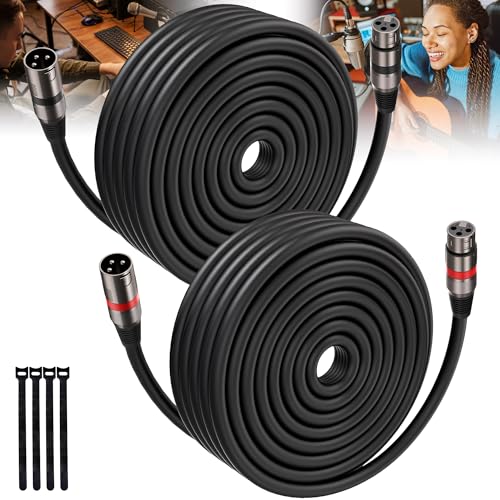
Two 100-foot cables with a 5-layer shield that a 30-year DJ says beats tour-grade expectations.
For long runs across a stage, auditorium, or church sanctuary, Bietrun delivers two 100-foot balanced XLR cables that use a serious multi-layer shielding system: cotton, copper, carbon fiber, a 6mm TPE (thermoplastic elastomer) jacket, and PE (polyethylene) coating. These five layers work together to block 99% of clutter and static interference, according to the manufacturer, and at 100 feet that level of protection matters because a long cable acts like an antenna for noise. The self-locking design on the connectors ensures the plug stays firmly seated in your gear during movement — no accidental disconnects mid-set.
One DJ and sound system owner with over 30 years of experience reports using Bietrun cables with their EV EKX subs and RCF HD 12a MK4s, noting the build quality is very close to tour grade without breaking their pockets. Another band has been gigging with several of these cables for a year or two and has not had a single failure. Each cable has a different colored connector for easy identification and comes with two Velcro ties for organization. The TPE jacket is also easy to clean — just wipe with a damp cloth, no need to deal with fraying nylon braid.
A few users note the connectors have a tendency to unscrew with common use, so you will want to check them before every show. For a pair of 100-foot heavy-duty cables, that small maintenance step is a reasonable trade-off for the price and performance.
Five-layer noise defense: The combination of cotton, copper, carbon, TPE, and PE layers provides exceptional hum rejection over long cable runs where noise is most likely to creep in.
Connector check required: Some customers note the barrel threads can loosen during regular use — a quick tighten before each gig solves it.
Best for: sound reinforcement companies, churches, and bands that need two very long balanced runs with premium noise rejection at a reasonable price. Consider another pick if — you want zero-maintenance connectors and prefer not to check the barrel tightness before every use.
6. GEARit XLR Cables 100ft OFC, Microphone Cable XLR Male to Female
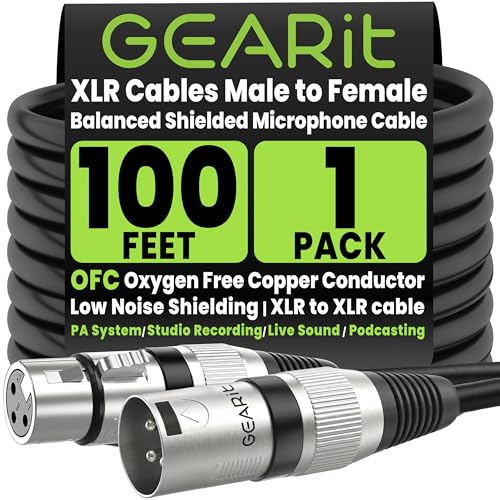
A single 100-foot balanced cable with EMI/RFI shielding for long, clean runs without a second wire.
Sometimes you only need one long cable — to reach a distant monitor, a front-of-house position, or a speaker on a tall stand. The GEARit 100-foot XLR gives you that single long run with oxygen-free copper (OFC) conductors and EMI/RFI shielding (shielding designed specifically to block both electromagnetic interference from power cables and radio frequency interference from wireless devices). The heavy-duty metal XLR housings and sturdy strain relief promise reliable connections through countless plug-unplug cycles, and the flexible jacket makes it easier to coil than stiffer cables.
This cable is designed for connecting microphones to audio mixers, preamplifiers, and patch bays across a large space. The 100-foot length covers almost any stage or event-hall scenario without needing an extension or coupler. The manufacturer notes it works with wireless mic sets, studio recordings, and live performances, and the advanced shielding is specifically engineered for critical listening environments where any noise would be unacceptable.
The catch here is value: at this length and with a single cable, the per-foot cost is higher than the Bietrun 2-pack, which gives you two 100-foot cables for about one-third more. If you need exactly two long runs, the Bietrun pair is a better deal. If you need one super-clean cable and do not want to pay for a second, the GEARit is a solid, no-frills choice.
Single-run specialist: A full 100 feet of balanced, shielded cable for those situations where one long, clean run is all you need.
Value comparison: For two long runs, the Bietrun 2-pack delivers more cable for your money.
Best for: one-cable-needs — a church front-of-house run, a single long monitor feed, or a studio tie-line. Not best for: stereo pairs or multiple-input setups that need two equal long runs.
7. Amazon Basics 2-Pack XLR Male to Female Microphone Cable

Two 25-foot cables that do the job for a beginner or budget build while staying affordable.
The Amazon Basics 2-pack is the entry-level choice that actually delivers on the basics. These use all-copper conductors (not copper-clad aluminum, which is common at this price) with an inner copper spiral shielding that reduces noise interference. The zinc alloy 3-pin connectors have a nickel plating for corrosion resistance, and the 6.0mm PVC jacket is flexible enough to coil easily after a gig. Reviewers point out the included Velcro cable ties keep transport tidy, a small but welcome addition that many pricier cables omit.
One buyer uses these to connect two 650-watt PA system speakers and reports they work flawlessly. In a blind comparison with expensive cables, a friend was shocked and wished they had bought these instead. Another reviewer calls the cable super thick, durable, and easy to coil — giving it a 9/10 for sound quality and build. At 1.65 pounds for the pair, these are the lightest option on this list (the Pig Hog PHM20 pair is 2 pounds), making them an easy carry for a small kit.
The honest limit: a few users report a faint buzzing in environments with lots of electronics nearby, since the spiral shielding is less effective than a full copper braid at blocking strong interference. If your setup sits between a computer tower and a dimmer rack, you may want the Pig Hog or Bietrun braided-shield models. For a clean desk, a small PA, or a podcast starter rig, these are an absolute steal.
Copper where it counts: Real all-copper conductors at a price where many competitors use copper-clad aluminum — that alone is a win.
Shielding trade-off: The spiral copper shield works fine in most rooms but can let in hum near heavy electronics; upgrade to braided if your space is noisy.
Best for: first-time PA owners, budget studio builds, and anyone who needs a solid back-up pair without spending much. skip it if — your gear sits in a high-interference space or you need the absolute quietest signal path for critical listening.
Understanding the Specs
Oxygen-Free Copper (OFC)
OFC is copper that has been melted and processed in a controlled environment to remove oxygen, which reduces internal corrosion and makes the metal a better conductor over time. Cheaper cables often use copper-clad aluminum (CCA) — aluminum wire with a thin copper coating — which has higher resistance and can oxidize more quickly, leading to signal degradation. OFC is the standard for any balanced cable that you expect to last more than a year or two, and it is especially important for long runs (25 feet or more) where resistance matters more.
Braided vs. Spiral Shielding
The shield is the layer of conductive material that wraps the inner signal wires to protect them from electromagnetic interference (EMI — noise from power cables, transformers, dimmers) and radio frequency interference (RFI — noise from Wi-Fi, cell towers, broadcast radio). A braided copper shield weaves thin copper strands into a flexible mesh that covers the signal wires completely, offering better coverage and more effective noise rejection than a spiral wrap (a single strand wound around the wires). Braided shields also hold up better to repeated flexing and bending, making them the choice for touring cables where reliability under stress is critical.
Connector Materials and Plating
The XLR plug is where most cable failures happen. Look for metal housings — zinc alloy or nickel-plated brass — rather than plastic, because metal withstands drops and stress better. The three pins inside are typically made of brass or copper, with gold plating as a premium option. Gold does not oxidize or corrode, so the electrical contact stays clean for years even in humid or outdoor conditions. Neutrik is the most trusted brand for XLR connectors, used by RØDE and high-end pro audio manufacturers; they also feature a chuck-style strain relief that grips the cable jacket securely to prevent the solder joints from pulling loose.
Jacket Material: PVC vs. TPE
The outer jacket of a cable determines its flexibility, durability, and how it feels when you coil it. PVC (polyvinyl chloride) is the most common jacket material — it is cheap, reasonably flexible, and provides decent abrasion resistance. TPE (thermoplastic elastomer) is more flexible than PVC, stays pliable in cold temperatures, and is easier to wipe clean, which is why it is increasingly used in mid-range and premium cables. Polyethylene (PE) jackets are even tougher and slipperier, allowing cables to slide past each other without tangling, but they can feel stiffer. For a balanced speaker cable that you coil and uncoil frequently, TPE or high-quality PVC is the balance between flexibility and protection.
FAQ
What is a balanced speaker cable and why do I need one?
Can I use a microphone XLR cable for powered speakers?
What length balanced cable do I need for my setup?
Does a more expensive balanced cable actually sound better?
What does OFC mean and does it matter?
Will a balanced cable remove ground loop hum from my system?
How do I clean and store balanced XLR cables properly?
What is the difference between a 3-pin and a 5-pin XLR cable?
Final Thoughts: The Verdict
Across the board, the balanced speaker cable winner is the Pig Hog XLR 25 Foot 2 Pack because copper braided shielding and oxygen-free copper conductors at this price deliver proven touring-grade durability and noise rejection. If you want a desk-friendly single cable with premium Neutrik connectors, grab the RØDE XLR-3. And for two 100-foot runs with multi-layer noise protection while staying affordable, the Bietrun 2-pack is the clear choice.
How We Picked
We do not accept paid placement. Every pick is matched to a real buyer and a real use-case; we do not hands-on test units.
Sources & Methodology
Specifications: manufacturer listings and product documentation. Review insights: verified customer reviews, as of July 2026. Pricing: not shown on this page (it changes often); check the current price via the retailer link.
As an Amazon Associate, Gadgets Feed earns from qualifying purchases. This does not affect which products we feature.
Related Guides
Product prices and availability are accurate as of the date/time indicated and are subject to change. Any price and availability information displayed on Amazon at the time of purchase will apply to the purchase of this product. As an Amazon Associate I earn from qualifying purchases.
CERTAIN CONTENT THAT APPEARS ON THIS SITE COMES FROM AMAZON. THIS CONTENT IS PROVIDED "AS IS" AND IS SUBJECT TO CHANGE OR REMOVAL AT ANY TIME.
Amazon and the Amazon logo are trademarks of Amazon.com, Inc. or its affiliates.