
That persistent hum, the buzz that never quite goes away, the crackle when you move a cable — if you’ve ever run a long signal path, you’ve battled induced noise from power lines, dimmers, and fluorescent ballasts. Balanced speaker wire exists to defeat that interference completely, using a twisted-pair topology and common-mode rejection to cancel the junk your unbalanced cables pick up. The difference isn’t subtle: on a properly terminated balanced line, your noise floor drops audibly, your dynamic range opens up, and your signal arrives exactly as it left.
I’m Min — the co-founder and writer behind Gadgets Feed. I’ve spent hundreds of hours analyzing connector metallurgy, shielding topology, and capacitance figures across the most popular XLR and TRS cable options, cross-referencing real user reports on long-run performance and connector durability to separate the genuinely noise-free builds from those that merely look the part.
Whether you’re wiring a home studio, a commercial sound system, or a high-fidelity listening room, the right cable determines whether you hear music or static. This guide cuts through the marketing to deliver the definitive best balanced speaker wire recommendations based on real-world shielding effectiveness, connector retention, and material integrity.
How To Choose The Best Balanced Speaker Wire
A balanced audio cable is defined by three interdependent elements: the conductor material and gauge, the shielding architecture, and the connector quality. Skimping on any one of these turns a potentially silent signal path into a noise magnet. Below are the critical decisions you need to make before buying.
Conductor Material and Gauge
The conductor is your signal highway. Oxygen-free copper (OFC) reduces oxidation at the crystal boundaries, maintaining consistent conductivity over decades. A 24 AWG conductor is standard for line-level balanced signals; it offers the right balance of flexibility and tensile strength. Cheaper CCA (copper-clad aluminum) wire introduces higher DC resistance and brittleness that leads to internal fractures in portable setups.
Shielding Topology
A balanced cable’s immunity to interference comes not from its shield alone, but from the combination of twisted pairs and a well-grounded shield. The most effective designs use a foil shield (100% coverage against high-frequency RFI) plus a braided or spiral copper shield (low-frequency EMI rejection and mechanical robustness). This dual-layer approach, often called “quad-star” construction in premium cables like Mogami, delivers the widest noise rejection bandwidth.
Connector Termination Quality
The connector is the cable’s weakest link. Look for gold-plated pins over brass or zinc — gold resists tarnish and maintains consistent contact pressure over thousands of insertion cycles. Self-locking XLR connectors with metal strain-relief springs prevent accidental disconnection during live performance or heavy use. For TRS-terminated cables, a solid machined barrel rather than a folded metal shell tells you the builder prioritized long-term reliability.
Quick Comparison
On smaller screens, swipe sideways to see the full table.
| Model | Category | Best For | Key Spec | Amazon |
|---|---|---|---|---|
| Mogami Gold TRS-XLRM-06 | Premium | Critical monitoring & studio wiring | Neglex Studio Quad 4-conductor | Amazon |
| SVS SoundPath XLR 1m | Premium | Hi-Fi component chains & subwoofers | 5-layer insulation system | Amazon |
| Bietrun XLR 100ft 2-Pack | Mid-Range | Long stage runs & multi-channel rigs | OFCC + foil + braid shield | Amazon |
| Ihurllu TRS to XLR 25ft 2-Pack | Mid-Range | Studio monitor to interface connections | Spiral OFC + foil dual shield | Amazon |
| DREMAKE TRS to XLR 100ft | Mid-Range | Long-distance balanced runs | 98% metal braid + foil shield | Amazon |
| BEZOKABEL XLR to 1/4″ 25ft 2-Pack | Budget | Converting XLR to TRS inputs | 24AWG OFC + anti-jamming ring | Amazon |
| Elecan XLR 75ft | Budget | Basic stage patching & long mic runs | 24AWG pure copper conductor | Amazon |
In‑Depth Reviews
1. Mogami Gold TRS-XLRM-06

Mogami’s Neglex Studio Quad cable uses a four-conductor twisted-pair geometry that delivers a capacitance figure of only 40 pF/ft, significantly lower than standard two-conductor balanced cables. This means the cable preserves high-frequency transient information over longer runs without roll-off, an advantage critical for studio monitor wiring where a 10kHz sine wave must arrive exactly as generated. The 6-foot length is ideal for rack-mount connections between an audio interface and monitor controller.
The gold-plated 1/4-inch TRS and XLR male connectors are machined from solid brass stock, not stamped metal, ensuring the contact pressure remains consistent after hundreds of insertion cycles. Users report the braided shield eliminates RFI from nearby routers and dimmers entirely, producing a silent noise floor even with gain stages cranked. Mogami backs this with a lifetime warranty redeemable at any authorized dealer without proof of purchase, a policy that speaks to their confidence in the termination quality.
At 6 feet, this cable is not meant for long stage runs; it is purpose-built for the critical short links where signal integrity matters most. The jacket is supple PVC that does not transmit vibration to the connectors, and the overall diameter remains thin enough to route cleanly behind a desk. If your signal path has a weak link between a DAC and a amplifier, this is the link to upgrade first.
Why it’s great
- Neglex Quad conductor design with ultra-low 40 pF/ft capacitance
- Lifetime warranty with no-proof-of-purchase replacement policy
- Machined brass connectors maintain long-term contact integrity
Good to know
- Limited to 6-foot length — not for long-distance runs
- Premium pricing reflects studio-grade materials and engineering
2. SVS SoundPath Balanced XLR Cable 1m
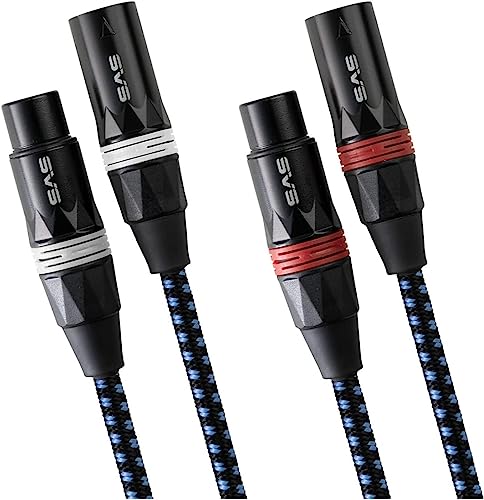
SVS engineered the SoundPath XLR with a five-layer insulation system that combines a spiral-wound OFC shield, a conductive PVC layer, a braided copper shield, a foil wrap, and a low-density polyethylene dielectric. This multi-layer architecture achieves 95 dB of common-mode rejection, meaning ambient electrical noise from nearby power cables and transformers is attenuated to inaudibility before it reaches your preamplifier’s differential input stage.
The connector barrel is a single-piece machined aluminum alloy, anodized for corrosion resistance, and terminates with 24K gold-plated center pins. Red and white marking bands on the strain-relief boots allow instant left/right channel identification without labels. At one meter, this cable is the right length for connecting a DAC to a preamp or a preamp to a power amplifier in a typical AV rack. Users report measurable noise-floor drops when replacing stock unbalanced interconnects in systems with subwoofers and high-gain amplifiers.
For the build quality and the scientific approach to shielding, the SoundPath represents a strong price-to-performance ratio in the premium tier. SVS offers it in lengths up to 15 meters for longer runs. The cable is not overly stiff — the aluminum foil layers add some mass, but the jacket remains flexible enough for tight-radius bends behind a rack.
Why it’s great
- Five-layer shielding for 95 dB common-mode rejection
- Machined aluminum barrel with anodized finish
- Color-coded strain-relief boots for channel identification
Good to know
- One-meter length may be too short for some rack arrangements
- Multi-layer design adds slight stiffness compared to standard XLR
3. Bietrun XLR 100ft 2-Pack
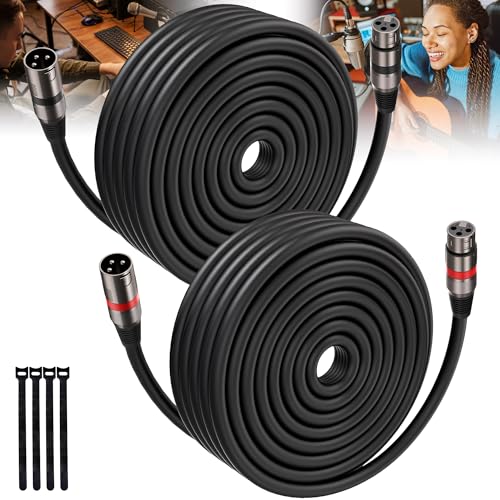
The Bietrun XLR 100ft 2-pack is engineered for long-distance stage and installation runs where signal integrity over distance is paramount. Each cable pairs an oxygen-free copper conductor with a multi-layer shield stack: cotton yarn wrap, a spiral copper braid, carbon fiber composite, a 6mm TPE jacket, and a PE coating. This combination effectively blocks 99% of EMI and RFI, as confirmed by user reports of silent operation even when cables run alongside DMX lighting lines and power distros.
A standout feature is the metal spring strain-relief (SR) design at the connector base, which outlasts standard PVC SR boots in flex testing by a significant margin. The self-locking XLR connectors use a durable alloy shell that snaps into place with a reassuring click and resists accidental pull-out during live performance. Each of the two cables in the pack features a different colored connector ring, making it easy to identify left and right channels without gaffer tape labels.
At 100 feet per cable, the wire gauge and material selection ensure that signal loss remains negligible — a critical factor for balanced lines where the receiver’s common-mode rejection compensates for line resistance. A 30-year veteran DJ reviewer noted a flattening of mids and highs from shouty horn speakers, suggesting the cable has a neutral enough transmission profile to reveal the speaker’s natural character without coloration. For long runs at a fair price, this is a compelling option.
Why it’s great
- 100-foot length suitable for large venues and installation work
- Metal spring SR design for superior flex-life durability
- Color-coded connector rings for channel identification
Good to know
- PE jacket is less supple than standard PVC
- Not as robust as tour-grade brands like Pig Hog under extreme abuse
4. Ihurllu TRS to XLR 25ft 2-Pack

For connecting a balanced audio interface output to active studio monitors, the Ihurllu 25-foot 2-pack offers the exact topology required: a 1/4-inch TRS male on one end and a 3-pin XLR male on the other. The cable uses a full-coverage spiral OFC shield layered over an inner aluminum foil wrap, providing dual protection against both RFI and low-frequency EMI. Users report a complete elimination of the hum that plagued their previous unbalanced connections between Scarlett interfaces and Yamaha HS-series monitors.
The 1/4-inch TRS plug features a drag-proof strain-relief design that clamps the cable jacket internally, preventing the conductor from pulling free under tension. Gold-plated contacts on both ends resist oxidation, ensuring consistent contact over time. The nylon braided jacket is both visually clean and practically durable — it resists kinking and is easier to pull through cable management sleeves than standard PVC. Each of the two cables in the pack has a different colored ring (red and blue) for channel identification.
It is important to note that this cable does not contain an impedance-matching transformer, so it is not suitable for high-impedance instrument outputs like electric guitar or bass into an XLR input. But for its intended purpose — a balanced line-level connection from a mixer, preamp, or audio interface to a powered monitor — it performs at a high level for its price tier. Users report clean signal paths with no measurable noise floor increase.
Why it’s great
- Spiral OFC + foil dual-shield eliminates monitor hum
- Nylon braided jacket resists kinking and pulls cleanly
- Red/blue ring identification for left/right channels
Good to know
- Not suitable for high-Z instrument outputs like guitar
- Nylon braid can fray if rubbed against sharp rack edges
5. DREMAKE TRS to XLR 100ft

The DREMAKE 100-foot TRS to XLR cable uses twin 24 AWG oxygen-free copper conductors with a shield system that includes an aluminum foil layer topped by a 98% coverage braided copper shield, plus a cotton yarn wrap for vibration damping. This level of shielding coverage at this length is uncommon at its price tier, and it shows in the real-world results — users report no audible noise when running 100 feet of cable between a mixer and powered speakers in a church installation, even with the cable running alongside power conduits.
The connectors use 24K gold-plated pins over what appears to be a brass base, with a reinforced PVC jacket that DREMAKE claims is harder than their earlier-generation cables to resist scratching and crushing under foot traffic. The cable itself is notably more flexible than the hard-jacket cables typically found at this price, making it easier to coil after a gig. Users report six months of daily use without any degradation in signal quality or intermittent crackling from the connectors.
At 1.63 kilograms, this is a heavy cable — the dense shielding and long length add significant mass. That weight is a trade-off for the solid RFI rejection. For a single long balanced TRS-to-XLR run at a reasonable cost, this is a strong contender. It is not the right choice if you need flexibility above all else, but for a permanent or semi-permanent installation where noise immunity is the priority, it delivers.
Why it’s great
- 98% metal braid + foil shield for long-run noise immunity
- Reinforced PVC jacket resists crushing and foot traffic
- Twin 24AWG OFC conductors with low capacitance
Good to know
- Heavy cable at 1.63 kg — not ideal for portable use
- Only one cable per package; no channel identification ring
6. BEZOKABEL XLR to 1/4″ 25ft 2-Pack

The BEZOKABEL XLR to 1/4-inch cable solves a specific problem: converting a balanced XLR output into a 1/4-inch TRS input, typically for powered speakers that accept a TRS jack rather than a full XLR. The 25-foot length in a 2-pack gives you two runs for stereo applications. The cable uses 24AWG OFC conductors with a double-shield arrangement — an inner foil layer plus a metal braid — and adds an anti-jamming magnetic ring (a ferrite choke) near the TRS end to filter out high-frequency interference from nearby wireless transmitters and switching power supplies.
The nylon braided jacket is soft to the touch and aesthetically clean, matching well with modern studio gear. The connectors feature gold-plated 6.35mm (1/4-inch) tips and silver-plated XLR pins. Users in professional DJ environments report that these cables reduced the noise floor on their studio monitors significantly compared to previous cables, and the build quality has held up after months of weekly pack-downs and setups. The ferrite core does add a slight bulge near the TRS end, which limits bend radius at that specific point.
At this price for a 2-pack, the BEZOKABEL delivers a strong value proposition for any studio or performer who needs to bridge between XLR-output mixers and TRS-input powered speakers. One user noted that the cables “greatly reduced the noise floor on my studio monitors” and called them their go-to for powered speakers. If your setup uses this specific connector topology, this is a logical, budget-friendly choice that does not compromise on the fundamentals of balanced signal integrity.
Why it’s great
- Integrated ferrite choke filters high-frequency interference
- Dual-shield OFC construction for clean signal transfer
- 2-pack at a competitive price point for stereo setups
Good to know
- Ferrite choke bulge limits tight-radius bending at TRS end
- Not suitable for XLR-female-to-TRS applications
7. Elecan XLR 75ft

The Elecan XLR 75-foot cable provides a long, straightforward male-to-female XLR connection at a cost that is hard to beat for a long run. The conductor is 24AWG pure copper (not CCA), which is an important distinction at this price tier — pure copper maintains lower DC resistance than copper-clad aluminum, minimizing line loss over the full 75 feet. The cable includes basic shielding for EMI/RFI rejection, and the nickel-plated XLR pins feature a self-locking mechanism that holds firmly once mated.
The jacket is made from a high-elasticity PVC that has been tested to over 10,000 bends, according to the manufacturer. Users consistently report that the cable feels “sturdy” and delivers “clear, noise-free audio over 50 ft.” The package includes 10 cable ties for managing excess length, a thoughtful addition for organizing a stage or installation. One user in a church AV environment reported running this cable alongside a bundle of other signal and power lines with no audible interference.
At this length and price, expectations should be calibrated: this is not a tour-grade cable with the same connector longevity as a Mogami or an SVS. The PVC jacket is adequate, but it lacks the crush-resistance of a TPE or polyurethane jacket. For a budget-conscious live sound installation, a temporary event, or a permanent run in a low-abuse environment like a home studio or house of worship, the Elecan 75-foot delivers functional, quiet signal transmission without breaking the bank.
Why it’s great
- Pure copper conductor avoids CCA signal loss
- 75-foot length covers long stage or room runs
- Self-locking XLR connectors stay secure under movement
Good to know
- Basic PVC jacket lacks crush- and abrasion-resistance of premium cables
- Nickel plating less corrosion-resistant than gold over time in humid environments
FAQ
Can I use a standard XLR microphone cable as balanced speaker wire?
Does a balanced cable need to be a specific impedance?
Will a better balanced cable eliminate ground loop hum?
How long can a balanced XLR cable run before signal degrades?
Final Thoughts: The Verdict
For most users, the best balanced speaker wire winner is the SVS SoundPath Balanced XLR Cable because it combines a scientific five-layer shielding system, machined aluminum connectors, and 24K gold pins in a well-priced package that delivers measurable noise rejection for any hi-fi or studio installation. If you want the absolute best signal integrity for short critical links like a DAC to a preamp, grab the Mogami Gold TRS-XLRM-06. And for long-stage runs where length and durability matter most, nothing beats the Bietrun XLR 100ft 2-Pack.