
Our readers keep the lights on and my morning glass full of iced black tea. As an Amazon Associate, I earn from qualifying purchases.
Specs are compiled from manufacturer listings and verified buyer reviews and can change over time — please confirm the key details on the product page before buying.
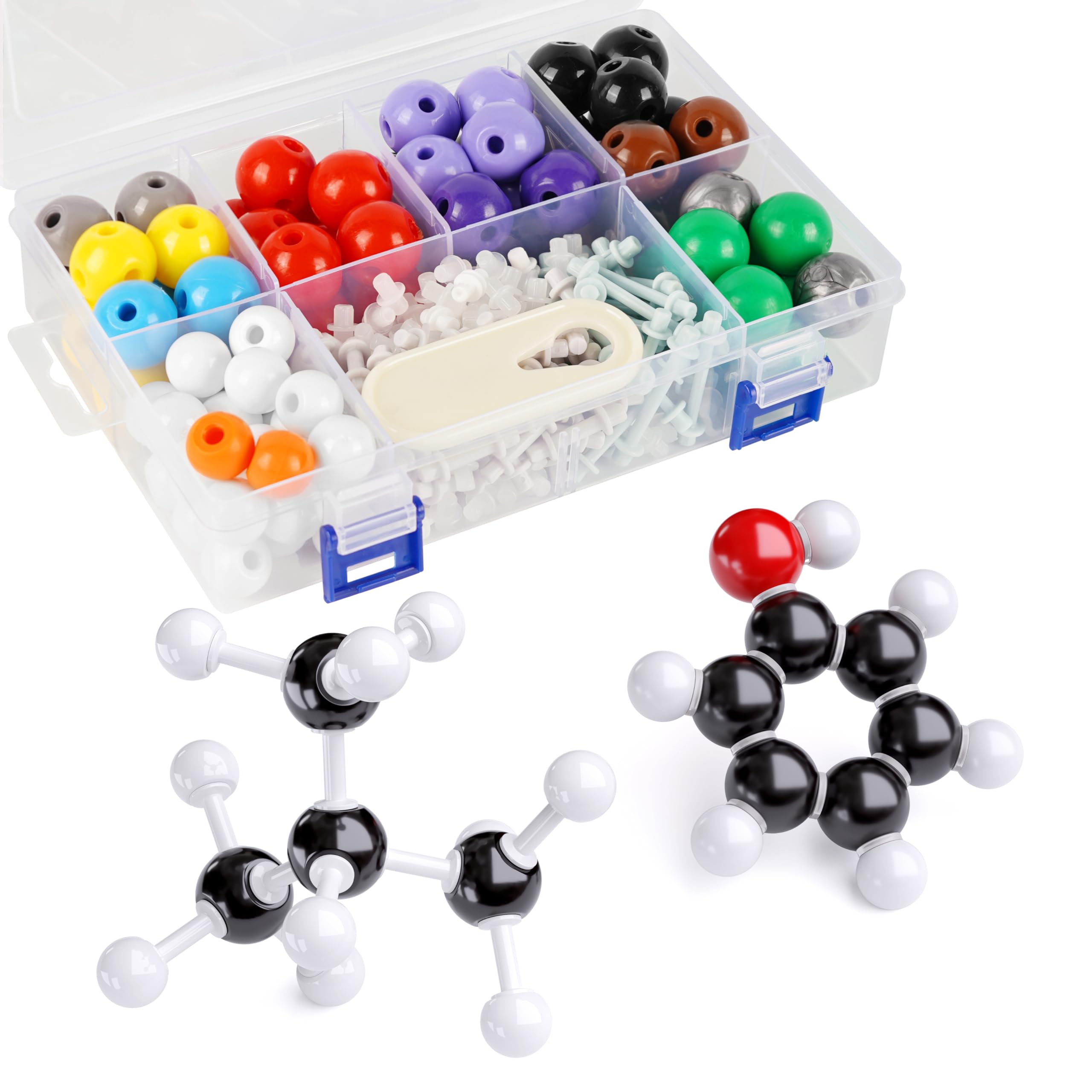
You are staring at a flat page of hexagons and wedges, and your brain refuses to turn it into a 3D shape. A ball and stick model fixes that in about ten seconds — but only if the pieces actually snap together, stay tight, and come apart without shredding your fingertips. The kits below are the ones worth your study time.
I’m Min — the founder and writer behind Gadgets Feed. This guide is built by comparing the manufacturers’ published specifications and the patterns across verified customer reviews, so you get each pick’s real strengths and trade-offs instead of marketing spin.
Piece count is the number everyone fixates on, yet atom variety and bond flexibility decide whether a kit carries you through a whole semester. The right ball and stick model should still have enough carbon and oxygen atoms to build real molecules in week twelve.
Our Picks at a Glance


How To Choose The Best Ball And Stick Model
The cheapest mistake in this category is buying on piece count alone. A 425-piece kit with only a handful of carbon atoms will stall on the third problem set. What you want is enough of the common atoms — carbon, hydrogen, oxygen, nitrogen — plus links that hold a bond angle without sagging.
Atom count versus piece count
Atoms are the colored spheres. Links are the sticks that join them. A kit listed at 122 pieces often carries 59 atoms and 62 links, so the headline number roughly doubles the real atom supply. Check the atom figure first, because that is what limits how many molecules you can build at once.
Why bond flexibility matters
Single bonds are short and stiff. Double and triple bonds need longer, more pliable links so the geometry reads correctly. A kit without flexible links will build ethane fine and then fail on ethene. Look for long flexible bonds in the parts list before you commit.
Color coding and the universal standard
Every serious kit colors atoms by element so you can read a structure at a glance — black for carbon, red for oxygen, and so on. That convention is what makes a model usable during an exam review instead of a puzzle. A set that ignores it costs you seconds on every single molecule.
Quick Comparison
| Model | Best For | Atoms | Total Pieces | Weight | Amazon |
|---|---|---|---|---|---|
| Duluth Labs MM-003 (125 Pieces)★ Best Overall | Compact starter kit | 54 | 125 | 9.6 ounces | Amazon |
| Swpeet 122 Pcs KitBudget Champion | Budget classroom pick | 59 | 122 | 15.52 ounces | Amazon |
| YCHOULEK 240 Pcs KitTop Performer | Space-filling builds | 86 | 240 | 0.51 kg | Amazon |
| LINKTOR 239-Piece Kit | Travel and small desks | 86 | 239 | 0.45 kg | Amazon |
| Duluth Labs MM-004 (88 Atoms) | Full-semester study | 88 | 228 | 0.63 kg | Amazon |
| JoyCat 404-Piece Kit | Organized storage | 100 | 404 | 0.82 kg | Amazon |
| RELIANCER 419 PCS Kit | Advanced structures | 179 | 419 | 0.98 kg | Amazon |
| Molymod MMS-008 | School-standard set | 50 | 112 | 460 g | Amazon |
| Old Nobby 425 PC Kit | Classroom demos | — | 425 | — | Amazon |
In‑Depth Reviews
1. Organic Chemistry Model Student Kit – (125 Pieces) – MM-003
Our pick — 4.5+★ from 650+ verified ratings; the strongest balance of quality and price.
Fifty-four atoms in a 9.6-ounce kit that slips into a backpack pocket.
Start with the number that actually decides your first semester: 54 atoms. That is fewer spheres than the bigger kits carry, but it covers the functional groups, conformations and stereochemistry you meet in an intro organic course. The set weighs 9.6 ounces, so it rides next to a textbook without adding noticeable bulk to your bag.
Reviewers praise it most for usefulness, and the pattern holds across hundreds of student encounters. Value and completeness follow close behind: the box arrives with the atom connectors and a molecular tool for pulling models apart. Duluth Labs also prints the atom key on the inside cover, so you are not hunting for a loose sheet mid-problem-set.
The honest catch is scale. Fifty-four atoms means you build a few molecules at a time, not an entire reaction scheme in one sitting. If you plan to leave a large structure assembled on a desk for days, a 100-atom kit like the JoyCat below serves you better. For portability and a clean intro-course fit, this one is the crowd favorite — 4.5+ stars across 600+ ratings.
Where it earns its keep
- 54 atoms cover functional groups, conformations and stereochemistry
- 9.6-ounce build travels easily between home and lecture hall
- Atom key printed on the inside cover, nothing loose to lose
- Included molecular tool pops models apart without finger strain
Worth knowing first
- Atom supply limits you to a few models at once
- Smaller footprint than the 100-atom and 179-atom kits
Solid for: first-year organic students who need one kit that fits in a backpack and covers the core concepts.
Pass if: you want a permanent desk display of a large molecule — this kit runs out of atoms before you finish.
2. Swpeet 122 Pcs Organic Chemistry Molecular Model Student and Teacher Kit
The entry-level kit that splits its 122 pieces into 59 atoms and 62 links.
Set the Swpeet next to the Duluth Labs MM-003 and the piece-count gap looks dramatic — 122 pieces against 125. But the Swpeet only carries 59 atoms, and the real working number is atom supply, not the box total. What it does bring is 59 atoms at a budget price, plus a short link remover tool that saves your fingertips on stubborn double bonds.
The parts are polypropylene, color coded to national standards, and they pack into a slim case 9.25 by 6.69 by 1.38 inches — thin enough to slide into a backpack sleeve beside a notebook. It covers C, H, O, N and S, so simple organic and inorganic structures are both on the table. Assembly is where opinions split: single bonds click together without fuss, while double bonds need a little more patience and the remover tool earns its place there.
Weighing 15.52 ounces, this is the heaviest of the small kits here, which is the trade-off for a sturdier case and thicker links. If you are buying for a high schooler who needs a first kit and might lose a piece or two, the budget positioning makes sense. Reviewers most often single out the sturdy case and thick links as the bright spot.
Straight read: a low-cost entry into molecular modeling with all the major atoms present and a case that survives a school bag.
Fair warning: double bonds take more force than singles, so plan to use the remover tool rather than your nails.
Buy it for: a first kit on a tight budget where losing the odd piece is a real risk.
skip it if: you want a large atom reserve for multi-molecule sessions — 59 atoms caps you early.
3. Molecular Model Kit, 240 Pcs Organic Chemistry Structure Set
Eighty-six atoms that build both ball-and-stick and space-filling shapes from one box.
The defining feature here is the embedded component design, which lets you assemble ball-and-stick models and space-filling models from the same parts. That matters because space-filling — where spheres sit next to each other at true scale — shows steric crowding in a way a stick model cannot. With 86 atoms and 154 bonds, you have enough to leave a couple of structures standing while you work on the next.
Compare it to the Swpeet and the jump is real: 86 atoms against 59, and 240 total pieces against 122. For a student moving past simple alkanes into polymers and larger biomolecules, that extra stock is the difference between building the molecule and building an approximation of it. YCHOULEK rates the set for Grade 7 through graduate level, and the plastic is described as high quality and portable.
The mixed note is versatility. Some buyers find the kit does not stretch as far into every corner of inorganic chemistry as they hoped, so if your course leans heavily on coordination compounds, check the atom list against your syllabus. The kit weighs 0.51 kg, light enough to carry, and its 9 by 5 by 2 inch profile fits a laptop sleeve.
What stands out
- 86 atoms and 154 bonds in a 240-piece set
- Builds both ball-and-stick and space-filling models
- 0.51 kg and 9 by 5 by 2 inches for easy transport
- Rated for Grade 7 through graduate-level study
The honest limits
- Inorganic coverage draws mixed feedback from buyers
- No storage compartment breakdown like the JoyCat offers
Best matched to: students who want one kit that handles both modeling styles without buying twice.
Think twice if: your syllabus is heavy on inorganic structures — the versatility reviews are not unanimous.
4. LINKTOR Chemistry Molecular Model Kit (239 Pieces)
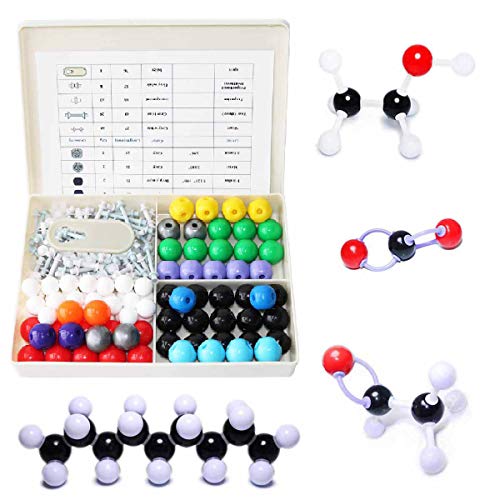
A 239-piece kit that packs down to 6 by 4 by 1.5 inches.
If desk space is the constraint, the LINKTOR wins before the lid even opens. Its footprint is 6 by 4 by 1.5 inches and it weighs 0.45 kg — by far the most compact of the mid-range kits, and a genuine fit for a crowded dorm desk or a laptop bag side pocket. The 86 atoms and 153 bonds inside carry the same modeling range as the YCHOULEK kit above.
LINKTOR spells out both structure styles in the listing: ball-and-stick, where spheres represent atoms and sticks represent bonds, and space-filling, where the spheres are scaled and sit next to one another as atoms do in a real molecule. The color standard is the universal one adopted across kits, so you can move between this set and a classroom demo without relearning the legend.
Chemistry-wise it shows bond angles and stereochemistry in three dimensions, which is the entire reason to own a model kit in the first place. The trade-off is the matter of buying blind — this listing carries fewer written reviews than the others here, so you are leaning on the published spec sheet rather than a long owner track record. The warranty the maker advertises is a full replacement or refund.
Space-to-spec ratio: 86 atoms and 153 bonds in a case smaller than most pencil boxes, which is the whole pitch.
Before you commit: the review history here is thinner than on the Duluth Labs or Molymod kits, so treat the spec sheet as your main evidence.
Made for: students in tight dorm rooms or commuters who need a kit that vanishes into a bag.
Not for: buyers who want a deep owner track record to read before spending — this listing runs lean on that front.
5. Organic Chemistry Molecular Model Student Kit – (88 Atoms and 140 Bond Parts) – MM-004

Eighty-eight atoms versus 54 in the smaller Duluth Labs set in the same family.
This is the step-up twin of the MM-003 above, and the atom jump tells the story: 88 atoms against 54, with 140 bond parts alongside. It lands squarely in the range a full semester of problem sets demands. The long bonds flex for double and triple bonds, which is how the set handles geometry a rigid-link kit cannot reach.
Ease of use is where this kit earns its reputation — the 88 atoms and 140 bonds click together easily and come apart without a fight, so you can build, check your work, and reset between problems. The color coding follows the universal standard, the atom key sits on the inside cover, and a molecular tool is included for the stubborn joints. The polypropylene atoms and links hold up across repeated assembly, which is why it lands near the top of this list rather than the middle.
Weight is the one thing to size up honestly. At 0.63 kg versus the LINKTOR kit’s 0.45 kg, it is not the one you toss into a tote without noticing. If it lives on a desk, the extra heft reads as substance rather than burden.
Why students keep it
- 88 atoms and 140 bonds handle a full semester of structures
- Long bonds flex for double and triple bond geometry
- Pieces assemble and disassemble without finger strain
- Universal color coding with the atom key on the inside cover
The counterweight
- 0.63 kg is noticeably heavier than the compact LINKTOR set
- Atom key placement means you flip the box open to read it
Pick this if: you want the atom headroom of a serious study kit without stepping into class-sized territory.
Look elsewhere if: you plan to carry the kit daily — 0.63 kg adds up in a full backpack.
6. JoyCat 404-Piece Molecular Model Kit for Organic and Inorganic Chemistry

The kit that finally puts every atom in a labeled slot instead of one jumbled bag.
Losing a carbon atom in a mixed bag is a small tragedy that happens to everyone; JoyCat answers it with a divided, labeled storage box. That single design choice saves minutes every session, and it is why this kit stands apart from the pile-it-all-in options. The 404 pieces break down to 100 atoms, 153 bonds, a 60-atom mini C60 set, 90 mini C60 bonds, and a remover tool.
That mini C60 cluster is unusual at this level — fullerene structures are a topic most student kits ignore entirely. JoyCat also throws in a 6-page learning guide and stencils, which turns the box into a small self-contained study kit. The manufacturer rates it for age 15 and up, with a stated range from grade 9 through college, and it covers both organic and inorganic chemistry.
Weighing 0.82 kg in an 8.9 by 7.09 by 1.76 inch box, this is not a pocket kit; it belongs on a desk and stays there. The plastic is described as smooth and burr-free, so assembly does not snag. Effectiveness for university-level organic chemistry is what buyers land on most consistently, and the value reads well against what is in the box.
Storage does the heavy lifting: labeled compartments mean no more sorting 100 atoms by hand before every study session.
One thing to note: at 0.82 kg it is the second-heaviest kit here, so treat it as a desk fixture rather than something you shuttle to class.
The right call for: disorganized study desks — labels and compartments keep the parts sorted with no effort.
Not ideal if: you need to carry a kit back and forth — this one belongs at home base.
7. RELIANCER Molecular Model Kit, 419PCS Organic Molecular Chemistry Set

179 atoms and four tetrahedral holes that open up structures other kits cannot build.
Here is the spec that separates the RELIANCER from everything else in this category: carbon, oxygen, nitrogen, sulfur and phosphorous all carry 4 tetrahedral holes. That lets you build ions with positive formal charges, including carbon monoxide and the ammonium ion, which most student kits physically cannot assemble. For a student heading into reaction mechanisms and formal charge problems, that capability has real weight.
The part breakdown is specific enough to respect: 179 atoms, 155 medium-length hard bonds, 25 long flexible bonds for double and triple bonds, 30 V-bonds for space-filling models, and 30 lone pairs of electrons. That lone-pair set is another feature you rarely see at this tier. The kit was built as a custom set for a college professor who picked pieces for his own classroom, which explains the depth of the parts list.
Materials are polypropylene atoms and low-density polyethylene links, described as smooth with no scraps at the holes, and the whole thing ships in a sturdy plastic box. It weighs 0.98 kg, the heaviest here besides the Old Nobby. The honest snag: with 419 pieces loose in a box, missing parts and assembly difficulty draw mixed feedback, so do a full count on arrival.
What the parts list open up
- 4 tetrahedral holes on all octet-rule atoms for charged structures
- 179 atoms, 25 flexible bonds, 30 V-bonds, 30 lone pairs
- Builds carbon monoxide and the ammonium ion
- COLOR-coded to national standards with an instructional guide
Where it can frustrate
- Mixed feedback on completeness and assembly, so count pieces on arrival
- 0.98 kg is a lot to carry, best left on a desk
Worth it for: students who need formal charge, lone pair and space-filling modeling in one kit.
Hold off if: you want a quiet, no-fuss first kit — this one asks you to verify the parts and learn the system.
8. Molymod MMS-008 Organic Chemistry Molecular Model, Student Set
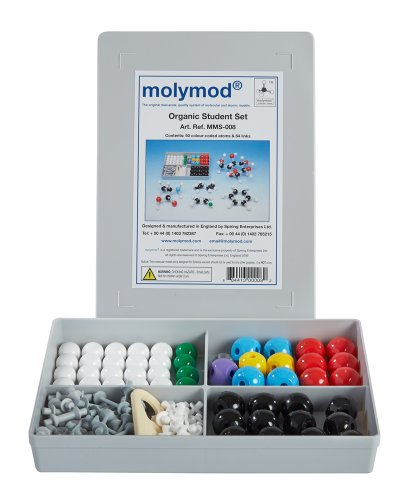
The classroom fixture with 50 atom parts, 62 links and a four-compartment box.
Molymod kits show up in school supply lists for a reason, and the MMS-008 is the student-sized one. It carries 50 atom parts and 62 links, aimed at grades 7 through 12, with atom diameters between 17mm and 23mm — large enough to grip and read from the back of a classroom. The plastic parts are color coded to national standards so the structure reads at a glance.
Compare it head to head with the YCHOULEK: 50 atoms against 86, and the Molymod is smaller as a result. What it buys you in return is a box with four compartments, so atoms and links do not arrive as a jumbled pile. The build is durable plastic designed for repeated assembly, which matters in a classroom where models get handled constantly.
For a school setting where durability outranks finicky comfort, that stiffness is usually the price of a link that does not loosen over time. At 460 g in a 9.25 by 6.69 by 1.38 inch case, it travels easily enough.
Familiar ground: these are the kits that turn up on school supply lists, with the compartmented case and national color coding already in place.
What to expect: links that seat firmly and sometimes fight you, so a tough grip beats soft fingertips.
For you if: you want a school-standard set for grades 7 through 12 with a compartmented case built for daily handling.
Consider skipping if: you want maximum atom variety — 50 atoms is lean compared to the YCHOULEK’s 86.
9. [425 PC] Molecular Model Kit – Organic Chemistry Model Kit for Teachers
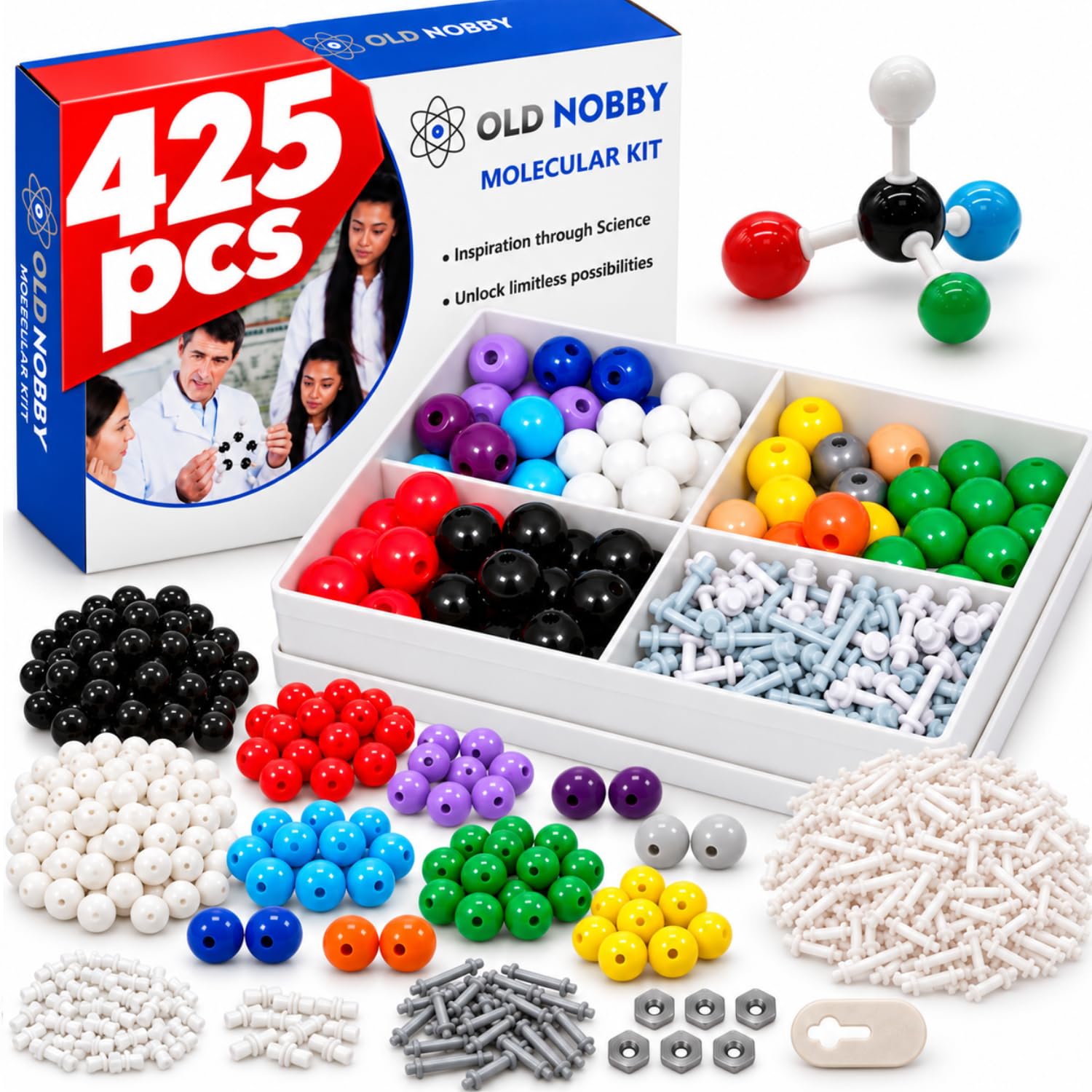
425 pieces — enough to build several molecules at once or one huge one up front.
The Old Nobby is pitched at teachers and study groups, and the 425-piece count backs that up. A teacher can build a large structure for the front of the room or run several smaller models in parallel for group work. The parts list includes atoms, single bonds and flexible bonds for double and triple bonds, plus the bond remover tool that saves your fingers on tight joints.
The color coding by element does the reading for you — a structure points at itself; black is carbon, red is oxygen, and the molecule tells you its own story. Straight bonds plus flexible links let you build alkanes, alkenes, benzene and ring compounds. For an advanced course where ring geometry and chirality come up constantly, that range matters more than raw piece count.
The catch is scale in both directions. And the listing is light on written owner reviews, so your confidence leans on the specs and the included guide rather than a long review history. The pieces ship in an organized case with an instructional guide, which keeps a kit this size manageable.
Where it shines in a classroom
- 425 pieces allow several models at once or one large molecule
- Flexible bonds handle alkane, alkene, benzene and ring compounds
- Bond remover tool simplifies teardown between problems
- Organized case and instructional guide included
What to weigh up
- Far too large for a student to carry daily
- Thin review history compared to the Molymod and Duluth Labs kits
Suits you if: you teach, tutor, or run a study group and need volume for demonstrations.
Overkill if: you are one student working alone — 425 pieces is more kit than one desk needs.
Understanding the Specs
Atom Count
Atoms are the colored spheres, and the atom count is what caps how many molecules you can build at once. A kit advertised at 240 total pieces often carries 86 atoms, with the rest being links and tools. When you compare two kits, compare atoms first and total pieces second, because a high piece count does not guarantee a deep atom reserve.
Bond Flexibility
Short, stiff links handle single bonds well. Double and triple bonds need longer, more flexible links so the geometry reads correctly. Some kits break the parts list out separately — for example 155 medium-length hard bonds plus 25 long flexible bonds — which is a clear sign the maker thought about geometry rather than dumping identical sticks in a box.
Tetrahedral Holes
Some atoms carry four holes arranged in tetrahedral geometry, which lets you build ions and structures with positive formal charges. That includes carbon monoxide and the ammonium ion, which simpler kits cannot assemble. If your course covers formal charge or charged intermediates, this is a deciding spec, not a nice-to-have.
Color Coding
Serious kits color atoms by element following a universal standard, so a structure reads at a glance without hunting for a legend. That consistency is what lets you move between a home kit and a classroom demo without relearning which sphere is carbon. A kit that does not follow the standard adds friction to every study session.
FAQ
Will a 54-atom kit get me through a whole organic chemistry semester?
What is the difference between a ball-and-stick model and a space-filling model?
Do I need flexible bonds for double and triple bonds?
How do I know whether a kit has enough atom variety for my course?
Is a 425-piece kit overkill for one student?
How should I store the pieces so I do not lose atoms?
Are the plastic parts safe for younger students?
Why do two kits with nearly the same piece count weigh different amounts?
Can I build benzene and other ring compounds with these kits?
Do these kits come with instructions for identifying every atom?
Final Thoughts: The Verdict
For most students, the ball and stick model winner is the Duluth Labs MM-003 because it balances a 54-atom supply with a 9.6-ounce body that fits a backpack, and it is the highest-rated set in this group. If you want atom headroom for a full semester, reach for the Duluth Labs MM-004 and its 88 atoms. And for classroom demonstrations or group work, the Old Nobby 425 PC kit is the one built for the front of the room.
One last thought on the buy: the Molymod MMS-008 carries the deepest owner track record in this category, a solid 4.5+ stars across 800+ ratings, which makes it the safest bet if you want the reassurance of a long, well-worn reputation.
How We Picked
We do not accept paid placement. Every pick is matched to a real buyer and a real use-case; we do not hands-on test units.
Sources & Methodology
Specifications: manufacturer listings and product documentation. Review insights: verified customer reviews, as of November 2026. Pricing: not shown on this page (it changes often); check the current price via the retailer link.
As an Amazon Associate, Gadgets Feed earns from qualifying purchases. This does not affect which products we feature.