
Our readers keep the lights on and my morning glass full of iced black tea. As an Amazon Associate, I earn from qualifying purchases.
Specs are compiled from manufacturer listings and verified buyer reviews and can change over time — please confirm the key details on the product page before buying.
A ball machine can be the difference between waiting for a partner and getting real reps in whenever you want. Many machines toss inconsistently, break quickly, or fail to replicate real-game speed and spin. This guide identifies machines that deliver consistent, usable practice.
I’m Min — the founder and writer behind Gadgets Feed. This guide is built by comparing the manufacturers’ published specifications and the patterns across verified customer reviews, so you get each pick’s real strengths and trade-offs instead of marketing spin.
Whether drilling curveballs or grooving a forehand, the goal is a machine that serves quality, trustworthy reps. Here is our curated list of the best ball machine options for focused, effective training.
Our Picks at a Glance


How To Choose The Best Ball Machine
The right ball machine depends on your sport, space, and commitment level. A foot-operated tosser suits casual fun; serious players need adjustable speed, consistent delivery, and curve or spin capability.
Power Source and Portability
A machine that needs a wall outlet limits you to a garage or a field with an extension cord. Rechargeable battery-powered units give you freedom, but battery life varies wildly. A machine that weighs under 6 pounds, like the Personal Pitcher Pro, is easy to carry from basement to backyard, while a 20-pound steel unit might stay put.
Speed, Spin, and Consistency
Speed (MPH) matters little without accuracy. Look for a machine that can replicate the type of pitch you want to face—fastballs, curveballs, or sliders for baseball, and topspin or backspin for tennis. More speed settings, oscillation, and adjustable launch angle make practice feel more realistic.
Ball Type and Capacity
Some machines cannot handle regulation baseballs or softballs. Many rely on specific dimpled or lightweight plastic balls to function correctly and prevent jams. Others, like the Louisville Slugger Blue Flame Pro, are multi-ball compatible and can even handle tennis balls. The ball hopper’s capacity also determines how often you have to stop and reload—a 150-ball capacity means longer, uninterrupted sessions.
Quick Comparison
| Model | Best For | Weight | Speed (Max) | Ball Type | Amazon |
|---|---|---|---|---|---|
| Personal Pitcher Pro★ Best Overall | Indoor/Outdoor Versatility | 6 lbs | Simulates 95 mph | Golf-sized plastic | Amazon |
| PONGBOT NOVA S ProTop Performer | Table Tennis Drills | 8.81 lbs | 15 m/s | 40mm Table Tennis | Amazon |
| Nisplay N1Premium Pick | Tennis Groundstrokes | 26 lbs | 68 mph | Tennis Balls | Amazon |
| Personal Pitcher Pro Starter | Complete Training Kit | 9 lbs | Simulates 95 mph | Golf-sized plastic | Amazon |
| PowerNet Launch F-lite | Baseball & Softball Crossover | 13 kg (28.6 lbs) | Simulates 90 mph | Launch F-lite Dimpled | Amazon |
| Furlihong 6902BHA | Kids’ Soft Toss Practice | 11.6 lbs | 4 Speed Settings | Regulation / Dimpled | Amazon |
| Heater Sports Slider Lite 360 | Curveball & Fastball Mix | 14.6 lbs | 80 mph at 46 ft | Lite Balls | Amazon |
| Louisville Slugger Blue Flame Pro | Multi-Ball Versatility | 20 lbs | 58 mph (baseballs) | Baseballs, Softballs, Dimpled, Tennis | Amazon |
| Furlihong 691BH | Budget Backyard Fun | 3.86 kg (8.5 lbs) | 4 Gears (Foot-Operated) | PU Baseball & Softball | Amazon |
In‑Depth Reviews
1. Personal Pitcher Pro Pitching Machine
Our pick — 4.5★ from 150+ verified ratings; the strongest balance of quality and price.
The lightest pro-style trainer that packs curveballs and fastballs into a tripod-ready frame.
This is the machine that wins people over for its sheer versatility. Weighing in at just 6 pounds, it is so light you can mount it on any standard camera tripod (not included) for basement, garage, or backyard use. It uses specially designed plastic golf-ball-sized balls, so you won’t crack wooden bats, and it comes with a 4-hour rechargeable battery and 48 balls right in the box.
The 4 speed settings simulate a huge range—from 15 to 95 mph depending on distance—and it can throw left- and right-handed curveballs. The Pro Timing Light helps you work on your load and timing. Buyers confirm that it offers consistent strike zone throws and is an excellent value for serious hitters, whether you are an adult or a youth player. One parent noted that a 30-foot basement setup works well for their 11-year-old intermediate player.
At 6 pounds versus the Heater Sports Slider Lite at 13 pounds, the Personal Pitcher Pro is far easier to carry from storage to the field and back.
What wins people over
- Extremely portable at 6 lbs; mounts to a standard tripod for personalized height.
- Versatile pitch types include fastballs and left/right curveballs.
- Comes with rechargeable battery, AC adapter, and 48 lightweight balls.
What you should know
- Uses proprietary small plastic balls, not regulation baseballs or softballs.
- Can be somewhat loud during operation.
- Picking up the 48 balls after a session can be laborious.
Reach for this if: you need a lightweight, powerful machine for indoor and outdoor use that can throw curves and fastballs without needing a dedicated pitching lane.
Think twice if: you specifically want to train with regulation-size or dimpled baseballs and softballs rather than the specialized plastic golf-ball-size balls
2. PONGBOT NOVA S Pro Table Tennis Robot
A customizable ping pong robot that puts 264 drills and a simulated landing spot in your app.
You get 9 types of spin from two independent BASF ball throw wheels that spin at 60 revolutions per second, with 21 levels of adjustment. The speed tops out at 15 m/s (about 34 mph), and you can set the frequency from 30 to 90 balls per minute. This machine redefines training by giving you pro-level spin control that mimics real game situations.
The Pongbot app lets you adjust spin, rotation intensity, landing point, ball speed, height, and frequency. You get 264 built-in preset training drills, and you can program your own custom drills. The app also shows a simulated animation of exactly where the ball will land, so you don’t have to guess placement. The hopper holds over 150 balls, so you stop less often during solo practice.
The catch? The app relies on Bluetooth and WiFi, and some users find it not super intuitive at first. An occasional WiFi disconnect might require a quick reboot. But once you get the hang of it, the consensus is that it is a standout for serious table tennis players of all skill levels.
The real deal for solo training: the versatility—16 aspects owners praise most—covers everything from basic practice to complex combo drills, making it a powerful tool for both beginners and pros.
Perfect for: table tennis players who want a machine that grows with them, from basic forehand practice to advanced multi-ball drills with programmable spin and placement.
Not for you if: you prefer a simple mechanical machine without the need for an app or Bluetooth connection to get the most out of it.
3. Nisplay N1 Portable Tennis Ball Machine
A compact tennis machine that uses dual motors to add topspin and backspin to your practice.
This is a dedicated tennis trainer that focuses on realistic groundstroke drills. It features a dual motor system that lets you shoot balls with flat, topspin, or backspin, which is crucial for practicing modern baseline play. At 26 pounds, it is on the heavier side, but it is designed for easy transport with oversized wheels and a 3-foot ergonomic folding handle that rolls over grass, gravel, and curbs.
The ball speed goes up to 68 mph, and you can adjust the elevation from 0 to 50 degrees. The external lithium battery provides over 4 hours of play, and it is removable, so you can charge it separately. The hopper holds over 80 balls, and the interval can be set between 1 to 9 seconds. Owners consistently praise its performance (24 mentions as a positive) and its solid build for the money.
One common note is that the remote doesn’t control the oscillator, and the ball frequency knob is labeled counter-intuitively. But for the price, it provides a level of spin control that is usually found in much more expensive machines.
What makes it stand out
- Dual motors deliver genuine topspin, backspin, and flat shots for realistic practice.
- External battery is removable and provides over 4 hours of continuous play.
- Oversized wheels and an ergonomic folding handle make it easy to pull like a cooler.
What to consider
- Jams occasionally (3-4 times per 80-ball basket), though it usually self-corrects.
- Remote control does not offer full control over oscillator or spin settings.
- At 26 lbs, it is heavier than most dedicated tennis machines in this class.
Ideal for: intermediate to advanced tennis players who want to practice topspin and backspin groundstrokes with realistic pace and ball flight while staying affordable.
Better to skip if: you need a simple machine only for basic, flat feed drills and don’t want to deal with occasional jams in the feeder.
4. Personal Pitcher Pro Starter Package
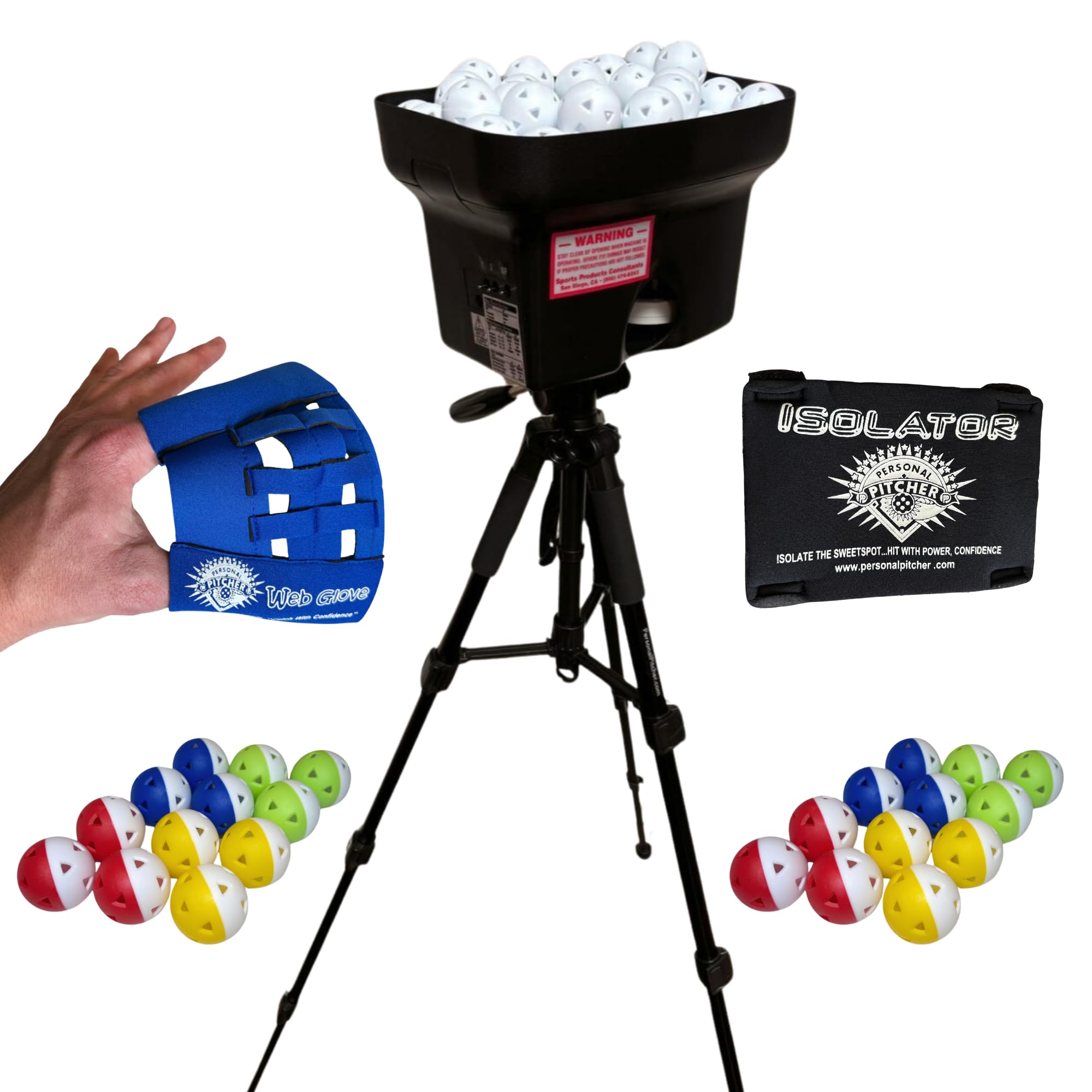
The complete hitting kit that adds a tripod, a unique catching glove, and a feedback pad to the machine.
This is the same Personal Pitcher Pro machine but bundled with everything to turn a field or garage into a full training station. You get the pitching machine, a custom tripod, the WebGlov (a finger glove that teaches proper catching technique in the web), the Isolator Pad (a pad that straps to your bat’s balance to give a “pop” sound on solid contact), and two dozen Focus Balls for a total of 48.
This kit is ideal for a parent who wants one box instead of hunting for separate accessories. The tripod is lightweight and collapsible for easy storage. The Isolator Pad solves a real issue: plastic balls don’t vibrate the bat like a real baseball, so you can’t feel if you hit the balance. Buyers call it an excellent training tool that works flawlessly right from the start, and it is easy to set up and use for kids around 10-12 years old.
The one quirk: the spinning feeder will occasionally stop, requiring a quick power cycle to get going again. But the overall build quality and the completeness of the package make it a fantastic value for a serious young player.
Best suited for: a serious baseball parent or coach who wants one box that includes everything needed for batting, catching, and contact drills.
Might be overkill if: you already own a tripod or catching trainer and just need the bare machine.
5. PowerNet Launch F-lite Pitching Machine

A dual-sport launcher that switches between baseball and softball with its own specialized balls.
Designed for the family with players in both sports, this machine comes with two interchangeable sets of tripod legs to alter the pitch height for baseball versus softball. It simulates speeds from 40 to 90 mph at 25 feet with four adjustable settings. The Launch F-lite machine is part of a system designed to work specifically with PowerNet’s own F-lite dimpled balls (12 are included, 6 of each sport).
It is not just for batting practice; you can use it to launch pop flies and line drives for fielding drills, helping build muscle memory. The build quality gets high marks, with one coach reporting it is sturdy and reliable after 4 months of heavy use with 16u down to 10u teams. The consensus is that it is a great value for youth programs because of its easy baseball-to-softball switch and consistent performance.
The catch is that it is calibrated only for PowerNet’s balls, and using other brands voids the warranty. Some buyers also report that the top speed is lower than advertised on radar, reaching closer to 27 mph at the max setting rather than the claimed 90 mph simulation.
What we like
- True dual-sport design with interchangeable leg sets for baseball and softball height.
- Capable of launching pop flies and line drives for fielding, not just batting.
- Sturdy build that holds up to regular youth team practice, from 10u to 16u.
What to keep in mind
- Designed specifically for PowerNet F-lite balls—using other balls voids the warranty.
- Some radar tests show the top speed is significantly lower than the advertised 90 mph simulation.
Grab this for: a family or youth team that needs one reliable machine for both baseball and softball practices without having to buy two separate units.
Hold off if: you strictly want to use regulation baseballs or softballs and don’t want to be locked into a proprietary ball system.
6. Furlihong 6902BHA Rechargeable Toss Machine

A rechargeable soft toss machine that saves your back from bending over with a tee.
This machine is designed for a specific, common task: consistent soft toss for batting practice. It features a high-end motor that provides stable tosses every 6 seconds, which is a massive timesaver and relieves the strain on a coach or parent from manually tossing balls or bending over a tee repeatedly. The toss height is adjustable from 1.2 m to 1.7 m for baseball (roughly 4 to 5.5 feet), which covers most youth and adult standing heights.
The rechargeable battery is a big deal—it allows you to take it out to the field without needing an extension cord. Owners find it excellent for children, and it works with regulation baseballs, softballs, or dimpled balls. It is light enough at 11.6 pounds to move around, though not as portable as the Personal Pitcher Pro. The extendable ball stacker provides a steady feed from the included ball tunnels.
The common feedback is that it is a great tool for basic swing practice and keeping kids engaged during the off-season, providing consistent reps without needing a second person. The battery lasts for about 300 balls before needing a recharge.
Why it fits: owners call it excellent for children—16 aspects cite its suitability—and it is one of the few machines that offers height-adjustable toss and rechargeable battery in one unit.
Good for: parents of young baseball players who want an automated soft toss machine to get their kids 300 consistent swings without needing to manually feed balls.
Not ideal for: advanced players who need machine-pitched fastballs or sharp breaking curves for serious batting practice.
7. Heater Sports Slider Lite 360 Pitching Machine

A 360-degree machine that focuses on accurate curveballs and lite ball fastballs up to 80 mph.
This machine is built around a pivot head design that allows it to throw precise curveballs, making it a specialized tool for hitters who struggle with breaking balls. It pitches lite balls at speeds up to 80 mph measured at 46 feet, which provides a challenging pace for young and intermediate players without using heavy regulation balls. It has an automatic ball feeder, so you can set it and focus on the at-bat.
The build features tubular steel legs with rubber tips for stability on any surface, and the package weight is 6.65 kilograms (about 14.6 pounds). It is a durable machine; some buyers report using it for 6 years with heavy use before any issues arise. The customer service from Heater Sports also gets strong praise—if a part fails, they are quick to send replacements at no cost.
The trade-off is that durability is a split issue. While many units last for years, a notable number of owners mention the motor burning out or the speed potentiometer failing after less than 10 uses. Accuracy and speed control are also points of contention; the machine can sometimes be inconsistent in its delivery.
Where it shines
- Pivot head design is specifically engineered for delivering accurate curveballs.
- Automatic ball feeder allows for hands-free continuous training.
- Sturdy tubular steel legs with rubber tips provide a stable base for consistent throws.
Where it falls short
- Some units experience motor burnout or speed control failure with relatively light use.
- Works best with specific lite balls; the feeder can jam with other brands or sizes.
- Plastic construction is louder than more expensive metal-framed machines.
Great for: players who want to practice hitting curveballs specifically and need a machine that can throw a consistent breaking ball at a reasonable price point.
Think twice if: you want a reliable daily driver for a team practice—the mixed durability reports suggest it is better for individual or occasional use.
8. Louisville Slugger Blue Flame Pro Pitching Machine
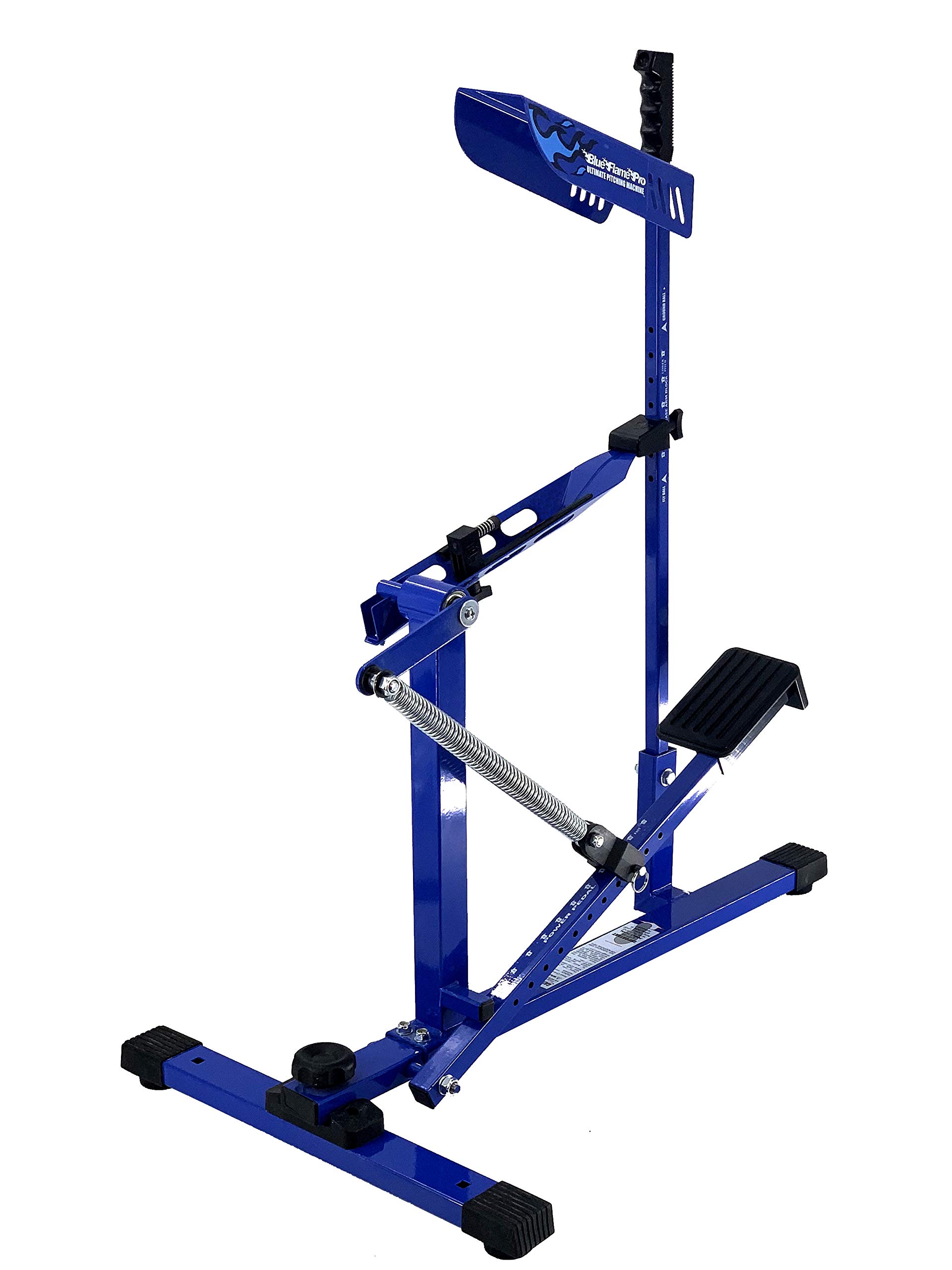
A steel-armed machine that accepts tennis balls, dimpled balls, and regulation baseballs for total versatility.
This manual, pedal-operated machine is a workhorse for versatility. It is a 20-pound steel unit (much heavier than the 6-pound Personal Pitcher Pro) that uses an enhanced ball-bearing throwing arm for smoother, more consistent pitches. It delivers speeds from 30 to 58 mph with a baseball, and up to 65 mph with restricted-flight balls. what separates it is its range of ball compatibility: baseballs, softballs, dimple balls, plastic balls, and even tennis balls all work.
It is used by Babe Ruth League and Pony Baseball & Softball programs, which speaks to its reliability in a competitive training environment. The ergonomic pedal design requires less force than older models, making it easier for a single coach to run practice drills, including level pitches, fly balls, and hard grounders. Setup is straightforward, and owners find it works well for 10u softball practice a couple of times a week.
The main source of frustration is the durability of the spring arm attachment. Several reviews report the spring breaking after only 2 practices. This seems to be a known weak point, and while some units function perfectly for years, it is a risk to be aware of.
The versatility factor: multi-ball compatibility lets it function as a baseball pitcher, a softball tosser, and even a tennis ball launcher for coordination drills, all in one machine.
Best for: coaches or families who need one machine that can handle baseballs, softballs, and tennis balls for varied training sessions without a steep upfront cost.
Pass on this if: you need a machine that will survive heavy daily practice—the spring arm is a recurring point of failure for some owners.
9. Furlihong 691BH Foot-Operated Toss Machine
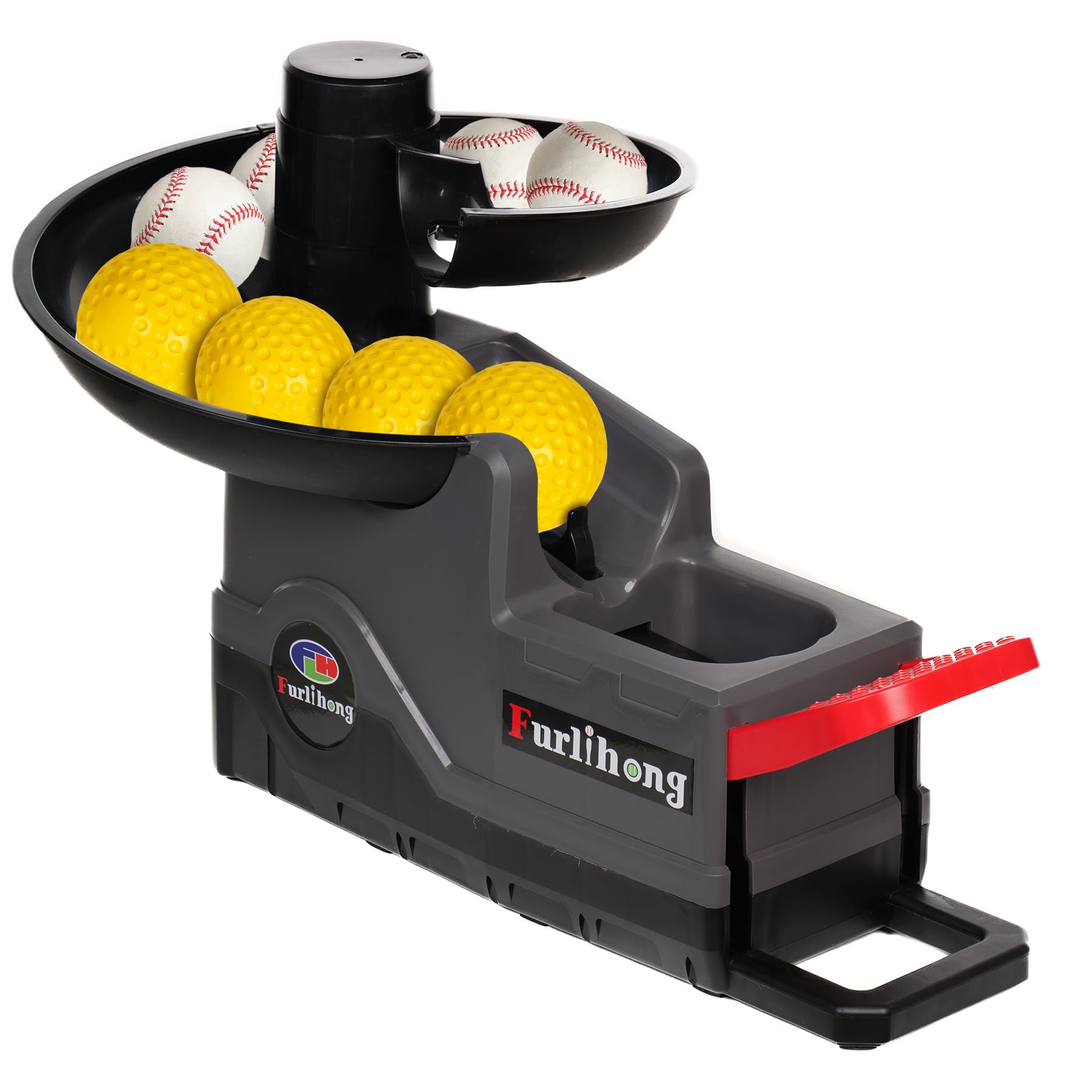
A simple foot-operated launcher that works without batteries or electricity for casual backyard fun.
This is the most budget-friendly entry in the guide, designed purely for simplicity. It is a 2-in-1 machine for both baseball and softball, featuring 4 adjustable gears: Levels 1 and 2 are tune for baseball, while Levels 3 and 4 are set for softball. You step on the red pedal, and after about 5 seconds, the ball launches. It requires absolutely no power, which is both its biggest advantage and its biggest limitation.
The package includes 2 ball chutes, 1 PU baseball, and 1 PU softball. It is lightweight—the package weighs just 3.86 kilograms (about 8.5 pounds)—and the dimensions of 20 x 12 x 10 inches make it easy to store in a garage or car trunk. It is a simple mechanical device.
The honest feedback from owners is that it is more of a “fun toy” than a serious training tool. The main complaint is inconsistency. The toss distance, height, and direction are very variable, and one owner estimates only about 25% of the pitches are in a hittable zone. The foot pedal doesn’t always engage properly. It works well for kids to get a laugh and some basic hand-eye coordination, but it won’t replace a dedicated pitcher or a more accurate machine.
The upside
- Does not require batteries, electricity, or any power source—works anywhere.
- Includes two ball chutes and one ball for each sport, ready to use from the start.
- Very lightweight and small, making it easy to store and bring to the park.
The trade-off
- Inconsistent toss in distance, height, and direction makes serious practice difficult.
- The foot pedal is unreliable and sometimes fails to engage the launch mechanism.
- Reviews consistently call it a fun toy, not a machine for serious batting practice.
Good for: a very casual, low-stakes backyard toss game for young kids who just want to swing at something moving, with zero setup or maintenance.
Avoid if: you are a serious coach or player looking for consistent, repeatable pitches to build muscle memory and skills.
Understanding the Specs
Speed Settings and MPH
Speed is usually listed in miles per hour (MPH) for baseball and tennis machines. Some models simulate higher speeds based on distance, so a machine claiming “95 mph” may only reach that if the hitter stands far back. For youth players, a range of 30-50 mph is typical, while high school and college players need machines that can hit the 60-90 mph zone. For tennis, speeds over 60 mph are considered fast and useful for advanced groundstrokes.
Spin and Pivot Head (Curveballs)
A machine that can throw curveballs usually has a pivot head that rotates the entire launch mechanism. This changes the ball’s axis, creating the spin that makes it break. For tennis, a dual-motor system allows for independent control of topspin (the ball dips) and backspin (the ball floats). A machine without spin control is essentially a fastball-only trainer.
Ball Hopper Capacity
This is how many balls the machine can hold at once, measured in count (e.g., 48 balls, 80 balls, 150 balls). A higher capacity means less time reloading and more time hitting. For a parent or coach running a practice, a larger hopper is a huge convenience. A smaller hopper forces you to stop frequently, which can break the rhythm of a training session.
Ball Compatibility
Some machines are designed for regular baseballs and softballs, while others only work with specialized light plastic balls or dimpled balls. Using the wrong type can jam the machine and void the warranty. The material the ball is made of—leather, plastic, or rubber—affects the launch mechanism and speed. Always check the product’s specified ball type before buying.
FAQ
Can a ball machine throw curveballs?
Is a foot-operated ball machine worth it for serious training?
How long does a ball machine battery last?
What type of balls do I need for a pitching machine?
How much space do I need for a ball machine?
Whats the difference between a toss machine and a pitching machine?
Is it better to buy a bundle or a standalone pitching machine?
Are ball machines safe for kids?
Final Thoughts: The Verdict
For most people, the ball machine winner is the Personal Pitcher Pro because it combines pro-level versatility (curveballs, fastballs, 4 speed settings) with a weight that makes it truly portable. If you want app-controlled drills and spin customization, grab the PONGBOT NOVA S Pro. And for the tennis player who wants topspin and backspin in a compact, pullable package, the Nisplay N1 is the one to reach for.
How We Picked
We do not accept paid placement. Every pick is matched to a real buyer and a real use-case; we do not hands-on test units.
Sources & Methodology
Specifications: manufacturer listings and product documentation. Review insights: verified customer reviews, as of July 2026. Pricing: not shown on this page (it changes often); check the current price via the retailer link.
As an Amazon Associate, Gadgets Feed earns from qualifying purchases. This does not affect which products we feature.