
Our readers keep the lights on and my morning glass full of iced black tea. As an Amazon Associate, I earn from qualifying purchases.
Specs are compiled from manufacturer listings and verified buyer reviews and can change over time — please confirm the key details on the product page before buying.
If you want the short answer: buy a machine that throws real, repeatable strikes at the speed your hitter actually faces — anything else just grooves bad habits into a young swing. The machine you pick decides how many quality reps your kid or team gets each week, and how long the unit survives a full season. This guide walks through the versions that hold up, from backyard cages to full field drills.
I’m Min — the founder and writer behind Gadgets Feed. This guide is built by comparing the manufacturers’ published specifications and the patterns across verified customer reviews, so you get each pick’s real strengths and trade-offs instead of marketing spin.
Some machines throw only baseballs, some switch between baseballs and softballs, and a few run cordless so you can set up anywhere. That variety is why the right ball pitching machine matters more than any single spec on the box.
Our Picks at a Glance

How To Choose The Best Ball Pitching Machine
The single biggest mistake first-time buyers make is chasing the highest top speed on the label. A machine that fires 70 mph but wanders a foot off the plate teaches your hitter to chase junk. A machine that nails the same spot at 45 mph builds a swing that actually transfers to game day. So the right pick depends on who is hitting, where you practice, and how the machine gets power.
Wheel count is the real pitch menu
A one-wheel machine grips the ball on a single spinning surface, so it throws fastballs and grounders well — that is the whole menu. A two-wheel machine adds a second spin axis, and a three-wheel unit can spin the ball on a third axis. That extra wheel is what lets you dial in curveballs, sliders, and knuckleballs instead of just heat. If your hitters only need straight fastballs, one wheel is plenty. If you are prepping a travel-ball kid for breaking pitches, the wheel count is the spec that decides whether the machine is even capable of the pitch.
Speed range versus usable speed
Every listing prints a range, like 30 to 60 mph or 10 to 52 mph. Read it as a window, not a guarantee. A machine that reaches its top number only with lightweight or restricted-flight balls will throw your regulation baseballs slower than the label claims. Look at whether the top speed is quoted for real baseballs or for dedicated training balls, and match that to the ball your team actually uses.
Corded, battery, or generator
Most machines run on standard household current — the spec sheets call it 110-volt AC — which means an outlet or a long extension cord. A few run cordless on an internal battery, and those are the ones you can roll onto a field with no power nearby. A handful also accept a portable inverter generator or a battery pack. If you practice on a real diamond instead of a garage, cordless power matters more than a couple of extra mph.
Quick Comparison
| Model | Best For | Speed Range | Weight | Power | Amazon |
|---|---|---|---|---|---|
| Junior Hack Attack★ Best Overall | Serious youth and teen training | Up to 70 mph | 96 lb | Corded (110V) | Amazon |
| Louisville Slugger Blue Flame ProBackyard Essential | Backyard batting practice | 30–58 mph | 20 lb | Manual pedal | Amazon |
| Heater Sports Heavy-DutyBest for Team Practice | Machine-pitch leagues and fielding | 10–52 mph | 42.7 lb | Corded | Amazon |
| Furlihong 636BH | Basement cages and solo drills | 40–68 mph | — | Corded (AC) | Amazon |
| Mound Yeti | Baseball and softball teams | 30–60 mph | 50 lb | Corded | Amazon |
| JUGS PS50 | Little League and fastpitch | Up to 50 mph | 50 lb | Corded (110V) | Amazon |
| BSN Sports Bulldog | Backyard value with softball option | 30–60 mph | 50.6 lb | 110V AC or generator | Amazon |
| Zooka ZS740 | Cordless field practice | 10–70 mph | 38 lb | Battery (cordless) | Amazon |
| JUGS BP1 | Travel teams and two-sport practice | 15–70 mph | 75 lb | 110V AC or generator | Amazon |
In-Depth Reviews
1. Junior Hack Attack Baseball Pitching Machine by Sports Attack
Our pick — over 4.5★ from 300+ verified ratings; the strongest balance of quality and price.
The three-wheel workhorse that throws breaking pitches a one-wheel machine simply cannot.
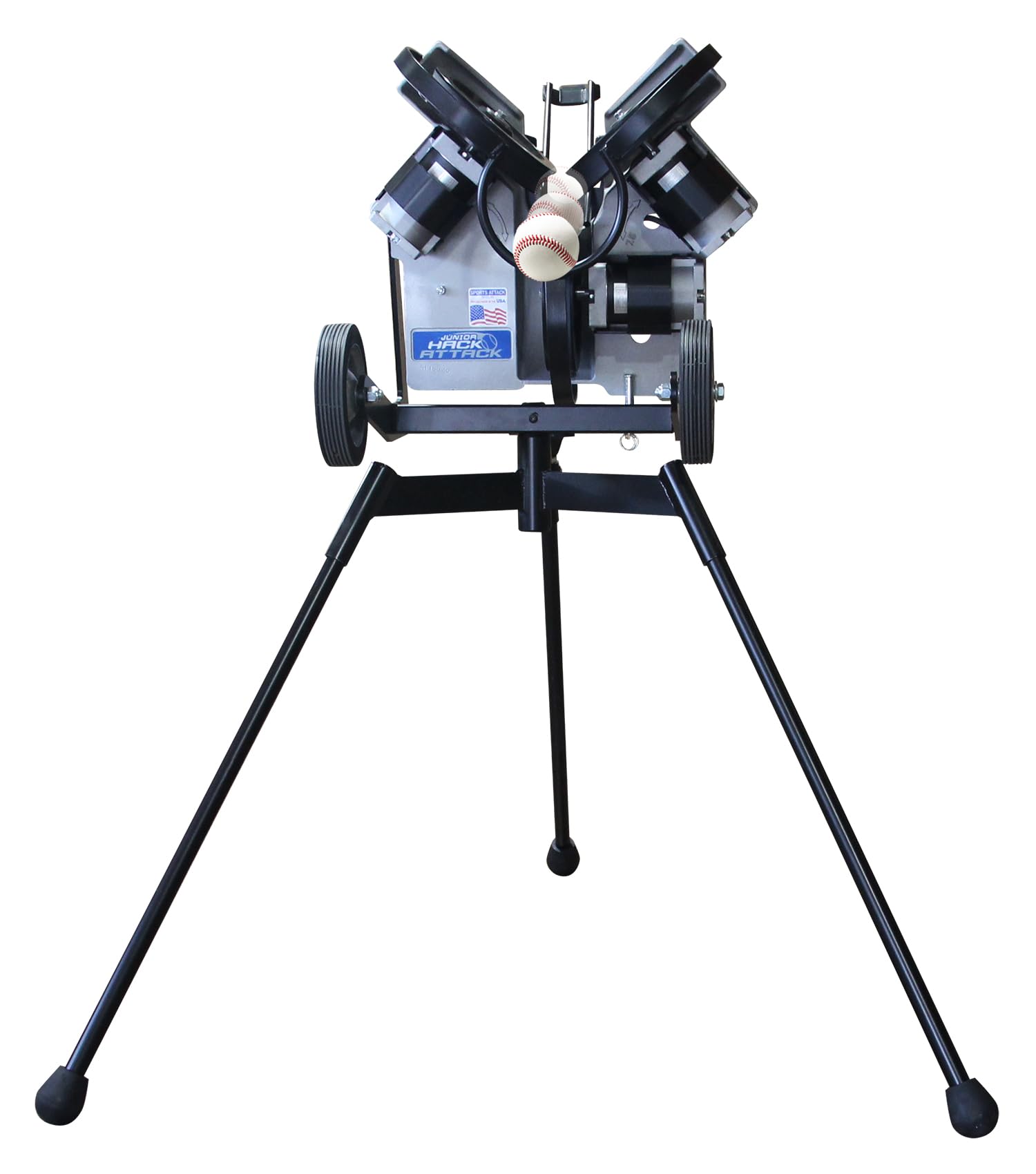
The Junior Hack Attack is the pick for the family whose hitter has outgrown a basic fastball feeder. Its three spinning wheels grip the ball on separate axes, so it can throw left- and right-handed fastballs, curveballs, sliders, split-fingers, and knuckleballs. It tops out at 70 mph, and because it delivers from a close release distance, hitters read the ball like a much faster pitch. It handles standard baseballs, including genuine leather, and it works with baseballs only — softballs will not fit this model.
The three-wheel design is genuinely more functional than a one- or two-wheel machine, because you can dial in pitch type instead of just speed. It runs on about 60 watts at 50 mph when hooked to a portable power station, which turns a field with no outlet into a real practice spot. Buyers report getting “8+ hrs” of pitching off a portable power station. The throwing head also pivots in any direction for defensive work, and it can toss ground balls, line drives, and fly balls out to about 250 feet. What wins people over is raw performance — it is the aspect owners praise most by a wide margin.
The catch is weight. At 96 pounds it is nearly five times heavier than the Louisville Slugger Blue Flame Pro’s 20 pounds, and one owner notes it takes two people to move around. Setup directions are thin and it ships partially assembled, so budget an afternoon for the first build. It is also a serious commitment for a beginner — a 6-year-old will get more out of a simpler machine, while a 12U-and-up travel player will get everything.
The pitch menu you get
- Three wheels throw fastballs, curveballs, sliders, split-fingers, and knuckleballs
- Speed tops out at 70 mph with repeatable, tight groupings
- Pivoting head handles grounders, line drives, and fly balls up to 250 ft
- Runs all day on a portable power station at roughly 60 watts
What you’re signing up for
- 96 pounds — needs two people to move and store
- Ships partially assembled with weak setup directions
- Baseballs only; softballs will not fit this model
Right call for: a travel-ball or high-school hitter who needs real breaking pitches and defensive drills from one machine.
Step back if: you practice alone or need to carry the unit in and out of a truck bed solo.
2. Louisville Slugger Blue Flame Pro Pitching Machine
Twenty pounds of steel you can carry with one hand and fire without a power cord.
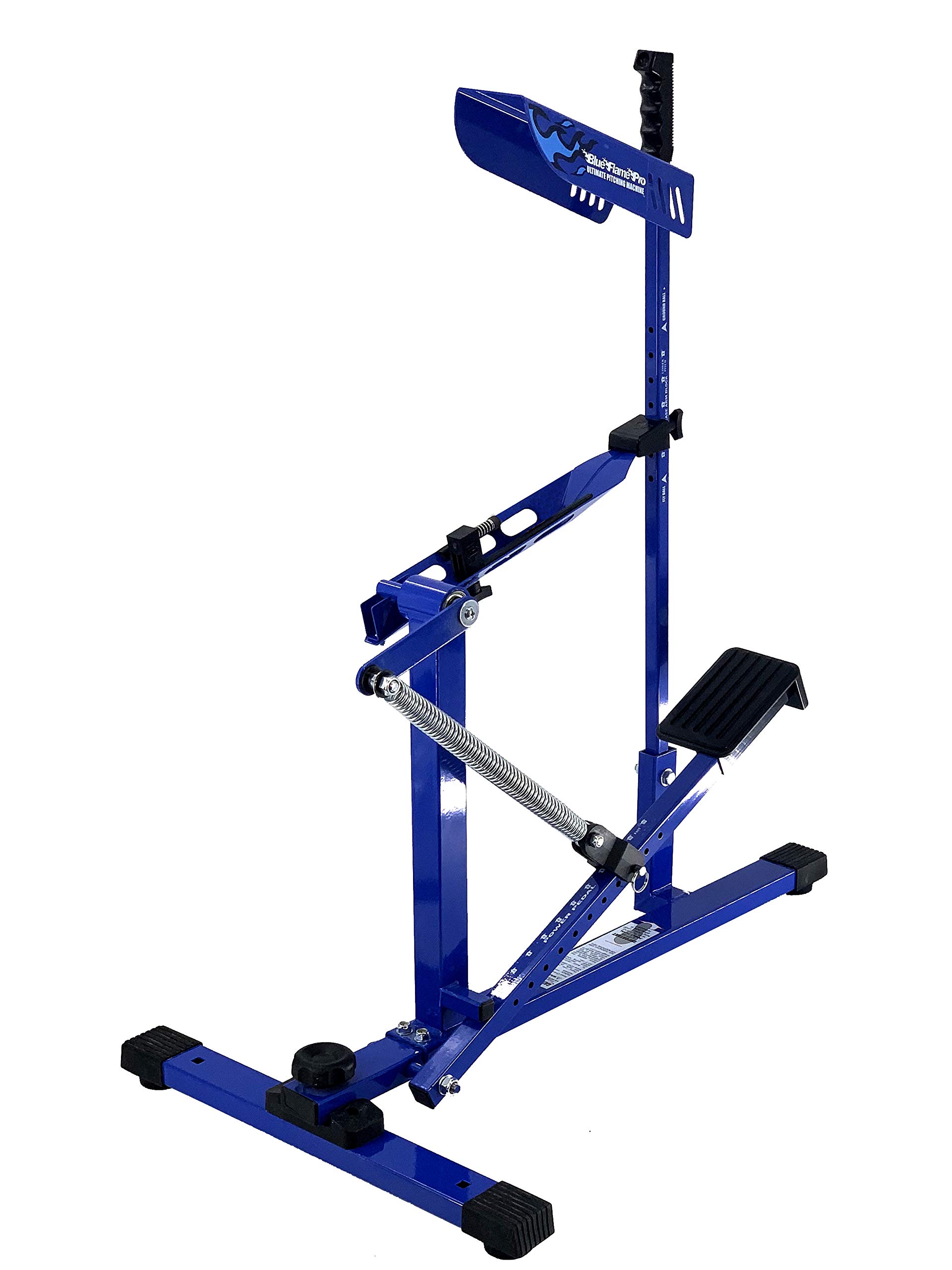
This is the machine for a parent who wants to throw batting practice in the driveway without dragging out an extension cord. It uses a spring-loaded arm instead of a spinning wheel, and a redesigned pedal lets you fire it with less leg effort than the older design. It throws baseballs from 30 to 58 mph, and up to 65 mph if you load restricted-flight balls. Because it is spring-fed, it also fires tennis balls, dimple balls, plastic balls, and softballs — the widest ball menu in this group. It shows up at Babe Ruth League and Pony Baseball & Softball programs nationwide, and it works out to roughly a fifth the weight of the Junior Hack Attack at just 20 pounds.
One machine covers grounders, fly balls, and true pitches, so you get a full practice from a single unit. As the review pages sum it up: “it does grounders, fly balls and pitches.” A 10U softball team runs it twice a week with easy loading and transport. The speed setting is a touch fiddly at first, but it dials in once you find your number. Assembly splits the crowd — some find it quick, others run into a snag.
Here is the honest trade-off, and it is a real one: durability draws negative feedback, and at least one owner received a unit whose spring arm attachment plate was welded halfway over a pre-drilled screw hole. That points to quality-control variance rather than a design flaw, so inspect your unit the day it arrives and use the return window if something is off. The rest of the ownership experience — value, functionality, ease of loading — holds up well. If your practice is casual and portable, this is a smart mid-range buy; if you need a machine that survives years of daily team use, look at the heavier JUGS and Sports Attack options above.
Portability is the whole pitch: at 20 pounds, it is about a fifth the heft of the Junior Hack Attack’s 96 pounds, so one adult can carry it from garage to yard.
The recurring gripe to plan around: assembly and spring-arm quality control are uneven, so open the box early and check the weld points before your first practice.
Best fit: backyard coaches who want cordless, carry-anywhere batting practice and a wide ball menu.
Reconsider: if you are running a travel team and need a machine that takes daily reps.
3. Heater Sports Heavy-Duty Baseball Pitching Machine W/Bonus Ball Feeder
The all-metal auto-feeder that drops a fresh ball every eight seconds so you never stop swinging.
If your practice is about volume, this is the machine that keeps a line moving. A built-in 12-ball feeder drops a baseball into the machine every 8 seconds, so your hitter gets pitch after pitch without a coach reloading by hand. And it is built to take that beating — an all-metal housing made in the USA, sized at 18.5 by 16.5 by 15.9 inches, compact enough that it sits low and stays stable. Construction quality is the aspect owners praise most, with compatibility right behind it.
Speed control is a simple 0 to 10 dial, adjusting from 10 to 52 mph for standard baseballs. Swap in Heater Sports Lite Baseballs and the machine reaches 20 to 80 mph, which covers everything from a young beginner to a teen working on timing. Owners throw it for grounders and pop flies as well as straight pitching, and a knob on the head pivots the delivery for those fielding reps. It runs on corded power, so it lives wherever an outlet or generator reaches.
The honest limits: accuracy lands in mixed territory — it is a machine-pitch league trainer, not a precision strike thrower. The manufacturers say as much with a 10-to-52-mph window and a 42.7-pound frame that is heavy-duty rather than featherweight. One owner saw the pitching wheel disintegrate after about three months of spring-season use, and the ball feeder jams occasionally. Size your expectations to the machine: it is made for improving a swing and running fielding drills, not for firing pinpoint pitches at a professional hitter.
Built for high-volume reps
- 12-ball auto feeder drops a pitch every 8 seconds
- All-metal housing made in the USA with an adjustable pivot head
- 0–10 speed control spans 10–52 mph on standard baseballs
- Lite Baseballs push speeds from 20 up to 80 mph
Where it asks patience
- Accuracy is mixed — machine-pitch consistency, not pinpoint placement
- Feeder jams occasionally and the pitching wheel wears under heavy use
- At 42.7 pounds it is not a one-hand carry
Made for: machine-pitch leagues and coaches who need unbroken fielding and batting reps through a whole practice.
skip it if: you want a machine light enough to toss in the car for solo backyard sessions.
4. Furlihong 636BH Upgraded Dual-Wheel Professional Baseball Pitching Machine

A dual-wheel basement trainer with covered wheels that keep your fingers out of harm’s way.
The Furlihong 636BH is aimed at the indoor-cage crowd: coaches and parents running reps in a garage or basement where the machine sits in one spot for the whole session. Two spinning wheels feed the ball, giving you adjustable angle and launch interval along with 10 speed gears that reach up to 68 mph and adjust down to 40 mph. A three-leg tripod base holds it steady so pitches stay consistent. The wheels are covered with a front guard, which keeps hands clear and shields the machine from a batted ball — the safety setup is what owners bring up first when they like this unit.
The packaging reflects the setup: four ball tracks, a top track, three training balls, and a dust cover come in the box, so you can run it right away. It plugs into standard AC power, and it assembles and disassembles without much fuss, which lets you break it down between sessions. One owner calls it a “consistent, affordable pitching machine for basement batting cage” work, and the adjustable speed and angle let it simulate a range of pitches.
The honest caveat is ownership consistency. Quality and value both land in mixed territory, and the recurring notes describe speed control that feels choppy and a spool-up that lags when pitches come rapidly. One long-term owner reported losing accuracy after roughly fifteen or sixteen practices. The machine can also produce an unexpected knuckleball from the dual-wheel setup, which is either charming or annoying depending on your hitter. Treat this as a solid indoor trainer for patient owners who will dial in settings and not overrun it — not a machine for someone who wants to pull it from the start and get flawless strikes every session.
What it gets right: covered dual wheels with a front guard make it the safest-feeling unit here, and the 40-to-68-mph range covers youth through adult.
What to watch: speed control is finicky, no remote or random mode, and accuracy drifts over a season of heavy use.
Worth your money if: you want a tripod-based dual-wheel trainer for a basement or garage cage and will take the time to dial it in.
Not the one for: travel teams that need season-after-season accuracy without re-tuning.
5. Mound Yeti Baseball Softball Pitching Machine
One machine with two chutes so baseball and softball practice never share the same setup.
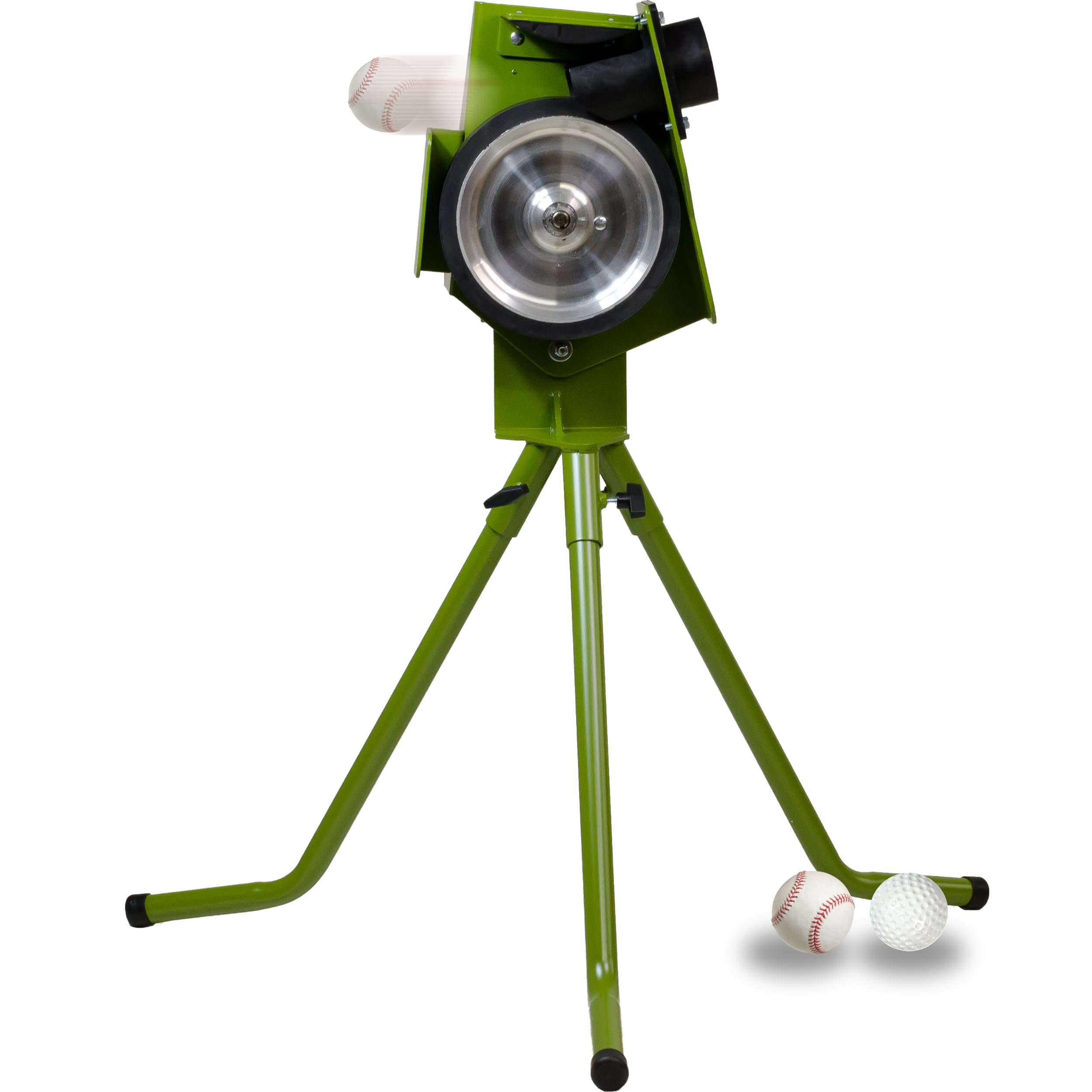
The Mound Yeti is the two-sport workhorse — a single-wheel machine that swings between baseball and softball with a pair of chutes so you can alternate in the same session. Speed adjusts from 30 to 60 mph for beginners and machine-pitch-league players, and it throws fastballs and grounders. A steel frame and reversible steel legs let you change pitch height between the two sports. It rolls out at 50 pounds and backs itself with a 2-year limited warranty.
The release heights are the details that separate this from a strict baseball machine. In baseball configuration the ball leaves at 37.5 inches; in softball configuration it drops to 27.5 inches, so the delivery shape matches each sport instead of forcing a compromise. Owners run it for batting and fielding drills with equal confidence, one calling it “great for practice ground balls, batting, pop flies,” and noting it travels easily and runs off a portable power bank when there is no outlet nearby.
The thing to know about the Yeti is that it is picky about what it eats. It wants hard baseballs, not soft training balls, and synthetic balls leave residue that takes real scrubbing to clear off the wheel. The speed knob is also touchy — you have to turn it slowly to land on the same number twice. Weight draws mixed reports: some find it light enough to move, others find it bulky to load into a truck. Pair it with the right balls and a steady hand on the dial, and it is a strong value for a team juggling two sports.
Two sports, one frame
- Two chutes switch between baseballs and softballs
- Reversible steel legs change pitch height, 37.5 in for baseball and 27.5 in for softball
- 30–60 mph covers youth through machine-pitch leagues
- 2-year limited warranty and steel construction
Feeding and dialing rules
- Wants hard baseballs — synthetic balls leave residue on the wheel
- Speed knob is touchy and needs a slow turn to repeat a setting
- Weight is easy for some to move and heavy for others
Pick this one if: your household or team runs baseball and softball practices through the same machine.
Look elsewhere if: you want one-touch speed changes or need to store the machine in a tight space.
6. JUGS PS50 Baseball and Softball Pitching Machine

Little League’s steady hand — a 50 mph machine that throws both baseballs and fastpitch softballs.
The PS50 is JUGS’s entry-level machine, and it is built for the family that wants a dependable trainer without the cost of a top-tier unit. A digital readout display shows your speed setting, and a patented “always see the ball” delivery system keeps the release point visible to the hitter. It throws up to 50 mph from 50 feet, and it handles both regulation baseballs and softballs, including perfect arching tosses for slowpitch. Quick-Snap legs and a grip-and-go handle make it easy to set up and move.
That 50-pound solid-steel construction is the trade: it feels planted and stable when it pitches, and it delivers the same pitch repeatedly. A non-marking 9-inch pneumatic tire rolls it around, and the machine ships preconfigured for baseball with a softball bracket included. Setup is straightforward, and the motor runs at a reasonable volume even near its top speed. The 1-year guarantee covers the machine itself.
The wrinkles are minor but worth planning for. The motor runs hot after about 30 minutes of continuous use, so you will need to clean the balls and wheel and give it a rest between long sessions. One owner noted the machine destroys leather balls over time and that the feeder bolt loosens periodically. If you are fine with routine maintenance and want a machine that throws clean, repeatable 50 mph pitches for little-league hitters, this is a solid reliable option. If you need to pitch at 70 mph, this is not the machine — step up to the BP1 above.
Where it earns its keep: a digital readout, a visible release point, and preconfigured baseball setup with softball bracket in the box mean a family can be practicing in minutes.
The maintenance reality: the motor wants cool-down time after about a half hour, and leather balls wear faster on its pneumatic tire.
Right when: you coach little-league baseball or fastpitch and want a 50 mph trainer that moves easily and handles both ball types.
Not enough if: your hitter needs speeds above 50 mph or breaking pitches.
7. BSN Sports Bulldog Baseball/Softball Pitching Machine

A 110-volt backyard machine that throws baseballs and 11- and 12-inch softballs from the same frame.
The Bulldog runs on standard household current or a generator, and its 1/4 HP DC motor spins a urethane wheel that never loses air pressure. It throws baseballs along with 11-inch and 12-inch softballs, and the heavy-duty legs convert for either sport. Speed ranges from 30 to 60 mph, and the entire machine weighs 50.6 pounds — light enough to roll between the backyard, a cage, and the field. Reliability is what owners mention first, and it is the aspect owners call out most often.
It plays nicely with a range of practice balls. Dimple balls run accurately and consistently, and quality leather balls with raised stitching work well too. The metal guard over the motor takes a line drive without flinching, and a pair of dials adjust speed and height without any drift during a session. Families using it in a 40-foot cage for hitters aged 7 to 10 get solid accuracy off same-weight balls. It even edged out a machine several times its cost in one owner’s cage testing.
Two honest caveats. First, the solid rubber wheel marks balls and bats black over time and wears faster with real baseballs, so keep machine balls on hand for daily work and save the leather for game prep. Replacement wheels run a meaningful fraction of the machine’s cost, so longer sessions shorten the wheel’s life. Second, one owner reports the machine arrived damaged with loose bolts working free over time, so check fasteners after the first few sessions. The counterweight is that buyers rate this machine among the best values in the category, and it holds steady through years of regular use.
The value story
- 30–60 mph range with a urethane wheel that never needs air
- Throws baseballs plus 11- and 12-inch softballs
- Runs on 110V AC or a generator with a convertible-leg base
- Metal motor guard shrugs off line drives
Owner notes worth knowing
- Rubber wheel marks balls and bats and wears faster with real baseballs
- Replacement wheels cost a significant share of a new machine
- Occasional reports of arriving with loose bolts
Best value for: backyard coaches and families who want baseball and softball practice from one corded machine.
Weigh against it: needing to buy a replacement wheel eventually if you run real baseballs through it daily.
8. Zooka ZS740 Baseball Pitching Machine

Battery-powered and cordless — 700 to 900 pitches without hunting for an outlet.
The Zooka ZS740 is the machine you take to the field with no outlet in sight. Its built-in battery throws 700 to 900 pitches on a single charge, and it packs down without tools to fit in a car trunk. Speed adjusts from 10 to 70 mph, and a telescoping tripod with a short-tripod option lets you deliver grounders, fly balls, line drives, and strikes. It weighs under 30 pounds with the tripod, and it fires baseballs, dimple balls, safety balls, and tennis balls.
The safety details matter when the machine is pitching to a child. Built-in features include a password lock and optic sensors, plus a pitch-alert beeper that sounds before every throw so the batter knows one is coming. The machine also rotates side to side for fielding work. Customers note the battery lasting a full practice and beyond — one buyer ran it nonstop for two hours at half capacity without any drop in performance. Its cordless design is what keeps it in play on real diamonds and in fields with no power.
What to know before you buy: the Zooka relies on clean balls. Older, dirty, or wet balls get heavier and throw less accurately, so keep your ball bag tight and dry. It also throws with no spin because it is air-powered, so it delivers straight pitches rather than breaking balls. Durability carries mixed reports, with most units running for years and one owner noting an early failure resolved under warranty. For the 6-to-13 age range and family or youth-league practice, this is the most portable machine in the group.
What makes it stand out: cordless battery power for 700 to 900 pitches and a push-button safety system with a pitch-alert beeper.
The plain limitation: no spin on the ball, and accuracy depends on keeping balls clean and dry.
Go cordless with: family and youth-league practice where there is no power and portability matters most.
Pass if: you need curveballs and sliders or expect season-after-season commercial-level durability.
9. JUGS BP1 Baseball/Softball Combo Pitching Machine
The two-sport combo machine with a 70 mph ceiling and a 360-degree swivel base.
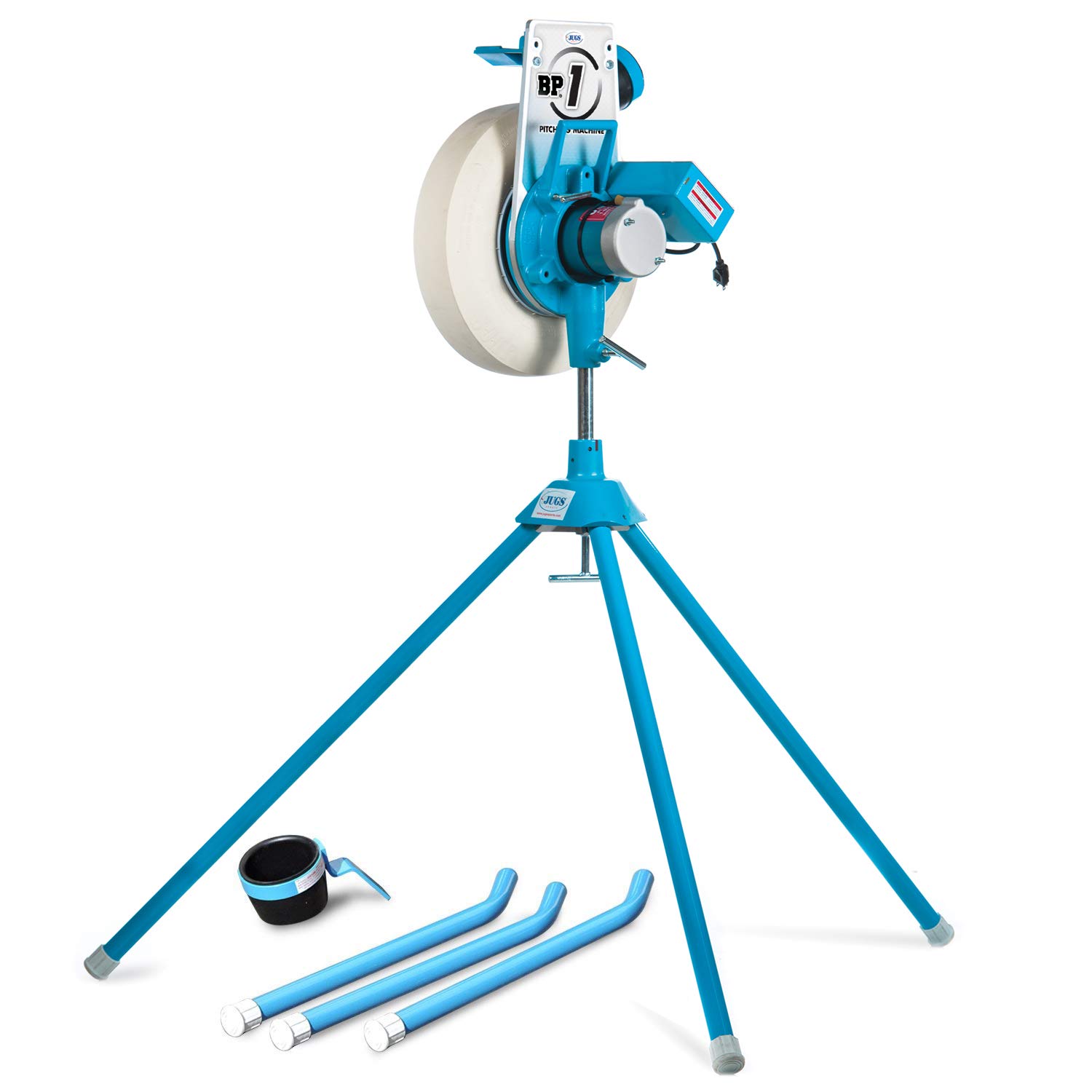
The BP1 is JUGS’s combo machine — it throws baseballs or softballs up to 70 mph with a digital readout display, and it delivers from a realistic height so the pitch shape matches a real pitcher’s release. A swivel-design base rotates 360 degrees for fly balls, pop-ups, and ground balls. The ball menu is the widest in this guide: 11- and 12-inch softballs, baseballs, Sting-Free baseballs in dimpled and seamed versions, Sting-Free softballs, tennis balls, Lite-Flite baseballs and softballs, SOFTIE balls, the JUGS Pearl, and LeatherLast softballs. It runs on 110-volt AC, a Yamaha EF2000iS V2 inverter generator, or an optional practice battery pack. A 2-year guarantee backs it.
Owners who buy this machine stay with the brand. One reports a JUGS double-wheel unit pitching for fifteen-plus years and training many players, and they mean it when they say it lasts. On the BP1 specifically, owners love that it throws from a realistic delivery height so hitters read pitch shape closer to game day. The swivel base turns it into a fielding machine at the twist of a hand, and it has no trouble moving from baseball reps to softball reps in a single practice. Consistent strikes with no post-pitch drift are what buyers come back to.
The BP1 is the heaviest machine here at 75 pounds, and it needs a cart-like roll or a helper to reposition. It runs corded or off a portable generator or battery pack, which is flexible but adds cost. Owner experiences land on the positive side — one buyer received a damaged unit and had a replacement assembled from spare parts and shipped in days. If your program spans baseball and softball and you want one machine to cover both, this closes the gap. The team that needs to move fast between sports will get more out of this than any single-sport machine.
Two sports, one machine
- 15–70 mph with a digital readout for setting exact speed
- Throws baseballs and 11- and 12-inch softballs from a realistic height
- 360° swivel base handles fly balls, pop-ups, and ground balls
- Runs on 110V AC, a Yamaha generator, or an optional battery pack
What to plan around
- 75 pounds — needs a helper or a cart to reposition
- Battery pack and generator are separate purchases
- Overkill for a single-sport youth player
Best for: a program or serious household juggling baseball and softball that wants one premium machine to cover both sports.
Skip if: a single sport and a single age group are all you coach.
Understanding the Specs
Wheel Count and Pitch Type
A machine’s wheel count decides which pitches it can throw. One wheel grips the ball on a single surface, so it throws fastballs and grounders — that covers youth leagues and basic batting work. Two wheels add a second spin axis for more pitch variety, and three wheels, like the Junior Hack Attack, spin the ball on a third axis so the machine can throw curveballs, sliders, split-fingers, and knuckleballs. If your hitter needs breaking pitches, the wheel count is the line between a machine that can and one that cannot.
Speed Range and the Real Number
Speed is printed as a range — for example 30 to 60 mph or 15 to 70 mph — but the top figure only means something when it matches the ball you use. Some machines reach their ceiling with lightweight dedicated balls; others get there with standard baseballs. Read between the lines: a machine quoting 70 mph with a specific training ball may pitch slower with a regulation baseball. Match the top speed to the ball you will actually feed it.
Weight and Portability
Portability is the spec you feel every practice. At 20 pounds, the Louisville Slugger Blue Flame Pro goes from trunk to setup alone, while at 96 pounds, the Junior Hack Attack needs two people to move and store. If you move between a garage, a cage, and a field, weight matters more than the printed speed range. Look for rolling wheels, quick-snap legs, and a grip handle if you will be the only one moving it.
Power Source and Ball Type
Most machines run on 110-volt AC household current, which means an outlet or extension cord. A few, like the Zooka ZS740, run on a built-in battery for 700 to 900 pitches, and others accept a portable inverter generator or battery pack for field use with no outlet. Ball type ties into this too — different machines prefer standard baseballs, dimple balls, leather balls, softballs, or training balls. Match the power source and ball menu to where and how you practice.
FAQ
Can a pitching machine throw curveballs and sliders?
Will a pitching machine work with softballs and baseballs?
How fast should my pitching machine throw for a young hitter?
Do pitching machines need a power outlet?
Will a pitching machine damage my baseballs?
How much does a pitching machine weigh and can one person move it?
Can a pitching machine throw grounders and fly balls too?
What kind of balls should I feed a pitching machine?
Is a pitching machine accurate enough for real batting practice?
Do pitching machines need assembly from the start?
Can I use a pitching machine on a field with no power nearby?
Final Thoughts: The Verdict
The best ball pitching machine for most families is the Junior Hack Attack, because its three-wheel head throws real breaking pitches and its pivoting head covers grounders and fly balls — a whole practice in one unit for the serious youth and teen hitter. If you want cordless portability on a field with no outlet, grab the Zooka ZS740 and get 700 to 900 pitches per charge. And for a two-sport household juggling baseball and softball, the JUGS BP1 throws both up to 70 mph with a 360-degree swivel base that doubles as a fielding machine. Whichever you pick, match the wheel count and speed range to your hitter’s level first — that one decision keeps practice productive for years.
How We Picked
We do not accept paid placement. Every pick is matched to a real buyer and a real use-case; we do not hands-on test units.
Sources & Methodology
Specifications: manufacturer listings and product documentation. Review insights: verified customer reviews, as of September 2026. Pricing: not shown on this page (it changes often); check the current price via the retailer link.
As an Amazon Associate, Gadgets Feed earns from qualifying purchases. This does not affect which products we feature.