
Our readers keep the lights on and my morning glass full of iced black tea. As an Amazon Associate, I earn from qualifying purchases.
Specs are compiled from manufacturer listings and verified buyer reviews and can change over time — please confirm the key details on the product page before buying.
The wrong banana palm tree can outgrow your space, fruit only once a decade, or arrive half-dead. You need a variety that actually fits your space, your growing zone, and your patience level—and the data on which starter plant survives shipping and produces real fruit. That is exactly what this guide cuts through.
I’m Min — the founder and writer behind Gadgets Feed. This guide is built by comparing the manufacturers’ published specifications and the patterns across verified customer reviews, so you get each pick’s real strengths and trade-offs instead of marketing spin.
Whether you have a sunny patio, a humid greenhouse, or just a bright indoor corner, the right banana palm tree starter can turn your space into a legitimate source of homegrown fruit in a single growing season — bringing a taste of the tropics without the airfare.
Quick Picks
- Banana Plants Double (Mahoi) Includes Four (4) Plants — Best Overall
- Banana Tree Dwarf Cavendish (4 Pack) Live Banana Plant — Top Value
- Ice Cream Banana Plant – Live Banana Tree Ice Cream Rare Banana Plant — Unique Flavor
- American Plant Exchange Dwarf Banana Plant – Live 6-Inch Potted — Indoor Favorite
- Truly Tiny Banana Tree – 4 Live Starter Plants – Musa – Edible Fruit Bearing Tree — Compact Choice
- Kokopo Banana Tree – 4 Live Starter Plants – Musa – Edible Fruit Bearing Tree — Rare Cultivar
- Banana Tree – 3 Live Plants in 4 Inch Growers Pots — Foliage King
How To Choose The Best Banana Palm Tree
Three specs decide whether your banana palm becomes a showpiece or a mushy stem. Here is what actually matters.
Expected Plant Height vs. Your Space
A banana tree is technically a giant herb, not a woody tree, so it can shoot up fast. “Dwarf” varieties still reach 5 to 7 feet tall, while standard types like the Ice Cream Banana top out at 12 feet. Measure your ceiling height if you are planting indoors, and plan for the mature size — not the cute 4-inch starter you receive.
Unit Count: How Many Starters You Get
Some sellers ship one plant in a 4-inch pot; others ship four starter plants in 2-inch tray pots. A 4-pack gives you redundancy — if one dies during shipping or acclimation, you still have other plants left. A single premium plant puts all your hopes on that one root ball.
USDA Hardiness Zone
Bananas are tropical plants. Most varieties survive year-round only in zones 9b through 11. If you live in zone 8 or colder, you will need to bring the pot indoors before the first frost or treat the plant as an annual. Check the product’s zone range against yours before buying.
Quick Comparison
On smaller screens, swipe sideways to see the full table.
| Model | Best For | Plant Height | Unit Count | Sunlight | Amazon |
|---|---|---|---|---|---|
| Double (Mahoi) | Fruit novelty indoors | 7 Feet | 4 Count | Full/Partial Sun | $26.99Amazon |
| Dwarf Cavendish 4-pack | Fast fruiting for beginners | 10 Feet | 4.0 Count | Full Sun | $28.99Amazon |
| Ice Cream Banana | Unique flavor, tall growth | 12 Feet | 1 Count | Full Sun | $34.94Amazon |
| Dwarf Banana (American Plant Exchange) | Indoor décor + fruit | — | 1 Item | Bright Indirect/Full Sun | $36.43Amazon |
| Truly Tiny Banana Tree | Compact patio tropical | — | 4 Count | Full Sun | $37.35Amazon |
| Kokopo Banana Tree | Rare variety collector | — | 4 Count | Full Sun | $43.65Amazon |
| Banana Tree 3-Pack | Large lush foliage | — | 3 Count | Full Sun/Partial Shade | $75.21Amazon |
In‑Depth Reviews
1. Banana Plants Double (Mahoi) Includes Four (4) Plants

The dwarf that packs a twin-fruit punch — 7 feet tall with the party trick of doubling your harvest.
You get two large fruit heads on one stalk with this “Mahoi” variety (the word means “twins” in Hawaiian), and on rare occasions it pushes out three. That double-head fruit production is the main reason to pick it over the single-head Dwarf Cavendish 4-pack. At an expected plant height of 7 feet, versus the Dwarf Cavendish at 10 feet and the Ice Cream Banana at 12 feet, it fits a patio or a sunroom with an 8-foot ceiling. Buyers report the plants “arrived quickly, well-packaged, healthy” — which matters because banana starters can look rough after transit. The 4-count unit gives you four starter plants in 2-inch tray pots, shipped at 3-6 inches tall, so you have four chances for a strong survivor. The plant thrives in USDA zones 9b-11 (the U.S. Department of Agriculture’s hardiness zones that tell you which climates the plant can survive winter in) with moderate watering and sandy soil. One reviewer in zone 8a found the leaves yellowed in full sun, so if you live north of zone 9, partial shade may be safer. skip it if you need a single, large, show-ready plant immediately — these come as 3-6 inch starters that need weeks to grow.
Why it wins
- Unique double-head fruit production — you get more bananas per plant
- Four starter plants for the price of one premium single
- Dwarf size (7 ft) fits most patios and indoor spaces
The trade-offs
- Not for cold climates — only hardy in zones 9b-11
- Some plants arrive with slight shipping stress (yellowing, torn leaf)
Best for: The buyer who wants the fun of a rare fruiting novelty with the safety net of multiple starter plants.
Look elsewhere if: You need a single, large, show-ready plant immediately — these come as 3-6 inch starters that need weeks to grow.
2. Banana Tree Dwarf Cavendish (4 Pack) Live Banana Plant

Four tiny starters that can rocket to 10 feet by the end of a Texas summer.
If you want a classic edible banana at a bargain per-plant cost, this 4-pack of Dwarf Cavendish is tough to top. The expected plant height is 10 feet — versus the Double Mahoi at 7 feet and the Ice Cream Banana at 12 feet — so you get a bigger trunk and larger leaves without the extreme height. Owners mention the plants “arrived alive and healthy; adapted well indoors then ground,” though the initial size is tiny: about 3 inches. One reviewer in humid Texas noted that after less than 6 weeks, the plants had “grown huge,” proving the growth rate is genuinely fast with enough sun and water. The 4.0 count gives you four starters, but some buyers received broken plants due to packing issues. The brand, Fam Plants, uses a reflective heat wrap that kept one shipment alive even in a freezing mailbox. Full sun is a must — these are not shade lovers. Moderately water and step up the pot size as the roots grow to maximize speed. Watch out: the tiny 3-inch starters require careful acclimation — one reviewer noted both orders died despite trying everything. Read up on banana care before you plant.
Even if one or two fail, you may still have surviving plants for a banana patch.
Reach for this if: You want the highest chance of at least one plant surviving to fruit, thanks to the 4-pack redundancy.
Watch out: The tiny 3-inch starters require careful acclimation — one buyer mentioned both orders died despite trying everything. Read up on banana care before you plant.
3. Ice Cream Banana Plant – Live Banana Tree Ice Cream Rare Banana Plant

The 12-foot giant that tastes like vanilla custard right off the stalk.
You get a very sweet, creamy dessert banana with a hint of vanilla flavor — the brand describes it as “among the best-tasting” bananas. The expected plant height is 12 feet, versus the Dwarf Mahoi at 7 feet and the Dwarf Cavendish at 10 feet, so it demands serious vertical space. One buyer in zone 9a (a USDA hardiness zone that indicates the average minimum winter temperature) reported it was the strongest banana plant from any seller and the first to fruit, ordering it in spring 2018 and watching it flower. Another reviewer noted the plant “tripled in size in 3 months” indoors under lights, hitting 15+ feet indoors before being moved outside. That is a growth rate you will not see from the smaller dwarfs. The seller, Natures Garden Nursery, ships a single plant in a 4-inch pot at 4-8 inches tall. It handles zones 8-11, versus the Mahoi at 9b-11. But one reviewer in Arkansas lost it when a sudden 10°F night hit after weeks of upper-20s — so zone 8 still needs winter protection. pass on it if you only have a 6-foot ceiling or your winters drop below 15°F without a heated greenhouse.
What stands out
- Unique vanilla-hint flavor that is nothing like store-bought Cavendish
- Fast, vigorous grower — triples in size in 3 months according to buyers
- One of the best-tasting dessert bananas (sellers claim “among the best”)
The drawbacks
- Tall — needs 12+ feet of headroom or outdoor planting
- Single plant; if it dies in shipping, you get nothing
- Some buyers found it challenging to keep alive indoors over winter
Grab it for: The adventurous grower who wants a standout flavor and has space for a 12-foot tree.
it’s not for you if: You only have a 6-foot ceiling or your winters drop below 15°F without a heated greenhouse.
4. American Plant Exchange Dwarf Banana Plant – Live 6-Inch Potted

A two-foot-tall starter that arrived with a bonus sprout — but no guarantee it fruits.
If you plan to keep your banana palm tree in a pot indoors year-round, this is the strongest candidate. It is a Dwarf Cavendish (Super Dwarf variety) shipped in a 6-inch nursery pot at about 2 feet tall, which is already a substantial size compared to the 3-inch starters from the Dwarf Cavendish 4-pack. A reviewer reported the plant “came about two feet tall and has another sprout already,” though the same buyer later updated that it died before yielding fruit — a reminder that indoor bananas are a challenge to fruit without a very sunny window or grow lights. At 5 pounds shipped weight, this is a heavier, better-established plant than the tiny tray pots. The brand, American Plant Exchange, lists it for indoor and outdoor use, thriving in bright indirect to full sunlight with moderate watering. It blooms in fall and is best planted in spring. The lush green foliage alone makes fine indoor jungle décor, even if fruit never appears.
The honest take: You are paying for the instant “tropical tree” look more than guaranteed fruit. The 6-inch pot and 2-foot height give you a head start that the other starters lack, but indoor humidity and light are tough hurdles for fruit production.
Choose this for: A decorative houseplant with fruit potential — treat the fruit as a bonus, not the expectation.
Reconsider if: You absolutely need to harvest bananas this year; you are better off with a 4-pack of outdoor starters in a sunny zone.
5. Truly Tiny Banana Tree – 4 Live Starter Plants – Musa – Edible Fruit Bearing Tree
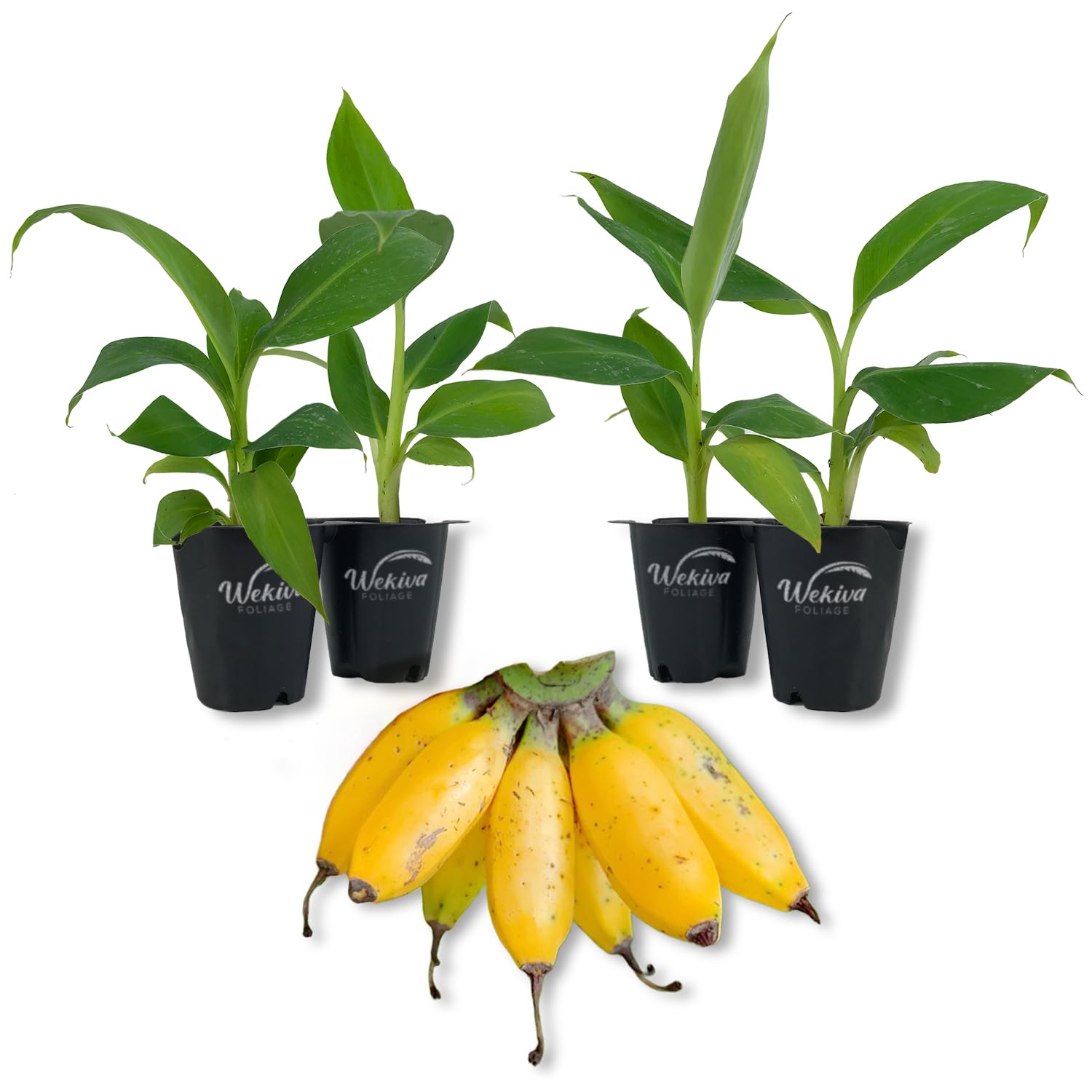
A 22-pound shipment of “Truly Tiny” starters that need 8-12 hours of sun daily.
Despite the name “Truly Tiny,” these are starter plants expected to grow into a full banana tree — the “tiny” refers to the fruit size, not the plant itself. Wekiva Foliage ships this as a 1.0 count unit, though the reviews mention Gros Michel bananas, which suggests the style is a compact fruiting variety. At 22 pounds shipped, this is the heaviest starter package in the list, indicating sturdy root balls and soil — the Kokopo Banana Tree is listed at 1 pound shipped. One buyer successfully kept 3 of 4 plants thriving under 12-hour red/blue grow lights for 2.5 months, proving this variety responds well to controlled indoor lighting. Full sun is non-negotiable: 8-12 hours of direct sunlight daily. Partial shade slows growth noticeably. The brand touts air purification as a special feature, though buyer reports are mixed — some received plants with spotted dead leaves and no pots, while others got “large and healthy” specimens. Spring blooming season means you plant in spring for summer foliage. Not for anyone unwilling to set up a strong light system — partial sun will leave this plant stuck in slow growth.
What works
- Heavy, well-packed root balls — 22 pounds suggests generous soil
- Loves 12-hour grow lights, great for indoor setups
- Technically an herb, not a woody tree, so it regrows fast if cut back
What does not
- Inconsistent shipping — some plants arrive not in pots with dead leaves
- Aggressive sun requirement; shade-tolerant buyers have struggled
Ideal for: The dedicated indoor grower who can run grow lights 12 hours a day and wants a true miniature fruit variety.
Not for: Anyone unwilling to set up a strong light system — partial sun will leave this plant stuck in slow growth.
6. Kokopo Banana Tree – 4 Live Starter Plants – Musa – Edible Fruit Bearing Tree
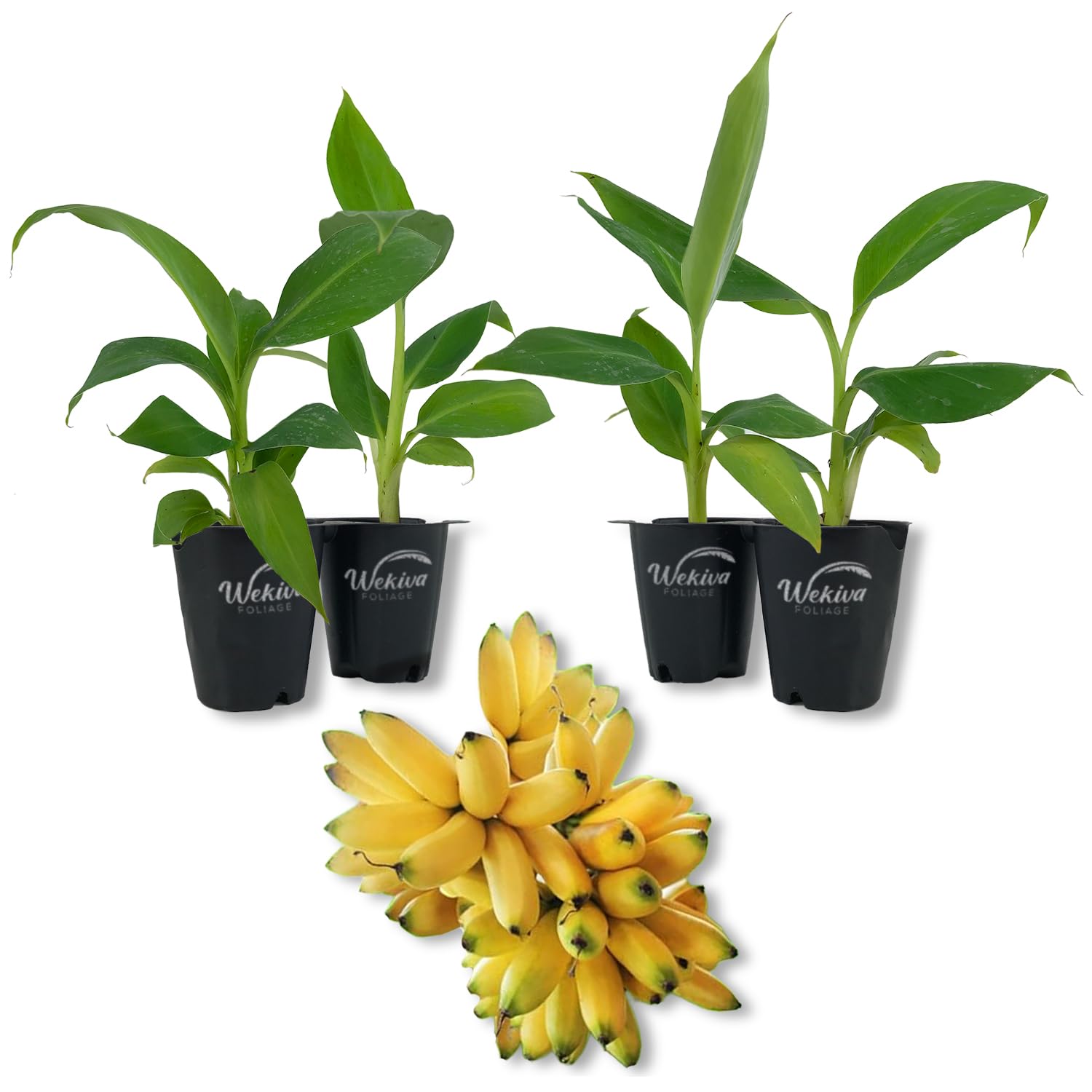
A rare Kokopo variety that weighs just 1 pound shipped — but 2 out of 4 died in one buyer’s hands.
The Kokopo is a lesser-known banana cultivar sold by Wekiva Foliage, and it is the lightest starter in the list at 1 pound shipped, while the Truly Tiny Banana Tree is listed at 22 pounds shipped. That low weight suggests small, soil-less root plugs rather than heavy nursery pots. Buyer reviews are shared with other Wekiva Foliage banana products: one reviewer successfully kept 3 of 4 Gros Michel plants alive under grow lights, while another reported “plants leaves spotted and dead. Not in pots.” A third buyer bluntly wrote “Two died.” Like all banana plants, the Kokopo needs full sun (8-12 hours daily) and well-draining soil that never pools water. The lack of a listed expected plant height or zone range in the data means you are buying into the unknown a bit — it is a gamble for collectors who want something you cannot find at a big-box nursery. The product title indicates 4 live starter plants. Pass if you want a guaranteed success on your first try — the Dwarf Cavendish 4-pack has far more positive reviews at a similar cost.
The honest word: This is a high-risk, high-novelty pick. The 1-pound shipping weight and mixed buyer experiences (3 of 4 survived vs. “not as advertised”) mean you should only buy this if you have experience rehabbing stressed plants and want a variety not sold at Home Depot.
Reach for this if: You are a banana collector who wants a cultivar you cannot find locally and you know how to nurse a stressed plant back to health.
Pass if: You want a guaranteed success on your first try — the Dwarf Cavendish 4-pack has far more positive reviews at a similar cost.
7. Banana Tree – 3 Live Plants in 4 Inch Growers Pots

Three established root systems in 4-inch pots — but the leaves may arrive crushed from shipping.
You get three live plants in 4-inch growers pots with this “Grower’s Choice” pack from Wekiva Foliage, where the specific variety is chosen based on availability. That could be a Dwarf Cavendish, a Grand Nain, or another common edible banana, so you do not know exactly what type you are getting until it arrives — unlike the Double Mahoi where you know the exact variety. One buyer received a plant with a “VERY established root system” and was happy, while another reported “the leaves were all smashed down and some are broken” due to transit damage. The seller recommends planting in spring, using loam soil, and watering regularly — not moisture-sensitive like sand-based bananas. The shipment is meant to create a lush tropical atmosphere indoors or on a patio, with the iconic large, oblong bright green leaves. The product’s own description honestly states that even without fruits indoors, the exotic beauty is the main draw. It handles full sun to partial shade, making it more flexible than the strict full-sun-only varieties like the Dwarf Cavendish. The pack contains 3 live plants. Skip if you need to know exactly which banana species you are planting and expect perfect leaf condition on arrival.
What you get
- Three plants in real 4-inch pots — more established than tiny tray starters
- Accepts partial shade, so less sun-demanding than most bananas
- Established root system noted by a buyer — good chance of survival
What you risk
- Unknown variety — “Grower’s Choice” means you do not pick the cultivar
- Leaves frequently arrive damaged from shipping constraints
- Premium pricing for an unknown species
Best for: Someone who values the instant tropical foliage look over fruit production and does not mind a mystery variety.
Skip if: You need to know exactly which banana species you are planting and expect perfect leaf condition on arrival.
Understanding the Specs
Expected Plant Height
This is the adult size of the banana plant, which is technically a giant herb, not a woody tree. A “dwarf” Cavendish reaches about 7-10 feet tall, while an Ice Cream Banana can tower 12 feet. If you are growing indoors, you need a ceiling at least 2 feet taller than the expected height or you will have to prune or move the plant. Measure your space first.
USDA Hardiness Zone
This tells you which climates the plant can survive winter in. Most edible bananas are rated zone 8-11 or 9b-11. If your zone number is lower (colder), the banana will die if left outside in frost. You can still grow it — just in a pot that you move indoors before the first freeze. Ignoring this spec is the most common reason first-time banana buyers lose their plant in year one.
Unit Count vs. Number of Pieces
Some sellers list “4 Count” meaning you receive 4 separate starter plants. Others list “1.0 Count” meaning a single plant or a single pack. More plants give you redundancy: if one dies, others can still fruit. Fewer plants generally means larger individual pots. Always read the “About this Item” section to confirm how many actual plants are in the shipment, because “Count” is not standardized across sellers.
FAQ
How long does it take a banana palm tree to produce fruit?
Can a banana palm tree survive winter indoors?
What is the difference between Dwarf Cavendish and Ice Cream Banana?
Will a banana tree grow in a pot indoors?
How many banana plants should I start with to guarantee fruit?
Do banana trees really need full sun?
Why did my banana plant die after shipping?
Can I grow a banana tree in zone 7?
What is the “Mahoi” banana variety?
Final Thoughts: The Verdict
For most buyers, the banana palm tree winner is the Banana Plants Double (Mahoi) Includes Four Plants because it packs a unique double-fruit novelty with the safety net of four starter plants at a reasonable entry cost. If you want the sweetest, most unique flavor and have the ceiling height for it, grab the Ice Cream Banana Plant. And for a budget-friendly indoor tropical look with a chance of fruit, the standout is the Dwarf Cavendish 4-pack for sheer growth speed and redundancy.
How We Picked
We do not accept paid placement, and we did not hands-on test every unit. Instead, we match each pick to a real buyer and use-case by comparing the manufacturers’ published specifications against the patterns in verified customer reviews — so you get each pick’s real strengths and trade-offs instead of marketing copy.
Sources & Methodology
Specifications: manufacturer listings and product documentation. Review insights: verified customer reviews, as of July 2026. Pricing: not shown on this page (it changes often); check the current price via the retailer link.
As an Amazon Associate, Gadgets Feed earns from qualifying purchases. This does not affect which products we feature.
Product prices and availability are accurate as of the date/time indicated and are subject to change. Any price and availability information displayed on Amazon at the time of purchase will apply to the purchase of this product. As an Amazon Associate I earn from qualifying purchases.
CERTAIN CONTENT THAT APPEARS ON THIS SITE COMES FROM AMAZON. THIS CONTENT IS PROVIDED "AS IS" AND IS SUBJECT TO CHANGE OR REMOVAL AT ANY TIME.
Amazon and the Amazon logo are trademarks of Amazon.com, Inc. or its affiliates.