
Our readers keep the lights on and my morning glass full of iced black tea. As an Amazon Associate, I earn from qualifying purchases.
Specs are compiled from manufacturer listings and verified buyer reviews and can change over time — please confirm the key details on the product page before buying.
Banana plugs are the quickest way to clean up your speaker wire mess. Instead of stripping, twisting, and hoping bare wire stays put inside a tiny hole, you just crimp one of these onto the end and click it into your receiver or speaker. No fraying, no shorts, no fuss.
I’m Min — the founder and writer behind Gadgets Feed. This guide is built by comparing the manufacturers’ published specifications and the patterns across verified customer reviews, so you get each pick’s real strengths and trade-offs instead of marketing spin.
The thing is, not all of them grip wire the same way, and a loose plug means lousy sound and a frustrating day. That is why we sorted through the top-rated options to find the best banana plug connectors for your setup and skill level.
Our Picks at a Glance
How To Choose The Best Banana Plug Connectors
Picking the right banana plug means looking past the gold color. Focus on how it grips the wire, what wire sizes it accepts, and whether the installation method matches your patience level. Here are the three factors that separate a reliable connection from a frustrating one.
Connection Mechanism: Crimp, Screw, or Solder
The way a plug grabs the wire determines how long it stays tight. Tool-free crimp plugs use self-crimping teeth that bite into the wire as you press them in — fast, no tools needed, great for quick jobs. Dual-screw plugs use small set screws to clamp the wire down manually. They take a tiny screwdriver and a bit of time, but the hold is extremely secure. Solder connections give the strongest bond but require a soldering iron and steady hands.
Wire Gauge Compatibility
Every plug lists a range of wire sizes it works with, measured in AWG (American Wire Gauge). A lower AWG number means thicker wire. Most receivers and speakers use 14 or 12 AWG wire. If a plug only goes up to 18 AWG, it may not close properly around a thicker 12 AWG wire, leading to a weak grip. Check that the plug’s max wire size matches the cable you plan to use.
Build Quality and Plating
The material of both the plug body and the contact tip matters for signal quality and long life. Gold plating over brass or copper prevents corrosion (rust) on the contact surface, which keeps the signal path clean over years. A brass or copper alloy body resists impact better than thin steel. The type of gold plating matters too — some brands use a direct plating method that skips a nickel underlayer, which they claim avoids signal distortion.
Quick Comparison
| Model | Best For | Connection Type | Max Wire Size (AWG) | Gold Plating | Amazon |
|---|---|---|---|---|---|
| Sewell Deadbolt 5-Pair★ Best Overall | Quick, reliable installs | Self-Crimping | 8 AWG | 24K over Steel Tip | Amazon |
| Nakamichi FanLockPremium Pick | Secure locking connection | FanLock (Screwless) | 10 AWG | 24K Direct Gold | Amazon |
| VCELINK 6-PairBest Value | Dual-screw security | Dual-Screw | 12 AWG | 24K Gold Plated | Amazon |
| Goupchn 10-Pack | Stackable test leads | Set Screw | — | Nickel Plated | Amazon |
| Amazon Basics 6-Pair | Budget-friendly bulk | Self-Crimping | 12 AWG | 24K Gold Plated | Amazon |
| AutCreation 1-Pair Cables | Pre-made cable solution | Fixed (Pre-Attached) | 14 AWG | Gold Plated | Amazon |
| FosPower 10-Pair | High volume, solid grip | Dual Set-Screw | — | 24K Gold Plated | Amazon |
| Goaycer 14 AWG Cables | Premium pre-terminated wires | Welded (Pre-Attached) | 14 AWG | 24K Gold Plated | Amazon |
| Sewell Right-Angle 12-Pair | Tight spaces behind gear | Self-Crimping | 8 AWG | 24K over Steel Tip | Amazon |
In‑Depth Reviews
1. Sewell Deadbolt Banana Plugs 5-Pairs
Our pick — over 4.5★ from 14,500+ verified ratings; the strongest balance of quality and price.
A tool-free crimp plug that makes speaker wire termination feel almost too easy.
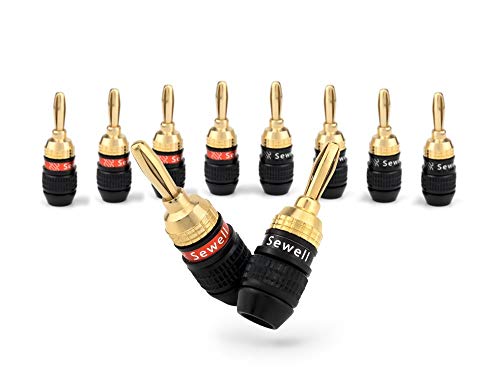
The Sewell Deadbolt is the crowd favorite for good reason — it uses self-crimping teeth so you just push the wire in and clamp the collar down, no screwdriver or soldering iron needed. It handles wire up to 8 AWG (the company suggests 10 AWG) and the tip diameter is 4.6mm, compressing to a standard 4mm for a firm fit in your receiver or speaker binding posts. The fast lock design removes the guesswork from a messy job.
Owners of these plugs routinely mention how solid the connection feels on 14 and 12 AWG cable, and the rubber-coated barrel helps keep stray strands from shorting against neighboring terminals. The biggest positive by far is the ease of installation, with a huge number of buyers reporting that the plugs work exactly as described on a WiiM Amp and Klipsch speakers, or for surround sound installations. The small trade-off? Because these are pressure-fitted rather than locking, they may loosen over time if you frequently reconfigure your system. The set includes 5 pairs with red and black polarity labels.
Why owners love it
- Tool-free crimp cuts install time to seconds per wire
- Fits thick wire up to 8 AWG for heavy-duty setups
- Short barrel makes it work in tight jacks
What to watch for
- Not a locking plug; may need re-tightening if moved often
- Some users report the hole is large for thinner wire, needing strand adjustment
Grab these if: you want a fast, reliable, no-tool solution for a home theater or stereo setup with 14 AWG to 12 AWG wire.
Look elsewhere if: your gear is behind a cabinet where plugs will be swapped weekly — a locking design may suit you better.
2. Nakamichi FanLock Excel Series Banana Plugs
A locking plug from a legendary Japanese brand engineered for zero signal loss.
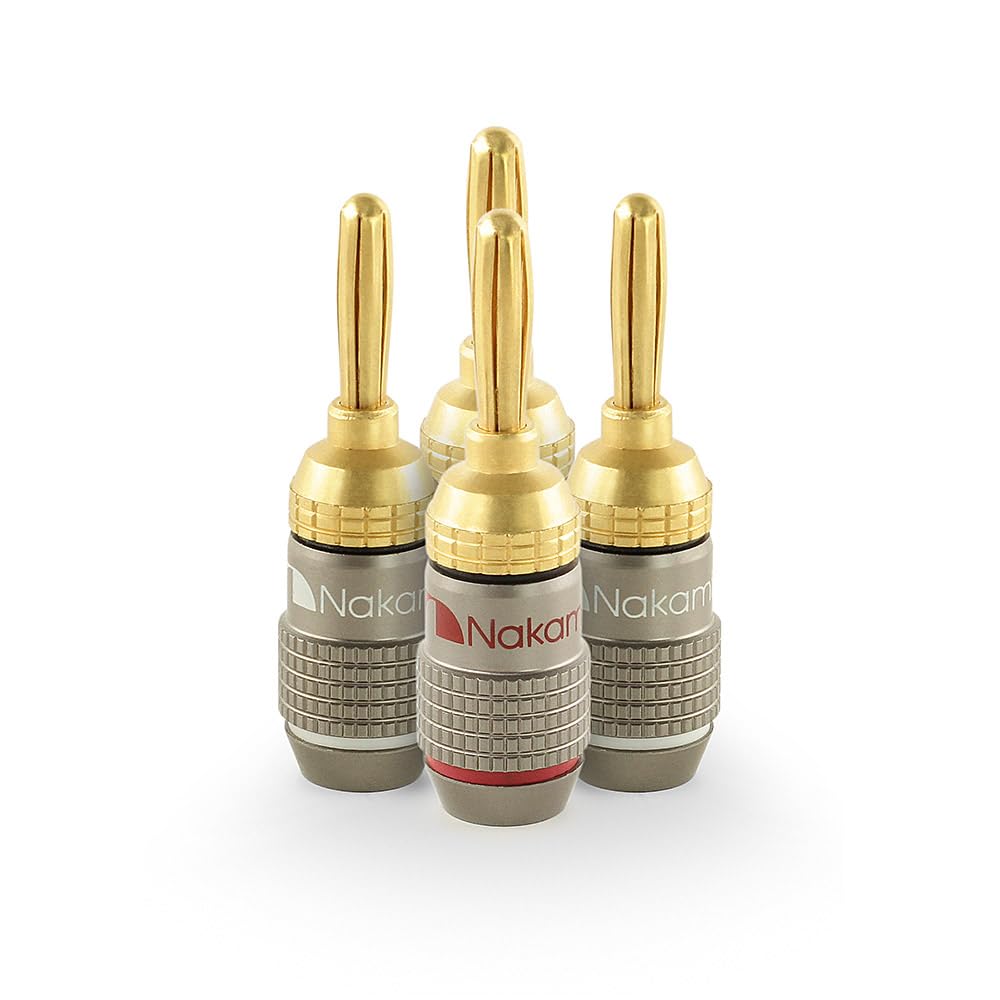
Nakamichi, a name audiophiles recognize from the cassette deck era, brings their FanLock design to the banana plug market. The mechanism uses what they call a fan lock to hold the wire without screws — you push the wire in and the internal teeth lock it down. The plug body is copper from the base right up to the tip, and the 24K gold plating uses direct gold-plating technology without a nickel underlayer. The company states this prevents the distortion that nickel can introduce. The collar is color-coded for polarity and non-conductive for safety.
Buyers consistently praise the rock-solid connection, reporting that the plugs work well with 12 AWG wire and fit a Yamaha amplifier securely with no sound degradation. The quality stands out to the point that some owners have purchased this set five separate times. The grip fits wire gauges from 10 AWG to 18 AWG, making it versatile for both thick speaker cables and thin signal wires. The catch for a few users? The solid pin design does not work well with older push-in binding posts that expect a split-pin (flexpin) style plug. The set comes as 4 pieces (2 pairs).
Locked in quality: Core is solid copper with direct gold plating, so the contact path is as clean as possible from the receiver to the speaker.
One real fit note: Check your binding posts before buying — if they are the older push-in type, a split-pin plug may fit better.
Reach for these if: clean audio signal is your priority and you want a locking mechanism that stays put.
Think twice if: your amp has old-style push-in terminals that need a spring-loaded pin.
3. VCELINK 4mm Banana Plugs 6 Pairs
A dual-screw plug that gives you grip security while staying affordable.
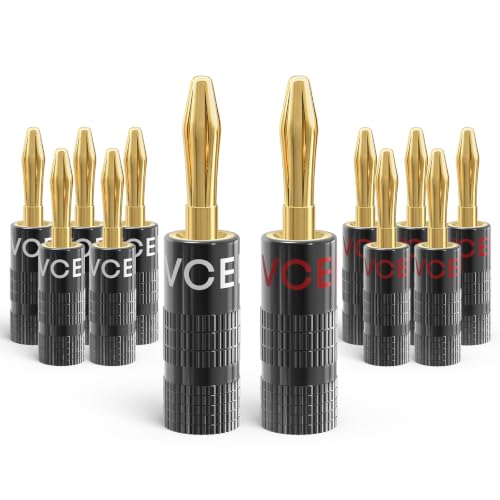
The VCELINK plug uses two tiny set screws to clamp your wire down inside a closed barrel, which isolates the conductors so they cannot short against each other. The body is a sturdy copper alloy with a knurled surface so your fingers can get a confident grip during installation. The slot pin is high-elasticity, meaning it presses firmly against the inside of your binding post while still letting you pull it out without a fight. The set includes 6 pairs (12 pieces total) in red and white for polarity identification.
Owners describe a “death grip” on the wire, noting that the dual-screw design keeps everything tight and that the plugs “grip the wire tightly” for a clean install. The build feels solid and high quality, and many consider them a great value. The fit does get mixed feedback — some find the plugs slightly large, needing a firm push to seat fully, but the elastic pin design prevents damage to your equipment. The plugs work with 12 to 18 AWG wire. Buyers recommend using them for receivers, amplifiers, and surround sound systems.
Secure connection: Two screws rather than one give the wire a more evenly distributed clamp, reducing the chance of one side pulling loose.
Before you push: The plugs are designed to be snug; they may require a firm initial push into the binding post, which is normal for this type.
Best for: anyone who wants a screw-down grip without paying premium prices — especially for installations that won’t change often.
skip it if: you need a tool-free install; the tiny screws require a precision driver.
4. Goupchn 4mm Stackable Shrouded Banana Plugs 10-Pack

A stackable plug made for test benches and DIY lab work, not just home theater.
You can daisy-chain these Goupchn plugs by plugging one into the back of another — a handy trick for oscilloscope leads, multimeter probes, and custom test equipment. The body uses a copper nickel-plated conductor inside a PA (polyamide, a tough insulating plastic) shell, so the plug is fully shrouded and safe to handle around live circuits. No soldering needed: you push the bare wire through the base, then through the plug’s 4mm jack, tighten a set screw at the end, and slide the shell on.
Buyers in labs and workshops call these “the good ones,” praising the set screw method as better than soldering. The quality and finish get strong approval, and custom test lead builders find them easy to assemble and effective. The attachment method gets mixed notes — the set screws are small and can occasionally get stuck inside the female end of the plug. One experienced owner recommends making good decisions on connections before pulling the plastic inserts back, as they are difficult to remove. The pack includes 5 red and 5 black plugs.
Lab favorite: The stackable feature means you can build complex test setups without extra wires or adapters.
Assembly heads-up: Check for the screw in the female end before you start — several reports mention it hides there and tips out easily.
Perfect for: engineers, hobbyists, and anyone making custom test leads or signal cables for measurement gear.
Not for: a standard home theater install — these are longer and bulkier than the typical speaker plug.
5. Amazon Basics Gold Plated Banana Plugs 6 Pairs
A 12-pack of self-crimping plugs that cost pocket change per pair.
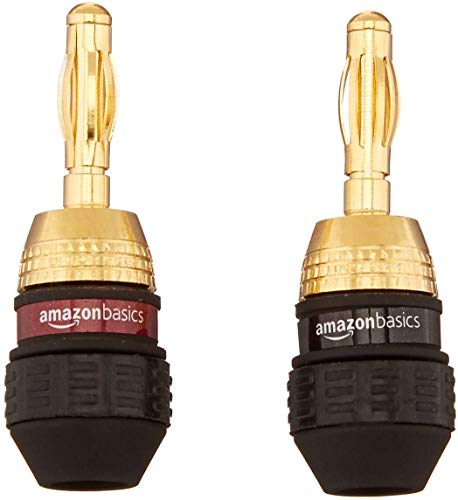
The Amazon Basics plugs use the same self-crimping teeth concept as the Sewell Deadbolts, making them just as easy to install without tools. They include 12 plugs total (6 pairs) in black, with red and black rings that you slide on for polarity coding. A neat extra is the female connection on the base of each plug — you can plug a second set of wires into the back, allowing you to daisy-chain multiple speakers from a single receiver output. The plugs accept 12 to 18 AWG wire.
Buyers report that these are “great value” for the price, with a solid build that works perfectly for 5.1 and 7.2 channel home theater systems with brands like Klipsch. The large base opening is a recurring point — some owners recommend using shrink tubing over the connection for extra strain relief, as the crimp collar does not lock down the wire’s insulation. The connection quality gets mixed feedback: while many report a solid grip, a notable number mention the plugs feel loose in certain binding posts. At this price, you get the convenience of a tool-free install with the trade-off of a less secure wire lock than screw-type plugs.
What works
- Tool-free install saves time across a 12-plug setup
- Female pass-through lets you connect multiple speakers off one terminal
- Pair count is high enough for a full 7.1 system
What may annoy
- No strain relief on the wire’s outer jacket; crimp grabs conductor only
- Reports of loose fit in some binding posts
Ideal for: a budget-conscious whole-system install where you need many plugs at once.
Think twice if: you want a snug, locking fit that won’t wiggle loose over time.
6. AutCreation 14 AWG Speaker Cable with Banana Plugs

A ready-to-run cable pair for people who just want to plug and listen.
If cutting and crimping is not your thing, this AutCreation set skips the whole process. It comes as one pair of 4.9-foot cables with banana plugs already attached on both ends. The wire is 14 AWG 99.9% oxygen-free copper (OFC) for low signal loss, and the plugs are gold-plated to resist corrosion. The cables are color-coded red and blue so polarity is obvious from both ends. It includes 8 banana plugs total — two on each end of each cable.
Buyers with a recording engineering background note these sound great and are well-made for the price, calling expensive cables mostly nonsense in comparison. The plugs are noted to be slightly oversized on some units, requiring a firm push to get into amplifiers and Klipsch R-51M speakers. A few owners also comment that the back edges of the plug housing feel a bit sharp. The sound quality is praised across the board, and the convenience of having a pre-terminated cable is a clear win for those who just want to set up and move on.
Plug-and-play: No tools, no wire stripping, no guesswork — just connect to your speaker and receiver.
Fit note: The banana plugs may feel stiff on first insertion; the brand suggests using more force or gently squeezing with pliers to loosen them.
Reach for this if: you want a quick, clean setup without handling raw wire or crimping tools.
pass on it if: you need exact custom lengths — these are fixed at 4.9 feet per cable.
7. FosPower Banana Plugs 10 Pairs

A massive 20-pack of dual-screw plugs for wiring whole-house audio.
When you have a 7.2.4 surround system or multiple zones to wire, the FosPower 20-pack saves trips back to the store. Each plug uses a closed-type design where two set screws clamp the wire inside an insulated barrel, preventing shorts. The tip is 24K gold plated for corrosion resistance, and the collar is color-coded for polarity. The plugs work with various wire gauges and fit receivers from brands like Klipsch, Pioneer, Polk, and Denon.
Buyers consistently call these the “most legit banana plugs” on Amazon, according to owner reports. The dual set screws earn praise for keeping the wire from loosening over time — a common problem with single-screw designs. A few installation quirks: the spring pin is tight at first and may need pliers or conductive paste for the first insertion, and the set screws are small enough to require a jewelers’ screwdriver. Some packs have had minor thread defects. The Limited Lifetime Warranty offers confidence if you are buying a large quantity.
Why this works
- 20 plugs cover a multi-zone or large home theater entirely
- Dual screws create a grip that does not loosen over time
- Lifetime warranty backs the purchase
Install quirks
- Small screws need a precision driver — not a tool-free job
- Tight spring pins may need a squeeze to fit initially
Ideal for: a serious home theater build with 10 or more speaker channels that need permanent, secure terminations.
it’s not for you if: you prefer tool-free crimp plugs or only need a couple of pairs.
8. Goaycer 14 AWG Speaker Wire with Banana Plugs
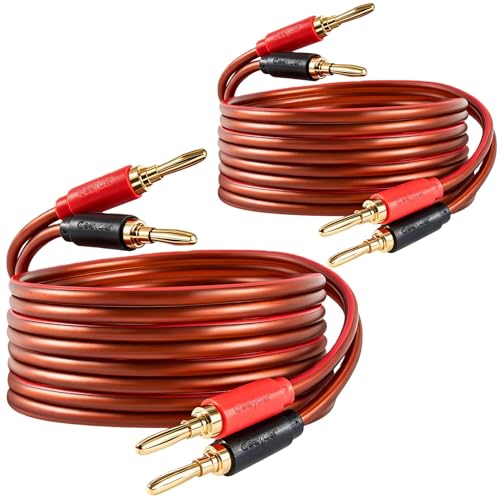
A pre-terminated cable where the plug is fused to the wire, not just crimped.
Goaycer takes a different manufacturing approach: ultrasonic welding fuses the copper wire strands directly to the brass banana plug body, then a press machine stamps the whole piece into shape. The result is a connection with no mechanical joint or crimp that could loosen. The wire itself is 14 AWG oxygen-free copper (OFC) enclosed in a flexible PVC jacket that resists tangling. The plugs are 24K gold plated and the set includes two 6.6-foot cables with male-to-male connections.
Reviewers call these “fantastic for the price,” noting that the banana clips are not oversized — a common frustration with pre-terminated cables. The build quality is consistently described as well-built and solid, with the connection feeling secure. The value is rated highly across the board. For the listed maximum current of 15 A and voltage of 36 volts, these are suitable for standard speaker-level signals. The main consideration is the fixed 6.6-foot length, so measure your run from receiver to speaker before ordering.
Fused joint: The ultrasonic welding creates a low-resistance bond that is physically stronger than a standard crimp or pressure contact.
One length only: These are 6.6 feet exactly — if you need 10 feet or 3 feet, this is not the cable for you.
Best for: short runs where you want the most durable plug-to-wire bond available at this level.
Not for: setups needing varied cable lengths or custom routing around furniture.
9. Sewell Deadbolt Right-Angle Banana Plugs 12 Pairs

A 90-degree plug that solves the problem of tight spaces behind your gear.
When your receiver is jammed into a cabinet and straight plugs push the wire into the wall, the right-angle design bends the cable down along the back panel instead of sticking straight out. These Sewell plugs use the same Fast Lock self-crimping technology as the straight Deadbolts — no tools required — and the wider base minimizes the chance of shorting against adjacent terminals. The 24K gold plating over a steel tip keeps the signal path clean, and the set includes 24 plugs (12 pairs). Like the straight version, they handle wire up to 8 AWG (10 AWG suggested).
Home theater owners find these perfect for tight spaces behind wall-mounted TVs and crowded receiver panels. The ease of installation is a consistent positive, with many noting that the right-angle shape solved a physical fitting problem that straight plugs could not. The quality gets high marks across the board, and the plugs “fit my receiver perfectly” according to multiple buyers. The durability does get mixed feedback — while many find them incredibly solid, a smaller number report that the collar or the right-angle joint can break under stress. The set is packed in a 12-pair quantity, enough for a large system.
What it solves
- 90-degree bend keeps wires flat against the wall or cabinet back
- Self-crimping install with no tools needed
- Wider base design reduces risk of shorting
Consider this
- Right-angle collar may be more fragile than a straight barrel on rough handling
- Not a locking plug — can loosen if moved frequently
Reach for these if: your amp or speakers are in a cramped cabinet or you want a tidy, low-profile wire path.
Think twice if: you frequently disconnect and reconnect your speaker wires — a locking plug might hold up better over time.
Understanding the Specs
Wire Gauge (AWG)
AWG stands for American Wire Gauge and it tells you the thickness of the speaker wire. The number works backwards: a smaller number like 12 AWG is a thicker wire than a higher number like 18 AWG. Most home theater and stereo systems run on 14 AWG or 12 AWG wire. When you buy a banana plug, look at the max wire size it accepts (like “8 AWG”) to be sure it can wrap around your cable properly. If the hole is too small for your wire, you will struggle to get a secure connection.
Gold Plating
Gold does not rust or corrode the way copper or steel can over time. A 24K gold-plated tip on a banana plug keeps the electrical contact surface clean, which matters for audio signals traveling from your receiver to your speakers. Some manufacturers use direct gold plating without a nickel underlayer, which they claim avoids any metallic distortion in the signal path. For everyday use, any gold plating is better than no plating, but direct-plated gold is a step up for critical listening setups.
FAQ
Are all banana plugs the same 4mm size?
Can I use banana plugs with any speaker or receiver?
What is the difference between a crimp plug and a screw plug?
Do banana plugs improve sound quality?
What does AWG mean and what gauge wire should I use?
Can I use banana plugs with outdoor speakers?
How many banana plugs do I need for a surround sound system?
How tight should a banana plug fit in the binding post?
What is a stackable banana plug?
Can I solder a banana plug instead of using the clamp?
Final Thoughts: The Verdict
Across the board, the best banana plug connectors winner is the Sewell Deadbolt 5-Pair because the tool-free self-crimping mechanism is reliable, fast, and works beautifully with common 14 and 12 AWG wire. If you are wiring a full surround setup and want locking security, the FosPower 10-Pair gives you 20 plugs with dual-screw grip. And for tight spaces behind a cabinet, the Sewell Right-Angle 12-Pair keeps everything clean with a 90-degree bend.
How We Picked
We do not accept paid placement. Every pick is matched to a real buyer and a real use-case; we do not hands-on test units.
Sources & Methodology
Specifications: manufacturer listings and product documentation. Review insights: verified customer reviews, as of July 2026. Pricing: not shown on this page (it changes often); check the current price via the retailer link.
As an Amazon Associate, Gadgets Feed earns from qualifying purchases. This does not affect which products we feature.