
A banana tree that stops growing, develops yellow leaf edges, or produces small, flavorless fruit is almost always starving for potassium. Unlike typical garden plants, bananas are heavy feeders that consume massive amounts of potash to support their rapid vegetative growth and fruit development. Without a targeted feeding schedule, even a well-watered banana plant in full sun will stall out at three feet tall.
I’m Min — the co-founder and writer behind Gadgets Feed. I’ve spent countless hours analyzing soil science reports, N-P-K ratio tables, and university extension bulletins to isolate the specific nutrient profiles that drive pseudo-stem thickness, leaf chlorophyll density, and bunch weight in banana plants.
This buying guide separates the micronutrient-rich formulas from the generic all-purpose blends so you can confidently choose the best banana tree fertilizer for your specific growing conditions.
How To Choose The Best Banana Tree Fertilizer
Bananas are not like tomatoes or roses. A single plant can consume over a pound of potassium during its fruiting cycle, and without a high-potassium formula, the fruit will lack sugar density and the pseudo-stem may topple under the bunch weight. Here are the three factors that separate effective banana-specific fertilizers from general yard products.
Prioritize the Potassium Number
The N-P-K ratio is the most critical spec on the label. Banana trees demand a potassium (K) number that equals or exceeds the nitrogen (N) amount. A ratio like 3-1-6 or 8-10-10 delivers the proper balance — high K drives fruit development, stem rigidity, and disease resistance, while sufficient N keeps the massive leaves photosynthesizing at full capacity. Avoid formulas where the middle phosphorus number is the highest, as that pushes bloom energy away from edible bunch production.
Liquid vs. Granular: Timing and Soil Type Matter
Liquid concentrates — such as the 32-ounce bottles from HiThrive or TPS Nutrients — give you immediate control over feeding frequency and are ideal for container-grown dwarf varieties that need consistent nutrient availability. Granular options like the Gardenwise 8-10-10 or Down To Earth 6-2-4 release nutrients slowly over weeks, making them a better fit for in-ground banana plants in warm climates where moisture degrades the prills gradually. Sandy soils drain fast and favor granular top-dressing, while clay soils benefit from liquid drenches that reach the root zone directly.
Micronutrient Profile: Beyond the Big Three
Bananas are sensitive to deficiencies in magnesium, zinc, and calcium. A fertilizer that includes these secondary nutrients — as the HiThrive liquid does with its calcium, magnesium, and zinc content — prevents the classic “pencil-leaf” narrowing and chlorotic banding that indicates micronutrient starvation. The Espoma Citrus-Tone adds 5% calcium specifically to support proper fruit cell wall development, a detail that matters if your bananas develop split skins or rubbery texture.
Quick Comparison
On smaller screens, swipe sideways to see the full table.
| Model | Category | Best For | Key Spec | Amazon |
|---|---|---|---|---|
| Wellspring Gardens Banana Fuel | Liquid Concentrate | Science-backed blend | 3-1-6 ratio | Amazon |
| Down To Earth Fruit Tree | Organic Granular | OMRI organic certification | 6-2-4 ratio | Amazon |
| TPS Nutrients Banana Fertilizer | Liquid Concentrate | Fast leaf development | 32 oz / 1 quart | Amazon |
| Gardenwise Elite 8-10-10 | Granular | Versatile fruit tree feeding | 8-10-10 ratio | Amazon |
| HiThrive Banana Plant Food | Liquid Concentrate | Reviving stressed plants | 32 oz makes 32 gal | Amazon |
| Espoma Citrus-Tone 5-2-6 | Organic Granular | High calcium for fruit quality | 5-2-6 plus 5% Ca | Amazon |
| Cz Garden Muriate of Potash 0-0-60 | Potassium Supplement | Custom N-P-K mixing | 0-0-60 straight K | Amazon |
In‑Depth Reviews
1. Wellspring Gardens Banana Fuel Liquid Fertilizer
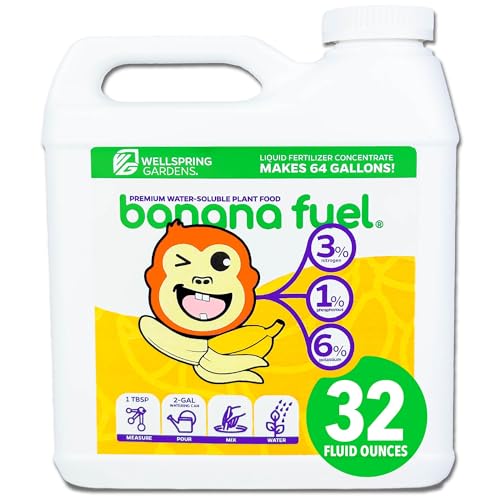
Wellspring Gardens formulated this liquid concentrate specifically around the 3-1-6 ratio that University of Florida research identifies as the optimal nutrient balance for banana plants. The heavy potassium load — six parts K against three parts N and one part P — directly supports the pseudo-stem thickening and fruit filling that home growers struggle to achieve with general-purpose 10-10-10 blends. One tablespoon mixed into two gallons of water provides a drench that reaches the root zone of container-grown dwarf varieties immediately, while the 32-ounce bottle yields dozens of feedings across a full growing season.
Customer reports highlight rapid recovery in heat-stressed plants — leaves perking up within seven days of first application. The absence of added dyes or synthetic growth stimulants means the concentrate relies purely on soluble potassium, nitrogen, and phosphorus to drive chlorophyll production and root respiration. For growers who need a simple, repeatable schedule, the 3-1-6 ratio eliminates guesswork: apply every two weeks through spring and summer, then taper to monthly during dormancy.
The liquid format requires careful measurement — one tablespoon per two gallons is not a splash-and-forget job — but the precision pays off in consistent pseudo-stem girth. If you grow multiple dwarf Cavendish or Lady Finger bananas in containers on a patio or greenhouse, this concentrate delivers the exact chemistry that mimics their natural tropical soil conditions without the risk of salt buildup that granular over-application can cause in confined root balls.
Why it’s great
- University-backed 3-1-6 formulation designed specifically for banana physiology
- Fast-acting liquid concentrate shows visible leaf improvement within one week
- Excellent value per feeding — 32 ounces makes dozens of applications
Good to know
- Daily watering may require more frequent reapplication in sandy soils
- Measurement must be precise — over-concentration risks fertilizer burn
2. Down To Earth Organic Fruit Tree 6-2-4

Down To Earth’s 6-2-4 granular formula earns its OMRI organic listing through a seven-ingredient blend that includes feather meal, fish bone meal, langbeinite, and kelp meal — each chosen to release nutrients as soil microbes break them down. The 6% nitrogen from feather meal drives the rapid leaf expansion that bananas require for photosynthesis, while the 4% potassium from langbeinite and potassium sulfate supports the fruit development cycle without the chemical concentration of synthetic salts.
The 5-pound box covers multiple mature in-ground banana plants spaced at the recommended 8-10 foot interval. Gardeners who apply it as a spring top-dressing and again in early summer report that the slow-release mechanism prevents the mid-season yellowing that plagues plants fed with quick-dissolve liquids. The added calcium carbonate also buffers soil pH, which is critical for banana plants because they struggle to uptake potassium below pH 5.5.
One notable side effect: the fish bone meal component gives the granules a strong natural odor that fades after watering. This is a non-issue for outdoor groves but becomes noticeable if stored in a garage during hot months. For growers who want a certified organic solution that feeds the soil microbiome as much as the plant, this formula delivers consistent pseudo-stem vigor and bunch development over multiple seasons without synthetic residue.
Why it’s great
- OMRI-listed organic ingredients support long-term soil health
- Slow-release granular format reduces risk of salt burn in heavy feeders
- Five-pound box provides excellent coverage for multiple in-ground banana plants
Good to know
- Strong fish-based odor noticeable after application
- Requires soil moisture for activation — less effective during drought
3. TPS Nutrients Banana Fertilizer
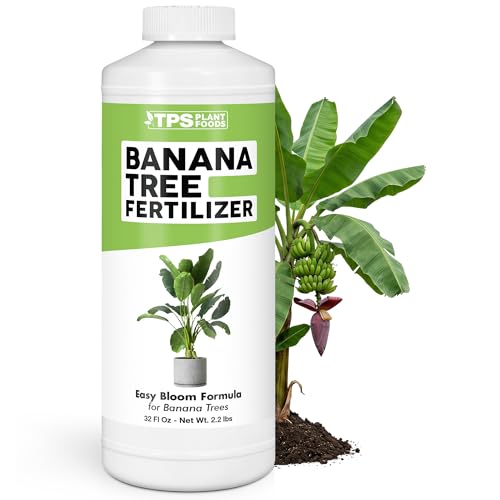
TPS Nutrients designed this liquid fertilizer exclusively for banana trees, and the formulation shows with its dual-application versatility — two teaspoons per gallon for root drenching or one teaspoon per quart for foliar misting. The foliar option is a standout feature for banana growers because the massive leaf surface area absorbs micronutrients directly, bypassing any soil pH or root zone issues that might block uptake. Users report measurable height gains of roughly one foot within weeks of starting the feeding schedule on young plants.
The 32-ounce bottle contains a chelated nutrient profile that remains available to the roots even in cooler soil temperatures that slow microbial activity. This matters for growers in USDA zones 8-9 who push their bananas through a marginal climate — the liquid stays plant-available when granular organics would stall. The mixing ratio is clearly printed on the label, and the concentrate has a mild, inoffensive scent compared to the fish-based organics in this roundup.
Banana trees grown in containers — especially the popular Dwarf Cavendish and Red varieties — respond well to the every-two-week root drench schedule during active growth. The formula’s potassium dominance encourages thick pseudo-stems that can support heavy bunches without staking. For growers who want a straightforward, banana-specific liquid that works through both root and leaf pathways, this is the most versatile single-bottle solution available.
Why it’s great
- Dual root drench and foliar mist application for flexible feeding
- Visible growth results within weeks on container bananas
- Chelated nutrients remain available in cooler soil temperatures
Good to know
- Foliar misting requires careful dilution to avoid leaf spotting
- Higher per-ounce cost compared to granular alternatives
4. Gardenwise Elite 8-10-10 Professional Fertilizer
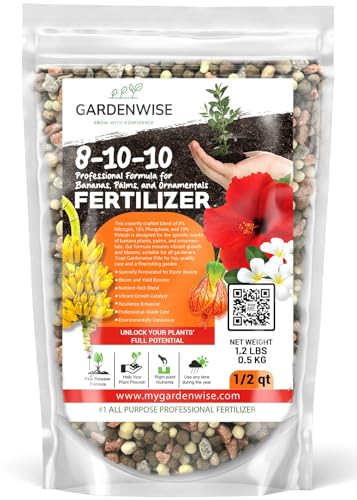
Gardenwise Elite brings a balanced 8-10-10 granular formula that works across fruit trees, ornamentals, and flowering plants, but its specific value for banana growers lies in the phosphorus boost. While bananas are primarily potassium seekers, the 10% phosphate content supports the root system proliferation needed before a banana plant can devote energy to fruit set. The granules are small enough to sprinkle evenly around the drip line of a young banana plant, and the analysis is printed in clear bold type for precise distribution.
Multiple customer reviews highlight dramatic recovery in plants that appeared “sad” or “all but dead” — including hibiscus and various ornamentals — which suggests the micronutrient profile is broad enough to correct multiple deficiency patterns at once. The half-quart bag size is ideal for growers with one to three banana plants who want to avoid committing to a five-pound box of granules sight unseen.
For small or container-grown banana plants that are actively blooming or beginning to set fruit, this granular provides the phosphorus surge that helps the transition from vegetative growth to reproductive stage. Apply it as a top-dress and water it in deeply once per month during the growing season. The bag size limits this to a single application for a large specimen, making it a better fit for younger plants or as a supplement rather than the primary season-long nutrient source.
Why it’s great
- High phosphorus 10% supports robust root and bloom transition
- Fine granules distribute evenly around drip lines
- Small bag ideal for testing with a few banana plants
Good to know
- Label instructions use exaggerated application rates for trunk diameter
- Small bag size insufficient for a full season on large plants
5. HiThrive Banana Plant Food Liquid Fertilizer
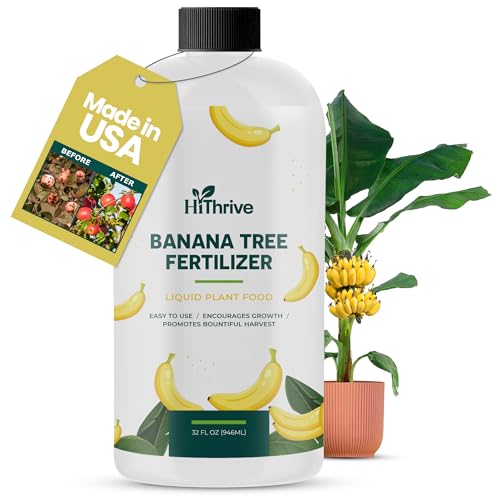
HiThrive’s liquid concentrate stands out for its inclusion of calcium, magnesium, and zinc — three micronutrients that banana plants require in greater quantities than most other fruit trees. Calcium prevents the fruit splitting that occurs when cell walls develop too rapidly under high-nitrogen feeding, while magnesium is the central atom in chlorophyll molecules that drive the dark green leaf color associated with healthy photosynthesis. The 32-ounce bottle yields a full 32 gallons of diluted fertilizer, making it one of the highest-value liquid options on this list on a per-gallon basis.
User reports consistently describe the product reviving banana plants that seemed to have stalled or died after transplanting. One reviewer noted that a banana tree began putting out new leaves just two weeks after being declared a loss — a recovery timeline that suggests the chelated micronutrients are immediately plant-available. The recommended application schedule of every one to two weeks during the growing season matches the rapid nutrient cycling that tropical grass-like plants demand in warm weather.
The liquid formulation makes it suitable for both in-ground and container bananas, though the dilution instructions should be followed strictly to avoid nutrient runoff in potted conditions. The bottle’s resealable cap and clear measurement markings reduce the risk of over-concentration. For growers managing multiple banana varieties — from Goldfinger to Red Banana to Plantains — this all-in-one liquid eliminates the need to stock separate micronutrient supplements.
Why it’s great
- Includes calcium, magnesium, and zinc for comprehensive nutrition
- High dilution ratio — 32 oz makes 32 gallons for exceptional per-feeding value
- Proven ability to revive stressed and transplant-shocked banana plants
Good to know
- Requires bi-weekly application during active growth for best results
- May need supplementing with a higher-potassium source for heavy fruiting
6. Espoma Organic Citrus-Tone 5-2-6

Espoma’s Citrus-Tone is formulated for citrus trees, but the 5-2-6 ratio plus 5% calcium aligns closely with what banana plants need for healthy fruit development. The Bio-tone microbial inoculant included in the formula introduces beneficial soil bacteria that break down organic matter into plant-available nutrients — a significant advantage for growers with compacted or nutrient-depleted soil where bananas struggle to establish deep root systems.
The 4-pound bag provides about three to four applications for a single mature in-ground banana plant when applied according to the label directions. Growers report using it effectively on lemon and orange trees as well as bananas, but the one catch is the strong natural odor that comes from the feather meal and bone meal ingredients. The smell dissipates after watering and is not noticeable once incorporated into the soil, but storing the open bag in an enclosed garage can cause lingering odors.
Application timing matters with this granular: late winter pre-bloom, spring post-bloom, and fall align with the three active growth phases of a banana plant’s annual cycle. The calcium content specifically helps prevent the blossom-end cellular breakdown that can cause the tips of developing banana fingers to blacken prematurely. For organic growers who already use Espoma products on other fruit trees, this bag simplifies inventory by serving multiple species without changing the feeding schedule.
Why it’s great
- Bio-tone microbes improve soil biology for long-term root health
- 5% calcium prevents blossom-end issues in developing fruit
- Versatile formula works on multiple fruit tree species
Good to know
- Strong odor during application may be unpleasant for indoor storage
- Designed for citrus — not strictly optimized for banana-specific K demand
7. Cz Garden Muriate of Potash 0-0-60

This is not a standalone banana fertilizer — it is a straight 60% potassium supplement designed for growers who mix their own N-P-K blends. The 0-0-60 analysis means there is no nitrogen or phosphorus, so it must be combined with a balanced base fertilizer or applied only when soil tests confirm potassium deficiency. For experienced banana growers who know their local soil composition and want precise control over the K input, this is the most cost-effective way to deliver massive potash to a heavy-feeding plant.
The 5-pound resealable bag stores well and the granules dissolve slowly in soil moisture, providing sustained potassium release over several weeks. Customers with fruit trees in poor, sandy soils report seeing their first real fruit production after supplementing their regular feeding with Muriate of Potash. The simplicity of the product means there are no fillers, no micronutrients, and no organic certification — just concentrated potassium chloride that delivers 60% K by weight.
Using this supplement requires some horticultural know-how: over-application can cause potassium-induced calcium or magnesium lockout, leading to leaf tip burn and reduced fruit quality. A starting rate of one tablespoon per mature plant per month, applied as a top-dress and watered in, is a safe baseline. This product belongs in the shed of a serious grower who already understands their soil chemistry, not a first-time banana planter looking for a complete solution.
Why it’s great
- Maximum 60% potassium concentration for targeted deficiency correction
- Budget-friendly option for soil chemists mixing custom formulations
- Resealable 5-pound bag lasts multiple seasons
Good to know
- No nitrogen or phosphorus — unsuitable as a standalone banana fertilizer
- Risk of nutrient antagonism if applied without calcium or magnesium monitoring
FAQ
Can I use a general 10-10-10 fertilizer on my banana tree?
How often should I fertilize a container-grown dwarf banana?
What deficiency does yellowing leaf edges on a banana plant indicate?
Final Thoughts: The Verdict
For most users, the best banana tree fertilizer winner is the Wellspring Gardens Banana Fuel because its 3-1-6 ratio matches university research exactly and delivers fast results for both in-ground and container plants. If you want certified organic ingredients that feed your soil microbiome over the long term, grab the Down To Earth 6-2-4. And for a do-it-all liquid that works through both root drench and foliar misting, nothing beats the TPS Nutrients Banana Fertilizer.