
Our readers keep the lights on and my morning glass full of iced black tea. As an Amazon Associate, I earn from qualifying purchases.
Specs are compiled from manufacturer listings and verified buyer reviews and can change over time — please confirm the key details on the product page before buying.
If you break out in red, itchy welts every time you peel off a standard bandage, you know the real problem isn’t the cut — it’s the adhesive. The good news is that the fix isn’t a lifetime of painful peel-offs or wounds left uncovered. It’s switching to a bandage built around a gentle, hypoallergenic adhesive, and the picks below are the ones that actually hold up in daily life.
I’m Min — the founder and writer behind Gadgets Feed. This guide is built by comparing the manufacturers’ published specifications and the patterns across verified customer reviews, so you get each pick’s real strengths and trade-offs instead of marketing spin.
If your skin turns red or blisters from standard bandages, the fix lies in the adhesive chemistry and how the pad is sealed—so you can find a bandage for adhesive allergy that stays put without the irritation.
Our Picks at a Glance


How To Choose The Best Bandage For Adhesive Allergy
The trigger isn’t always the bandage itself — it’s usually the glue. Standard adhesives use rubber-based compounds that can irritate skin, especially with prolonged wear. Your first move is to identify what your skin actually reacts to, then match the bandage’s adhesive chemistry to that trigger.
Silicone vs. Traditional Adhesive
Silicone adhesives are the gentlest option for reactive skin. Unlike rubber-based glues, silicone bonds to skin without chemical cross-linking, so it holds firmly but releases without pulling at the top layer of your skin. That’s why “painless removal” and “repositionable” are such common claims on silicone bandages — they’re built to be lifted and reapplied without losing stick.
Latex-Free Is Non-Negotiable
A true latex allergy can cause immediate hives, while a general adhesive sensitivity shows up as redness after a day of wear. If you know latex is the culprit, every bandage here is explicitly latex-free. But if you’re still reacting to latex-free options, the issue is likely the rubber accelerators used in the glue itself — which is where switching to a pure silicone or mineral-based adhesive makes the difference.
Pad Design and Wound Contact
The worst part of a bandage change isn’t always the adhesive — sometimes it’s the pad sticking to the wound. Look for a non-stick absorbent pad that wicks fluid away from the healing tissue, or a pad with a 360° adhesive seal that prevents debris from getting into the wound. A pad that doesn’t stick to the cut is what makes removal truly painless.
Quick Comparison
| Model | Best For | Adhesive Type | Pad Size | Count | Amazon |
|---|---|---|---|---|---|
| Hansaplast Sensitive★ Best Overall | Severe adhesive allergies | Hypoallergenic plaster | Cut-to-size roll | 10 strips | Amazon |
| Coverlet/Leukoplast PatchLongest Adhesion | Long-wear wound protection | Latex-free fabric | 1.5″ x 2″ | 100 | Amazon |
| Tru-Colour FabricShade Match | Skin-tone variety | Latex-free fabric | Medium + Large | 120 | Amazon |
| Dimora Silicone | Fragile, thin skin | Silicone | 1″ x 2.4″ | 25 | Amazon |
| Silicone Variety Pack | Mixed sizes on a budget | Silicone | 0.75″x3″ + 1.63″x4″ | 55 | Amazon |
| Hysimedy 4×4 Silicone | Large-area coverage | Silicone | 2.36″ x 2.36″ | 15 | Amazon |
| Hysimedy 1.63×4 Silicone | Everyday cuts & scrapes | Silicone | 1.1″ x 2.05″ | 40 | Amazon |
| PATCH Bamboo | Eco-conscious buyers | Mineral-based adhesive | Strip | 100 | Amazon |
| Coverlet Quilt Cloth | Knees, elbows, toes | Latex-free quilt cloth | 1″ x 3″ | 300 (3 boxes) | Amazon |
In‑Depth Reviews
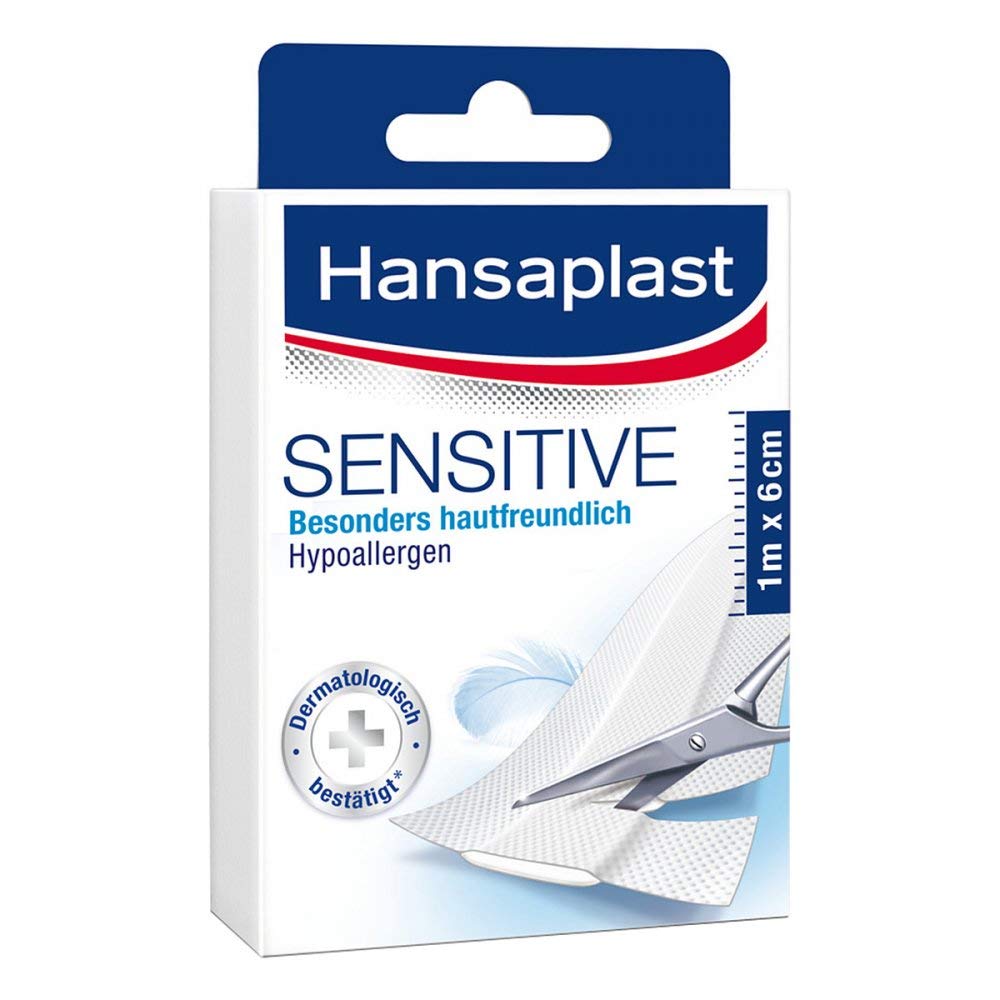
1. Hansaplast Sensitive 100 x 6 cm
Our pick — over 4.5★ from 850+ verified ratings; the strongest balance of quality and price.
The German-made strip that ended a 20-brand losing streak for truly reactive skin.
If your skin reacts to almost every bandage, this one repeatedly wins. Buyers report: “Severe Bandaid adhesive allergy (not latex); 20 brands failed; Hansaplast caused no reaction.” That track record earns it the top spot—the hypoallergenic plaster is breathable, flexible, and dermatologically tested for skin compatibility, so it won’t trigger the redness you’re used to.
You get a 1 m x 6 cm roll of plaster that you cut to whatever size you need, which means one box covers a finger tip, a knuckle, or a longer scrape. At just 0.16 ounces, the whole box is nearly weightless in a drawer. The trade-off is that it’s not pre-cut — you’ll be reaching for scissors, and the roll format takes a little getting used to.
The adhesive holds strong enough to stay put through normal activity, yet removal is genuinely painless — “no pain bandage removal from sensitive areas” comes up again and again in the feedback. For severe sensitivities where every other option fails, this is the definitive answer.
Why it wins: It’s the only pick here that earned its reputation by solving the hardest cases — true adhesive allergies that defeated 20 other brands. The cut-to-size format is a small price for that reliability.
The adjustment: You have to cut each strip yourself, and the roll is thinner than a typical bandage, so it takes a gentle hand to apply without creases.
The crowd’s answer: If you’ve been told “nothing works for your skin,” start here — it’s the one that keeps converting skeptics.
Who it’s not for: If you want grab-and-go pre-cut bandages without scissors, the silicone options below are more convenient.
2. Coverlet/Leukoplast Adhesive Patch Bandage 1-1/2″ x 2″
The hospital-grade favorite where the glue is the whole point — it simply doesn’t quit.
If your bandages peel off by lunchtime, this one solves that—owners mention “the adhesive lasts and lasts and it protects the wound very well.” The elastic fabric absorbs up to 10 times its weight in water, making it a solid pick for open wounds needing moisture management without frequent changes.
The pad is fully surrounded by adhesive, sealing the area against air, debris, and contamination. At 1.5″ x 2″ each, a box of 100 is the kind of bulk buy that keeps a medicine cabinet stocked for a year. One buyer described it as genuinely useful at home, and a dermatologist specifically recommended it for staying on all day, even resisting water.
The honest catch: the adhesion is so tenacious that a few find it almost too sticky. After about a week on a surgical site, one person reported the surrounding skin getting raw. This is a long-wear bandage, not a daily-replace one — use it where you need maximum hold, not for every tiny scratch.
What owners rave about
- Adhesion that survives water and a full day of movement
- Pad won’t stick to the wound itself, easing healing
- Sterile while the pouch stays sealed
The honest trade-off
- Can be too sticky for very sensitive areas over multiple days
- Size runs small for larger wounds
Reach for this if: You need a bandage that stays through showers, sweat, and a full workday without peeling.
Look elsewhere if: You change dressings daily — the aggressive hold can irritate delicate skin with repeated removal.
3. Tru-Colour Skin Tone Shade Fabric Bandages
Four skin-tone shades that finally make a sensitive-skin bandage blend in, not stand out.
For anyone tired of beige-only bandages that clash with deeper complexions, this pack solves that instantly. You get beige, olive, dark brown, and brown-black shades across 4 resealable bags, each with 15 medium and 15 large bandages. A medic working in TV and film specifically praised having multiple shades on hand for diverse cast and crew.
These are latex-free fabric bandages that flex as you move and stick firmly — customers note sticking well even after getting wet, which is a strong test for any adhesive. The resealable bags keep the spares clean and organized, and the 120-count total makes this a true first-aid-kit staple.
The caveat is the color match itself. While some say the shades match their skin perfectly, others find the tones run a bit “orangy” against their complexion, and adhesion gets mixed feedback too. It’s a great fit if your tone lands in these four shades; it’s a gamble if it doesn’t.
The stand-out: No other pick here offers shade variety — that alone makes it the right call for households with multiple skin tones.
Worth knowing: It’s a fabric bandage, so it’s more breathable than plastic options but less waterproof than the silicone picks.
Buy it for: A family first-aid kit where everyone deserves a bandage that matches their complexion.
skip it if: Your skin tone falls between the four shades offered, or you need heavy-duty waterproof hold.
4. Dimora Silicone Non-Woven Adhesive Bandage 2″ x 4″
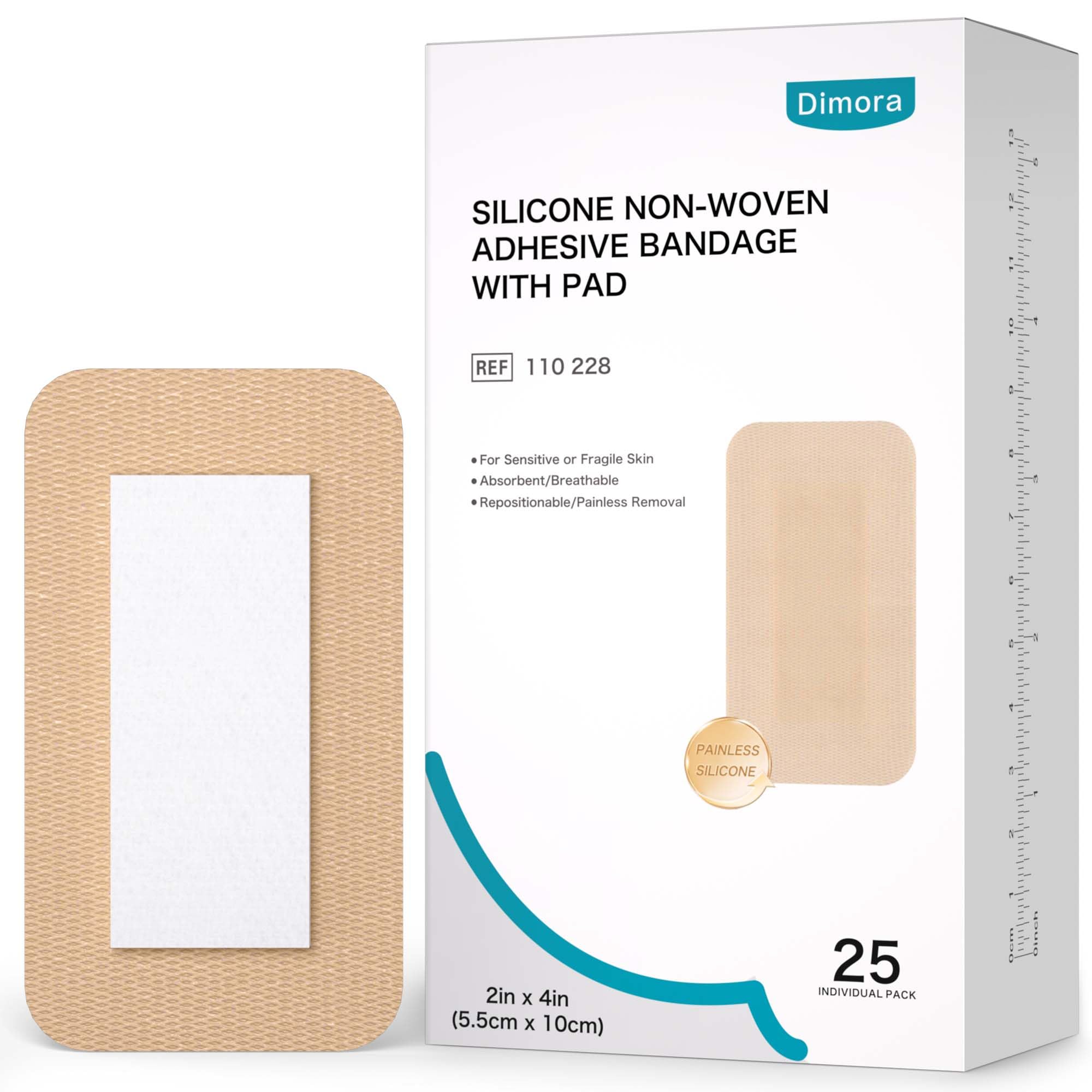
The wound-care-nurse favorite that protects ulcer sites without breaking down the skin around them.
When a wound care nurse specifically recommends a bandage for a diabetic foot ulcer, that’s a serious endorsement. The silicone adhesive sticks to skin but not the wound, reducing pulling force and preventing secondary skin damage during changes. For thin, fragile skin that tears with regular bandages, this is the safer choice.
The sterile dressing has a non-stick absorbent pad measuring 1″ x 2.4″, and the bandage itself is 2″ x 4″ — noticeably larger than the Coverlet’s 1.5″ x 2″, giving you 33% more coverage for bigger areas. The non-woven fabric conforms to body contours while letting air and moisture vapor through, so the skin beneath stays healthy instead of macerating.
Reviewers point out it works well on diabetic foot ulcers and that the adhesive stays in place without breaking down a spouse’s sensitive skin. One person with thin skin said regular bandages tear or leave burn-like marks, but these stick well without damage on removal. At 25 per box, it’s pricier per bandage, but for medical-grade assurance on fragile skin, owners say it’s worth it.
What wins people over
- Hospital-grade, hypoallergenic, and non-cytotoxic
- Large 2″ x 4″ size covers bigger wounds
- Pad absorbs light drainage without sticking to tissue
The reality check
- Only 25 per box — you’ll reorder often
- Non-woven fabric is less stretchy than knit options
Choose this for: Post-surgical sites, ulcer care, or any wound where you cannot afford the skin around it breaking down.
Think twice if: You need an everyday, high-volume bandage — the count is low for the price.
5. Silicone Bandages for Sensitive Skin Variety Pack 55 Counts
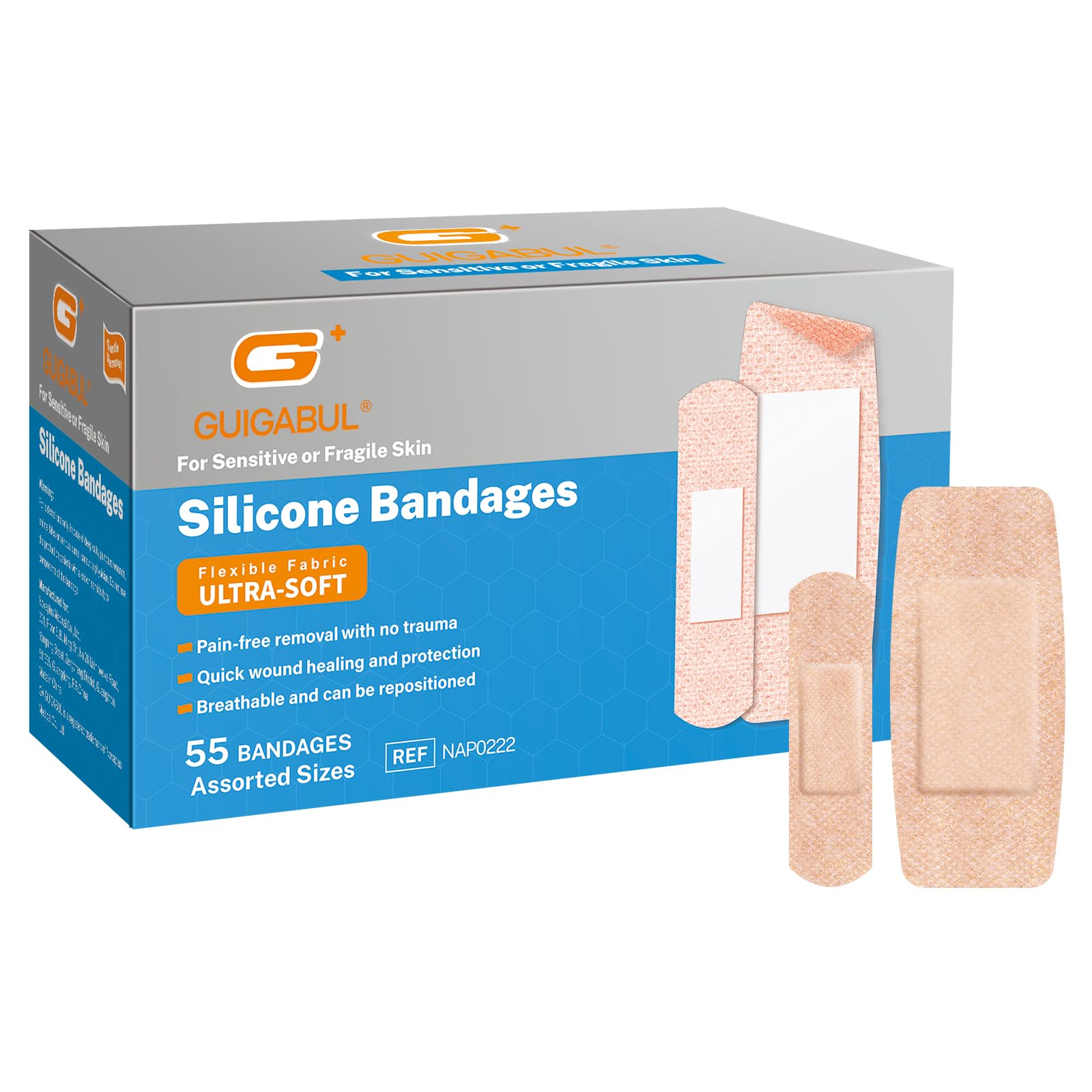
A 55-count silicone assortment that gives you sizes for every bump, scrape, and burn in one box.
This is the practical pick for households — a variety pack with 40 medium bandages at 0.75″ x 3″ for minor cuts and 15 extra-large at 1.63″ x 4″ for bigger wounds. Each one is individually packed in a clear pouch, so it stays sterile and easy to grab in a pinch. That’s a smarter buy than a single-size box if you never know what injury is coming next.
The silicone adhesive is repositionable, meaning you can lift it and re-paste it to get the placement just right without losing stickiness. Buyers with thin, senior skin say it “pills right off very softly” instead of tearing, and one noted it stayed on where other sensitive-skin brands failed. The 4-sided seal blocks dirt and germs while the pad wicks fluid away from the wound.
The medium size’s surface is waterproof with a PU film layer, though the extra-large size is only water-resistant briefly — so don’t expect a full swim session from the big ones. A common wish is for a mid-size option between the two, and some note that removal still needs a slow hand.
Best value call: At 55 bandages for the price, you get the most usable variety per dollar in this list.
The gap: No true mid-size bandage, and the extra-large ones won’t survive heavy water exposure.
Grab this if: You want one box that covers everything from a paper cut to a knee scrape.
Pass if: You only ever need one specific size — a single-size box is more efficient.
6. Hysimedy Silicone Bandages 4×4 Inch Painless Removal
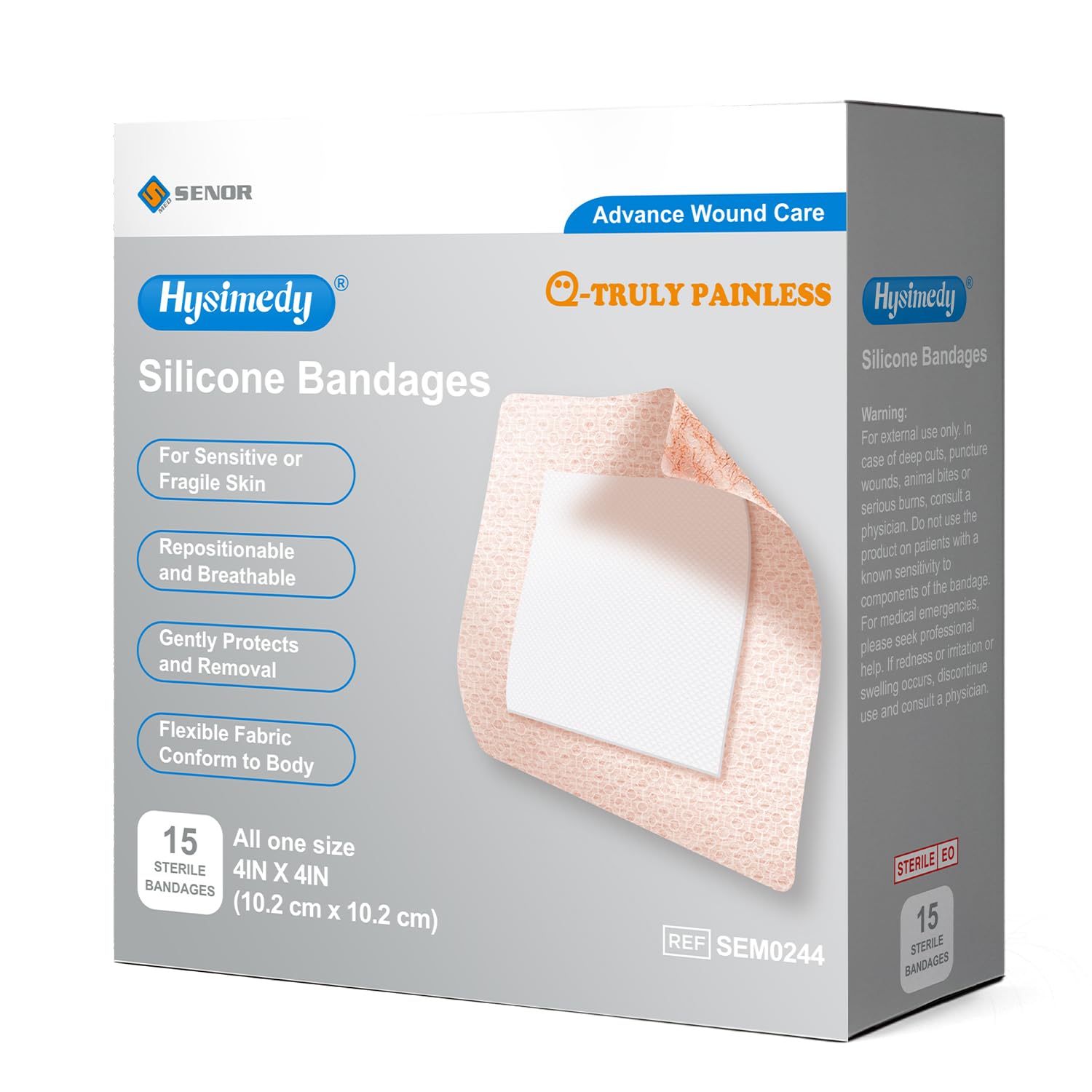
The big-pad silicone that covers a 2.36-inch square pad for serious wounds on sensitive skin.
For wounds that need real coverage, this 4×4 inch bandage brings a cotton pad of 2.36″ x 2.36″ — the largest pad of any bandage here. That makes it a genuine option for burns, large scrapes, and post-surgical sites where you need absorption plus protection. The 2.36″ x 2.36″ cotton pad is 2x more absorbent and breathable, and its non-stick surface prevents secondary trauma on removal.
The 4-sided sealed silicone adhesive is repositionable, letting you lift and adjust it without losing stick—useful for tricky spots. One buyer with severe adhesive sensitivity, who usually ends up with large welts from regular bandages, reported zero irritation and no sticky mess left behind. Another, recovering from back surgery, managed daily changes solo with these.
Buyers describe it as staying on well and being easy to remove, and it’s recommended by a home health nurse. The honest downsides: a rare unit arrived with poor stickiness and itch, and at 15 per box, the per-bandage cost is on the higher side. It’s built for important wounds, not everyday scratches.
Loved for
- Massive 2.36″ x 2.36″ absorbent pad
- Latex-free and rubber-free for allergies
- Repositionable without losing stick
Consider
- 15 per box means frequent reorders
- Occasional quality variance reported
Reach for this if: You have a larger wound and thin skin that can’t handle standard adhesives.
Not for: Tiny cuts where a bandage this size is overkill — you’ll burn through the box fast.
7. Hysimedy Silicone Bandages 1.63×4 Inch Painless Removal
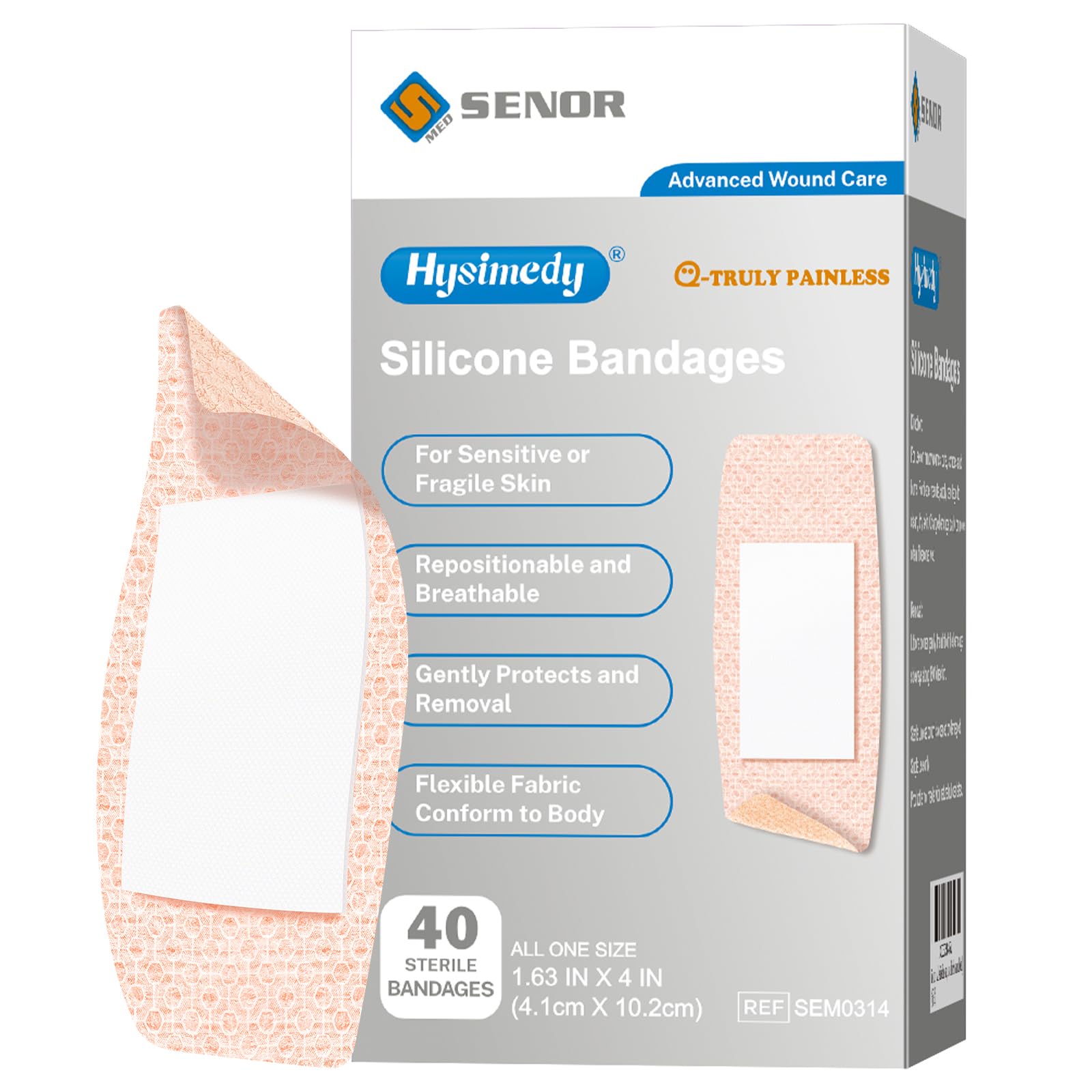
The higher-count silicone workhorse with a pad designed for fragile, thinning skin.
Where the 4×4 version covers big wounds, this 1.63″ x 4″ version is the daily-use companion, packing 40 hospital-grade hypoallergenic bandages in one size. The 1.1″ x 2.05″ cotton pad is 2x more absorbent and breathable, wicking fluid while keeping the wound from sticking to the dressing. It’s the more sensible count for regular use.
The feedback here is dominated by older users with fragile skin — one 76-year-old said these don’t hurt their skin and you can lift and reseal them. Another buyer, a seasoned 76-year-old, praised the painless removal from the long edge with no marks left behind. The adhesive is 4-sides sealed, latex-free, and rubber-free, so it won’t pull your skin even when a child is running and jumping with it on.
One reviewer noted it absorbs blood, stays on, and is less bulky than gauze, while keeping the wound moist — which some prefer for healing. The recurring trade-offs are the individual plastic packaging (which some find wasteful) and the price per bandage, which runs higher than standard fabric options. It’s the choice when skin fragility matters more than cost.
the balance: This balances silicone gentleness with a practical 40-count, so you get a month’s worth of daily changes without reordering.
Keep in mind: It’s a single size, so bigger wounds will need the 4×4 version instead.
Perfect for: Older adults, kids, or anyone with fragile skin who needs a reliable everyday silicone bandage.
Look past if: You want a mix of sizes or prefer plastic-free packaging.
8. PATCH 100 Count Organic Natural Bamboo Bandages

The plastic-free bamboo strip that handles adhesive allergies without harming the planet.
If your sensitivity comes with an eco-conscience, this is the rare bandage that satisfies both. Made from 100% organic bamboo fiber with a mineral-based pressure-sensitive adhesive, it’s hypoallergenic, latex-free, vegan, and free of plastic and irritating chemicals. The strips are compostable and tested to break down in garden soil within weeks — something no other bandage here can claim.
For a kid with adhesive allergies, a parent reports these “never trigger her” and hold up all day without falling off. Buyers consistently describe them as soft, non-toxic, and painless to remove, with a texture that’s much gentler than standard fabric. The 100-count box means you’re well stocked, and the cute designs are a bonus for kids.
The honesty check: because the adhesive is mineral-based and gentle, adhesion gets mixed reviews. Some find them not sticky enough, with edges peeling before the day ends. One owner noted they don’t last as long as plastic bandages — the trade-off of a formula gentle enough for reactive skin. If you need maximum hold, a silicone option beats these; if you need zero irritation and zero waste, these win.
Why it stands out: It’s the only pick that’s compostable, plastic-free, and made from renewable bamboo — no one else comes close on materials.
The catch: The gentle adhesive trades some holding power; expect to replace these more often than silicone.
Pick these if: Your priority is a chemical-free, planet-friendly bandage that won’t trigger allergies.
Choose silicone instead if: You need a bandage that survives sweaty, active days or heavy water exposure.
9. Coverlet Latex-Free Adhesive Dressings 1″ x 3″ (300 Count)

The 300-count quilt-cloth workhorse built for knees, elbows, toes, and high-traffic household use.
Some bandage needs are about volume, and this 3-box pack of 100 delivers a full 300 bandages that stretchy fabric moves with the body’s curves. The extra-large pad absorbs up to 10 times its weight in water, while the 360° adhesive seal keeps wounds clean. It’s the bulk option for a busy household or a professional first-aid kit.
A buyer who learned about the brand through workplace first-aid kits notes these are tougher than name-brand options, with strong fabric and adhesive that sticks well. A podiatrist uses this brand for staying on the bottom of feet, and another person says they hold up even when wet — a durability test that many bandages fail. One long-time household user says they’ve always kept Coverlet on hand without complaints.
The catch is the sheer volume — buying 300 bandages when you only need a handful of the 1″ x 3″ size is a commitment. One family that loved the old single-box format had to buy 3 boxes because the name changed, leaving them with far more than they need. If your household goes through bandages fast, this is the cost-per-bandage king; if not, it’s a lot of storage.
What impresses
- 300 bandages for truly heavy use
- Quilt cloth absorbs fluid faster than competitors
- Stays on through hand-washing and wet conditions
What to know
- Single size only — 1″ x 3″ may be small for larger wounds
- Buying 300 at once overshoots most home needs
This is for: Large families, workshops, schools, or anyone who genuinely burns through a box a month.
Not for: A single person who needs a variety of sizes — you’ll be storing bandages for years.
Understanding the Specs
Silicone vs. Rubber Adhesive
The single biggest decision is the adhesive chemistry. Rubber-based glues (even latex-free ones) can contain accelerators that trigger contact dermatitis. Silicone adhesives skip those compounds entirely, bonding to the skin physically rather than chemically. That’s why silicone bandages are repositionable and painless to remove — they simply don’t form the same grip that tears skin. If you’ve reacted to “sensitive” bandages before, silicone is the safer bet.
Pad Size and Absorbency
The pad ratio matters more than the bandage’s outer size. A bandage with a large outer footprint but a tiny pad is useless for a real wound. Look for the pad measurements in inches — like 1″ x 2.4″ or 2.36″ x 2.36″ — and match that to your wound size. A non-stick absorbent pad that won’t adhere to the wound is critical for painless changes, and a 360° adhesive seal keeps debris out completely.
FAQ
What causes adhesive allergy on bandages?
Are silicone bandages truly painless to remove?
Is latex-free the same as hypoallergenic?
How long can I wear a silicone bandage?
Will these bandages stay on in the shower?
What’s the difference between the two Hysimedy silicone sizes?
Can I cut the Hansaplast roll to any size?
Why do the Tru-Colour bandages get mixed reviews on adhesion?
Is the PATCH bamboo bandage as sticky as silicone?
Which bandage is best for post-surgical wounds?
Final Thoughts: The Verdict
For most people, the bandage for adhesive allergy winner is the Hansaplast Sensitive because it’s the one that solved the hardest cases — true adhesive allergies that defeated 20 other brands. If you want silicone’s painless removal and repositionable hold, grab the Hysimedy 1.63×4. And for eco-conscious buyers who want plastic-free, compostable materials, the PATCH Bamboo is the one to reach for.
How We Picked
We do not accept paid placement. Every pick is matched to a real buyer and a real use-case; we do not hands-on test units.
Sources & Methodology
Specifications: manufacturer listings and product documentation. Review insights: verified customer reviews, as of August 2026. Pricing: not shown on this page (it changes often); check the current price via the retailer link.
As an Amazon Associate, Gadgets Feed earns from qualifying purchases. This does not affect which products we feature.