
Our readers keep the lights on and my morning glass full of iced black tea. As an Amazon Associate, I earn from qualifying purchases.
Specs are compiled from manufacturer listings and verified buyer reviews and can change over time — please confirm the key details on the product page before buying.
What matters most in bandage scissors is simple: a blade that still bites after months of casts and dressings, and a blunt lower tip that slides under a bandage without nicking skin. Everything else — the color, the coating, the carabiner — is a bonus. This guide breaks down seven real options so you can pick the pair that fits your kit, your hand, and the way you actually work.
I’m Min — the founder and writer behind Gadgets Feed. This guide is built by comparing the manufacturers’ published specifications and the patterns across verified customer reviews, so you get each pick’s real strengths and trade-offs instead of marketing spin.
You will learn which blade coatings matter, how to match an ambidextrous handle to your grip, and why autoclavability changes what you can safely reuse. If you want a shortlist you can trust, this look at the best Bandage Scissors will help you choose the right pair for your kit.
Our Picks at a Glance

How To Choose The Best Bandage Scissors
The pair that works for a wound-care nurse on a hospital floor is not always the pair worth keeping in a car kit. Before you buy, decide where the scissors will live most of the time and what they will cut. That single question filters the list faster than any spec sheet.
Blade Length and Leverage
Longer blades give you more leverage when you cut through denim, leather, or layered gauze. A 7.5-inch shear such as the Madison Supply pair or the Pyrsiva Lite is the common size for hands that need reach and force. A shorter 4.5-inch to 5.5-inch pair like the CynaMed set is built for tight spots — removing bandages from a finger or a small limb where a full shear feels clumsy.
Blade Coating and Cutting Smoothness
Coating is what keeps a blade from grabbing sticky materials. Fluoride coating on the Madison Supply blades and titanium coating on the Pyrsiva and CynaMed shears both aim at the same goal: a surface that does not bind on tape, gauze, or adhesive residue. A coated blade also wipes clean more easily between uses.
Tip Shape and Safety
A blunt or curved tip lets you slide the lower blade under a bandage while the serrated upper blade does the cutting. That design keeps the sharp working edge away from the skin. The CynaMed pair adds a probe end specifically to guide the blade and stop an accidental nick.
Quick Comparison
| Model | Best For | Blade Length | Blade Material | Autoclavable | Amazon |
|---|---|---|---|---|---|
| Madison Supply EMT and Trauma Shears★ Best Overall | First responders and first aid kits | 7.5 inches | Fluoride-coated stainless steel | Up to 143°C | Amazon |
| Pyrsiva Trauma ShearsTop Performer | Wound care and high-stress use | 7.5 inches | Titanium-coated stainless steel | — | Amazon |
| ZAKUTO Trauma Shears 2 Pack | Nurses who want a carry clip | 2.2 inches | Stainless Steel 440 | — | Amazon |
| MEUUT Medical Scissors 2-Pack | Home, office, and vehicle kits | 8 inches | Stainless Steel 440 | — | Amazon |
| SURGICAL ONLINE 6 Pc EMT Trauma Shears | Equipping several kits at once | 7 inches | Stainless steel | Up to 290°F (143°C) | Amazon |
| CynaMed Knowles Bandage Scissors Set | Tight, precise bandage removal | 4.5 in. & 5.5 in. | Titanium-coated steel | Yes | Amazon |
| OK TAPE Shears | Compact first aid kit storage | — | Teflon-coated stainless steel | Up to 143°C | Amazon |
In‑Depth Reviews
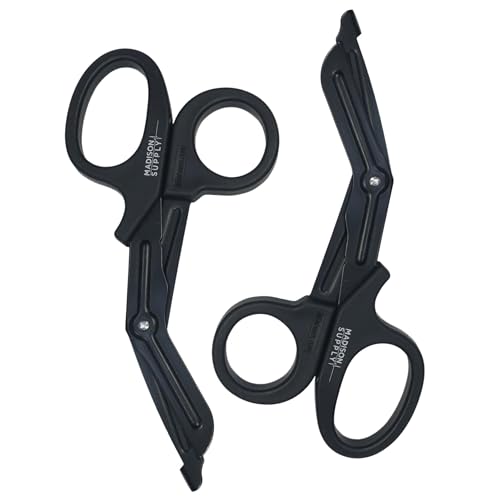
1. Madison Supply EMT and Trauma Shears for Left and Right Hand -7.5-Inch
Our pick — over 4.5★ from 28,000+ verified ratings; the strongest balance of quality and price.
The pair that keeps cutting after the coating has done its job a hundred times over.
If you work on your feet with a shear clipped to your pocket, start here. This Madison Supply pair is the crowd favorite — 4.8 stars across 28,000+ ratings — and what wins people over is the cutting itself. The 7.5-inch stainless steel blades carry milled serrations and a fluoride coating, so they bite through tough fabric without grabbing on tape or adhesive. At 0.15 kg they sit comfortably in the hand for long shifts.
The blunt lower blade slides under a bandage while the serrated upper blade cuts from above, keeping the sharp edge off a moving patient’s skin. The high-impact handles are built for a gloved grip, and the same pair can be autoclaved up to 143 degrees C for cleaning between patients.
The trade-off worth knowing: it runs 6.38 ounces, roughly double the 3.2-ounce OK TAPE shear, so if you want something light for a pocket kit that weight is real. A handful of buyers report the back of the jaw on some blades does not always start the cut cleanly, so you may need to seat the material deeper in the jaw before you squeeze. For everyone else, the value holds up — a two-pack covers your bag and your kit without a second order.
Where This Shear Earns Its Keep
- Non-stick fluoride coating keeps tape and adhesive from building up on the blade
- Blunt tip and serrated upper blade cut safely without nicking skin
- Autoclavable up to 143 degrees C for reuse between patients
- Two pairs per pack covers a bag and a home kit at once
Worth Knowing Before You Buy
- At 6.38 ounces it is the heavier option here — not the one for a lightweight pocket carry
- A few buyers find the back of the jaw needs a deeper seat to start a clean cut
Made for: Nurses, EMTs, and first responders who cut through clothing and dressings every shift and want a coated blade they can sterilize.
Think twice if: you want a featherweight pair for a glove box — the 3.2-ounce OK TAPE shear is the lighter pick.
2. Pyrsiva Trauma Shears – 7.5″ Titanium-Coated Medical Shears
Titanium-coated blades and rubber grips for the messiest dressings on your rounds.
Wound care is where this one shines. The micro-serrated blades cut through heavy denim, thick gauze, clothing, leather, and adhesive surgical bandages, and the titanium coating on the stainless steel helps them resist rust and wear so the edge holds. A reinforced rivet joint keeps the shear smooth at the pivot, which is what separates a pair you can rely on from a disposable one.
The rubberized handle is the part you notice on a long shift. It eliminates pressure points and gives you control when your hands are stressed or gloved. The 7.5-inch frame slides into a scrub pocket or duty belt without catching. As owners put it, “This item is as described,” and the coating makes cleanup quick when dressings are tacky.
Honest note on the build: some owners mention the shears feel lighter than a full heavy-duty pair, so if you routinely force thick material that light-in-hand feel may not suit you. A few also mention a loose pivot screw turning up over time. For everyday dressing changes and rapid bandage removal, though, the blade does the work, and the titanium coating earns its keep the more you use it.
The coating story: Titanium-coating on stainless steel is why this pair keeps its bite on adhesive bandages and resists rust between cleanings.
The grip story: Rubberized handles with a reinforced rivet joint give you steady control during high-stress cuts — the part you feel on a long shift.
The fit: Wound-care nurses and medics who cut through layered dressings and want a coated blade with a grippy handle.
Consider another pick if: you want a heavier, solid-feeling shear for forcing thick materials.
3. ZAKUTO Trauma Shears 2 Pack – 8″ EMT Medical Scissors with Carabiner Clip
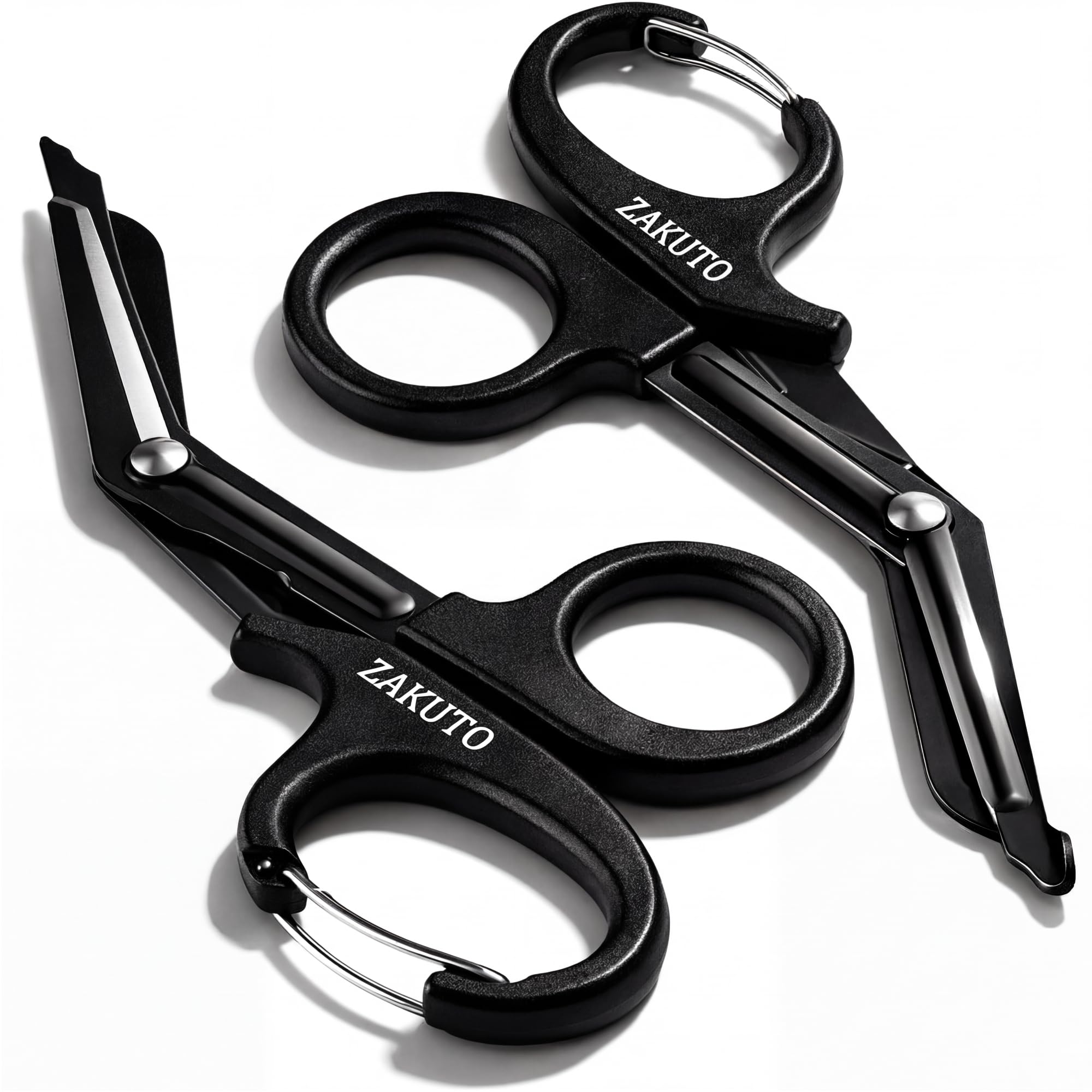
Clip it to your scrubs and forget about hunting for a shear mid-shift.
The hook here is the carabiner — each of the two pairs comes with one so you can hang a shear on a badge, belt, or pack loop. If you have ever patted down three pockets looking for scissors while a patient waits, that small clip is the whole point. The 8-inch frame gives you reach and leverage, and the serrated Stainless Steel 440 blade cuts denim, leather, and clothing in one pass.
The lower blade sits flat against skin and the non-stick coating stops adhesive from building up on the edge. It works as a trauma shear, bandage scissor, surgical scissor, and first aid scissor depending on the cut you need. Customers note the edge holding up for years of regular use before it dulls. Plenty of owners get years out of this one before the edge dulls.
One thing to size up: the blade itself measures 2.2 inches, so this is not the pick for a long, sweeping cut through thick layered material. It is built for fast cuts of tape and gauze, not for forcing through a heavy boot. If you want a pair you can clip and grab without thinking, this is the one.
Why It Stays In The Kit
- Carabiner clip keeps the shear on a badge, belt, or pack
- Serrated 8-inch blade cuts clothing and tape in a single pass
- Non-stick coating resists adhesive buildup on the edge
- Two pairs per pack covers a kit and a backup
The Honest Limits
- 2.2-inch blade is short for forcing through thick layers
- Built for quick cuts, not for heavy leverage work
Reach for this if: you want a clip-on shear for bedside and roadside work and hate losing a tool in your pocket.
Look elsewhere if: your day involves forcing through thick boots and heavy webbing.
4. MEUUT Medical Scissors 2-Pack Trauma Shears for Nurses EMT All Purpose

Longer blades than the rest for bigger leverage when the cut needs a little more force.
At 8 inches, this is the longest pair on the list — the Madison Supply shear measures 8 inches too, but the MEUUT blade reaches a full 8 inches with Stainless Steel 440 and a fluoride-coated non-stick surface. Those extra inches translate into leverage, so you can cut ribbon, burlap, rope, car seat belts, and leather with less effort than a shorter shear allows. The soft-grip handle is built for precision control.
What makes this a smart kit buy is what comes in the bag. You get two pairs in black and red, ambidextrous so both a left- and right-handed user can work with one, and a built-in oxygen wrench that opens a cylinder without getting in the way of the cutting. The 6.38-ounce build sits heavier than the 3.2-ounce OK TAPE shear, but that weight is the trade you make for the longer blade.
This pair is not built to be your main clinical shear for eight-hour shifts — a couple of owners say it will not hold an edge the way a professional shear does. So it earns its spot in a vehicle, office, or home first aid kit instead. Treat it as the reliable backup you hope you never need, and it delivers.
The leverage play: An 8-inch blade and ambidextrous handle let you cut through seat belts and leather with less force than a shorter shear.
The kit math: Two pairs plus an oxygen wrench in one pack equip a home, car, and office kit at once.
Who it serves: Households and first aid kits that want a durable backup shear in every vehicle and bag.
skip it if: you need a daily-clinical shear that stays razor-sharp through long shifts.
5. SURGICAL ONLINE 6 Pc EMT Trauma Shears – Multi-Color

One order, six shears, so every room and kit stops sharing a single pair.
This is the buy for anyone who wants scissors everywhere at once. You get six 7.5-inch shears in assorted colors, each with razor-sharp stainless steel blades and milled serrations for cutting clothing and bandages. The color range is the clever part — drop a different color in each kit, and you can spot which shear is missing without opening every bag.
The design covers both hands. Soft-grip, non-slip handles with large finger openings stay comfortable through prolonged use, and the ambidextrous layout means a left- and right-handed user can both grab one off the shelf. The blunted tip and non-stick fluoride-coated surface make for precise cuts without sticking, and the 7.5-inch frame fits a scrub pocket or a home first aid box. The full set is autoclavable up to 290°F (143°C) when you need to sterilize.
Here is the caveat that matters: sharpness is the one thing buyers split on, so if you expect every shear in a multi-pack to arrive with the same edge, set your expectations by the price tier. It is not billed as a top-of-the-line surgical shear; it is a workhorse for equipping many kits at once, and at that job it is hard to argue with.
What You Get In The Box
- Six shears in assorted colors for arming multiple kits
- Autoclave-safe up to 290°F (143°C)
- Non-stick fluoride coating keeps blades from binding
- Ambidextrous soft-grip handles with large finger openings
Set Expectations Here
- Sharpness varies from shear to shear within the set
- Not a top-tier surgical edge — it is a kit-filler, not a daily-clinical tool
The match: Anyone stocking several first aid kits, classrooms, or stations who wants color-coded shears in one order.
Not the match if: you want one premium shear with a consistent factory edge.
6. CynaMed Knowles Bandage Scissors Set (2-Pack) – 4.5 in. & 5.5 in.
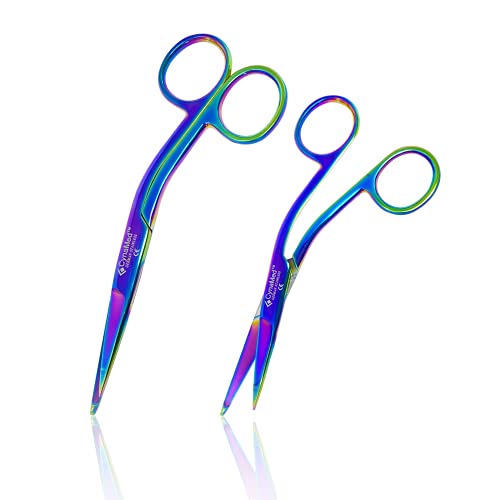
Two compact shears with an angled probe tip that keeps the blade off the skin.
Most shears on this list are built for big, sweeping cuts. This CynaMed set is the opposite — a 4.5-inch and a 5.5-inch pair with large, angled blades made for sizing dressings and removing circumferential bandages in tight spots. The probe end is the standout: it guides the blade along the material and prevents you from accidentally catching skin, which is exactly what you want when the bandage is wrapped close.
The handles are made for control and stability, and the titanium-bonded multicolor coating resists corrosion. At 2.99 ounces the pair is noticeably lighter than the 6.38-ounce MEUUT shear, so it is easy to keep one in a small pouch. A 7.5-inch shear is too much blade for a finger or a small limb. That is the niche this set fills.
Fair warning on edges: the larger pair does not always cut as sharply as the smaller one, which a couple of buyers noticed when working through tough wraps. The smaller shear tends to handle quick bandage removal better. Used as a matched pair — the big one for dressing prep, the little one for tight wraps — that difference works in your favor.
Two sizes in one set: A 4.5-inch and 5.5-inch shear cover both sizing dressings and tight bandage removal without swapping tools.
What owners like about the steel: German-equivalent, autoclavable, and corrosion-resistant with a titanium-bonded coating.
Pick these if: you work with small limbs, IV lines, or dressings where a full-size shear is just too much blade.
Look at a 7.5-inch shear instead if: you need leverage for heavy clothing removal.
7. OK TAPE Shears – Bandage Scissors
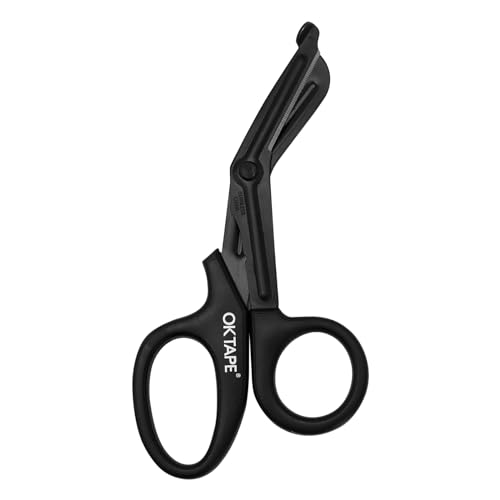
The lightest shear here, sized and shaped to disappear into a compact kit.
At 3.2 ounces, this is the lightest pair on the list — roughly half the 6.38-ounce MEUUT shear. That weight is the feature: it tucks into a first aid kit or a bag and you forget it is there until you need it. The blades are stainless steel with a Teflon coating that keeps them from sticking to tape and adhesive, and the milling serration on the blade helps prevent slippage so the cut stays clean.
The build details suit a kit. High-strength ABS handles give you an ergonomic hold, the curved tip and blunt edge let you cut fast without worrying about nicking yourself, and the shears survive autoclave treatment up to 290F/143C when they need a proper clean. The compact package dimensions mean it stores in spots a full-size shear cannot.
Be honest about the edge: sharpness is the one point buyers split on, so plan on the cut taking a bit more effort on very thick material. It is built for bandages, tape, rope, and lightweight surfaces, and it is at its best when you make rounded corners on KT tape or trim a dressing. For a small kit shear, that is a fair bargain.
Reasons To Tuck It In A Kit
- 3.2 ounces — the lightest shear on this list
- Teflon coating keeps tape and adhesive off the blade
- Curved tip and blunt edge cut fast without nicking skin
- Compact enough for a first aid kit or bag pocket
Where It Falls Short
- Sharpness varies, so thick material takes more effort
- Best for bandages and tape, not heavy clothing removal
Ideal for: A tucked-away kit shear you want to forget about until the moment it is needed.
pass on it if: your primary need is slicing through thick clothing and heavy wraps.
Understanding the Specs
Blade Coating: Fluoride, Titanium, and Teflon
Each of these coatings aims at the same problem — a blade that grabs and binds on sticky material. Fluoride coating on the Madison Supply blades, titanium coating on the Pyrsiva and CynaMed shears, and Teflon coating on the OK TAPE blades all work to keep tape, gauze, and adhesive from sticking. A coated edge also wipes clean faster between patients, which matters when you are moving from one dressing to the next.
Autoclavable Stainless Steel
Autoclavable means the shear can go into an autoclave — a machine that uses high-pressure steam to sterilize metal tools — without warping or rusting. The Madison Supply, OK TAPE, SURGICAL ONLINE, and CynaMed shears all carry autoclavable ratings, so you can safely reuse a pair instead of tossing it after one use. If you work in a clinical setting or share a kit, this is the spec that decides whether a shear is reusable or disposable.
FAQ
What is the difference between bandage scissors and trauma shears?
Can I put bandage scissors in an autoclave?
Are these shears safe for cutting near the skin?
How long do stainless steel bandage scissors stay sharp?
Do left-handed people need a special pair?
Should I buy a multi-pack or a single pair?
What is the ideal blade length for bandage scissors?
How do I keep bandage scissors from rusting?
Final Thoughts: The Verdict
For most people, the best Bandage Scissors pick is the Madison Supply EMT and Trauma Shears. It pairs a non-stick fluoride-coated blade with a blunt tip and an autoclavable body, and the loyal following behind it says the cutting holds up shift after shift. If your work is wound care and you want a titanium-coated blade with a rubberized grip, reach for the Pyrsiva Trauma Shears. For a clip you can grab without thinking, take the ZAKUTO Trauma Shears, and if the job is tight bandage removal on small limbs, the CynaMed Knowles set is the one to keep close.
How We Picked
We do not accept paid placement. Every pick is matched to a real buyer and a real use-case; we do not hands-on test units.
Sources & Methodology
Specifications: manufacturer listings and product documentation. Review insights: verified customer reviews, as of September 2026. Pricing: not shown on this page (it changes often); check the current price via the retailer link.
As an Amazon Associate, Gadgets Feed earns from qualifying purchases. This does not affect which products we feature.