
Our readers keep the lights on and my morning glass full of iced black tea. As an Amazon Associate, I earn from qualifying purchases.
Specs are compiled from manufacturer listings and verified buyer reviews and can change over time — please confirm the key details on the product page before buying.
The quickest way to turn a frustrating bandsaw into a precision tool isn’t a new saw — it’s a blade that actually matches what you’re cutting. The single biggest mistake woodworkers make is running the stock blade for years, and the second biggest is picking any blade without checking the TPI (teeth per inch) and width for the job.
I’m Min — the founder and writer behind Gadgets Feed. This guide is built by comparing the manufacturers’ published specifications and the patterns across verified customer reviews, so you get each pick’s real strengths and trade-offs instead of marketing spin.
You’ll learn which bandsaw blades for wood handle resawing thick stock, which ones excel at tight curves, and why one universal blade rarely does both jobs well.
Our Picks at a Glance


How To Choose The Best Bandsaw Blades For Wood
The right blade for your project boils down to three numbers: the length your saw needs, the width that fits the cut, and the TPI that matches the material thickness. Getting these three right transforms the machine; getting them wrong leads to wandering cuts and burned edges.
Match TPI to Material Thickness
Teeth per inch (TPI) is the count of cutting points along the blade. A high TPI like 14 gives you a smooth, slow cut through thin wood and plastic, while a low TPI like 3 or 4 clears sawdust fast and rips through thick hardwood without bogging down. A simple rule: you want at least three teeth in contact with the workpiece at all times.
Width Determines Your Turning Radius
Wider blades (like 3/4″) track straight for resawing but resist tight curves, while narrow blades (like 1/8″) whip around corners easily but tend to drift on long cuts. If you’re cutting intricate shapes, go narrow; if you’re slicing boards in half, go wide and low-TPI.
Quick Comparison
| Model | Best For | Length x Width | TPI | Blade Thickness | Amazon |
|---|---|---|---|---|---|
| Timber Wolf 93-1/2″ 4TPI★ Best Overall | Resawing thick stock | 93-1/2″ x 1/2″ | 4 | 0.03 inches | Amazon |
| BOSCH BS9312-6WCurve Master | Intricate scroll work | 93-1/2″ x 1/4″ | 6 | 0.02 inches | Amazon |
| POWERTEC 13604 3PKVersatile Trio | Versatility on 9″ saws | 59-1/2″ Assortment | 14 / 6 / 6 | — | Amazon |
| POWERTEC 13100-P2 | 9″ benchtop saws | 59-1/2″ x 1/8″ | 14 | 0.025 inches | Amazon |
| AYAO 93-1/2″ 12TPI | General shop cutting | 93-1/2″ x 1/4″ | 12 | 0.018 inches | Amazon |
| FOXBC 3/4″ 3TPI | Re-sawing logs | 93-1/2″ x 3/4″ | 3 | 0.025 inches | Amazon |
| AYAO 80″ 4TPI | Craftsman 12″ saws | 80″ x 1/2″ | 4 | 0.02 inches | Amazon |
| Timber Wolf 3423VPC | Hardwood resawing | 93-1/2″ x 3/4″ | 9 | 0.03 inches | Amazon |
| Timber Wolf 111″ 3TPI | Large 20″+ resaw capacity | 111″ x 3/4″ | 3 | — | Amazon |
In‑Depth Reviews
1. Timber Wolf Bandsaw Blade 1/2″ X 93-1/2″, 4 Tpi
Our pick — over 4.5★ from 550+ verified ratings; the strongest balance of quality and price.
The resaw champion that erases blade wander on a 14-inch Delta
If you’ve fought a wonky blade that drifts no matter how you adjust the guides, this is the fix. Built from high silicon, low carbide steel, it runs under low tension so it doesn’t demand heavy horsepower from your saw, and the thin kerf wastes less wood as it slices. Owners of a Delta 14″ report the saw “behaves completely differently” after the switch — the wander that plagued them simply disappears.
The 4 TPI tooth count makes this a dedicated resawing blade, perfect for cutting thick stock like maple or walnut into thinner slabs. It cuts through seasoned ash “like butter” and tracks true with minimal vibration, though the instructions warn you to budget about 30 minutes for installation since you’ll need to adjust several guides and guards.
Quality and cutting performance are the two things owners praise most, and the blade holds its edge well enough that many buy a spare just to have it on hand. The one mixed note is the welding quality at the joint — most blades are perfect, but the occasional bad weld slips through.
Why it wins
- Low-tension design keeps smaller motors happy
- Thin kerf preserves more of your expensive hardwood
- Tracks straight with no drift on resawing
Things to watch
- Installation is fiddly — plan for 30 minutes
- Blade uncoils with a snap, so wear gloves
- An occasional unit has a flawed weld
Reach for this if: you resaw boards or face drift on a 14-inch saw, and it holds a 4.7-star average across 500+ owners
Look elsewhere if: you need to cut tight curves — the 4 TPI and 1/2″ width are built for straight, thick work
2. BOSCH BS9312-6W 93-1/2 In. 6 TPI General Purpose Stationary Band Saw Blade
The tight-radius specialist for scroll work and intricate shapes
The 1/4-inch width combined with 6 TPI makes this Bosch the go-to for cutting intricate shapes and tight turns out of wood up to 1-1/2 inches thick. It’s the blade people reach for when building projects like rocking horses, where you need to pivot the workpiece through sharp curves without the blade binding. It’s a full 0.02 inches thick — side by side with the Timber Wolf above, that’s 50% thinner, and the thinner body contributes to less material resistance in the cut.
Bosch uses advanced laser-cutting technology to grind each tooth to exacting specifications, and the tune tooth geometry keeps heat buildup lower for a longer blade life. Owners call it “super sharp” and note it fits standard stationary 14-inch band saws perfectly, with one running it on an import 14-incher for bowl blanks with great results.
Blade quality is what owners praise most, followed closely by value for money. The honest downside: sharpness is the most mixed topic in the reviews. It stays keen for moderate shop use, but one owner reported it “got dull pretty quick while cutting white oak,” so the 0.02-inch thin body means it’s best reserved for softer woods and lighter duty, not daily commercial resawing.
Bottom line: a nimble, well-priced general-purpose blade that shines on curves and smooth cuts in a hobby shop, but a 6 TPI tooth count and thin body mean it’s not built for heavy resawing or dense hardwoods.
3. POWERTEC 59-1/2 Inch Bandsaw Blades Assortment for Woodworking, 3PK
Three blades in one box to cover every cut your 9-inch saw can make
Instead of guessing which single blade you need, this 3-pack gives you a fast-cutting 14 TPI for thin stock, a 6 TPI scroll blade for curves, and another 6 TPI for general-purpose cutting. It’s the smartest starting point for a 9-inch benchtop saw owner who cuts a little bit of everything and wants a blade ready for each job without ordering three separate packs.
The blades are made from high-grade carbon steel with heat resistance, and buyers report they run cool and track straight with no vibration. On an older Delta BS100 9-inch saw, buyers found them the longest-lasting blades they’ve tried, staying sharp and drift-free through extended use — one set held up for up to 30 months of occasional shop work.
Cutting performance earns the most praise, with quality a close second. The honest caveat: these are not a match for lighter-duty saws like the WEN 3959 or Skil BW9501. They physically fit those machines, but the blade is too thick to tension safely, risking damage to a smaller saw — so confirm your saw’s capability before buying.
Verdict: the ultimate versatility play for heavier 9-inch saws, letting you switch tooth counts without a second order — just verify your machine can handle the thicker blade profile.
4. Timber Wolf 3423VPC 93.5″ by 3/4″ Silicone Steel Low Tension Resaw Blade

The silicone-steel ripper that slices 8-inch walnut into 1/4-inch boards
When the job is ripping dense hardwood like maple, ebony, or rosewood into thin slabs, this is the blade that gets it done without heating up the wood or the blade. The milled teeth are 50 percent sharper than stamped blades, and the tooth edge is 20 percent harder than high carbon steel, extending sharp life in real cutting.
On a dialed-in Delta 14-inch saw, owners cut an 8-inch wide walnut board into 1/4-inch pieces “straight as an arrow” with zero wandering. The blade moves through oak down to 3/32 of an inch thick, and the low-tension silicone steel design runs cooler and stays more ductile, extending the flex life of the blade across many cuts.
Quality earns the most owner praise, with effectiveness and sharpness close behind. The narrowest complaint is blade tracking — most run perfectly true, but a small number of owners had to spend extra time tuning their guides to get an optimal path.
The strong points
- Cut 8-inch walnut into clean 1/4-inch slabs
- 50% sharper teeth vs stamped blades, per the maker
- Runs cool so the wood doesn’t burn
The trade-offs
- Requires a well-tuned saw to track perfectly
- 3/4-inch width limits tight curve cutting
Best for: the resaw-focused woodworker who regularly rips thick hardwoods and wants clean, straight results
Not for: scrolling or tight-radius work, where the wide 3/4-inch body will fight you
5. FOXBC 93-1/2 Inch x 3/4 Inch x 3 TPI Woodworking Bandsaw Blades, 2-Pack

The aggressive 3 TPI ripper that mills logs and book-matches thick boards
If your bandsaw doubles as a mini sawmill, this 2-pack of 3 TPI blades is built exactly for that life. Owners use them to mill small logs of poplar, sugar maple, and honey locust, and the blades hold up through hardwood after hardwood. The same sharpness that handles logs also makes short work of resawing thick boards in half for book-matching or wrap-around grain boxes.
Made from premium Japan SK8 high carbon steel, the blade uses induction-hardened teeth that are milled for true tracking — which means less deflection when you’re pushing a thick oak board through. The blade puts an end to scorched edges: one owner who had constant burning on cherry wood with his old blade found this one cut cleanly with no burn at all.
Sharpness is the single most-praised aspect of this blade, with durability a close second. It’s note the 3 TPI tooth count means a rougher finish on thin stock, so this is a big-work blade, not a finish-cut blade.
What owners love
- Mills small logs of hard maple and locust
- No burning on cherry wood
- 2-pack means a spare ready to go
Keep in mind
- 3 TPI leaves a rougher finish on thin material
- Wide 3/4″ body is not for curves
Pick this if: you resaw thick boards and mill small logs — the 2-pack gives you a working blade plus a backup
Think twice if: you mostly cut thin plywood or intricate shapes, where the aggressive teeth are overkill
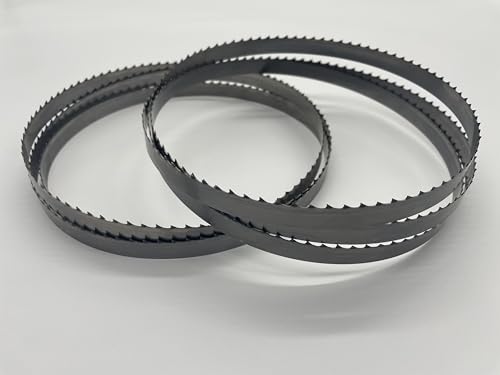
6. AYAO Hardened Teeth Band Saw Blades 80 Inch X 1/2 Inch X 4TPI, 2PK
The long-life 4 TPI that keeps a Craftsman 12-inch saw cutting straight for years
Owners mention the first blade from this 2-pack lasting about six years of steady, non-daily use with no real complaints. That kind of longevity comes from the hardened teeth and the raker set arrangement, where every tooth is evenly spaced for better cutting performance on hard and soft woods alike.
The 4 TPI count makes this a solid resaw blade, and the 1/2-inch width balances straight tracking with enough flexibility for light curves. It cuts wood and plastic cleanly, stays sharp, and the unique welding technique produces a smooth joint that doesn’t snag or vibrate in the cut.
Overall quality is the top-praised aspect, with cutting performance close behind. One owner’s only note is that it’s an “o.k. blade for the price” when ripping 1-inch strips for a wood flag — it’s sharp and cuts true, but it’s not a premium boutique blade.
Grab it if: you own a 12-inch Craftsman and want a reliable, long-lasting resaw blade without spending premium money
skip it if: your saw takes a different length — the 80-inch size only fits specific machines like that Craftsman
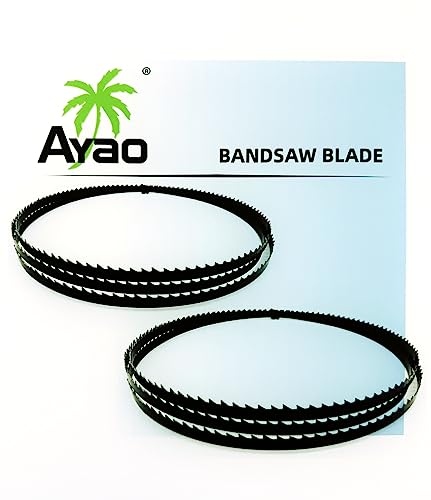
7. AYAO Pack of 2 Band Saw Blades 93-1/2 Inch X 1/4 Inch X 12TPI
The hobbyist’s workhorse that cuts straight on a 14-inch saw at a friendly price
For the woodworker who wants a reliable 1/4-inch general-purpose blade without paying name-brand prices, this 2-pack delivers. It fits the standard 14-inch family of saws — Delta, Jet, Rikon, Grizzly, and more — and owners say it cuts straight and fast “for 12 TPI,” with excellent results on material under an inch thick.
The raker set teeth and the unique welding technique produce a smooth, strong joint, and the blade runs very true during operation. Since you get two in the pack, you have a spare ready when the first one eventually wears out, which buyers describe as smart value for money.
Blade quality is the most-praised aspect, followed by value for money. The honest trade-off: on 2-inch hardwood, the cutting slows down noticeably compared to a lower-TPI resaw blade, so keep your expectations realistic for thick stock.
Final read: a smart, budget-friendly 2-pack for general shop cutting and light curves on a 14-inch saw, best kept to stock under an inch thick for fast, clean results.
8. POWERTEC 59-1/2 Inch Bandsaw Blades, 1/8″ x 14 TPI, 2 Pack

The thin 1/8-inch blade that turns a 9-inch benchtop saw into a real cutter
If you own a 9-inch benchtop bandsaw like the WEN 3959, Ryobi, or Skil, the factory blade is usually the weak link. This 2-pack of 1/8-inch, 14 TPI blades is a documented upgrade — customers note it “cuts cleaner and faster” than the factory blade and can even handle thicker hardwood the original couldn’t manage.
The narrow 1/8-inch width makes this an ideal blade for intricate scroll work and tight curves on small saws, while the 14 TPI raker set tooth profile gives you a smooth, controlled cut on thin wood and plastic. At 0.025 inches thick, it’s noticeably beefier than the 0.018-inch AYAO blade above, which gives it better stability in the cut.
Blade quality is the top-praised aspect, and buyers new to bandsaws appreciate that these blades are forgiving — one beginner bought them worried about breaking blades while learning and hasn’t broken one yet. The 2-pack also fits older Ryobi tabletop models, and owners note these seem less prone to rust than previous blades they’ve used.
The good
- Genuine upgrade over factory blades on 9″ saws
- 1/8″ width excels at tight curves
- 2-pack gives you a spare for the same price
The catch
- 14 TPI is too fine for fast resawing
- Only fits 59-1/2″ saws — verify your model
Best for: owners of 9-inch benchtop saws who want a sharper, more capable blade for curves and thin stock
Not for: resawing thick boards — the fine teeth will struggle and bind
9. Timber Wolf Bandsaw Blade 111″ X 3/4″, 3 TPI

The aggressive 111-inch ripper for large resaw capacity saws
This is the blade for woodworkers with a larger bandsaw — think 20-inch or bigger machines that take a 111-inch blade. The 3 TPI tooth count and 3/4-inch width make it a dedicated resawing monster that moves through thick stock with surprising speed, and reviewers point out it “tracks like an arrow” through materials.
Built from the same high silicon, low carbide steel as the smaller Timber Wolf above, it runs under low tension, which means it doesn’t bog down smaller motors, and the thin kerf preserves wood. It’s the blade one owner chose over a premium Laguna Resaw King, noting he hits nails in his lumber too often to justify that price — this one delivers similar results at a more sensible cost.
Blade quality and cutting performance get the most praise, and sawdust removal is a standout feature — the 3 TPI teeth clear material fast so you’re not pushing against a clogged gullet. The honest caveat is blade life: some owners say it stays sharp and lasts longer than other blades, while others report it dulls quickly, making this a mixed bag for longevity. Value for money is similarly split.
The verdict: a fast, aggressive resaw blade for large saws that impresses on cut quality and speed, but longevity varies by how you use it, so don’t expect uniform blade life.
Understanding the Specs
TPI and Tooth Geometry
TPI, or teeth per inch, is the count of cutting points along the blade edge. Lower TPI (3-4) removes material fast for resawing thick boards, while higher TPI (14) gives a smooth cut on thin material. The tooth set pattern — like raker set, where teeth are arranged evenly — determines how well the blade clears sawdust and resists clogging.
Blade Width and Thickness
The width of a blade (measured in inches like 1/8″ or 3/4″) controls its turning radius: narrow blades bend around tight curves, wide blades track straight for long cuts. Thickness (in inches like 0.025″) affects stability and how much tension the blade needs — thicker blades resist deflection but demand more from your saw.
FAQ
How do I know what length bandsaw blade my saw needs?
What TPI should I use for resawing thick hardwood?
Can I cut tight curves with a wide resaw blade?
Will a 93-1/2 inch blade fit my 14-inch Delta bandsaw?
Why does my blade drift or wander during a cut?
What is a raker set tooth arrangement?
How long should a bandsaw blade last?
How do I tell if my blade is installed correctly?
What does “low tension” mean for a bandsaw blade?
Final Thoughts: The Verdict
For the majority of shoppers, the bandsaw blades for wood winner is the Timber Wolf 1/2″ 4 TPI because it erases blade wander and cuts thick stock cleanly with a low-tension design. If you want a nimble blade for curves and scroll work, grab the BOSCH 6 TPI. And for resawing thick hardwood slabs, the Timber Wolf 3423VPC 3/4″ is the one to reach for.
How We Picked
We do not accept paid placement. Every pick is matched to a real buyer and a real use-case; we do not hands-on test units.
Sources & Methodology
Specifications: manufacturer listings and product documentation. Review insights: verified customer reviews, as of August 2026. Pricing: not shown on this page (it changes often); check the current price via the retailer link.
As an Amazon Associate, Gadgets Feed earns from qualifying purchases. This does not affect which products we feature.