
A single bad termination or a crushed cable run can turn a routine network deployment into hours of frustrating guesswork. The right diagnostic tool transforms that process from speculation into certainty, revealing exactly where signal degradation occurs, what the wiremap looks like, and whether Power over Ethernet is actually reaching the endpoint.
I’m Min — the co-founder and writer behind Gadgets Feed. I have spent countless hours cross-referencing datasheets, lab-test reports, and field-use feedback from network technicians to build a definitive guide on the tools that actually deliver on their specs.
Whether you manage a data center or run cable through a crawlspace, this research-backed guide to the best bandwidth test meter will help you cut through marketing noise and choose a verifier that matches your real-world workflow.
How To Choose The Best Bandwidth Test Meter
A bandwidth test meter is not a single-purpose device; it lives at the intersection of continuity verification, length measurement, PoE detection, and frequency-based signal analysis. Choosing the right one means prioritizing which combination of these capabilities your daily workload demands.
Prioritize TDR for Copper Fault Finding
Time Domain Reflectometry is the method that measures cable length and pinpoints the distance to a break, short, or impedance mismatch. A basic continuity tester only tells you if the pairs are wired correctly end-to-end. A bandwidth test meter with TDR gives you the exact distance in feet or meters to the fault, saving hours of physical inspection.
Check PoE Detection Limits
Power over Ethernet standards range from 15.4W (802.3af) to 90W+ (802.3bt). Your meter must detect the voltage level, polarity, and wiring scheme (end-span or mid-span) of the switch port. Premium models display the actual negotiated power class, while budget units only indicate the presence of voltage. For field work on modern networks, support for 60VDC and 802.3at/bt is critical.
Optical Power Meter Integration Matters
If your work environment mixes copper and fiber, a combo unit that includes an Optical Power Meter (OPM) and a Visual Fault Locator (VFL) eliminates the need to carry a second device. Look for OPM with at least six calibrated wavelengths (850, 1300, 1310, 1490, 1550, 1625 nm) and a detection range that dips below -50 dBm for accurate signal loss measurements on single-mode runs.
Quick Comparison
On smaller screens, swipe sideways to see the full table.
| Model | Category | Best For | Key Spec | Amazon |
|---|---|---|---|---|
| Fluke Networks MS2-100 | Premium | Professional cabling verification | TDR length & distance to fault | Amazon |
| NetAlly LinkSprinter 300 | Premium | 10-second network connectivity checks | PoE + DHCP + Gateway test | Amazon |
| Klein Tools VDV501-853 | Premium | Voice/data/video testing with Map remotes | 2000 ft length measurement | Amazon |
| Fluke Networks MT-8200-60-KIT | Premium | IntelliTone digital cable tracing | Digital + analog toning | Amazon |
| NOYAFA NF-8508 | Mid-Range | Copper + fiber combo troubleshooting | 7-wavelength OPM + VFL | Amazon |
| NOYAFA NF-8506 | Mid-Range | Ping / IP scanning & TDR length | Ping test + port flashing | Amazon |
| KOLSOL AT338 | Mid-Range | Compact all-in-one with OPM | Li-Ion battery + NCV | Amazon |
| FNIRSI 2C53T | Mid-Range | Oscilloscope + multimeter combo | 50 MHz scope / 19999 counts DMM | Amazon |
| Testo 405i | Mid-Range | HVAC airflow measurement | Bluetooth hot-wire anemometer | Amazon |
In‑Depth Reviews
1. Fluke Networks MS2-100 MicroScanner2

The Fluke Networks MS2-100 MicroScanner2 is the industry benchmark for copper cable verification. It integrates TDR-based length measurement, full wiremap diagnostics, and a built-in IntelliTone toner in a rugged yellow chassis. The single screen displays cable length, wiremap, cable ID, and distance to fault simultaneously, so you never toggle between menus to understand a run. It supports RJ11, RJ45, and coax connectors and tests up to 1000 MHz bandwidth, covering Cat3 through Cat6A installations.
Field technicians consistently report that the MS2-100 reduces cable troubleshooting from weeks to days. The ability to detect open faults, short faults, split pairs, and reversed pairs with a single button press eliminates the trial-and-error method. The IntelliTone digital toning cuts through ambient noise in live switch closets, letting you isolate a single cable among hundreds without false positives. The unit runs on 2xAA batteries and ships with a wiremap adapter and carrying case.
The primary limitation is cost — this is a premium investment that pays for itself in high-volume environments. Fluke does not offer repair service, so if the main unit fails after warranty, replacement is the only path. However, for professionals who need accurate, repeatable measurements on every job, the MS2-100 remains the most respected tool in its class. It does not include an Optical Power Meter or fiber testing, but for pure copper verification it has no equal at this level.
Why it’s great
- Displays cable length, wiremap, and distance to fault on one screen
- Built-in IntelliTone toner eliminates false signals in active networks
- Rugged build quality trusted by enterprise network engineers
Good to know
- No integrated optical power meter or fiber VFL
- Fluke does not repair the main unit — replacement only
- Premium price point reflects professional-grade accuracy
2. NetAlly LinkSprinter 300

The NetAlly LinkSprinter 300 is engineered for speed. Press one button and within ten seconds it verifies PoE voltage, link speed, DHCP reachability, gateway connectivity, and internet access. It identifies the nearest switch name, port number, and VLAN via CDP, LLDP, and EDP protocols. The unit is pocket-sized, powered by PoE or 2xAA batteries, and uploads every test result automatically to the Link-Live cloud portal for documentation and team oversight.
Unlike traditional cable testers that require interpreting wiremap graphs, the LinkSprinter 300 uses lighted indicator icons for pass/fail status. There is no screen to read or menu to navigate. For helpdesk and frontline teams, this reduces the skill barrier to network troubleshooting. The built-in Wi-Fi hotspot connects to a mobile UI that shows detailed results, including cable length measurement on the Model 300, switch firmware, and DHCP server response time.
The trade-off is that the LinkSprinter 300 does not offer deep cable diagnostics like split-pair detection or TDR fault location. It tells you whether the link works and where it breaks in the network stack, but not whether the copper itself has impedance anomalies. It also lacks a carrying case — the unit can turn on accidentally when jostled in a tool bag, draining batteries. For rapid triage in enterprise environments where documentation and speed matter, this is an essential pre-check tool.
Why it’s great
- Complete connectivity check in under 10 seconds — PoE, DHCP, Gateway, Internet
- Identifies switch name, port, and VLAN via LLDP/CDP
- Automatic cloud upload to Link-Live for team reporting
Good to know
- No wiremap or split-pair diagnostic capability
- No physical display — relies on indicator lights or mobile UI
- Battery drain from accidental power-on without carrying case
3. Klein Tools VDV501-853 Scout Pro 3

The Klein Tools Scout Pro 3 covers voice, data, and video testing in a single kit. It tests RJ11, RJ12, RJ45, and F-connector coax cables with wiremap diagnostics that detect miswires, split pairs, shorts, opens, and shield faults. The length measurement function reaches up to 2000 feet — sufficient for most structured cabling runs. It also detects Power over Ethernet, displaying the voltage and confirming compliance with 802.3af/at standards.
The kit includes six Test+Map remotes (#1 through #6) that allow you to label and test multiple locations simultaneously. The multi-style tone generator works with an analog probe (sold separately) for tracing wires in bundles. The backlit display and rubber-grip chassis make it field-friendly in dim server rooms or patch closets. The padded carrying case keeps all 7 coax barrel adapters, 7 RJ45 jumpers, and 2 RJ12 jumpers organized.
Some users report that the unit occasionally fails to recognize questionable terminations on the first pass, requiring re-termination until the tester accepts the connection. Replacement remotes can be difficult to source individually. The tone generator is useful but requires a separate probe purchase. For technicians who need a comprehensive wired-network tester with multiple remote IDs, the Scout Pro 3 delivers strong value below the Fluke pricing tier.
Why it’s great
- Tests voice (RJ11/12), data (RJ45), and video (F-connector) in one device
- 6 remotes enable multi-point cable mapping and labeling
- Measures cable length up to 2000 feet with wiremap detail
Good to know
- Analog probe for tone tracing is sold separately
- May need re-termination of marginal cables to pass inspection
- Add-on remotes not sold individually from all retailers
4. Fluke Networks IntelliTone Pro 200 Kit

The Fluke Networks MT-8200-60-KIT IntelliTone Pro 200 is the gold standard for locating cables in active networks. Unlike analog toners that struggle with background noise, the IntelliTone digital mode transmits a signal that only the matching probe can decode, effectively filtering out crosstalk from live data traffic. The SmartTone analog mode isolates individual wire pairs within a cable, allowing the technician to identify a specific pair in a bundle.
The probe includes a built-in pair tester that identifies opens, shorts, reversed pairs, and split pairs. Signal strength indicator LEDs help differentiate one cable from dozens of identical runs in a bundle. The toner can safely apply a signal to active networks without disrupting service, making it ideal for corporate environments where downtime is not an option. The kit includes alligator clips, multiple tone selection, and a carrying case.
The primary limitation is that the IntelliTone Pro 200 is a toner and probe kit, not a full bandwidth verifier. It does not measure cable length or perform TDR diagnostics. Some early units had digital mode range limitations of only one foot on certain cable types, though Fluke replaced those under warranty. For cable tracing and pair verification in dense patch panels, this tool is unmatched — but you will need a separate tester for length and certification work.
Why it’s great
- Digital IntelliTone eliminates false signals on live networks
- SmartTone analog mode isolates individual wire pairs
- Built-in pair tester detects opens, shorts, reversed, and split pairs
Good to know
- Does not measure cable length or perform TDR diagnostics
- Early units reported limited digital range on some Cat6 cables
- Manual provides minimal guidance on advanced features
5. NOYAFA NF-8508 Network Cable Tester with OPM
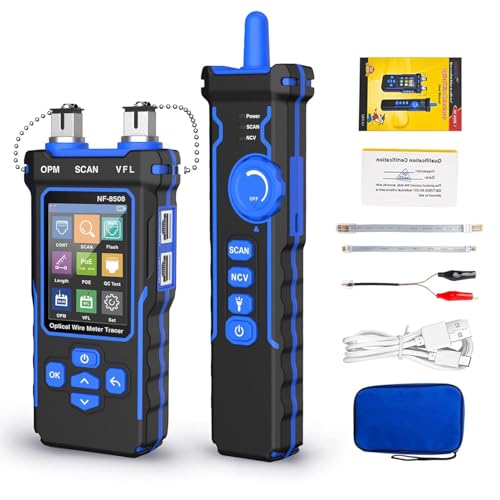
The NOYAFA NF-8508 packs nine functions into a single handheld unit, making it the most feature-dense mid-range bandwidth test meter available. It combines RJ45 cable continuity testing, TDR length measurement up to 200 meters, PoE voltage detection up to 60VDC, a 7-wavelength Optical Power Meter (850/1300/1310/1490/1550/1625/1650 nm), and a Visual Fault Locator with 650nm laser at three flash rates: fast, slow, and static. The power detection range on the OPM goes from -70 dBm to +10 dBm, sufficient for most single-mode and multimode fiber troubleshooting.
The integrated port flashing function identifies which switch port a cable terminates into, displaying the speed and duplex mode directly on the tester screen. The built-in 1500 mAh lithium battery delivers up to 10 hours of continuous use, and Type-C charging eliminates the need for proprietary cables. Non-contact voltage detection adds an extra safety check for identifying live AC wiring before touching conductors.
The display is noticeably dim in direct sunlight, and the English instructions contain minimal detail on advanced OPM calibration. Build quality does not match Fluke or NetAlly — the plastic chassis feels lighter, and the Li-Ion battery is not user-replaceable. The OPM uses an SC connector and requires an LC adapter for common fiber patch cables. For mixed copper/fiber environments where budget is a factor, the NF-8508 provides an impressive feature set at a fraction of the enterprise cost.
Why it’s great
- 7-wavelength OPM with -70 to +10 dBm detection range
- VFL with 3 flash rates for fiber fault identification
- PoE detection up to 60VDC with port flashing
Good to know
- Display screen is difficult to read in direct sunlight
- Non-replaceable lithium battery limits long-term serviceability
- OPM port uses SC connector — LC adapter required for many fiber cables
6. NOYAFA NF-8506 Network Cable Tester with IP Scan
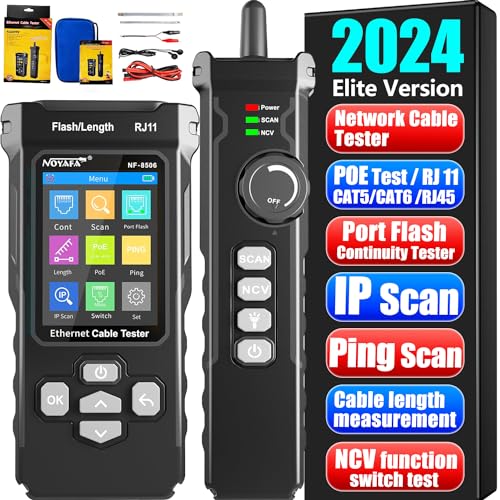
The NOYAFA NF-8506 differentiates itself from other mid-range testers by including a built-in Ping and IP scanning function. This allows you to verify TCP/IP connectivity, measure round-trip time, and discover device IP addresses on a LAN segment without carrying a separate laptop or tablet. Combined with TDR-based cable length measurement up to 200 meters, PoE detection with crossover mode identification (end-span, mid-span, 8-core), and port flashing, the NF-8506 serves as a practical bridge between basic continuity testers and full network analyzers.
The device automatically detects link speeds of 10/100/1000 Mbps and performs QC testing to verify copper contact integrity. The LED flashlight and non-contact voltage detection add utility for dark crawl spaces and residential wiring checks. The color screen (non-touch, button-operated) displays cable faults, wiremap results, and PoE polarity clearly. The 1500 mAh battery lasts through a full workday.
Some users have reported that the TDR length measurement occasionally returns an error on certain cable pairs, and the tone generator function works best when the remote unit is properly connected to the correct port — wrong port selection produces false readings. The build quality is adequate for light-to-moderate field use but does not match the drop-tolerance of Fluke hardware. For network technicians who need a quick IP-level health check along with basic cable diagnostics, the NF-8506 offers a rare all-in-one solution at a competitive price point.
Why it’s great
- Built-in Ping and IP scanner for LAN diagnostics on the go
- TDR length measurement up to 200 meters with fault detection
- PoE crossover mode identification (end-span, mid-span, 8-core)
Good to know
- TDR may return error on specific cable pairs
- Tone generator readings vary depending on port selection
- Not as rugged as premium Fluke or Klein models
7. KOLSOL AT338 Network Cable Tester with OPM

The KOLSOL AT338 is a 4-in-1 tool that combines a LAN cable tester, Optical Power Meter, Visual Fault Locator, and non-contact voltage detector in a single compact chassis. It runs on a rechargeable 1500 mAh lithium battery and charges via Type-C. The OPM supports the standard fiber wavelengths used in telecom and data center environments, while the VFL uses a 650nm laser to identify breaks, bends, and poor splices in fiber links. The NCV function adds an extra layer of safety when working near energized wiring.
For copper cabling, the AT338 performs continuity testing, PoE detection, and QC checks on Cat5, Cat6, and Cat7 runs. The wiremap function identifies correct pin-to-pin connectivity and flags cross-wired or open pairs. The remote unit is included and communicates reliably with the main tester over runs up to typical building distances. The LED flashlight helps illuminate dark patch panels and attic spaces.
Unlike the NOYAFA NF-8508, the AT338 does not include a dedicated length measurement function or port flashing capability. The OPM lacks a detailed calibration log and may show slightly different readings compared to certified lab-grade meters. The build quality is acceptable for occasional field use, but the plastic housing feels less durable under repeated drops. For homeowners, small IT teams, or field service technicians who need a lightweight backup for both copper and fiber, the AT338 provides solid functionality in a smaller footprint.
Why it’s great
- Combines copper tester, OPM, VFL, and NCV in one unit
- Rechargeable 1500 mAh lithium battery with Type-C charging
- Compact form factor fits easily in a tool pouch
Good to know
- No dedicated TDR cable length measurement
- OPM accuracy not certified for lab-grade fiber work
- Plastic housing less durable than professional-grade alternatives
8. FNIRSI 2C53T Handheld Oscilloscope / Multimeter
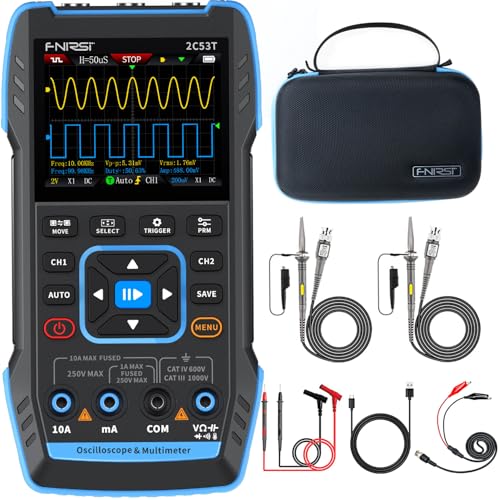
The FNIRSI 2C53T is a 3-in-1 instrument that combines a 50 MHz dual-channel oscilloscope, a 4.5-digit (19999 counts) multimeter, and a 50 kHz DDS signal generator. While not a traditional bandwidth test meter for Ethernet certification, it excels in analog signal analysis and general electronics diagnostics. The oscilloscope features 250 MSa/s sampling rate, 1 Kpts record depth, and automatic measurement of frequency, period, duty cycle, and voltage parameters. The multimeter measures AC/DC voltage up to 999.9V, current up to 9.999A, resistance up to 19.99 MΩ, capacitance up to 99.99 mF, and includes continuity/diode testing.
The built-in DDS signal generator outputs up to 13 waveform types with a maximum frequency of 50 kHz and 1 Hz step resolution. The FPGA+MCU+ADC architecture provides stable waveform capture and the 2.8-inch LCD display shows clear grid lines and measurement readouts. A 3000 mAh battery provides approximately 6 hours of standby operation, and the Type-C interface supports 5V/1A charging. The included storage case holds all probes and cables.
The user interface defaults to Chinese on first boot, and switching to English requires navigating through the system settings menu. The battery life is shorter than dedicated cable testers — expect around 3-4 hours of active use. The multimeter auto-ranging mode is noticeably slow compared to dedicated DMMs. The unit is best suited for electronics repair technicians, hobbyists, or educational settings where oscilloscope and multimeter functions are needed together, rather than as a primary network cable tester.
Why it’s great
- Combines 50 MHz oscilloscope, 19999-count DMM, and DDS generator
- FPGA+MCU+ADC architecture for stable waveform capture
- Includes storage case, 10X probe, and multimeter leads
Good to know
- UI defaults to Chinese — must toggle to English in settings
- Active battery life around 3-4 hours, below cable testers
- Multimeter auto-ranging is slower than dedicated units
9. Testo 405i Anemometer / Airflow Meter

The Testo 405i is a hot-wire anemometer designed for HVAC airflow measurement, not traditional network bandwidth testing. It belongs in this guide because airflow bandwidth — the capacity of a duct to deliver conditioned air — is measured in CFM (cubic feet per minute), and the 405i calculates this value when you input duct dimensions via the smartphone app. The telescopic shaft extends up to 15 inches, allowing measurement inside tight ducts and vents without removing grilles. The hot-wire sensor is accurate across a range of 0 to 10 m/s (0 to 1970 fpm) and temperature range of -20 to +60°C.
The Bluetooth 4.0 connection pairs instantly with the Testo Smart Probe App on iOS or Android. The app displays real-time air velocity, temperature, and calculated volume flow as tables and graphs. All data can be stored, retrieved, and exported in custom reports. The unit runs on 3 AAA batteries and has been widely adopted by HVAC technicians for balancing residential and commercial systems. The probe hinge allows 90-degree articulation for flush contact against duct walls.
The maximum velocity of 6000 FPM limits its use in high-performance industrial ductwork. The hot-wire bulb is sensitive to dust buildup, which can skew readings if not cleaned regularly. The unit is not designed for in-line permanent mounting. For technicians balancing residential AC systems, performing fume hood certification checks, or optimizing dust collection ductwork, the Testo 405i provides lab-grade accuracy in a portable, app-connected format that eliminates the need for manual CFM calculations.
Why it’s great
- App-connected calculation of CFM from duct dimensions
- Telescoping 15-inch probe reaches inaccessible duct positions
- Real-time data logging and graph export for reporting
Good to know
- Max velocity of 6000 FPM limits high-performance duct use
- Hot-wire sensor is sensitive to dust and debris buildup
- Not designed for permanent in-line mounting
FAQ
What is the difference between a bandwidth test meter and a cable certifier?
How accurate does a TDR length measurement need to be for field work?
Can I test fiber optic cables with a copper-only bandwidth test meter?
What does port flashing reveal that a continuity test does not?
Is a higher sampling rate on an oscilloscope important for Ethernet testing?
Final Thoughts: The Verdict
For most users, the best bandwidth test meter winner is the Fluke Networks MS2-100 MicroScanner2 because it combines TDR length measurement, full wiremap diagnostics, and IntelliTone toning in a robust field-proven package that delivers lab-grade accuracy on every cable run. If you need rapid network-layer triage with cloud documentation, grab the NetAlly LinkSprinter 300 for its ten-second pass/fail connectivity check and automatic reporting. For mixed copper and fiber environments, nothing beats the NOYAFA NF-8508 — its 7-wavelength OPM, VFL, and PoE detection deliver enterprise-level versatility without the enterprise price tag.