
The gap between a backyard BBQ and competition-level ‘que isn’t just about the rub — it’s about holding a 225°F chamber temperature across a 10-hour brisket cook without a single spike. That steady, low-and-slow mastery hinges entirely on the design of your pit, its airflow control, and the thermal mass of its walls. The wrong barbecue pit smoker turns a weekend project into a frustrating battle against temperature swings, smoke leaks, and fuel starvation.
I’m Min — the co-founder and writer behind Gadgets Feed. I’ve spent countless hours mapping the thermal behavior of offset baffle systems, ceramic dome airflows, and pellet-drive controllers to understand exactly what makes a smoker hold temperature under load.
The market is packed with vertical propane units, traditional offset stick-burners, and app-connected pellet grills, but only a handful of models deliver the consistent heat and smoke circulation that defines great ‘que. This guide breaks down the critical specs and real-world performance of the best barbecue pit smokers available today so you can buy with confidence.
How To Choose The Best Barbecue Pit Smoker
Choosing a barbecue pit smoker starts with understanding the trade-off between fuel type, thermal stability, and convenience. An offset charcoal smoker gives you the most authentic smoke flavor but demands constant fire management, while a pellet grill offers set-and-forget ease but delivers a milder smoke profile. The right choice depends entirely on how much time you’re willing to spend tending the fire versus monitoring an app.
Fuel Matters: Charcoal, Propane, Wood Pellets, or Electric
Charcoal offsets produce the boldest bark and smoke ring but require you to manage airflow with dampers and add fuel every hour. Propane vertical smokers, like the Masterbuilt 230S, offer push-button ignition and a steady 15,400 BTU burner that holds temperature with minimal effort — ideal for beginners. Wood pellet grills, such as the Traeger Pro 780, use an auger and digital controller to feed pellets automatically, but they burn through fuel faster in cold weather and produce lighter smoke flavor than a wood split in an offset. Electric smokers like the Ninja Woodfire combine convenience with real wood pellets for smoke, but their heating element limits maximum temperature compared to a propane burner.
Thermal Mass and Heat Retention
Heavy-gauge steel and thick ceramic walls store heat and resist temperature swings when you open the lid. A Kamado Joe Classic III’s 18-inch ceramic body radiates heat evenly and can hold 225°F for hours with minimal airflow adjustment, while a thin-walled offset like the Oklahoma Joe’s Highland needs added gaskets to seal leaks and maintain stable temperature in cold weather. The rule is simple: heavier construction means steadier cooking, but it also means a heavier price tag and harder mobility.
Airflow and Smoke Circulation
Reverse flow designs — like the Oklahoma Joe’s Longhorn — route smoke from the firebox under a baffle plate, then back across the cooking chamber. This eliminates the 50°F temperature differential found in traditional offsets, where the firebox side runs hotter than the chimney side. Vertical smokers use a direct-flow design where smoke rises through racks, which works well for even heat but can be harder to control at very low temperatures below 200°F.
Quick Comparison
On smaller screens, swipe sideways to see the full table.
| Model | Category | Best For | Key Spec | Amazon |
|---|---|---|---|---|
| Traeger Ironwood 885 | Wood Pellet | Smart set-and-forget smoking | 885 sq. in. cooking area | Amazon |
| Traeger Pro 780 | Wood Pellet | Wi-Fi controlled pellet smoking | 780 sq. in. cooking area | Amazon |
| Kamado Joe Classic III | Charcoal Ceramic | Ultimate heat retention and searing | 18-inch ceramic dome | Amazon |
| Oklahoma Joe’s Highland | Charcoal Offset | Traditional offset smoking on a budget | 619 sq. in. primary cooking space | Amazon |
| Oklahoma Joe’s Longhorn | Charcoal Reverse Flow | Even heat across large cooks | 1,060 sq. in. total cooking area | Amazon |
| Ninja Woodfire Pro Connect XL | Electric/Pellet | Compact 7-in-1 versatility | 180 sq. in. cooking space | Amazon |
| Pit Boss 3-Series | Propane Vertical | Beginner-friendly gas smoking | 880 sq. in. cooking area | Amazon |
| Sophia & William Vertical Offset | Charcoal Offset/Vertical | Large capacity vertical offset | 961 sq. in. total cooking area | Amazon |
| Masterbuilt MPS 230S | Propane Vertical | Budget-friendly propane smoking | 15,400 BTU stainless-steel burner | Amazon |
In‑Depth Reviews
1. Traeger Ironwood 885 Wood Pellet Grill and Smoker

The Traeger Ironwood 885 is the benchmark for pellet-powered barbecue pit smokers, combining an 885 square inch cooking surface with double-wall insulation and the D2 direct-drive controller. Its Super Smoke Mode kicks in between 165°F and 225°F, forcing more smoke across the meat for a bolder wood-fired flavor than standard pellet grills deliver. The WiFIRE app lets you monitor internal temperature via the wired probe from anywhere, and the 20-pound hopper supports extended overnight cooks without refueling.
Assembly requires two people due to the 170-pound weight, but once set up, the operation is genuinely set-and-forget. The lack of a smokestack — smoke exits through a bottom vent — reduces heat loss, and the porcelain-coated grill grates make cleanup simple. Reviews consistently highlight the ease of producing competition-quality brisket and perfectly reverse-seared steaks with minimal effort. The Super Smoke Mode alone justifies the upgrade over the Pro series, delivering a noticeably thicker smoke ring in the first two hours of a cook.
The Ironwood does consume pellets at a higher rate during long cooks in cold weather, and the foil drip tray liners are pricey, but these are minor trade-offs for a smoker that maintains 225°F within a 5-degree window across an entire pork shoulder cook. If you want maximum convenience with authentic wood-fired results, this is the sweet spot.
Why it’s great
- Super Smoke Mode delivers noticeably bolder wood-fired flavor than standard pellet grills
- Double-wall insulation keeps chamber temperature stable in winter conditions
- WiFIRE app with wired probe enables remote monitoring from anywhere
Good to know
- Pellet consumption is higher in cold weather, requiring frequent hopper checks
- Proprietary foil drip tray liners are expensive to replace
2. Kamado Joe Classic Joe III 18-inch Charcoal Grill & Smoker

The Kamado Joe Classic III represents the pinnacle of ceramic charcoal cooking, using a thick 18-inch insulated ceramic dome to hold steady temperatures from 225°F for low-and-slow smoking up to 750°F for steak searing. Its patent-pending SlōRoller Hyperbolic Smoke Chamber uses Harvard-derived science to create rolling, recirculating waves of smoke and heat, wrapping the food in a convection-like flow that reduces hot spots and temperature differentials. The 3-Tier Divide & Conquer system with half-moon grates lets you cook different foods at different distances from the coals simultaneously.
The Air Lift hinge reduces the heavy dome weight so it opens with a single finger, and the Kontrol Tower top vent maintains a consistent airflow setting even when you open the lid, minimizing temperature drop. Owners report that after the initial learning curve for charcoal fueling and damper adjustments, the Classic III requires far less active management than a traditional offset smoker. The ceramic shell holds heat so efficiently that a single load of charcoal can run for 18 hours at low temperatures.
The trade-off is the weight — assembly definitely requires two people — and the price, which places this firmly as an investment piece for serious barbecuers. The included Grill Gripper, ash tool, and side shelves add utility out of the box. For someone who wants a single grill that can smoke brisket overnight and sear ribeye at restaurant temperatures, the Kamado Joe Classic III is unmatched in versatility.
Why it’s great
- SlōRoller chamber creates rolling smoke waves for even heat distribution and enhanced flavor
- Ceramic construction holds 225°F for 18+ hours on a single charcoal load
- Reaches 750°F for high-heat searing on the same grill
Good to know
- Heavy ceramic body requires two people for assembly and careful handling
- Requires a learning period to master damper settings for precise temperature control
3. Traeger Grills Pro 780 Wood Pellet Smoker Grill
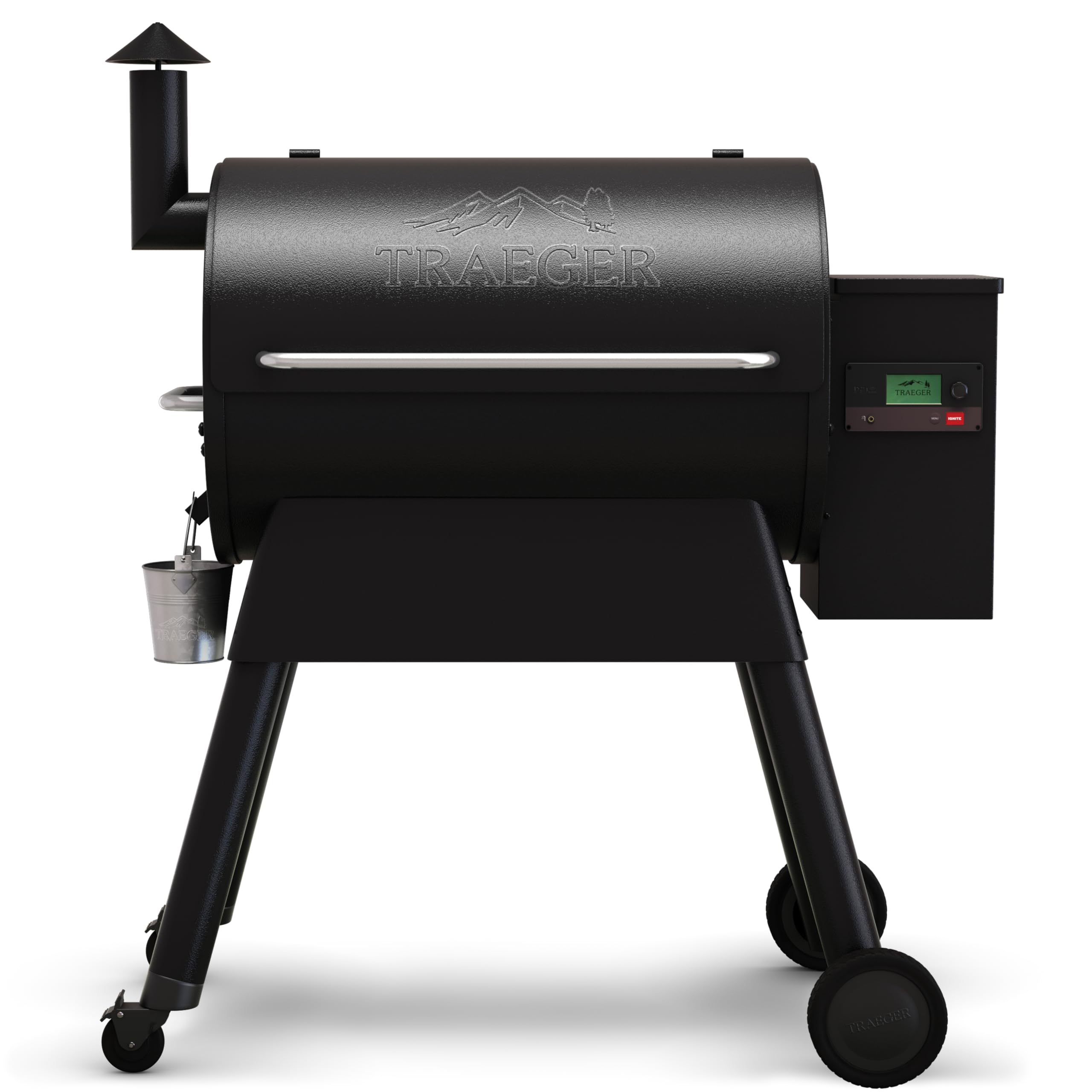
The Traeger Pro 780 is the entry point into Wi-Fi-connected pellet smoking without sacrificing cooking capacity. Its 780-square-inch cooking surface fits up to 6 racks of ribs or 6 whole chickens, and the D2 drivetrain with brushless motor delivers reliable ignition and fast temperature recovery when the lid is opened. TurboTemp mode automatically pushes the fan and auger to bring the chamber back to target temperature quickly, which is critical during long brisket cooks where every degree swing affects bark formation.
The Traeger app lets you adjust the temperature from your phone, set timers for food flipping, and monitor the included meat probe. Owners consistently mention that the Pro 780 produces excellent results on ribs, pulled pork, and even beef filet mignon with minimal hands-on time. Assembly is straightforward but heavy — a second person is recommended for lifting the main body. The powder-coated steel body and heavy-duty wheels make it easy to roll around the patio, and the 18-pound hopper provides enough pellets for a full brisket cook without refilling.
The primary difference from the Ironwood is the lack of double-wall insulation and Super Smoke Mode, which means the Pro 780 produces a lighter smoke flavor and struggles slightly more in freezing temperatures. For most home cooks who want consistent, convenient ‘que without managing a fire all day, the Pro 780 delivers exceptional value. The probe is accurate but reads about 5°F off in some units, though the overall temperature control stays within a tight 10-degree band.
Why it’s great
- D2 drivetrain with brushless motor provides fast ignition and stable temperature control
- WiFIRE app with meat probe enables remote monitoring and recipe guidance
- 780 sq. in. cooking surface fits large gatherings with ease
Good to know
- Single-wall construction struggles to hold heat in sub-freezing weather
- Smoke flavor is milder than offset or Super Smoke-capable pellet grills
4. Oklahoma Joe’s Longhorn Reverse Flow Offset Smoker

The Oklahoma Joe’s Longhorn Reverse Flow is the heavy-hitter for offset smoking purists who want even heat across the entire cooking chamber. With 1,060 square inches of cooking space split between a 751 sq. in. primary chamber and a 309 sq. in. secondary warming shelf, this charcoal smoker can handle multiple briskets, racks of ribs, and whole chickens simultaneously. The reverse flow design uses four baffles below the cooking grates to force smoke from the firebox to travel under the baffle plate and back across the food, reducing the typical 50-75°F temperature differential found in standard offsets.
The firebox door provides easy access for adding charcoal and hardwood splits without opening the main chamber, which helps maintain a stable cooking environment. Owners report that after adding high-temp gaskets and RTV silicone around the firebox lid seal, the Longhorn holds 225°F within a 10-degree range even in moderate winds. The heavy-gauge steel construction — weighing 226 pounds — provides the thermal mass necessary for consistent temperature recovery. The smokestack location is switchable between the reverse flow position and the traditional offset position, giving you flexibility depending on the cook.
Delivery damage is a common theme — the firebox paint blisters during initial seasoning and boxes often arrive dented — but Amazon’s customer service is responsive. The included temperature gauge is inaccurate; most users install a Tel-Tru probe at grate level for real readings. Once you seal the leaks and upgrade the thermometer, this smoker competes with units costing two to three times as much. For large-volume offset smoking where even heat matters more than convenience, the Longhorn is a clear step up from budget offsets.
Why it’s great
- Reverse flow baffles eliminate hot spots, keeping the chamber temperature within 10°F
- 1,060 sq. in. of cooking space fits massive quantities of meat
- Switchable smokestack location provides flexibility for reverse flow or traditional offset cooking
Good to know
- Requires high-temp gaskets and sealer to fix factory smoke leaks
- Paint blisters on the firebox during initial seasoning
5. Oklahoma Joe’s Highland Offset Smoker

The Oklahoma Joe’s Highland is the classic entry-level offset smoker that has launched countless backyard pitmasters. It offers 619 square inches of primary cooking space with an additional 281 square inches of secondary rack space, designed to run on charcoal and hardwood splits. The firebox is large enough to hold a full chimney of lit coals plus several wood chunks, giving you a solid foundation for long-duration smoking. The porcelain-coated wire cooking grates resist rust better than plain steel alternatives and are easy to clean after heavy use.
The Highland’s thin-walled steel construction is the biggest trade-off at this price tier. Without added gaskets, smoke leaks from the firebox door and the main chamber lid, making it difficult to maintain a consistent temperature below 250°F in cool weather. The professional temperature gauge mounted on the front is only a rough indicator — the actual grate-level temperature can differ by 75°F from the firebox side to the chimney side. Experienced owners treat this as a starter platform, adding high-temp sealant, a Tel-Tru thermometer, and felt gaskets to bring performance much closer to premium offsets.
Assembly takes under an hour with labeled hardware, and the large wagon-style wheels make it easy to maneuver. The firebox door with integrated air damper simplifies ash cleanup, and the cool-touch handles protect your hands during long shifts. If you are willing to invest in basic modifications and accept that you will be managing the fire actively, the Highland delivers authentic offset flavor at a fraction of the cost of a custom-built rig. For someone who wants to learn stick-burning without a huge financial commitment, this is the right starting point.
Why it’s great
- Large firebox holds a full chimney of coals plus wood splits for extended burns
- Porcelain-coated wire cooking grates resist rust and are easy to clean
- Easy assembly and maneuvering with large wagon-style wheels
Good to know
- Thin steel walls require added gaskets to prevent excessive smoke leakage
- Temperature differential of up to 75°F between firebox and chimney side without baffle modifications
6. Ninja Woodfire Pro Connect XL Outdoor Grill & Smoker
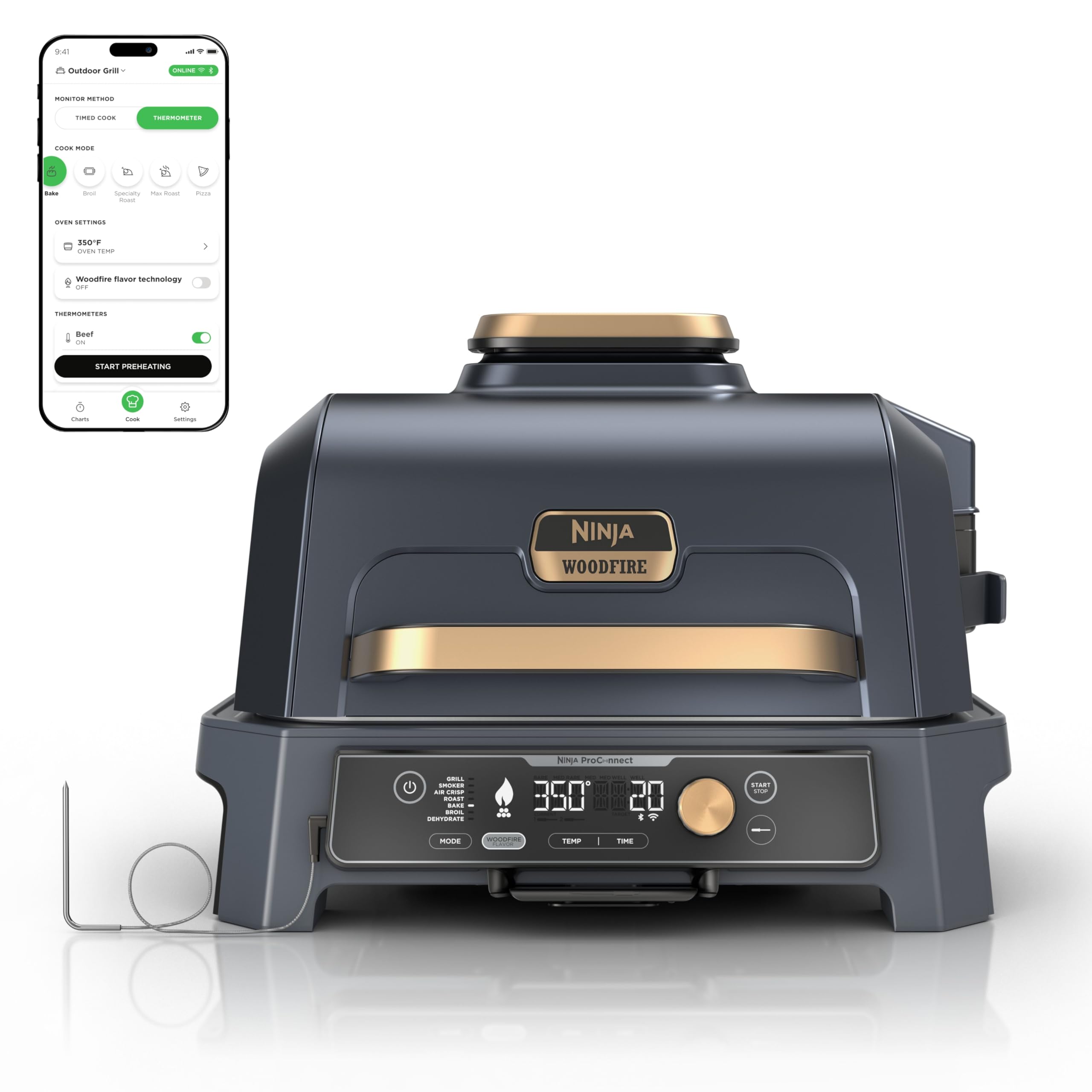
The Ninja Woodfire Pro Connect XL breaks the barbecue pit smoker mold by packing 7 functions — grill, smoke, air fry, roast, bake, broil, and dehydrate — into a compact, electric-powered unit. Its Woodfire Technology burns real hardwood pellets to generate visible smoke, delivering authentic BBQ bark and smoky flavor using only half a cup of pellets per smoke session. The 180-square-inch nonstick cooking surface fits 2 racks of ribs, 10 burgers, or a 10-pound brisket, making it suitable for smaller households, apartment balconies, RVs, or tailgating where a full-sized offset or pellet grill isn’t practical.
The built-in thermometer pairs with the Ninja ProConnect app via Bluetooth, letting you set target doneness for two different proteins, receive real-time notifications for preheat, food addition, and flipping, and access cooking charts. The dual temperature zones allow simultaneous searing at high heat and low-and-slow smoking on the same grate. Reviews consistently mention that the Ninja produces more visible smoke in 30 minutes than a pellet smoker does in 3 hours, though the flavor is lighter than what a traditional offset would impart.
The small pellet hopper means you cannot add pellets while the unit is hot, and pellets continue to burn after shutdown until they are consumed entirely. Cleanup is straightforward — the nonstick grate and crisper basket wipe down easily, and the grease tray collects drips. For someone who wants the authentic wood-fired experience without the space, fuel management, or cleanup of a full-sized smoker, the Ninja Woodfire Pro Connect XL is the most versatile option in this list. The separate air fryer and dehydrator functions add real value for multi-purpose outdoor cooking.
Why it’s great
- 7-in-1 functionality replaces a grill, smoker, air fryer, and dehydrator in one compact unit
- Woodfire Technology uses only 0.5 cup of pellets per smoke session for visible real-wood smoke
- Bluetooth app with dual-probe thermometer simplifies monitoring across two proteins
Good to know
- Pellet hopper is small and cannot be refilled while hot
- Smoke flavor is lighter than what a traditional offset or reverse flow smoker produces
7. Pit Boss 3-Series Gas Vertical Smoker
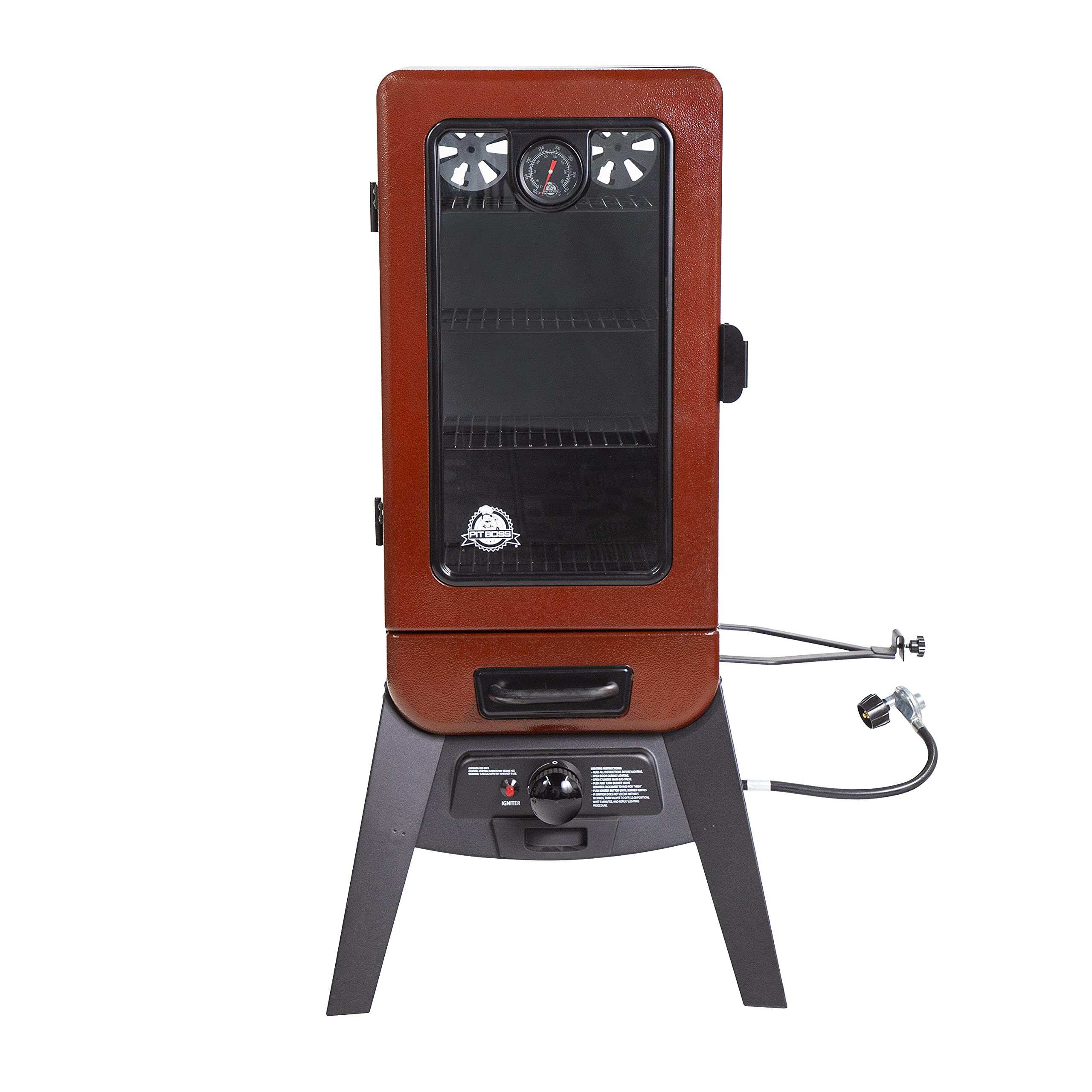
The Pit Boss 3-Series Gas Vertical Smoker offers 880 square inches of cooking space across 4 porcelain-coated stainless steel racks, running on a dual-valve, dual-burner system rated at 12,500 BTUs. Its temperature range spans 100°F to 320°F, giving you the low end for cold smoking cheese or fish and the upper end for traditional BBQ. The propane fuel source means you get push-button piezo ignition and consistent heat output without managing charcoal or emptying ash mid-cook — an ideal learning platform for new smokers.
The vertical design distributes heat naturally from bottom to top, but the external wood chip and ash removal tray makes adding smoke wood and cleaning out spent chips simple without opening the main door. The large viewing window with a heat indicator lets you monitor the internal temperature and smoke density without losing heat. Owners note that the high-temp door seal effectively retains cooking temperatures and smoke, though some smoke leakage from the chip tray and door becomes apparent in cold weather. In freezing conditions, maintaining 250°F requires frequent burner adjustments, but the dual-valve system gives you fine-grained control over flame height.
Assembly takes about an hour with a drill, and two rear rolling wheels make it easy to reposition on a patio. The front-access grease drawer catches drips and slides out for quick cleaning. The Pit Boss strikes a good balance between the convenience of gas and the authentic smoke flavor from external chip loading, making it a strong recommendation for someone who wants to smoke consistently without the learning curve of charcoal or the cost of wood pellets.
Why it’s great
- Dual-valve, dual-burner system provides precise temperature control from 100°F to 320°F
- External wood chip and ash tray allows refueling without opening the main cooking chamber
- 880 sq. in. capacity across 4 racks fits large batches of meat or fish
Good to know
- Smoke leakage from door and chip tray occurs in cold, windy conditions
- Maintaining 250°F requires active burner adjustments in sub-freezing outdoor temperatures
8. Sophia & William Heavy-Duty Vertical Offset Charcoal Smoker
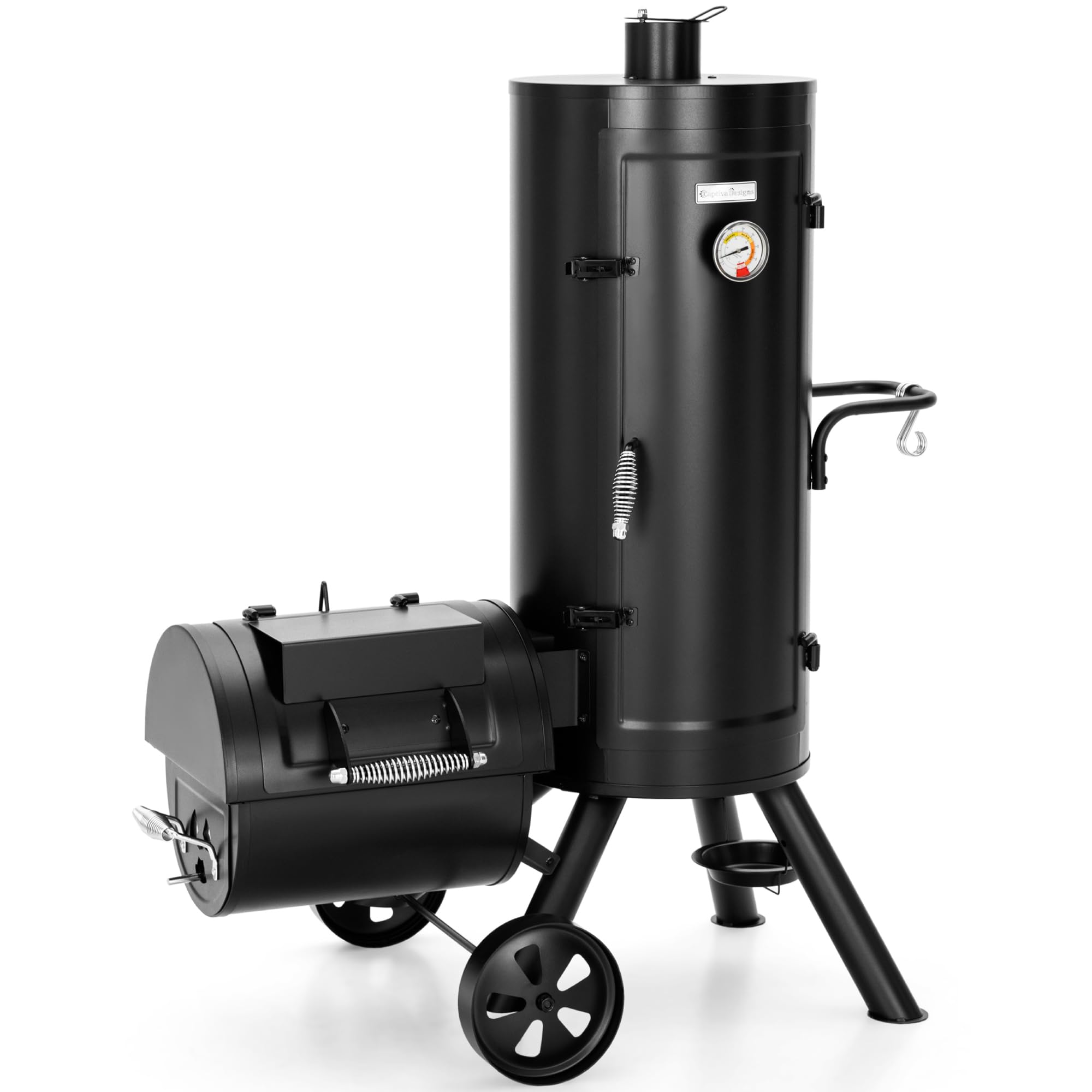
The Sophia & William Heavy-Duty Vertical Offset Charcoal Smoker combines the indirect heat benefits of an offset firebox with the even heat distribution of a vertical cabinet. Its total cooking area of 961 square inches breaks down into 855 sq. in. of primary chamber space and a 106 sq. in. offset smoker section, with 5 chrome-plated cooking grates that can be repositioned to fit different food heights. The design lets you cook with only the heat from smoking wood, without direct or carry-over heat reaching the food, resulting in more consistent results across large batches.
The heavy-duty steel construction — weighing 101 pounds — provides enough thermal mass to hold temperatures between 220°F and 250°F with clean smoke, and the adjustable latches keep the door sealed tightly to minimize heat loss. The hanging racks inside the primary chamber add space for ribs, sausages, and whole poultry, maximizing the use of vertical space. Owners report that the color-coded thermometer (with zones for smoking, BBQ, and grilling) is easy to read, and the grease cup combined with a push-out ash tray makes post-cook cleanup fast.
The main concern is that some units arrive with minor alignment issues on hardware, and the side water filling door design can be slightly finicky to operate. Some buyers note the need for an additional gasket around the firebox door to achieve a perfect smoke seal. However, after seasoning the smoker properly and tightening all hardware, the performance is excellent for the price tier. For large gatherings or batch cooking where you need to feed 6 to 8 people, this smoker provides an unusual blend of vertical capacity with true offset smoke circulation.
Why it’s great
- 961 sq. in. total cooking area with offset heat gives indirect, even cooking across 5 grates
- Hanging racks expand capacity for ribs, sausages, and poultry without taking up grate space
- Heavy-duty steel construction with adjustable latches provides good heat retention and smoke seal
Good to know
- Minor assembly alignment issues reported — plan to use a drill and extra washers
- Additional high-temp gasket around the firebox door can improve smoke seal
9. Masterbuilt MPS 230S Propane Smoker

The Masterbuilt MPS 230S is a no-frills propane vertical smoker designed for people who want wood-fired flavor without charcoal management or pellet hopper refills. Its 15,400 BTU stainless-steel burner powers four chrome-coated smoking racks inside a 43.5-inch-tall cabinet, giving you enough vertical space for whole chickens, multiple racks of ribs, or a 7-pound pork shoulder. The patented porcelain-coated flame disk bowl shields the burner from grease drips while allowing the flame to reach wood chips placed in the tray, creating visible smoke without clogging the gas supply.
Push-button electronic ignition lights the burner quickly, and the built-in temperature gauge on the front door gives a rough reading of the chamber temperature. Assembly is straightforward, taking under an hour with clear instructions. The unit connects to a standard propane tank from a gas grill, eliminating the need for a separate fuel source.
The primary limitation is temperature control at the low end. Several users report that the smoker struggles to maintain temperatures below 200°F, and the burner can blow out on the lowest setting. Smoke leakage from the door and inconsistent temperature swings between 150°F and 225°F are also noted. Some experienced owners resolve this by adding a needle valve for finer gas flow control or aftermarket gaskets. If your target smoking temperature is 225°F and above, the Masterbuilt MPS 230S delivers solid value and consistent results — just plan for occasional monitoring.
Why it’s great
- Push-button ignition and propane fuel make it the easiest smoker to start and run
- 4 chrome-coated racks provide ample vertical capacity for whole birds and multiple ribs
- Patented flame disk bowl prevents grease fires while allowing wood chips to smolder
Good to know
- Struggles to hold temperatures below 200°F — best suited for 225°F+ cooking
- Some units have smoke leakage from door and burner instability at low settings
FAQ
What is the difference between an offset smoker and a vertical smoker for barbecue pits?
Do I need to season a new barbecue pit smoker before its first use?
How do I maintain a steady 225°F on a charcoal offset smoker in cold weather?
Final Thoughts: The Verdict
For most users looking for the best barbecue pit smokers, the winner is the Traeger Ironwood 885 because its double-wall insulation, Super Smoke Mode, and WiFIRE app make it the most reliable set-and-forget pellet smoker that still delivers bold wood-fired flavor. If you want the ultimate in heat retention and temperature versatility from cold smoking to 750°F searing, grab the Kamado Joe Classic III. And for large-scale competitive-style offset smoking where even heat across a massive 1,060 square inch cooking surface matters, nothing beats the Oklahoma Joe’s Longhorn Reverse Flow.