
Our readers keep the lights on and my morning glass full of iced black tea. As an Amazon Associate, I earn from qualifying purchases.
Specs are compiled from manufacturer listings and verified buyer reviews and can change over time — please confirm the key details on the product page before buying.
Buying a laser engraver is really a question of what you want to mark and how big your workspace is. If you mainly engrave wood, leather and painted tumblers, a diode machine does the job for a mid-range budget. If you need crisp marks on bare metal, jewelry or challenge coins, you need a fiber laser, and those are premium-tier tools.
I’m Min — the founder and writer behind Gadgets Feed. This guide is built by comparing the manufacturers’ published specifications and the patterns across verified customer reviews, so you get each pick’s real strengths and trade-offs instead of marketing spin.
The power rating tells you the material it can handle, the working area tells you the project size, and the enclosure tells you how safe your room will be. Everything below helps you match those three things to your own bench. This is a working map of the barcode laser engraving machine market, sorted by what each pick actually does well.
Our Picks at a Glance

How To Choose The Best Barcode Laser Engraving Machine
Three numbers decide almost everything about a laser engraver: power in watts, working area in inches or millimeters, and the safety class. Get those wrong and no amount of software polish will save the purchase.
Start with the material you actually engrave
Diode lasers handle wood, leather, acrylic, glass and coated metal. A fiber laser is what you want for bare stainless steel, brass, titanium and jewelry — the 1064nm wavelength it uses is what makes deep metal marking possible. If your order book is full of tumblers and cutting boards, a diode machine in the mid-range tier covers it. If it is full of challenge coins, it does not.
Working area tells you the biggest job you can start
A machine with a larger bed lets you finish a full project without repositioning it halfway through. This matters most if you batch out items like door signs or dozens of small tags in one run. A small enclosed desktop unit is friendlier on a crowded bench, but every part you make has to fit inside it.
Enclosure and safety class are not optional extras
Class 1 machines are fully enclosed and filter the laser light, so you can run one without goggles. Class 4 machines are open or partially open, and they require eye protection plus real ventilation because they put smoke and debris into the air. If the machine is going in a spare bedroom or a shared living space, treat the enclosure as a must-have rather than a nice-to-have.
Software and connections decide your daily workflow
LightBurn and LaserGRBL are the two programs most owners end up in, and most machines on this list run at least one of them. A built-in touchscreen or Wi-Fi link matters if you want to run jobs without a laptop chained to the machine by a short cable.
Quick Comparison
| Model | Best For | Laser Power | Working Area | Safety Class | Amazon |
|---|---|---|---|---|---|
| xTool S1 40W★ Best Overall | Large wood and acrylic projects | 40W / 40,000mW | 23.93″ x 15.16″ | Class 1 | Amazon |
| AlgoLaser 10WBest Value | PC-free beginner work | 10W | 15.7″ x 17.1″ | Class 1 | Amazon |
| Longer RAY5 10WOffline Ready | Offline touchscreen control | 10W | 400 x 400mm | — | Amazon |
| LONGER Ray5 20W | High-speed diode cutting | 20W | 400 × 365mm | — | Amazon |
| ATOMSTACK A20 Pro V2 | Personalized gifts and cards | 20,000mW | — | Class 4 | Amazon |
| Creality Falcon A1 | Tumbler and round-object work | 80,000mW | 460 × 346mm honeycomb | Class 1 | Amazon |
| OMTech K40+ 45W | CO2 cutting of acrylic and wood | 45W | 12″ x 8″ | Class 2 | Amazon |
| LaserPecker LP2 Plus | Portable work away from the bench | 10W / 450nm | — | — | Amazon |
| GWEIKE G2 Plus 20W | Colored metal marking | 20W / 1064nm fiber | 150 x 150mm | Class 4 | Amazon |
| GWEIKE G2 Max 50W | Deep fiber engraving on metal | 50W / 1064nm fiber | 150 x 150mm | Class 4 | Amazon |
| xTool F2 Ultra | Metal plus wood in one unit | 60W MOPA + 40W diode | 8.7″ x 8.7″, expandable to 8.7″ x 19.7″ | Class 4 | Amazon |
In‑Depth Reviews
1. xTool S1 40W Laser Cutter and Laser Engraver for Tumblers
Our pick — over 4.5★ from 200+ verified ratings; the strongest balance of quality and price.
A 40W enclosed workhorse that swallows a full door sign in one pass.
This is the machine for the buyer whose projects keep getting bigger. The 40W (40,000mW) laser slices 18mm cherry wood in a single pass, and the 23.93″ x 15.16″ bed fits full door signs.
Two features set it apart from cheaper diode machines. xTool’s patented Pin-point Positioning (a system that lines the laser up precisely) keeps curved-surface engraving cleaner on spoons and plates, and AutoPassthrough Technology (a feed system that moves long material through the machine) lets you run projects up to 118 inches (3000mm) long. Setup is quick for this category — among the most repeated lines from buyer reviews sums up the first experience: “first test piece in under an hour, 97% perfect (3% user error).”
What wins people over is the build. A 3mm aerospace-grade aluminum frame holds alignment steady, and the machine logged over 71,830 hours of testing before shipping. The Class 1 enclosure filters 99% of laser light, blocks smoke and noise, and adds five flame sensors plus a lid-open stop. What the crowd flags as the catch is the price position in the tier and instructions that reviewers describe as a little vague. Both are real. Neither changes how much the machine does.
What You’re Actually Buying
- 40W laser (40,000mW) cuts 18mm cherry wood in one pass.
- Enclosed Class 1 design filters 99% of laser light — no goggles needed.
- Air-cooled space plus five built-in flame sensors and an emergency stop.
Where It Asks For Patience
- The instruction booklet leaves gaps reviewers fill with online videos.
- No motor braking, so the head can be bumped out of alignment.
- The upgraded rotary bundle sits in the premium tier.
Reach for it if: your order book includes door signs, tumblers and curved items and you want a sealed machine the whole family can be around safely.
Look elsewhere if: you mostly do one-off small tags and never need a bed this large.
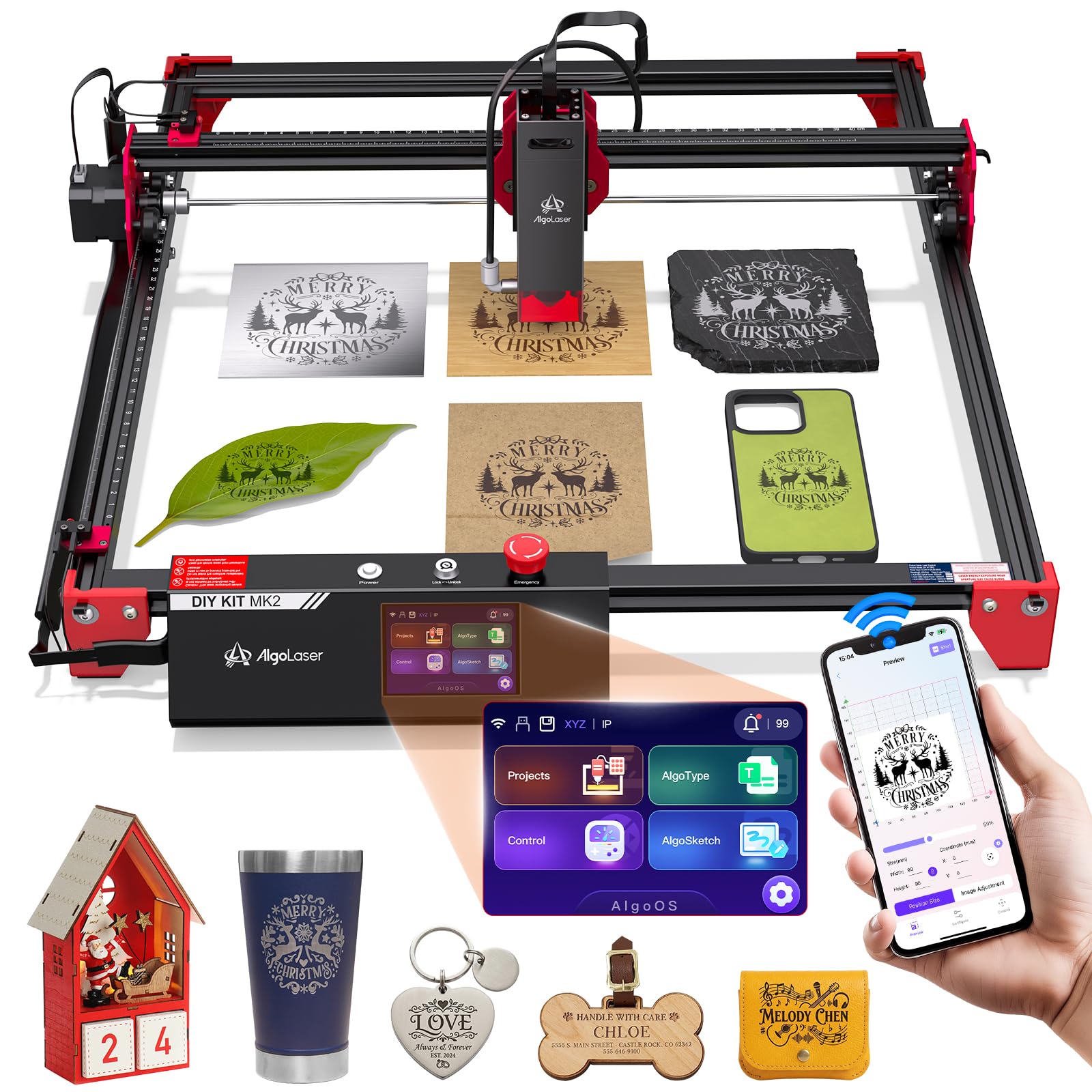
2. AlgoLaser 10W Laser Engraver Machine with 3.5″ Smart Touchscreen & AlgoOS
Runs whole jobs from its own screen, no laptop tied to the bench.
The reason to shortlist this one is the 3.5-inch touchscreen running AlgoOS (the machine’s own onboard operating system). You get hundreds of preset designs, saved custom projects and over-the-air updates right on the unit, so the computer can stay in the house. Money-wise it lands in the budget-friendly tier, which is unusual for a machine with onboard control.
What it does well is the basics. The 10W laser is fine for wood, acrylic, leather, glass and coated metal, and the 0.05mm spot keeps fine detail readable. The 15.7″ x 17.1″ work surface is the surprising part — it is a genuinely large bed for the money. Two connections stand out too: 2.4G Wi-Fi for hooking it to your network, and full compatibility with LightBurn and LaserGRBL if you outgrow the built-in software.
The honest catch is that 10W takes patience on thicker cuts, and a small number of owners hit a mid-job stall with a “lost communication with driver board” error. That is not every machine — most user feedback clusters around how easy it is to run once you learn to set the laser height for each material. Wood engraving leaves a real burning smell, so plan on ventilation or run it outdoors.
Why owners stay happy: the setup curve is gentle, the touchscreen removes the computer, and the price sits well below the mid-range tier.
Where it asks for care: treat it as a wood-and-leather machine first; thick stock cutting is a slow job here, and the plastic feet and split-loom wiring are the first things owners swap out.
Pick it if: you want to start engraving this week with the smallest possible setup hassle.
Try another if: your work is mostly thick hardwood cutting rather than engraving.
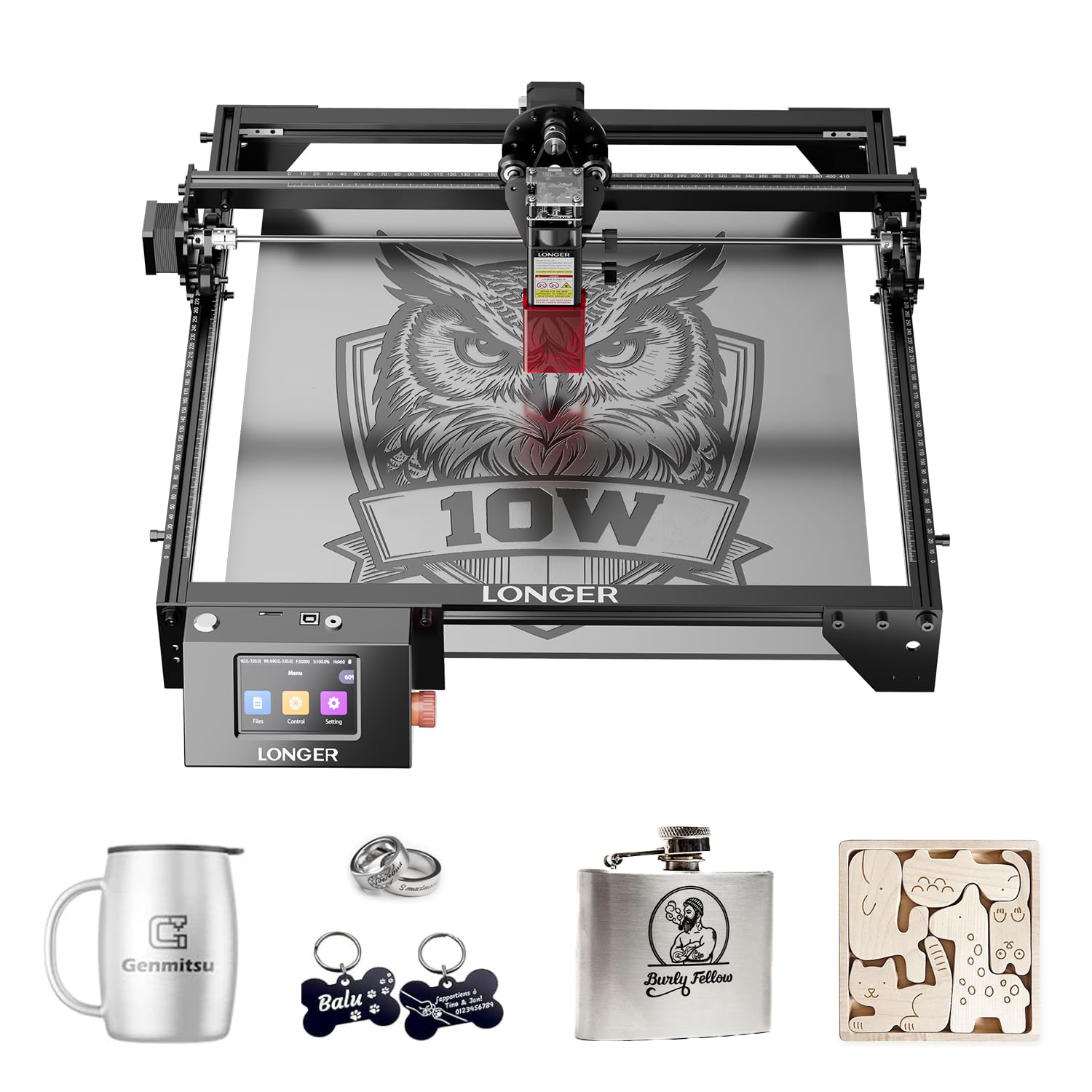
3. LGT Longer RAY5 Laser Engraver, 10W High-Precision
A square 400mm bed and a 0.06mm spot for detail work without a laptop.
Square work areas are underrated, and that is exactly what this Longer gives you — 400 x 400mm, equal on both sides. The engraving spot is 0.06mm x 0.06mm, which is what makes fine lettering and detailed line art come out crisp rather than mushy.
Cutting numbers back up the claim. It cuts 0.8 inches (20mm) of wood board and 1.2 inches (30mm) of acrylic, and the dual-beam design reaches 10,000mm per minute engraving speed. A 32-bit core motherboard (the control board that runs the motion) keeps the head moving steadily through long jobs. Connectivity covers Wi-Fi, USB cable, app and TF card, and the 3.5-inch touchscreen means you can run offline.
What makes it easy to live with is the support side. Longer bundles the tools and accessories in the box with installation guides, offers lifetime technical assistance and 24-hour customer service — and the service reputation holds up in the owner feedback. It is not the fastest machine here, and the price sits in the mid-range tier rather than the bargain bin, so it earns its spot on comfort rather than raw speed.
The everyday reality: assembly is straightforward, the SD card ships with sample images for a first test, and one unit that arrived with a cracked shell was replaced free once the owner sent a photo.
The trade-off: a 10W module can cut wood and acrylic, but if you plan on thick hardwood runs the 20W machines below save you hours.
Best matched to: the hobbyist who wants a square, roomy bed and a machine that runs with no computer nearby.
Not the one for: a production shop chasing the highest throughput per hour.
4. LONGER Ray5 Laser Engraver and Cutter Machine, 20W
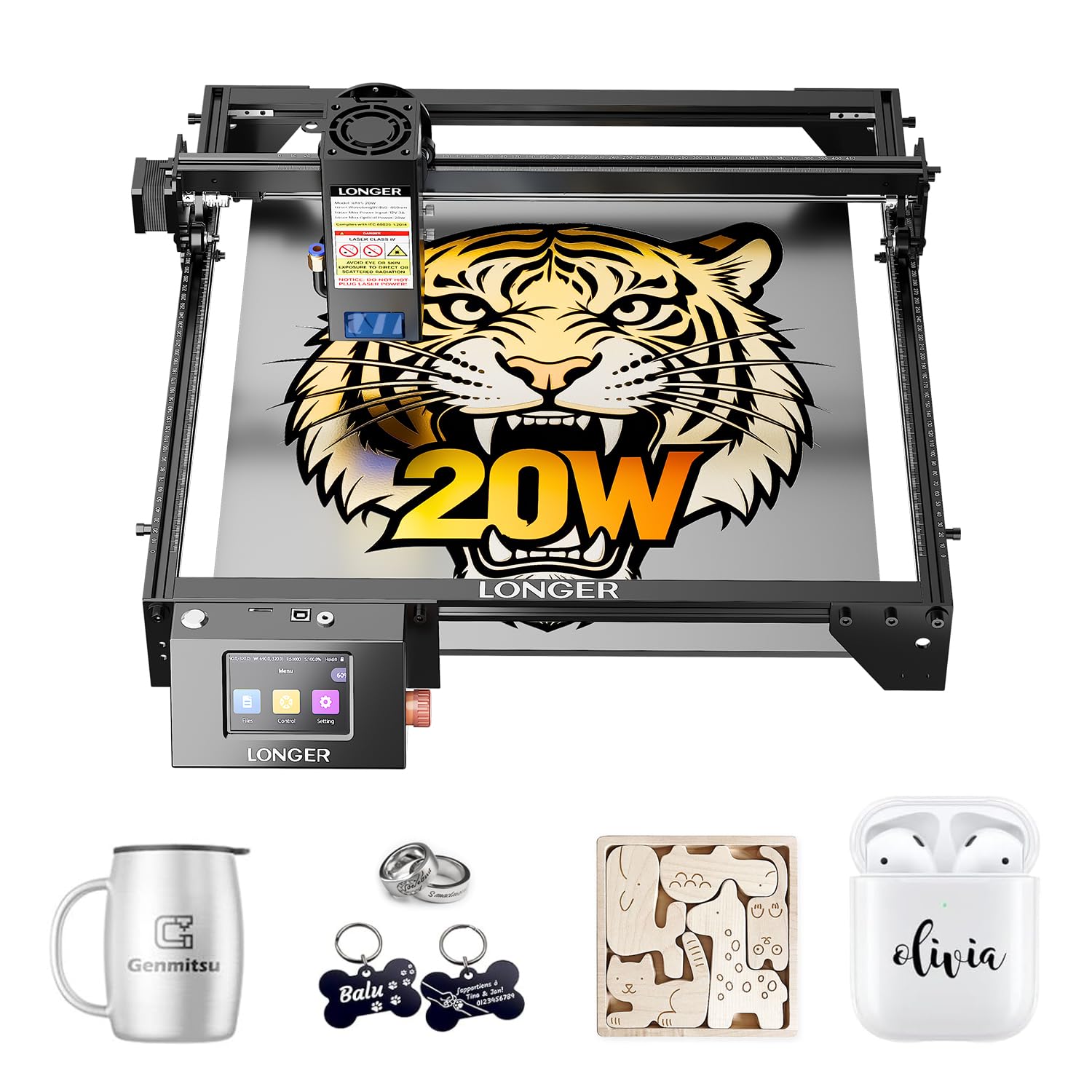
Double the diode power with a color palette the 10W machines cannot match.
Power is the whole story here. The 20W module cuts 15mm (0.59″) pine, 0.05mm (0.002″) stainless steel and 8mm (0.31″) acrylic in one pass, and up to 25mm wood and 35mm acrylic with multiple passes. The maximum engraving speed reaches 24,000mm per minute, twice the pace of the 12,000mm/min class of machines. Under the hood a 240MHz ESP32 chipset (the processor that drives the motion and the jobs) keeps the carriage stable at speed.
Color engraving is where this machine earns its keep. A 256-color palette (the color tones the laser produces on metal) pairs with a 0.08 × 0.1mm spot and 0.01mm precision, giving softer transitions and stronger contrast on stainless steel, metal, leather and glass. A single unit can also drive multiple machines at once, which suits studios running several units in parallel.
Control is straightforward: a 3.5-inch touchscreen shows progress live and lets you adjust parameters mid-job, and it works with LaserGRBL, LightBurn and LONGER’s own LaserBurn software. The dip in the crowd reaction is software cost — one owner’s read is that you will want paid software rather than the free option — so budget for that in your head. There is also a genuine speed-to-noise trade: this is a louder machine than the 10W units because the laser head carries a powerful cooling fan.
Numbers Worth Paying For
- 24,000mm/min top speed with single-pass cuts on pine, acrylic and thin stainless.
- 256-color palette and 0.01mm precision for richer metal images.
- Protective shield filters over 95% of laser radiation, plus goggles and enclosure.
Things to Plan Around
- Pro-level software is a paid extra, not included.
- The cooling fan makes this a noticeably loud machine.
- Occasional units arrive out of alignment and need a return.
Go for it if: you want true color on stainless and metal without jumping to fiber pricing.
Hold off if: your workshop is in a live-in room, since this unit is not a quiet one.
5. ATOMSTACK 20W Laser Engraver, A20 PRO V2

A modular frame you can build in about twenty minutes and run from your phone.
Assembly is this machine’s headline, and that matters — the integrated linear guide structure (a rail system that keeps the head tracking straight) means fewer parts to align and better precision once it is built. The aluminum alloy frame and modular design are there for durability as much as looks. Buyers report getting it running in roughly 20 minutes out of numbered part bags.
On performance, the output is 20000mW, the laser class is 4, and the dot compression technology produces 0.08 x 0.1mm dots. Engraving speeds reach 400mm/s, which cuts processing time across wood, acrylic and metal. A cross-line light plus built-in limit switches hold engraving accuracy at 0.01mm, and the modular design supports a removable magnetic protective cover, safety glasses and a tilt-angle safety beep that sounds past 15 degrees.
Control options are the flexible part — Type-C or USB stick for job files, plus the ATOMSTACK app, PC software, LightBurn and LaserGRBL. The honest limitation is documentation. The free app cannot set travel speed and engraving speed separately, so the head moves at engraving feed when you would rather it hustle, and the paper instructions are thin enough that most owners end up in LightBurn. A few note the gantry cables can snag without added drag chains.
Strongest point: the frame is genuinely rigid and the 10000-hour rated laser lifespan with free replacement parts backs the build claim.
Weakest point: belt-driven motion means its accuracy on very large pieces is good rather than perfect, and the free software wants replacing.
Suits you if: you want a fast, well-built 20W diode for gifts, cards and small-batch work.
Think again if: you need hand-holding through software setup — this one assumes you will Google your way forward.
6. Creality Falcon A1 10W Laser Engraver

Arrives pre-assembled with a camera that picks settings for you.
For a first laser, the Falcon A1 strips out almost every setup headache. It comes fully pre-assembled — zero build required — and the built-in camera recognises the material in front of it and applies the recommended engraving or cutting settings, so you are not guessing at power and speed. Precision holds at 0.05mm with an advanced CoreXY system (a belt layout that moves all four corners together for faster travel), and speed reaches 600mm/s.
The enclosure is the part that matters most in a home. It is a Class 1 machine, blocks 99% of laser light, and reduces smoke and noise, so you can run it without goggles. The double-door layout with transparent panels lets you watch the job and load material from the side, and a Falcon roller kit lets you engrave curved and round objects like tumblers and bottles. It cuts 6mm wood in a single pass.
Software is where the split in feedback shows. Setup and beginner-friendliness draw the strongest praise, and the enclosed design is repeatedly called out as the reason people chose it over open-frame options. The friction points are real and worth naming: several owners hit connection issues, initially over USB-C and, on some units, over Wi-Fi, and the included cables run short enough that the machine wants to sit near your computer. The camera also needs calibrating before the full-area view lines up accurately.
The Case for This One
- Pre-assembled — you can cut on arrival with nothing to build.
- Internal camera auto-recognises material and applies settings.
- Class 1 enclosure with emergency stop and lid-open pause.
Before You Commit
- Compatibility is limited to 460 × 346mm honeycomb panels.
- Reflective materials like mirror-finish metal are strictly prohibited.
- Connectivity and the camera are the two areas with the most mixed feedback.
Made for you if: you want a sealed, camera-guided machine that starts working the day it arrives.
Pass on it if: you plan to engrave mirror-finish metal, since this model forbids it.
7. OMTech K40+ 45W Desktop CO2 Laser Engraver & Cutter
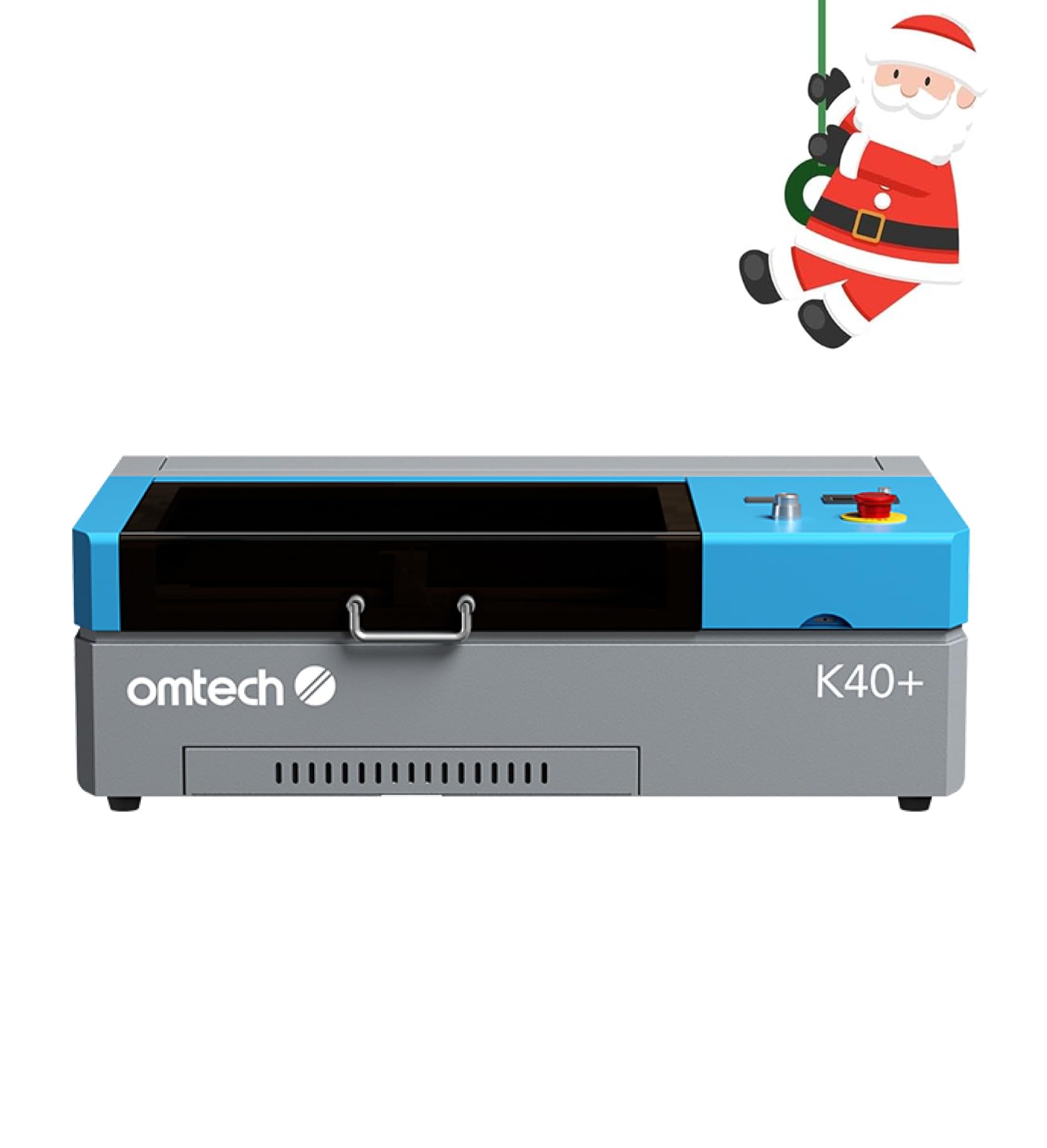
The CO2 route: a sealed tube cutter built for acrylic and leather.
This is a different animal from the diode machines above. A CO2 tube laser (a sealed glass tube filled with gas that produces the beam) cuts acrylic and leather cleanly in a way diodes struggle to match. The 45W tube slices 0.4″ (10mm) acrylic and 0.31″ (8mm) wood, and the maker claims 1.5–2× faster cutting and 15–20% more depth than the lower-power version. Engraving tops out at 300 mm/s, which is the slowest speed in this roundup and honest for a CO2 design.
The setup details are suited to a real workshop. A compact 12″ x 8″ workspace takes both flat and irregular materials, with a honeycomb bed for flat items and a detachable base plus optional rotary axis for cylinders and taller pieces. A built-in 45° air assist adjusts airflow based on laser power to clear smoke, protect the lens, reduce wood carbonization and lower fire risk. It runs LightBurn and LaserGRBL, and safety covers door protection, water protection, an emergency stop and a flame-retardant acrylic panel.
Two things a buyer should weigh honestly. First, a CO2 laser needs the tube and water cooling maintained, and setup is not a beginner task — the machine carries a Class 2 rating and the manufacturer cites a 0.827 mW output power figure. Second, this one shows up occasionally with shipping damage and alignment issues. Support earns its reputation, though: an owner who was new to CO2 work got a video consult that walked them through alignment.
Where it earns its keep: acrylic and leather cutting with a built-in air assist and full LightBurn support, backed by a 2-year service commitment.
The reality check: the 12″ x 8″ bed is the smallest here, and this is the heaviest machine in the roundup at 81.8 pounds — plan its spot before it arrives.
Right one for: a maker cutting batches of acrylic and leather who does not mind learning a CO2 machine.
Wrong one for: anyone wanting a plug-in-and-go first laser with a roomy bed.
8. LaserPecker LP2 Plus (Basic) 10W Diode Laser Engraver

A 3.39kg laser you can carry to the job and align in seconds.
Portability is the entire pitch, and the numbers back it. The LP2 Plus weighs 3.39kg — 24% lighter than the maker says comparable machines run — so it can travel in a bag rather than being bolted to a bench. A multi-angle laser head open up engraving on angled or hard-to-reach surfaces, from car interiors and walls to furniture that never leaves the room.
Speed is the other headline. It engraves at 4000mm/s, which the maker claims is 6x faster than the older LP2. A 10W 450nm laser paired with an upgraded F-theta lens (a flat-field lens that keeps the beam sharp across the whole work area) delivers 4K-detailed engraving, 1.5× stronger cutting power and cuts up to 6mm basswood in a single pass. Dual red-dot focus lets you line up the material in seconds without a ruler.
Where it earns its keep over a fixed machine is material range — wood, leather, acrylic, coated metal, glass, stone, cork, rubber, paper, and even food. The app draws strong comments for simplicity, and setup is quick enough that a beginner can run it the same day. Its small size is also its limit: this is not the machine for large signage, and a few owners mention units arriving that needed a return. At 11.22 x 7.01 x 11.42 inches, storage is not a problem — the bench footprint just has to be planned around.
One-line read: the best pick here if your work moves between a booth, a market and a home bench.
The catch: the small physical size limits the project size, so large one-piece signs belong on a fixed-bed machine.
Choose it if: you sell at markets and need a laser that travels with you and sets up in minutes.
skip it if: your most common job is a full door sign in one piece.
9. GWEIKE G2 Plus 20W Fiber Laser Engraver

The fiber laser that marks 30+ colors directly into stainless steel.
Fiber lasers do the one thing diodes cannot: mark bare metal, permanently, in color. This G2 Plus uses a 1064nm fiber laser (a wavelength absorbed by metal, unlike the diode machines above) at 20W, and it produces over 30 different colors on stainless steel and titanium. A high-speed precision galvanometer (a mirror system that steers the beam instead of moving a head) pushes engraving speeds to 15000 mm/second, which is a different order of speed from the gantry machines.
Resolution options are 2k, 4k or 8k, with engraving accuracy of 0.001mm — fine enough for detailed work that would blur on a diode spot. The engraving area is 150 x 150mm, and an electric lifting column means you press a button to focus instead of turning a dial. Dual red light positioning and a fully digital Galvano scanning system support square and graphic previews for quicker setup. It connects over Wi-Fi and USB, is compatible with LightBurn, and the detachable structure lets you take the head off the bench for awkward jobs.
The trade-offs are honest ones. It is a Class 4 laser, so eye protection, the included protective cover and a proper exhaust setup are not optional. The 150 x 150mm area is small, which is standard for fiber galvo machines but still worth knowing before you buy. There was one report of a unit that burned out after 20 minutes, though GWEIKE replaced a machine with a power supply issue within days in another owner’s case.
Why Metal Workers Want It
- 30+ colors engraved into stainless steel and titanium.
- 15000 mm/second speed and 0.001mm accuracy for fine detail.
- Electric lift column removes manual focusing entirely.
Know Before You Buy
- Class 4 rating means eye protection and ventilation are required.
- The 150 x 150mm engraving area rules out big flat panels.
- You will want a computer or phone connected to run jobs.
Ideal match: a jeweler or small metal shop moving up from diodes into real metal marking.
Not the one for: broad flat sign work — the bed is small, and diodes do wood cheaper.
10. GWEIKE G2 Max 50W Fiber Laser Engraver
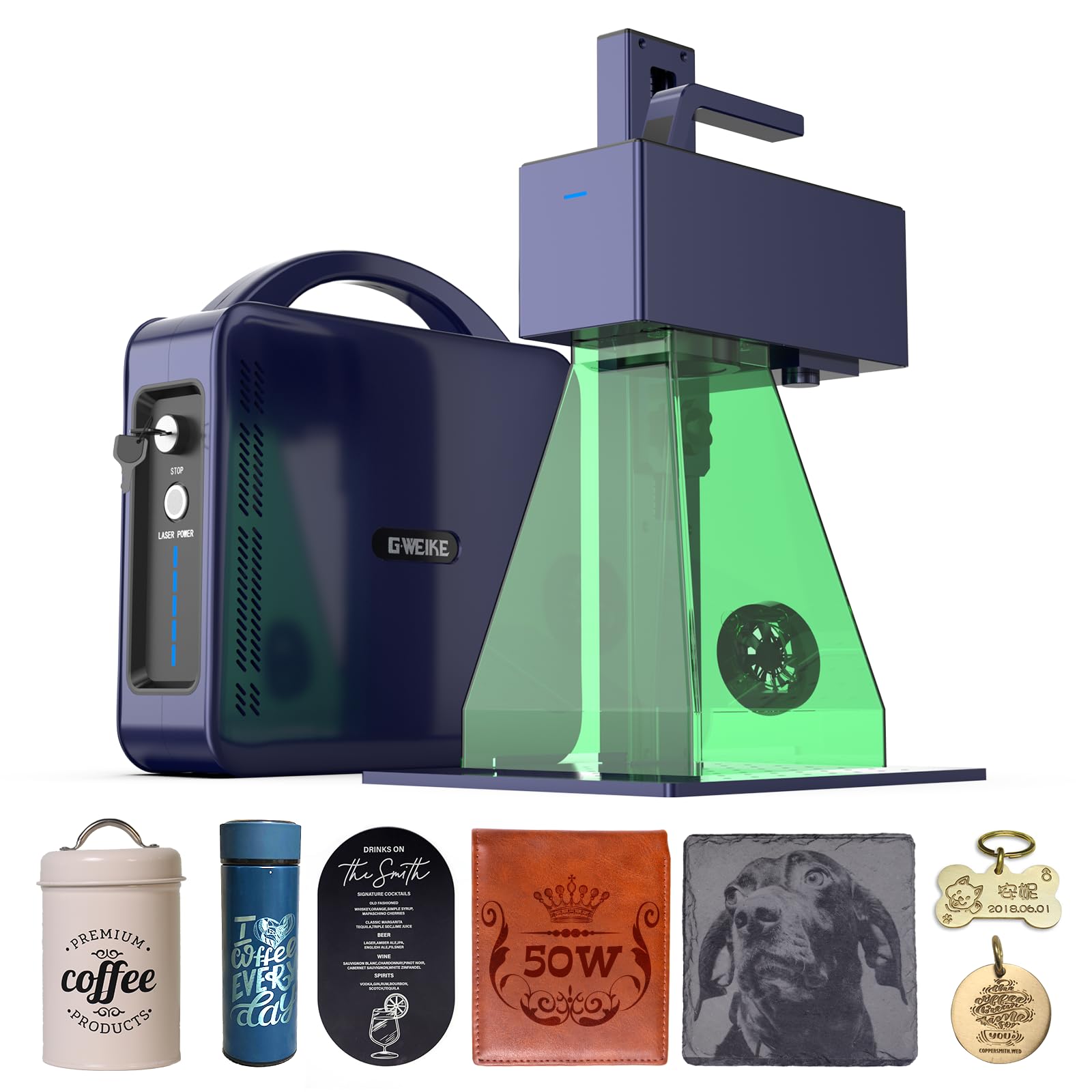
Twice the fiber power of the G2 Plus for deeper marks and faster batches.
If you already know you want fiber, this is the step-up. The 50W 1064nm fiber laser (50,000mW) doubles the output of the G2 Plus above, and the difference shows in the depth — it deep-engraves into metal, cuts metal, and does 3D carving that shallower modules cannot. That power increase matters most on challenge coins and dense metal parts, where the extra watts translate directly into penetration rather than a slower multi-pass run.
The speed and accuracy numbers mirror the G2 Plus at 15000 mm/s and 0.001mm accuracy, with HD 8K engraving resolution for fine detail. Color capacity is higher too: over 90 vibrant colors on stainless steel and titanium, versus the 30+ on the smaller unit. The engraving area is 150 x 150mm with an electric lift column for one-button focusing, and dual red light positioning speeds up material preview. It supports GLaser and LightBurn and covers Wi-Fi and USB file transfer.
Where a buyer should be careful is reliability at this power level. The setup draws the strongest positive feedback, and support is responsive — in at least two cases where a unit failed, the company sent a replacement quickly. But a mixed pattern shows up in the reliability feedback, with some owners reporting a failure within a few weeks of use. That is worth knowing if the machine is going straight into a paying job. One buyer also noted it works well on stainless and plastic but struggles on bare aluminum, which only carries anodizing or coating marks.
What you gain over the G2 Plus: 50W versus 20W, 90+ colors versus 30+, plus metal cutting capability the smaller unit does not claim.
What to weigh: the highest-output machine in the fiber group here, with a mixed reliability signal in the owner feedback and no bigger a work area.
Buy it for: deep-engraved coins, flasks and jewelry where 50W saves real hours per batch.
Buy the G2 Plus instead if: you only need surface marking rather than deep cuts and full color.
11. xTool F2 Ultra 60W MOPA & 40W Diode Dual Laser Engraver

Metal and wood from one machine, without switching hardware mid-job.
This is the only machine here that runs two lasers in one housing. A 60W MOPA fiber laser (a fiber laser whose pulse timing can be tuned, which is how it produces consistent colors) and a 40W diode handle metal, wood, acrylic, leather, glass, rubber and fabric from the same setup, so you are not swapping units between a metal job and a wood job. The fiber cuts 2mm metal; the diode cuts 20mm acrylic and 23mm wood.
Color engraving reaches over 100 consistent colors on metal, and the preset color files let you engrave a color matrix in one click instead of testing one tone at a time. The fiber side also supports black marking on aluminum, laser cleaning and thin metal welding. Industrial speed sits at 15,000mm/s, and the maker says the 60W MOPA cuts 3D embossing time by up to 80% compared to 20W fiber lasers. Two 48MP AI cameras (48MP describes the camera resolution) lift positioning accuracy to 0.2mm.
The catch is the learning curve and the work area. The 8.7″ x 8.7″ space expands to 8.7″ x 19.7″ if you add the auto conveyor for batch work, but the base bed is the smallest in this roundup alongside the fiber galvos. And it is a Class 4 laser at 60,000mW fiber and 40,000mW diode output, so ventilation and eye protection are mandatory. Beyond that, tuned-up performance is genuinely industrial: production users describe clean, permanent multi-color results on metal coins with consistent batches once settings are dialled in.
Why It’s the Top-Tier Pick
- 60W MOPA fiber plus 40W diode in a single unit — no hardware switching.
- 100+ consistent colors on metal with one-click color matrix files.
- Dual 48MP AI cameras with 0.2mm positioning accuracy and auto-detect.
The Fine Print
- Base work area is 8.7″ x 8.7″ — small for desk-friendly flat work.
- Camera alignment is imperfect on uneven or reflective surfaces.
- Color tuning requires trial and error to reach ideal settings.
Your machine if: you run a production shop doing metal coins and wood products on the same bench and refuse to buy two machines.
Your money is better spent on a GWEIKE G2 Max if: metal-only work is the plan — the -tier fiber handles deep engraving without paying for the diode half.
Understanding the Specs
Laser Power in Watts
Power rating is the single fastest way to judge what a machine can cut. A 10W diode is fine for thin wood, leather and shallow marking. A 20W diode cuts thicker stock and adds color capability. A 40W or higher diode pushes through wood and acrylic in fewer passes. A fiber laser is a different wavelength entirely — 1064nm — absorbed by bare metal, which is what lets it mark stainless steel and titanium in permanent color rather than just scoring the surface.
Power also affects how long a job takes. Higher wattage means fewer passes on the same material, so a batch that takes an hour on a 10W machine may run in a fraction of that on a 20W or 40W unit.
Working Area and Speed
Working area, whether stated in inches or millimeters, sets the largest project you can run without repositioning. A 23.93″ x 15.16″ bed handles door signs; a 150 x 150mm fiber area is built for coins and small metal parts rather than flat panels. Match the bed to your biggest repeat job, not to the biggest job you might do someday.
Speed, measured in mm/s or mm per minute, determines throughput on batches. It matters less for one-off pieces and more once you are running dozens of items per session. Check whether the marketed top speed refers to engraving or travel — the two are not the same.
FAQ
Can a 10W diode laser engrave metal?
Do I need an enclosure for a laser engraver?
What is the difference between a diode and a fiber laser engraver?
How do I know which working area size I need?
Is LightBurn required to run these machines?
What materials should never go in a laser engraver?
How long does a laser module last?
Can these machines engrave curved objects like tumblers?
Do I need ventilation or an exhaust fan?
Should I buy a diode laser or save up for fiber?
Final Thoughts: The Verdict
For most buyers, the barcode laser engraving machine worth starting with is the xTool S1 40W because the enclosed Class 1 build (a safety rating that keeps the laser beam contained), the 40W laser and the 23.93″ x 15.16″ bed cover wood, acrylic and curved work in one unit without a second purchase. If metal marking is your goal and you want true color on stainless, reach for the GWEIKE G2 Plus 20W. And for a portable setup that travels to markets and sets up in minutes, the LaserPecker LP2 Plus is the one to grab. Whichever you pick, the safest bet is the enclosed S1 — it is the top-rated pick by buyers overall, and the machine you will actually run every day.
How We Picked
We do not accept paid placement. Every pick is matched to a real buyer and a real use-case; we do not hands-on test units.
Sources & Methodology
Specifications: manufacturer listings and product documentation. Review insights: verified customer reviews, as of September 2026. Pricing: not shown on this page (it changes often); check the current price via the retailer link.
As an Amazon Associate, Gadgets Feed earns from qualifying purchases. This does not affect which products we feature.