
A slow or unreliable barcode scanner doesn’t just cost you seconds—it costs you hours of labor re-entering SKUs and fighting with clunky POS systems. In a warehouse, retail floor, or small inventory room, the difference between a scanner and a scanner isn’t just build quality; it’s whether your team can hit 300 scans in 45 minutes without the connection dropping mid-shift. The right scanner decodes damaged labels, survives concrete drops, and talks to everything from iOS to legacy Windows terminals without a single driver install.
I’m Min — the co-founder and writer behind Gadgets Feed. I’ve spent hundreds of hours dissecting technical specifications like scan engine type, transmission range in feet, battery capacity in mAh, IP sealing ratings, and drop-test tolerances to separate the true workhorses from fragile, disposable hardware.
This guide cuts through the noise to help you identify rugged, fast, and future-proof hardware. Whether you manage a high-volume distribution center or a small boutique, selecting the right barcode scanner for inventory directly impacts your daily throughput and error rate.
How To Choose The Best Barcode Scanner For Inventory
Inventory environments differ drastically. A retail counter sees clean, undamaged labels on new stock, while a warehouse deals with dusty, creased barcodes on shrink-wrapped pallets. The optimal scanner for one setting can cripple productivity in the other. Focus on three pillars: scan engine capability, connectivity range, and physical durability.
1D Laser vs. 2D CMOS Imager
A 1D laser scanner reads traditional UPC and Code 39 barcodes with a single red beam. It is fast and affordable, but it cannot read QR codes, Data Matrix codes, or barcodes displayed on phone screens. A 2D CMOS imager captures an image of the barcode, allowing it to decode PDF417 on driver’s licenses, QR codes, and even damaged or poorly printed labels. If your inventory workflow involves scanning items from mobile devices or picking barcodes from glossy packaging, a 2D imager is the only viable choice.
Wireless Range and Interference Management
Bluetooth scanners offer convenience, but the effective range in a real warehouse with metal shelving, concrete walls, and competing Wi-Fi signals can drop from a claimed 115 feet to under 40 feet. Scanners with a dedicated 2.4G dongle provide a more stable connection at longer distances. Premium models like those from Zebra use Wi-Fi Friendly Mode to actively avoid channel overlap with enterprise WLANs, preventing the disconnections that plague generic Bluetooth devices.
Battery Life and Charging Convenience
Look for a battery capacity of at least 2500mAh for full-shift operation. A charging cradle is not a luxury—it ensures the scanner is always topped off and ready when the next shift starts. Standby time over 180 days is useful for intermittent use, but continuous runtime in hours is the spec that matters for high-volume scanning sessions.
Drop and Environmental Resistance
A scanner dropped from a warehouse ladder or knocked off a retail counter should survive. Prioritize models rated for drops of 6 feet (1.8 meters) or higher onto concrete. For environments with dust or moisture, an IP67 rating guarantees the scanner is dust-tight and can withstand immersion in water, making it suitable for outdoor logistics or freezer applications.
Quick Comparison
On smaller screens, swipe sideways to see the full table.
| Model | Category | Best For | Key Spec | Amazon |
|---|---|---|---|---|
| Inateck BCST-75 | Industrial | Harsh environments & high drops | IP67 / 2600mAh / 3.6m drop | Amazon |
| Zebra DS2278-SR | Enterprise | Uninterrupted enterprise scanning | Wi-Fi Friendly / 14.5in range | Amazon |
| Tera HW0009 | Mid-Range Pro | On-scanner configuration & data review | Screen / 2500mAh / 3-in-1 | Amazon |
| Alacrity 2D Industrial | Long Range | Extreme transmission distance | 1968ft 433MHz / 2D imager | Amazon |
| ScanAvenger SA9000 | Versatile | Small business & POS systems | 3-in-1 / Vibration / Auto-sense | Amazon |
| Inateck BCST-70 | Wireless Basic | Budget Bluetooth with long standby | 180-day standby / 115ft range | Amazon |
| Zebra LS2208 | Corded Basic | Reliable plug-and-play counter scanning | Corded / 5.3oz / Stand included | Amazon |
In‑Depth Reviews
1. Inateck Industrial Barcode Scanner Bluetooth BCST-75

This is the scanner that doesn’t flinch. The BCST-75 boasts an IP67 rating, meaning it is completely dust-tight and can survive submersion in one meter of water for 30 minutes. For a warehouse floor that sees sawdust, cardboard debris, or condensation from freezer aisles, that seal is a game-changer. The ABS and thick TPU construction is rated to survive drops from 3.6 meters (11.8 feet) onto concrete, so it can handle a fall from a top shelf or a forklift guard.
The 2600mAh battery is the largest capacity in this roundup, paired with a proprietary power algorithm that stretches runtime across a full double shift. The 2D CMOS imager decodes QR codes, Data Matrix, and PDF417 (driver’s licenses) alongside standard 1D symbologies. You get three transmission modes: 2.4G dongle for up to 100 meters in open air, Bluetooth for 40 meters, and a direct USB cable for stationary use. The included charging cradle keeps the scanner docked and ready, and the real-time battery indicator on the device prevents surprise shutdowns.
Some users note the beeper is quite loud by default, but the scanner is customizable through configuration barcodes. The IP67 and drop ratings make this the best choice for industrial and logistics environments where other scanners fail. It carries a 2-year warranty, reflecting Inateck’s confidence in its durability.
Why it’s great
- Highest durability with IP67 and 3.6m drop test rating
- Large 2600mAh battery supports multi-shift operation
- Triple connectivity (2.4G, Bluetooth, USB) with long range
Good to know
- Audible beep is loud and requires configuration to quiet
- Slightly heavier than non-industrial models
2. Tera Barcode Scanner Wireless with Screen HW0009
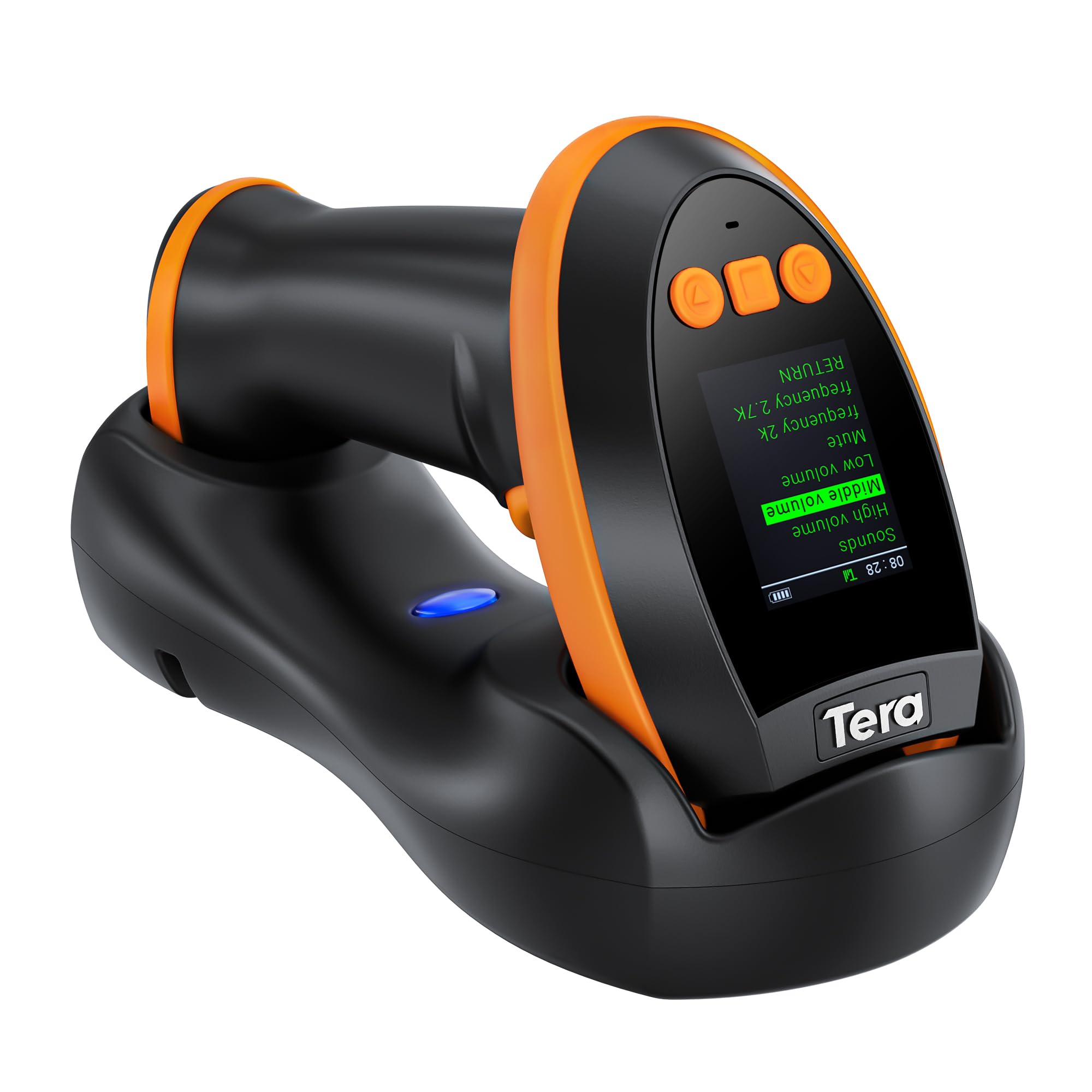
The Tera HW0009 earns the top spot because it delivers a genuinely unique feature at a mid-range price: an LCD screen on the scanner itself. This screen allows you to see stored barcode data, adjust volume, change the language, and switch connection modes without hunting for a manual or scanning a dozen configuration barcodes. For an inventory manager training new staff, this self-contained setup drastically reduces onboarding friction.
Under the hood, it uses a 2D CMOS imager that reads everything from standard UPC to high-density PDF417 on driver’s licenses. The 2500mAh battery provides a full shift of continuous use, and the included charging cradle keeps it topped off. The 3-in-1 connectivity supports 2.4G wireless (up to 328 feet line-of-sight, 114 feet with obstacles), Bluetooth, and a USB wired mode. The programmable feature set allows prefix/suffix editing up to 32 characters and partial barcode hiding—critical for compliance with certain inventory systems.
Testers report it scans broken and wrinkled labels more reliably than entry-level alternatives. The software support includes a broader set of symbologies than most competitors, covering GS1 Databar, ITF-14, and Maxicode. A small critique is the screen could be larger for easier reading, and navigating the menu takes a few tries. Overall, it is the best balance of features, battery life, and price for most inventory operations.
Why it’s great
- LCD screen for on-device settings and data review
- 2500mAh battery with convenient charging cradle
- Excellent decode capability on damaged labels and PDF417
Good to know
- On-screen menu navigation has a learning curve
- Screen size is modest for data display
3. Zebra Symbol DS2278-SR Wireless 2D/1D Bluetooth Scanner

Zebra is the gold standard in enterprise barcode scanning, and the DS2278-SR demonstrates why. Its standout feature is Zebra’s proprietary Wi-Fi Friendly Mode, which actively prevents the scanner from operating on channels used by your WLAN. In a busy warehouse or retail setting with dozens of devices competing for airtime, this eliminates the random disconnections that plague generic Bluetooth scanners.
The DS2278-SR is a 2D imager with an omni-directional scan head, meaning workers don’t need to perfectly align the scanner with the barcode. It reads codes from 0.5 inches to 14.5 inches away, speeding up checkout and receiving lines. The kit includes a cradle, a battery, and a heavy-duty shielded 7-foot USB cable (CBA-U21-S07ZAR). Out of the box, it works without any configuration—just charge, pair, and scan.
IT administrators can control scanner settings—beeper volume, LED behavior, symbology toggles—from a smartphone, tablet, or PC using Zebra’s 123Scan utility. The build quality is exceptional; one user reported purchasing seven units for a lumber yard, and all survived rough, daily abuse without failure. The premium price reflects the enterprise-grade durability and wireless management features that justify the investment for high-volume operations.
Why it’s great
- Wi-Fi Friendly Mode prevents Bluetooth interference on enterprise networks
- Omni-directional 2D scanning with a wide 14.5-inch working range
- IT-manageable via 123Scan from any host device
Good to know
- Premium price point requires budget justification
- Not IP rated, so less suited for wet or extremely dusty environments
4. Alacrity Upgraded 2D Industrial Barcode Scanner

If your inventory spans a large yard, a multi-acre lot, or an expansive warehouse floor, the Alacrity 2D scanner has a transmission spec that crushes everything else. It uses a 433MHz wireless link combined with Bluetooth for an advertised transmission distance of 1968 feet. This is not a typo—the 433MHz frequency penetrates walls and metal racks far better than standard 2.4GHz Bluetooth. The scanner and its charging base communicate over this dedicated band, keeping the connection stable across vast distances.
The scan engine is a 2D Global Shutter CMOS sensor designed for high-speed reading of printed labels and digital barcodes on phone screens. It handles shrink-wrapped labels, partial damage, and poor print quality without slowing down. The charging cradle tilts 45 degrees for easy docking, and the base simultaneously charges the scanner while maintaining the 433MHz link. The unit is built to survive drops and dust, though it does not carry an official IP rating.
It scans QR codes and regular 1D barcodes without programming. Users in manufacturing environments report it boosts productivity because workers can scan at floor level while the base stays at the station. Note that this scanner is not designed for reading long-distance barcodes (20 feet away); it is for transmitting data long distance. A small number of users reported connectivity dropouts, which may indicate unit-to-unit variance.
Why it’s great
- Unmatched 1968ft transmission range via 433MHz link
- Global Shutter CMOS reads damaged and shrink-wrapped labels reliably
- Charging cradle tilts for easy docking on cluttered desks
Good to know
- Some users experienced connectivity reliability issues
- Not a long-distance barcode reader (range applies to data transmission, not scanning)
5. ScanAvenger Wireless Portable 1D&2D with Stand SA9000

The ScanAvenger SA9000 packs a surprising number of features into a lightweight, ergonomic body. It supports three scan modes—manual trigger, continuous, and auto-sense—so you can set it to scan automatically when a barcode is held in front of the lens. This is particularly useful for high-volume inventory counting where pressing the trigger for every single item becomes fatiguing. The vibration feedback feature lets you know a scan succeeded without having to listen for the beep, which is invaluable in noisy environments.
It connects via Bluetooth, a 2.4G wireless dongle, or a USB cable, making it compatible with Windows, macOS, Android, and iOS devices. The charging stand uses a smart connector rather than a cable plug, so the scanner simply drops into the cradle and starts charging. The 1.1-pound weight makes it easy to handle for long shifts, and the 2D imager reads UPC, EAN, QR codes, PDF417, Data Matrix, and Aztec codes. It does not support Maxicode, which is worth noting for logistics companies using that specific symbology.
Reviewers emphasize that this scanner is “plug-and-play”—no software or driver installation is required for most systems. It works out of the box with standard POS terminals and inventory management apps. The main limitation is compatibility: it does not work natively with Square, Shopify, or ShopKeep, which require proprietary integrations. For small businesses using open POS systems, this is an excellent mid-range option.
Why it’s great
- Three scan modes including auto-sense for hands-free operation
- Vibration feedback works in high-noise environments
- Lightweight and ergonomic with no-driver setup
Good to know
- Incompatible with Square, Shopify, and ShopKeep systems
- Does not support Maxicode symbology
6. Inateck Bluetooth Barcode Scanner BCST-70

The Inateck BCST-70 is a mass-market favorite for good reason: it offers reliable Bluetooth scanning at an entry-level price point. The 180-day standby time means you can leave it in a drawer for months and grab it for an audit without finding a dead battery. The actual continuous working time is around 15 days of moderate use, which is still excellent for a scanner in this tier. The range is advertised at 115 feet line-of-sight, though in real-world conditions with obstructions, that drops to around 30–40 feet.
The BCST-70 is a 1D laser scanner, meaning it reads standard UPC, Code 39, Code 128, and Codabar. It cannot read QR codes or 2D symbologies, so it is best suited for retail stores and warehouses that only deal with traditional barcodes. The external TPU protective case is twice as thick as competing products, and the internal components receive a triple consolidation treatment for drop resistance. It is rated to survive 6-foot drops onto concrete, which is impressive for a sub- scanner.
Users who purchased 30+ units for warehouse operations report consistent performance and simple pairing with Windows 10 and iPad. The scanner supports editing prefix/suffix up to 32 digits and can hide parts of a barcode—useful for compliance. Some users report Bluetooth connectivity is less stable than a 2.4G dongle option, and there is no charging cradle (only a USB cable). For budget-conscious setups that only need 1D capability, this is a solid choice.
Why it’s great
- Extreme 180-day standby battery life
- Thick TPU case with 6-foot drop test rating
- Supports custom prefix/suffix editing up to 32 digits
Good to know
- 1D laser only—cannot read QR codes or 2D barcodes
- Bluetooth range drops significantly with obstacles
- No charging cradle included
7. Zebra Symbol LS2208 Corded Scanner Kit

Sometimes you just need a scanner that works the instant you plug it in, and the Zebra LS2208 is the benchmark for plug-and-play reliability. This is a corded 1D laser scanner with a USB connection. It requires no software installation, no drivers, and no configuration. It is recognized by Square, most POS systems, and Mac/Windows computers as a keyboard input device—meaning the barcode data appears as typed text in your spreadsheet or inventory field.
The LS2208 is incredibly lightweight at only 5.3 ounces, making it the lightest scanner in this roundup. It comes with a gooseneck stand, allowing you to use it hands-free by sliding items under the laser beam. The 30-degree scan angle and standard range allow comfortable scanning of items up to a few feet away. The build quality is classic Zebra: a single user reported using these scanners for years without a single failure, and the 3-year warranty backs that claim.
The main limitation is obvious: it is corded. The 7-foot USB cable anchors it to the counter, so you cannot roam a warehouse floor. It is also a 1D-only scanner, so it cannot read QR codes or barcodes on phone screens. For a fixed retail checkout counter or a dedicated inventory station where mobility is not required, this is the most cost-effective and reliable option available. Several reviewers bought multiple units specifically for Square-based inventory systems.
Why it’s great
- True plug-and-play—no software or drivers required
- Ultra-lightweight at 5.3 ounces with included gooseneck stand
- Zebra build quality and 3-year warranty
Good to know
- Corded design limits mobility to the countertop
- 1D laser only, cannot scan QR codes or 2D barcodes
- Works with Square but may need periodic re-detection
FAQ
Can a barcode scanner for inventory read damaged or wrinkled labels?
What is the difference between batch scanning and real-time transmission?
Final Thoughts: The Verdict
For most users, the barcode scanner for inventory winner is the Inateck BCST-75 because it brings industrial-grade IP67 protection and a 2600mAh battery at a price that undercuts enterprise competitors. If you want on-scanner configuration and a built-in screen for data review, grab the Tera HW0009. And for low-maintenance, counter-based scanning on a tight budget, nothing beats the corded reliability of the Zebra LS2208.