
A bare wood surface is porous, thirsty, and loaded with natural tannins that can bleed through cheap paint, leaving yellow stains. The wrong primer means adhesion failure, peeling, and a project you will be sanding back to square one. The right one locks everything down.
I’m Min — the co-founder and writer behind Gadgets Feed. I have spent hundreds of hours cross-referencing technical spec sheets, customer test logs, and real-world application results to isolate exactly what makes a wood primer effective on raw timber, from resin content to dry-film porosity.
This guide cuts through the marketing to analyze the binding chemistry, dry times, and stain-blocking capability that define a dependable bare wood primer.
How To Choose The Best Bare Wood Primer
Bare wood is the most demanding substrate for any coating. Without an effective primer, the topcoat soaks into the grain unevenly, tannins leach through, and the finish fails from day one. The right choice depends on three variables.
Water-Based Acrylic vs. Oil-Based Alkyd
Water-based acrylic primers like the INSL-X Aqua Lock dry fast, clean up with soap and water, and emit low odor. They are ideal for interior trim and cabinetry where quick recoating matters. Oil-based alkyd primers, such as the Diamond Brite Industrial Oil Alkyd, penetrate deeply into end-grain, form a harder film, and block tannins more aggressively. They require mineral spirits for cleanup and longer dry times, but provide superior resistance on exterior wood and resinous species like cedar and redwood.
Stain-Blocking and Binder Technology
Raw wood contains water-soluble tannins that migrate through latex paints. A primer must physically seal these pores. High-binder-content formulas, like the General Finishes Stain Blocking Primer, contain more solid resin that forms a thicker barrier. Lower-cost primers thin out over open grain and require multiple coats to achieve the same block. Check coverage rates — a quart should cover at least 75 to 100 square feet to indicate adequate film build.
Adhesion to Smooth and Glossy Substrates
Not all bare wood is the same. Kiln-dried lumber, MDF, and pressure-treated wood each present unique adhesion challenges. The XIM UMA Bonder uses specialized acrylic chemistry to grip ultra-smooth surfaces like laminate and cured epoxy, making it useful for mixed-material projects where wood meets painted or sealed surfaces. A primer that passes a fingernail scratch test after 24 hours indicates reliable mechanical bond.
Quick Comparison
On smaller screens, swipe sideways to see the full table.
| Model | Category | Best For | Key Spec | Amazon |
|---|---|---|---|---|
| General Finishes Stain Blocking Primer | Premium | Tannin Blocking Over Kitchen Cabinets | 21-day full cure | Amazon |
| Rust-Oleum Marine Wood and Fiberglass Primer | Premium | High-Moisture Areas and Exterior Wood | 1-hour dry to touch | Amazon |
| Rust-Oleum Universal Bonding Primer | Mid-Range | Adhesion to Smooth and Mixed Surfaces | 35 sq. ft. coverage per quart | Amazon |
| Polar Wood Primer | Mid-Range | Weather-Resistant Exterior Wood Projects | 130 sq. ft. coverage per 33 oz | Amazon |
| XIM UMA Bonder and Primer | Mid-Range | Bonding to Laminate and Hard Glossy Surfaces | Low-temp application | Amazon |
| INSL-X Aqua Lock Plus | Budget | Fast Interior Drywall and Plaster Sealing | 30-minute tack free | Amazon |
| Diamond Brite Industrial Oil Alkyd Primer | Budget | Heavy-Duty Exterior Wood and Metal Protection | 300 sq. ft. per gallon | Amazon |
In‑Depth Reviews
1. General Finishes Stain Blocking Primer

The General Finishes Stain Blocking Primer is engineered specifically to combat tannin bleed-through on raw wood, MDF, and previously finished surfaces. Its water-based formula delivers a semi-gloss finish that seals porous grain without raising the fibers excessively, creating a smooth base for milk paints, chalk-style paints, and pigmented polyurethanes. The 21-day full cure cycle indicates a chemically advanced binder that continues cross-linking for maximum stain resistance after initial dry times.
Real-world application data confirms its effectiveness on dark-stained oak kitchen cabinets, where lower-tier primers allow yellow bleed-through within weeks. Users report that the sticky consistency requires careful brushing technique, but the results justify the effort — no bleed-through concerns even over deep stains. Coverage is listed as medium, so expect two quarts for a standard set of cabinet doors.
The key trade-off is the extreme cure time. While the primer dries to touch within a few hours, full film hardness and tannin-blocking capability require the full 21 days. Painting too early can compromise the barrier. This primer is not designed for exterior use or high-moisture environments like bathrooms.
Why it’s great
- Superior tannin blocking — prevents yellowing from oak, cedar, and other resinous woods
- Versatile base coat for multiple GF finish lines, including milk paint and pigmented poly
- Low odor and water cleanup simplify indoor projects
Good to know
- Extremely long 21-day full cure window before topcoat adhesion is maximized
- Formula is sticky and can be difficult to apply smoothly without proper brush technique
- Not intended for exterior or high-humidity environments
2. Rust-Oleum Marine Wood and Fiberglass Primer

The Rust-Oleum Marine Coatings Wood and Fiberglass Primer is formulated for durability in demanding conditions, including semi-green pressure-treated lumber and fiberglass shower surrounds. It dries to the touch in one hour and covers 100 square feet per quart, offering a fast recoat cycle for multi-coat projects. Its corrosion-resistant film sands easily and provides a strong mechanical bond for topcoats on bare and previously painted surfaces.
User reports confirm excellent results on kiln-dried and pressure-treated wood, with full curing observed after 12 hours before applying a topcoat. On fiberglass, it requires thorough surface prep—sanding, degreasing, and mineral spirits wiping—but one coat is sufficient for a 36-inch shower surround. The finish is extremely slippery when wet, which is a safety concern for flooring or shower floors.
The powerful solvent odor requires a respirator and strong ventilation, limiting its appeal for indoor living spaces. This primer is designed for utility and durability rather than aesthetic smoothness, making it best suited for workshops, boats, and exterior wood fixtures.
Why it’s great
- Bonds reliably to semi-green pressure-treated wood where water-based primers often fail
- Fast 1-hour dry time enables same-day topcoat application in good conditions
- Excellent adhesion to fiberglass after proper surface preparation
Good to know
- Strong fumes necessitate heavy ventilation or respirator use
- Slippery cured surface requires non-slip tread tape on walking surfaces
- Not formulated for fine furniture or interior trim where smooth finish is critical
3. Rust-Oleum Universal Bonding Primer

The Rust-Oleum Quart Universal Bonding Primer is a reliable workhorse for mixed-material projects where raw wood meets metal, laminate, or previously painted surfaces. Its matte finish provides a flat surface profile that does not obscure grain but delivers strong adhesive grip on smooth substrates where typical primers peel. The quart size covers 35 square feet, which is lower than average, indicating a thick film build designed for high-bond applications.
User feedback highlights its effectiveness on metal lockers, kiln-treated flower pots, and Formica countertops, where few other primers pass the fingernail test. Application is straightforward with minimal drips, and a single coat is often sufficient for bonding, though two coats are recommended for maximum durability on porous wood. The 24-hour dry time before recoating is longer than water-based alternatives but allows full solvent evaporation for maximum film integrity.
Coverage is the main limitation here. At 35 square feet per quart, a gallon-size option would be more economical for larger projects like kitchen cabinets or full-room trim. For small furniture pieces, single doors, or spot repairs, this primer is an excellent bonding solution.
Why it’s great
- Outstanding adhesion to ultra-smooth surfaces like Formica, metal, and cured epoxy
- Thick formula creates strong film that passes fingernail scratch test after curing
- Easy brush-on application with minimal dripping on vertical surfaces
Good to know
- Low coverage rate — only 35 sq. ft. per quart — drives higher cost for large projects
- 24-hour dry time slows down multi-coat workflows
- Oil-based formulation requires mineral spirits for cleanup
4. Polar Wood Primer
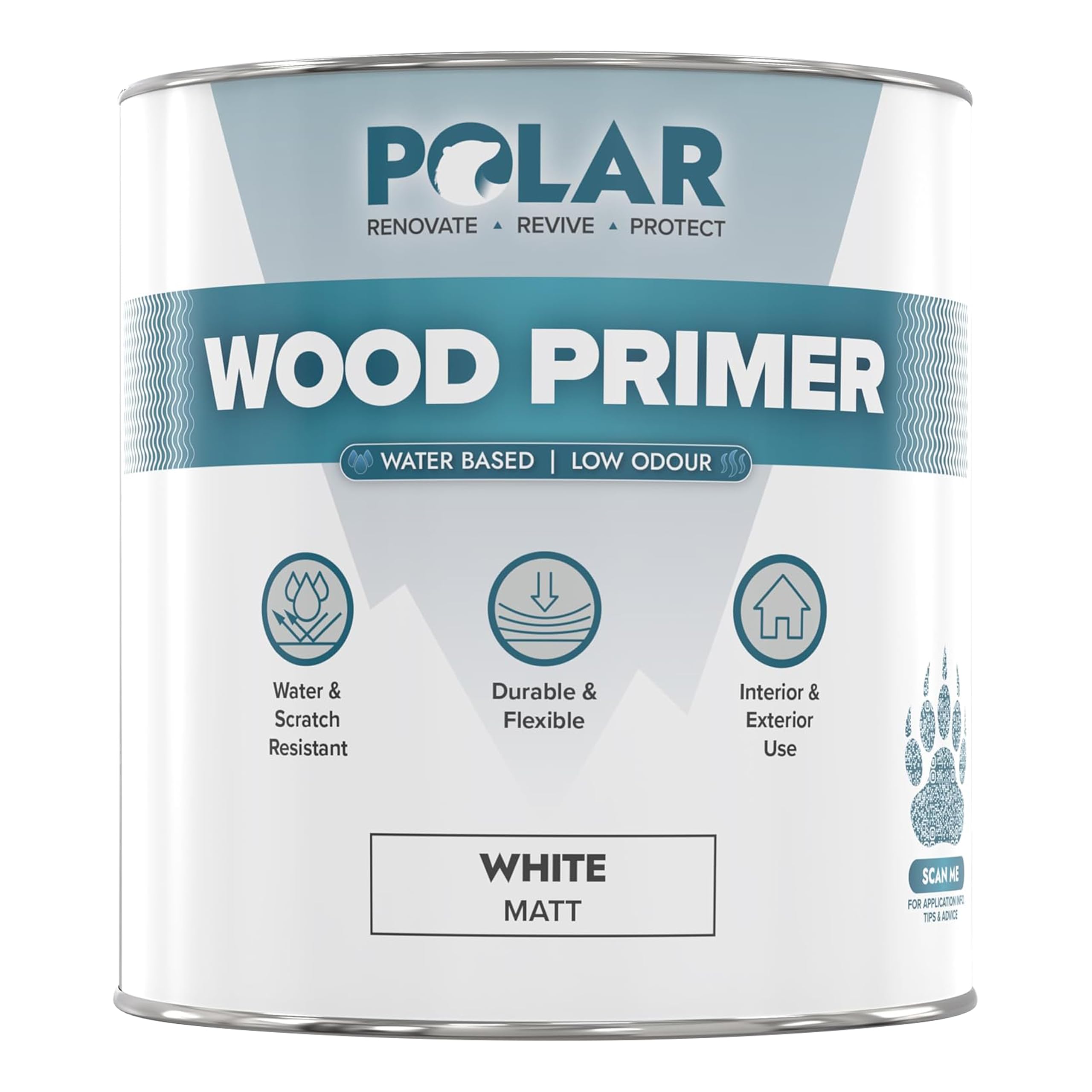
Polar Wood Primer is a water-based acrylic specifically engineered for bare and previously painted wood surfaces, with explicit weather resistance, UV protection, and water repellency. Its 33-fluid-ounce format covers 130 square feet — the highest coverage rate in this lineup — making it cost-effective for medium-sized exterior projects. The flexible finish expands and contracts with temperature changes, reducing cracking on siding, window frames, and trim boards exposed to direct sun.
Users report that the thin consistency allows excellent flow and leveling, penetrating open grain deeply without leaving brush marks. On exterior window frames, it creates a solid base that holds topcoat without peeling for at least one season of exposure. The quick recoat window — 4 hours — enables a two-coat system in a single afternoon, which is rare for a outdoor-rated primer.
The main uncertainty is long-term durability. The product lacks a published technical data sheet, so UV resistance and moisture vapor transmission rates are unverified by independent standards. Early adopters report strong results on exterior trim, but five-year performance data is not yet available. For budget-conscious users seeking a weather-ready option, this is a solid choice.
Why it’s great
- Exceptional coverage at 130 sq. ft. per 33 oz container reduces material cost per project
- Dries in 1-2 hours and is recoatable after 4 hours for fast project completion
- Flexible finish resists cracking on exterior wood exposed to temperature swings
Good to know
- No published technical data sheet available for independent verification of UV claims
- Thin consistency may require two coats on rough-sawn or highly porous wood
- Long-term outdoor durability beyond one season is unproven by long-term user tests
5. XIM UMA Bonder and Primer

The XIM UMA Bonder is a specialized acrylic primer that solves the most difficult adhesion challenge: gripping ultra-smooth, non-porous surfaces like laminate, Formica, cultured marble, and high-gloss painted wood. Its water-based formulation bonds where standard primers slide off, and it performs reliably at low temperatures and high humidity — conditions that cause many primers to fail. The matte finish levels well and provides a uniform base for latex or oil-based topcoats.
User reports confirm that it passes the fingernail adhesion test on laminate after surface prep with degreaser, alcohol, and 100-grit sanding. On bare MDF for epoxy countertops, it prevents peeling after multiple coats of heavy paint. The primary downside is the application requirement — two to three thin coats are necessary to build uniform coverage, and the 2-day dry time before heavy topcoats slows down project timelines.
The product’s narrow focus makes it ideal for mixed-material furniture flips and refacing projects where raw wood meets laminate or painted sections. For projects involving only bare wood without hard glossy surfaces, a standard wood primer is more cost-effective.
Why it’s great
- Superior mechanical bond to laminate, Formica, and other ultra-smooth surfaces
- Low-temperature and high-humidity application tolerance extends usable season
- Low odor and water-based cleanup simplify indoor work
Good to know
- Requires 2-3 thin coats and 2-day dry time for maximum bond strength
- Expensive per-coat cost compared to general-purpose wood primers
- Overkill for standard bare wood without glossy or non-porous sections
6. INSL-X Aqua Lock Plus Primer

The INSL-X Aqua Lock Plus is a low-VOC, 100% acrylic primer sealer optimized for interior surfaces like new drywall, plaster, and painted wood where a fast turnaround is required. It claims tack-free status in 30 minutes and topcoat readiness in as little as one hour, enabling single-day projects. Coverage is advertised at 75 to 100 square feet per quart, which is competitive for a budget-oriented product.
User feedback validates its sealing performance on new sheetrock and old plaster, reducing topcoat consumption significantly. On pressure-treated decking, it applies with good texture and holds up well for low-traffic, sheltered areas. However, users report that on ramps and high-traffic exterior wood, the finish is inadequate against frost and ice, and the white color shows dirt quickly in outdoor applications.
This primer struggles with tannin blocking on resinous woods like cedar and redwood, where the thin film allows bleed-through within weeks. It is best matched with interior projects involving non-resinous wood species, drywall, or previously painted surfaces where its speed and low odor are clear advantages.
Why it’s great
- Very fast dry times — tack free in 30 minutes, recoat in 1 hour
- Low odor and low VOC make it suitable for occupied indoor spaces
- Excellent adhesion to new drywall and plaster, reducing topcoat consumption
Good to know
- Weak stain-blocking performance on resinous woods; tannins may bleed through
- White color stains easily on exterior applications, showing dirt and mildew quickly
- Not ice-resistant on outdoor decking or high-traffic wood ramps
7. Diamond Brite Industrial Oil Alkyd Primer

The Diamond Brite Industrial Oil Alkyd Primer is a heavy-duty, rust-resistant base coat formulated for wood, metal, masonry, and concrete in interior and exterior applications. Its oil-alkyd chemistry penetrates deep into wood grain, cross-linking into a tough, durable film that resists scuffs, fading, cracking, and peeling. At 300 square feet per gallon, it offers the lowest per-square-foot cost in this comparison, making it the most economical choice for large-scale projects like siding, fencing, or barn doors.
Real-world users report excellent performance on exterior T-111 siding after one year, with no peeling or cracking. On a metal door exposed to intense desert heat, the oil-based film held up where latex primers bubbled and failed. The gray color serves as a universal base for both light and dark topcoats. The primary drawback is the slow cure time — without a hardener additive, the primer can take several days to fully dry, especially in cooler or humid conditions.
The high-gloss finish type listed in the specs indicates a dense, non-porous surface that requires mechanical sanding for topcoat adhesion on large flat areas. For rough-sawn wood or log homes, the oil penetration is ideal, but for smooth furniture-grade plywood, the sheen can cause topcoat slippage if not sanded adequately.
Why it’s great
- Exceptional value at 300 sq. ft. coverage per gallon — lowest cost per square foot
- Proven one-year outdoor durability on T-111 siding without peeling or cracking
- Rust-resistant formulation works on both wood and metal substrates
Good to know
- Very long cure time without hardener additive, especially in cool or humid weather
- High-gloss sheen requires sanding for proper topcoat adhesion on smooth surfaces
- Oil-based requires mineral spirits cleanup and emits strong fumes
FAQ
Can I use a water-based primer on pressure-treated wood?
How do I prevent tannin bleed-through on cedar or redwood?
What is the difference between a primer and a primer-sealer?
Final Thoughts: The Verdict
For most users, the bare wood primer winner is the General Finishes Stain Blocking Primer because it offers the most reliable tannin-blocking chemistry on raw wood, MDF, and previously finished surfaces, saving the most expensive part of any paint job — the topcoat. If you need a fast-drying option for exterior wood with UV protection, grab the Polar Wood Primer. And for heavy-duty outdoor protection on a budget, nothing beats the Diamond Brite Industrial Oil Alkyd Primer.