
Our readers keep the lights on and my morning glass full of iced black tea. As an Amazon Associate, I earn from qualifying purchases.
Specs are compiled from manufacturer listings and verified buyer reviews and can change over time — please confirm the key details on the product page before buying.
You might think decent binoculars have to cost as much as a weekend trip. The real challenge used to be finding a sharp, clear image at a price that does not make you wince. Today, even budget options pack excellent glass, and the trick is knowing which spec actually matters for your outing.
I’m Min — the founder and writer behind Gadgets Feed. This guide is built by comparing the manufacturers’ published specifications and the patterns across verified customer reviews, so you get each pick’s real strengths and trade-offs instead of marketing spin.
Whether you scan the horizon on a cruise, track a bird through the woods, or just want a closer view at the big game, this round-up of the best bargain binoculars gives you seven proven options that deliver real optical quality without emptying your wallet.
Our Picks at a Glance


How To Choose The Best Bargain Binoculars
Picking a pair of budget binoculars is about matching the specs to your real use. You do not need a sniper scope for a nature walk, but you also do not want a blurry mess. Focus on three things: magnification, objective lens size (the front lens that gathers light), and what the lenses are coated with.
Magnification vs. Stability
A higher number like 20x sounds impressive, but it also magnifies every tiny shake in your hands. For most handheld use, 8x to 12x is the balance — you get a clear, steady image. If you go higher, you will likely need a tripod to keep things from bouncing around.
Objective Lens Diameter and Light Gathering
The second number — 25mm, 42mm, or 50mm — tells you how big the front lenses are. A larger lens lets in more light, so your view stays bright in dusk or shadow. But it also adds weight. A 50mm lens is great for low light; a 25mm lens is much easier to pack.
Lens Coatings and Prism Type
Look for “fully multi-coated” (FMC, meaning every glass surface gets multiple anti-reflection layers) and “BAK4” prisms. FMC gives you a sharper, brighter image. BAK4 prisms have a higher refractive index than cheaper BK7 glass, so you see a crisp, round image rather than a cut-off shadow.
Quick Comparison
| Model | Best For | Magnification | Objective Lens | Exit Pupil | Amazon |
|---|---|---|---|---|---|
| Occer 12×25★ Best Overall | Compact travel & eyeglass wearers | 12x | 25mm | 2.5mm | $35.98Amazon |
| IBQ 12×50Best Value | Low-light wildlife and birding | 12x | 50mm | 4.17mm | $39.83$49.83Limited time dealAmazon |
| OPAITA 20×32 | Long-distance spotting on cruises | 20x | 32mm | 1.6mm | $38.99$45.99Amazon |
| Bushnell Explorer 10×42 | All-weather hiking and durability | 10x | 42mm | 4mm | $44.99Amazon |
| Adorrgon 15×45 | Birders who want a phone adapter kit | 15x | 45mm | 3.5mm | $49.86$67.25Amazon |
| Bushnell PowerView 2 | General family use with a classic feel | 10x | 50mm | 5.25mm | $69.09$89.95Amazon |
| Sogries 20×60 | Stationary stargazing and long range | 20x | 60mm | — | $69.99Amazon |
In-Depth Reviews
1. Occer 12×25 Compact Binoculars
Our pick — over 4★ from 33,000+ verified ratings; the strongest balance of quality and price.
The pocket-sized binocular that disappears into a jacket but still delivers a clear, wide view.
You get steady 12x magnification and a field of view of 273 feet at 1000 yards — wide enough to track a soccer play or scan a canyon wall without constant repositioning. The Occer 12×25 uses a BAK4 prism (a high-quality internal glass that produces a full, round image) and fully multi-coated (FMC) lenses (every glass surface gets anti-reflection layers), so the image stays crisp even in lower light. Buyers report, “I bought these to take on an Alaskan cruise,” and many note they perform like much more expensive brands.
The real standout is the eyeglass-friendly design. The rubber eyepieces fold down easily, and the 20mm of eye relief (the distance your eye can be from the lens and still see the full picture) means you do not have to mash your glasses into the cups. One reviewer pointed out the strap is weak and tends to come loose, so you may want to swap it for a sturdier one. At 2.5mm, the exit pupil (the circle of light your eye sees) is fine for daytime use but will feel dim at twilight — a trade-off for the compact size.
Unlike the Bushnell Explorer below, which weighs more and uses a bulkier aluminum chassis, the Occer is built from ABS plastic with a rubber armor coating. It is lighter, cheaper, and far easier to toss in a carry-on. If you want a do-it-all binocular that fits in your hand and still takes a splash, this is the one to start with.
Why It Wins
- FMC Broadband coating and BAK4 prism for clear, true-color images
- 15mm large eyepieces and 20mm eye relief work great with glasses
- Only 2.5mm exit pupil but excellent daytime clarity
The Catch
- Included strap is unreliable, according to multiple buyers
- Not for very low-light use due to the small 25mm objective lens
- Plastic body does not feel as sturdy as aluminum binoculars
Reach for this if: you need an everyday compact binocular for travel, sports, and outdoor trips that is easy on the eyes (and your wallet).
Look elsewhere if: you need a bright image at dusk or dawn — the small lenses limit the light you get.
2. IBQ 12×50 UHD Binoculars
A 50mm light-gathering giant that punches way above its price point for low-light clarity.
The IBQ 12×50 gives you the brightest image in this price tier for evening use — the exit pupil (the circle of light your eye sees) is 4.17mm, compared to 2.5mm on the pocket-sized Occer 12×25. With 12x magnification and a 50mm objective lens that pulls in plenty of light, you can pick out feather details in the shade. Owners mention “excellent optical clarity for under: good resolution, no chromatic aberration, decent color” — that means vivid and sharp without the purple fringing common in cheap optics. The 22mm large eyepiece makes the image feel rich.
It also comes with a phone adapter, though some owners note the adapter does not fit larger phones like the iPhone 14 Pro Max. The body is a mix of aluminum and polycarbonate (PC) with a rubber coating, giving it a sturdy feel. It weighs 0.72 kilograms (about 1.6 pounds), which is noticeably heavier than the Occer but expected for a 50mm lens. The IPX7 rating means it can be submerged to 1 meter for 30 minutes — so that sudden rain shower or a splash on the boat deck is no problem.
The main catch is the lack of a tripod adapter in the box. There is a mounting screw hole, but you need to buy an adapter separately. The Adorrgon 15×45 further down the list includes one, so if you want to use a tripod straight away, that is the better pick.
Big glass, big value: A 50mm objective lens and a wide 5.8-degree field of view that captures more light — and more detail — than any other pick near this price.
Buy it for: hunting, evening birdwatching, or any low-light situation where a bright, clear image matters most.
skip it if: you prefer a pocketable binocular — this one is full-size and demands a little bag space.
3. Bushnell Explorer 10×42 Waterproof Roof Prism Binoculars

A tough aluminum-bodied binocular built to survive a drop and keep giving you a sharp view.
The Bushnell name carries 70-plus years of making optics that work in the field. The Explorer 10×42 uses an all-glass, fully multi-coated system with BAK4 prisms to boost contrast and light transmission, giving you a bright, crisp picture during a morning hike or an afternoon at the ballpark. The exit pupil (the circle of light your eye sees) is 4mm, which is generous enough for overcast days. One reviewer who used them at Yellowstone said they were “exactly what we needed” for spotting wildlife from a distance.
What sets this apart is the build quality. The aluminum chassis is wrapped in a non-slip rubber armor with an aggressive texture, so you grip it confidently even with one hand. The IPX7 waterproof rating matches the IBQ above, meaning it can handle a 1-meter dunk for half an hour. The roof prism design (a straight, compact barrel) keeps the body compact and easy to stow. The eye relief (distance your eye can be from the lens) is 17.5mm, which is comfortable for glasses wearers — though not as generous as the Occer’s 20mm.
The biggest knock from buyers is the lens caps — they pop off too easily and are not tethered to the body. Some also say the strap could be better. If you need a binocular that takes abuse and delivers consistent optical quality across varied conditions, this is the one. It is more compact than the Bushnell PowerView 2 below because it uses a roof prism instead of a porro prism design (the offset, wider barrels), though both share that sturdy Bushnell feel.
Built Tough
- Aluminum body with non-slip rubber armor for drop protection
- All-glass, fully multi-coated optics with BAK4 prisms for contrast
- IPX7 waterproof and fog-proof construction
Minor Gripes
- Lens caps are loose and not attached to the binocular
- Strap is functional but not premium
- Center focus wheel is smoother on some competitors
This is for: anyone who needs a rugged daily driver for hiking, national parks, or field work in wet conditions.
Not ideal if: you want the absolute compact size of a 25mm travel binocular — this is midsized but still very packable.
4. Bushnell PowerView 2 Binoculars
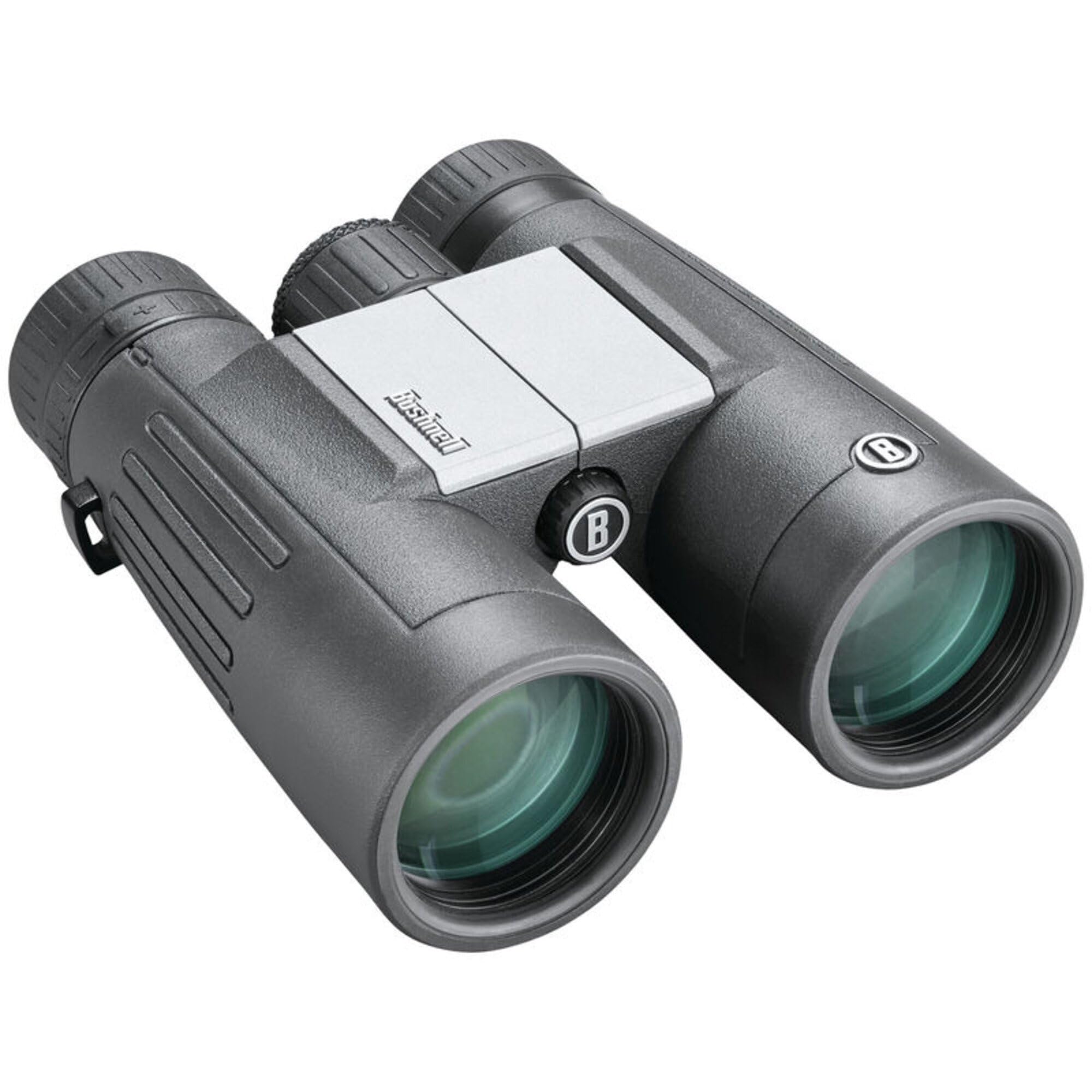
A classic porro-prism design that gives you a 5.25mm exit pupil for bright, steady views.
The PowerView 2 uses porro prisms (the offset barrel shape), which often produce a sharper image and better depth perception than roof prisms at the same price. With a 10x magnification and 50mm objective lenses, the exit pupil (the circle of light your eye sees) is a big 5.25mm — larger than the Bushnell Explorer’s 4mm — so your eyes get a lot of light even as evening falls. That makes it a great pick for dusk walks or wildlife that moves at twilight. The multi-coated lenses draw in more light for vibrant color, and the ultra-smooth focus wheel lets you dial in sharpness quickly.
Construction is a strong point. The aluminum alloy chassis is wrapped in soft-touch rubber with a brushed metal finish that looks sharper than most at this level. It is tripod-compatible, and the center focus wheel is smooth enough to operate with one finger. One buyer planning an Alaska cruise said, “bought for our upcoming Alaska cruise like them a lot,” while another called it “very clear and precise” for bird watching.
The biggest difference from the Bushnell Explorer above is the porro vs. roof prism design — the PowerView 2 is bulkier and heavier, but that extra bulk gives you the larger exit pupil. If brightness is your priority over compactness, this is the better Bushnell choice. The drawback is the 5mm of eye relief (distance from the lens your eye can be), which is low for glasses wearers compared to the Explorer’s 17.5mm or the Occer’s 20mm.
Bright & Steady
- Large 5.25mm exit pupil for excellent low-light performance
- Aluminum alloy chassis with soft-touch rubber grip
- Smooth center focus wheel for quick adjustments
One Notable Limitation
- 5mm eye relief is too short for eyeglass wearers
- Porro prism design makes it bulkier than roof prism models
- No smartphone adapter included
Reach for it when: you need a bright view in low light and you do not wear glasses — this is a stellar performer for the price.
Pass if: you wear prescription glasses and need more eye relief, or you want a compact travel companion.
5. Adorrgon 15×45 HD Binoculars
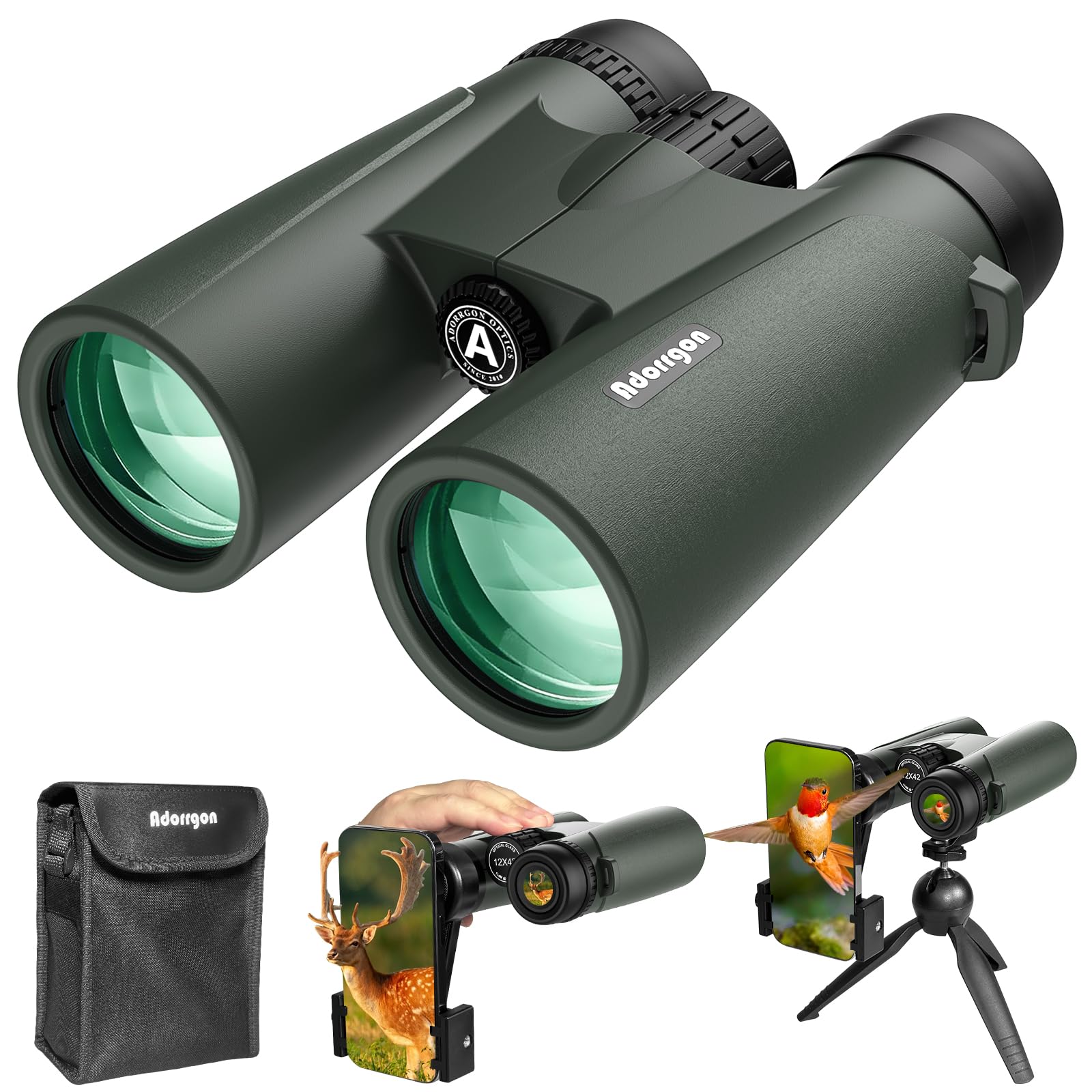
A complete kit with a phone adapter and tripod for sharing what you spot with friends.
If you want to take photos of what you see, this bundle includes everything you need. The Adorrgon 15×45 HD has a 15x magnification combined with a 45mm objective lens and a 3.5mm exit pupil (the circle of light your eye sees). The fully multi-coated lenses and 16.5mm BAK4 prism (high-quality internal glass) deliver a bright image even as light starts to fade. The manufacturer claims the 18.5mm large eyepieces give you 2.25 times the image size of a typical 14mm eyepiece, so the view feels expansive and rich.
The kit is the real value here. It includes a 2025-upgraded phone adapter that clamps in from three directions, plus a 360-degree rotatable tripod. Customers note the binoculars are “surprisingly clear image quality for the price” and “lightweight, clear, comfortable,” but the phone adapter has mixed reviews — one owner called it “useless” for photos, while others said it works well after a short learning curve. At only 1.1 pounds, it is 0.6 pounds lighter than many 10×50 full-size binoculars, making it easy to carry on long walks.
The trade-off is that 15x magnification demands a steady hand or the included tripod. Handheld, you will notice some shake compared to the 10x or 12x options. But if you plan to set it up on a tripod for bird photography or stargazing, that magnification gives you a lot of reach. It is a better all-in-one digiscoping package than the IBQ 12×50 above, which does not include a tripod in the box.
Complete Package
- Includes phone adapter, tripod, and tripod adapter
- Lightweight at just 1.1 pounds
- 18.5mm large eyepieces for an expansive view
The Downsides
- Phone adapter quality is inconsistent across reviews
- 15x magnification is shaky without a tripod
- Not pocket-sized — bigger design than 12×25 compacts
Ideal for: nature lovers who want to capture and share distant shots of birds or landscapes using their smartphone.
Consider something else if: you need a quick, handheld binocular for scanning fast-moving action — the higher mag will wobble.
6. OPAITA 20×32 Compact Binoculars

A powerful 20x optic that reaches far out to sea — ideal for spotting whales and dolphins.
At 20x magnification, the OPAITA gives you double the reach of the 10x Bushnell Explorer. Combined with a 32mm objective lens, you can pick out details on a faraway coastline or identify a whale spout on the horizon. The BAK4 prism (high-quality internal glass) and fully multi-coated lenses (FMC, meaning anti-reflection layers on every surface) keep the image sharp, and the field of view is 235 feet at 1000 yards — narrower than lower-power binoculars but expected for this zoom level.
Buyers love it for cruises. One owner said, “Bought for Alaska cruise. Nice compact size and good magnification. Saw lots of whales that I would have missed if I did not have these.” Another called it “one of the Best Buys that I could find with a good price” for a concert. The compact size (small enough for a coat pocket) and light weight make it easy to carry all day. The downside is the exit pupil (the circle of light your eye sees): at just 1.6mm (compared to 4.17mm on the IBQ 12×50), it needs bright conditions to work well. In overcast weather or deep woods, the image will look dim.
The OPAITA also has the weakest eye relief (distance from the lens your eye can be) at 13mm, so glasses wearers may struggle to see the full image without pressing their specs against the eyepieces. For anyone without glasses who wants maximum reach in good light, though, this is the budget king of distance — far more magnification than the Occer or IBQ for similar money.
Longest Reach
- 20x magnification is the highest in this lineup
- Compact and lightweight for easy packing
- Excellent for open-water or stadium spotting
Trade-Offs
- 1.6mm exit pupil means poor low-light performance
- 13mm eye relief is short for glasses wearers
- Needs a steady rest to avoid hand-shake at 20x
Take it on: a cruise or boat trip where daytime sun is strong and you need to scan the horizon for wildlife.
Leave it behind if: you plan to use it at dusk, in forests, or if you wear eyeglasses full-time.
7. Sogries 20×60 Binoculars
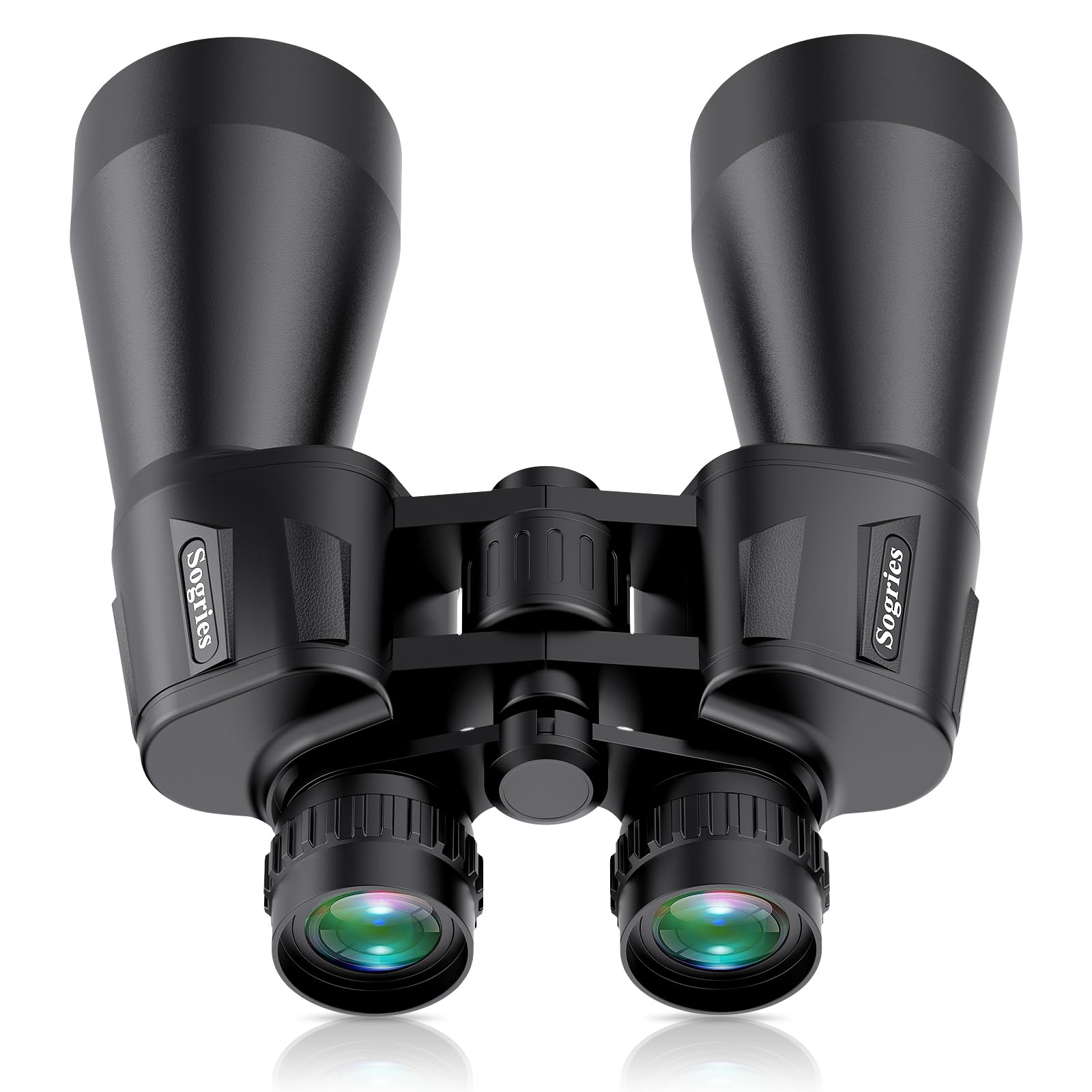
The biggest objective lens here — 60mm — for anyone who wants to get closer to the night sky.
The Sogries 20×60 packs 20x magnification onto a massive 60mm objective lens, making it the most powerful light-grabber in the group. The multilayer-coated aspherical lenses are designed to deliver 99.8% light transmission, so even at high magnification you get a bright image. The BAK4 Porro prism (high-quality offset glass) improves color reproduction, which helps separate stars from the background glow.
Construction is solid — a metal body with IPX7 waterproof and nitrogen-sealed fog-proof protection. Reviewers point out it is “sturdy, easy to use” and “clear, sturdy and easy to use” with a “sharp image, simple operation.” At 1.42 pounds, it is the heaviest pick here, which is why most owners recommend using a tripod. The field of view is tight at 7.2 feet per 1000 yards (that is about 48 yards at 1000 yards), so tracking a moving bird by hand will be a challenge — this binocular is best on a steady mount. The eye relief (distance from the lens your eye can be) is 12mm, which is short for glasses wearers.
Compared to the OPAITA 20×32 above, the Sogries gives you way more light with that 60mm front lens, but it is a lot bigger and heavier. If compactness matters to you, pick the OPAITA. If you want to actually see the moons of Jupiter or read a house number half a mile away, the Sogries is your budget-friendly heavy hitter.
Maximum Magnification
- 20x magnification with 60mm lens for extreme reach
- IPX7 waterproof and nitrogen-sealed
- Great value for stargazing enthusiasts
Size Matters
- Heavy at 1.42 pounds — tripod recommended
- Narrow field of view makes target acquisition hard
- 12mm eye relief is not ideal for eyeglass wearers
Best for: backyard astronomers and long-range spotters who use a tripod and want the most magnification for the money.
Not for: hiking or casual handheld use — you will struggle to keep it steady and the view steady.
Understanding the Specs
Exit Pupil Diameter
This is the little circle of light you see when you hold the binoculars at arm’s length. A larger number like 5.25mm on the Bushnell PowerView 2 means more light reaches your eye, giving you a brighter image at dawn or dusk. A smaller number like 1.6mm on the OPAITA 20×32 means the binocular needs bright sunlight to work well. For general use, aim for 3mm to 5mm.
Field of View (FOV)
Measured in feet at 1000 yards, this tells you how wide an area you can see at once. A wider number like 273 feet on the Occer 12×25 makes it easier to track moving birds or follow a soccer play. A narrower number like 48 yards on the Sogries 20×60 is like looking through a straw — you get more detail but less context, and you need a steady aim.
FAQ
What makes a bargain binocular worth buying?
Is 20x magnification too high for handheld use?
What does BAK4 prism mean and why does it matter?
Can I use bargain binoculars with eyeglasses?
What is the difference between roof prism and porro prism binoculars?
How important is fully multi-coated (FMC) optics?
Will a 25mm objective lens work for birdwatching?
How do I clean binocular lenses without scratching them?
What does IPX7 waterproof mean for binoculars?
Can I use a smartphone adapter with any binocular?
Final Thoughts: The Verdict
The best bargain binoculars for most people is the Occer 12×25 Compact Binoculars because it combines a lightweight, glasses-friendly design with a surprisingly clear image at a price that is tough to top. If you want a brighter view in low light — with a 50mm lens that pulls in twice the light of the Occer — grab the IBQ 12×50 UHD Binoculars. And for stationary stargazing with a massive 60mm objective lens, the Sogries 20×60 Binoculars gives you the most reach for your money.
How We Picked
We do not accept paid placement. Every pick is matched to a real buyer and a real use-case; we do not hands-on test units.
Sources & Methodology
Specifications: manufacturer listings and product documentation. Review insights: verified customer reviews, as of July 2026. Pricing: not shown on this page (it changes often); check the current price via the retailer link.
As an Amazon Associate, Gadgets Feed earns from qualifying purchases. This does not affect which products we feature.
Related Guides
Product prices and availability are accurate as of the date/time indicated and are subject to change. Any price and availability information displayed on Amazon at the time of purchase will apply to the purchase of this product. As an Amazon Associate I earn from qualifying purchases.
CERTAIN CONTENT THAT APPEARS ON THIS SITE COMES FROM AMAZON. THIS CONTENT IS PROVIDED "AS IS" AND IS SUBJECT TO CHANGE OR REMOVAL AT ANY TIME.
Amazon and the Amazon logo are trademarks of Amazon.com, Inc. or its affiliates.