
A first telescope should crack open the night sky, not your wallet. The difference between a frustrating plastic toy and a real instrument often comes down to a few key specs that cheap marketing skips entirely — aperture size, glass coatings, and mount stability. Finding that sweet spot where price meets performance is the only way to guarantee a beginner actually sticks with the hobby past the first few nights.
I’m Min — the co-founder and writer behind Gadgets Feed. After sifting through hundreds of hours of user reports and technical spec sheets for refractors, tabletop Dobsonians, and compact travel scopes, I’ve isolated the models that deliver real resolving power without demanding a second mortgage.
Whether you are shopping for a curious child or fueling your own new obsession, this guide cuts through the noise to reveal the true best bargain telescope for an unforgettable first look at the lunar surface.
How To Choose The Best Bargain Telescope
A good bargain telescope is not the one with the smallest price tag — it is the one with the biggest usable aperture for the money. Every other feature, from the tripod legs to the eyepiece quality, must support that central goal. Here are the three non-negotiable factors to weigh before clicking add to cart.
Aperture: The Single Most Important Number
Aperture is the diameter of the main lens (on a refractor) or mirror (on a reflector), measured in millimeters. A 70mm aperture gathers about 36 percent more light than a 60mm aperture, and an 80mm aperture gathers roughly 30 percent more light than a 70mm. More light means you see fainter stars, more detail on Jupiter’s cloud bands, and sharper crater rims on the moon. Beginner telescopes in this price range typically run from 70mm to 90mm. Stick to the larger end of that spectrum whenever possible.
Mount Stability Over Flashy Accessories
A wobbly tripod ruins every view, regardless of how good the optics are. Cheap mounts introduce vibration with the slightest touch or gust of wind, making high-magnification viewing nearly impossible. Look for an aluminum or stainless steel tripod with a center brace or accessory tray that locks the legs in place. An alt-azimuth mount with slow-motion control knobs gives you smooth tracking of celestial objects without jarring the image.
Glass Coatings and Eyepiece Quality
Fully coated optics (a single layer of anti-reflective film on each lens surface) are standard in this price bracket, but fully multi-coated optics (multiple layers on each surface) significantly improve contrast and light transmission. The supplied eyepieces are almost always Kellner or basic Plossl designs — adequate for starting out, but upgrading to a higher-quality eyepiece later is the single most cost-effective way to improve your views.
Quick Comparison
On smaller screens, swipe sideways to see the full table.
| Model | Category | Best For | Key Spec | Amazon |
|---|---|---|---|---|
| MEEZAA 90mm | Premium | Best all-around performance | 90mm aperture, 800mm FL | Amazon |
| Koolpte 90mm | Premium | Smooth planetary tracking | 90mm aperture, slow-mo mount | Amazon |
| Gskyer 80mm | Mid-Range | Versatile optics stable mount | 80mm aperture, 400mm FL | Amazon |
| Dianfan 90mm | Mid-Range | Complete kit including stool | 90mm aperture, 550mm FL | Amazon |
| Gskyer 70mm | Mid-Range | Travel-friendly with remote | 70mm aperture, 400mm FL | Amazon |
| HUGERSTAR 80mm | Budget | Great accessory bundle value | 80mm aperture, 600mm FL | Amazon |
| Celestron Travel Scope 70 | Budget | Ultra-portable backpack design | 70mm aperture, 400mm FL | Amazon |
In‑Depth Reviews
1. MEEZAA 90mm Telescope

The MEEZAA 90×800 refractor delivers the largest usable aperture in this roundup, paired with a focal ratio of f/8.88 that minimizes chromatic aberration — the purple fringing that plagues faster scopes. Fully multi-coated optics produce crisp, high-contrast views of the moon, Jupiter’s four Galilean moons, and Saturn’s ring system at 32X to 240X magnification. The stainless steel tripod, adjustable from 28 to 46 inches, provides a rock-solid platform that resists wind vibration far better than aluminum alternatives.
Assembly takes roughly ten minutes thanks to a detailed paper manual and clearly labeled parts. The kit includes two Kellner eyepieces (25mm and 10mm), a 3X Barlow lens, a smartphone adapter for quick lunar snapshots, and a padded carry bag that accommodates the entire setup. The alt-azimuth mount moves smoothly without the backlash typical of budget gear, making it easy to track objects as they drift across the field of view.
One downside: the straight-through finderscope requires you to crouch or kneel for comfortable alignment. Replacing it with a right-angle finder later is a common upgrade path. For a beginner seeking the widest possible light-gathering capability without jumping to a premium price tier, this scope stands alone in value.
Why it’s great
- 90mm aperture gathers enough light for satisfying lunar and planetary detail
- Stainless steel tripod eliminates the shake that plagues cheaper scopes
- Fast assembly and intuitive mount make it a true grab-and-go design
Good to know
- Straight-through finder is awkward for taller users
- Included Kellner eyepieces benefit from a future upgrade to Plossl designs
2. Koolpte 90mm Telescope
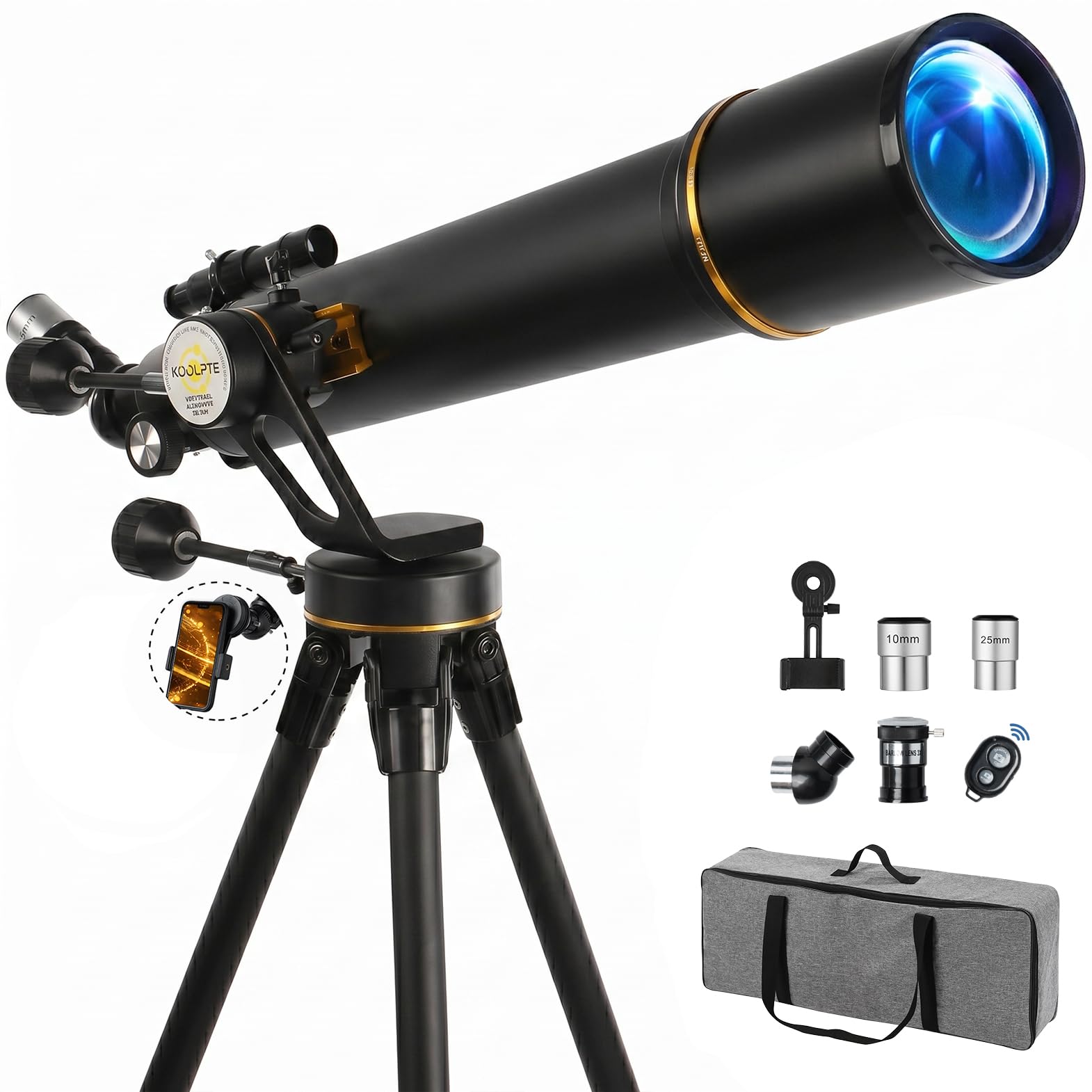
The Koolpte 90×700 refractor pairs a large 90mm aperture with a 700mm focal length (f/7.78) and the exclusive Vertisteel AZ slow-motion mount — a design that uses precision cable control to eliminate the overshoot and backlash common in this price bracket. The fully multi-coated optics achieve a claimed 99 percent light transmission, which translates to bright, glare-free lunar views and discernible cloud bands on Jupiter even under moderate light pollution.
Setup is genuinely tool-free, with most users reporting completion in under ten minutes. The kit includes Kellner eyepieces in 10mm and 25mm, a 3X Barlow lens, a smartphone adapter with wireless remote, a reflex finderscope, and a padded carry bag. The slow-motion controls are the standout feature here: a quarter turn of the knob moves the field of view smoothly by about half a degree, making it possible to follow Saturn for extended periods without touching the tripod.
The tripod, while sturdy, struggles with height adjustment for users over six feet tall when the tube is pointed near zenith. Additionally, a small number of units have reported internal debris after shipping, so inspect the optical path upon arrival. For the dedicated beginner who values smooth tracking over sheer portability, this mount design is worth the small premium.
Why it’s great
- Vertisteel slow-motion mount provides backlash-free tracking
- 90mm aperture and FMC optics deliver bright, high-contrast views
- Wireless remote and phone adapter simplify starter astrophotography
Good to know
- Tripod height is limiting for tall observers at high angles
- Quality control on optical cleanliness can vary between units
3. Gskyer 80mm Telescope

Gskyer’s 80mm refractor has been a consistent top-seller for years, and the reason is simple: it delivers a stable alt-azimuth mount with a standard dovetail plate — a feature rarely seen at this tier that allows future upgrades to a better tripod or Vixen-style dovetail accessories. The 400mm focal length (f/5) produces a wider field of view than longer tubes, making it easier for beginners to locate objects before zooming in with the supplied 16X, 40X, and 80X eyepieces plus the 3X Barlow.
The fully coated glass optics show minimal chromatic aberration for an f/5 design, and the erect-image diagonal means the scope doubles as a daytime spotting scope for birding or landscape observation. The 6×30 finderscope has a reflex-style aiming point that simplifies targeting, though the bracket can arrive loose and require a small adjustment with a screwdriver or file to seat properly.
At 7.9 pounds, this is one of the heavier scopes in the mid-range category, but that weight contributes directly to mount stability. The included tripod has an accessory tray that locks the leg spread, and the dovetail attachment allows quick balancing when swapping eyepieces. If you want a telescope that can grow with you — accepting better eyepieces and a sturdier tripod later — this is the most future-proof option in the lineup.
Why it’s great
- Dovetail mount allows tripod upgrades without buying a whole new scope
- Erect-image diagonal makes it usable for daytime terrestrial viewing
- Stable tripod with accessory tray minimizes vibration at high power
Good to know
- Finderscope bracket may need minor adjustment out of the box
- Wider field of view means less effective magnification for planets
4. Dianfan 90mm Telescope
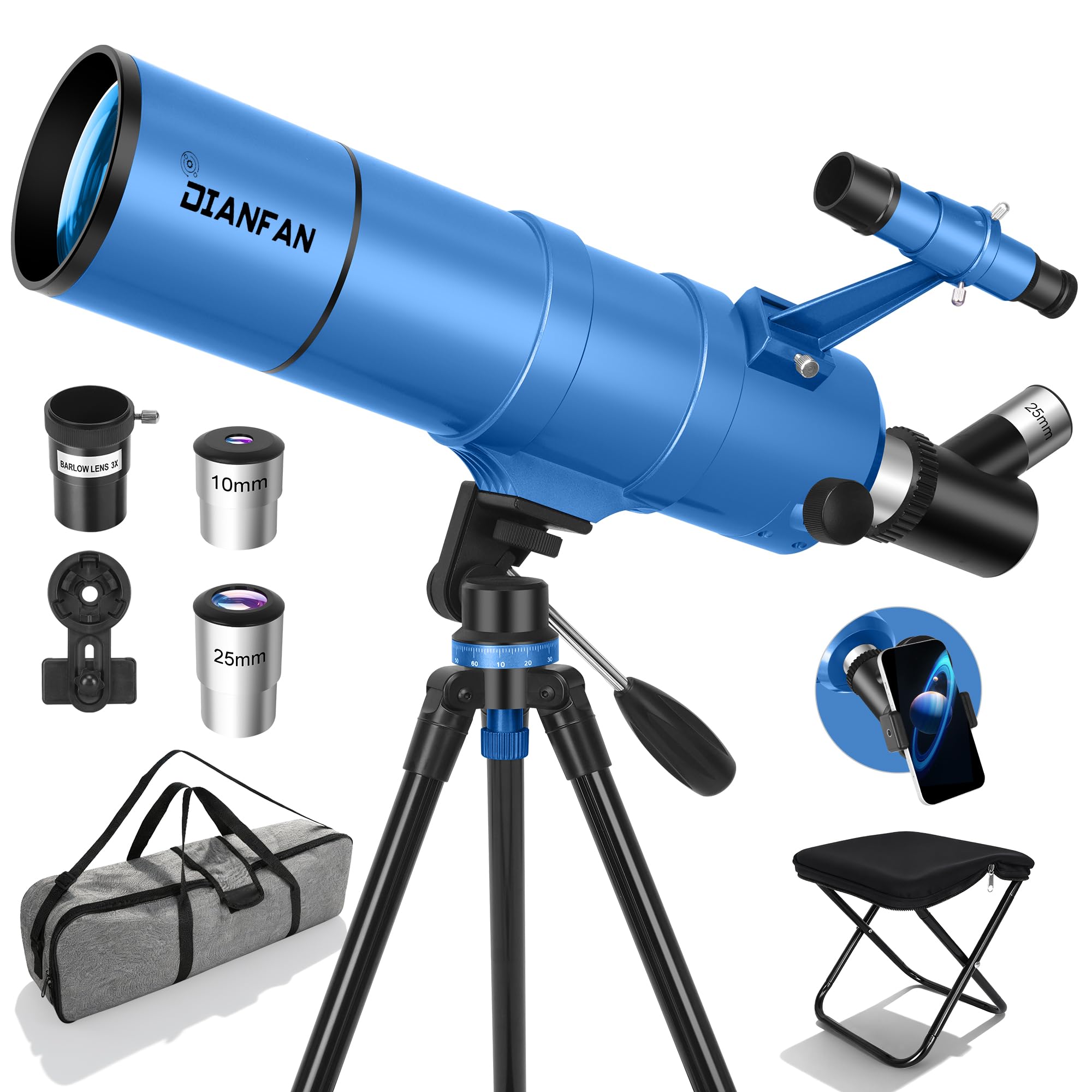
The Dianfan 90×550 refractor packs the same 90mm aperture as the top-tier models but at a lower entry point, making it the strongest aperture-to-price ratio in the group. The 550mm focal length (f/6.1) offers a good compromise between wide-field sweeps of the Milky Way and close-up views of the moon. Fully multi-coated optics keep the image bright and the contrast solid for a scope at this level.
What sets this kit apart is the inclusion of a folding stool rated for up to 198 pounds — a thoughtful addition that solves the crouching problem most beginner scopes create. The carry bag, finderscope, and smartphone adapter round out a package that requires nothing extra for the first observing session. Magnification ranges from 22X to 165X using the 10mm and 25mm eyepieces with the 3X Barlow, which is enough to split double stars and see the Cassini division in Saturn’s rings on a steady night.
The trade-off is the tripod: it is lighter than the stainless steel units on the premium models and transmits vibration more readily in breezy conditions. A simple ankle-weight hack or hanging a bag from the accessory tray largely solves this. For the beginner who wants maximum light-gathering for the lowest cash outlay and does not mind a minor stability DIY fix, this kit is the smartest financial play.
Why it’s great
- 90mm aperture at a remarkably accessible price point
- Folding stool is a genuinely useful ergonomic accessory
- Easy 15-minute tool-free assembly for absolute beginners
Good to know
- Tripod is lightweight and prone to vibration in wind
- Straight-through finder requires bending down to use
5. Gskyer 70mm Telescope

The Gskyer 70×400 sits at the popular 70mm aperture and 400mm focal length (f/5.7) configuration, making it the lightest and most travel-friendly refractor in this lineup. Fully coated optics and a 5.8-degree field of view allow sweeping views of the moon that fill the entire eyepiece, while the included 3X Barlow pushes magnification high enough to spot Jupiter’s moons on a clear night.
This kit stands out for its astrophotography-in-a-box approach: the smartphone adapter and wireless camera remote let you capture and share lunar shots without touching the scope and introducing shake. The adjustable aluminum tripod and padded carry bag make it easy to bring on camping trips or to a dark-sky site away from city lights. Assembly is straightforward, and the reflex finderscope speeds up target acquisition for beginners.
The 70mm aperture is a real limitation — Mars shows no surface detail, and most deep-sky objects like galaxies and nebulae remain invisible. The short tripod also forces a stooped posture for anyone over five and a half feet tall. This scope is best viewed as an introduction to the hobby that prioritizes portability and shareability over raw light-gathering power. It is ideal for a family with young kids who want quick, rewarding views of the moon before bedtime.
Why it’s great
- Ultra-light 5.7-pound build fits easily into a backpack or carry-on
- Wireless remote and phone adapter enable shake-free smartphone astrophotography
- Wide field of view makes lunar and terrestrial targets easy to find
Good to know
- 70mm aperture limits detail on planets and deep-sky objects
- Short tripod height is uncomfortable for taller adults
6. HUGERSTAR 80mm Telescope
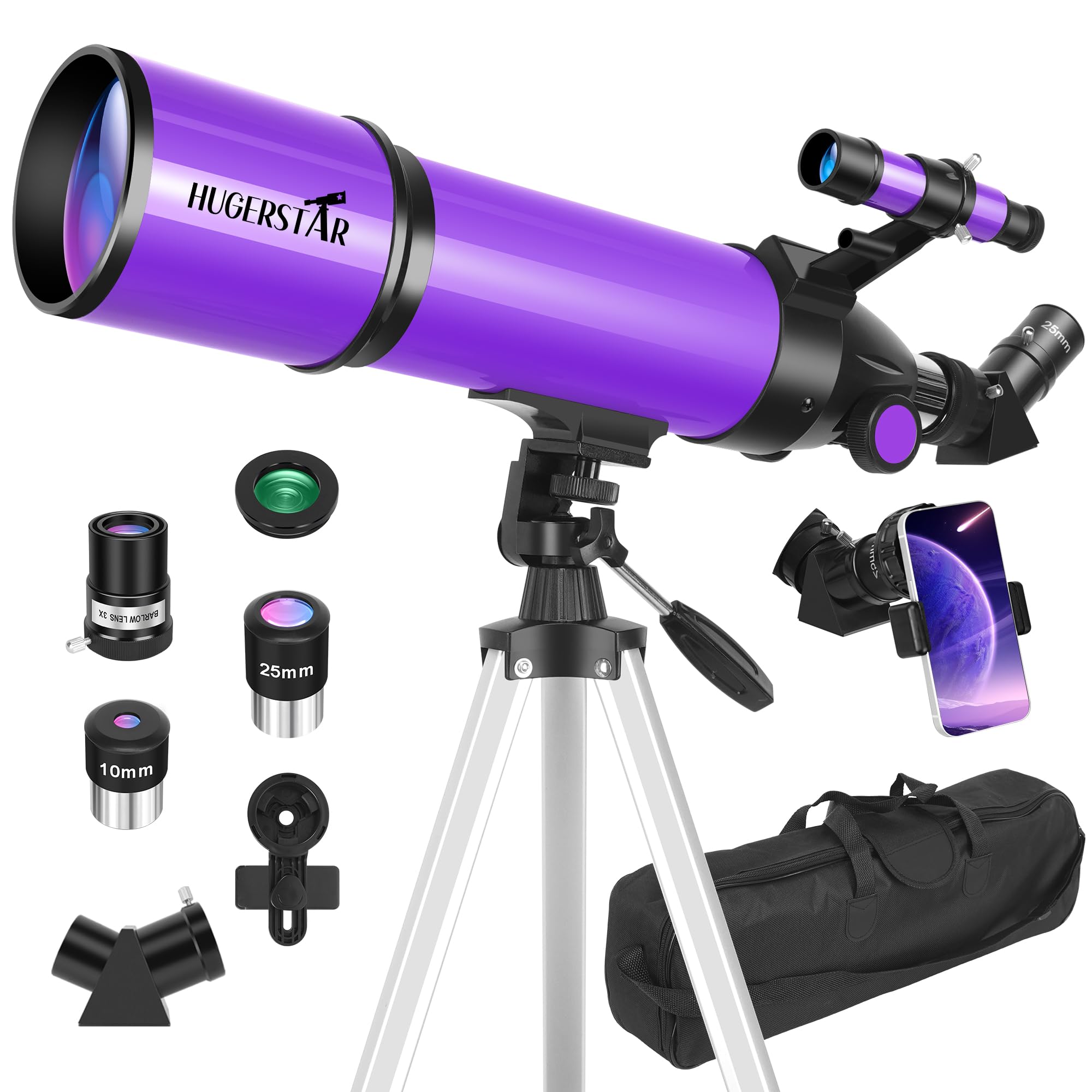
The HUGERSTAR 80×600 refractor punches above its tier by combining an 80mm aperture with fully multi-coated optics and a practical 600mm focal length (f/7.5). This configuration keeps chromatic aberration well controlled while providing enough focal length to show Saturn’s ring structure as more than just a bump. The included 25mm and 10mm Kellner eyepieces plus the 3X Barlow deliver a usable magnification range from 24X to 180X.
Setup is genuinely tool-free and takes most beginners around ten minutes. The aluminum tripod adjusts from 21.2 to 44 inches, accommodating both seated and standing viewing positions, though the maximum height is still a bit short for six-foot users. The package includes a 5×24 straight-through finderscope, a moon filter to reduce glare during full lunar observation, a smartphone adapter, and a padded carry bag for transport.
The biggest shortcoming is the finderscope, which is a simple straight-through design with no crosshair illumination, making nighttime alignment tedious. The mount also lacks slow-motion controls, so you must nudge the tube manually to track objects — a common limitation at this price. For the budget-conscious buyer who wants the largest aperture available at the lowest cost, this scope delivers on the core optics promise and leaves room for later upgrades.
Why it’s great
- 80mm aperture with multi-coated optics at a very low entry price
- Included moon filter improves comfort during bright lunar sessions
- Tool-free setup gets you observing within minutes
Good to know
- No slow-motion controls requires manual nudging for tracking
- Straight-through finder is dim and hard to use at night
7. Celestron Travel Scope 70
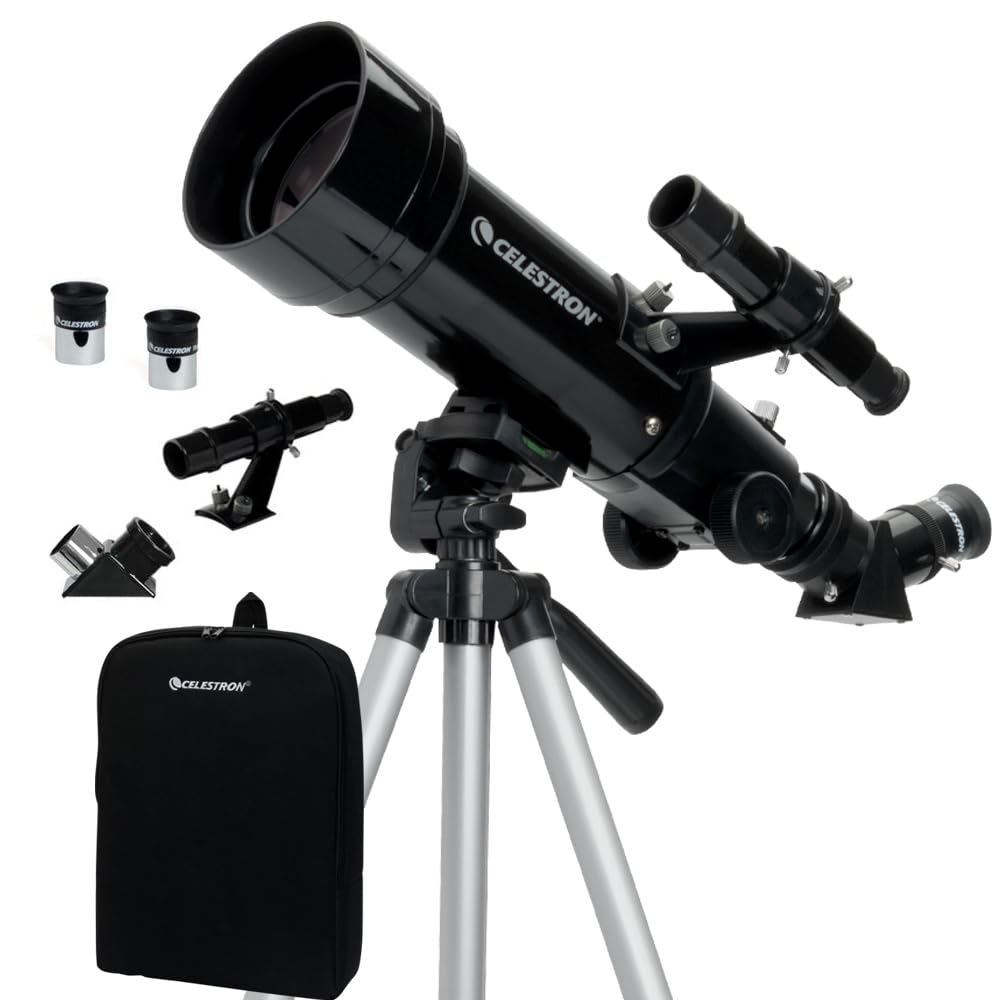
The 70mm aperture and 400mm focal length (f/5.7) provide bright, razor-sharp views of the moon and enough resolution to catch Jupiter’s moons and Saturn’s ring halo on a stable night. The fully coated glass optics and 45-degree erect-image diagonal make this scope equally capable for daytime birding or landscape spotting.
The standout feature is the included padded backpack, which stores the optical tube, tripod, 20mm and 10mm eyepieces, finderscope, and star diagonal in a compact, carry-on-friendly package. No other scope in this roundup packs down as small. Setup truly requires no tools — the tripod legs lock with flip-levers, and the tube attaches via a quick-release dovetail shoe. Celestron also includes a free download of Starry Night software to help new observers plan their sessions.
The trade-offs are well-documented: the tripod is lightweight and prone to vibration, the 45-degree diagonal is uncomfortable for astronomy (a 90-degree upgrade is recommended), and the stock eyepieces show narrow apparent fields. The 70mm aperture also means deep-sky objects beyond the moon and brightest planets will be disappointing. For the traveler or the family who wants a telescope that can go on a plane, hike, or camping trip without sacrificing basic optical quality, this is the one.
Why it’s great
- Complete backpack kit fits the entire scope and accessories for true portability
- Proven Celestron optics with a 2-year US warranty and expert support
- Sets up in seconds with no tools for spontaneous observing sessions
Good to know
- Lightweight tripod is shaky at high magnification; a tabletop setup is more stable
- 45-degree diagonal is better for daytime use; a 90-degree diagonal improves astronomy
FAQ
How much aperture do I really need for a beginner telescope?
What does fully coated vs fully multi-coated mean for my views?
Why does the tripod matter so much for a cheap telescope?
Final Thoughts: The Verdict
For most users, the best bargain telescope winner is the MEEZAA 90mm Telescope because it delivers a full 90mm of aperture, a rock-solid stainless steel tripod, and enough accessories to start observing immediately — all without demanding a premium price. If you want smooth planetary tracking with slow-motion controls, grab the Koolpte 90mm Telescope. And for a travel-ready option that packs into a backpack, nothing beats the Celestron Travel Scope 70.