
A Barlow lens is often the single most effective upgrade you can make to your telescope, instantly multiplying the magnification of every eyepiece you own without needing a new set of glass. But the difference between a cheap, fringed, hazy view and a crisp, high-contrast planetary observation comes down to a few critical design choices that separate the top-tier options from the rest.
I’m Min — the co-founder and writer behind Gadgets Feed. My work here involves deep dives into technical specifications and countless hours cross-referencing real-world user data to find which Barlow lenses genuinely deliver on their optical promises without introducing nasty chromatic aberration.
This guide breaks down seven of the most compelling models on the market, covering everything from budget-friendly kits to premium apochromatic designs, to help you find the best barlow lens for your current gear and observing goals.
How To Choose The Best Barlow Lens
A Barlow lens works by diverging the light cone from the telescope, effectively increasing the focal length and thus magnification. While the concept is simple, the optical execution varies dramatically, making the choice between a decent starter lens and a high-performance upgrade a matter of understanding a few key specifications.
Magnification Factor and Telescope Limits
The most common Barlow factors are 2x, 3x, and 5x, simply meaning they double, triple, or quintuple the focal length. The critical rule is your telescope’s maximum useful magnification, typically around 50x per inch of aperture for average seeing conditions. A 3x Barlow pushed past this limit will only yield a larger, blurry image, so match the factor to your scope’s potential.
Optical Design and Lens Elements
A basic 2-element Barlow is the cheapest design but often introduces noticeable false color. Higher-end 3-element and 4-element designs use apochromatic (APO) or Extra-low Dispersion (ED) glass to bring the three primary colors to the same focus, virtually eliminating chromatic aberration and delivering sharper, truer views that matter for planetary detail.
Coating Quality
Look for “Fully Multi-Coated” (FMC) optics. This means every air-to-glass surface has multiple anti-reflective layers, maximizing light transmission and contrast while minimizing internal glare and ghosting. A “coated” or “multi-coated” descriptor on only some surfaces is a cheaper alternative that reduces the lens’s efficiency.
Quick Comparison
On smaller screens, swipe sideways to see the full table.
| Model | Category | Best For | Key Spec | Amazon |
|---|---|---|---|---|
| Tele Vue 3x | Premium | Ultimate image purity | 3-element, high-index glass | Amazon |
| Celestron X-Cel LX 2x | Premium | Sharper views at 2x | 3-element APO, FMC optics | Amazon |
| SVBONY SV216 3x | Mid-Range | High-res 3x planetary | 4-element APO, brass ring | Amazon |
| Astromania 2x ED | Mid-Range | 2-inch wide-field setups | ED glass, 2-inch & 1.25-inch | Amazon |
| Celestron 93640 | Mid-Range | Versatile 3-in-1 use | 2x Barlow & T-Adapter | Amazon |
| CelticBird Kit | Value | Full kit for beginners | 13-piece set with case | Amazon |
| XCCYG 2x-3x-5x Kit | Budget | Multiple mag options | 3-lens kit, fully metal | Amazon |
In‑Depth Reviews
1. Tele Vue 1.25″ 3x Barlow Lens

The Tele Vue 3x Barlow is the reference standard in the astronomy community, known for its parfocalizing design and exceptional image correction. Its three-element, high-index glass configuration produces a 10.5mm focal length that effectively triples your eyepiece’s power while maintaining a flat, sharp field edge-to-edge. The build quality is immediately apparent, with captive lock screws that secure your eyepiece without risking damage to the barrel.
This Barlow is optimized for planetary and lunar observation where every percent of contrast matters. The multi-coated optics efficiently suppress internal reflections, and the threaded barrel allows for standard 1.25-inch filter attachment. Weighing in at just half a pound, it remains a manageable addition to any visual setup.
Users consistently report that the Tele Vue 3x delivers “crystal clear” images that feel optically invisible — meaning it adds magnification without degrading the base view. It is, however, a significant financial investment, and its high power can easily exceed the usable magnification of smaller aperture scopes, so careful matching with your telescope is recommended.
Why it’s great
- Superior image clarity and contrast across the full field
- Parfocal design maintains focus when changing eyepieces
- Exceptional build quality with captive lock screws
Good to know
- High magnification factor may push small scopes past their limit
- Premium price point, best for committed astronomers
2. Celestron 93529 1.25 Inch X-Cel LX 2X Barlow Lens

The Celestron X-Cel LX 2x Barlow sits at the sweet spot of performance and price, offering a three-element apochromatic design that virtually eliminates the color fringing common in lower-tier options. This fully multi-coated optical train delivers bright, sharp images ideal for both visual planetary work and lunar details. The rubberized grip provides a secure hold even on cold nights, a thoughtful ergonomic touch.
A key feature is the brass compression ring, which holds your eyepieces firmly without the risk of marring the barrel — a common issue with set-screw-only designs. The barrel is also threaded to accept standard 1.25-inch filters, allowing you to stack neutral density or color filters directly. The 5.6-ounce body is lightweight enough for any focuser.
Reviews frequently mention that the X-Cel LX 2x produces an “exceptionally crisp” image that is close to optically invisible, with one seasoned user calling it the “closest to ‘invisible’ Barlow among many tested.” The main trade-off is that the 3x version of the same line is less versatile, making this 2x model the smarter choice for most observers.
Why it’s great
- Apochromatic 3-element design for outstanding color correction
- Brass compression ring secures eyepieces without damage
- Excellent value compared to premium APO alternatives
Good to know
- Rubber grip can collect dust over time
- Premium price, though justified by optical quality
3. SVBONY SV216 3X Barlow Lens, 1.25″
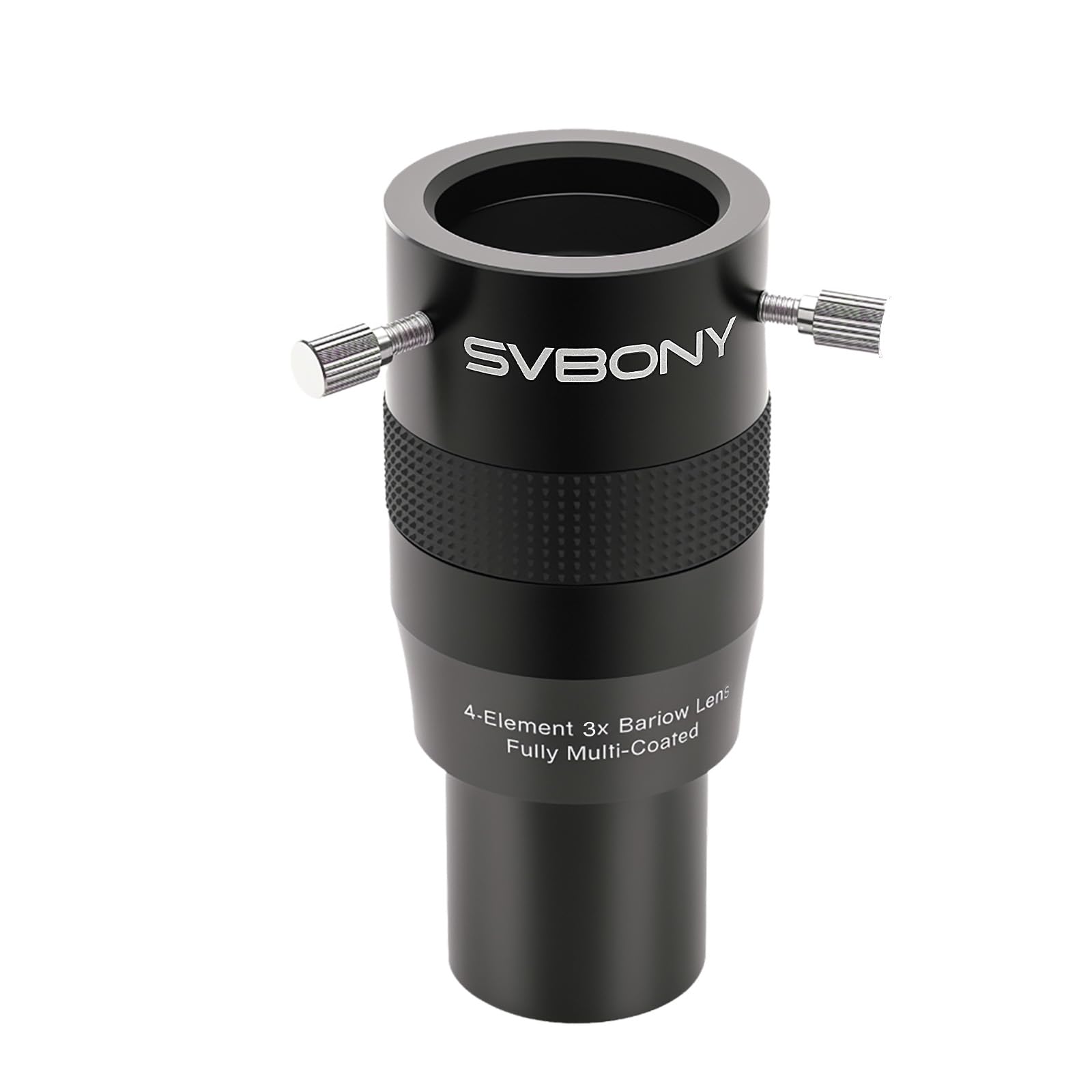
SVBONY’s SV216 is an aggressive player in the mid-range space, packing a four-element apochromatic optical design that directly rivals more expensive premium units. This configuration effectively splits the light path to correct for chromatic aberration at a 3x magnification factor, making it a standout choice for detailed planetary imaging and high-power lunar observation. The FMC coatings on every lens surface maximize transmission.
The mechanical execution is equally impressive, featuring a three-screw coaxial locking mechanism and a high-strength brass compression ring that centers the eyepiece securely while preventing barrel damage. The durable aluminum housing feels solid, and included dust caps protect the optics when not in use. The 4.8-inch body length is well-proportioned for most focusers.
Buyers consistently praise the “very sharp and clear images” and note that it’s a “significant improvement” over stock Barlows that come with most telescope kits. One user mentioned using it with a 13-inch Dobsonian and seeing Jupiter’s Red Spot for the first time. The only potential concern is its relatively recent market introduction, meaning long-term durability data is still emerging.
Why it’s great
- Four-element APO design for exceptional color purity
- Brass compression ring with coaxial locking for secure fit
- Outstanding value for a high-performance 3x Barlow
Good to know
- Newer product, limited long-term user reports
- 3x is powerful; ensure your scope can support it
4. Astromania Barlow Lens 2X, 2 Inch ED Glass
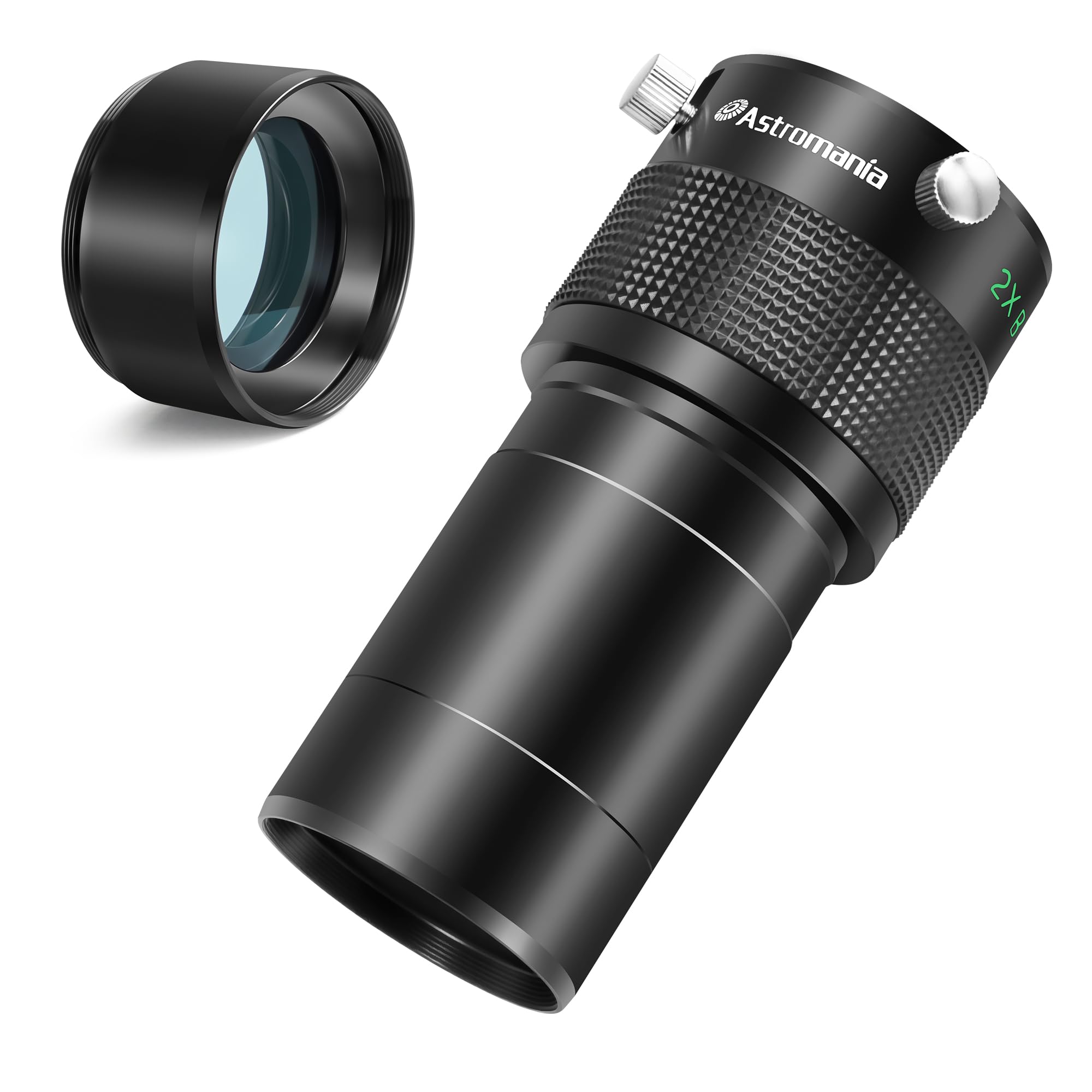
The Astromania 2x ED Barlow is designed specifically for the wide-field enthusiast using 2-inch focusers and eyepieces. The use of Extra-low Dispersion (ED) glass in its 2-element design significantly reduces chromatic aberration to near-APO levels, producing high-contrast images. Its 2-inch diameter ensures no vignetting on larger camera chips or wide-field eyepieces, a critical advantage over 1.25-inch Barlows.
The modular design is a standout: the Barlow element unscrews and can be threaded directly into a 2-inch eyepiece, effectively shortening the optical train and reducing the weight hanging off the focuser. It also includes a 1.25-inch reducer adapter and a 2-inch filter thread, offering flexibility for different setups. At 11.46 ounces, it has a reassuring heft.
Reviews highlight its effectiveness for astrophotography, with one user noting it “helps achieve prime focus on a DSLR” and reduces vignetting compared to a 1.25-inch Barlow. Some users on fast focal ratio scopes found it required additional extension to reach focus. The unit is well-built and praised as a “great value” for those invested in the 2-inch format.
Why it’s great
- ED glass delivers near-APO color correction
- Reduces vignetting on large chips and 2-inch eyepieces
- Modular design allows direct thread to eyepieces
Good to know
- Heavier than 1.25-inch counterparts
- May need extension tube for fast telescopes
5. Celestron 93640 1.25 Inch Universal Barlow and T-Adaptor
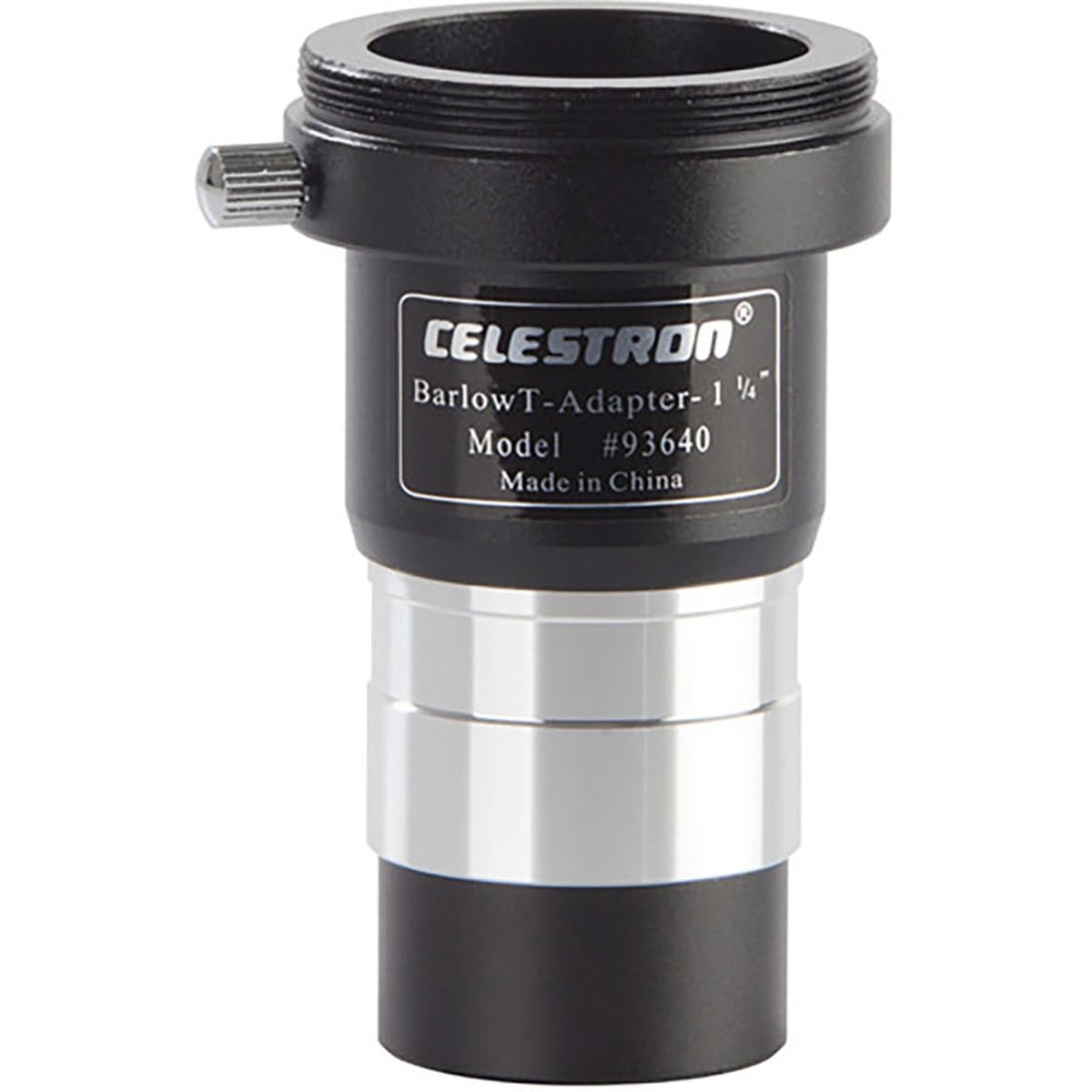
The Celestron 93640 is a cleverly designed multi-tool that serves as a 2x Barlow for visual use, a T-adapter for prime focus astrophotography, and a tele-extender when both functions are combined. This eliminates the need for a separate T-ring adapter, streamlining a DSLR setup. The multi-coated optics provide good light transmission for visual observing of the moon and brighter planets.
In practice, the Barlow function works well with standard 1.25-inch eyepieces, noticeably sharpening planetary views at a reasonable 2x boost. When used for photography, the T-threads accept any camera-specific T-ring (sold separately), allowing you to transform your telescope into a telephoto lens. The body is compact at just 65 grams, making it negligible in weight.
Users praise it as a “money saver” that effectively combines two useful tools. Some DSLR photographers note that on certain telescopes, achieving focus without the Barlow is impossible, but with it attached the camera focuses fine on terrestrial targets. The T-adapter section can feel slightly loose in some focusers, though it remains secure. It is a streamlined solution for the visual observer who occasionally shoots photos.
Why it’s great
- 3-in-1 design (Barlow, T-adapter, tele-extender)
- Seamless DSLR connection with T-ring
- Compact and lightweight at 65 grams
Good to know
- Adapter may feel slightly loose in some focusers
- Basic multi-coating compared to premium FMC options
6. CelticBird Telescope Accessory Kit 1.25″

For the beginner looking to build out an entire eyepiece collection in one box, the CelticBird kit delivers a 2x Barlow, five Plossl eyepieces (40mm to 6mm), and seven filters (including a moon filter and five color filters). The 2x Barlow effectively doubles each eyepiece’s magnification, giving you ten effective power levels. The T2 threads on the Barlow also allow compatibility with a T-ring for basic astrophotography.
The Plossl eyepieces offer a noticeable clarity upgrade over the standard Kellner or Huygens eyepieces that come with most beginner telescopes. The color filters help tease out details on planetary surfaces, and the moon filter is essential for comfortable lunar viewing. The entire set packs into a sturdy, foam-lined metal carrying case that keeps everything organized and safe.
Customers consistently describe it as a “great starter kit” that provides “excellent value” and allows new observers to explore a wide range of magnifications immediately. The case has enough extra room for a couple of additional small accessories. While the Barlow is a basic 2x unit and not a premium APO design, it is more than sufficient for a beginner to learn what targets and magnifications they enjoy most.
Why it’s great
- Complete kit with 5 eyepieces, 2x Barlow, and 7 filters
- Includes durable metal carry case for storage
- Huge value compared to buying accessories separately
Good to know
- Barlow lacks premium APO or ED glass
- Case foam may not suit advanced users’ layouts
7. XCCYG Telescope Barlow Lenses Kit 2X-3X-5X

The XCCYG kit offers three distinct magnification factors (2x, 3x, and 5x) in a single package, providing maximum flexibility at a minimum cost. Each Barlow is constructed from fully metal machined aluminum with a black anodized finish, giving them a feel that significantly exceeds their price point. The fully multi-coated green film optics aim to minimize chromatic aberration and improve image transmission.
The set includes a removable optical element that lets you attach the lens directly to an M42x0.75 camera thread for astrophotography. At 1.25-inch format, these Barlows work with standard eyepieces and filter threads. The 3.8-inch height keeps them pocket-friendly for quick changes at the eyepiece. They are lightweight and easy to swap in the field.
Users are consistently surprised by the performance, calling them “great lenses” that “actually work quite well” even on telescopes like the Celestron 130EQ. The 5x element is noted to be softer, as expected at that extreme magnification, but the 2x and 3x elements are praised for providing clear, usable views. They are an ideal choice for someone who wants to experiment with different powers without a significant financial commitment.
Why it’s great
- Three Barlow lenses for the price of one
- All-metal construction feels durable
- Excellent way to experiment with different magnification factors
Good to know
- 5x Barlow can produce soft images on smaller scopes
- Basic multi-coating, not apochromatic
FAQ
Will a 3x Barlow lens damage my telescope?
Can I use a 2-inch Barlow with a 1.25-inch focuser?
What is the difference between a 2x and a 3x Barlow for planetary viewing?
Final Thoughts: The Verdict
For most users, the best barlow lens winner is the Celestron X-Cel LX 2x because it strikes the perfect balance of premium apochromatic optics, solid mechanical design, and a price that doesn’t break the bank. If you want the absolute maximum image purity and are willing to invest, the Tele Vue 3x is the undisputed champion. And for a budget-friendly way to explore multiple magnifications, the XCCYG 2x-3x-5x Kit is a fantastic entry point.