
Checking your phone’s weather app might tell you if it’s raining, but it won’t reveal the subtle shifts in atmospheric pressure that predict whether that drizzle will turn into a downpour or clear up within the hour. A dedicated barometric pressure gauge at home gives you the raw data your smartphone’s simplified forecast strips away, offering a direct window into the physical forces shaping your immediate environment.
I’m Min — the co-founder and writer behind Gadgets Feed. I’ve spent countless hours dissecting technical specifications, calibrating algorithms, and cross-referencing user data to find the most reliable hardware for tracking real-time pressure trends and forecasting accuracy.
If you’re looking for a device that brings professional-grade monitoring into your home, this guide to the best barometric pressure gauge will help you decide between traditional analog craftsmanship and modern digital precision.
How To Choose The Best Barometric Pressure Gauge
A home barometric pressure gauge isn’t a single type of product — it spans everything from classic liquid-based storm glasses to wireless color stations that log pressure every second. Before you commit, consider how you plan to use the data and where you’ll place the unit.
Reading Method: Analog Physics vs. Digital Sensors
Analog gauges — either liquid columns or aneroid bellows — respond directly to air pressure changes but require a tap to overcome internal friction before giving a reading. Digital sensors (MEMS barometers) sample pressure at fixed intervals, apply temperature compensation, and can display a 24-hour trend graph. If you want a decorative conversation piece, analog works. If you need precise millibar readings for storm spotting, go digital.
Connectivity and Remote Monitoring
A standalone digital station tracks indoor pressure, but a system with a remote sensor lets you compare pressure differentials between rooms or outdoors. Some smart gauges pair with an app via Bluetooth or act as a Wi-Fi gateway, enabling 30-day on-board data logging and alert notifications. For cigar humidors, freezers, or greenhouses, app-based monitoring with historical graphing is essential.
Display Legibility and Power Source
Large LCD digits with adjustable backlighting are critical when glancing from across the room. AC-powered displays keep the backlight and pressure graph running constantly, while battery-only modes often turn off the backlight after a few seconds to conserve power. Analog gauges require no power at all but demand ambient light to read.
Quick Comparison
On smaller screens, swipe sideways to see the full table.
| Model | Category | Best For | Key Spec | Amazon |
|---|---|---|---|---|
| BALDR Wireless Weather Station | Digital Station | 12-Hour Forecast at Home | 12-Hour Forecast from Pressure Trends | Amazon |
| Ambient Weather BA212 | Analog Liquid Barometer | Decorative Wall Décor | Cherry Finish / Liquid Column | Amazon |
| La Crosse 308-1417BL | Digital Forecast Station | Budget-Friendly Pressure History Graph | 24-Hour Barometric History Graph | Amazon |
| Lily’s Home Analog Station | Analog Combo | Gift-Ready Décor Piece | Galileo Thermometer + Barometer | Amazon |
| La Crosse Technology S77925-INT | Digital Color Station | Color Display & Atomic Clock | Color LCD / 24-Hour Pressure Graph | Amazon |
| AcuRite Notos 01604M | Pro Digital Weather Station | Wind Speed + Pressure Combo | 3-in-1 Sensor / Wind Speed | Amazon |
| SensorPush HTP.xw | Smart Sensor | App-Based Remote Monitoring | Bluetooth / 30-Day Data Logging | Amazon |
In‑Depth Reviews
1. BALDR Wireless Indoor Outdoor Thermometer Weather Station
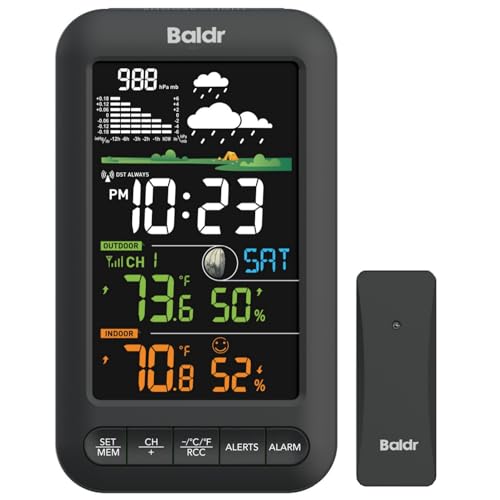
The BALDR station stands out because it runs a local 12-hour forecast algorithm based on real-time barometric pressure trends from its own sensor, so you never need a phone app or internet connection. The vertical color LCD organizes temperature, humidity, and forecast icons in a clean, easy-to-scan layout, and the front-facing controls make adjusting settings quick. It supports up to three remote sensors, letting you monitor the garage, basement, and nursery from one console.
The AC adapter keeps the display and adjustable backlight on permanently, while battery backup preserves settings during outages — the backlight automatically shuts off after ten seconds in battery mode to save power. The optional atomic clock sets itself and includes a snooze alarm, adding bedside-friendly functionality. Users note the sensor must be placed in a sheltered area, as direct rain exposure can distort the humidity reading.
Accuracy is high out of the box, with several owners reporting that the temperature and pressure readings match local stations within a degree. The ability to rotate through sensor data automatically avoids manual switching, making this a near-set-and-forget solution for daily pressure trend tracking.
Why it’s great
- 12-hour forecast derived from local barometric pressure trends
- Vertical color display with auto-rotating sensor data
- AC powered with battery backup and adjustable brightness
Good to know
- Outdoor sensor requires a shaded, rain-protected spot
- Red indoor temperature digits can be hard to read from six feet away
2. SensorPush HTP.xw Smart Temperature Sensor

The SensorPush HTP.xw is a tiny, Bluetooth-enabled sensor that measures temperature, humidity, barometric pressure, heat index, dew point, and VPD — all streamed to your phone via an app that logs data 24/7. Setup takes seconds, and the CR2477 battery lasts up to three years under typical conditions. The unit records 30 days of onboard data, and when combined with the optional G1 Wi-Fi gateway, you get remote access and unlimited cloud storage for exportable .csv history.
Accuracy is exceptional: multiple units consistently read within 0.02 percent relative humidity and 0.1°F temperature of each other. Users have deployed these sensors inside freezers, greenhouses, cigar humidors, and attics, with Bluetooth penetrating steel walls and 25-foot distances. The app provides customizable alert thresholds — push notifications for freeze conditions or high humidity spikes — and displays historical graphs by the hour, day, or month.
Because it lacks a built-in screen, the SensorPush is not for passive glancing across the room. It shines when you want detailed pressure trend analysis on your phone or computer, with data exportable for scientific or agricultural use. The splash-resistant design and broad operating range (from sub-freezing to 140°F) make it the most versatile pressure monitoring tool in this list.
Why it’s great
- Professional-grade accuracy with 0.1°F precision
- 30-day onboard data logging + unlimited cloud with gateway
- Custom alerts for pressure, temperature, and humidity thresholds
Good to know
- No built-in display — requires phone or gateway to read
- Battery life drops in extremely cold environments without adapter pack
3. AcuRite Notos (3-in-1) 01604M Pro Color Digital Weather Station

The AcuRite Notos packs a full weather station into a surprisingly affordable package, combining temperature, humidity, wind speed, and barometric pressure into one illuminated color display. The remote 3-in-1 sensor mounts outdoors and transmits updated wind speed readings every 18 seconds, while the console tracks daily and all-time highs and lows. Barometric pressure trends are displayed alongside moon phase, giving you a clear picture of changing weather systems without an app.
AC power keeps the backlight and display running permanently, with a dimmer adjustment for nighttime viewing. When on battery backup, the backlight dims significantly — a trade-off for portability. The sensor’s battery life stretches to nearly two years (17,500 hours), and users report reliable performance through winds up to 40 MPH after multiple years of service. The outdoor sensor includes mounting hardware for a pole or flat surface.
Several owners note that the viewing angle is narrow — numbers can wash out unless you are standing directly in front of the display. The lack of a wall-mount option for the console (it ships with a tabletop stand) and the sensor’s tendency to underreport peak wind gusts are minor compromises. Still, for combining wind speed data with pressure tracking at this price, the Notos is hard to beat.
Why it’s great
- Combines wind speed, barometric pressure, and moon phase
- Sensor updates every 18 seconds with 2-year battery life
- AC-powered with adjustable backlight dimmer
Good to know
- Narrow viewing angle — numbers fade unless viewed straight-on
- Console lacks a wall-mount bracket for permanent installation
4. La Crosse Technology S77925-INT Wireless Color Weather Station

The La Crosse S77925-INT features a colorful, uncluttered LCD that makes barometric pressure history immediately digestible via a 24-hour trend graph. Dynamic forecast icons with tendency arrows show whether pressure is rising, falling, or steady, and custom alerts can be set for high and low temperature and humidity on both indoor and outdoor channels. The atomic clock self-sets via WWVB radio signal, automatically adjusts for Daylight Savings Time, and includes a crescendo alarm with a 10-minute snooze.
AC power keeps the backlight on with adjustable brightness settings; on battery backup, the power-saving feature illuminates only the LCD segments. The included TX141TH-B sensor transmits at 433 MHz and pairs instantly — several reviewers noted the remote connected faster than previous units. The display is designed to be wall-mounted vertically, and when placed at or slightly below eye level, the colors remain vibrant and legible from across the room.
At wider viewing angles, the color LCD can appear washed out, with the background taking on an orange or green tint. The brightness adjustment also dims the numerical values, so finding the optimal setting for a bright room may take some trial and error. For those wanting a visually appealing, feature-rich station that highlights pressure trends, the S77925-INT delivers a polished experience.
Why it’s great
- Vibrant color display with 24-hour barometric pressure history graph
- Atomic self-set clock with DST auto-reset
- Custom temperature/humidity alerts for indoor and outdoor
Good to know
- Display legibility drops at wider viewing angles
- Brightness adjustment also dims the numerical readouts
5. Ambient Weather BA212 Wall Mounted Weather Station

The Ambient Weather BA212 is a traditional liquid storm glass barometer housed in a warm cherry wood frame, designed to be both a functional instrument and a piece of wall art. The sealed glass body is half-filled with water, and a narrow spout rises above the water line: when atmospheric pressure drops, the water level in the spout rises, indicating stormy weather ahead; when pressure rises, the water level falls. It includes a comfortmeter with temperature and humidity dials to round out the display.
Setup requires filling the glass with water mixed with red dye (instructions provided), and the unit must be manually calibrated against your local barometric pressure reading. Because it’s a liquid column, there are no batteries or electronics involved — response time depends on the pressure gradient, and the barometer works best as a visual trend indicator rather than a precise numeric instrument. The cherry wood finish and classic design draw frequent compliments, making it a natural conversation starter.
Owners report that the provided mounting screws may be undersized for the drip cup and wall anchor, and the markings on the glass offer broad pressure zones rather than specific millibar values. The unit requires an initial filling procedure that can be tricky, but once set, it reliably shows pressure changes — several users noted the water level rose noticeably before an actual rain event. It is a decorative tool for those who appreciate analog craftsmanship over digital precision.
Why it’s great
- Classic liquid storm glass in rich cherry wood finish
- No batteries or electronics — always ready
- Functions as decorative wall art while tracking pressure trends
Good to know
- Filling and manual calibration required before first use
- No precise numeric pressure readout — trend indicator only
6. Lily’s Home Analog Weather Station with Galileo Thermometer
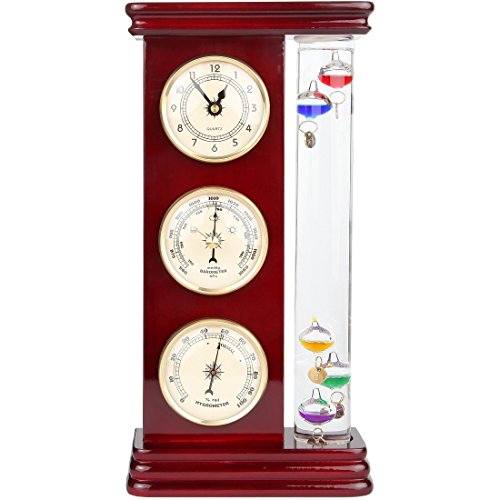
The Lily’s Home station combines a Galileo thermometer, an aneroid barometer, a hygrometer, and a precision quartz clock into one elegant wood-and-gold display unit. The Galileo thermometer uses five multi-colored glass spheres that float or sink based on ambient temperature — a visualization of density changes that doubles as a science lesson. The barometer measures pressure via a sealed metal bellows that moves a needle across an analog face, and the hygrometer tracks relative humidity with a similar dial.
The analog barometer requires a light tap on the glass to overcome mechanical friction before the needle settles on the current pressure reading — a quirk of all aneroid barometers that new users should be aware of. The unit stands on a desk or shelf (no wall mount), and the glossy wood finish with gold accents complements traditional or Victorian-style decor. A single battery powers the quartz clock, which must be installed via a rear compartment.
Some owners report that the barometer’s directional instructions are minimal and that the perceived build quality doesn’t match the price of a precision instrument. The Galileo thermometer is visually engaging but lacks the precision of a digital sensor. For a combined decorative set that offers a general sense of temperature, pressure, and humidity without needing a power outlet, this is an excellent gift option.
Why it’s great
- Combines Galileo thermometer, barometer, hygrometer, and clock
- Elegant wood-and-gold design for home decor
- No AC power required for pressure and temperature reading
Good to know
- Barometer requires a tap to read accurately due to mechanical friction
- Battery compartment screw may be stripped on some units
7. La Crosse Technology 308-1417BL Backlight Wireless Forecast Station
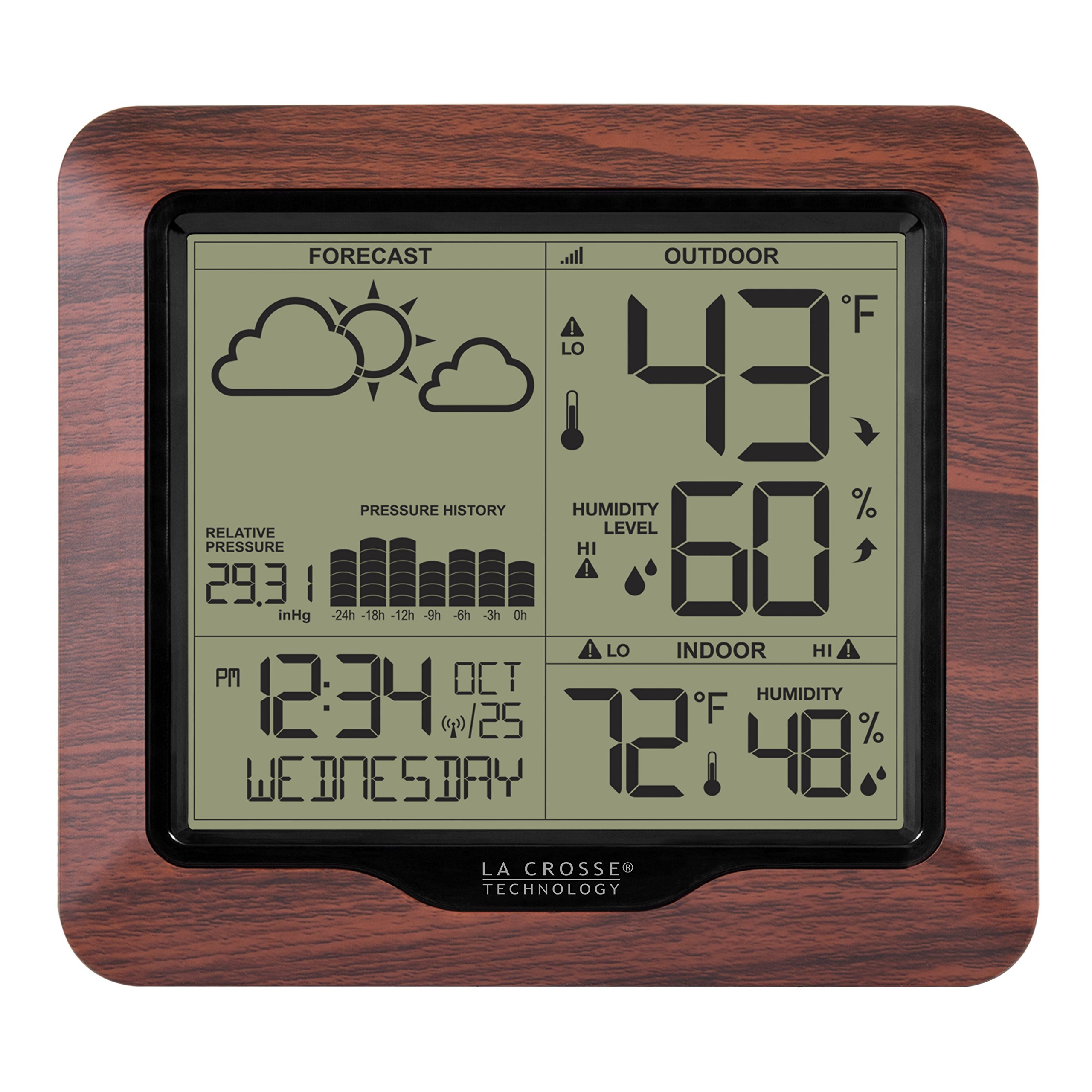
The La Crosse 308-1417BL is a no-nonsense digital forecast station that keeps the focus on barometric pressure history, displaying a 24-hour graph alongside dynamic forecast icons and tendency indicators. It tracks indoor/outdoor temperature (in °F or °C) and humidity (%RH), and stores high and low recorded values. The atomic clock self-sets the time and date via WWVB reception with seven USA time zones and automatic DST reset.
The display is a standard LCD with an AC-powered constant backlight; when running on batteries alone, the backlight operates in HI/LO/OFF mode on demand to conserve power. The included remote temperature/humidity sensor transmits at 915 MHz and can be wall-mounted in a shaded location. Setup is straightforward: plug in the power adapter, insert backup batteries, and sync the sensor — no app required.
Customers note that the LCD viewing angle is narrow — the numbers disappear if you view the station from the side — and the backlight in its brightest setting can wash out the digits in a dark room. A few units experienced sensor failure after 3–4 years of continuous use. For a budget-friendly station that delivers actual barometric history data rather than just a forecast icon, the 308-1417BL is a capable entry point.
Why it’s great
- 24-hour barometric pressure history graph at an entry-level price
- Atomic self-set clock with automatic DST adjustment
- AC-powered constant backlight for 24/7 visibility
Good to know
- LCD requires a precise viewing angle — disappears off-axis
- Sensor life reported at 3–4 years for some units
FAQ
How do I calibrate an analog barometer for my elevation?
Why does my digital station need 7 to 10 days to calibrate the forecast?
Can I use a barometric pressure gauge inside a humidor or greenhouse?
What is the difference between relative and absolute barometric pressure?
Final Thoughts: The Verdict
For most users, the best barometric pressure gauge winner is the BALDR Wireless Weather Station because it combines a clear color display, a 12-hour local forecast derived from pressure trends, and expandable sensor support — all at a price that undercuts most competitors. If you want app-based remote monitoring with 30-day data logging, grab the SensorPush HTP.xw. And for a blend of wind speed tracking and pressure history on a single illuminated screen, nothing beats the AcuRite Notos 01604M.