
Our readers keep the lights on and my morning glass full of iced black tea. As an Amazon Associate, I earn from qualifying purchases.
Specs are compiled from manufacturer listings and verified buyer reviews and can change over time — please confirm the key details on the product page before buying.
If you are hauling a catcher’s set, four bats, cleats and a helmet across a gravel parking lot, a wheeled bag with 4-inch wheels and a telescoping handle saves your shoulder on the walk from the parking lot to the dugout. The short answer: buy a bag with big wheels, a telescoping handle and a real shoe compartment — because a bag that sinks in dirt or tips when you let go of the handle ends up carried by hand.
I’m Min — the founder and writer behind Gadgets Feed. This guide is built by comparing the manufacturers’ published specifications and the patterns across verified customer reviews, so you get each pick’s real strengths and trade-offs instead of marketing spin.
Wheels only help when the base is rigid and the handle reaches your player’s height, so check wheel diameter, liters and handle length before you buy. This breakdown of the best baseball bags with wheels covers wheel size, real capacity, and who each bag actually suits.
Our Picks at a Glance
How To Choose The Best Baseball Bags With Wheels
Most buyers pick a wheeled bag by color and pocket count, then discover on the first away game that the wheels bog down in infield dirt. Three specs decide whether a wheeled bag works: wheel diameter, usable liters, and handle height for your player.
Wheel Size and Ground Clearance
Wheels under 3 inches catch on gravel and curb edges; 4-inch wheels roll over them. The 40% larger wheels on the Boombah Rolling Superpack measure nearly 4 inches wide, and Boombah says they lift the bottom of the bag more than half an inch higher off the ground to stop it scraping on dirt and gravel. Look for a molded or reinforced base too, since a soft bottom is what lets a full bag slump and drag.
Capacity: Liters, Bat Sleeves and Catcher’s Sets
A catcher’s helmet, mask, chest protector and shin guards need 56 liters or more. Two numbers tell you the real story: total liters and how many bats the sleeves hold. A 56-liter or 60-liter bag with a dedicated helmet compartment fits most youth sets, while 37-liter bags suit a position player with a bat, glove and cleats. If you catch, buy a bag with a dedicated helmet compartment rather than one large main pocket.
Handle Height and Fence Hooks
A telescoping handle that only extends to adult height leaves a nine-year-old dragging the bag on one wheel. Boombah solves this with a second, shorter handle position that sits 4 inches below the standard fully extended length, aimed at younger players. Fence hooks matter just as much: they keep a heavy bag off wet grass and out of the way in the dugout, and reinforced J-hooks survive a season of hanging.
Quick Comparison
| Model | Best For | Capacity | Bat Sleeves | Material | Amazon |
|---|---|---|---|---|---|
| Boombah Rolling Superpack★ Best Overall | All-round team bag | — | 4 bats | Heavy duty fabric | Amazon |
| GOBUROS Rolling BagBudget Champion | Budget gear hauler | 4 bat load | 4 bats, 34 in max | 600D Nylon | Amazon |
| AUROTIER Rolling BackpackBest on Rough Ground | Catchers on rough ground | 56 liters | 4 bats | Polyester / PVC panel | Amazon |
| Champion Sports Wheeled Bag | Team and travel gear | — | — | Nylon Ripstop | Amazon |
| Rawlings YADI Catcher’s Bag | Full catcher’s sets | 37 liters | 4 bats | — | Amazon |
| KAVIGOR Rolling Bag | Youth players | 60 liters | 4 bats | 900D Oxford cloth | Amazon |
| Boombah Superpack Hybrid | Rolling or backpack carry | 4 bat load | 4 bats | Polyester | Amazon |
| PowerNet Odyssey | Travel ball families | — | 4 bats | Heavy Duty Fabric | Amazon |
| PowerNet Optimus Catcher’s Bag | Serious catchers | 8 compartments | 7 bats | Heavy Duty Fabric | Amazon |
In‑Depth Reviews
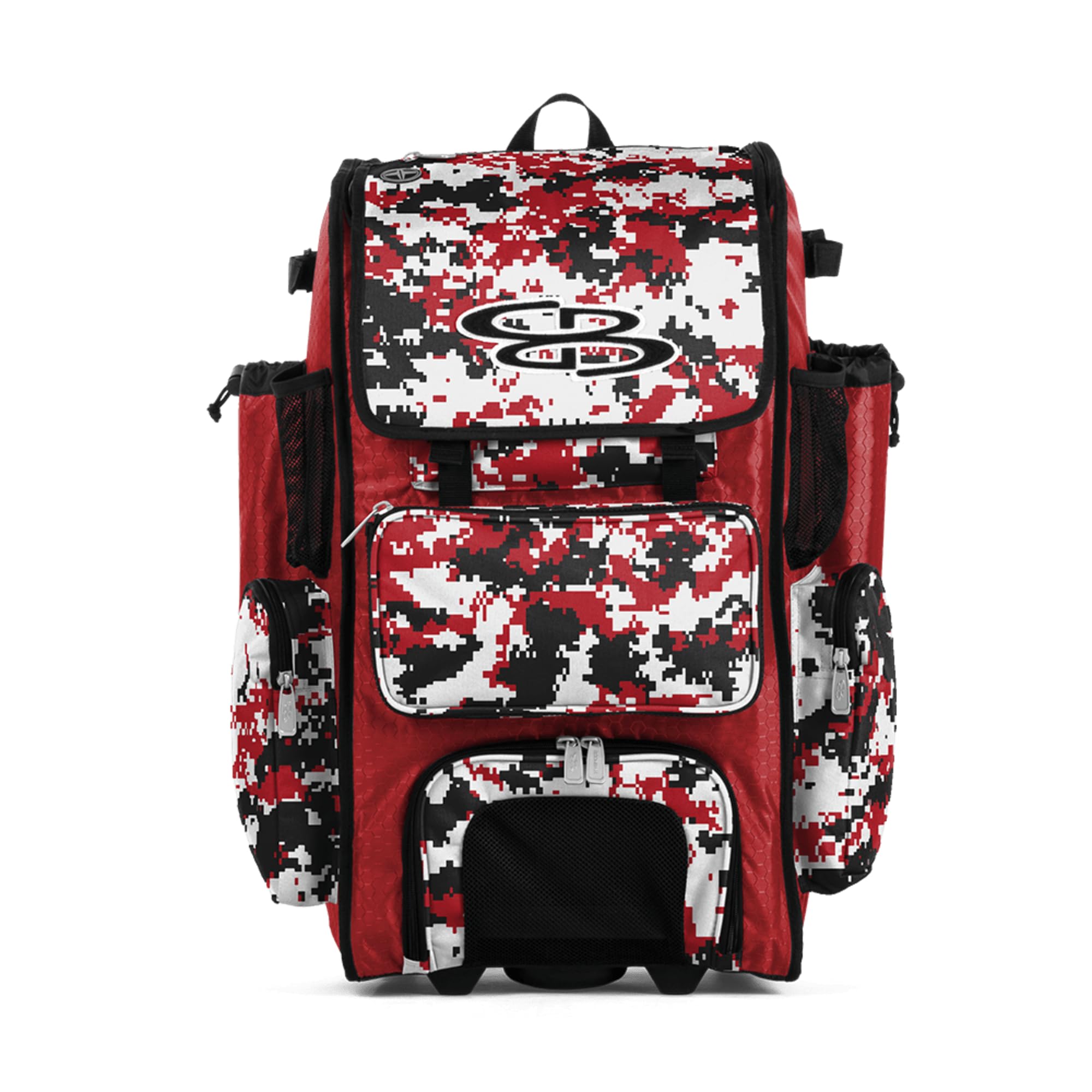
1. Boombah Rolling Superpack Digital Camo Baseball/Softball Gear Bag
Our pick — over 4.5★ from 650+ verified ratings; the strongest balance of quality and price.
The wheeled workhorse that lifts itself over gravel so your catcher never drags it.
Start with the wheels, because they are the whole point of buying a rolling bag. Boombah made these nearly 4 inches wide — the company says they are 40% larger than the previous version — and that extra size raises the bottom of the bag more than half an inch off the ground. On a gravel lot or a dirt infield path, that gap is what keeps the fabric from scraping through.
What wins people over is the build. This bag is the crowd favorite here at 4.8 stars across 600+ ratings, and the pattern behind that score is consistency: a new molded plastic base that stays stiff when the bag is full, heavy-duty zippers and straps, and a shoe compartment that keeps cleat grit away from clean jerseys. It measures 23.5 x 13.5 x 9.5 inches and weighs 7.5 pounds empty, and the telescoping handle includes a second, shorter position 4 inches below full extension — a real difference if a younger player is the one pulling it.
The honest catch is stability when parked. This bag can tip over when it is standing free, which owners work around by clipping the reinforced J-hooks to a chain-link fence so it stays upright. As buyers report: “It does tip over pretty easy but the hooks help keep it upright when secured to a fence.” That is a fair trade for a bag this easy to roll, and it is why the fence hooks matter as much as the wheels.
What earns its keep
- Wheels nearly 4 inches wide lift the base over half an inch off dirt and gravel.
- Molded plastic base stays stiff so a fully loaded bag does not slump.
- Second handle position sits 4 inches lower for younger players.
- Dedicated shoe compartment keeps cleats away from clean gear.
Where it needs care
- Can tip when standing free — plan on hanging it from the fence hooks.
- At 7.5 pounds empty, it is the heavier build in this lineup.
- A few owners mention the bottom mesh folding and wearing over time.
Grab this one: the best all-round wheeled bag for baseball, fastpitch or slowpitch players who haul a bat, gloves, cleats and a helmet to every practice and game.
Plan around: the free-standing tip — if you never hang your bag on a fence, pick a design with a wider wheelbase instead.
2. GOBUROS Rolling Baseball Softball Bag with Wheels for 4 Bats Catchers Bag
Five separate compartments for gear that never seems to fit anywhere else.
The case for this bag is organization on a budget. It splits storage across five compartments — a dedicated helmet pocket, shoe compartment, glove pocket and a large main pocket — so a mask does not end up crushed under a pair of cleats. The bat sleeves hold up to four bats as long as 34 inches, and two interior hooks let you hang the whole thing for quick access.
Owners describe exactly how much fits. As customers note: “Holds at least 3 bats, facemask, 2 gloves, shoes, water bottle etc, more room to spare with lots of pockets.” The zip is a two-way design, the material is sturdy 600D nylon, and the grey shell measures 36.5 x 12 x 12 inches — long enough to lay bats flat along the base.
Here is the trade-off to weigh honestly: this bag rolls well on pavement but gets shaky on grass or dirt, and the catcher-specific crowd finds it snug once a full set of gear goes in. If your player is a position player carrying a couple of bats and cleats, the layout is a bargain. If you catch, the tighter fit and thinner base may leave you wanting the AUROTIER or Rawlings instead.
The layout story: every piece of gear has a named pocket, which is why this bag appeals to families tired of digging for a single glove at the bottom of one big sack.
What to expect in week one: the wheels and extendable handle make loading and unloading the car simple, but expect the bag to wobble a little once it crosses from sidewalk to infield.
Smart pick if: you want real compartmentalized gear storage without moving into the premium tier, and your player is not hauling a full catcher’s set.
Look past it if: you need a bag that holds the line on bumpy ground or swallows shin guards and a chest protector with room left over.
3. AUROTIER Rolling Baseball Backpack with Off-road Wheels
Steel-bearing wheels and a rigid back panel for players who cross real dirt.
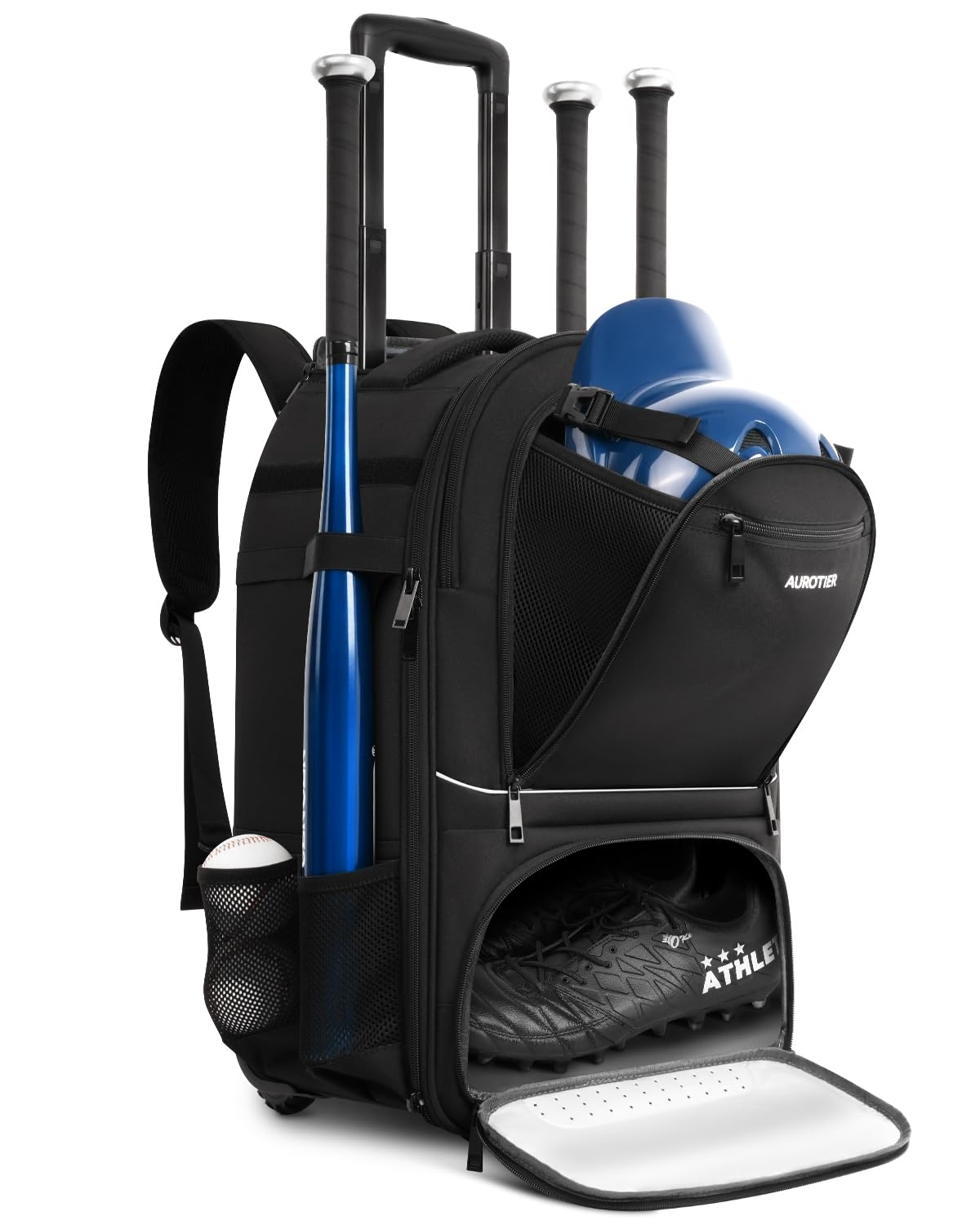
Most wheeled bags in this tier use plain plastic wheels that chatter on anything but pavement. AUROTIER fits steel bearing off-road wheels with a large ground clearance, so grass, sand and parking-lot gravel do not stop the roll. The back is a sturdy PVC panel for rigidity, and the waterproof bottom wipes clean after a wet morning at the field.
Inside, this is a catcher’s bag first. It holds 56 liters across four compartments, with a dedicated helmet compartment, a breathable shoe compartment to cut dust, four elastic mesh sleeves for bats and water bottles, and a dry/wet separation pocket for clean clothes or frozen drinks. At 6 pounds empty it is lighter than the Superpack above, and reflective stripes on the shoulder straps add visibility in low light.
The one thing buyers notice is what is missing: this version does not include its own backpack straps, so the wheels and telescoping handle do the hauling. That is fine for most players, but if you wanted a bag you can also wear on your back, the Boombah Hybrid or PowerNet Odyssey covers that need better.
Built for the walk in: the combination of bearing wheels, PVC back panel and waterproof base is the grounded, no-surprises shape a travel-ball family wants.
Fine print to know: a hidden fence hook raises the bag off wet grass and out of the dugout path, and the front hook-and-loop flap is there for a pitcher’s glove.
Best match: catchers and travel-ball players who drag a heavy load over grass, sand and gravel and want wheels that keep rolling.
Not the one: if a shoulder-carry option is non-negotiable for you, because this bag rolls and pulls but does not strap to your back.
4. Champion Sports Wheeled Equipment Bag

A team-sized rolling bag that swallows catcher’s gear and keeps going.
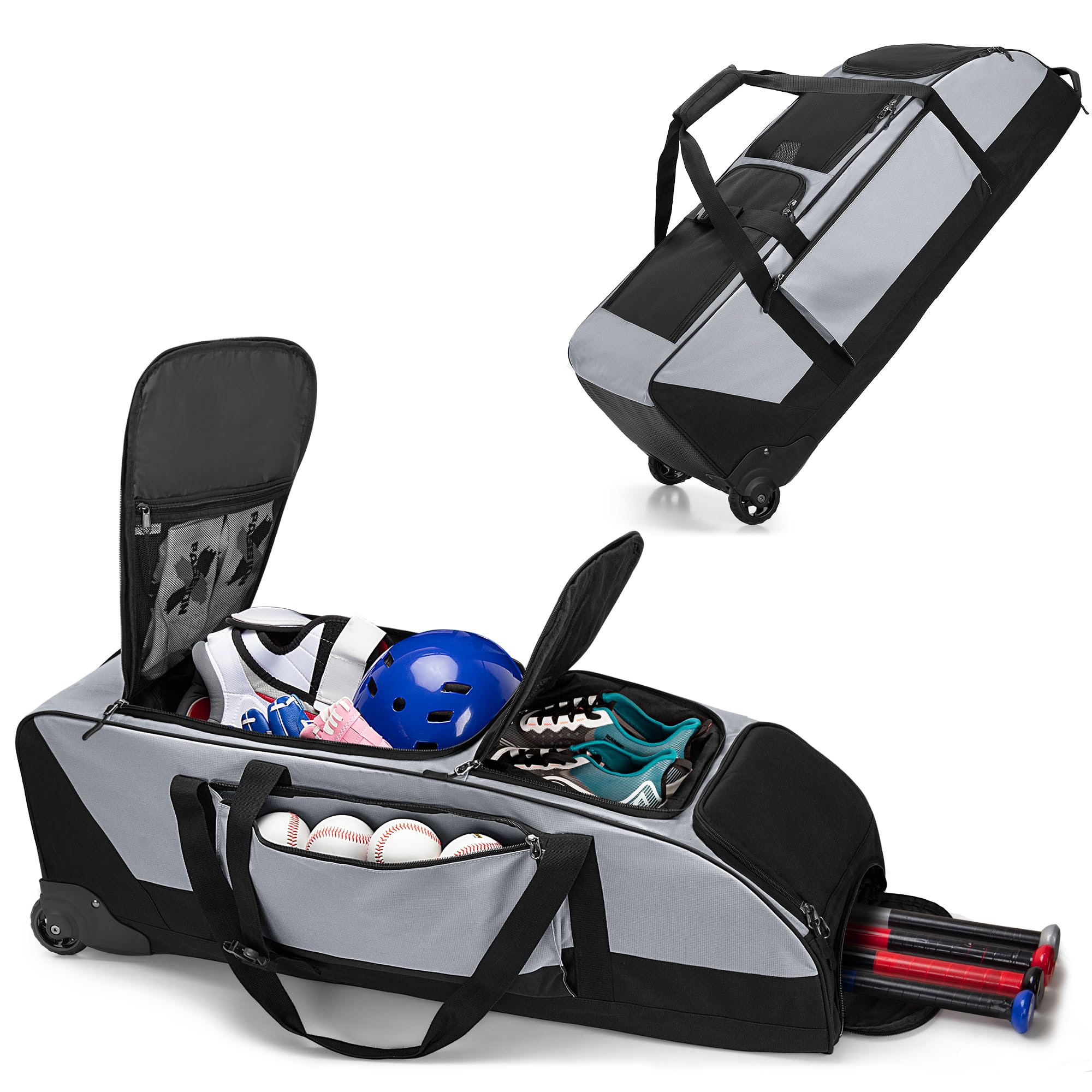
This is not a bat bag with a few extra pockets — it is a rolling equipment hauler built for team gear. The main compartment measures 37 x 19 x 16 inches, and owners pack it out with a full catcher’s set, several helmets and even practice bases. It is also built with tough ripstop nylon, held at wide web handles, and rolls on a durable wheel design that takes the lifting out of moving heavy equipment.
On count, size is what owners notice first, and the mobility runs a close second: reviewers point out it handles 72 lbs of equipment easily, which is the kind of load no shoulder strap should carry. The multi-sport angle is real too — it takes baseball, football, basketball, soccer and hockey gear, so one bag covers the whole family’s seasons.
The honest note is the wheels. While most owners find this bag durable for the long haul, a handful report wheel trouble within the first month of hard use, so treat a fully loaded bag gently over curbs. Metal spikes are the other one to watch — cleats can cut into the interior fabric if you toss them loose instead of using a compartment.
The capacity read: at 37 x 19 x 16 inches, this bag has more raw volume than a standard bat pack, which is exactly the point when you are the team parent carrying half the roster’s gear.
Load it smart: use the side pockets for flat items like scorebooks and leave the main compartment for bulky catcher gear, so the bag keeps its shape as it rolls.
Right for you if: you are hauling team equipment or a catcher’s full set and want a rolling bag with room to spare for helmets, bases and overflow gear.
Rethink it if: you want a lightweight bag for one player’s bat and glove — the size is overkill, and the trade-off is a bulkier bag on curbs.
5. Rawlings YADI Wheeled Catcher’s Bag

The catcher-first bag that starts from a full set of gear and works backward.
For a catcher, the question is never whether a bag is spacious — it is whether the set actually drops in without a fight. This Rawlings bag answers that with an XL main compartment built for a full catcher’s set, four bats and exterior pockets that keep valuables away from muddy gear. It measures 37 x 14 x 14 inches and rolls on large rugged wheels over a reinforced support base, pulled by a telescopic handle.
The claim holds up in real use. Shoppers say it fitting two sets of gear for a team, and reviews routinely call it the bag that finally holds everything a catcher hauls. One 10-year-old catcher got a whole season out of it, and it still swallows the full set with room to spare — the kind of simple, huge answer that makes youth catchers stop trading gear between bags.
The trade-off is fit for grown players. Its 37-liter interior is generous for youth gear but tighter on larger adult sets, and a few owners mention the zippers wanting care over a season. Treat the pulls gently, and this bag gives a serious catcher a lot of seasons.
Why catchers like it: the XL main compartment is shaped for a mask, helmet, chest protector and shin guards, with exterior pockets for the smaller items you want within reach.
One honest limitation: with 37 liters of space, this is a catcher-focused bag rather than a team hauler, and a bigger adult set can feel snug.
Suits a happy catcher: a youth or travel catcher who needs a bag built around the full set, with wheels and a pull handle to spare their shoulders.
Another route may fit better if: you want a big open space for multiple players’ gear or a backpack-carry option — this bag stays dedicated to one catcher’s load.
6. KAVIGOR Rolling Baseball Bag with Wheels, 60L Capacity
A 60-liter youth bag that keeps its footing when it is fully loaded.
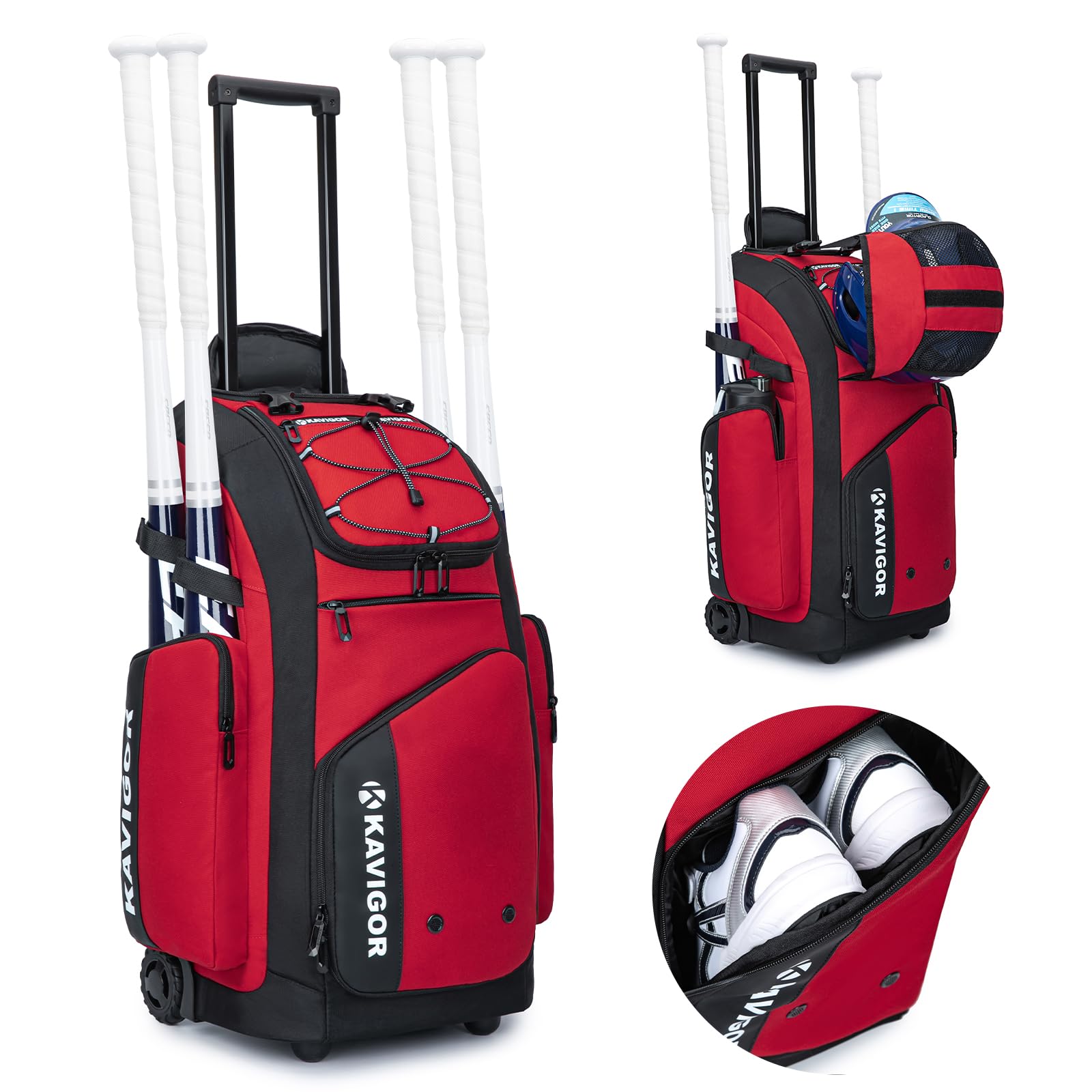
Two details make this bag stand out for young players. The extendable handle reaches up to 37 inches so it adjusts to different heights, and a sturdy aluminum dual-pull design with bottom support is built to prevent tipping and shaking even when the bag is full. That is the exact problem with youth bags — a light kid pulling a heavy, tippy sack one wheel at a time.
It carries 60 liters across three compartments, holds four bats plus two gloves, shoes, helmet, face mask and clothing, and hides the helmet in an exterior compartment to free up internal space. The shell is tear-resistant 900D Oxford cloth with sponge padding and a water-resistant finish, and the two oversized side pockets take 1500 ml water bottles. The main body measures 25 x 14 x 10.5 inches, while the hidden helmet pocket adds the usual storage area.
The catch is helmet access. Because the helmet lives in the external compartment, you have to lift it off before you can reach inside the main bag. It is a small extra step, and if putting the helmet on last works for your routine, the space it saves is worth it.
The reason it sells
- Extendable handle reaches up to 37 inches to fit younger players.
- Aluminum dual-pull handle with bottom support fights tipping when full.
- 60 liters across three compartments, with a hidden exterior helmet pocket.
- All-terrain wheels and tear-resistant 900D Oxford cloth.
Before you commit
- You must remove the helmet to open the main compartment.
- Three compartments is fewer dividers than some multi-pocket rivals.
- Best for youth gear — a full adult catcher’s set will feel tight.
Buy this for: a young baseball or softball player who needs a bag that stays upright while they learn to haul their own gear.
Skip the trade-off if: you want one big open compartment with no helmet-lifting step — a single-pocket team bag will suit that routine better.
7. Boombah Superpack Hybrid Rolling Bat Bag
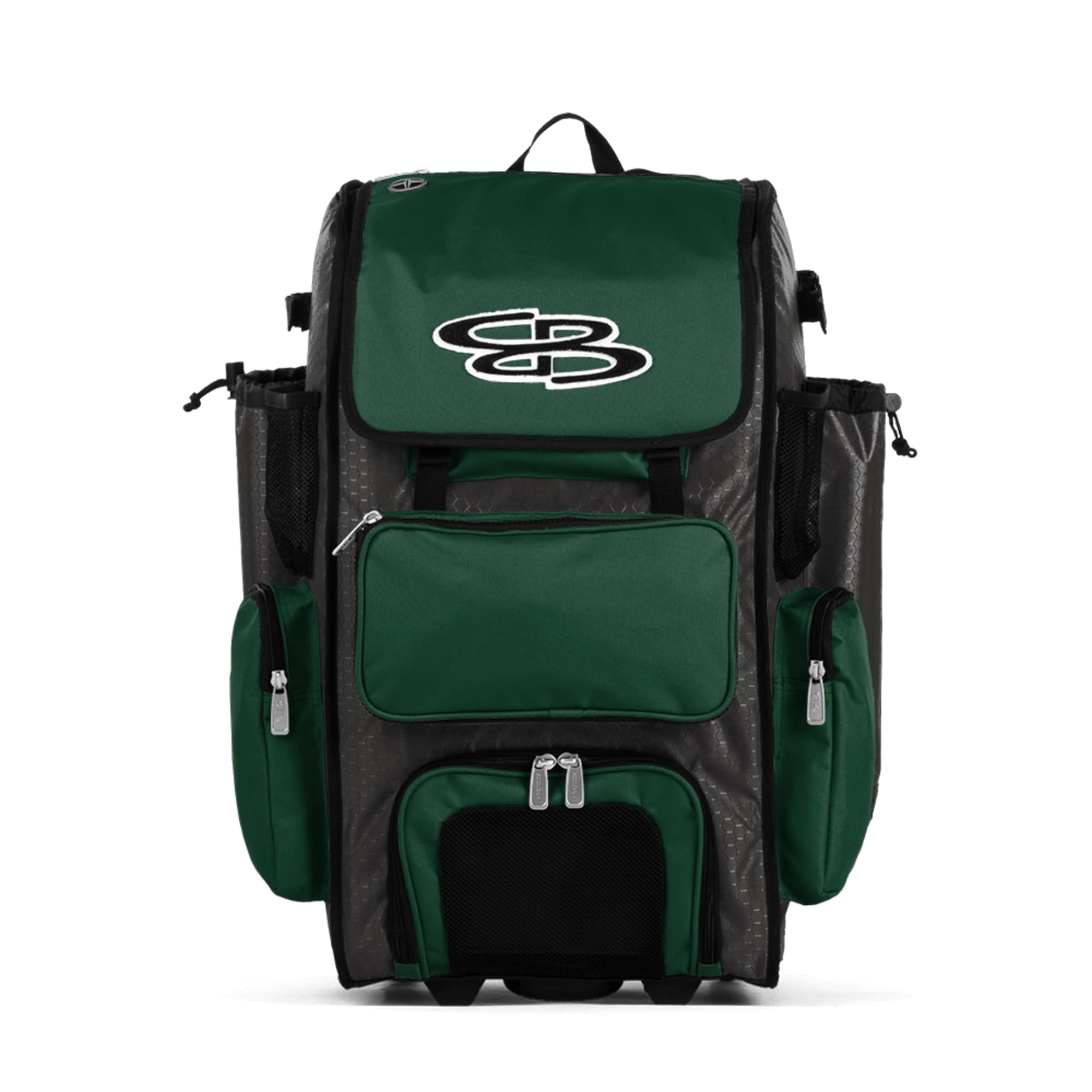
One bag that rolls through the lot and rides your back up the bleachers.
The hybrid idea is simple: same bat bag, two ways to carry it. Heavy-duty wheels and a telescopic handle do the ground work, hidden straps turn it into a backpack when the path turns to stairs or stands, and reinforced J-hooks hang it on a chain-link fence the moment you reach the dugout. Two side bat compartments hold up to four bats, and a separate shoe compartment keeps cleats apart from the rest of the load.
Size is the thing owners keep naming, alongside the storage. The bag measures 23.5 x 13.5 x 9.5 inches and takes a full bat-and-gloves load with different compartments for everything, and it slides easily into the back of a small SUV. That dual identity is what makes it flexible for families who play at fields with stairs, no parking, or long gravel walks.
Two things to plan for. The bottom is not level, so the bag may not stand on its own without support. And while most owners find the build durable, a few report the straps giving out over a long season, so if you plan to use it mostly as a backpack, keep an eye on the strap stitching. If rolls win out for you anyway, the wheels carry the bag just fine.
Why it earns its price: the rolling-or-backpack choice is real utility, and reinforced J-hooks mean the bag hangs high and clear in the dugout rather than sitting in the dirt.
Handle the one quirk: the uneven base is the trade-off for the hidden backpack straps — lean it against a fence or bench rather than expecting it to free-stand.
Go here if: you want one bag that rolls across a parking lot and converts to a backpack for stairways, bleachers or long paths.
Consider elsewhere if: you need a bag that stands upright on its own at the field or would rather not worry about strap wear.
8. PowerNet Odyssey Softball & Baseball Bag
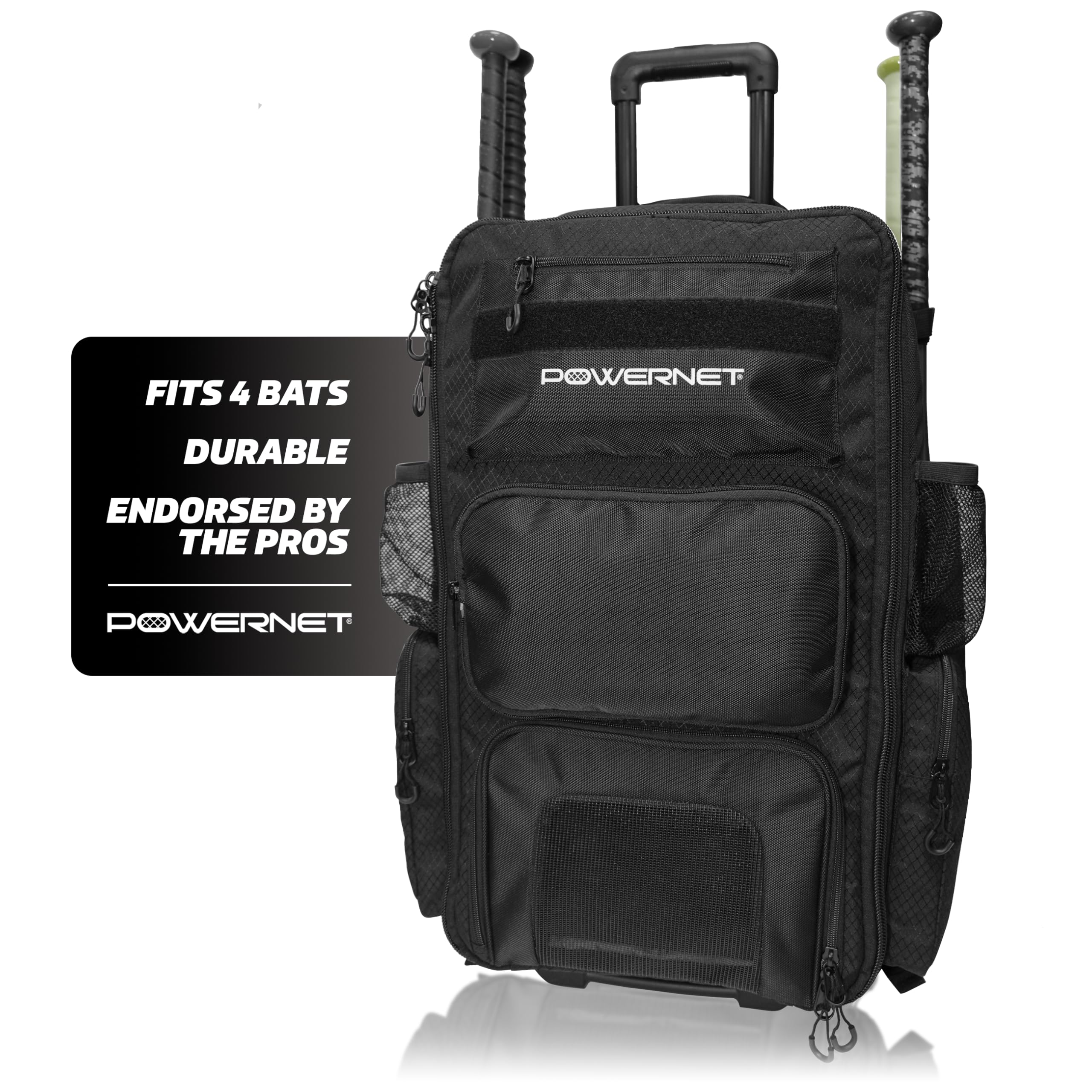
The travel-ball bag with four bat sleeves and hooks that keep it off wet grass.
For families who spend weekends at tournaments, the details that matter are the ones that survive a car trunk, a hotel room and a wet dugout. This bag brings a large main compartment for the full gear load, multiple pockets for batting gloves and valuables, four bat sleeves and a cleat compartment. Heavy-duty hanging hooks lift it off the ground in the dugout, and the telescoping handle plus wheels work with hidden backpack straps when you want to wear it.
Owners are loyal to it. Several describe it as a dependable bag that has run over a year in good condition while holding plenty of gear, with room for cleats and a full season’s wear. The heavy-duty zippers and buckle straps give it the secure, sturdy feel that keeps items in place through a long road trip. It measures 18.5 x 13 x 39 inches.
The one weakness owners name is durability of the soft parts — a few report the bottom of the bat sleeve pockets coming apart over time, so keep the bag from sitting on abrasive surfaces. Load it before traveling, and the rigid frame and heavy-duty zippers carry the weight well.
The travel case: multiple pockets keep small items organized and the hidden backpack straps mean you can carry it on your shoulders when wheeling something else through a crowded field.
One recurring gripe, sized fairly: the bat sleeve bottoms are the soft spot — set the bag down gently rather than tossing it, and it holds up.
The pick for: travel-ball and tournament families who need a bag that rolls, converts to a backpack, and keeps bats and gear organized between games.
Not ideal if: you expect to drag the bag over pavement repeatedly — the soft bat sleeve bottoms are the part to protect.
9. PowerNet Optimus Catcher’s Bag
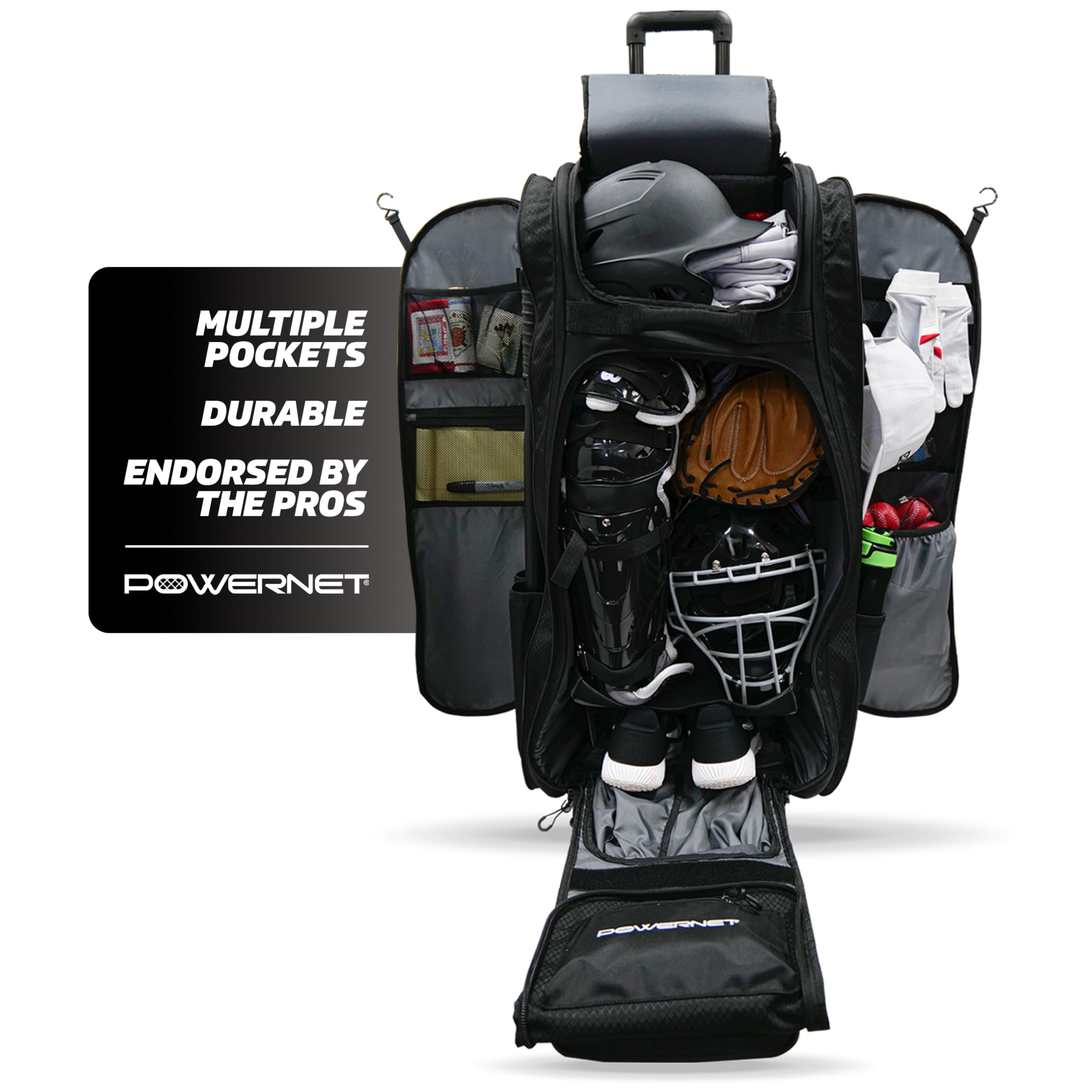
A rolling dugout locker built around eight compartments and seven bat sleeves.
If the Rawlings above is the classic catcher’s bag, this is the organizer’s version of it. The Optimus holds eight compartments, with adjustable shelves, two internal mesh pockets, three accessory hangers and two water bottle holders in the main pocket. Seven internal bat sleeves handle a full bat rotation, felt-lined pockets protect a phone, fabric strips hold batting gloves, and a ventilated cleat compartment lets cleats air out inside the bag instead of stinking up the car.
It also solves the fence problem. Five hidden hanging hooks let you hang the bag on any chain-link fence during games and practice, and support rails on the back reinforce the stress points so a season of hauling does not tear the fabric. Owners describe it as a portable locker that keeps gear off the floor and easy to reach on grass, dirt and sidewalks alike — a full catcher’s set plus bats, gloves and cleats fits without feeling stuffed.
What you pay for is organization, and the one complaint to weigh is the shell’s toughness around the corners. A few owners note the plastic edging could be more sturdy, and one bag picked up a hole in the side after flipping off a curb. Roll it deliberately and it holds its shape for a long run — just do not treat it like a hard travel case.
The organizer’s verdict: adjustable shelves, indoor cleat ventilation, felt-lined phone pockets and five fence hooks make this the most compartment-tuned catcher’s bag here.
Glass-half-empty: the shell around the sides and corners is fabric, not hard plastic, and it is the part most likely to take damage on a curb, so ease it down rather than dropping it.
Worth it for: catchers and coaches who want everything in a labeled spot, from cleats and phone to seven bats, and a bag that hangs high on the fence during the game.
Look at the Rawlings instead if: you want a simpler catcher’s bag with fewer compartments and a lighter structure around the sides.
Understanding the Specs
Capacity (Liters and Compartments)
Capacity tells you how much gear a bag actually takes before it fights back. Liters measure total volume, while compartment count tells you how well that volume is split up. A 60-liter bag with three compartments is more roomy than a 37-liter catcher’s bag, but the smaller bag often keeps a mask and helmet more protected because each has its own dedicated space. Match the liters to your gear: a position player with a bat and glove is fine in the 30s to 40s, while catchers and teams want 56 liters and up — the AUROTIER at 56 liters and the KAVIGOR at 60 liters sit in that range.
Wheel Type and Ground Clearance
Wheel size and clearance decide whether a loaded bag glides or drags on dirt. Larger wheels roll over gravel and grass that swallow smaller ones, and the same width that lifts the bag off the ground also keeps the fabric from scraping through. The Boombah Rolling Superpack’s nearly 4-inch wheels — the company calls them 40% larger than before — raise the base more than half an inch. The AUROTIER goes a step further with steel bearing off-road wheels and large ground clearance. Neither matters as much as a rigid, supported base though: a soft, unsupported bottom is what lets a full bag slump and catch the ground.
FAQ
How many bats does a wheeled baseball bag usually hold?
Will a rolling bag fit a full catcher’s set?
Do wheeled baseball bags roll well on grass and dirt?
What is the benefit of a bag with wheels that also works as a backpack?
How tall does a telescoping handle extend for kids?
Why do some rolling baseball bags tip over when standing?
Do I need a separate shoe or cleat compartment?
Is 60 liters too big for a young player?
Will a wheeled bag fit in a car trunk or SUV?
What material holds up best in a rolling baseball bag?
Final Thoughts: The Verdict
For most players, the baseball bags with wheels winner is the Boombah Rolling Superpack because its nearly 4-inch wheels lift the base over dirt and gravel while a stiff molded base keeps a full load from slumping. If you want a catcher’s bag that fits the whole set and vents your cleats inside, reach for the PowerNet Optimus Catcher’s Bag. And for young players learning to haul their own gear, the KAVIGOR is the one to grab, with its 37-inch extendable handle and steady bottom support made for smaller pullers.
How We Picked
We do not accept paid placement. Every pick is matched to a real buyer and a real use-case; we do not hands-on test units.
Sources & Methodology
Specifications: manufacturer listings and product documentation. Review insights: verified customer reviews, as of September 2026. Pricing: not shown on this page (it changes often); check the current price via the retailer link.
As an Amazon Associate, Gadgets Feed earns from qualifying purchases. This does not affect which products we feature.