
Our readers keep the lights on and my morning glass full of iced black tea. As an Amazon Associate, I earn from qualifying purchases.
Specs are compiled from manufacturer listings and verified buyer reviews and can change over time — please confirm the key details on the product page before buying.
You need live batting practice, but finding someone to throw you 100 pitches every day is nearly impossible. A baseball ball launcher (a machine that automatically tosses or fires balls at you) solves that by giving you consistent, repeatable reps whenever you want — whether you are an 8-year-old working on hand-eye coordination or a high schooler grooving your swing. The trick is picking the right one: some need an electrical outlet, some run on foot pressure, some are built for basics, and others can throw a curveball (a spinning pitch that curves as it approaches the plate). The Junior Hack Attack stands out as the best for serious young athletes because it throws real fastballs, curves, and knuckleballs up to 70+ mph with commercial-grade build quality.
I’m Min — the founder and writer behind Gadgets Feed. This guide is built by comparing the manufacturers’ published specifications and the patterns across verified customer reviews, so you get each pick’s real strengths and trade-offs instead of marketing spin.
These reviews pinpoint the best baseball ball launcher for hitting repetition, fielding drills, and daily training without an extra person on the mound.
Quick Picks
- Junior Hack Attack Baseball Pitching Machine by Sports Attack — Top Performer
- Heater Sports Heavy-Duty Baseball Pitching Machine HTR6000BBC — Best Value
- Franklin Sports Total Pitcher Baseball + Softball Training Aid — Versatile Pick
- MOXOW Sagitta Manual Baseball & Softball Pitching Machine BP55 — Smart Buy
- Louisville Slugger Soft Toss Training System — Tempo Trainer
- Furlihong 691BH Baseball Softball Toss Machine — Dual Sport
- Furlihong 898BH Baseball Soft Toss Machine — Budget Champion
How To Choose The Best Baseball Ball Launcher
Before you buy, think about who is using the machine and where. A foot-operated soft-toss unit (a launcher that lobs the ball at close range) is perfect for a solo batter in the backyard, but a team coach needs something that can throw fastballs, curveballs, and grounders without breaking down. Here are the specs that matter most.
Power Source & Portability
Some launchers are fully manual — you step on a pedal or pull a lever, and a spring or mechanical arm launches the ball. These need no electricity, so you can set them up anywhere. Others use an electric motor or two spinning wheels that grip and fire the ball. Electric machines give you real pitch speed and movement (curves, sliders), but they need an outlet or a generator. Match the power source to where you practice most.
Feeder System & Ball Capacity
A good feeder (a mechanism that drops a new ball into the launcher every few seconds) lets you keep your stance and swing without reaching down. Look for an automatic 12-ball feeder or a caddy (a basket) that holds up to 50 balls. If you are serious about hitting 100 reps a session, a large capacity saves you time between rounds. Some machines include a ball caddy, others let you add extra stackers (extensions that hold more balls).
Speed Range & Pitch Type
The speed you need depends on the batter’s age. For kids 7-12, a machine that tops out around 50-52 mph is plenty. For high school and above, you want a machine that reaches at least 70 mph and can throw different pitches — fastballs, curveballs, sliders. A color-coded speed chart or numbered dial makes it simple to dial in the right velocity.
Build Quality & Stability
A launcher that shakes or walks across the grass after every pitch is a frustration. Look for anti-tilt bars (supports that stop tipping), wide bases, or ground stakes (metal pegs you push into the earth). The machine’s weight also matters: heavier, metal-framed units stay put, while lightweight plastic models may need anchoring. A good warranty (12 months or more) is a solid sign the maker stands behind the build.
Quick Comparison
On smaller screens, swipe sideways to see the full table.
| Model | Best For | Power Source | Max Speed | Weight | Amazon |
|---|---|---|---|---|---|
| Junior Hack Attack | Competitive Youth / Team | Electric (2-wheel) | 70+ MPH | 96 lbs | $2,699.00Amazon |
| Heater Sports HTR6000BBC | Youth League Practice | Electric (1-wheel) | 52 MPH | 42.7 lbs | $453.95Amazon |
| Franklin Sports Total Pitcher | Versatile Backyard Drills | Spring-powered | Adjustable (chart) | 28.3 lbs | $170.00$199.99Amazon |
| MOXOW Sagitta BP55 | Batting & Fielding All-in-One | Manual (mechanical) | 3-speed color guide | 29.5 lbs | $129.99$139.99Amazon |
| Louisville Slugger Soft Toss | Soft-Toss Tempo Work | Manual soft-toss system | Variable interval | 11.7 lbs | $129.99Amazon |
| Furlihong 691BH | Baseball & Softball Switch | Foot-operated | 4 gears | 8.5 lbs | $159.99Amazon |
| Furlihong 898BH | Budget Tee-Ball / Kids | Foot-operated | 3 angles | 5.2 lbs | $69.99Amazon |
In‑Depth Reviews
1. Junior Hack Attack Baseball Pitching Machine by Sports Attack
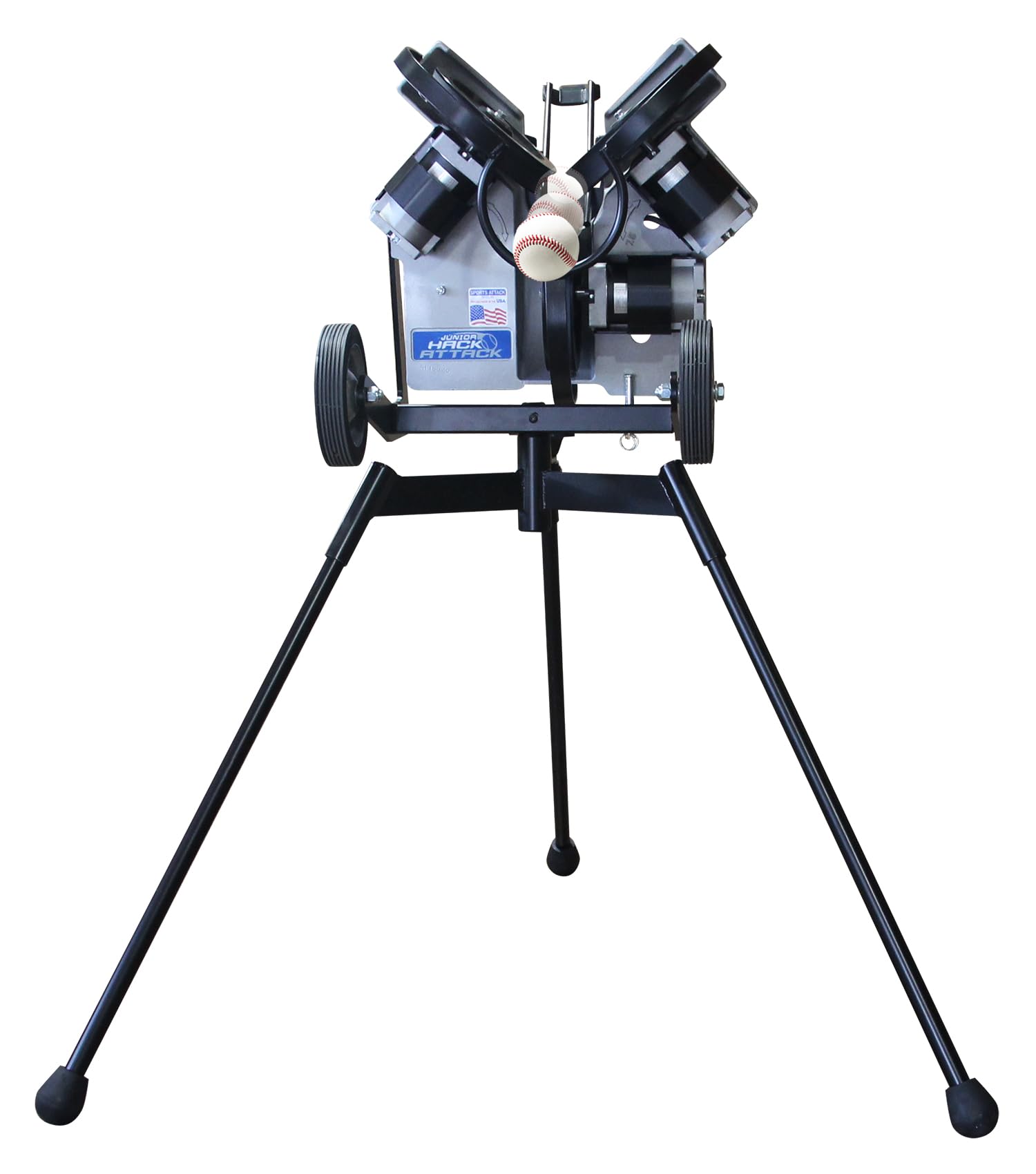
Delivers live rounds of fastballs, curves, and knuckleballs up to 70+ mph — the only machine here that simulates a real pitcher for serious young athletes.
You buy this machine when a soft-toss unit stops challenging your hitter. The Junior Hack Attack uses two spinning wheels to fire balls. Unlike the single-wheel Heater Sports HTR6000BBC, which throws only straight fastballs, this machine can throw fastballs, curveballs, sliders, split fingers (a pitch that dives suddenly), and knuckleballs (a slow, fluttering pitch). You can quickly pivot the throwing head in any direction for ground balls, line drives, or fly balls sailing up to 250 feet — so one machine covers batting practice and full defensive drills.
Buyers report it is surprisingly portable at 96 lbs (about 43.5 kg), with one reviewer noting that one adult can transport it easily and it fits in a car trunk with room to spare. Setup takes under five minutes. The machine runs on a 60W draw, which means a portable power station (a battery generator) can keep it going for eight-plus hours. Owners say it is “commercial quality” and has survived direct hits from 60+ mph baseballs without issue.
The catch: it costs significantly more than every other launcher here, and it is baseball-only — softballs will not fit. For 10U players (ages 10 and under), this is ideal; for 12U and above, you might want the full-size Hack Attack for higher speeds. But if you are coaching a competitive youth team and want a machine that can simulate a live pitcher, this is the gold standard.
Why Coaches Buy This
- Throws multiple pitch types – fastballs, curves, sliders, knuckleballs
- 70+ mph capability for serious youth and high school hitters
- Pivot head for ground balls, line drives, fly balls up to 250 ft
- Extremely portable for its class; fits in a trunk
- 60W draw runs 8+ hours on a portable power station
The Trade-Offs
- Price is a major investment vs. manual launchers
- Compatible with baseballs only; no softball option
- Full-size Hack Attack better for 12U+ players needing higher speeds
Buy for the team: If you coach a competitive 8U-10U group and need a machine that delivers live pitches, this is the one.
Look elsewhere if: Your budget is under or you need softball compatibility.
2. Heater Sports Heavy-Duty Baseball Pitching Machine HTR6000BBC

Gives you consistent, motorized speed from 10 to 52 mph with a 12-ball auto feeder — the closest youth experience to a live pitcher without paying for a two-wheel machine.
Unlike the foot-operated models lower on this list, the Heater HTR6000BBC uses a motor and a single spinning wheel to fire baseballs, meaning you get consistent pitch speed without relying on pedal force. The 0-10 speed control lets you dial in speeds from 10 to 52 mph, and the pivot head adjustment is a simple knob turn for changing between grounders and pop flies. The automatic 12-ball feeder drops a ball every eight seconds, so you can stand in the box and take continuous reps — a major upgrade over single-toss launchers.
Owners mention setup takes under ten minutes, and that the variable speed is ideal for kids aged 7-12 in a 22-26 foot cage (a netted practice tunnel). One buyer called it perfect for the new machine-pitch division. Build quality is solid — the all-metal construction weighs 42.7 pounds, which keeps it planted compared to lighter plastic models. Customers note speeds 1-5 are too slow from 24 feet, but setting 6 and above “mimics all-star play.” At a fraction of the cost of a two-wheel machine, it offers the closest experience to a live pitcher for a youth squad.
The trade-off: the pitching wheel can wear unevenly over time. One unhappy buyer reported it disintegrated within three months, causing 18-inch inaccuracy, and a replacement wheel costs. The feeder also occasionally jams with non-dimpled balls (smooth balls without dimples/grooves), though that improves with use. For the price, it is a strong buy for recreational leagues, but heavy daily use may test the wheel’s durability.
Great For Reps
- Continuous practice with the auto 12-ball feeder (8-second intervals)
- All-metal housing adds stability over plastic alternatives
- Adjustable pivot head for grounders and pop flies
- Speed control from 10 to 52 mph fits 7-12 year olds well
Watch Out For
- Pitching wheel may wear out after months of heavy use ( replacement)
- Feeder can jam with non-dimpled balls initially
- Speeds 1-5 are too slow for a 24-foot distance
- Top speed of 52 mph limits older or advanced hitters
Best for youth leagues: If your team needs consistent, adjustable pitching without the cost of a two-wheel machine, start here.
Pass if: You plan to run 200+ balls daily — the wheel wear may frustrate you.
3. Franklin Sports Total Pitcher Baseball + Softball Training Aid

A spring-loaded arm launches balls with no electricity — just release the mechanism — and a color-coded speed chart makes adjusting velocity simple for backyard drills.
Unlike the pedal-powered soft-toss machines, the Franklin Total Pitcher uses a spring-powered arm that launches balls when you release the mechanism — no batteries, no foot pedal, and no electricity required. It comes with a detachable basket with handles for collecting and carrying balls between reps. The attached color-coded speed chart makes adjustments intuitive, giving you control over pitch velocity for batting practice, grounders, or pop flies. The steel frame and included ground stakes keep the unit stable on grass.
One coach buyer reported the machine reloads in under three seconds and throws consistent pitches 99% of the time. A reviewer said the build quality is solid, with good welds and on-board storage for accessories. It works with baseballs, softballs, and tee balls, making it flexible for families with players in both sports — the Heater HTR6000BBC, by contrast, is baseball-only.
But a few buyers hit quality control issues: one said the plastic throwing arm snapped at the joint after three sessions with standard softballs, and another reported a weld breaking off the arm during first use after about 40 pitches. The 90-day limited warranty is short. If you get a good unit, it is a great multi-purpose training aid; if you get a faulty one, the warranty may not cover much beyond the first season.
Why It Works
- Spring-powered — no electricity or foot pedal needed
- Works with baseballs, softballs, and tee balls
- Detachable basket with handles for easy ball collection
- Color-coded speed chart for quick adjustments
- Steel frame with ground stakes for stability
Heads Up
- Some units had the throwing arm or weld fail early
- 90-day warranty is minimal for the price
- Assembly needed and the arm can feel slow vs. throwing manually
Ideal for families: If you want one machine for baseball and softball practice in the backyard, and you are willing to check quality on arrival, this fits.
Skip if: You need a guaranteed daily driver — the failure reports make it a gamble for intensive use.
4. MOXOW Sagitta Manual Baseball & Softball Pitching Machine BP55
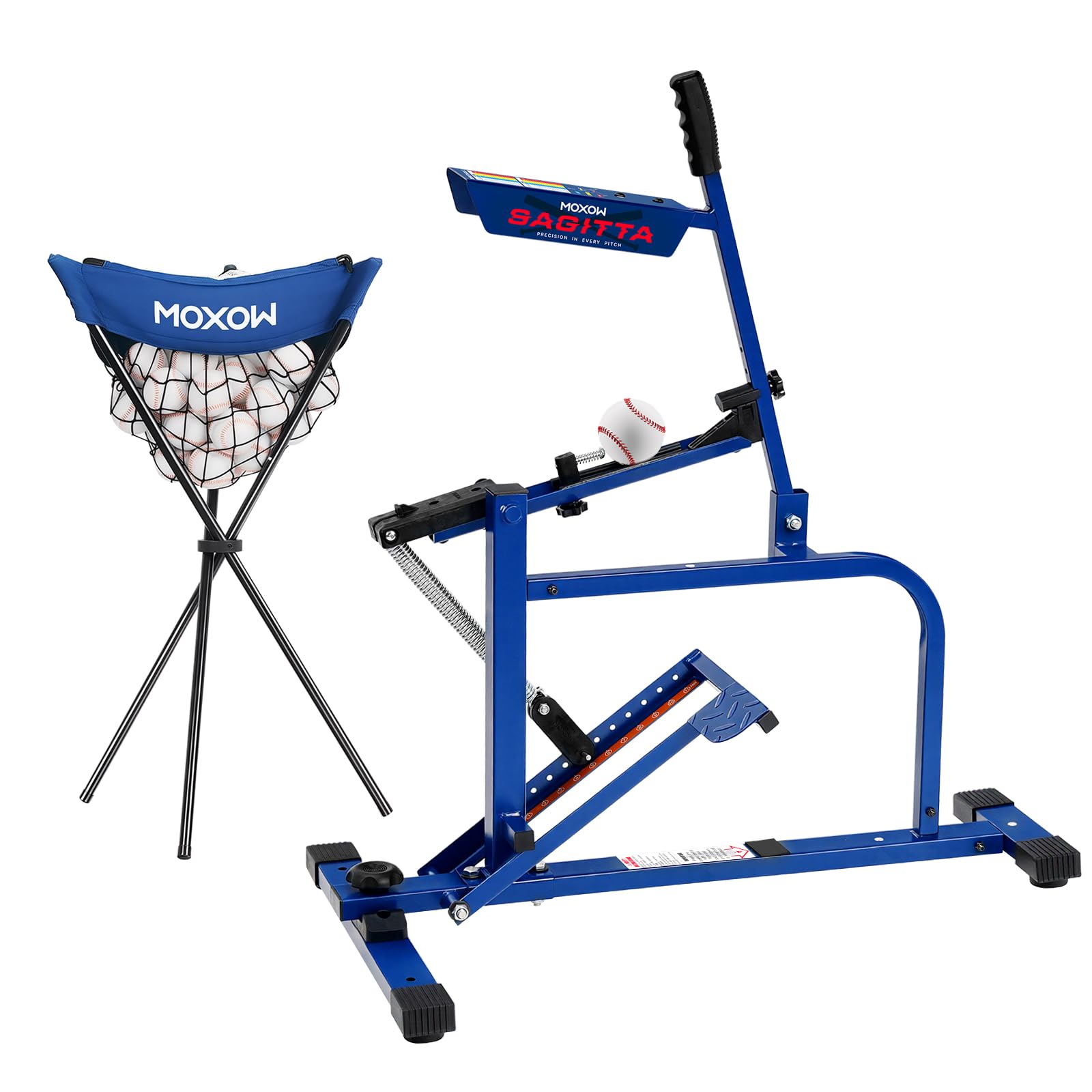
Its 50-ball caddy is the biggest in this list — you run 50 swings without stopping — and the steel frame’s anti-tilt design keeps it stable on grass.
The MOXOW Sagitta is a fully manual pitching machine — no batteries, no electricity, and no motor. You load a ball, set the machine, and it uses a spring mechanism to throw strikes, grounders, and fly balls. Its steel frame includes a dual-purpose beam that doubles as a carrying handle, making it portable despite its 29.5-pound weight. The included ball caddy holds up to 50 baseballs or 30 softballs, which cuts down on the constant shagging between reps. A color-coded speed setting guide helps you quickly dial in the right velocity for the batter’s level. This bigger caddy makes it a better value for volume practice than the Franklin Total Pitcher, which relies on a smaller detachable basket.
Buyers across multiple reviews say the machine is easy to set up, stable, and great for kids — one parent of a 6-year-old called it “excellent for casual youth training.” Another reviewer noted the consistent pitching and the anti-tilt design keep the machine on target. At 13.38 kilograms (29.5 lbs) package weight, it is noticeably heavier than the foot-operated options, which actually helps it stay planted on grass.
The biggest concern is durability: one reviewer noted a broken spring pin after the first use and said MOXOW would not supply a replacement spring, calling it a complete waste of money. The 90-day limited warranty is short. If you get a solid unit, this is a fantastic all-in-one solution with a ball caddy that no other manual launcher here matches. But the quality control gamble is real.
Best Features
- 50-ball caddy saves time collecting and loading balls
- Steel frame with anti-tilt design for stable, accurate pitches
- Color-coded speed guide for quick adjustments
- Throws strikes, grounders, and fly balls for all-around training
- Portable with built-in carrying handle
Watch Out
- Reports of broken spring pin after first use with no replacement available
- Only a 90-day limited warranty
- Not intended for advanced players or high-speed reps
Great for parents: If you want a single machine with a big ball caddy for backyard batting and fielding practice with your kids, this is a smart value.
Pass if: You want a long-term machine — the warranty and build reports suggest it may not survive a full season.
5. Louisville Slugger Soft Toss Training System

A soft-toss system lets you train without a partner and adjust the toss height for different drills.
Unlike a foot-operated launcher, the Louisville Slugger Soft Toss is a soft-toss training system designed to work without a partner. You can adjust the toss height, and the system switches to fielding mode to roll realistic ground balls at short distance. It disassembles quickly and comes with a carry bag for transport. Weighing 11.7 lbs (5.31 kg) versus the Heater Sports HTR6000BBC at 42.7 lbs, it is easier to move around the yard.
Reviewers point out assembly takes 3-5 minutes, and it works with baseballs, softballs, tennis balls, and plastic wiffle balls. One buyer mentioned it is “perfect for kids’ practice without a pitcher.” Another called it the “best baseball practice purchase” they have made. At 5.31 kilograms package weight, it is light enough to move around the yard easily.
The catch: shoppers say the system can struggle after heavy use. The stand can also wobble with heavier softballs, causing occasional misdelivery. And the toss height may be insufficient for tall adults. It works well for light daily practice, but if you are running hundreds of reps every day, durability may become an issue.
Good Points
- Soft-toss training without a foot pedal
- Adjustable toss height for tempo training
- Works with baseballs, softballs, tennis balls, wiffle balls
- Lightweight and packs down with carry bag
- Fielding mode for ground ball practice
Limitations
- Durability may be an issue with heavy-use practice
- Stand wobbles with heavy softballs; less stable than foot-operated units
- Toss height too low for tall adults
Perfect for solo hitters: If you want to set a tempo and take 50-100 swings without a partner, this system delivers.
Avoid if: You need high-volume daily practice (200+ reps) — the motor durability is a known weak point.
6. Furlihong 691BH Baseball Softball Toss Machine
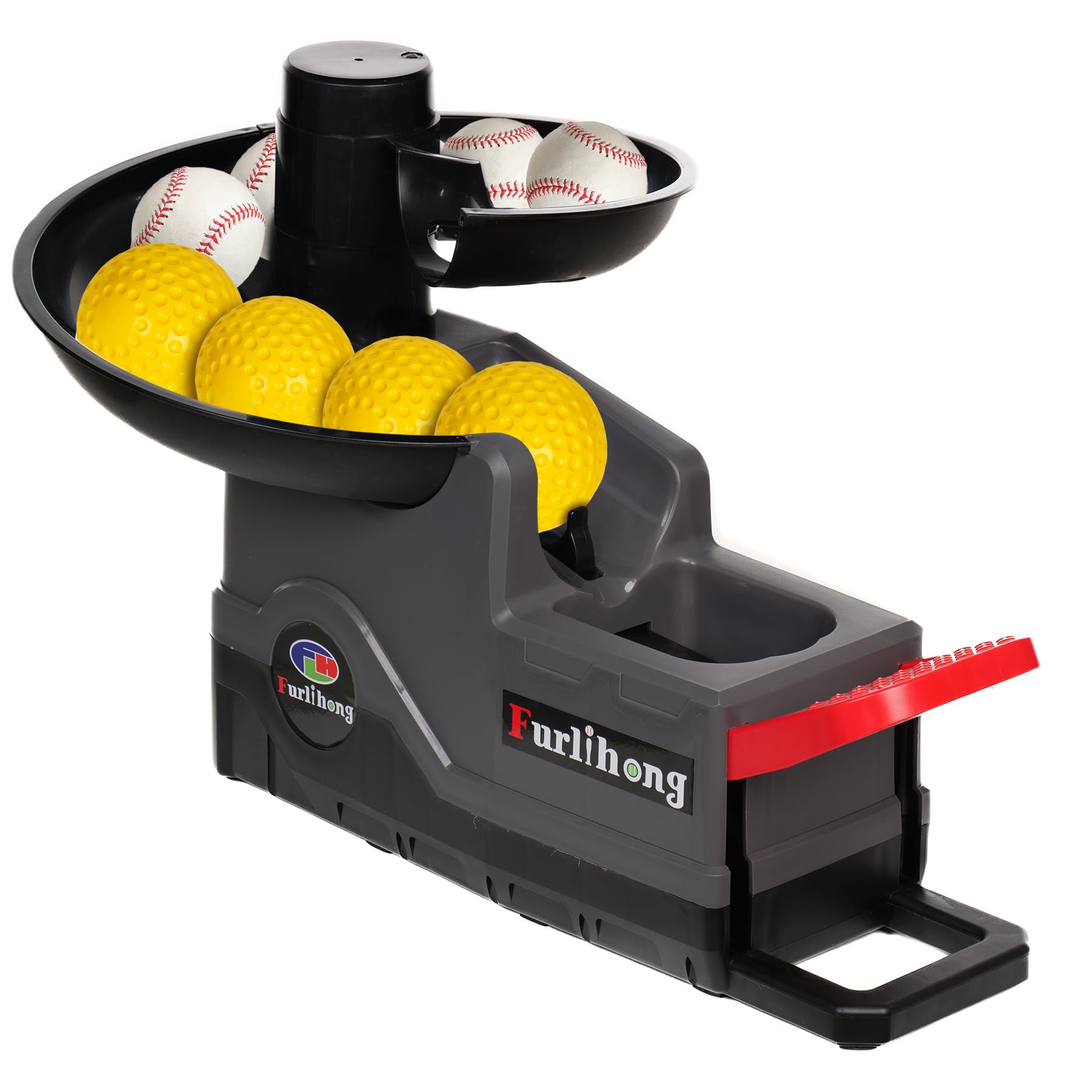
Foot-operated with four speed gears specifically tuned for baseball and softball — the 12-month warranty is the strongest among foot-operated launchers here.
The Furlihong 691BH is the larger sibling of the 898BH, designed to handle both baseballs and softballs with dedicated speed settings. It has four adjustable gears: levels 1 and 2 are optimized for baseball, while levels 3 and 4 are tuned for softball. You step on the red pedal and the ball launches in about five seconds — no batteries or electricity. The package includes two ball chutes, one PU baseball, and one PU softball, so you have everything you need from the first use.
At 3.86 kilograms (8.5 lbs) package weight, it is the heaviest of the foot-operated machines in this list but still light enough to carry around the yard. One owner reported it is great for team practice and kids love it. The 12-month warranty is also much stronger than the 90-day or 180-day covers on other machines here.
The reality from buyers is mixed. One reviewer estimated only about 25% of tosses are actually hittable, with most requiring “circus swings.” Another said the machine is unstable and inconsistent in launch height, distance, and timing, and the foot pedal does not always engage. A third described it as a “fun toy, not serious training.” For the price, the versatility is appealing, but expect unpredictable tosses more often than not — it works better as a family amusement device than a precision training tool.
Why Pick It
- Dedicated speed gears for baseball (1-2) and softball (3-4)
- Includes two ball chutes and one baseball + one softball
- Foot-operated — no power source needed
- 12-month warranty is best in class among foot-operated launchers
Heads Up
- Only ~25% of tosses are hittable per buyer feedback
- Unstable and inconsistent launch height, distance, timing
- Foot pedal may not always engage
- More of a fun toy than a serious training aid
Good for families: If you have kids who play both baseball and softball and want a simple launcher for casual backyard fun, this fits.
Not for serious training: The inconsistency makes it frustrating for developing mechanics or timing.
7. Furlihong 898BH Baseball Soft Toss Machine

Weighs just 2.38 kg (5.2 lbs) — the lightest and cheapest way to start a young hitter on soft toss with no electricity needed.
The Furlihong 898BH is the simplest entry point in this list: you step on the paddle, release it, and wait about six seconds for the ball to launch. There is no circuit system, no batteries, and no electricity — just a mechanical spring that lifts the ball. Three adjustable toss angles via a rear switch let you match the arc to the hitter’s age. It weighs 2.38 kilograms (5.2 lbs) versus the MOXOW Sagitta at 29.5 lbs, making it the most portable option here. You can move it around the yard with one finger.
Buyers give it strong reviews for its value and simplicity. One says it is “great for batting practice” — simple, reliable, and the pedal gives an 8-year-old enough time to get set. Another noted the three angles are versatile for different drills. At this price point, it delivers exactly what it promises: a low-cost way to take soft-toss reps without needing a partner.
However, there are clear limitations. The machine tends to walk across the ground every couple of pitches — buyers report it “needs anchoring” to stay in place, unlike the heavier Heater or MOXOW units. The hopper track is flimsy and can fail to feed balls properly. And occasional mislaunches happen if the ball is not fully seated or if pedal pressure is insufficient for younger kids. For the price, it is a great starter unit, but you will likely outgrow it quickly if your hitter develops serious power and timing.
Why It’s Worth It
- Mechanical, no-power operation — use it anywhere
- Extremely lightweight at 2.38 kg (5.2 lbs)
- Three adjustable toss angles for different skill levels
- Great value for tee-ball and entry-level players
The Downside
- Machine moves every ~2 pitches; needs anchoring
- Hopper track is flimsy and may not feed properly
- Occasional mislaunches — ball must be fully seated
- Too light for heavy or frequent use
Best for beginners: If your child just moved from tee-ball and you want the cheapest way to practice soft toss, this is the one.
Move on when: Your hitter can consistently barrel the ball — this machine will not keep up with their development.
Understanding the Specs
Power Source
A baseball ball launcher either runs on electricity (a motor spins a wheel or arm) or is mechanical (you step on a pedal, pull a lever, or release a spring). Electric machines deliver more consistent speed and can throw curveballs, but they need an outlet or generator. Mechanical launchers are fully portable and work anywhere, but they rely on your physical force and may not repeat exactly. Match the power source to where you practice — a backyard with no outlet calls for mechanical; a batting cage (a netted practice area) with power can use an electric unit.
Pitch Speed & Adjustability
Speed is measured in miles per hour (MPH). For kids ages 7 to 12, a top speed of 50 to 52 mph is plenty. For high school or advanced travel ball, you need 70 mph or more. Adjustability is key: a numbered dial, color-coded chart, or set of gears lets you increase speed gradually as the hitter improves. Some machines also adjust the launch angle for grounders, line drives, or pop flies, so one machine can serve both batting and fielding practice.
Feeder System & Ball Capacity
A feeder drops a ball into the launch mechanism at a set interval (typically every five to eight seconds) so you can stay in the batter’s box without reloading. The simplest feeders hold 12 balls; a ball caddy (a large basket) can carry 50 baseballs or 30 softballs, letting you get through dozens of reps without stopping. For solo practice, a larger capacity saves significant time. Manual loading means you pause every pitch to place a ball — fine for warm-ups, but slow for volume training.
Portability & Stability
Lightweight machines (under 10 pounds) are easy to carry but may slide or tip during use — several foot-operated models need anchoring with stakes or a weighted base. Heavier machines (30 to 100 pounds) stay put on grass or turf and deliver more consistent tosses, but they are harder to move from field to field. Look for a carrying handle, wheels, or a frame that fits in a car trunk if you plan to transport it regularly. A wide base or anti-tilt bar also helps keep the machine on target during high-speed throws.
FAQ
Does a foot-operated toss machine work for serious batting practice?
Can these machines throw curveballs or sliders?
How many balls can I practice with before reloading?
Do these launchers work with softballs too?
How long does a baseball ball launcher last?
Can a child operate these machines by themselves?
Do I need to anchor these machines to the ground?
What is the difference between a pitching machine and a ball launcher?
Which machine is best for a 10U travel ball team?
Do I need to buy special balls for these machines?
Final Thoughts: The Verdict
For most players and families, the best baseball ball launcher is the Junior Hack Attack because it delivers real pitch types, consistent speed up to 70+ mph, and commercial-grade build quality in a portable package. If you need a powerful electric machine for a youth league team at a fraction of the price, grab the Heater Sports HTR6000BBC. And for the simplest, cheapest way to start a young hitter on soft toss — especially if you want no electricity and zero setup time — the Furlihong 898BH is the entry point.
How We Picked
We do not accept paid placement, and we did not hands-on test every unit. Instead, we match each pick to a real buyer and use-case by comparing the manufacturers’ published specifications against the patterns in verified customer reviews — so you get each pick’s real strengths and trade-offs instead of marketing copy.
Sources & Methodology
Specifications: manufacturer listings and product documentation. Review insights: verified customer reviews, as of July 2026. Pricing: not shown on this page (it changes often); check the current price via the retailer link.
As an Amazon Associate, Gadgets Feed earns from qualifying purchases. This does not affect which products we feature.
Product prices and availability are accurate as of the date/time indicated and are subject to change. Any price and availability information displayed on Amazon at the time of purchase will apply to the purchase of this product. As an Amazon Associate I earn from qualifying purchases.
CERTAIN CONTENT THAT APPEARS ON THIS SITE COMES FROM AMAZON. THIS CONTENT IS PROVIDED "AS IS" AND IS SUBJECT TO CHANGE OR REMOVAL AT ANY TIME.
Amazon and the Amazon logo are trademarks of Amazon.com, Inc. or its affiliates.