
A baseball ball machine needs to deliver consistent, repeatable pitches session after session, or it is just an expensive way to practice bad habits. The difference between a machine that builds muscle memory and one that frustrates a batter often comes down to wheel quality, speed range, and feeding reliability. This guide cuts through the noise to find the models that actually earn their spot on the field.
I’m Min — the co-founder and writer behind Gadgets Feed. I’ve dissected wheel materials, feeder mechanisms, and speed curves across dozens of baseball ball machine models to separate the practice-grade units from the ones that belong in a batting cage.
Whether you are a coach stocking a facility or a parent setting up backyard drills, the best baseball ball machine must balance accuracy, durability, and adjustability for your specific age group and training goals.
How To Choose The Best Baseball Ball Machine
Choosing a baseball ball machine is not about picking the highest speed number on the box. The real fit depends on the age of the hitter, the type of practice (batting vs. fielding), and the machine’s ability to place the ball in the strike zone repeatedly without wearing down after a few hundred pitches.
Wheel Design and Material
The wheel is the heart of any baseball ball machine. Single-wheel machines are lighter and simpler, making them ideal for soft-toss drills and younger players. Dual-wheel machines offer independent speed control, enabling a true curveball or slider by spinning each wheel at a different rate. Urethane wheels grip the ball without scuffing it, while solid rubber wheels mark the ball and wear faster over time. Pneumatic tires need periodic inflation and can go flat mid-session.
Speed Range and Adjustability
A machine’s speed range must match the player’s development stage. For tee-ball and coach-pitch leagues, a range of 10 to 45 mph is sufficient. For 10U to 14U travel ball, 40 to 70 mph covers batting practice and game-speed simulation. Above 70 mph, dual-wheel designs provide the control needed to keep pitches in the zone. Look for independent speed knobs, not a single dial, if you want to throw breaking pitches.
Ball Feed System Reliability
The feeder determines how many uninterrupted swings a player gets in a session. Automatic feeders that drop a ball every 5–8 seconds allow solo practice without a coach standing behind the screen. The best feeders handle seamed baseballs without jamming, but many machines run more reliably with dimpled practice balls. A feeder that jams after every third pitch destroys the rhythm of a practice.
Portability and Power Source
A heavy machine that takes two people to move rarely makes it to the field. Cordless models with rechargeable batteries offer freedom from extension cords and generators, but battery life varies widely — some deliver 400 pitches per charge, others exceed 900. AC-powered units are cheaper and lighter but tether you to an outlet. Portable models under 50 pounds with telescoping legs or collapsible frames fit in a car trunk for on-the-go training.
Quick Comparison
On smaller screens, swipe sideways to see the full table.
| Model | Category | Best For | Key Spec | Amazon |
|---|---|---|---|---|
| Junior Hack Attack | Premium | Serious youth / facility training | Up to 70 MPH, 96 lbs | Amazon |
| Zooka ZS740 | Premium | Cordless backyard / league use | 10–70 MPH, 38 lbs, battery | Amazon |
| BSN Bulldog | Mid-Range | Backyard cage / team practice | 30–60 MPH, urethane wheel | Amazon |
| Mound Yeti | Mid-Range | Softball / baseball fielding drills | 30–60 MPH, 50 lbs, dual chute | Amazon |
| Heater Deuce 75 | Mid-Range | Curveball / breaking ball practice | 15–75 MPH, dual pneumatic | Amazon |
| Furlihong 636BH | Mid-Range | Budget-conscious coaching | 40–68 MPH, 10-speed gears | Amazon |
| Heater Heavy-Duty | Mid-Range | Youth practice / all-metal build | 10–52 MPH, 43 lbs, metal | Amazon |
| PowerNet Launch F-lite | Budget-Friendly | Multi-sport / portable use | 40–90 MPH (sim), 28 lbs | Amazon |
| Jugs Soft Toss | Budget-Friendly | Hand-eye coordination drills | 8 hr battery, 13 lbs | Amazon |
In‑Depth Reviews
1. Junior Hack Attack Baseball Pitching Machine by Sports Attack
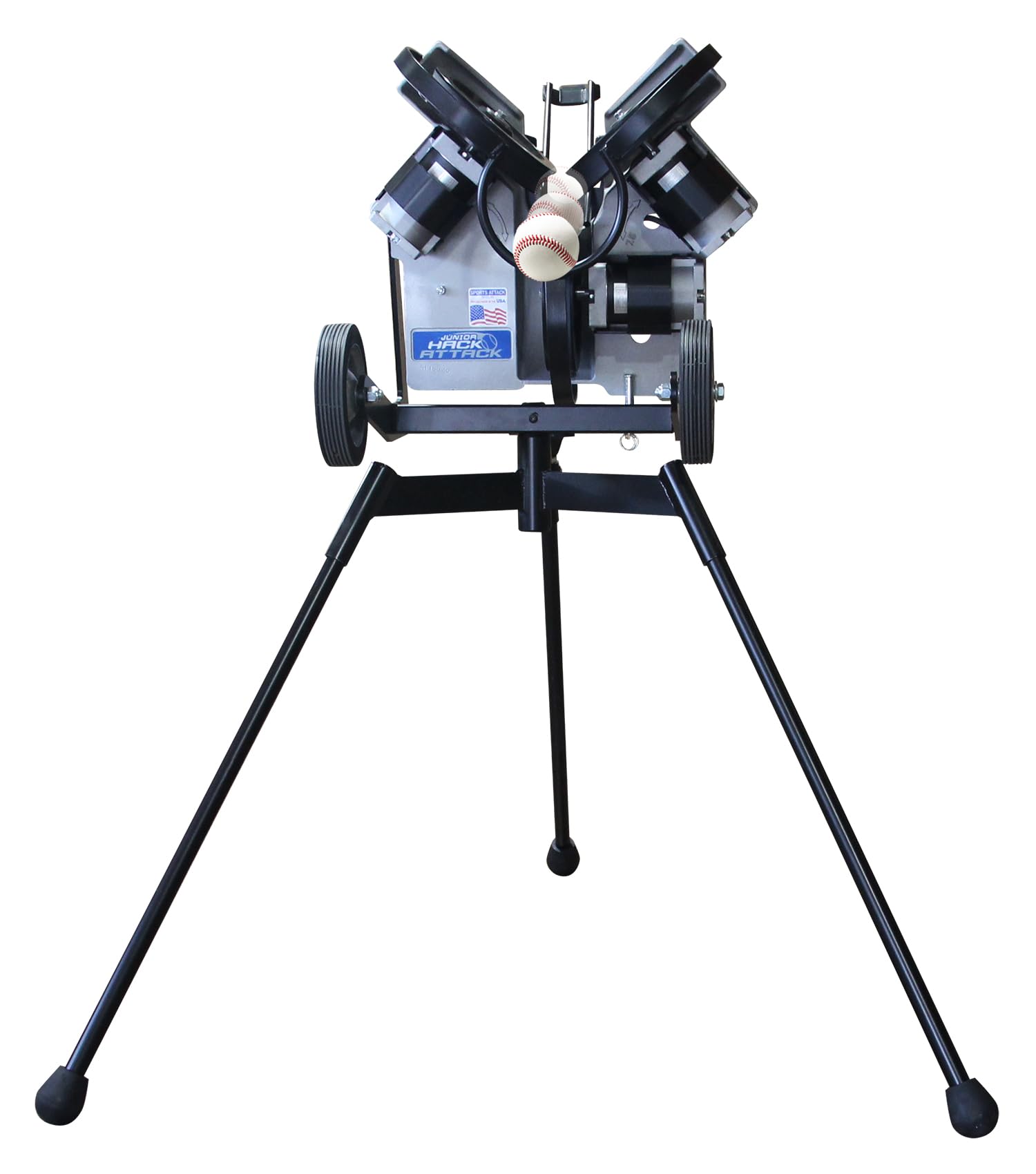
The Junior Hack Attack is the gold standard for youth programs that demand commercial-grade reliability in a portable package. Its dual-wheel design throws fastballs, curveballs, sliders, split-fingers, and knuckleballs up to 70 MPH, giving coaches the ability to simulate real game scenarios without needing a second machine. The ball feed system handles standard leather baseballs without jamming, a critical advantage over machines that require dimpled balls exclusively.
At just under 100 pounds, it is light enough for one adult to load into a car trunk and sets up in under five minutes. The throwing head pivots in any direction, so a single machine can run batting practice and then switch to defensive drills — ground balls, line drives, and fly balls out to 250 feet. Owners consistently report tight pitch groupings and zero degradation in accuracy after hundreds of sessions.
The 60-watt power draw means it runs for over eight hours on a portable power station, making it viable for fields without electric access. It is a significant investment, but the build quality and pitch versatility justify the price for any coach or facility that needs one machine to do everything well.
Why it’s great
- Throws every pitch type including curveballs and knuckleballs
- Portable enough for one-person transport and trunk storage
- Low power draw enables generator-free off-grid training
Good to know
- Highest upfront cost in this lineup
- Compatible only with baseballs — softballs require the full-size model
2. Zooka ZS740 Baseball Pitching Machine

The Zooka ZS740 solves the biggest frustration of field training: finding a power outlet. Its internal battery delivers 700 to 900 pitches per charge, which covers multiple practices without needing a generator or extension cord. The 10 to 70 MPH speed range and tall telescoping tripod make it configurable for kids, teens, and adults, as well as for ground balls, fly balls, and line drives.
Safety features include a password lock and optic sensors that prevent accidental firing, plus an audible beep before each pitch. The air-powered design is inherently spin-free, producing straight fastballs that improve bat-on-ball timing. Owners report excellent accuracy with dimpled balls, though performance drops once the balls lose weight from wear. The unit disassembles without tools and fits easily into a car seat or trunk.
Customer service is a standout — multiple reviewers praise Zooka for replacing defective units and repairing bent feeders under warranty. The lightweight build (under 30 pounds) makes it the most portable full-speed machine in this price tier.
Why it’s great
- Truly cordless with a long-lasting rechargeable battery
- Safety sensors and password protection for kid-controlled use
- Easy tool-free breakdown for transport and storage
Good to know
- Throws spin-free pitches only — no curveballs or sliders
- Accuracy decreases significantly once practice balls wear down
3. BSN Sports Bulldog Baseball/Softball Pitching Machine

The Bulldog is a workhorse machine that outperforms units costing twice as much. Its solid urethane wheel eliminates the air-pressure headaches of pneumatic tires and resists the wear that destroys softer rubber wheels. The 30 to 60 MPH speed range and convertible legs work with both baseballs and 12-inch softballs, making it a flexible tool for multi-sport families or coaches.
Accuracy is the Bulldog’s strongest trait — reviewers report tight strike-zone consistency, especially when using dimpled balls of uniform weight. The metal housing protects the motor from line drives, and the precise height control allows the user to dial in a consistent pitch location. Owners who push the machine hard for eight hours a week report no mechanical issues after two months of continuous use.
The trade-off is that real leather baseballs leave black rubber residue on the ball and the bat. Over time, the solid rubber wheel will mark cheap balls, so most owners switch to McGregor dimpled balls for routine practice. The legs also lack a left-right pivot, so fine-tuning horizontal placement requires moving the whole unit.
Why it’s great
- Durable urethane wheel with no air pressure maintenance
- Consistent pitch placement with dimpled practice balls
- Handles both baseballs and 12-inch softballs
Good to know
- Rubber wheel marks leather baseballs and bats
- No left-right horizontal adjustment built into the base
4. Mound Yeti Baseball Softball Pitching Machine
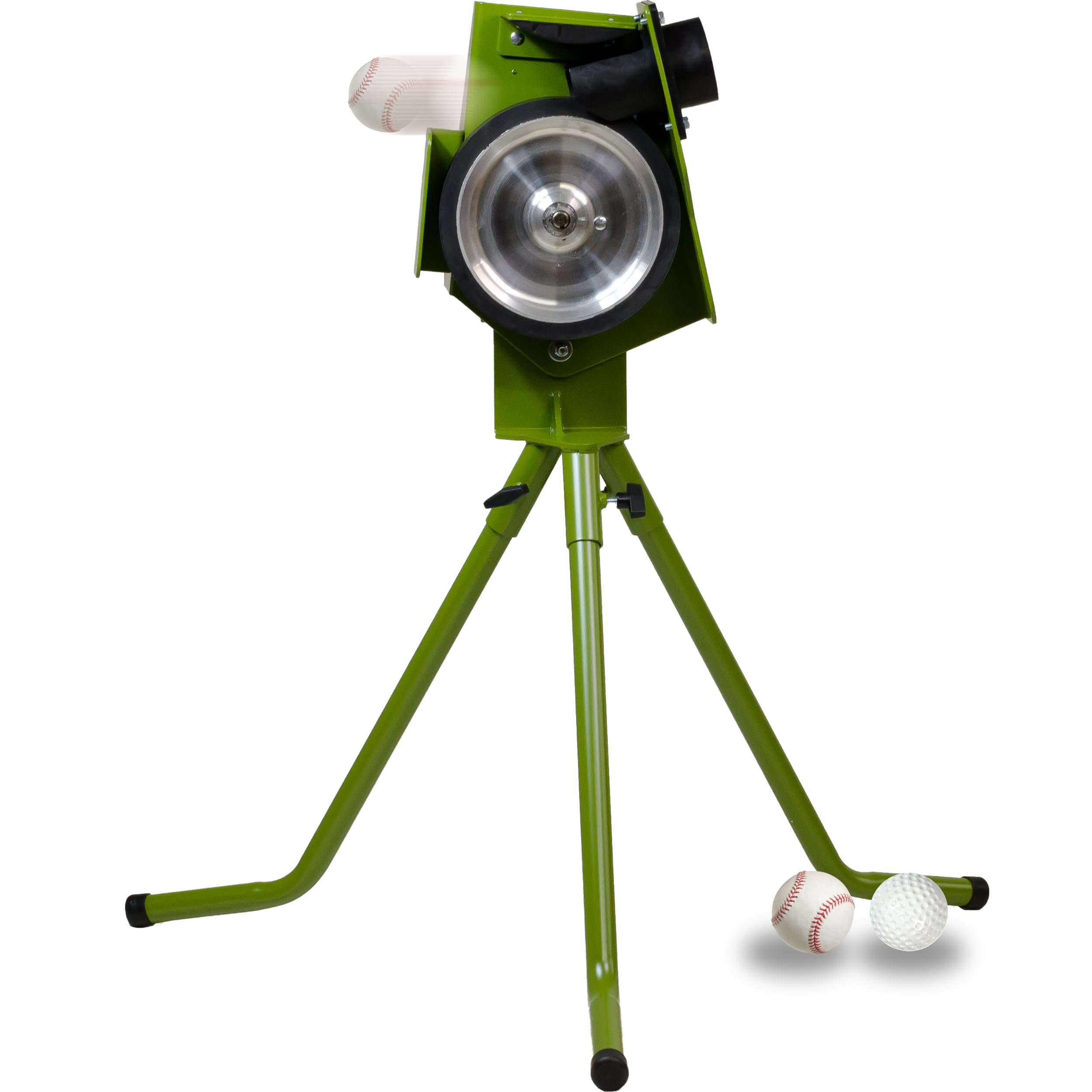
The Mound Yeti is the only machine in this roundup that ships with two dedicated chutes — one for baseballs and one for softballs — eliminating the need to swap components between sports. Its single-wheel design keeps the weight at 50 pounds while delivering consistent 30 to 60 MPH fastballs. The reversible steel legs change pitch height from 37.5 inches for baseball to 27.5 inches for softball in seconds.
Youth softball players benefit most from this machine because the speed range (mid-30s to roughly 65 MPH) aligns perfectly with 12U and 14U pitching velocities. The 2-year limited warranty is among the best in class, and customer service is responsive — reviewers note that parts get shipped overnight when issues arise. The unit runs on a Jackery-style power bank, so it works on fields without AC power.
The single-wheel design limits the machine to fastballs and grounders; it cannot throw curveballs or sliders. The speed display uses reference numbers rather than actual MPH, so dialing in a specific velocity requires trial and error. It is also picky about ball quality — synthetic-leather balls leave residue on the wheel, while genuine leather or dimpled balls perform best.
Why it’s great
- Dedicated baseball and softball chutes for instant sport switching
- Reversible legs change pitch height in seconds
- 2-year limited warranty with responsive customer support
Good to know
- No curveball capability — fastballs and grounders only
- Speed dial uses arbitrary numbers, not actual MPH
5. Heater Sports Deuce 75 MPH Adjustable Baseball Pitching Machine

The Deuce 75 is the entry point for dual-wheel pitching without jumping to the four-figure bracket. Independent speed knobs on each pneumatic tire let the user dial in fastballs, curveballs, sliders, and pop-ups with genuine movement. The pivot head design tilts the entire throwing assembly, so the transition from fastballs to grounders or fly balls takes seconds, not minutes.
The included 12-ball automatic feeder drops a ball every eight seconds, enabling solo practice without a feeder. The 15 to 75 MPH range covers coach-pitch speeds through high school velocities, and Lite-Balls push the ceiling to 85 MPH for advanced hitters. The all-metal housing encases the wheels for safety and durability. At 75 pounds, the Deuce is heavier than single-wheel options but still fits in a car trunk with the legs folded.
Accuracy with real baseballs is the main concern — some units throw erratic pitches outside the strike zone, especially at high speed. The pneumatic tires also wear unevenly with heavy use, and replacement wheels cost a significant portion of the machine’s price. Owners who stick with dimpled yellow balls report the best consistency and extended wheel life.
Why it’s great
- Independent dual-speed control for real breaking pitches
- 12-ball auto feeder supports true solo practice
- Pivot head adjusts to any angle for fielding drills
Good to know
- Pneumatic tires require inflation and may wear unevenly
- Accuracy with real seamed baseballs can be inconsistent
6. Furlihong 636BH Upgraded Dual-Wheel Baseball Pitching Machine

The Furlihong 636BH brings dual-wheel construction and a 10-speed gear system to a more accessible price point. Speeds range from 40 to 68 MPH, covering the critical zone for youth baseball and middle-school travel ball. The adjustable launch interval lets coaches control the pace of practice, while the angle adjustment accommodates grounders, line drives, and fly balls from a single setup.
The tripod base and iron construction give the machine a stable footprint during operation. Assembly and disassembly are straightforward, and the included dust cover and three training balls provide immediate out-of-box utility. Owners who use the machine in a basement cage or on a flat field report consistent pitch placement for the first dozen or so practices.
Long-term dependability is a concern. Several reviewers note that speed control becomes choppy after 15–16 sessions, and accuracy degrades as components loosen. The lack of a remote control or random pitch mode means the coach must walk back to the machine to change speed or angle between sets. The 180-day warranty is shorter than the industry average.
Why it’s great
- Dual-wheel design at a lower entry price than competitors
- Adjustable launch interval and angle for varied practice
- Stable tripod base with easy assembly and takedown
Good to know
- Speed accuracy and consistency may decline after heavy use
- No remote control — settings require walking to the machine
7. Heater Sports Heavy-Duty Baseball Pitching Machine

The Heater Heavy-Duty is built around a single all-metal housing that withstands hits from line drives and years of storage in a damp garage. Its 0–10 speed control produces pitches from 10 to 52 MPH, making it a strong match for tee-ball through 12U practice. With Heater Lite Baseballs, the ceiling climbs to 80 MPH, which extends the machine’s relevance as the hitter improves.
The pivot head adjusts for grounders, pop flies, and line drives with a simple knob turn. The automatic 12-ball feeder drops a ball every eight seconds, and it can be removed for manual feeding when the coach wants to control the pace. Setup takes less than ten minutes out of the box, and the 43-pound weight is manageable for one person to move within a backyard or cage.
The most significant weak point is the wheel. Multiple owners report that the pitching wheel disintegrates unevenly within three months of regular use, causing 18-inch accuracy swings that make the machine unpredictable. Replacement wheels cost roughly , which undermines the machine’s value proposition. The feeder also jams occasionally early in its life, though this improves with break-in.
Why it’s great
- All-metal housing is extremely durable and impact-resistant
- Pivot head adjusts easily for grounders, flies, and line drives
- Integrated 12-ball feeder supports uninterrupted batting practice
Good to know
- Pitching wheel may wear down and lose accuracy within a few months
- Replacement wheel costs roughly one-quarter of the original price
8. PowerNet Launch F-lite Softball & Baseball Pitching Machine

The PowerNet Launch F-lite is one of the few machines that ships with two sets of tripod legs specifically for switching between baseball and softball pitch heights. The simulated speed range of 40 to 90 MPH at 25 feet covers everything from 10U coach-pitch to high school velo, all from a unit that weighs just 28 pounds. Included are six dimpled baseballs and six dimpled softballs, so the machine is ready for both sports out of the box.
Owners consistently praise the machine’s accuracy and ease of setup. The speed adjustment has four settings that produce distinct pitch velocities, and the one-piece construction holds its calibration well. It works for fielding practice too — pop flies and line drives are manageable, though the reviewer notes that catching pop flies from this machine is challenging due to the ball’s trajectory, which actually helps players learn distance judgment.
The machine is designed exclusively for PowerNet’s Launch F-lite balls. Using any other brand voids the warranty and may affect durability and performance. This locked-in ball ecosystem is limiting — if you lose or wear out the proprietary balls, the machine becomes unusable until you buy replacements from the same brand.
Why it’s great
- Dual tripod legs for quick baseball-to-softball conversion
- Lightweight 28-pound design for easy transport
- Includes six baseballs and six softballs for immediate use
Good to know
- Only works with proprietary PowerNet F-lite balls — no exceptions
- Simulated speed may not match actual radar-gun readings
9. Jugs Soft Toss Baseball/Softball Pitching Machine

The Jugs Soft Toss machine is not designed to fire 90 MPH fastballs — it exists to solve a different problem: building hand-eye coordination through repetitive, controlled tosses. It holds up to 14 baseballs or 10 softballs and delivers one every five seconds with a gentle arc that mimics soft-toss drills. The internal rechargeable battery runs for up to eight hours, which translates to roughly 400 tosses per charge.
At just 13 pounds with a 10-by-10-foot setup footprint, this machine can live in a garage, basement, or backyard without dedicated cage space. The included home plate and drill book give new users a structured starting point. Reviewers note that the machine produces consistent tosses at belt height, making it ideal for beginners and for players working on tracking the ball from release to contact. The machine also works with foam balls for indoor use.
The Jugs is not a substitute for a live-velocity pitching machine. It is limited to underhand soft tosses, so it cannot simulate game-speed fastballs or curveballs. Seamed baseballs can jam in the chute if loaded carelessly, requiring individual feeding for smooth operation. The toss height is fixed around belt level, which may be too low for adult hitters looking for a higher launch point.
Why it’s great
- 8-hour rechargeable battery for extended indoor/outdoor sessions
- Ultra-light 13-pound build with a small 10×10 footprint
- Includes home plate and drill book for structured practice
Good to know
- Limited to soft-toss height — cannot replace a live-velocity machine
- Seamed baseballs may jam in the chute if not loaded individually
FAQ
Can I use real leather baseballs in a pitching machine?
What speed range do I need for a 10U player?
How many pitches does a typical battery-powered machine throw per charge?
Final Thoughts: The Verdict
For most users, the best baseball ball machine winner is the Junior Hack Attack because it combines dual-wheel pitch versatility, commercial-grade build quality, and true portability for youth training. If you want a cordless machine for fields without power, grab the Zooka ZS740. And for a budget-friendly two-sport option that weighs under 30 pounds, nothing beats the PowerNet Launch F-lite.