
Every ground ball takes a bad hop on a rough infield, turning routine plays into errors. The difference between a championship-ready diamond and a frustrating one is the quality of the dirt and the tools used to maintain it.
I’m Min — the co-founder and writer behind Gadgets Feed. I’ve spent hundreds of hours analyzing commercial-grade field maintenance gear, comparing steel gauges, mesh densities, and attachment systems to separate the tools that actually level hard-packed clay from the ones that just scatter loose topsoil.
Whether you’re grooming a little league field or a high school varsity diamond, choosing the right baseball infield dirt maintenance equipment directly impacts playing surface consistency and player safety.
How To Choose The Best Baseball Infield Dirt
Selecting infield dirt tools isn’t about grabbing the heaviest steel mat or the cheapest hitting turf. The right choice depends on your field size, the vehicle you use for dragging, and whether you need to groom existing clay or install a fresh hitting surface.
Steel Drag Mat Construction and Weight
Galvanized steel mesh drag mats come in different wire gauges and opening sizes. Thicker wire and tighter mesh create more resistance against packed infield clay, producing a smoother finish in fewer passes. Lighter mats with wider spacing work better for loose topsoil and driveway gravel but won’t penetrate hard-packed infield surfaces. A mat around 35 pounds offers a good middle ground for most youth and high school diamonds, while heavier units above 45 pounds suit collegiate and professional fields.
Attachment System and Vehicle Compatibility
The chain and tow ring configuration determines how the drag mat follows your ATV, UTV, or garden tractor. Fixed single-point attachments work fine for straight-line dragging but create uneven patterns on turns. Double-chain or offset attachment systems allow the mat to float independently, maintaining consistent ground contact across the full width. If you plan to drag by hand, look for welded rope loops or D-rings at multiple points on the mat’s leading edge.
Hitting Mat vs. Drag Mat: Understanding the Difference
Many field managers confuse the two. A hitting mat with foam backing — like the 12′ x 6′ Premium Pro Turf model — protects the batter’s box area from cleat damage and provides a consistent strike zone surface. It sits on top of the dirt and does not groom the infield. A steel drag mat, by contrast, physically reshapes the infield dirt by leveling high spots, filling low areas, and breaking up crusted clay. Most well-maintained fields require both tools: one for daily grooming and one for the batter’s box and home plate area.
Quick Comparison
On smaller screens, swipe sideways to see the full table.
| Model | Category | Best For | Key Spec | Amazon |
|---|---|---|---|---|
| Premium Pro Turf 12′ x 6′ | Hitting Mat | Batter’s box and home plate | 5mm EVA foam backing, nylon top | Amazon |
| Nelco All Steel Drag Mat | Drag Mat | Large field grooming with cutting bar | 38 lbs, 6’W x 3’L, asymmetrical cutting bar | Amazon |
| Yard Tuff 4′ x 4′ | Drag Mat | All-around ATV field grooming | 35 lbs, zinc-plated steel mesh | Amazon |
| StadiumMax 3ft x 4ft | Drag Mat | Multi-sport field leveling | Galvanized steel, 6 size options | Amazon |
| Shimeyao 4 x 3 ft | Drag Mat | Compact fields and manual dragging | 24 lbs, add-on weight capacity up to 50 lbs | Amazon |
| Rengue 4 x 4 Feet | Drag Mat | Quick game-day infield prep | 31 lbs, galvanized steel, ATV/UTV compatible | Amazon |
| On Deck Sports 3′ x 7′ Mat | Hitting Mat | Indoor and portable batting practice | Spike-resistant synthetic turf, rubber backing | Amazon |
In‑Depth Reviews
1. Premium Pro Turf 12′ x 6′ Hitting Mat

This 12-foot by 6-foot hitting mat uses 100% nylon with a 5mm EVA foam backing, giving it a stable platform that won’t bunch up or wrinkle under heavy cleat traffic. The clay-colored surface matches infield dirt visually, which helps batters maintain a natural depth perception at the plate. Inlaid white lines for the batter’s box are bonded into the nylon, so they won’t flake or fade after repeated use.
User reports confirm this mat survives 1,200 swings per week during practice plus another 600 warmup swings before games. The foam backing provides enough cushion to protect gym floors during indoor training, while the nylon top resists tearing from metal cleats. Two adults can roll it up for storage, though its 12-foot length makes it a two-person job.
If you maintain both indoor and outdoor facilities, this mat bridges the gap better than thinner throw-down options. The EVA foam prevents the mat from sliding on concrete or hard-packed clay, and the 0.2-inch thickness provides enough structure to lie flat without curling at the edges.
Why it’s great
- Heavy-duty nylon construction withstands thousands of swings without visible wear
- Inlaid white lines stay legible season after season
- Foam backing eliminates slipping on both indoor floors and outdoor infield dirt
Good to know
- Bulky to transport and store without dedicated space
- Premium-tier investment compared to basic synthetic turf mats
2. Nelco All Steel Drag Mat 6’W x 3’L
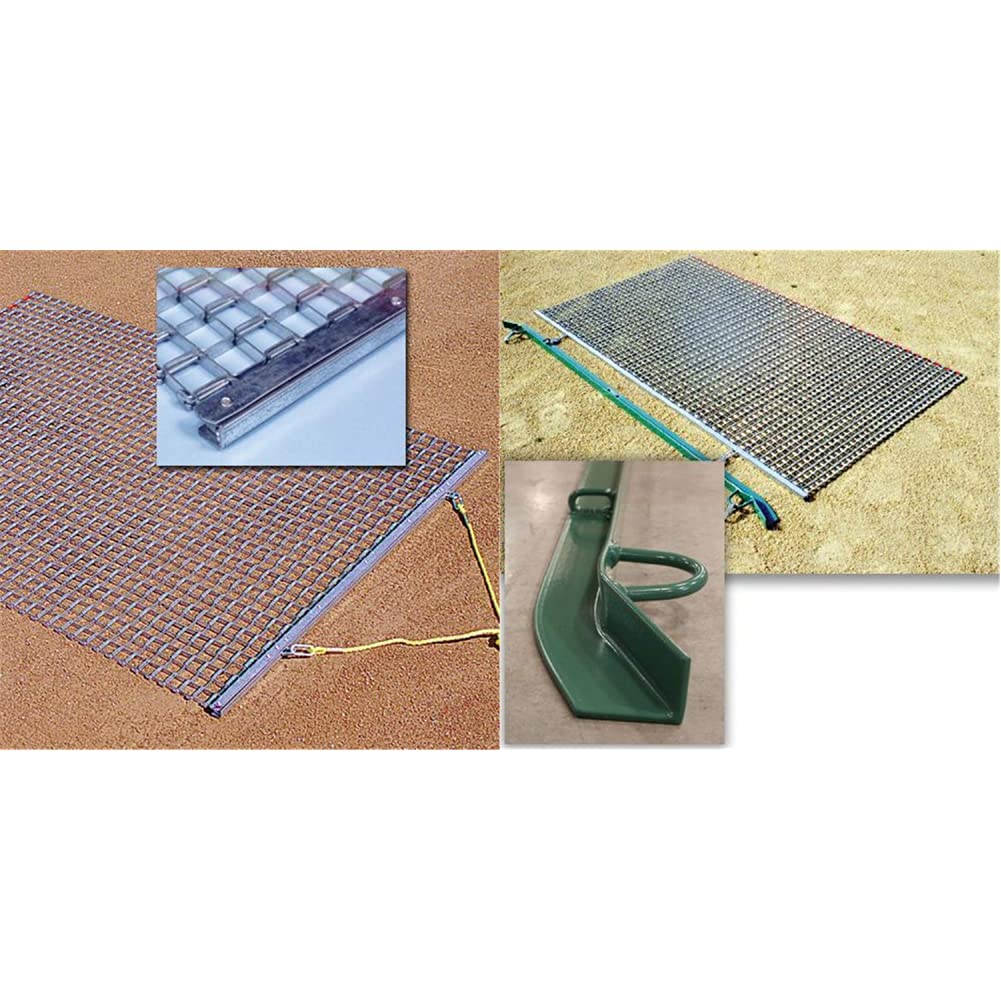
The Nelco drag mat combines a 38-pound galvanized steel mesh with a 6-foot asymmetrical cutting bar that attaches via quick-link connectors. The cutting bar serves a specific purpose: it slices through crusted infield clay and fills low spots before the drag mat smooths the surface. This two-phase action in a single pass saves significant time on large diamonds between games.
At 6 feet wide, this mat covers more surface per lap than standard 4-foot models, which means fewer passes to groom an entire infield. Users report that the poly rope tow line works fine behind garden tractors but recommend upgrading to a chain for ATV use, as the rope frays under sustained heavy pulling. The 3-foot length keeps the mat manageable for storage and transport.
The galvanized construction resists rust even when stored outdoors, and the cutting bar’s quick-link attachments allow easy switching between dragging and cutting modes. For fields with compacted clay and uneven grade, this mat addresses both problems without requiring separate passes.
Why it’s great
- Integrated cutting bar eliminates need for separate scarifying passes
- 6-foot width reduces grooming time on large fields
- Quick-link attachments enable fast setup and breakdown
Good to know
- Tow rope frays with extended tractor use — chain upgrade recommended
- Dimensions shown in product photo may be reversed from actual orientation
3. Yard Tuff 4′ x 4′ Zinc and Steel Drag Mat
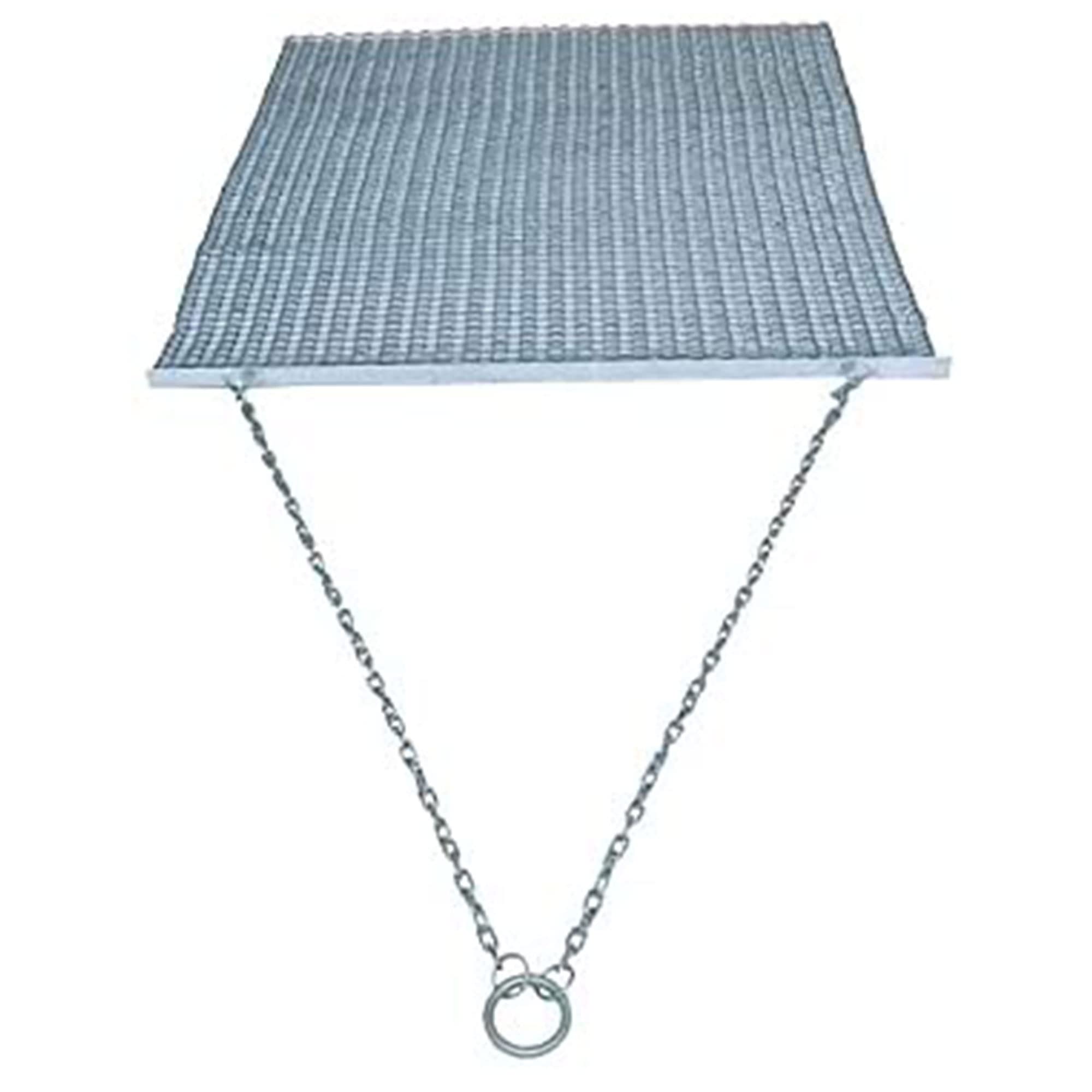
The Yard Tuff 4-foot by 4-foot drag mat hits the sweet spot between coverage area and weight. At 35 pounds with a zinc-plated steel mesh construction, it provides enough mass to penetrate infield clay without being so heavy that it digs ruts during turns. The included tow chain with ring attachment hooks to any ATV, UTV, or lawn tractor without adapters.
Users praise this mat for smoothing arena sand and organic dirt mixes, with the mesh collecting small pebbles and rocks during turns for easy removal. The zinc plating provides genuine corrosion resistance — owners report leaving it outdoors for entire seasons with no rust formation. The 4-foot width works well for medium-sized infields, covering ground efficiently without skipping narrow strips near the bases.
The mesh spacing is tight enough to break up clods while allowing finer particles to pass through, creating a consistent surface texture. For field managers looking for a single drag mat that handles both pregame grooming and post-game leveling, this model offers the best balance of durability and maneuverability.
Why it’s great
- Zinc-plated construction resists rust through multiple seasons of outdoor storage
- 35-pound weight provides solid clay penetration without excessive drag
- Collects rocks and debris during turns for easy field cleanup
Good to know
- Tends to clump in very moist infield conditions
- Less effective on heavily compacted clay without added weight
4. StadiumMax Steel Drag Mat 3ft x 4ft

StadiumMax offers this drag mat in six different sizes ranging from 3×4 feet up to 8×4 feet, making it the most versatile option for facilities that maintain multiple field types. The 3×4 base size uses full galvanized steel with a corrosion-resistant coating that holds up against moisture and chemical infield conditioners. The included chain allows attachment to tractors, ATVs, or even manual pulling for smaller sections.
The mat’s foldable form factor makes it easy to roll up and transport between fields, and the galvanized construction means it won’t rust even when stored in damp equipment sheds. Users report it works effectively on baseball infields, golf fairways, and even breaking up horse manure in pasture applications — a testament to the mesh density and ground contact consistency.
While it performs well as a general-purpose drag mat, owners note it performs best when a small amount of additional weight is placed on top for deeper penetration on hard-packed surfaces. The chain attachment system includes multiple hook points, giving you flexibility to adjust the drag angle depending on your vehicle and surface conditions.
Why it’s great
- Available in six sizes to match any field dimension
- Galvanized steel won’t rust in outdoor storage
- Multiple chain hook points for adjustable drag angle
Good to know
- Requires added weight for deeper penetration on hard clay
- Limited user reviews make long-term durability assessment incomplete
5. Shimeyao Zinc Heavy Duty Drag Mat 4 x 3 ft

The Shimeyao drag mat comes in a compact 4×3 foot format at 24 pounds, making it one of the lightest steel drag mats on this list. What sets it apart is the design capacity to add up to 50 pounds of extra weight on top, allowing field managers to adjust the penetration force depending on soil conditions. On loose infield dirt, run it at base weight; on packed clay, load it up.
The nylon chain attachment system connects to ATVs, UTVs, or lawn tractors, and the rolled design stores easily in small spaces. Users report effective leveling on gravel paths and baseball diamonds with the added weight, though some noted that the welded rope connection points can fail if the mat catches on a buried rock or root. The zinc coating provides basic corrosion protection for seasonal outdoor use.
For youth leagues or practice fields where budget matters and field conditions vary week to week, this drag mat offers the flexibility to adapt without buying multiple grooming tools. Its smaller footprint also makes it suitable for manual dragging on smaller diamonds where ATV access is limited.
Why it’s great
- Adjustable weight capacity from 24 to 74 pounds for varying soil conditions
- Compact 4×3 size ideal for smaller diamonds and manual dragging
- Nylon chain system compatible with most tow vehicles
Good to know
- Weld quality at rope attachment points inconsistent across units
- Base weight alone insufficient for hard-packed infield clay grooming
6. Rengue ATV/UTV 4 x 4 Feet Baseball Field Drag

At 31 pounds with a 4×4 foot galvanized steel mesh, the Rengue drag mat is built for speed. Travel team managers report grooming an entire infield in under 10 minutes per game day, which makes this a practical choice for teams that rotate through multiple field locations. The chain and plug system attaches quickly to ATVs and UTVs without tools.
The steel construction handles the weight well, and the mesh spacing is designed for infield clay rather than loose gravel. Users note that the heavy weight makes handling awkward during setup and transport, but the payoff comes in smoother, more consistent surfaces during games. The mat rolls up for storage, though at 31 pounds it’s a two-person job to move it rolled up.
Where this mat falls short is in attachment point durability. Some users reported that the connections at the ends weren’t satisfactory after repeated use, suggesting that the chain attachment points could be reinforced. For teams that need a reliable mid-week grooming tool rather than a full-field renovation drag, this hits the right balance of weight and coverage.
Why it’s great
- 31 pounds provides substantial clay penetration without excessive drag vehicle strain
- Full infield grooming achievable in under 10 minutes per session
- Galvanized construction suitable for outdoor storage between games
Good to know
- Attachment point connections may loosen with repeated use
- Awkward handling during setup due to weight distribution
7. On Deck Sports 3′ x 7′ Batting Mat

The On Deck Sports 3×7 foot batting mat uses spike-resistant synthetic turf bonded to a rubber backing, creating a portable hitting surface that protects both gym floors and outdoor infield dirt. Unlike steel drag mats that groom the infield, this mat sits on top of the dirt to provide a consistent batters box surface for practice. The rubber backing prevents movement on concrete and holds position on loose infield dirt.
Users report that this mat takes heavy abuse from metal cleats without wearing through, with one reviewer noting it survives both pitching practice foot drag and daily batting cage use. The turf is thick enough to lay flat without bunching, and at about 15 pounds it rolls up easily for storage in a 5-gallon bucket. The green color makes it clearly visible against brown infield dirt, which is useful for indoor facilities where the mat needs to stand out on turf or concrete.
For teams that need a portable solution for practice fields or home batting cages, this mat provides the same cleat protection as a full hitting mat at a fraction of the size and weight. It won’t groom your infield dirt, but it will keep the batter’s box from turning into a muddy divot pit after a week of practice.
Why it’s great
- Spike-resistant turf survives metal cleats without visible wear
- Rubber backing prevents slipping on both concrete and infield dirt
- Rolls up compactly for storage in a standard bucket
Good to know
- Does not groom or level infield dirt — it’s a protective surface only
- Green color contrasts with brown infield dirt, which may not suit all facility aesthetics
FAQ
How often should I drag my baseball infield during a game day?
Can I use a driveway drag mat on my baseball infield?
What size drag mat do I need for my field?
Why does my drag mat skip over hard-packed infield dirt?
Should I drag wet infield dirt or wait for it to dry?
Final Thoughts: The Verdict
For most teams and facilities, the right baseball infield dirt maintenance setup starts with the Yard Tuff 4′ x 4′ for daily grooming because its 35-pound zinc-plated construction provides the best balance of clay penetration and maneuverability without breaking the budget. If your field sees heavy compaction and requires serious cutting, the Nelco All Steel Drag Mat with its integrated asymmetrical cutting bar saves time by combining scarifying and smoothing in one pass. And for protecting the batter’s box area across both indoor and outdoor training, the Premium Pro Turf 12′ x 6′ hitting mat delivers the most durable nylon surface with a foam backing that stays put on any surface.