
A youth baseball pitching machine is the single most efficient tool for building swing confidence without burning out a parent’s arm or relying on a teammate’s availability. The right machine transforms backyard sessions into structured reps, letting young hitters see a moving ball every few seconds rather than standing idle through wild throws.
I’m Min — the co-founder and writer behind Gadgets Feed. This guide is the result of dozens of hours combing through technical specifications, customer durability reports, and speed-range data across nine distinct machines to isolate what actually matters for youth players, from T-ball ages up to 14U travel ball.
Whether you need a simple tosser for the garage or a dual-wheel unit for fielding drills, the best choice among the best baseball pitching machine for youth options depends on matching the child’s age to the machine’s speed floor and ball type compatibility.
How To Choose The Best Baseball Pitching Machine For Youth
The gap between a useful youth pitching machine and a frustrating purchase lives in the details of speed range, power source, and ball compatibility. Three criteria separate a machine that earns its place in regular practice from one that becomes a garage ornament.
Speed Floor — The 30 MPH Rule
A machine that starts at 40 MPH is already too fast for an eight-year-old standing 35 feet away. The best youth machines offer a bottom speed of 30 MPH or less, letting coaches dial in confidence-building pitches before gradually moving up. Machines without a true low-speed gear force beginners to chase balls they cannot track, reinforcing bad swing mechanics born from panic, not training.
Ball Type and Motor Durability
Single-wheel machines that chew through regulation baseballs will burn out a motor within months on youth teams. Many machines explicitly require dimpled plastic balls or lite training balls to stay reliable. Ignoring ball-type requirements voids warranties and causes wheel wear, inconsistent trajectories, and sudden speed surges. Always verify the manufacturer’s approved ball list before buying.
Power Source and Portability
Youth machines live in backyards, dugouts, and garage spaces — not always near an outlet. AC-only units like the dual-wheel designs require extension cords or a portable power station for field use. Battery-powered machines offer true freedom, but the charging life varies wildly from 300 tosses to 8 hours. A machine that takes longer to set up than it runs will see less use over a season.
Quick Comparison
On smaller screens, swipe sideways to see the full table.
| Model | Category | Best For | Key Spec | Amazon |
|---|---|---|---|---|
| Heater Sports Junior | Mid-Range | Team BP ages 6-12 | 15-48 MPH, 23.45 lbs | Amazon |
| PowerNet Launch F-lite | Premium | Baseball/softball families | 40-90 MPH sim, 28.6 lbs | Amazon |
| Jugs Tossing Machine | Mid-Range | Garage hand-eye drills | 14-ball chute, 21 lbs | Amazon |
| Personal Pitcher Pro Starter | Premium | Reaction training with small balls | 9 lbs, tripod mount | Amazon |
| Mound Yeti Single Wheel | Premium | Durable facility use | 30-60 MPH, 50 lbs | Amazon |
| Furlihong 636BH Dual-Wheel | Premium | Structured team practices | 40-68 MPH, 39 lbs | Amazon |
| MaxBP Reaction Machine | Mid-Range | Eye-hand coordination drills | 1.68″ balls, 6.9 lbs | Amazon |
| Furlihong 6902BHA Toss | Budget | Soft toss for young beginners | 4 speed settings, 11.6 lbs | Amazon |
| Heater Sports Slider Lite 360 | Budget | Lite-ball fast/curve practice | Up to 80 MPH, 13 lbs | Amazon |
In‑Depth Reviews
1. Heater Sports Junior Baseball Pitching Machine

The Heater Sports Junior earns the top spot because its speed dial starts at a genuine 15 MPH — the lowest floor in this class — making it the only machine that works for both a six-year-old’s first batting practice and a 12-year-old’s 48 MPH game-speed reps. That 1/4 horsepower DC motor and 12-ball automatic feeder deliver a ball every 10 seconds, which keeps practice flowing without a parent standing next to the chute manually loading.
Air-filled tires absorb shock on grass surfaces, and the full enclosure around the wheel prevents little fingers from getting near the spinning tire. The tripod stand, while heavy at 23 pounds, provides stability on uneven ground. Multiple verified reports show these units surviving over 3,000 balls across multiple seasons when paired with yellow dimpled balls — owners who fed it regulation baseballs saw tire damage and feeder jams.
Customer support from Heater Sports is notably responsive, with one owner receiving a free replacement potentiometer when the speed control failed. The main tradeoff is that the auto feeder occasionally hesitates with brand-specific balls, and the machine creeps forward on hard-packed dirt during extended sessions.
Why it’s great
- Lowest speed floor (15 MPH) ideal for young beginners
- Reliable 12-ball auto feeder for hands-free practice
- Excellent US-based customer support track record
Good to know
- Requires dimpled yellow balls; regulation balls damage tire and void warranty
- Air tires need inflation to 40 PSI despite sticker recommendation
- Feeder jams with brand-specific baseballs
2. PowerNet Launch F-lite Pitching Machine

The PowerNet Launch F-lite solves a problem every multi-sport family knows: one machine that shifts between baseball and softball without swapping parts. Two sets of tripod base legs change the release height, and the four-speed dial simulates 40 to 90 MPH at 25 feet. That 90 MPH equivalent is marketing math, but the machine consistently delivers live-ball speeds suitable for 10U through 16U practice.
Verified buyers report stable, accurate pitches across months of team use. The machine ships with 12 balls — six baseballs and six softballs — all of which are ultra-lite dimpled design. PowerNet explicitly warns that using any other brand voids the warranty, which locks you into their proprietary ball supply. The setup is quick out of the box, and the frame stays planted even during pop-fly drills.
The tradeoff for versatility is that the max speed at the plate feels closer to 65 MPH real-world than the simulated 90 MPH claim. Pop-up fielding drills produce balls that bounce hard out of gloves due to the lite-ball construction, making it less forgiving for infield work than a regulation-weight ball machine.
Why it’s great
- Switch between baseball and softball with leg swap
- Accurate pitch placement suited for 10U-16U levels
- Sturdy build that holds position on grass
Good to know
- Warranty requires PowerNet-brand dimpled balls only
- Top real-world speed lower than simulated 90 MPH claim
- Pop flies bounce hard — fielders need reaction time
3. Jugs Tossing Machine

Jugs built its reputation on durable baseball training equipment, and the tossing machine lives up to that legacy with a simple, motor-less iron action bar that tosses a ball every five seconds. The internal rechargeable battery runs up to eight hours on a single charge, translating to roughly 400 tosses before needing a wall outlet. That battery life alone makes it the most set-it-and-forget-it option for a parent who wants to run a practice without hunting for extension cords.
The machine holds 14 baseballs or 10 softballs and works with just about any ball type — regulation, dimpled, or foam. Setup requires only a 10×10-foot space, and the 21-pound weight makes it easy to move from garage to field. The tossing arc delivers belt-high pitches that land 5 to 10 feet in front of the plate, forcing hitters to track the ball into the zone rather than swinging on autopilot.
Some owners note that balls occasionally hang up in the chute, requiring manual nudge about once per 40 tosses. There is no height adjustment and the machine does not sit still on concrete — it drifts slightly during use, which can shift pitch location across a long session.
Why it’s great
- 8-hour battery life — lasts multiple practice sessions
- Works with regulation, dimpled, and foam balls
- Simple mechanical action with minimal failure points
Good to know
- No height adjustment; toss height is fixed
- Machine drifts slightly on smooth surfaces during use
- Balls occasionally stick in the chute
4. Personal Pitcher Pro Starter Package
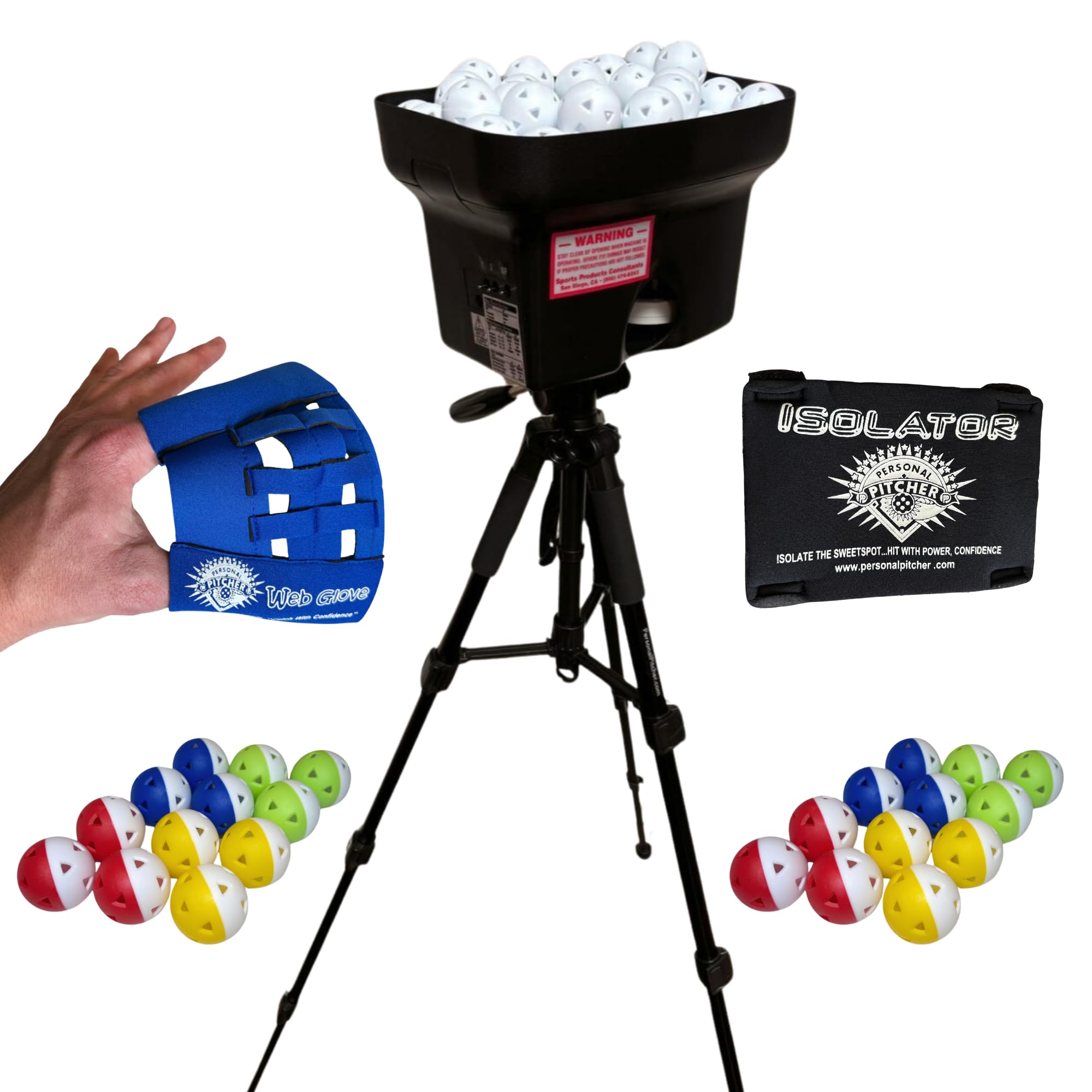
The Personal Pitcher Pro uses a completely different approach: it pitches a small, hard focus ball about the size of a golf ball at varying speeds and locations to train the hitter’s eyes and reaction time. The theory is that hitting a tiny ball makes a regulation baseball feel huge at the plate, and verified reviews confirm that players who struggle with pitch recognition see measurable improvement after consistent use.
The starter package includes the tripod, a WebGlov for catching drills, and an Isolator Pad that straps to the bat sweet spot for audible feedback on contact quality. The whole unit weighs under 9 pounds, making it the most portable machine in this lineup. The spinning feeder occasionally stops rotating and requires a power cycle, but customer service from the company owner has been praised for overnight replacement of defective units.
This machine is not for traditional batting practice with regulation balls. It is a specialized reaction trainer, best used as a supplementary tool alongside a standard pitching machine or live BP. Beginners may find the small ball frustrating, and the proprietary focus ball system means ongoing supply costs.
Why it’s great
- Small focus balls improve hand-eye coordination dramatically
- Ultra-light 9 lb design, easy to move and store
- Excellent owner-operated customer support
Good to know
- Focus balls are proprietary and not for regulation practice
- Feeder can stall, requiring manual restart
- Frustrating for absolute beginners due to small target
5. Mound Yeti Single Wheel Pitching Machine
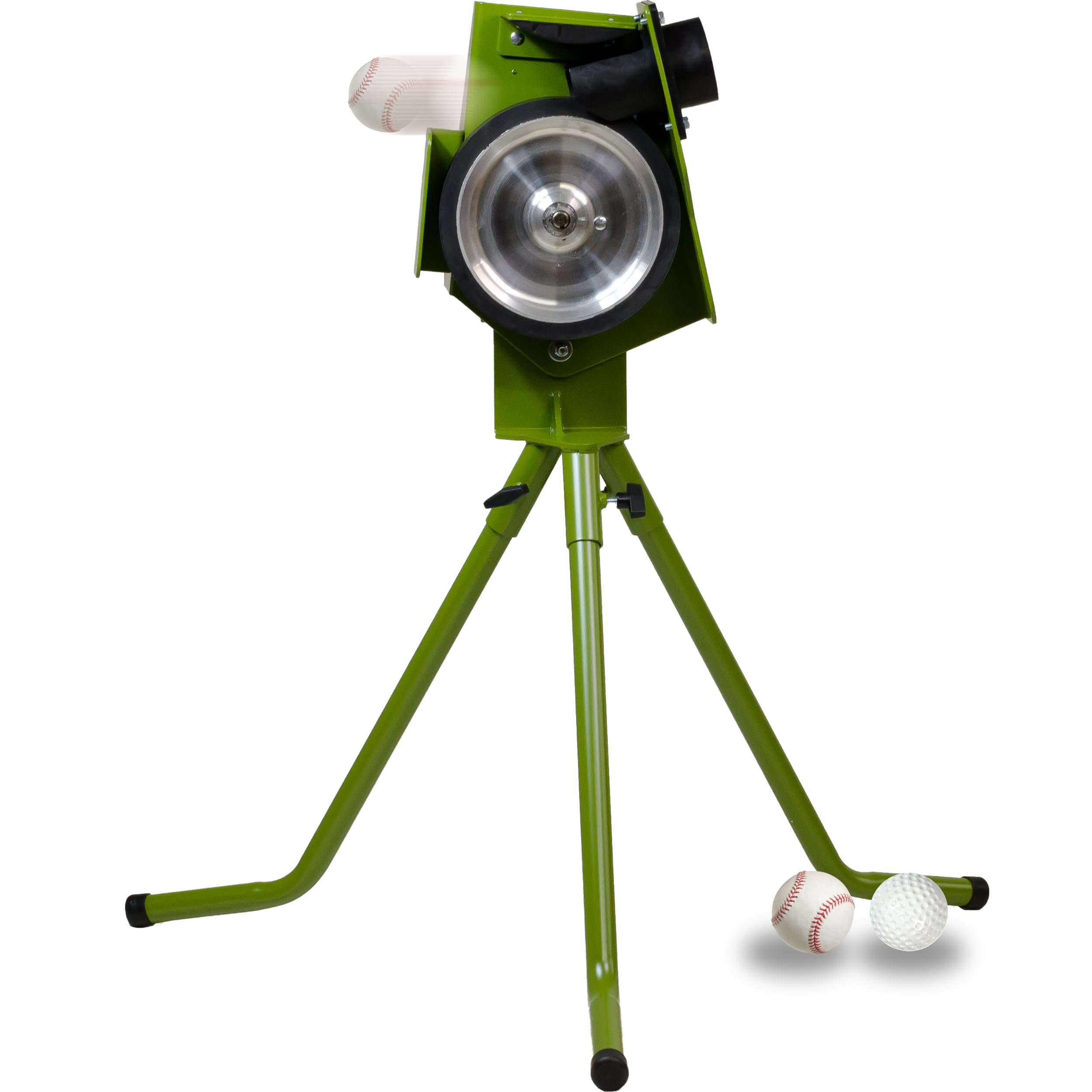
The Mound Yeti is built like a piece of field equipment rather than a backyard toy: steel frame, 50-pound weight, reversible legs that change release height between baseball (37.5 inches) and softball (27.5 inches). The single wheel delivers speeds from 30 to 60 MPH, covering the entire youth spectrum from machine-pitch league through middle school. Two chutes let you switch between ball types without tools.
Multiple facility owners report buying several units for fielding drills and batting practice, citing consistent speed and accurate placement. The speed dial uses arbitrary reference numbers rather than MPH markings, so you have to calibrate with a radar gun to know exactly what speed you are throwing. The machine requires high-quality dimpled or leather balls — lower-grade synthetic balls leave residue on the wheel that degrades performance over time.
The 2-year limited warranty is the longest in this comparison, and customer service has been responsive, sending overnight replacement parts for potentiometer issues. The main downside is the weight: at 50 pounds it is not a machine you casually move in and out of a car trunk. It needs a dedicated spot or a cart.
Why it’s great
- Steel frame and 50 lb weight ensure no movement during use
- Reversible legs adjust for baseball vs softball height
- 2-year warranty — best coverage in this class
Good to know
- Speed dial uses arbitrary numbers, not MPH markings
- 50 lb weight reduces portability significantly
- Low-quality synthetic balls leave wheel residue
6. Furlihong 636BH Dual-Wheel Pitching Machine

The Furlihong 636BH brings dual-wheel technology at a price point well below traditional big-brand dual-wheel units, offering 10 speed gears from 40 to 68 MPH. The dual-wheel design produces more consistent spin and trajectory than single-wheel alternatives, which is critical for older youth players preparing for the jump to regulation pitching distances. Adjustable angle and launch interval give coaches control over drill sequencing without moving the machine.
Assembly is straightforward, and the unit breaks down for transport, though at 39 pounds it is still a two-hand carry. The AC power requirement means you need an outlet or a portable generator for field use. Verified owners report the machine works well for 9U select teams and adult amateur leagues, though some note the speed control feels choppy rather than smooth, and the wheels can develop lag after 15+ practice sessions, causing occasional knuckleball trajectories.
Customer reviews are polarized: some praise the value versus premium brands, while others report wildly inconsistent pitches after moderate use. The lack of a remote and the need to stop the machine to change settings is a legitimate coaching inconvenience during live reps.
Why it’s great
- Dual-wheel design for consistent spin and trajectory
- 40-68 MPH range covers advanced youth levels
- Adjustable launch interval for custom drill sequences
Good to know
- Requires AC power — not ideal for remote fields
- Speed control can be choppy on some units
- No remote; must stop to adjust settings
7. MaxBP Pitching Machine
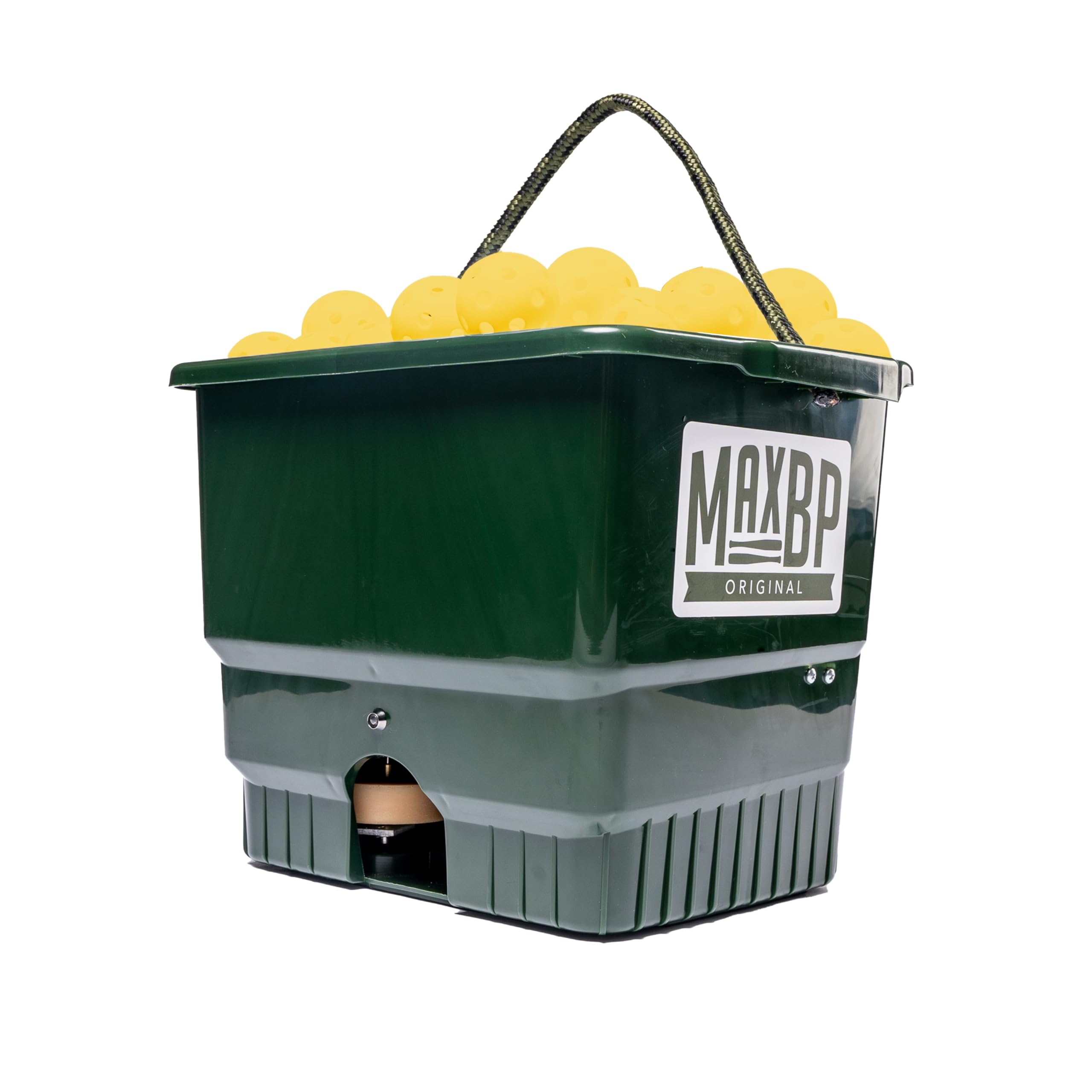
MaxBP uses the same small-ball training philosophy as the Personal Pitcher but takes it further with a simulated reaction speed range of 30 to 145-plus MPH. The 1.68-inch diameter yellow balls force the hitter to track a smaller target, sharpening bat control and pitch recognition. The machine weighs only 6.9 pounds and runs on batteries, making it the most portable option for taking to a field or setting up in a living room.
Multiple parents report that children as young as 11U set the machine up themselves and run solo practice for hours, giving hitters hundreds of visual tracking reps without a coach present. The included attachment ramp allows for fly ball practice, expanding the machine beyond just hitting drills. Customer reviews are overwhelmingly positive, though they tend to be brief — suggesting the machine is simple enough that there is little to complain about.
The limitation is obvious: it does not throw regulation-sized balls, so it cannot replace a standard pitching machine for game-speed batting practice. It is strictly a supplemental trainer for hand-eye coordination and reaction time, best used before or after regular BP sessions.
Why it’s great
- Ultra-light 6.9 lbs — truly portable
- Small ball improves tracking and bat control
- Kids can operate independently without adult help
Good to know
- Not a replacement for regulation ball batting practice
- Small balls are proprietary and wear out with heavy use
- Limited to reaction training; no live pitch experience
8. Furlihong 6902BHA Rechargeable Toss Machine

The Furlihong 6902BHA is a soft-toss machine that replaces the parent or coach who stands at a 45-degree angle and flips balls for swing reps. With an extendable ball stacker and four speed settings, it delivers a ball every six seconds at adjustable toss heights ranging from 1.2 to 1.7 meters for baseball. The rechargeable battery lasts for 300-plus tosses, making it practical for multiple backyard sessions before needing a charge.
Verified buyers highlight how the machine keeps kids engaged during off-season training, eliminating the need for a second person to soft toss. It works with both regulation baseballs and softballs, and the plastic construction keeps the weight down to 11.6 pounds for easy transport. The ball does not come directly at the hitter — it arrives from the side at an arc — which makes it best for stance, contact point, and eye training rather than live pitching simulation.
This machine is strictly for beginner-level swing mechanics and soft toss. It cannot pitch fastballs or simulate game situations. Young players ready for machine-pitch leagues will outgrow it quickly, and the plastic build means it cannot handle the abuse of team practice environments.
Why it’s great
- Rechargeable battery allows cordless backyard use
- Adjustable height suits baseball and softball
- Eliminates need for a parent to soft toss
Good to know
- Only does side soft toss — not live pitching
- Plastic build limits durability for team use
- Outgrown quickly once player advances past soft toss
9. Heater Sports Slider Lite 360

The Heater Sports Slider Lite 360 is the only machine at the budget end of the market that includes a pivot head design for throwing curveballs, giving young hitters exposure to breaking ball trajectories without needing an expensive multi-wheel unit. It pitches lite balls up to 80 MPH at 46 feet, covering distances appropriate for youth fields. The 13-pound weight and tubular steel legs with rubber tips make it easy to set up on grass or dirt.
Verified owners report the machine surviving multiple seasons across three kids when used exclusively with the recommended green dimpled balls. The auto feeder works reliably with lite balls, though users caution against using yellow dimpled balls that can damage the net and the machine’s internal components. Some units have experienced motor burnout after limited use and inconsistent ball speeds, but the company’s customer service has been responsive with replacement parts.
The 360-degree rotation capability is a genuine differentiator for fielding practice, letting coaches hit pop flies and grounders in any direction without repositioning the base. However, owners report the speed potentiometer can fail on some units, locking the machine at full speed, and the plastic construction feels noticeably less durable than the Heater Junior model above this price tier.
Why it’s great
- Pivot head for curveball practice at entry-level price
- 360-degree rotation for fielding drills without repositioning
- Light 13 lb weight makes it truly portable
Good to know
- Plastic frame less durable than mid-range options
- Speed potentiometer can fail, locking at high speed
- Requires specific lite dimpled balls; yellow balls damage internals
FAQ
What is the best speed for a youth player starting with a pitching machine?
Can I use regulation baseballs in a dimpled-ball-only pitching machine?
How do I know if my child is ready for a two-wheel pitching machine?
Final Thoughts: The Verdict
For most families, the best baseball pitching machine for youth is the Heater Sports Junior because its 15 MPH floor makes it the only machine that grows with a player from T-ball through 12U without needing an upgrade. If you need baseball and softball versatility in one package, grab the PowerNet Launch F-lite. And for garage-based hand-eye drill work that fits in a closet, nothing beats the Personal Pitcher Pro Starter Package for sheer portability and reaction training value.