
Every coach knows the bottleneck: a single live arm can only throw so many batting practice pitches before fatigue sets in, and the repetition quality drops. A throwing machine removes that human variable, delivering consistent, repeatable pitches that let hitters lock in their timing and mechanics without waiting for a pitcher to recover.
I’m Min — the co-founder and writer behind Gadgets Feed. I’ve spent hundreds of hours analyzing the mechanical differences between single-wheel, dual-wheel, and arm-style machines, studying how wheel diameter, motor power, and feeder design translate into real-world pitch accuracy and longevity across this category.
Whether you’re a parent building a backyard cage or a coach equipping a team, finding the right best baseball throwing machine means balancing speed range, portability, and consistent strike-zone delivery against your specific training goals and budget.
How To Choose The Best Baseball Throwing Machine
Selecting the right machine goes beyond picking the cheapest or most expensive option. The decision hinges on who will use it, where, and how often. A machine built for a 10-year-old in a backyard will frustrate a high school team practicing daily, and a pro-grade dual-wheel unit can overwhelm a young player still learning hand-eye coordination.
Speed Range and Wheel Configuration
The machine’s mechanism dictates its pitch profile. Single-wheel machines are simpler and cheaper but can impart spin that makes pitches less predictable. Dual-wheel machines, with independently spinning wheels, cancel out excess spin and deliver cleaner, more accurate pitches across a wider speed range. Arm-style machines use a mechanical arm that mimics a human pitcher’s motion, creating more realistic pitch trajectories at the cost of top-end speed. For youth players, a machine covering 30–50 MPH is sufficient; high school and college athletes need 50–80 MPH or higher.
Ball Type and Feeder System
Not all machines handle regulation baseballs. Many budget-friendly and mid-range machines are designed exclusively for dimpled practice balls or lite balls, which are softer and lighter. Using a standard baseball in a machine not rated for it risks damage to both the machine and the ball. The feeder system — manual single-load, automatic rotating feeder, or gravity-fed hopper — determines practice flow. Auto feeders that release a ball every 6–9 seconds keep drills moving and eliminate the need for a dedicated feeder. For solo training, a machine with a reliable auto feeder is a significant advantage.
Build Quality, Portability, and Power Source
A machine’s frame material (plastic vs. tubular steel), wheel construction, and motor quality directly impact its lifespan. Steel frames with rubber-tipped legs offer superior stability on uneven grass or turf, while plastic frames keep weight down for easy transport. Weight matters: lighter machines (under 20 lbs) are portable but may vibrate or shift during operation. Heavier machines (35–45 lbs) stay planted but are harder to move from field to field. Power source is another critical factor — most machines are AC-powered, requiring an extension cord or generator for field use. A few rechargeable models offer true cordless operation, which is a major convenience for remote practice locations.
Quick Comparison
On smaller screens, swipe sideways to see the full table.
| Model | Category | Best For | Key Spec | Amazon |
|---|---|---|---|---|
| PowerNet Launch F-lite | Premium | Dual-sport teams | 40–90 MPH at 25 ft | Amazon |
| Personal Pitcher Pro Starter | Mid-Range | Complete training kits | Includes WebGlov and Isolator Pad | Amazon |
| Furlihong 636BH Dual-Wheel | Premium | Professional training | 40–68 MPH, 10-speed gears | Amazon |
| MaxBP Reaction Trainer | Premium | Reaction time training | 30–145+ MPH equivalent | Amazon |
| Jugs Small-Ball Machine | Premium | Depth perception drills | Uses 5-inch foam balls | Amazon |
| Heater Sports Softball Machine | Mid-Range | Softball fastpitch practice | 9-ball auto feeder, 40 lbs | Amazon |
| Louisville Slugger Blue Flame Pro | Budget | Multi-ball versatility | 30–58 MPH, manual arm | Amazon |
| Furlihong 6902BHA Toss Machine | Budget | Soft toss and swing reps | Rechargeable, height adjustable | Amazon |
| Heater Sports Slider Lite 360 | Budget | Entry-level curveball training | Pivoting head, 80 MPH lite balls | Amazon |
In‑Depth Reviews
1. PowerNet Launch F-lite

The PowerNet Launch F-lite stands out for its dual-sport versatility, shipping with two sets of tripod legs to switch between baseball and softball pitching heights. The variable speed dial simulates 40 to 90 MPH at a 25-foot distance, making it suitable for everyone from 10U rec players to high school athletes working on timing.
Ball compatibility is a notable consideration — this machine is calibrated to perform best with PowerNet’s own Launch F-lite balls, and using other brands voids the warranty. The included 12 balls (6 baseball, 6 softball) let you start practicing immediately, and the stable tripod base keeps the machine planted during aggressive swing drills.
Professional athletes like Corbin Carroll and German Marquez are associated with PowerNet, which adds credibility to the training outcomes. The 1-year limited warranty on frame and metal components provides reasonable coverage, though users should store the unit out of direct sun and rain to maintain the plastic housing.
Why it’s great
- Interchangeable legs for baseball and softball
- Simulated speed range covers youth to advanced levels
- Stable tripod base prevents tipping during operation
Good to know
- Warranty voided if non-PowerNet balls are used
- Top speed may feel slightly lower than advertised at longer distances
- Plastic construction may not withstand rough transport in team bags
2. Personal Pitcher Pro Starter Package
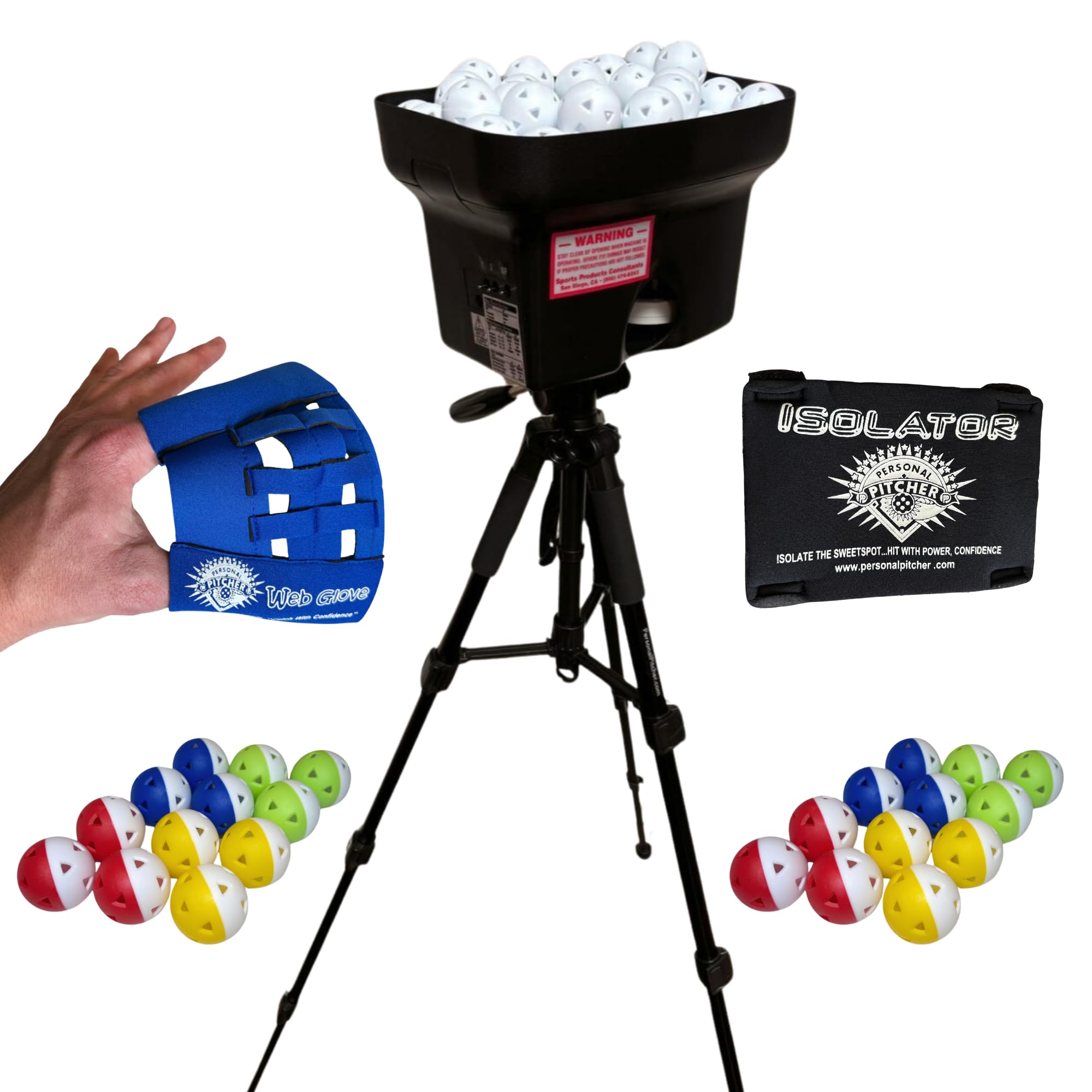
The package includes the Pro machine, a collapsible tripod, the WebGlov catching trainer, an Isolator Pad that provides audible feedback on contact quality, and two dozen Focus Balls that vary in speed and location to train pitch recognition.
This machine uses a spinning feeder that delivers one ball at a time, and users report that the battery holds a long charge for extended practice sessions. The included tripod allows height adjustments for both baseball and softball, and the entire setup packs down small enough for easy storage in a garage or duffel.
Customer service is a standout feature — the company’s owner, Chris, is responsive to questions and has sent replacement parts quickly for the few units that arrived with issues. The 1-year manufacturer warranty backs the investment, making this a low-risk entry into serious batting practice equipment.
Why it’s great
- All-in-one kit includes catching and contact feedback tools
- Long battery life supports hours of solo practice
- Responsive customer service from the manufacturer
Good to know
- Occasional feeder jams require power cycling to reset
- Focus balls are small and easy to lose in grass
- Plastic frame may feel less robust than steel machines
3. Furlihong 636BH Dual-Wheel Pitching Machine

The Furlihong 636BH brings dual-wheel technology to the mid-premium segment, offering 10 speed gears from 40 to 68 MPH for precise pitch velocity control. The adjustable angle and launch interval make it suitable for coaching sessions where pitch type and timing need to vary between batters.
Assembly is straightforward, and the machine is designed to be portable — the tripod base folds down and the unit can be moved between a basement cage and an outdoor field. It comes with four ball tracks, a top track, a dust cover, and three training balls to get started. The iron construction gives it a weight that helps with stability during operation.
Users have noted that speed control can feel choppy at certain settings, and the lack of a remote control means you must walk to the machine to change speed or angle between pitches. Some reviews cite accuracy degradation after 15–16 practices, suggesting the motor and wheel assembly may have longevity concerns at the upper end of the speed range.
Why it’s great
- Dual-wheel design delivers cleaner pitches than single-wheel machines
- Adjustable launch interval adds variety to practice
- Portable enough for indoor and outdoor training
Good to know
- No remote control; must adjust settings manually at the machine
- Speed control can be choppy, creating occasional knuckleball effects
- Long-term durability concerns reported after moderate use
4. MaxBP Pitching Machine
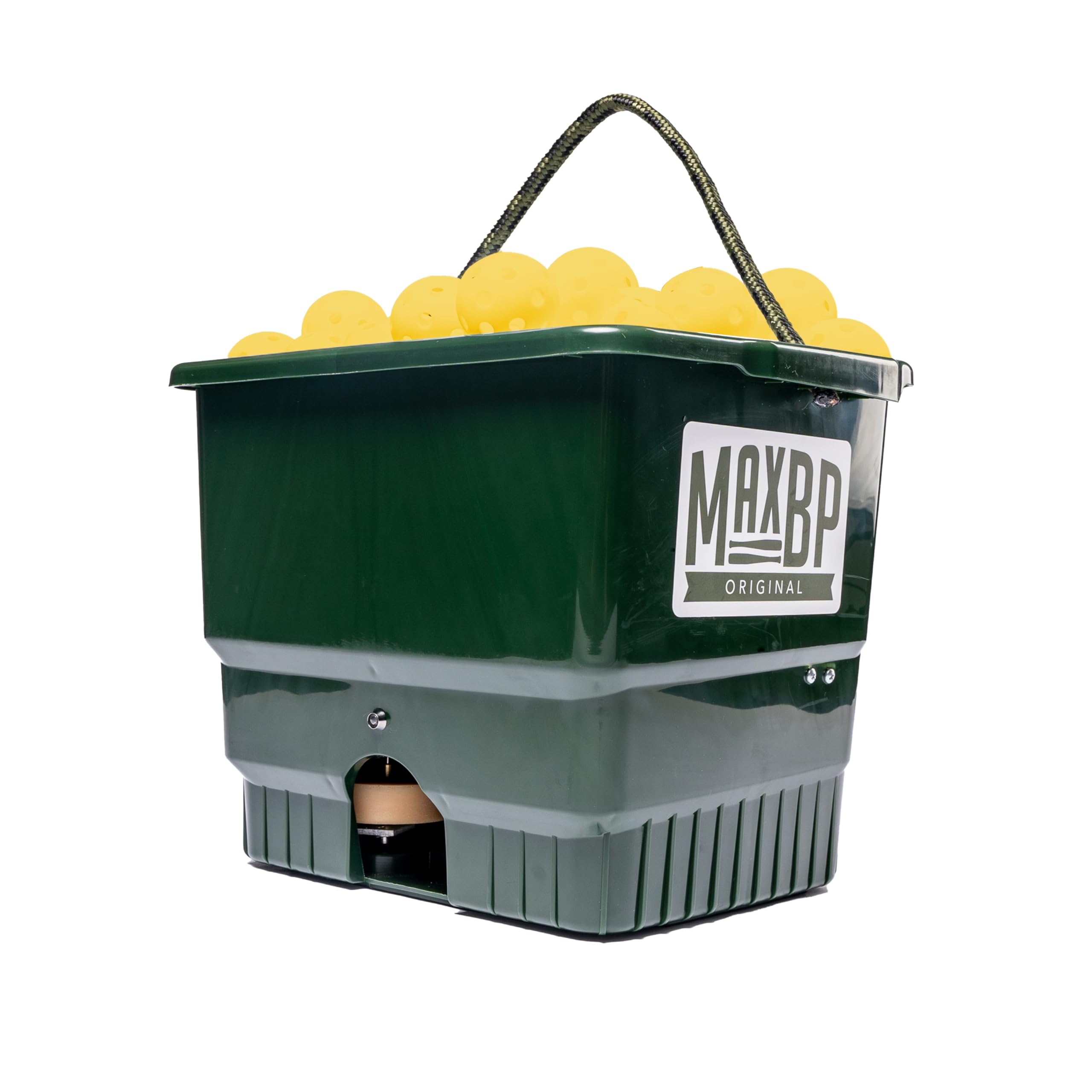
The MaxBP takes a fundamentally different approach — it uses small 1.68-inch reaction balls to simulate the equivalent of 30 to 145+ MPH when scaled to full-size baseball distance. This makes it a pure reaction training tool rather than a traditional batting practice machine, aimed at improving hand-eye coordination and swing timing for players of all ages.
The machine is lightweight at just under 7 pounds and completely portable, running on a rechargeable battery. It comes with 96 yellow MaxBP reaction balls in the standard package, and the automatic feeder keeps a steady stream of pitches coming. The compact size means it fits in a backpack and can be set up in a backyard, gym, or driveway in seconds.
Because the balls are small and travel at extreme simulated speeds, this is not a replacement for a full-size pitching machine doing regular batting practice. It excels as a supplemental tool for high-rep swing training and vision drills, especially during off-season or inclement weather when field time is limited.
Why it’s great
- Extremely portable and battery-powered for use anywhere
- Simulates speeds well beyond what real machines can throw
- Huge rep count per charge with included 96 balls
Good to know
- Not designed for regulation baseball or softball practice
- Requires attachment ramp for fly ball and fielding drills
- Small balls are easy to lose in grass or outfields
5. Jugs Small-Ball Pitching Machine

The Jugs Small-Ball Machine uses 5-inch, 5-ounce polyurethane foam balls — half the size of a regulation baseball — to train hitters on depth perception and contact precision. Built from heavy-duty steel with adjustable legs, it simulates realistic delivery height and throws fastballs and overhand curves at speeds up to 75 MPH.
The machine weighs 25 pounds, making it more substantial than plastic units, and the steel frame ensures it stays put during operation. It offers both a manual single-feed mode and an automatic feeder that can hold 25 small balls, and it can also shoot fly balls and grounders for fielding practice. The 1-year warranty from Jugs is backed by a company known for durable pitching equipment.
One limitation is that there is no speed control — the machine throws at two fixed speeds corresponding to fastball and curveball settings. To change the effective speed, you must physically move the machine closer or further from the plate, which requires re-aiming. The small foam balls are softer than real baseballs, reducing the risk of property damage during indoor use.
Why it’s great
- Steel construction offers superior durability over plastic machines
- Half-size balls improve hand-eye coordination and tracking
- Excellent for fielding drills with pop flies and grounders
Good to know
- No adjustable speed control; only two fixed speeds
- Comes with only 3 balls; additional balls sold separately
- Erratic throws outside the strike zone are not uncommon
6. Heater Sports Softball Pitching Machine with 9 Ball Auto Feeder

Heater Sports designed this machine specifically for fastpitch softball, with a fully enclosed wheel system for safety and a 9-ball auto feeder that delivers a pitch every 9 seconds. The variable speed control allows coaches to dial in speeds appropriate for different age groups, from 10U rec to high school varsity.
The steel and rubber construction weighs 40 pounds, providing a stable platform that doesn’t shift during use. The adjustable legs set the delivery height, and the machine can throw grounders and fly balls in addition to fastballs. Tire pressure is critical for accuracy — users report that checking tire pressure before each session ensures consistent strike-zone delivery.
The machine lacks an emergency stop button, and stray pitches are possible if the ball feeder misaligns. Some units have shipped with cosmetic blemishes or missing parts, though customer service has resolved these issues. At its tier, it offers comparable performance to machines costing significantly more, especially for fastpitch teams on a budget.
Why it’s great
- Enclosed wheel design improves safety for younger players
- 9-ball auto feeder maintains practice rhythm without a dedicated feeder
- Steel frame provides stability for outdoor field use
Good to know
- Tire pressure must be checked before every session for accuracy
- No emergency stop button; stray pitches possible
- Some units have arrived with cosmetic or missing parts
7. Louisville Slugger Blue Flame Pro Pitching Machine
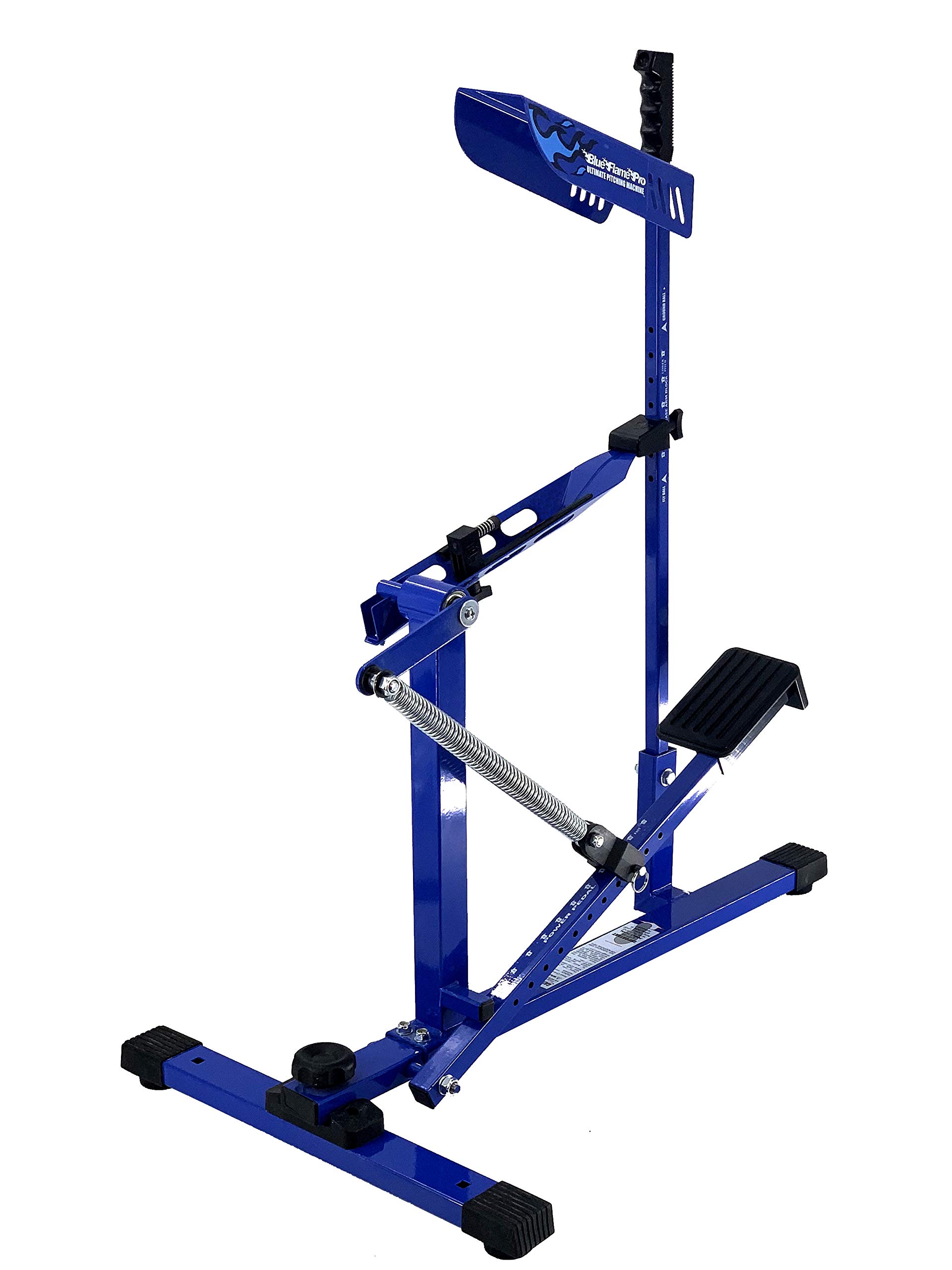
The Louisville Slugger Blue Flame Pro uses an upgraded throwing arm with enhanced ball bearings to deliver pitches from 30–58 MPH with baseballs and up to 65 MPH with restricted-flight balls. It’s a manual arm-style machine that works with tennis balls, dimple balls, plastic balls, softballs, and regulation baseballs, giving coaches extreme versatility for different drills.
The ergonomic pedal design reduces the force required to fire the machine, making it easier for younger players or assistants to operate during long practice sessions. It’s portable at 20 pounds and used by Babe Ruth League and Pony Baseball programs, signaling its acceptance at the organized league level.
Accuracy is the main trade-off — users report that constant adjustment between pitches is needed to keep the ball in the strike zone, which slows down practice flow and disrupts a hitter’s rhythm. Placing the ball with the laces in a 4-seam position helps slightly, but the machine is less consistent than wheel-based alternatives. It also struggles with grounders and fly balls as advertised.
Why it’s great
- Extremely broad ball compatibility for varied training
- Lightweight and portable for take-to-the-field use
- Reduced pedal effort makes operation easier for younger users
Good to know
- Requires constant re-aiming between pitches for strike-zone accuracy
- Not well-suited for grounder and fly ball drills
- Quality control issues reported on discounted units
8. Furlihong 6902BHA Rechargeable Toss Machine

The Furlihong 6902BHA is a rechargeable toss machine designed for soft toss and light batting practice, not for full-speed pitching. Its adjustable height ranges from 1.2 m to 1.7 m for baseball and 0.4 m to 0.6 m for softball, and the 4-speed settings let you vary toss height and trajectory for different swing drills.
The built-in rechargeable battery delivers over 300 tosses per charge, which is enough for multiple practice sessions before needing a recharge. The machine tosses a ball every 6 seconds, saving coaches and parents from bending over to hand-place balls on a tee. It accepts regulation baseballs, softballs, and dimpled balls, making it suitable for both sports.
This is strictly a soft toss machine — it does not pitch the ball directly at the batter with speed, so it cannot replace a traditional pitching machine for live batting practice. It is best used for swing mechanics work, hand-eye coordination drills, and pre-game warmups where dozens of light reps are more valuable than high-speed pitches.
Why it’s great
- Cordless operation with 300+ tosses per charge
- Adjustable height accommodates baseball and softball
- Saves coaches from physical strain of manual soft toss
Good to know
- Not a pitching machine; does not deliver direct, high-speed pitches
- Plastic construction may not withstand frequent outdoor use
- Ball does not come directly at the batter; trajectory is more arcing
9. Heater Sports Slider Lite 360 Pitching Machine

The Heater Sports Slider Lite 360 is an entry-level pitching machine that uses lite balls to deliver fastballs and curveballs up to 80 MPH at 46 feet. The pivoting head design allows the machine to throw accurate curveballs, which is a rare feature at this tier and helps hitters learn to recognize spin before game situations.
The machine weighs only 13 pounds and has tubular steel legs with rubber tips for stability on grass or dirt. The automatic ball feeder keeps a steady supply of lite balls moving, and the plastic body keeps the overall cost low while still providing functional training. Assembly is straightforward and the machine is ready for use out of the box.
Durability is a concern — while some users report years of reliable use, others have experienced motor burnout after fewer than 10 uses, and the speed potentiometer can fail, preventing speed adjustment. The machine is also loud compared to metal-framed alternatives, and it is designed exclusively for lite balls — using regulation baseballs will damage the machine and invalidate any support.
Why it’s great
- Pivoting head enables realistic curveball training at a low cost
- Very lightweight at 13 pounds for easy transport
- Auto feeder maintains practice momentum without a feeder
Good to know
- Will not accept regulation baseballs; lite balls only
- Motor and speed control reliability is inconsistent
- Plastic construction and loud operation during use
FAQ
Can I use regulation baseballs in a lite-ball-only pitching machine?
How often should I replace the wheels on a dual-wheel pitching machine?
What is the ideal distance to set up a pitching machine for youth batting practice?
Final Thoughts: The Verdict
For most users, the best baseball throwing machine winner is the PowerNet Launch F-lite because it combines true dual-sport compatibility, a wide speed range, and stable tripod construction in a package trusted by professional athletes. If you want a complete training ecosystem with catching and contact feedback tools, grab the Personal Pitcher Pro Starter Package. And for pure reaction training that simulates elite-level pitch speeds in a portable form, nothing beats the MaxBP Pitching Machine.